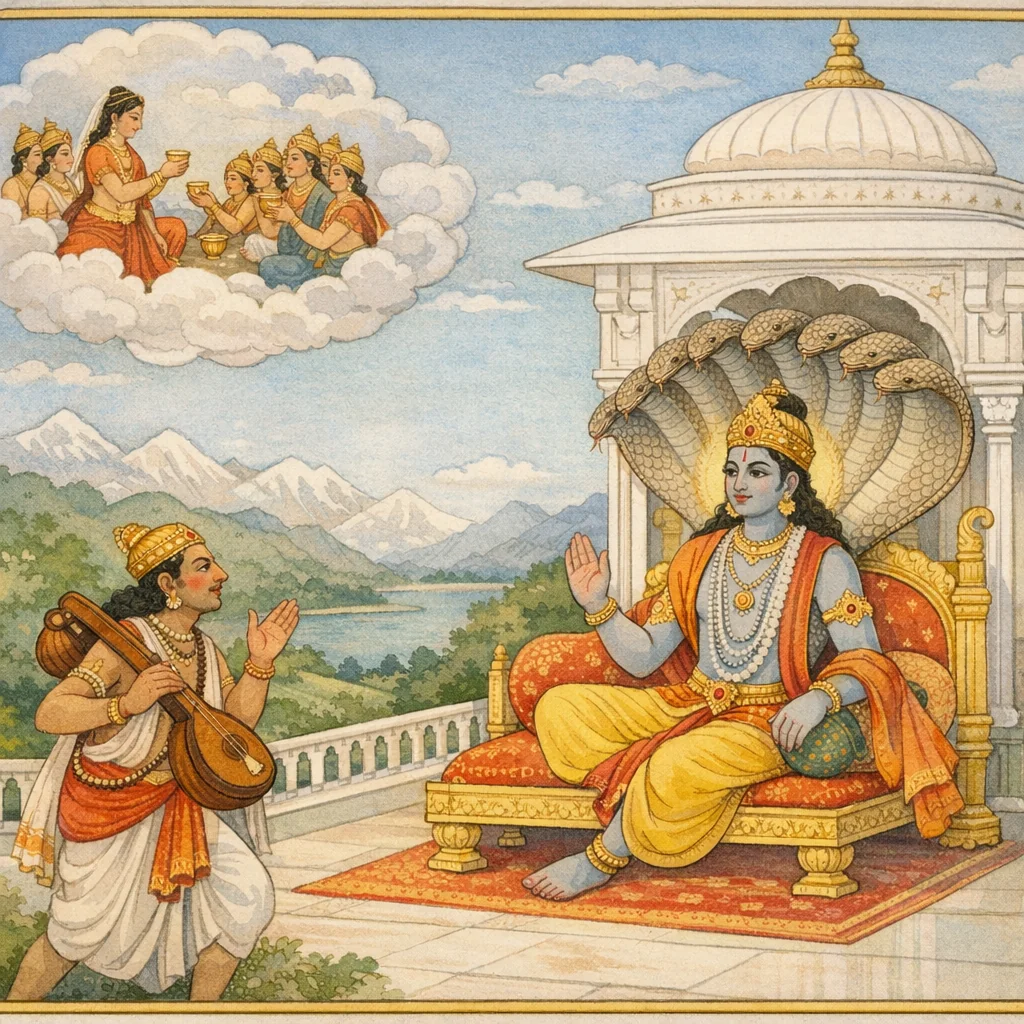
नारदस्य विष्णूपदेशवर्णनम् — Nārada and Viṣṇu: Instruction after Delusion
Adhyāya 4 continues the Sṛṣṭyupākhyāna, focusing on Nārada after he has become vimohita (deluded) and has pronounced a fitting śāpa upon Śiva’s gaṇas. Yet, by Śiva’s will (śivecchayā), he remains unawakened; recalling Viṣṇu’s earlier deception (harikṛta-chala), he is seized by unbearable anger and goes to Viṣṇuloka. There he speaks harshly, accusing Viṣṇu of duplicity and of bewitching the world through māyā, citing the Mohinī episode and the giving of vāruṇī to the asuras instead of amṛta. Through Nārada’s invective the chapter foregrounds the governance of māyā: divine stratagems are not moral disorder but controlled līlā within a higher Śaiva intentional order. The chapter then turns toward Viṣṇu’s reply as upadeśa, to reframe Nārada’s reactive cognition, temper krodha, and restore doctrinal clarity about the deities’ roles and the purpose of delusion in cosmic functioning.
Shlokas
Verse 1
शृणु तात प्रवक्ष्यामि सुहितं तव निश्चयात्
Listen, dear child—out of firm resolve, I shall declare to you what is truly beneficial for your welfare.
Verse 2
गतयोर्गणयोश्शंभोस्स्वयमात्मेच्छया विभोः । किं चकार मुनिः क्रुद्धो नारदः स्मरविह्वलः
As Śambhu’s two hosts of gaṇas proceeded, set in motion by the Lord’s own sovereign will, what did the sage Nārada do—angered and inwardly shaken by the power of Kāma (desire)?
Verse 3
सूत उवाच । विमोहितो मुनिर्दत्त्वा तयोश्शापं यथोचितम् । जले मुखं निरीक्ष्याथ स्वरूपं गिरिशेच्छया
Sūta said: The sage, overcome by delusion, pronounced upon them the appropriate curse. Then, gazing at his face in the water, he beheld his own form—according to the will of Girīśa (Lord Śiva).
Verse 4
शिवेच्छया न प्रबुद्धः स्मृत्वा हरिकृतच्छलम् । क्रोधं दुर्विषहं कृत्वा विष्णुलोकं जगाम ह
Not being awakened—by Śiva’s own will—and remembering the deception devised by Hari (Viṣṇu), he roused an unbearable wrath and then went to Viṣṇu’s realm.
Verse 5
उवाच वचनं कुद्धस्समिद्ध इव पावकः । दुरुक्तिगर्भितं व्यङ्गः नष्टज्ञानश्शिवेच्छया
Consumed by anger, he spoke like a blazing fire—his words laden with harsh speech and sarcasm; for by Śiva’s will his discernment had been eclipsed.
Verse 6
नारद उवाच । हे हरे त्वं महादुष्टः कपटी विश्वमोहनः । परोत्साहं न सहसे मायावी मलिनाशयः
Nārada said: “O Hari, you are exceedingly wicked—deceitful and a deluder of the world. You cannot bear another’s rising zeal and excellence; you wield māyā, with an impure intent.”
Verse 7
मोहिनीरूपमादाय कपटं कृतवान्पुरा । असुरेभ्योऽपाययस्त्वं वारुणीममृतं न हि
Assuming the enchanting form of Mohinī, you once employed a stratagem: you made the Asuras drink Vāruṇī, not amṛta, the nectar of immortality.
Verse 8
चेत्पिबेन्न विषं रुद्रो दयां कृत्वा महेश्वरः । भवेन्नष्टाऽखिला माया तव व्याजरते हरे
If Rudra—Mahādeva, Mahēśvara—out of compassion were not to drink the poison, then all your māyā, O Hari, would be ruined and undone by your own pretense.
Verse 9
गतिस्स कपटा तेऽतिप्रिया विष्णो विशेषतः । साधुस्वभावो न भवान्स्वतंत्रः प्रभुणा कृतः
O Viṣṇu, this crooked course of yours is exceedingly dear to you. By nature you are not straightforward, nor are you independent; you act as fashioned and directed by the Supreme Lord.
Verse 10
कृतं समुचितन्नैव शिवेन परमात्मना । तत्प्रभावबलं ध्यात्वा स्वतंत्रकृतिकारकः
The Supreme Self, Lord Śiva, did not at all do what was fitting for the immediate purpose. Meditating on the strength and influence of His power, the agent of creation—acting independently—proceeded to carry out the work of creation.
Verse 11
त्वद्गतिं सुसमाज्ञाय पश्चात्तापमवाप सः । विप्रं सर्वोपरि प्राह स्वोक्तवेद प्रमाणकृत्
Having clearly understood your true course (and greatness), he was seized by remorse. Then, upholding the authority of the Veda as he himself had proclaimed, he declared the brāhmaṇa (vipra) to be supreme above all.
Verse 12
तज्ज्ञात्वाहं हरे त्वाद्य शिक्षयिष्यामि तद्बलात् । यथा न कुर्याः कुत्रापीदृशं कर्म कदाचन
Knowing this, O Hari, I shall instruct you today by the strength of that authority, so that you may never again perform such an act—anywhere, at any time.
Verse 13
अद्यापि निर्भयस्त्वं हि संगं नापस्तरस्विना । इदानीं लप्स्यसे विष्णो फलं स्वकृतकर्मणः
Even now you remain fearless, for you have not yet crossed the perilous current of attachment. But now, O Viṣṇu, you shall receive the fruit of your own actions.
Verse 14
इत्थमुक्त्वा हरिं सोथ मुनिर्माया विमोहितः । शशाप क्रोधनिर्विण्णो ब्रह्मतेजः प्रदर्शयन्
Having spoken thus to Hari (Viṣṇu), the sage—bewildered by Māyā—then, distressed and inflamed with anger, pronounced a curse, displaying the blazing spiritual splendour born of brahminical austerity.
Verse 15
स्त्रीकृते व्याकुलं विष्णो मामकार्षीर्विमोहकः । अन्वकार्षीस्स्वरूपेण येन कापट्यकार्यकृत्
O Viṣṇu, that deluder made me distressed on account of a woman; and by assuming his own form he pursued me—he who is the doer of deceitful acts.
Verse 16
इति शप्त्वा हरिं मोहान्नारदोऽज्ञानमोहितः । विष्णुर्जग्राह तं शापं प्रशंसञ्शांभवीमजाम्
Thus, having cursed Hari in delusion, Nārada—bewildered by ignorance—spoke. Viṣṇu accepted that curse, while praising the unborn Śāmbhavī, the divine power of Śiva.
Verse 17
त्वं स्त्रीवियोगजं दुःखं लभस्व परदुःखदः । मनुष्यगतिकः प्रायो भवाज्ञानविमोहितः
“You who cause sorrow to others shall yourself obtain the grief born of separation from a woman. Deluded by ignorance, you will mostly take a human course of existence.”
Verse 19
अथ शंभुर्महालीलो निश्चकर्ष विमोहिनीम । स्वमायां मोहितो ज्ञानी नारदोप्यभवद्यया
Then Śambhu, sporting in His great divine play, projected the power that bewilders. By that very power—His own Māyā—even the wise sage Nārada became deluded.
Verse 20
अंतर्हितायां मायायां पूर्ववन्मतिमानभूत् । नारदो विस्मितमनाः प्राप्तबोधो निराकुलः
When that Māyā withdrew and vanished, Nārada became wise as before. Astonished in mind, yet having regained true understanding, he grew calm and free from agitation.
Verse 21
पश्चात्तापमवाप्याति निनिन्द स्वं मुहुर्मुहुः । प्रशशंस तदा मायां शांभवीं ज्ञानिमोहिनीम्
Thereafter he was seized by remorse and again and again reproached himself. Then he praised Śāmbhavī Māyā—the power of Śiva that can bewilder even the learned—marvelling at her irresistible force.
Verse 22
अथ ज्ञात्वा मुनिस्सर्वं मायाविभ्रममात्मनः । अपतत्पादयोर्विष्णोर्नारदो वैष्णवोत्तमः
Then, having fully understood the delusive confusion wrought by Māyā upon himself, the sage Nārada—foremost among the devotees of Viṣṇu—fell down at the feet of Lord Viṣṇu.
Verse 23
हर्य्युपस्थापितः प्राह वचनं नष्ट दुर्मतिः । मया दुरक्तयः प्रोक्ता मोहितेन कुबुद्धिना
When he was brought into the presence of Hari (Viṣṇu), the man of ruined understanding spoke these words: “In delusion, with a perverted intellect, I have uttered wicked and improper statements.”
Verse 24
दत्तश्शापोऽपि तेनाथ वितथं कुरु तं प्रभो । महत्पापमकार्षं हि यास्यामि निरयं धुवम्
“O Lord, though a curse has been pronounced by him, please render that curse ineffective. I have indeed committed a grievous sin; surely I shall go to hell.”
Verse 25
कमुपायं हरे कुर्यां दासोऽहं ते तमादिश । येन पापकुलं नश्येन्निरयो न भवेन्मम
“O Lord Hari, what means should I adopt? I am Your servant—please instruct me in that path by which the entire lineage of my sins may be destroyed, and hell may not befall me.”
Verse 26
इत्युक्त्वा स पुनर्विष्णोः पादयोर्मुनिसत्तमः । पपात सुमतिर्भक्त्या पश्चात्तापमुपागतः
Having spoken thus, that foremost of sages—Sumati—again fell at the feet of Lord Viṣṇu with devotion, overcome by remorse.
Verse 27
अथ विष्णुस्तमुत्थाप्य बभाषे सूनृतं वचः । विष्णुरुवाच । न खेदं कुरु मे भक्त वरस्त्वं नात्र संशयः
Then Viṣṇu lifted him up and spoke gentle, truthful words: “O my devotee, do not grieve. You shall indeed receive a boon—of this there is no doubt.”
Verse 28
निरयस्ते न भविता शिवश्शं ते विधास्यति
For you there shall be no fall into hell; Lord Śiva will indeed bestow auspiciousness upon you.
Verse 29
यदकार्षीश्शिववचो वितथं मदमोहितः । स दत्तवानीदृशं ते फलं कर्म फलप्रदः
Intoxicated by pride and delusion, you treated Śiva’s words as false. Therefore, He—who dispenses the fruits of deeds—has granted you precisely such a result, in accordance with your karma.
Verse 30
शिवेच्छाऽखिलं जातं कुर्वित्थं निश्चितां मतिम् । गर्वापहर्ता स स्वामी शंकरः परमेश्वरः
Know with firm conviction that everything arises from Śiva’s will alone. He—the Lord Śaṅkara, the Supreme Īśvara—is the master who removes the pride of beings.
Verse 31
परं ब्रह्म परात्मा स सच्चिदानंदबोधनः । निर्गुणो निर्विकारो च रजस्सत्वतमःपर
He is the Supreme Brahman, the Supreme Self—pure awareness in the form of Existence, Consciousness, and Bliss (Sat-Cit-Ānanda). He is without attributes and without change, transcending rajas, sattva, and tamas.
Verse 32
स एवमादाय मायां स्वां त्रिधा भवति रूपतः । ब्रह्मविष्णुमहेशात्मा निर्गुणोऽनिर्गुणोऽपि सः
Thus, taking up His own Māyā, He becomes threefold in form—having as His very Self Brahmā, Viṣṇu, and Maheśa. Yet He remains Nirguṇa (beyond qualities), and also appears as Anirguṇa—seemingly with qualities—through that manifestation.
Verse 33
निर्गुणत्वे शिवाह्वो हि परमात्मा महेश्वरः । परं ब्रह्माव्ययोऽनंतो महादेवेति गीयते
In His attribute-less (nirguṇa) state, the Supreme Self—MahāĪśvara—is indeed called “Śiva.” He is the Supreme Brahman, imperishable and endless; therefore He is celebrated as “Mahādeva.”
Verse 34
तत्सेवया विधिस्स्रष्टा पालको जगतामहम् । स्वयं सर्वस्य संहारी रुद्ररूपेण सर्वदा
By His service, Vidhī (Brahmā) becomes the creator; I become the protector of the worlds; and He Himself, ever in the form of Rudra, is the destroyer of all.
Verse 35
साक्षी शिवस्वरूपेण मायाभिन्नस्स निर्गुणः । स्वेच्छाचारी संविहारी भक्तानुग्रहकारकः
As the Witness in the very form of Śiva, He remains untouched by Māyā and is beyond the guṇas. Moving by His own free will, He sports in divine play (līlā) and ever grants grace to His devotees.
Verse 36
शृणु त्वं नारद मुने सदुपायं सुखप्रदम् । सर्वपापापहर्त्तारं भुक्तिमुक्तिप्रदं सदा
Listen, O sage Nārada, to this noble means that bestows true ease: it destroys all sins and ever grants both worldly enjoyment and liberation.
Verse 37
इत्युक्त्वास्त्वसंशयं सर्वं शंकरसद्यशः । शतनामशिवस्तोत्रं सदानन्यमतिर्जप
Having thus spoken, Śaṅkara—whose glory is immediate and unfailing—removed every doubt. Then, with an undivided mind, he instructed: “Always recite the hymn of Śiva’s hundred names.”
Verse 38
यज्जपित्वा द्रुतं सर्वं तव पापं विनश्यति । इत्युक्त्वा नारदं विष्णुः पुनः प्राह दयान्वितः
“By repeating that mantra, all your sin is swiftly destroyed.” Having said this to Nārada, Lord Viṣṇu—moved by compassion—spoke again.
Verse 39
मुने न कुरु शोकं त्वं त्वया किंचित्कृतं नहि । स्वेच्छया कृतवान्शंभुरिदं सर्वं न संशयः
O sage, do not grieve. You have done nothing at all here. Śambhu has brought all this about by His own free will—of this there is no doubt.
Verse 40
अहार्षित्त्वन्मतिं दिव्यां काम क्लेशमदात्स ते । त्वन्मुखाद्दापयांचक्रे शापं मे स महेश्वरः
Kāma carried away your divine resolve and brought you distress. Then that Mahādeva, Maheśvara, made my curse be uttered from your own mouth.
Verse 41
इत्थं स्वचरितं लोके प्रकटीकृतवान् स्वयम् । मृत्युंजयः कालकालो भक्तोद्धारपरायणः
Thus, the Lord Himself made His own divine deeds manifest in the world—He who is Mṛtyuñjaya, the conqueror of death; the very death of Time; and the One wholly devoted to rescuing His devotees.
Verse 42
न मे शिवसमानोस्ति प्रियः स्वामी सुखप्रदः । सर्वशक्तिप्रदो मेऽस्ति स एव परमेश्वरः
For me there is no beloved Lord equal to Śiva, the giver of bliss. He alone bestows upon me every power; He indeed is the Supreme Lord, Parameśvara.
Verse 43
तस्योपास्यां कुरु मुने तमेव सततं भज । तद्यशः शृणु गाय त्वं कुरु नित्यं तदर्चनम्
O sage, perform His worship; adore Him alone without interruption. Listen to His glory and sing it; offer Him daily arcana, the rite of adoration.
Verse 44
कायेन मनसा वाचा यश्शंकरमुपैति भो । स पण्डित इति ज्ञेयस्स जीवन्मुक्त उच्यते
O dear one, he who approaches Śaṅkara with body, mind, and speech is to be known as a true learned man; such a devotee is called jīvanmukta, liberated even while living.
Verse 45
शिवेति नामदावाग्नेर्महापातकप र्वताः । भस्मीभवन्त्यनायासात्सत्यं सत्यं न संशयः
The very name “Śiva” is like a wildfire; mountain-like heaps of great sins are effortlessly reduced to ashes by it. This is truth—truth indeed—there is no doubt.
Verse 46
पापमूलानि दुःखानि विविधान्यपि तान्यतः । शिवार्चनैकनश्यानि नान्य नश्यानि सर्वथा
Therefore, the many kinds of sufferings that arise from the root of sin are destroyed solely by the worship of Śiva; by no other means are they completely destroyed.
Verse 47
स वैदिकस्य पुण्यात्मा स धन्यस्स बुधो मुने । यस्सदा कायवाक्चित्तैश्शरणं याति शंकरम्
O sage, he alone is truly Vedic in spirit—pure-souled, blessed, and wise—who always takes refuge in Śaṅkara with body, speech, and mind.
Verse 48
भवंति विविधा धर्मा येषां सद्यःफलोन्मुखाः । तेषां भवति विश्वासस्त्रिपुरांतकपूजने
Those people who pursue many kinds of religious observances with their minds set on immediate results develop firm faith in the worship of Tripurāntaka (Lord Śiva, the destroyer of Tripura).
Verse 49
पातकानि विनश्यंति यावंति शिवपूजया । भुवि तावंति पापानि न संत्येव महामुने
O great sage, by the worship of Śiva, as many sins as are destroyed, so many sins on the earth simply do not remain at all—for they are wiped out by that devotion.
Verse 50
ब्रह्महत्यादिपापानां राशयोप्यमिता मुने । शिवस्मृत्या विनश्यंति सत्यंसत्यं वदाम्यहम्
O sage, even immeasurable heaps of sins—beginning with brahma-hatyā—are destroyed by the remembrance of Śiva. This is truth; truth indeed I declare.
Verse 51
शिवनामतरीं प्राप्य संसाराब्धिं तरंति ते । संसारमूलपापानि तस्य नश्यंत्यसंशयम्
Having attained the boat of Śiva’s Name, they cross the ocean of saṃsāra. The root-sins that give rise to saṃsāra are destroyed for that devotee—without any doubt.
Verse 52
संसारमूलभूतानां पातकानां महामुने । शिवनामकुठारेण विनाशो जायते ध्रुवम्
O great sage, the sins that are the very root of worldly bondage are surely destroyed by the axe of Śiva’s Name.
Verse 53
शिवनामामृतं पेयं पापदावानलार्दितैः । पापदावाग्नितप्तानां शांतिस्तेन विना न हि
For those scorched by the wildfire of sin, the nectar of Shiva’s Name is to be drunk. For beings burned by that forest-fire of wrongdoing, there is truly no peace without it.
Verse 54
शिवेति नामपीयूषवर्षधारापरिप्लुतः । संसारदवमध्यपि न शोचति न संशयः
One who is drenched by the rain-stream of nectar that is the Name “Śiva”—even while standing in the midst of the wildfire of worldly existence—does not grieve; of this there is no doubt.
Verse 55
न भक्तिश्शंकरे पुंसां रागद्वेषरतात्मनाम् । तद्विधानां हि सहसा मुक्तिर्भवति सर्वथा
For men whose minds are absorbed in attachment and aversion, devotion to Śaṅkara does not arise. But for those who follow His prescribed disciplines, liberation indeed comes—suddenly and in every way.
Verse 56
अनंतजन्मभिर्येन तपस्तप्तं भविष्यति । तस्यैव भक्तिर्भवति भवानी प्राणवल्लभे
O Bhavānī, beloved of my very life—only one who has practiced tapas (austerity) through countless births becomes truly endowed with bhakti toward You and the Lord.
Verse 57
जातापि शंकरे भक्तिरन्यसाधारणी वृथा । परं त्वव्यभिचारेण शिवभक्तिरपेक्षिता
Even if devotion to Śaṅkara has arisen, if it is a common, wavering devotion mixed with other aims, it becomes fruitless. What is required is unwavering, exclusive bhakti to Śiva.
Verse 58
यस्या साधारणी शंभौ भक्तिरव्यभिचारिणी । तस्यैव मोक्षस्सुलभो नास्येतिन्य मतिर्मम
For one whose bhakti to Śambhu is simple, steady, and never strays, mokṣa is indeed easily attained. Such is my conviction—there is no other view.
Verse 59
कृत्वाप्यनंतपापानि यदि भक्तिर्महेश्वरे । सर्वपापविनिर्मुक्तो भवत्येव न संशयः
Even if one has committed countless sins, if there is bhakti to Maheśvara, one surely becomes freed from all sins—of this there is no doubt.
Verse 60
भवंति भस्मसाद्वृक्षादवदग्धा यथा वने । तथा भवंति दग्धानि शांकराणामघान्यपि
Just as trees in a forest are burned by a blazing fire and reduced to ash, so too the sins of Śaṅkara’s devotees are burned away.
Verse 61
यो नित्यं भस्मपूतांगो शिवपूजोन्मुखो भवेत् । स तरत्येव संसारमपारमतिदारुणम्
He whose body is ever purified with sacred ash (bhasma) and whose heart remains intent on the worship of Lord Śiva—he indeed crosses beyond this boundless and exceedingly dreadful saṃsāra.
Verse 62
ब्रह्मस्वहरणं कृत्वा हत्वापि ब्राह्मणान्बहून् । लिप्यते नरः पापैर्विरूपाक्षस्य सेवकः
Even if one has stolen a brahmin’s property, and even if one has slain many brahmins, a person who is a devoted servant of Virūpākṣa (Lord Śiva) is not stained by sins.
Verse 63
विलोक्य वेदानखिलाञ्छिवस्यैवार्चनम्परम् । संसारनाशनोपाय इति पूर्वैर्विनिश्चितम्
Having examined all the Vedas, the ancients conclusively determined that the supreme means for the destruction of saṃsāra is indeed the worship of Śiva alone.
Verse 64
अद्यप्रभृति यत्नेन सावधानो यथाविधि । साम्बं सदाशिवं भक्त्या भज नित्यं महेश्वरम्
From this very day onward, with earnest effort—attentive and in the prescribed manner—worship daily, with devotion, Mahēśvara: Sadāśiva, the Lord ever united with Umā (Sāmba).
Verse 65
आपादमस्तकं सम्यक् भस्मनोद्धूल्य सादरम् । सर्वश्रुतिश्रुतं शैवम्मंत्रञ्जप षडक्षरम्
Having reverently smeared sacred ash (bhasma) properly from the feet up to the head, one should chant with devotion the six-syllabled Śaiva mantra, renowned and affirmed throughout all the Śruti (Vedas).
Verse 66
सवार्ङ्गेषु प्रयत्नेन रुद्राक्षाञ्छिववल्लभान् । धारयस्वातिसद्भक्त्या समन्त्रम्विधिपूर्वकम्
With careful effort, wear the Rudrākṣa beads—dear to Lord Śiva—upon all parts of the body. Do so with deep and sincere devotion, accompanied by mantra and according to the prescribed rite.
Verse 67
शृणु शैवीं कथां नित्यं वद शैवीं कथां सदा । पूजयस्वातियत्नेन शिवभक्तान्पुनः पुनः
Listen daily to the sacred Śaiva narrative, and always speak of the Śaiva narrative. With great effort and reverence, honor the devotees of Śiva again and again.
Verse 68
अप्रमादेन सततं शिवैकशरणो भव । शिवार्चनेन सततमानन्दः प्राप्यते यतः
Therefore, be ever vigilant and take refuge in Śiva alone. For by constant worship of Śiva, unbroken bliss is attained.
Verse 69
उरस्याधाय विशदे शिवस्य चरणाम्बुजौ । शिवतीर्थानि विचर प्रथमं मुनिसत्तम
Placing upon your pure chest the lotus-feet of Lord Śiva, O best of sages, first go forth and wander through the holy tīrthas consecrated to Śiva.
Verse 70
पश्यन्माहात्म्यमतुलं शंकरस्य परात्मनः । गच्छानन्दवनं पश्चाच्छंभुप्रियतमं मुने
Beholding the incomparable greatness of Śaṅkara—the Supreme Self—go thereafter, O sage, to Ānandavana, the most beloved forest of Śambhu.
Verse 71
तत्र विश्वेश्वरं दृष्ट्वा पूजनं कुरु भक्तितः । नत्वा स्तुत्वा विशेषेण निर्विकल्पो भविष्यसि
There, upon beholding Viśveśvara, the Lord of the universe, worship Him with devotion. Having bowed down and praised Him with special fervor, you will become free from mental constructions—established in nirvikalpa, undifferentiated awareness.
Verse 72
ततश्च भवता नूनं विधेयं गमनं मुने । ब्रह्मलोके स्वकामार्थं शासनान्मम भक्तितः
Therefore, O sage, you must surely proceed. Go to Brahmaloka for the fulfillment of your desired purpose, in accordance with my command, and out of devotion to me.
Verse 73
नत्वा स्तुत्वा विशेषेण विधिं स्वजनकं मुने । प्रष्टव्यं शिवमाहात्म्यं बहुशः प्रीतचेतसा
O sage, having bowed down and offered special praise to Vidhī (Brahmā), your own progenitor, you should repeatedly inquire—with a joy-filled heart—into the greatness (māhātmya) of Lord Śiva.
Verse 74
स शैवप्रवरो ब्रह्मा माहात्म्यं शंकरस्य ते । श्रावयिष्यति सुप्रीत्या शतनामस्तवं च हि
That Brahmā—foremost among Śiva’s devotees—will, with great delight, recite to you the glory of Śaṅkara, and also the hymn of His hundred names.
Verse 75
अद्यतस्त्वं भव मुने शैवश्शिवपरायणः । मुक्तिभागी विशेषेण शिवस्ते शं विधास्यति
From today onward, O sage, become a true Śaiva—wholly devoted to Śiva. In a special way you shall be a recipient of liberation, for Śiva Himself will surely ordain your welfare and auspiciousness.
Verse 76
इत्थं विष्णुर्मुनिं प्रीत्या ह्युपदिश्य प्रसन्नधीः । स्मृत्वा नुत्वा शिवं स्तुत्वा ततस्त्वंतरधीयत
Thus Lord Viṣṇu—his mind serene—lovingly instructed the sage. Then, remembering Śiva, bowing to Him and praising Him, he thereafter vanished from sight.
Frequently Asked Questions
Nārada—deluded and angered—travels to Viṣṇuloka and confronts Viṣṇu, invoking the Mohinī episode and the distribution of vāruṇī to asuras, setting the stage for Viṣṇu’s corrective instruction (upadeśa).
It encodes a Śaiva causal hierarchy: even a sage’s cognition and affect (moha/krodha) can be temporarily governed by Śiva’s intentional order, making delusion a controlled condition that enables doctrinal clarification.
Śaṃbhavī māyā (Śiva’s māyā), Viṣṇu’s Mohinī-rūpa (enchanting form), and Rudra/Maheśvara’s salvific act of drinking poison—each referenced to argue about cosmic protection, deception, and divine function.