Ghuśmā–Sudehā: Jealousy, Household Honor, and the Ethics of Śaiva Merit (गुश्मा–सुदेहा प्रसङ्गः)
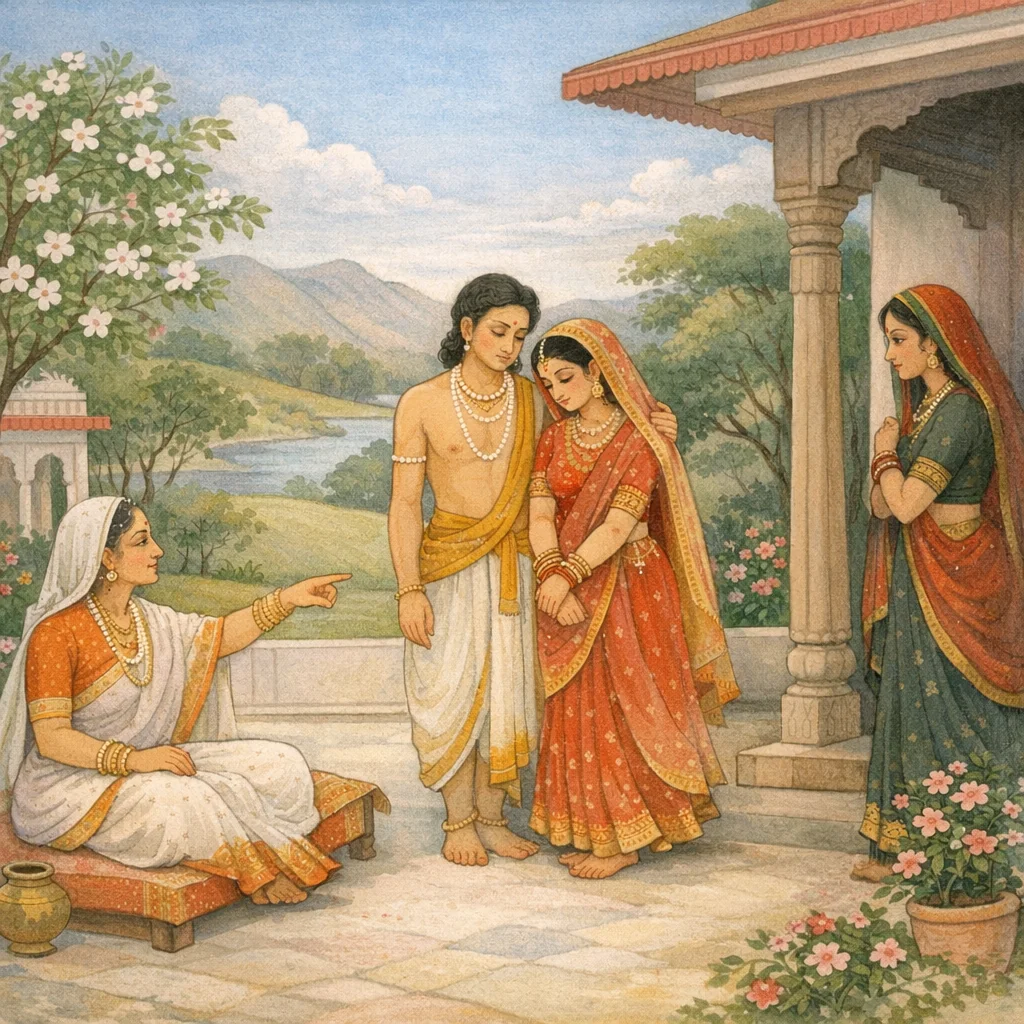
In Sūta’s narration, this chapter presents a household episode shaped by rivalry between the elder and younger wives. The younger wife, Ghuśmā, gains honor through childbirth and the praised excellence of her son, while the elder wife, Sudehā, is consumed by envy and humiliation, her anguish described as an inner “burning” that signals karmic peril. When a marriage is arranged for the son, Ghuśmā’s status rises further and Sudehā’s despair deepens. Ghuśmā then speaks with humility, redefining possession and kinship by saying the son and daughter-in-law belong to the elder wife, modeling non-appropriation. Yet partiality in the home remains. The Śaiva teaching emphasizes that inner impurity (malā) such as jealousy corrodes merit, whereas self-effacing devotion and restraint uphold dharma and prepare the ground for Śiva’s saving intervention.
Shlokas
Verse 1
सूत उवाच । पुत्रं दृष्ट्वा कनिष्ठाया ज्येष्ठा दुःखमुपागता । विरोधं सा चकाराशु न सहंती च तत्सुखम्
Sūta said: Seeing that the younger (wife/sister) had borne a son, the elder was overcome with sorrow. Unable to endure that happiness, she swiftly stirred up opposition.
Verse 2
सर्वे पुत्रप्रसूतिं तां प्रशशंसुर्निरन्तरम् । तया तत्सह्यते न स्म शिशो रूपादिकं तथा
All the people continually praised that birth of a son. Yet she could not bear it—so too the infant’s appearance and other features were not endurable to her.
Verse 3
सुप्रियं तनयं तं च पित्रोस्सद्गुणभाजनम् । दृष्ट्वाऽभवत्तदा तस्या हृदयं तप्तमग्निवत्
Seeing that dearly beloved son—an embodiment of the father’s noble qualities—her heart at that moment burned, as if scorched by fire.
Verse 4
एतस्मिन्नंतरे विप्राः कन्यां दातुं समागताः । विवाहं तस्य तत्रैव चकार विधिवच्च सः
Meanwhile, O brāhmaṇas, the brāhmaṇas assembled there to give the maiden in marriage; and he, in that very place, duly performed the wedding rites according to proper injunctions.
Verse 5
सुधर्मा घुश्मया सार्द्धमानन्दं परमं गतः । सर्वे संबंधिनस्तस्यां घुश्मायां मानमादधुः
Sudharmā, together with Ghuśmā, attained the supreme bliss. Thereafter all their relatives placed honor and reverence upon Ghuśmā.
Verse 6
तं दृष्ट्वा सा सुदेहा हि मनसि ज्वलिता तदा । अत्यन्तं दुःखमापन्ना हा हतास्मीति वादिनी
On seeing him, Sudehā’s mind flared up within. Overwhelmed by intense sorrow, she cried, “Alas, I am ruined!”
Verse 7
सुधर्म्मा गृहमागत्य वधूं पुत्रं विवाहितम् । उत्साहं दर्शयामास प्रियाभ्यां हर्षयन्निव
Sudharmā returned home and, seeing his son married and the daughter-in-law present, displayed great enthusiasm, as though delighting those dear to him.
Verse 8
अभवद्धर्षिता घुष्मा सुदेहा दुःखमागता । न सहंती सुखं तच्च दुःखं कृत्वापतद्भुवि
Ghuṣmā was struck down by oppression, and Sudehā was overwhelmed by sorrow. Unable to endure that happiness, she turned it into grief and fell upon the ground.
Verse 9
घुश्माऽवदद्वधूपुत्रौ त्वदीयौ न मदीयकौ । वधूः पुत्रश्च तां प्रीत्या प्रसूं श्वश्रममन्यत
Ghuśmā said, “The bride and the son belong to you, not to me.” Out of affection, both the daughter-in-law and the son regarded the mother who bore him as their own mother-in-law.
Verse 10
भर्त्ता प्रियां तां ज्येष्ठां च मेने नैव कनिष्ठिकाम् । तथापि सा तदा ज्येष्ठा स्वान्तर्मलवती ह्यभूत्
The husband regarded that beloved wife as the elder one, not as the younger. Yet at that time, though called “the elder,” her inner being was indeed tainted by impurity.
Verse 11
एकस्मिन्दिवसे ज्येष्ठा सा सुदेहा च दुःखिनी । हृदये संचिचिन्तेति दुःखशांतिः कथं भवेत्
One day, the elder (woman), Sudehā, afflicted with sorrow, pondered deeply in her heart: “How can this suffering be brought to peace?”
Verse 12
सुदेहोवाच । मदीयो हृदयाग्निश्च घुश्मानेत्रजलेन वै । भविष्यति ध्रुवं शांतो नान्यथा दुःखजेन हि
Sudeha said: “Indeed, the fire burning in my heart will surely be quenched by Ghuśmā’s tears. It cannot be otherwise, for they arise from true sorrow.”
Verse 13
अतोऽहं मारयाम्यद्य तत्पुत्रं प्रियवादिनम् । अग्रे भावि भवेदेवं निश्चयः परमो मम
“Therefore, today I shall kill that son—one who speaks pleasingly. In the time to come, it shall indeed be so; this is my supreme resolve.”
Verse 14
सूत उवाच । कदर्य्याणां विचारश्च कृत्याकृत्ये भवेन्नहि । कठोरः प्रायशो विप्राः सापत्नो भाव आत्महा
Sūta said: “In the miserly there is, indeed, no discernment regarding what ought to be done and what ought not to be done. Such people are generally hard-hearted, O brāhmaṇas—ever in rivalry, and slayers of their own nobler disposition.”
Verse 15
एकस्मिन्दिवसे ज्येष्ठा सुप्तं पुत्रं वधूयुतम् । चिच्छिदे निशि चांगेषु गृहीत्वा छुरिकां च सा
One day, the elder woman, taking a knife in her hand, went at night and cruelly cut the limbs of her son while he slept together with his wife.
Verse 16
सर्वांगं खण्डयामास रात्रौ घुश्मासुतस्य सा । नीत्वा सरसि तत्रैवाक्षिपद्दृप्ता महाबला
In the night, that proud and mighty woman cut Ghuśmā’s son limb by limb; then, carrying him away, she cast him into that very lake.
Verse 17
यत्र क्षिप्तानि लिंगानि घुश्मया नित्यमेव हि । तत्र क्षिप्त्वा समायाता सुष्वाप सुखमागता
“Wherever Ghuśmā would daily cast the (worshipped) liṅgas, there she went and cast them again; having returned, she slept, having attained ease and peace.”
Verse 18
प्रातश्चैव समुत्थाय घुश्मा नित्यं तथाकरोत् । सुधर्मा च स्वयं श्रेष्ठो नित्यकर्म समाचरत्
Rising early each morning, Ghuśmā would unfailingly perform her daily observances. Sudharmā too, being a noble man, regularly carried out his prescribed duties.
Verse 19
एतस्मिन्नंतरे सा च ज्येष्ठा कार्यं गृहस्य वै । चकारानन्दसंयुक्ता सुशांतहृदयानला
Meanwhile, the elder lady attended to the household duties. Endowed with joy, and with the fire of her heart fully pacified, she carried out the work in a tranquil, composed manner.
Verse 20
प्रातःकाले समुत्थाय वधूश्शय्यां विलोक्य सा । रुधिरार्द्रां देहखंडैर्युक्तां दुःखमुपागता
Rising in the morning, she looked at the bride’s bed; seeing it soaked with blood and strewn with pieces of a body, she was overwhelmed with sorrow.
Verse 21
श्वश्रूं निवेदयामास पुत्रस्ते च कुतो गतः । शय्या च रुधिरार्द्रा वै दृश्यंते देहखंडकाः
He reported it to his mother-in-law: “And where has your son gone?” Indeed, the bed is soaked with blood, and pieces of a body are seen there.
Verse 22
हा हतास्मि कृतं केन दुष्टं कर्म शुचिव्रते । इत्युच्चार्य रुरोदातिविविधं तत्प्रिया च सा
“Alas, I am undone! What wicked deed has been done, and by whom, O you of pure vows?”—uttering these words, she, the beloved of that man, wept in many ways.
Verse 23
ज्येष्ठा दुःखं तदापन्ना हा हतास्मि किलेति च । बहिर्दुःखं चकारासौ मनसा हर्षसंयुता
Then the elder one fell into apparent sorrow, crying, “Alas, I am ruined indeed!” Yet, though she displayed grief outwardly, within her mind she remained joined to joy.
Verse 24
घुश्मा चापि तदा तस्या वध्वा दुखं निशम्य सा । न चचाल व्रतात्तस्मान्नित्यपार्थिवपूजनात्
Then Ghuśmā too, hearing the sorrow of her daughter-in-law, did not waver from her vow—she remained steadfast in the daily worship of the earthen (Pārthiva) Śiva-liṅga.
Verse 25
मनश्चैवोत्सुकं नैव जातं तस्या मनागपि । भर्तापि च तथैवासीद्यावद्व्रतविधिर्भवेत्
Her mind did not grow restless even in the least; and her husband too remained unchanged—so long as the observance of the sacred vow (vrata) endured.
Verse 26
मध्याह्ने पूजनांते च दृष्ट्वा शय्यां भयावहाम् । तथापि न तदा किञ्चित्कृतं दुःखं हि घुश्मया
At midday, when her worship had concluded, she saw a bed that was terrifying to behold. Yet even then Ghuśmā did not give way to any lamentation or distress—she did nothing out of grief.
Verse 27
येनैव चार्पितश्चायं स वै रक्षां करिष्यति । भक्तप्रियस्स विख्यातः कालकालस्सतां गतिः
He to whom this offering has been made will surely grant protection. He is famed as the beloved of devotees, the “Death of Death” (the Lord who transcends Time), and the refuge and final goal of the righteous.
Verse 28
यदि नो रक्षिता शंभुरीश्वरः प्रभुरेकलः । मालाकार इवासौ यान्युङ्क्ते तान्वियुनक्ति च
If Śambhu, the one and only Lord, is our protector, then—like a garland-maker—He joins together whom He wills, and He also separates them again.
Verse 29
अद्य मे चिंतया किं स्यादिति तत्त्वं विचार्य सा । न चकार तदा दुःखं शिवे धैर्यं समागता
Reflecting on the truth—“What, indeed, could come of my anxiety today?”—she no longer gave way to sorrow then; taking refuge in Śiva, she became steady and courageous.
Verse 30
पार्थिवांश्च गृहीत्वा सा पूर्ववत्स्वस्थमानसा । शंभोर्नामान्युच्चरंती जगाम सरसस्तटे
Taking the earthen liṅgas in her hands, she—just as before, with a steady and composed mind—went to the bank of the lake, continually uttering the sacred names of Śambhu.
Verse 31
क्षिप्त्वा च पार्थिवांस्तत्र परावर्त्तत सा यदा । तदा पुत्रस्तडागस्थो दृश्यते स्म तटे तया
After casting the earthen offerings there, when she turned back, she then saw her son—who had been in the pond—appearing on the bank before her.
Verse 32
पुत्र उवाच । मातरेहि मिलिष्यामि मृतोऽहं जीवितोऽधुना । तव पुण्यप्रभावाद्धि कृपया शंकरस्य वै
The son said: “Mother, indeed I shall meet you. Though I was dead, I am now alive—through the power of your merit, and truly by the compassionate grace of Śaṅkara.”
Verse 33
इति श्रीशिवमहापुराणे चतुर्थ्यां कोटिरुद्रसहितायां धुश्मेशज्योतिर्लिंगोत्पत्तिमाहात्म्यवर्णनं नाम त्रयस्त्रिंशोऽध्यायः
Thus, in the Śrī Śiva Mahāpurāṇa, in the Fourth section called the Koṭirudra Saṃhitā, ends the thirty-third chapter entitled “The narration of the greatness of the manifestation of the Dhuśmeśa Jyotirliṅga.”
Verse 34
एतस्मिन्समये तत्र स्वाविरासीच्छिवो द्रुतम् । ज्योतिरूपो महेशश्च संतुष्टः प्रत्युवाच ह
At that very moment, Śiva swiftly manifested there. Maheśa, the Great Lord, appearing in the form of radiant Light and being pleased, then spoke in reply.
Verse 35
शिव उवाच । प्रसन्नोऽस्मि वरं ब्रूहि दुष्टया मारितो ह्ययम् । एनां च मारयिष्यामि त्रिशूलेन वरानने
Śiva said: “I am pleased. Speak your boon. This one has indeed been slain by that wicked woman; and I shall also slay her with the trident, O fair-faced one.”
Verse 36
सूत उवाच । पुरा तदा वरं वव्रे सुप्रणम्य शिवं नता । रक्षणीया त्वया नाथ सुदेहेयं स्वसा मम
Sūta said: In former times she then chose a boon. Bowing low and prostrating before Śiva, she said, “O Lord, may my sister Sudehā be protected by You.”
Verse 37
शिव उवाच । अपकारः कृतस्तस्यामुपकारः कथं त्वया । क्रियते हननीया च सुदेहा दुष्टकारिणी
Śiva said: “She has harmed you—how is it that you now show her kindness? Sudehā is a doer of wicked deeds; she deserves to be slain.”
Verse 38
घुश्मोवाच । तव दर्शनमात्रेण पातकं नैव तिष्ठति । इदानीं त्वां च वै दृष्ट्वा तत्पापं भस्मतां व्रजेत्
Ghuśmā said: “By the mere sight of You, sin cannot remain. Now indeed, having seen You, that very sin will be reduced to ashes.”
Verse 39
अपकारेषु यश्चैव ह्युपकारं करोति च । तस्य दर्शनमात्रेण पापं दूरतरं व्रजेत्
Even toward those who cause harm, whoever responds with kindness and renders help—by the mere sight of such a person, sin departs and goes far away.
Verse 40
इति श्रुतं मया देव भगवद्वाक्यमद्भुतम् । तस्माच्चैवं कृतं येन क्रियतां च सदाशिव
“Thus, O Deva, I have heard the wondrous words of the Blessed Lord. Therefore, O Sadāśiva, let it be duly carried out, just as You have declared.”
Verse 41
सूत उवाच । इत्युक्तस्तु तया तत्र प्रसन्नोऽत्यभवत्पुनः । महेश्वरः कृपासिंधुः समूचे भक्तवत्सलः
Sūta said: Thus addressed by her there, Mahādeva again became exceedingly pleased—Mahēśvara, the ocean of compassion, and truly the affectionate guardian of His devotees.
Verse 42
शिव उवाच । अन्यद्वरं ब्रूहि घुश्मे ददामि च हितं तव । त्वद्भक्त्या सुप्रसन्नोऽस्मि निर्विकारस्वभावतः
Śiva said: “O Ghuśmā, ask for another boon. I shall grant you what is truly beneficial for you. By your devotion I am exceedingly pleased; for by My very nature I am free from all change and defect.”
Verse 43
सूत उवाच । सोवाच तद्वचश्श्रुत्वा यदि देयो वरस्त्वया । लोकानां चैव रक्षार्थमत्र स्थेयं मदाख्यया
Sūta said: Having heard those words, he spoke: “If a boon is to be granted by You, then for the protection of the worlds You should abide here, bearing my name.”
Verse 44
तदोवाच शिवस्तत्र सुप्रसन्नो महेश्वरः । स्थास्येऽत्र तव नाम्नाहं घुश्मेशाख्यस्सुखप्रदः
Then the supremely gracious Lord Śiva, the Great Mahēśvara, spoke there: “In this very place I shall abide, bearing your name as ‘Ghuśmeśa’, bestowing happiness and spiritual well-being.”
Verse 45
घुश्मेशाख्यं सुप्रसिद्धं लिंगं मे जायतां शुभम् । इदं सरस्तु लिंगानामालयं जायतां सदा
“May this auspicious Liṅga of mine become renowned by the name Ghuśmeśa. And may this sacred lake ever remain the abode and dwelling-place of the Liṅgas.”
Verse 46
तस्माच्छिवालयं नाम प्रसिद्धं भुवनत्रये । सर्वकामप्रदं ह्येतद्दर्शनात्स्यात्सदा सरः
Therefore, the sacred place called Śivālaya is renowned in all the three worlds. Indeed, it bestows every desired good; by merely beholding it, one becomes ever-blessed and attains auspiciousness.
Verse 47
तव वंशे शतं चैकं पुरुषावधि सुव्रते । ईदृशाः पुत्रकाः श्रेष्ठा भविष्यंति न संशयः
O you of excellent vows, in your lineage there will be one hundred and one men in succession. Sons of such noble character will indeed be born—of this there is no doubt.
Verse 48
सुस्त्रीकास्सुधनाश्चैव स्वायुष्याश्च विचक्षणाः । विद्यावंतो ह्युदाराश्च भुक्तिमुक्तिफलाप्तये
They are blessed with a virtuous wife, endowed with wealth, long life, and discerning wisdom; learned and noble as well—so that they may attain the fruits of both bhukti (worldly enjoyment) and mukti (final liberation).
Verse 49
शतमेकोत्तरं चैव भविष्यंति गुणाधिकाः । ईदृशो वंशविस्तारो भविष्यति सुशोभनः
Indeed, there will be one hundred and one descendants, endowed with superior virtues. Thus shall this lineage expand—beautiful and illustrious—by the grace that upholds dharma.
Verse 50
सूत उवाच । इत्युक्त्वा च शिवस्तत्र लिंगरूपोऽभवत्तदा । घुश्मेशो नाम विख्यातः सरश्चैव शिवालयम्
Sūta said: Having spoken thus, Śiva thereupon manifested in that place in the form of the Liṅga. He became renowned by the name Ghuśmeśa, and that sacred lake too became celebrated as Śiva’s own abode (Śivālaya).
Verse 51
सुधर्मा स च घुश्मा च सुदेहा च समागताः । प्रदक्षिणं शिवस्याशु शतमेकोत्तरं दधुः
Then Sudharmā, and Ghuśmā, and Sudehā gathered together, and at once performed one hundred and one circumambulations of Lord Śiva in reverent devotion.
Verse 52
पूजां कृत्वा महेशस्य मिलित्वा च परस्परम् । हित्वा चांतर्मलं तत्र लेभिरे परमं सुखम्
Having worshipped Maheśa and met one another in harmony, they cast off the inner impurity then and there and attained the supreme bliss.
Verse 53
पुत्रं दृष्ट्वा सुदेहा सा जीवितं लज्जिताभवत् । तौ क्षमाप्याचरद्विप्रा निजपापापहं व्रतम्
Seeing her son, the brāhmaṇa woman Sudehā felt ashamed even of her own life. After seeking forgiveness from the two of them, she undertook a vow (vrata) that destroys one’s own sins.
Verse 54
घुश्मेशाख्यमिदं लिंगमित्थं जातं मुनीश्वराः । तं दृष्ट्वा पूजयित्वा हि सुखं संवर्द्धते सदा
O best of sages, thus this Liṅga came to be known as Ghuśmeśa. By merely beholding it and then worshipping it, one’s well-being and happiness ever increase.
Verse 55
इति वश्च समाख्याता ज्योतिर्लिंगावली मया । द्वादशप्रमिता सर्वकामदा भुक्ति मुक्तिदा
Thus I have related to you the sacred series of Jyotirlingas—twelve in number—bestowing the fulfillment of all rightful desires, and granting both worldly enjoyment (bhukti) and final liberation (mukti).
Verse 56
एतज्ज्योतिर्लिंगकथां यः पठेच्छृणुयादपि । मुच्यते सर्वपापेभ्यो भुक्तिं मुक्तिं च विंदति
Whoever recites—or even hears—this sacred account of the Jyotirliṅga is released from all sins and, through the grace of Lord Śiva, the Supreme Pati, attains both worldly fulfillment (bhukti) and final liberation (mukti).
Frequently Asked Questions
A household conflict narrative: the elder wife’s envy intensifies as the younger wife’s childbirth and the son’s marriage bring praise and status; the chapter uses this social event to argue that inner vices (especially jealousy) are spiritually destructive, while humility and restraint preserve dharma.
The ‘burning heart’ imagery functions as a diagnostic symbol for antaḥkaraṇa-impurity (malā): envy is portrayed as an inner fire that consumes merit. Conversely, Ghuśmā’s non-possessive speech symbolizes anāsakti—detachment within relationship—which is treated as a subtle form of sādhanā in the gṛhastha sphere.
In the provided verses, no explicit Śiva/Gaurī form-name is foregrounded; the chapter operates through ethical narration that implicitly supports Śaiva soteriology (purification leading to grace), rather than iconographic description of a particular divine manifestation.