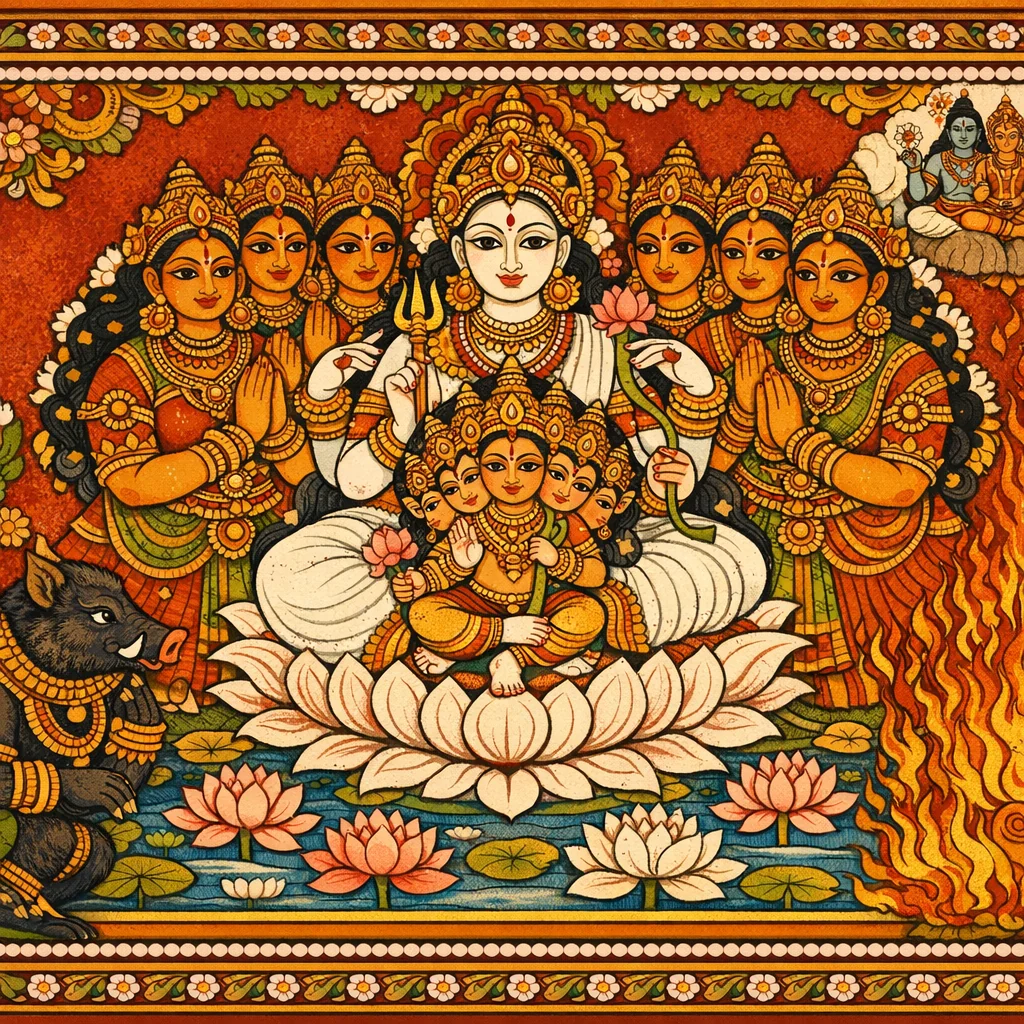
Adhyaya 158: Mahāgaurī’s Entry, Agni Bearing Śiva’s Seed, and the Birth of Six-Faced Kumāra
महागौरी-प्रवेशः, अग्निद्वारा वीर्यधारणं, कुमारोत्पत्तिश्च
Speaker: Vīraka, Devī (Pārvatī/Śailajā/Mahāgaurī/Caṇḍikā), Sūta, Rudra/Śiva (Hara/Śarva/Mahādeva), Agni (Hutāśana/Pāvaka/Jvalana), Kṛttikās
Sūta continues the episode: Vīraka bars entry; the Goddess inwardly perceives the paradox of being called “not a woman” and repents the curse uttered in anger. She reveals her identity, saying her fair, radiant form is Brahmā’s boon, yet the curse’s result must still unfold—Vīraka will return to human life with desire. Vīraka offers an ornate stuti to Caṇḍikā/Mahāgaurī; pleased, she enters Śiva’s abode. Śiva, at first of mixed mood, becomes Bhairava; she mirrors him as Bhairavī and discloses her Tārā-form, removing his doubt. The divine couple dwell in secrecy for a thousand years; the gods are turned away by Vīraka and send Agni to investigate. Agni spies in boar-form; Śiva commands him to drink the remaining potency. The devas, filled with it, release it, bringing forth a shining hermitage and a vast pure lake with golden lotuses. Pārvatī drinks its sweet water; the Kṛttikās ask for motherhood and the right to name. From Pārvatī’s right side arises a radiant six-faced Kumāra, armed to destroy the Daityas.
Key Concepts
Shlokas in Adhyaya 158
Verse 1
*वीरक उवाच एवमुक्त्वा गिरिसुता माता मे स्नेहवत्सला प्रवेशं लभते नान्या नारी कमललोचने //
Vīraka said: “Having spoken thus, the daughter of the Mountain—my mother, affectionate and tender—may obtain entry; no other woman (besides her), O lotus-eyed one, is permitted to enter.”
Verse 2
इत्युक्ता तु तदा देवी चिन्तयामास चेतसा न सा नारीति दैत्यो ऽसौ वायुर्मे यामभाषत //
Thus addressed, the Goddess then pondered in her mind: “That demon said, ‘She is not a woman’—and the Wind spoke to me in that very manner.”
Verse 3
वृथैव वीरकः शप्तो मया क्रोधपरीतया अकार्यं क्रियते मूढैः प्रायः क्रोधसमीरितैः //
In vain indeed was Vīraka cursed by me, for I was overcome with anger. For the foolish, stirred up by wrath, commonly do what ought not to be done.
Verse 4
क्रोधेन नश्यते कीर्तिः क्रोधो हन्ति स्थिरां श्रियम् अपरिच्छिन्नतत्त्वार्था पुत्रं शापितवत्यहम् विपरीतार्थबुद्धीनां सुलभो विपदोदयः //
By anger one’s good fame is destroyed; anger strikes down even stable prosperity. Not having clearly discerned the true meaning of reality, I ended up cursing my own son. For those whose understanding runs contrary to what is right, the arising of misfortune comes easily.
Verse 5
संचिन्त्यैवमुवाचेदं वीरकं प्रति शैलजा लज्जासज्जविकारेण वदनेनाम्बुजत्विषा //
Having reflected thus, Śailajā (the Mountain-born goddess) spoke these words to Vīraka—her lotus-bright face showing the tender change that comes with bashful modesty.
Verse 6
*देव्युवाच अहं वीरक ते माता मा ते ऽस्तु मनसो भ्रमः शंकरस्यास्मि दयिता सुता तुहिनभूभृतः //
The Goddess said: “O Vīraka, I am your mother—let there be no delusion in your mind. I am the beloved of Śaṅkara (Śiva), and the daughter of the Snow-mountain (Himālaya).”
Verse 7
मम गात्रच्छविभ्रान्त्या मा शङ्कां पुत्र भावय तुष्टेन गौरता दत्ता ममेयं पद्मजन्मना //
O son, do not entertain any doubt because you are bewildered by the radiance of my body. This fair complexion of mine was granted to me by Padmajanman (Brahmā), who was pleased.
Verse 8
मया शप्तो ऽस्यविदिते वृत्तान्ते दैत्यनिर्मिते ज्ञात्वा नारीप्रवेशं तु शंकरे रहसि स्थिते //
I was cursed—because this affair, contrived by the Daityas, was not known (to me). Later, having understood the entry of a woman while Śaṅkara was abiding in secrecy, (the consequence of that curse came about).
Verse 9
न निवर्तयितुं शक्यः शापः किं तु ब्रवीमि ते शीघ्रमेष्यसि मानुष्यात् स त्वं कामसमन्वितः //
“This curse cannot be averted. Yet I tell you this: you will soon return to human life—though you, at that time, will be driven by desire.”
Verse 10
*सूत उवाच शिरसा तु ततो वन्द्य मातरं पूर्णमानसः उवाचोदितपूर्णेन्दुद्युतिं च हिमशैलजाम् //
Sūta said: Then, bowing his head, he reverently saluted the Mother with a heart made whole, and addressed Himāśailajā—she whose radiance was like the newly risen full moon.
Verse 11
*वीरक उवाच नतसुरासुरमौलिमिलन्मणिप्रचयकान्तिकरालनखाङ्किते नगसुते शरणागतवत्सले तव नतो ऽस्मि नतार्तिविनाशिनि //
Vīraka said: O daughter of the Mountain, whose awe-inspiring nails are marked with the radiant luster of heaps of jewels pressed together from the diadems of bowing gods and demons; O loving protectress of those who seek refuge— I bow to you, O destroyer of the distress of those who bow.
Verse 12
तपनमण्डलमण्डितकंधरे पृथुसुवर्णसुवर्णनगद्युते विषभुजंगनिषङ्गविभूषिते गिरिसुते भवतीमहमाश्रये //
O Daughter of the Mountain (Girisute), whose neck is adorned with the circle of the sun, who shines with broad gold and golden ornaments, and who is beautified by the hanging hooded serpent—O Goddess, I take refuge in You.
Verse 13
जगति कः प्रणताभिमतं ददौ झटिति सिद्धनुते भवती यथा जगति कां च न वाञ्छति शंकरो भुवनधृत्तनये भवतीं यथा //
In this world, who else grants—instantly—the desired boon of those who bow in reverence, as you do, O bestower of success? And in this world, whom does Śaṅkara not desire—just as he desires you, O daughter of Bhūvanadhṛt (the Earth)?
Verse 14
विमलयोगविनिर्मितदुर्जयस्वतनुतुल्यमहेश्वरमण्डले विदलितान्धकबान्धवसंहतिः सुरवरैः प्रथमं त्वमभिष्टुता //
In the circle of Maheshvara—whose form, wrought by stainless Yoga, is invincible and self-sufficient—your host, having shattered the gathered kinsmen and allies of Andhaka, was the first to be hymned by the foremost of the gods.
Verse 15
सितसटापटलोद्धतकंधराभरमहामृगराजरथस्थिता विमलशक्तिमुखानलपिङ्गलायतभुजौघविपिष्टमहासुरा //
Mounted on the chariot of the great lion-king, its neck and shoulders uplifted by a canopy of white mane, she shines forth—her spotless spear blazing like fire at its point—while her tawny, long-reaching multitude of arms crushes the mighty asuras.
Verse 16
निगदिता भुवनैरिति चण्डिका जननि शुम्भनिशुम्भनिषूदनी प्रणतचिन्तितदानवदानवप्रमथनैकरतिस्तरसा भुवि //
Thus was the Mother Caṇḍikā proclaimed by the worlds—she who slew Śumbha and Niśumbha, who swiftly upon the earth delights in the single task of crushing the demons, and who grants the cherished wishes of those who bow to her.
Verse 17
वियति वायुपथे ज्वलनोज्ज्वले ऽवनितले तव देवि च यद्वपुः तदजिते ऽप्रतिमे प्रणमाम्यहं भुवनभाविनि ते भववल्लभे //
That form of Yours, O Goddess—present in the sky, along the path of the winds, in the blazing fire, and upon the surface of the earth—before that unconquered, incomparable One I bow. O You who bring forth the worlds, beloved of Bhava (Śiva), I offer my reverence to You.
Verse 18
जलधयो ललितोद्धतवीचयो हुतवहद्युतयश्च चराचरम् फणसहस्रभृतश्च भुजंगमास् त्वदभिधास्यति मय्यभयंकराः //
The oceans with their playfully surging waves; the fires blazing with their radiance; all beings, moving and unmoving; and the serpent-hosts bearing a thousand hoods—when they utter Your name in me, they become makers of fearlessness (and no longer a cause of terror).
Verse 19
प्रशममेहि ममात्मजवत्सले तव नमो ऽस्तु जगत्त्रयसंश्रये त्वयि ममास्तु मतिः सततं शिवे शरणगो ऽस्मि नतो ऽस्मि नमो ऽस्तु ते //
Be pacified, O Mother who loves me like your own child. Salutations to you, the refuge of the three worlds. O Śivā, may my mind rest in you always. I have come for shelter; I bow down—salutations to you.
Verse 20
*सूत उवाच प्रसन्ना तु ततो देवी वीरकस्येति संस्तुता प्रविवेश शुभं भर्तुर् भवनं भूधरात्मजा //
Sūta said: Thereupon the goddess—pleased and praised as “the consort of Vīraka”—entered the auspicious dwelling of her husband, she who was the daughter of Bhūdhara (the Mountain).
Verse 21
अथ रुद्रो महागौरीं गौरीं दृष्ट्वा तु सुन्दरीम् चित्तव्यामोहनाकारां करीन्द्रोन्मत्तगामिनीम् //
Then Rudra, seeing the beautiful Mahāgaurī—Gaurī herself—whose form bewilders and enchants the mind, and whose gait is like that of an elephant-lord in rut, (was struck with wonder).
Verse 22
पूर्णचन्द्राननां तन्वीं नितम्बोरुघनस्तनीम् मध्ये क्षामां तथाक्षीणलावण्यामृतवर्षिणीम् //
She is slender, with a face like the full moon; with full hips and thighs and ample breasts; with a waist that is delicately lean—yet she pours forth an unwaning nectar of beauty and charm.
Verse 23
सर्वाभरणपूर्वाङ्गीं मदो मन्देन कारिणीम् सकामः शङ्कितो दीनो रौद्रो वीरो भयानकः //
She is to be shown with her limbs first adorned with all ornaments; (her) intoxicated mood is to be rendered with gentle, languid movement. (Likewise, figures may be portrayed as) amorous, apprehensive, dejected, furious, heroic, or fearsome.
Verse 24
करुणाहास्यबीभत्सकिंचित्किंचिद्धरो ऽभवत् जिघांसुर्देववाक्येन भैरवं कृतवान्वपुः //
Then Hara (Śiva) became of a mixed demeanor—partly compassionate, partly laughing, and partly terrible. Wishing to slay (the offender), and at the bidding of the gods, he assumed the body-form of Bhairava.
Verse 25
सा चापि भैरवी जाता देवस्य प्रतिरूपिणी तस्या रूपसहस्राणि ददर्श गिरिगोचरः //
She, too, became Bhairavī—assuming a form that mirrored the Deva; and the mountain-roaming one beheld her in thousands of forms.
Verse 26
ग्रस्ते सहस्ररूपाणां तारारूपे प्रदर्शिते पार्वत्या चाथ निःशङ्कः शंकरो वाभवत्ततः //
When the multitude of manifold forms had been subdued, and the form of Tārā was shown by Pārvatī, then Śaṅkara became free from doubt and was reassured thereafter.
Verse 27
दृष्ट्वा जगन्मयीं तां तु रराम सुरतप्रियः विरहोत्कण्ठितां भार्यां प्राप्य भूयो हिमात्मजाम् //
But on seeing her—who was as though embodying the whole world—he, fond of love’s pleasures, delighted again, having regained his wife, the daughter of Himavat, who had been yearning in separation.
Verse 28
यावद्वर्षसहस्रान्तम् उभयो रहसिस्थयोः नानाकरणबद्धोत्था क्रीडासीत् संतता तयोः //
For as long as a thousand years, while the two remained in a secret place, their amorous play continued unbroken—arising from many postures and movements bound into varied embraces.
Verse 29
द्वारस्थो वीरको देवान् हरदर्शनकाङ्क्षिणः व्यसर्जयत् स्वकान्येव गृहाण्यादरपूर्वकम् //
Standing at the gateway, Vīraka courteously directed the gods—who longed for the sight of Hara—to proceed, and with due respect assigned them to their own respective lodging-houses.
Verse 30
नास्त्यत्रावसरो देवा देव्या सह वृषाकपिः निभृतः क्रीडतीत्युक्ता ययुस्ते च यथागतम् //
“There is no occasion (to intrude) here, O gods—Vṛṣākapi is privately sporting with the Goddess.” Thus addressed, those gods departed, returning just as they had come.
Verse 31
गते वर्षसहस्रे तु देवास्त्वरितमानसाः ज्वलनं चोदयामासुर् ज्ञातुं शंकरचेष्टितम् //
When a thousand years had passed, the gods—anxious and quickened in mind—urged Jvalana (Agni) to find out the intention and action of Śaṅkara (Śiva).
Verse 32
प्रविश्य जालरन्ध्रेण शुकरूपी हुताशनः ददृशे शयने शर्वं रतं गिरिजया सह //
Entering through an opening in the lattice, Hutāśana (Agni), having assumed the form of a boar, beheld Śarva (Śiva) upon the couch, engaged in amorous union together with Girijā (Pārvatī).
Verse 33
ददृशे तं च देवेशो हुताशं शुकरूपिणम् तमुवाच महादेवः किंचित्कोपसमन्वितः //
Then the Lord of gods beheld Hutāśa (Agni) in the form of a boar; and Mahādeva addressed him, his words edged with a slight anger.
Verse 34
*शर्व उवाच निषिक्तमर्धं देव्यां मे शुक्रस्य शुकविग्रह लज्जया विरतिस्थायां त्वमर्धं पिब पावक //
Śarva (Śiva) said: “O Fire (Pāvaka), half of my semen has already been discharged into the Goddess. Since she has stopped out of modesty, you drink the remaining half.”
Verse 35
यस्मात्तु त्वत्कृतो विघ्नस् तस्मात्त्वय्युपपद्यते इत्युक्तः प्राञ्जलिर्वह्निर् अपिबद्वीर्यमाहितम् //
“Since the obstruction has been caused by you, it must be resolved by you alone.” Thus addressed, Agni (the Fire-god), with folded hands, drank in the deposited potency (vital energy/seed).
Verse 36
तेनापूर्यत तान्देवांस् तत्तत्कायविभेदतः विपाट्य जठरं तेषां वीर्यं माहेश्वरं ततः //
By that (power), those Devas were filled—each according to the division of his own body; then, splitting open their bellies, the Maheshvara-born potency (vīrya) issued forth from them.
Verse 37
निष्क्रान्ते तप्तहेमाभं विततं शंकराश्रमे तस्मिन्सरो महज्जातं विमलं बहुयोजनम् //
When that (radiant presence) had emerged, the Śaṅkara-hermitage shone forth like molten gold; and there, a vast lake came into being—spotless and extending for many yojanas.
Verse 38
प्रोत्फुल्लहेमकमलं नानाविहगनादितम् तच्छ्रुत्वा तु ततो देवी हेमद्रुममहाजलम् //
It was filled with fully blossomed golden lotuses and resounded with the calls of many kinds of birds. Hearing that, the Goddess then (turned her attention toward) the great expanse of water by the golden trees (Hemadruma-mahājala).
Verse 39
जगाम कौतुकाविष्टा तत्सरः कनकाम्बुजम् तत्र कृत्वा जलक्रीडां तदब्जकृतशेखरा //
Filled with eager curiosity, she went to that lotus-lake where golden lotuses bloomed. There she sported in the water, and then adorned her hair with a crest made of those very lotus-flowers.
Verse 40
उपविष्टा ततस्तस्य तीरे देवी सखीयुता पातुकामा च तत्तोयं स्वादु निर्मलपङ्कजम् //
Then the goddess, accompanied by her companions, sat down upon its bank; wishing to drink, she drank that water—sweet, clear, and lotus-filled.
Verse 41
अपश्यत्कृत्तिकाः स्नाताः षडर्कद्युतिसंनिभाः पद्मपत्रे तु तद्वारि गृहीत्वोपस्थिता गृहम् //
He saw the Kṛttikās after their bath, radiant like the splendor of six suns; having taken that water upon a lotus-leaf, they approached the house.
Verse 42
हर्षादुवाच पश्यामि पद्मपत्रे स्थितं पयः ततस्ता ऊचुरखिलं कृत्तिका हिमशैलजाम् //
Harṣa said, “I see milk resting upon a lotus-leaf.” Then the Kṛttikās told in full (the account concerning) the daughter of the snowy mountain (Himālaya).
Verse 43
*कृत्तिका ऊचुः दास्यामो यदि ते गर्भः सम्भूतो यो भविष्यति सो ऽस्माकमपि पुत्रः स्याद् अस्मन्नाम्ना च वर्तताम् भवेल्लोकेषु विख्यातः सर्वेष्वपि शुभानने //
The Kṛttikās said: “If the child-to-be is indeed conceived in you, we will nurse and raise him. Let him also be regarded as our son and be known by our name. O fair-faced one, may he become renowned in all the worlds.”
Verse 44
इत्युक्तोवाच गिरिजा कथं मद्गात्रसंभवः सर्वैरवयवैर्युक्तो भवतीभ्यः सुतो भवेत् //
Thus addressed, Girijā (Pārvatī) said: “How could a son, born from my own body, come into being from you—complete in all his limbs?”
Verse 45
ततस्तां कृत्तिका ऊचुर् विधास्यामो ऽस्य वै वयम् उत्तमान्युत्तमाङ्गानि यद्येवं तु भविष्यति //
Then the Kṛttikās said to her: “Indeed, we shall provide for him the finest and most excellent limbs—if this is truly what is to happen.”
Verse 46
उक्ता वै शैलजा प्राह भवत्वेवमनिन्दिताः ततस्ता हर्षसम्पूर्णाः पद्मपत्रस्थितं पयः //
Thus addressed, Śailajā (the Mountain-born Goddess) said, “So be it, blameless ones.” Then, filled with joy, they took the milk that had been placed upon a lotus-leaf.
Verse 47
तस्यै ददुस्तया चापि तत्पीतं क्रमशो जलम् पीते तु सलिले तस्मिंस् ततस्तस्मिन्सरोवरे //
They gave her water, and she, in turn, drank that water little by little. When that water had been drunk up, then (they placed her) in that lake.
Verse 48
विपाट्य देव्याश्च ततो दक्षिणां कुक्षिमुद्गतः निश्चक्रामाद्भुतो बालः सर्वलोकविभासकः //
Then, tearing open the goddess’s right side, there emerged and came forth a wondrous child, radiant—illumining all the worlds.
Verse 49
प्रभाकरप्रभाकारः प्रकाशकनकप्रभः गृहीतनिर्मलोदग्रशक्तिशूलः षडाननः //
He is radiant like the Sun, his form itself a blaze of light; shining with the luster of bright gold. In his hands he bears a spotless, lofty spear and a trident—he is the six-faced Lord.
Verse 50
दीप्तो मारयितुं दैत्यान् कुत्सितान्कनकच्छविः एतस्मात्कारणाद्दैवः कुमारश्चापि सो ऽभवत् //
Blazing forth—golden-hued—he arose to slay the vile Daityas; and for this very reason he became known as the divine Youth (Kumāra) as well.
Frequently Asked Questions
Alongside the Skanda-birth narrative, the chapter explicitly teaches krodha-viveka: anger destroys kīrti (good fame) and stable śrī (prosperity), and rash wrath leads even a divine mother to curse her own son. The implied instruction is to discern tattvārtha (true meaning/reality) before acting, because viparīta-buddhi (misdirected understanding) makes misfortune easy to arise.
This adhyāya is primarily mythic-theological and dharmic-ethical rather than Vastu or Rajadharma. It covers (1) Dharma/ethics through the critique of anger and the consequences of a curse, and (2) Puranic theogony/genealogical myth through the origin of Kumāra/Skanda (six-faced), Agni’s carrying of Śiva’s potency, and the Kṛttikās’ role as foster-mothers and name-givers.