Adhyaya 44: Kārtavīrya Arjuna’s Solar Boon and the Genealogy from Kroṣṭu to the Yādava Lines (Andhaka–Vṛṣṇi–Bhoja)
कार्तवीर्यार्जुनस्य आदित्यवरप्राप्तिः तथा क्रोष्टुवंशानुकीर्तनम्
Speaker: Ṛṣayaḥ (Sages), Sūta
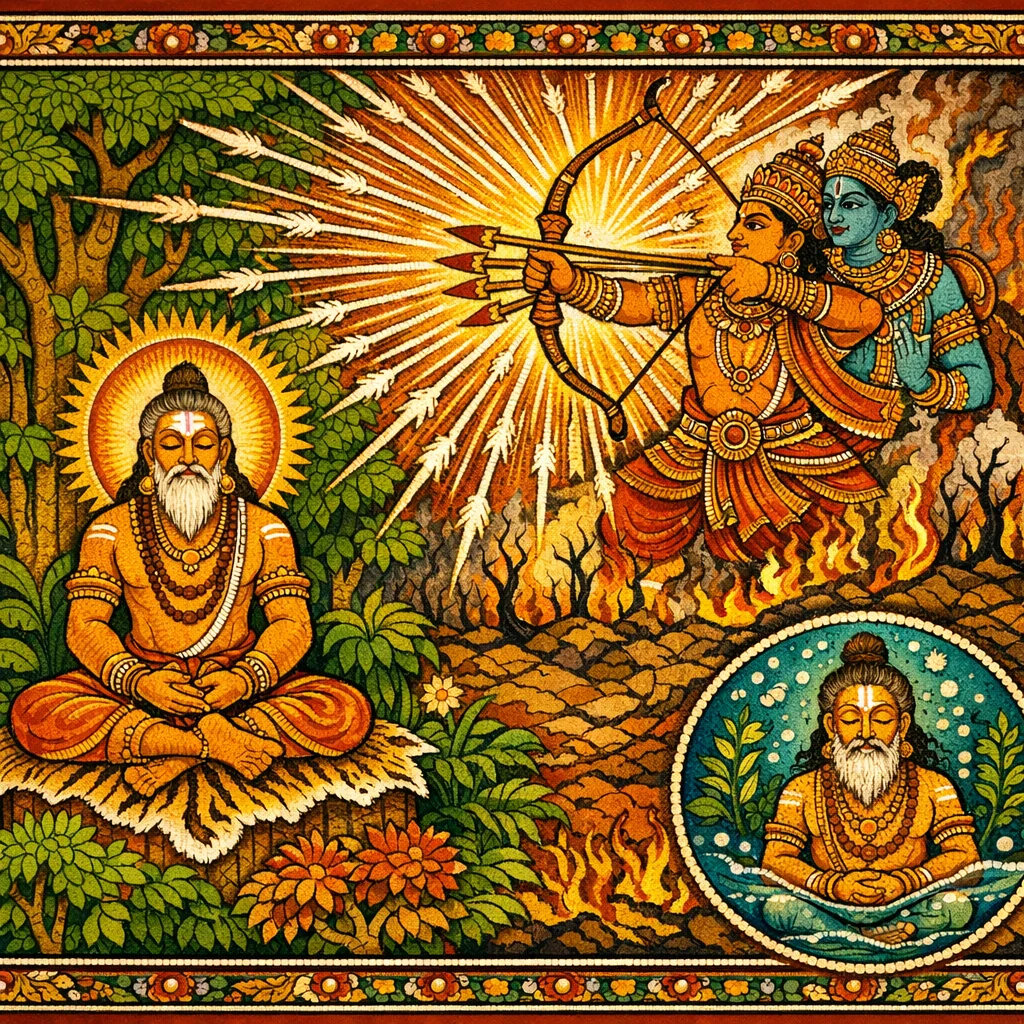
Adhyāya 44 unfolds in a Ṛṣi–Sūta samvāda. The sages question how Kārtavīrya Arjuna—remembered as a protector—could burn Āpava’s sacred tapas-grove. Sūta explains an etiological episode: Āditya (the Sun), disguised as a brāhmaṇa, seeks “satisfaction” and asks for all stationary beings as food. When Arjuna admits he cannot burn all immovables by personal prowess, Āditya grants inexhaustible, all-directional arrows infused with solar tejas. With these, Arjuna scorches forests, villages, hermitages, and the quarters, leaving earth treeless; Āpava remains in water for ten thousand years, later rising to find his āśrama destroyed—linking to the earlier curse motif. The chapter then pivots into Purāṇic genealogy: the Kroṣṭu line and extensive Yādava-related branches (Śaśabindu, Jyāmagha, Vidarbha, Cedi/Caidya, Daśārha, Ahuka, Devaka, Ugrasena, Hṛdīka, Andhakas). The underlying teaching contrasts royal might empowered by divine boons with the dharmic consequences of harming ascetic landscapes, while using vaṁśa as a mnemonic-historical scaffold for Itihāsa-Purāṇa tradition.
Key Concepts
Shlokas in Adhyaya 44
Verse 1
*ऋषय ऊचुः किमर्थं तद्वनं दग्धम् आपवस्य महात्मनः कार्तवीर्येण विक्रम्य सूत प्रब्रूहि तत्त्वतः //
The sages said: “For what reason was that forest—belonging to the great-souled Āpava—burned after it was overrun by Kārtavīrya? O Sūta, tell us the truth precisely.”
Verse 2
रक्षिता स तु राजर्षिः प्रजानामिति नः श्रुतम् स कथं रक्षिता भूत्वा अदहत्तत्तपोवनम् //
We have heard that this royal sage was a protector of the people. How then, having become their guardian, did he burn that grove of ascetics’ penance?
Verse 3
*सूत उवाच आदित्यो द्विजरूपेण कार्तवीर्यमुपस्थितः तृप्तिमेकां प्रयच्छस्व आदित्यो ऽहं नरेश्वर //
Sūta said: The Sun-god (Āditya), having assumed the form of a brahmin, approached Kārtavīrya and said, “O lord of men, grant me a single act of satisfaction (a meal/charitable hospitality); I am Āditya.”
Verse 4
*राजोवाच भगवन्केन तृप्तिस्ते भवत्येव दिवाकर कीदृशं भोजनं दद्मि हुत्वा तु विदधाम्यहम् //
The King said: “O Blessed One, by what means are you truly satisfied, O Divākara (the Sun)? What kind of food-offering should I give—what should I offer into the fire of homa—so that I may perform it duly?”
Verse 5
*आदित्य उवाच स्थावरं देहि मे सर्वम् आहारं ददतां वर तेन तृप्तो भवेयं वै सा मे तृप्तिर्हि पार्थिव //
Āditya said: “O best among givers, grant me as food all sustenance that is fixed (immovable). By that I shall indeed be satisfied; for that, O king, is truly my satisfaction.”
Verse 6
*कार्तवीर्य उवाच न शक्याः स्थावराः सर्वे तेजसा च बलेन च निर्दग्धुं तपतां श्रेष्ठ तेन त्वां प्रणमाम्यहम् //
Kārtavīrya said: “O best among ascetics, it is not possible to burn up all immovable beings—whether by tejas (splendor) or by sheer bala (strength). Therefore, I bow to you.”
Verse 7
*आदित्य उवाच तुष्टस्ते ऽहं शरान्दद्मि अक्षयान्सर्वतोमुखान् ये प्रक्षिप्ता ज्वलिष्यन्ति मम तेजःसमन्विताः //
Āditya said: “Pleased with you, I grant you inexhaustible arrows, striking in every direction; when released, they shall blaze forth, endowed with the power of my radiance (tejas).”
Verse 8
आविष्टा मम तेजोभिः शोषयिष्यन्ति स्थावरान् शुष्कान् भस्मीकरिष्यन्ति तेन तृप्तिर्नराधिप //
Pervaded by my radiance (tejas), those arrows will dry up the immovable beings; once dried, they will reduce them to ashes—by that, O lord of men, their hunger will be satisfied.
Verse 9
*सूत उवाच ततः शरांस्तदादित्यस् त्व् अर्जुनाय प्रयच्छत ततो ददाह सम्प्राप्तान् स्थावरान् सर्वमेव च //
Sūta said: Then that Āditya bestowed the arrows upon Arjuna; thereafter he burned up all immovable beings—everything that had come within reach.
Verse 10
ग्रामांस्तथाश्रमांश्चैव घोषाणि नगराणि च तपोवनानि रम्याणि वनान्युपवनानि च //
“(He described) villages and hermitages as well; pastoral hamlets and cities; delightful forests of austerity (tapovana), and also forests and pleasure-groves (upavana).”
Verse 11
एवं प्राचीमन्वदहत् ततः सर्वां स दक्षिणाम् निर्वृक्षा निस्तृणा भूमिर् हता घोरेण तेजसा //
Thus he scorched the eastern quarter; then he likewise burned the entire southern region. The earth, struck by that dreadful blaze, became stripped of trees and bereft of grass.
Verse 12
एतस्मिन्नेव काले तु आपवो जलमास्थितः दश वर्षसहस्राणि तत्रास्ते स महानृषिः //
At that very time, the great sage Āpava, having taken refuge in the waters, remained there for ten thousand years.
Verse 13
पूर्णे व्रते महातेजा उदतिष्ठंस्तपोधनः सो ऽपश्यदाश्रमं दग्धम् अर्जुनेन महामुनिः //
When his sacred vow was completed, that great, radiant sage—rich in ascetic power—rose up, and the great seer saw that his hermitage had been burned by Arjuna.
Verse 14
क्रोधाच्छशाप राजर्षिं कीर्तितं वो यथा मया क्रोष्टोः शृणुत राजर्षेर् वंशमुत्तमपौरुषम् //
I have already recounted to you, as I did before, how in anger a curse befell the royal sage. Now listen to the excellent lineage of the royal sage Kroṣṭu, renowned for its noble manliness and heroic virtue.
Verse 15
यस्यान्ववाये सम्भूतो विष्णुर्वृष्णिकुलोद्वहः क्रोष्टोरेवाभवत्पुत्रो वृजिनीवान्महारथः //
From his lineage was born Viṣṇu, the foremost ornament of the Vṛṣṇi clan. From Kroṣṭu was born the great chariot-warrior Vṛjinīvān.
Verse 16
वृजिनीवतश्च पुत्रो ऽभूत् स्वाहो नाम महाबलः स्वाहपुत्रो ऽभवद् राजन् रुषङ्गुर् वदतां वरः //
From Vṛjinīvat there was born a son named Svāha, a man of great strength. O King, Svāha’s son was Ruṣaṅgu, renowned as the foremost among eloquent speakers.
Verse 17
स तु प्रसूतिमिच्छन् वै रुषङ्गुः सौम्यमात्मजम् चित्रश्चित्ररथश्चास्य पुत्रः कर्मभिरन्वितः //
Desiring offspring, Ruṣaṅgu begot a gentle-natured son. His son was Citra—also known as Citraratha—endowed with worthy deeds.
Verse 18
अथ चैत्ररथिवीरो जज्ञे विपुलदक्षिणः शशबिन्दुरिति ख्यातश् चक्रवर्ती बभूव ह //
Then there was born the heroic Caitrarathi, famed for abundant generosity; he became renowned as Śaśabindu and indeed became a universal sovereign (cakravartin).
Verse 19
अत्रानुवंशश्लोको ऽयं गीतस् तस्मिन्पुराभवत् शशबिन्दोस्तु पुत्राणां शतानाम् अभवच्छतम् //
Here this genealogical verse is sung, as it was recited in ancient times: King Śaśabindu had a hundred sons—indeed, a full hundred.
Verse 20
धीमतां चाभिरूपाणां भूरिद्रविणतेजसाम् तेषां शतप्रधानानां पृथुसाह्वा महाबलाः //
Among them—wise and comely, endowed with abundant wealth and splendor—among the foremost of that hundred were the great and mighty ones bearing the name Pṛthu.
Verse 21
पृथुश्रवाः पृथुयशाः पृथुधर्मा पृथुंजयः पृथुकीर्तिः पृथुमना राजानः शशबिन्दवः //
These were the kings of the Śaśabindu lineage: Pṛthuśravā, Pṛthuyaśā, Pṛthudharmā, Pṛthuṃjaya, Pṛthukīrti, and Pṛthumanā.
Verse 22
शंसन्ति च पुराणज्ञाः पृथुश्रवसमुत्तमम् अन्तरस्य सुयज्ञस्य सुयज्ञस्तनयो ऽभवत् //
The knowers of the Purāṇas also recount the excellent Pṛthuśravas: from Antara was born Suyajña, and Suyajña became his son.
Verse 23
उशना तु सुयज्ञस्य यो रक्षन्पृथिवीमिमाम् आजहाराश्वमेधानां शतमुत्तमधार्मिकः //
But Uśanā, while protecting this earth on behalf of Suyajña, performed a hundred Aśvamedha sacrifices; he was a supremely righteous upholder of dharma.
Verse 24
तितिक्षुरभवत्पुत्र औशनः शत्रुतापनः मरुत्तस्तस्य तनयो राजर्षीणामनुत्तमः //
From Auśana was born a son named Titikṣu, a scorcher of enemies. His son was Marutta—unsurpassed among the royal sages (rājarṣi).
Verse 25
आसीन्मरुत्ततनयौ वीरः कम्बलबर्हिषः पुत्रस्तु रुक्मकवचो विद्वान्कम्बलबर्हिषः //
Marutta had a heroic son named Kambalabarhiṣ. And Kambalabarhiṣ had a learned son named Rukmakavaca.
Verse 26
निहत्य रुक्मकवचः परान्कवचधारिणः धन्विनो विविधैर्बाणैर् अवाप्य पृथिवीमिमाम् //
Rukmakavaca, having slain those clad in golden armor and the other armor-bearing archers with many kinds of arrows, thus won possession of this earth.
Verse 27
अश्वमेधे ददौ राजा ब्राह्मणेभ्यस्तु दक्षिणाम् यज्ञे तु रुक्मकवचः कदाचित्परवीरहा //
At the Aśvamedha sacrifice, the king granted the dakṣiṇā, the ritual fee, to the Brahmins. And in that very rite, Rukmakavaca—slayer of enemy heroes—on a certain occasion was present/performed.
Verse 28
जज्ञिरे पञ्च पुत्रास्तु महावीर्या धनुर्भृतः रुक्मेषुः पृथुरुक्मश्च ज्यामघः परिघो हरिः //
Five sons were born—mighty in valor and bearers of the bow: Rukmeṣu, Pṛthurukma, Jyāmagha, Parigha, and Hari.
Verse 29
परिघं च हरिं चैव विदेहे ऽस्थापयत्पिता रुक्मेषुरभवद्राजा पृथुरुक्मस्तदाश्रयः //
In Videha, the father installed Parigha and Hari as rulers; thereafter Rukmeṣu became king, and Pṛthurukma remained dependent upon him, taking refuge in his protection.
Verse 30
तेभ्यः प्रव्राजितो राज्याज् ज्यामघस्तु तदाश्रमे प्रशान्तश्चाश्रमस्थश्च ब्राह्मणेनावबोधितः //
Driven out by them from his kingdom, Jyāmagha went to that hermitage; there, becoming calm and living as an āśrama-dweller, he was instructed by a brāhmaṇa and awakened to right understanding.
Verse 31
जगाम धनुरादाय देशमन्यं ध्वजी रथी नर्मदां नृप एकाकी केवलं वृत्तिकामतः //
Taking up his bow, the banner-bearing king, a warrior in his chariot, went alone to another region—toward the Narmadā—driven solely by the desire to secure his livelihood.
Verse 32
ऋक्षवन्तं गिरिं गत्वा भुक्तमन्यैरुपाविशत् ज्यामघस्याभवद्भार्या चैत्रा परिणता सती //
Having gone to Mount Ṛkṣavat and taking his meal after others had eaten, he sat down. Thereafter, the virtuous Caitrā, having come to maturity, became the wife of Jyāmagha.
Verse 33
अपुत्रो न्यवसद्राजा भार्यामन्यां न विन्दत तस्यासीद्विजयो युद्धे तत्र कन्यामवाप्य सः //
Childless, the king lived on, yet he did not obtain another wife. He achieved victory in battle, and there he won a maiden (as his bride).
Verse 34
भार्यामुवाच संत्रासात् स्नुषेयं ते शुचिस्मिते एवमुक्ताब्रवीदेनं कस्य चेयं स्नुषेति च //
Then, in alarm, he said to his wife: “O pure-smiling one, she is your daughter-in-law.” Thus addressed, she replied to him: “Whose daughter-in-law is she?”
Verse 35
*राजोवाच यस्ते जनिष्यते पुत्रस् तस्य भार्या भविष्यति तस्मात्सा तपसोग्रेण कन्यायाः सम्प्रसूयत //
The king said: “The son who will be born to you—she will become his wife. Therefore, through the intensity of her austerities, let that maiden be duly brought forth (as a daughter).”
Verse 36
पुत्रं विदर्भं सुभगा चैत्रा परिणता सती राजपुत्र्यां च विद्वान्स स्नुषायां क्रथकैशिकौ लोमपादं तृतीयं तु पुत्रं परमधार्मिकम् //
From the princess (his royal daughter), the virtuous and duly married Chaitrā—fortunate and chaste—there was born a son named Vidarbha. From the learned one’s daughter-in-law were born Kratha and Kaiśika; and the third son was Lomapāda, supremely righteous in dharma.
Verse 37
तस्यां विदर्भो ऽजनयच् छरान्रणविशारदान् लोमपादान्मनुः पुत्रा ज्ञातिस्तस्य तु चात्मजः //
From her, Vidarbha begot sons skilled in shooting arrows and proficient in warfare—Lomapāda and Manu; and another son of his was named Jñāti.
Verse 38
कैशिकस्य चिदिः पुत्रस् तस्माच्चैद्या नृपाः स्मृताः क्रथो विदर्भपुत्रस्तु कुन्तिस् तस्यात्मजो ऽभवत् //
Cidi was the son of Kaiśika; from him the kings known as the Caidyas are remembered. Kratha was the son of Vidarbha, and Kunti was born as his son.
Verse 39
कुन्तेर्धृष्टः सुतो जज्ञे रणधृष्टः प्रतापवान् धृष्टस्य पुत्रो धर्मात्मा निर्वृतिः परवीरहा //
From Kuntī was born a son named Dhṛṣṭa; from Dhṛṣṭa was born the valiant and mighty Raṇadhṛṣṭa. From Raṇadhṛṣṭa was born Nirvṛti, righteous in soul, famed as a slayer of hostile heroes.
Verse 40
तदेको निर्वृतेः पुत्रो नाम्ना स तु विदूरथः दशार्हस्तस्य वै पुत्रो व्योमस्तस्य च वै स्मृतः दाशार्हाच्चैव व्योमात्तु पुत्रो जीमूत उच्यते //
Nirvṛti had a single son named Vidūratha. His son was Daśārha, and Daśārha’s son is remembered as Vyoma. From Daśārha and (from) Vyoma was born a son called Jīmūta.
Verse 41
जीमूतपुत्रो विमलस् तस्य भीमरथः सुतः सुतो भीमरथस्यासीत् स्मृतो नवरथः किल //
Jīmūta’s son was Vimala. Vimala’s son was Bhīmaratha; and Bhīmaratha’s son, as the tradition remembers, was Navaratha.
Verse 42
तस्य चासीद् दृढरथः शकुनिस्तस्य चात्मजः तस्मात्करम्भः कारम्भिर् देवरातो बभूव ह //
From him was born Dṛḍharatha, and his son was Śakuni. From Śakuni were born Karambha, Kāraṃbhi, and Devarāta.
Verse 43
देवक्षत्रो ऽभवद्राजा दैवरातिर्महायशाः देवगर्भसमो जज्ञे देवनक्षत्रनन्दनः //
Devakṣatra became king, and Daivarāti—of great renown—was born. Then there was born one equal to Devagarbha, the delight (son) of Devanakṣatra.
Verse 44
मधुर्नाम महातेजा मधोः पुरवसस् तथा आसीत् पुरवसात् पुत्रः पुरुद्वान्पुरुषोत्तमः //
From Madhu was born a son of great radiance named Madhur, also called Puravas. And from Puravas was born his son Purudvan, a supreme man among men.
Verse 45
जन्तुर्जज्ञे ऽथ वैदर्भ्यां भद्रसेन्यां पुरुद्वतः ऐक्ष्वाकी चाभवद्भार्या जन्तोस्तस्यामजायत //
Then Jantu was born to Purudvat by the Vidarbha princess Bhadrasenī. Jantu’s wife was a lady born in the Ikṣvāku line, and through her he obtained offspring.
Verse 46
सात्वतः सत्त्वसंयुक्तः सात्वतां कीर्तिवर्धनः इमां विसृष्टिं विज्ञाय ज्यामघस्य महात्मनः प्रजावान् एति सायुज्यं राज्ञः सोमस्य धीमतः //
Sātvata—endowed with true goodness and a cause of increased fame for the Sātvatas—having understood this account of the unfolding lineage of the great-souled Jyāmagha, is blessed with progeny and attains sāyujya, union with the wise King Soma.
Verse 47
सात्वतान् सत्त्वसम्पन्नान् कौशल्या सुषुवे सुतान् भजिनं भजमानं तु दिव्यं देवावृधं नृप //
O king, Kauśalyā gave birth to sons—Sātvatas endowed with purity of character: Bhajina, Bhajamāna, the radiant Divya, and Devāvṛdha.
Verse 48
अन्धकं च महाभोजं वृष्णिं च यदुनन्दनम् तेषां तु सर्गाश् चत्वारो विस्तरेणैव तच्छृणु //
And Andhaka, Mahābhoja, and Vṛṣṇi—the delight of the Yadus—these lineages have four distinct origins; hear that account in full detail.
Verse 49
भजमानस्य सृञ्जय्यां बाह्यकायां च बाह्यकाः सृञ्जयस्य सुते द्वे तु बाह्यकास्तु तदाभवन् //
From Bhajamāna, through Sṛñjayyā and (her line) Bāhyakāyā, the Bāhyakas arose; and for Sṛñjaya, two daughters were then known, called the Bāhyakās.
Verse 50
तस्य भार्ये भगिन्यौ द्वे सुषुवाते बहून्सुतान् निमिं च कृमिलं चैव वृष्णिं परपुरंजयम् ते बाह्यकायां सृञ्जय्यां भजमानाद् विजज्ञिरे //
His two wives—who were sisters—bore many sons: Nimi, Kṛmila, and also Vṛṣṇi, conqueror of enemy cities. These were born to him from Bhajamāna through Bāhyakāyā and Sṛñjayyā.
Verse 51
यज्ञे देवावृधो राजा बन्धूनां मित्रवर्धनः अपुत्रस्त्वभवद्राजा चचार परमं तपः पुत्रः सर्वगुणोपेतो मम भूयादिति स्पृहन् //
In sacrifice, King Devāvṛdha increased the gods’ due share and fostered the welfare of kinsmen and friends. Yet he remained without a son; longing, “May a son endowed with every virtue be mine,” he undertook the highest austerities.
Verse 52
संयोज्य मन्त्रमेवाथ पर्णाशाजलमस्पृशत् तदोपस्पर्शनात्तस्य चकार प्रियमापगा //
Then, having duly applied the mantra, he touched the water taken in a leaf-cup; and by that sanctifying contact, the river—the flowing waters—became well-disposed and granted him a favorable response.
Verse 53
कल्याणत्वान्नरपतेस् तस्मै सा निम्नगोत्तमा चिन्तयाथ परीतात्मा जगामाथ विनिश्चयम् //
Because of the king’s auspiciousness and noble nature, that best of rivers, after reflecting with a heart full of concern, arrived at a firm decision regarding him.
Verse 54
नाधिगच्छाम्यहं नारीं यस्यामेवंविधः सुतः जायेत तस्मादद्याहं भवाम्यथ सहस्रशः //
I find no woman in whom a son of such a kind could be born. Therefore, from this very day, I shall manifest in a thousand forms.
Verse 55
अथ भूत्वा कुमारी सा बिभ्रती परमं वपुः ज्ञापयामास राजानं तामियेष महाव्रतः //
Then she became a maiden, assuming a most splendid form, and made herself known to the king; thereupon Mahāvrata desired her.
Verse 56
अथ सा नवमे मासि सुषुवे सरितां वरा पुत्रं सर्वगुणोपेतं बभ्रुं देवावृधान्नृपात् //
Then, in the ninth month, that excellent lady among the river-born maidens gave birth to a son—Babhru—endowed with every virtue, from King Devāvṛdha.
Verse 57
अनुवंशे पुराणज्ञा गायन्तीति परिश्रुतम् गुणान्देवावृधस्यापि कीर्तयन्तो महात्मनः //
It is well known that the knowers of the Purāṇas sing these accounts in the successive lineage; even the virtues of Devāvṛdha are celebrated by great-souled men.
Verse 58
यथैव शृणुमो दूराद् अपश्यामस् तथान्तिकात् बभ्रुः श्रेष्ठो मनुष्याणां देवैर्देवावृधः समः //
Just as we can hear from afar, so too we could see him even from close at hand. Babhru was the foremost among men—equal, in the eyes of the gods, to Devāvṛdha.
Verse 59
षष्टिश्च पूर्वपुरुषाः सहस्राणि च सप्ततिः एते ऽमृतत्वं सम्प्राप्ता बभ्रोर् देवावृधान्नृप //
Sixty and seventy thousand of the ancient forefathers—these all attained immortality, O King, through the lineage of Babhru and the Deva-vṛddhas.
Verse 60
यज्वा दानपतिर् वीरो ब्रह्मण्यश्च दृढव्रतः रूपवान्सुमहातेजाः श्रुतवीर्यधरस्तथा //
He was a performer of sacrifices (yajña), foremost in gifts, and a true hero—devoted to the Brahmins and steadfast in his vows. Handsome and of great splendor, he also upheld the famed valor of his lineage.
Verse 61
अथ कङ्कस्य दुहिता सुषुवे चतुरः सुतान् कुकुरं भजमानं च शशिं कम्बलबर्हिषम् //
Then Kaṅka’s daughter gave birth to four sons—Kukura, Bhajamāna, Śaśin, and Kambalabarhiṣ.
Verse 62
कुकुरस्य सुतो वृष्णिर् वृष्णेस्तु तनयो धृतिः कपोतरोमा तस्याथ तैत्तिरिस्तस्य चात्मजः //
Kukura’s son was Vṛṣṇi; and Vṛṣṇi’s son was Dhṛti. From him came Kapotaromā, and thereafter Taittiri, who was his son.
Verse 63
तस्यासीत्तनुजः सर्पो विद्वान्पुत्रो नलः किल ख्यायते तस्य नाम्ना स नन्दनो दरदुन्दुभिः //
From him was born a son named Sarpa; and (another) son, the learned Nala, is indeed celebrated. By Nala’s name that descendant became renowned as Nandana Daradundubhi.
Verse 64
तस्मिन्प्रवितते यज्ञे अभिजातः पुनर्वसुः अश्वमेधं च पुत्रार्थम् आजहार नरोत्तमः //
When that sacrifice was underway, the well-born Punarvasu was manifested; and that best of men then performed the Aśvamedha, desiring a son.
Verse 65
तस्य मध्ये ऽतिरात्रस्य सभामध्यात्समुत्थितः अतस्तु विद्वान्कर्मज्ञो यज्वा दाता पुनर्वसुः //
In the midst of that Atirātra sacrifice, he rose from the very center of the assembly. Therefore he was (known as) a learned man, skilled in ritual action—one who had performed sacrifices and who gave gifts—(renowned as) Punarvasu.
Verse 66
तस्यासीत् पुत्रमिथुनं बभूवाविजितं किल आहुकश्चाहुकी चैव ख्यातं मातेमतां वर //
From him, it is said, an unconquered pair of children was born—Ahuka and also Ahukī—renowned, O best among the wise.
Verse 67
इमांश्चोदाहरन्त्यत्र श्लोकान्प्रति तमाहुकम् सोपासङ्गानुकर्षाणां सध्वजानां वरूथिनाम् //
In this context, they cite these verses in reply to that statement—concerning the war-hosts (varūthin-s) that move with their attached equipment and drawn supplies, and that advance bearing their banners.
Verse 68
रथानां मेघघोषाणां सहस्राणि दशैव तु नासत्यवादी नातेजा नायज्वा नासहस्रदः //
Even if one possesses ten thousand chariots that thunder like clouds, he is not thereby a speaker of truth, nor truly radiant, nor a sacrificer, nor a giver of thousands.
Verse 69
नाशुचिर्नाप्यविद्वान् हि यो भोजेष्वभ्यजायत आहुकस्य भृतिं प्राप्ता इत्येतद्वै तदुच्यते //
He was neither impure nor unlearned; indeed, he was one born among the Bhojas. It is said that he obtained the maintenance (service/allowance) of Āhuka; thus is this matter stated.
Verse 70
आहुकश्चाप्यवन्तीषु स्वसारं चाहुकीं ददौ आहुकात्काश्यदुहिता द्वौ पुत्रौ समसूयत //
Āhuka, moreover, in the land of the Avantis, gave his own sister Āhukī in marriage. From Āhuka, the daughter of Kāśya bore two sons.
Verse 71
देवकश्चोग्रसेनश्च देवगर्भसमाव् उभौ देवकस्य सुता वीरा जज्ञिरे त्रिदशोपमाः //
Devaka and Ugrasena—both born of Devagarbhā—are named. And to Devaka were born heroic sons, like the gods themselves.
Verse 72
देववानुपदेवश्च सुदेवो देवरक्षितः तेषां स्वसारः सप्तासन् वसुदेवाय ता ददौ //
Devavān, Upadeva, Sudeva, and Devarakṣita—these were the sons. They had seven sisters; those seven were given in marriage to Vasudeva.
Verse 73
देवकी श्रुतदेवी च मित्रदेवी यशोधरा श्रीदेवी सत्यदेवी च सुतापी चेति सप्तमी //
Devakī, Śrutadevī, Mitradevī, Yaśodharā, Śrīdevī, Satyadevī, and Sutāpī—these are named as the group of seven.
Verse 74
नवोग्रसेनस्य सुताः कंसस्तेषां तु पूर्वजः न्यग्रोधश्च सुनामा च कङ्कः शङ्कुश्च भूयसः //
Ugrasena had many sons; among them Kaṃsa was the eldest. There were also Nyagrodha, Sunāmā, Kaṅka, and Śaṅku—indeed, many more.
Verse 75
अजभू राष्ट्रपालश्च युद्धमुष्टिः सुमुष्टिदः तेषां स्वसारः पञ्चासन् कंसा कंसवती तथा //
Ajabhū, Rāṣṭrapāla, Yuddhamuṣṭi, and Sumuṣṭida are named; and there were also five sisters, including Kaṃsā and Kaṃsavatī.
Verse 76
सुतन्तू राष्ट्रपाली च कङ्का चेति वराङ्गनाः उग्रसेनः सहापत्यो व्याख्यातः कुकुरोद्भवः //
The noble women were Sutantū, Rāṣṭrapālī, and Kaṅkā. And Ugrasena—together with his offspring—has been described as born in the lineage of Kukura.
Verse 77
भजमानस्य पुत्रो ऽथ रथिमुख्यो विदूरथः राजाधिदेवः शूरश्च विदूरथसुतो ऽभवत् //
Now, Bhajamāna’s son was Vidūratha, foremost among chariot-warriors; and Vidūratha’s son was Śūra, also known as Rājādhideva.
Verse 78
राजाधिदेवस्य सुतौ जज्ञाते देवसंमितौ नियमव्रतप्रधानौ शोणाश्वः श्वेतवाहनः //
To Rājādhideva were born two sons, comparable to the gods—foremost in disciplined observances and vows: Śoṇāśva and Śvetavāhana.
Verse 79
शोणाश्वस्य सुताः पञ्च शूरा रणविशारदाः शमी च देवशर्मा च निकुन्तः शक्रशत्रुजित् //
Śoṇāśva had five sons—valiant heroes, skilled in warfare: Śamī, Devaśarmā, Nikunta, and Śakraśatrujit, the conqueror of Indra’s enemies.
Verse 80
शमिपुत्रः प्रतिक्षत्रः प्रतिक्षत्रस्य चात्मजः प्रतिक्षेत्रः सुतो भोजो हृदीकस्तस्य चात्मजः //
From Śamī was born Pratikṣatra; and Pratikṣetra was the son of Pratikṣatra. From Pratikṣetra was born Bhoja, and Hṛdīka was his son.
Verse 81
हृदीकस्याभवन्पुत्रा दश भीमपराक्रमाः कृतवर्माग्रजस् तेषां शतधन्वा च मध्यमः //
Hṛdīka had ten sons, all of formidable valor. Among them Kṛtavarmā was the eldest, and Śatadhanvā was the middle one.
Verse 82
देवार्हश्चैव नाभश्च भीषणश्च महाबलः अजातो वनजातश्च कनीयककरम्भकौ //
Also there were Devārha and Nābha; Bhīṣaṇa and Mahābala; Ajāta and Vanajāta; and the two—Kanīyaka and Karambhaka.
Verse 83
देवार्हस्य सुतो विद्वाञ् जज्ञे कम्बलबर्हिषः असामञ्जाः सुतस्तस्य तमोजातस्य चात्मजः //
From Devārha was born the learned Kambalabarhiṣ; and his son was Asāmañja, who is also spoken of as the son of Tamo-jāta.
Verse 84
अजातपुत्रा विक्रान्तास् त्रयः परमकीर्तयः सुदंष्ट्रश्च सुनाभश्च कृष्ण इत्यन्धका मताः //
Three valiant men, of supreme renown and without sons, were regarded as Andhakas—namely Sudaṃṣṭra, Sunābha, and Kṛṣṇa.
Verse 85
अन्धकानामिमं वंशं यः कीर्तयति नित्यशः आत्मनो विपुलं वंशं प्रजावानाप्नुते नरः //
Whoever regularly recites this lineage of the Andhakas, that man attains for himself a vast lineage and becomes blessed with offspring.
Frequently Asked Questions
The chapter illustrates how divine boons can amplify royal power (Āditya’s solar arrows) yet also magnify adharma when used to devastate tapas-forests and settled lands. By framing the event as the cause behind Āpava’s burned āśrama and recalling the earlier curse, the text warns that kingship (rajadharma) must protect ascetic sanctuaries and the ecological basis of dharma, not merely display conquest.
This adhyāya is primarily Genealogy (vaṁśa) and Rajadharma ethics. It contains a narrative on the burning of a tapas-vana (dharma/ethics of rulership and violence) and then an extensive vaṁśānucarita mapping Kroṣṭu-descendants into Yādava-related branches (Śaśabindu line; Jyāmagha–Vidarbha; Cedi/Caidya; Daśārha; Ahuka–Devaka–Ugrasena; Hṛdīka; Andhakas). Vastu-śāstra/architecture is not a core focus in this specific chapter.