Adhyaya 24: Genealogy from Budha to Purūravas and Yayāti; Raji’s war episode; the Paurava line begins
बुध–पुरूरव–ययाति–वंशवर्णनम्
Speaker: Sūta
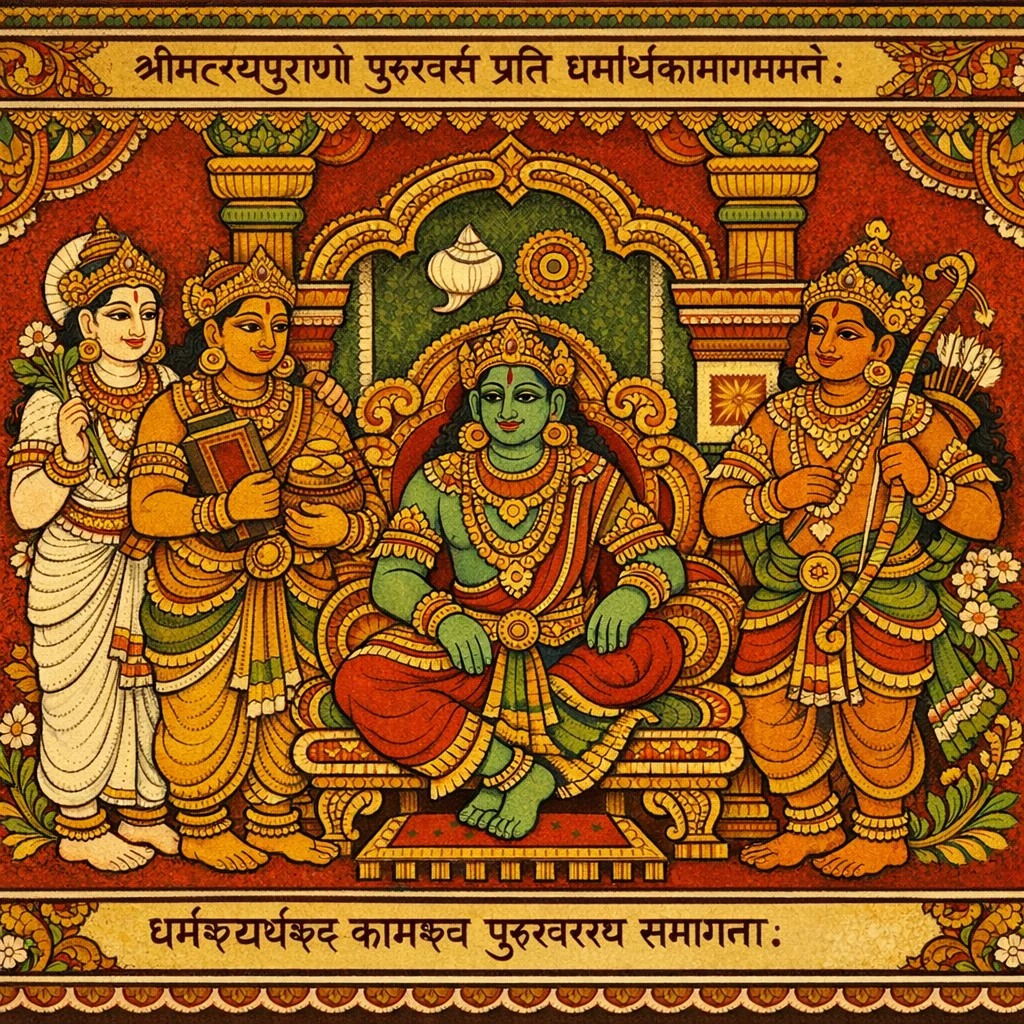
Sūta recounts Budha’s birth from Tārā, Soma’s acceptance and naming of him, and Budha’s royal consecration. Budha begets Purūravas in Ilā’s womb; Purūravas performs great sacrifices, worships Janārdana, upholds the earth through dharma, and becomes renowned. Dharma–Artha–Kāma visit him: Artha curses him for greed, Kāma foretells madness from separation from Urvaśī, and Dharma blesses the endurance of his lineage. A conflict episode follows—Keśin carries off Urvaśī; Budha’s son defeats the foes; Bharata’s fierce curse afflicts Urvaśī and Purūravas but later ends. The genealogy continues through the sons to King Raji, who receives boons from Nārāyaṇa, prevails in the Deva–Asura war, and hands rule to Indra; later Raji’s sons seize Indra’s share. Bṛhaspati restores Indra by graha-śānti/pauṣṭika rites and by deluding Raji’s sons with Veda-bāhya hetuvāda, after which Indra destroys them. The chapter closes with Nahuṣa’s sons, Yayāti’s marriages and five sons, and Yayāti’s request to exchange old age—refused by most, accepted by Pūru—thereby establishing the Paurava line.
Key Concepts
Shlokas in Adhyaya 24
Verse 1
*सूत उवाच ततः संवत्सरस्यान्ते द्वादशादित्यसंनिभः दिव्यपीताम्बरधरो दिव्याभरणभूषितः //
Sūta said: Then, at the end of the year, there appeared one radiant like the twelve Ādityas, clad in divine yellow garments and adorned with celestial ornaments.
Verse 2
तारोदराद्विनिष्क्रान्तः कुमारश्चन्द्रसंनिभः सर्वार्थशास्त्रविद्धीमान् हस्तिशास्त्रप्रवर्तकः //
From Tārā’s womb emerged a prince, radiant like the moon—master of all practical sciences and the promulgator of the science of elephants (the discipline of training and managing elephants).
Verse 3
नाम यद्राजपुत्रीयं विश्रुतं गजवैद्यकम् राज्ञः सोमस्य पुत्रत्वाद् राजपुत्रो बुधः स्मृतः //
The renowned science of treating elephants, known as “Rājaputrīya,” is so named because Budha is remembered as a “rājaputra” (prince), being the son of King Soma.
Verse 4
जातमात्रः स तेजांसि सर्वाण्येवाजयद्बली ब्रह्माद्यास्तत्र चाजग्मुर् देवा देवर्षिभिः सह //
No sooner was he born than that mighty one overcame the splendors (powers) of all. Then Brahmā and the other gods came there, accompanied by the divine seers.
Verse 5
बृहस्पतिगृहे सर्वे जातकर्मोत्सवे तदा अपृच्छंस्ते सुरास्तारां केन जातः कुमारकः //
Then, at Bṛhaspati’s house, during the child’s birth-rite celebration (jātakarma), all the gods asked Tārā: “By whom was this boy begotten?”
Verse 6
ततः सा लज्जिता तेषां न किंचिदवदत्तदा पुनः पुनस्तदा पृष्टा लज्जयन्ती वराङ्गना //
Then, embarrassed before them, she said nothing at that time. Though questioned again and again, the beautiful woman, overcome with modesty, remained bashful.
Verse 7
सोमस्येति चिरादाह ततो ऽगृह्णाद्विधुः सुतम् बुध इत्यकरोन्नाम्ना प्रादाद्राज्यं च भूतले //
After a long time, the Moon (Vidhu) said, “(He is) Soma’s,” and then accepted the son. He named him “Budha” and bestowed upon him sovereignty on the earth.
Verse 8
अभिषेकं ततः कृत्वा प्रधानमकरोद्विभुः गृहसाम्यं प्रदायाथ ब्रह्मा ब्रह्मर्षिसंयुतः //
Then, having performed the consecration (abhiṣeka), the Mighty Lord appointed him as the chief; and thereafter Brahmā—accompanied by the brahmarṣis—bestowed the proper ordering and equal regulation of households.
Verse 9
पश्यतां सर्वदेवानां तत्रैवान्तरधीयत इलोदरे च धर्मिष्ठं बुधः पुत्रमजीजनत् //
While all the gods looked on, he vanished then and there; and within Ilā’s womb, Budha begot a most righteous son.
Verse 10
अश्वमेधशतं साग्रम् अकरोद्यः स्वतेजसा पुरूरवा इति ख्यातः सर्वलोकनमस्कृतः //
By his own splendor, he performed a full hundred Aśvamedha sacrifices; renowned as Purūravas, he became one who was bowed to by all the worlds.
Verse 11
हिमवच्छिखरे रम्ये समाराध्य जनार्दनम् लोकैश्वर्यमगाद्राजा सप्तद्वीपपतिस्तदा //
Having duly worshipped Janārdana on a lovely peak of the Himālaya, the king attained worldly sovereignty and then became the lord of the seven continents (saptadvīpas).
Verse 12
केशिप्रभृतयो दैत्याः कोटिशो येन दारिताः उर्वशी यस्य पत्नीत्वम् अगमद्रूपमोहिता //
By him, Daityas—beginning with Keśin—were torn apart by the tens of millions; and Urvaśī, enchanted by his beauty, came to him as his wife.
Verse 13
सप्तद्वीपा वसुमती सशैलवनकानना धर्मेण पालिता तेन सर्वलोकहितैषिणा //
That earth—comprising the seven continents, with its mountains, forests, and groves—was protected by him through dharma, for he sought the welfare of all worlds.
Verse 14
चामरग्राहिणी कीर्तिः सदा चैवाङ्गवाहिका विष्णोः प्रसादाद्देवेन्द्रो ददाव् अर्धासनं तदा //
Kīrti (Fame), holding the royal chowrie (cāmara), ever served as the personal attendant. Then, by the grace of Viṣṇu, Devendra (Indra) bestowed a half-seat—a share of the throne and honour—at that time.
Verse 15
धर्मार्थकामान्धर्मेण समम् एवाभ्यपालयत् धर्मार्थकामाः संद्रष्टुम् आजग्मुः कौतुकात्पुरा //
He safeguarded Dharma, Artha, and Kāma—keeping them in true balance under Dharma. And in former times, Dharma, Artha, and Kāma themselves came, out of curiosity, to behold him.
Verse 16
जिज्ञासवस्तच्चरितं कथं पश्यति नः समम् भक्त्या चक्रे ततस्तेषाम् अर्घ्यपाद्यादिकं नृपः //
Eager to know his conduct, (he wondered), “How does this being behold us as equals?” Then the king, with devotion, performed for them the rites of hospitality—offering arghya, pādya, and the like.
Verse 17
आसनत्रयमानीय दिव्यं कनकभूषितम् निविश्याथाकरोत्पूजाम् ईषद्धर्मे ऽधिकां पुनः //
Bringing three seats—splendid and adorned with gold—he then sat down and performed worship once again, with a slightly greater adherence to dharma (ritual propriety).
Verse 18
जग्मतुस्तेन कामार्थाव् अतिकोपं नृपं प्रति अर्थः शापमदात्तस्मै लोभात्त्वं नाशमेष्यसि //
Thus Kāma (Desire) and Artha (Wealth) went to the king, who was exceedingly wrathful. Then Artha pronounced a curse upon him: “Through greed, you shall meet destruction.”
Verse 19
कामो ऽप्याह तवोन्मादो भविता गन्धमादने कुमारवनमाश्रित्य वियोगादुर्वशीभवात् //
Kāma, the god of love, also said: “Your frenzy will arise on Gandhamādana; taking refuge in the grove called Kumāravana, it will come about because of your separation from Urvaśī.”
Verse 20
धर्मो ऽप्याह चिरायुस् त्वं धार्मिकश्च भविष्यसि संततिस्तव राजेन्द्र यावच्चन्द्रार्कतारकम् //
Dharma himself also spoke: “You shall be long-lived, and you shall indeed be righteous; and, O king, your lineage shall endure as long as the moon, the sun, and the stars remain.”
Verse 21
शतशो वृद्धिमायातु न नाशं भुवि यास्यति इत्युक्त्वान्तर्दधुः सर्वे राजा राज्यं तदन्वभूत् //
Saying, “May it increase a hundredfold; it shall not come to ruin upon the earth,” they all disappeared. Thereafter the king indeed enjoyed and governed that kingdom.
Verse 22
अहन्यहनि देवेन्द्रं द्रष्टुं याति स राजराट् कदाचिदारुह्य रथं दक्षिणाम्बरचारिणम् //
Day after day that sovereign king went to behold Devendra (Indra); and once, mounting a chariot, he set out along the southern course, toward the southern quarter.
Verse 23
सार्धमर्केण सो ऽपश्यन् नीयमानामथाम्बरे केशिना दानवेन्द्रेण चित्रलेखामथोर्वशीम् //
Then he, together with Arka (the Sun), saw Citralekhā and Urvaśī being carried away through the sky by Keśin, the lord of the Dānavas.
Verse 24
तं विनिर्जित्य समरे विविधायुधपाणिना बुधपुत्रेण वायव्यम् अस्त्रं मुक्त्वा यशो ऽर्थिना //
Having defeated him in battle, the son of Budha—his hands bearing many kinds of weapons—released the Vāyavya (Wind) weapon, seeking glory.
Verse 25
तथा शक्रो ऽपि समरे येन चैवं विनिर्जितः मित्रत्वम् अगमद् देवैर् ददाव् इन्द्राय चोर्वशीम् //
Likewise, Śakra (Indra) too—having been thus defeated in battle by him—entered into friendship with the gods; and they gave Urvaśī to Indra.
Verse 26
ततःप्रभृति मित्रत्वम् अगमत् पाकशासनः सर्वलोकातिशायित्वं बलमूर्जो यशः श्रियम् //
From that time onward, Pākaśāsana (Indra) entered into friendship, and he attained supremacy over all the worlds—along with strength, vigor, fame, and prosperity.
Verse 27
प्रादाद्वज्रीति संतुष्टो गेयतां भरतेन च सा पुरूरवसः प्रीत्या गायन्ती चरितं महत् //
Pleased (and saying), “He has bestowed the thunderbolt,” he declared: “Let it be sung also by Bharata.” And she—out of affection for Purūravas—sang aloud his great and illustrious deeds.
Verse 28
लक्ष्मीस्वयंवरं नाम भरतेन प्रवर्तितम् मेनकामुर्वशीं रम्भां नृत्यतेति तदादिशत् //
He then commanded that Menakā, Urvaśī, and Rambhā should perform the dance in the presentation called “Lakṣmī’s Svayaṃvara,” which had been instituted by Bharata.
Verse 29
ननर्त सलयं तत्र लक्ष्मीरूपेण चोर्वशी सा पुरूरवसं दृष्ट्वा नृत्यन्ती कामपीडिता //
There, Urvaśī danced with graceful charm, appearing in the form of Lakṣmī. Seeing Purūravas, she continued to dance, tormented by desire.
Verse 30
विस्मृताभिनयं सर्वं यत्पुरा भरतोदितम् शशाप भरतः क्रोधाद् वियोगादस्य भूतले //
When all the acting (abhinaya) that Bharata had formerly taught was forgotten, Bharata—angered by this separation—pronounced a curse upon him on the earth.
Verse 31
पञ्चपञ्चाशदब्दानि लता सूक्ष्मा भविष्यसि पुरूरवाः पिशाचत्वं तत्रैवानुभविष्यति //
“For fifty-five years you shall become a subtle creeper (a delicate vine). And Purūravas shall, in that very place, undergo the state of a piśāca (a goblin-like being).”
Verse 32
ततस्तमुर्वशी गत्वा भर्तारमकरोच्चिरम् शापान्ते भरतस्याथ उर्वशी बुधसूनुतः //
Then Urvaśī went to him and, for a long time, made him her husband. And when Bharata’s curse came to an end, Urvaśī—she who was connected with Budha’s lineage—returned.
Verse 33
अजीजनत्सुतानष्टौ नामतस्तान्निबोधत आयुर् दृढायुर् अश्वायुर् धनायुर् धृतिमान्वसुः //
He begot eight sons—learn their names: Āyu, Dṛḍhāyu, Aśvāyu, Dhanāyu, Dhṛtimān, and Vasu (the remaining two are implied in the fuller genealogical list).
Verse 34
शुचिविद्यः शतायुश्च सर्वे दिव्यबलौजसः आयुषो नहुषः पुत्रौ वृद्धशर्मा तथैव च //
Śucividya and Śatāyu—indeed all of them endowed with divine strength and vigor—were the sons of Āyuṣa and Nahuṣa; and likewise there was Vṛddhaśarmā.
Verse 35
रजिर्दम्भो विपाप्मा च वीराः पञ्च महारथाः रजेः पुत्रशतं जज्ञे राजेयमिति विश्रुतम् //
Raji, Dambha, and Vipāpman—these heroes (together with two others) were the five great chariot-warriors. From King Raji were born a hundred sons, renowned collectively as the Rājeyas.
Verse 36
रजिराराधयामास नारायणमकल्मषम् तपसा तोषितो विष्णुर् वरान्प्रादान्महीपते //
King Rajira worshipped Nārāyaṇa, the stainless Lord. Pleased by his austerities (tapas), Viṣṇu granted him boons, O lord of the earth.
Verse 37
देवासुरमनुष्याणाम् अभूत्स विजयी तदा अथ देवासुरं युद्धम् अभूद् वर्षशतत्रयम् //
Then he became the victorious one among the Devas, the Asuras, and humankind. Thereafter, the war between the Devas and the Asuras continued for three hundred years.
Verse 38
प्रह्लादशक्रयोर्भीमं न कश्चिद्विजयी तयोः ततो देवासुरैः पृष्टः प्राह देवश्चतुर्मुखः //
In that dreadful confrontation between Prahlāda and Śakra (Indra), neither could gain victory over the other. Therefore, when the Devas and Asuras questioned him, the four-faced god (Brahmā) spoke in reply.
Verse 39
अनयोर्विजयी कः स्याद् रजिर्यत्रेति सो ऽब्रवीत् जयाय प्रार्थितो राजा सहायस्त्वं भवस्व नः //
“Which of these two will be the victor, and where will the battle be fought?”—so he asked. Then the king, being entreated for victory, said, “Become our ally.”
Verse 40
दैत्यैः प्राह यदि स्वामी वो भवामि ततस्त्वलम् नासुरैः प्रतिपन्नं तत् प्रतिपन्नं सुरैस्तथा //
He said to the Daityas: “If I become your lord, then let that be enough. What has been agreed to by the Asuras has likewise been accepted by the Devas.”
Verse 41
स्वामी भव त्वमस्माकं संग्रामे नाशय द्विषः ततो विनाशिताः सर्वे ये ऽवध्या वज्रपाणिना //
“Be our lord and commander; in this battle, destroy our enemies.” Then all those who were beyond the slaying of Vajrapāṇi (Indra) were utterly destroyed.
Verse 42
पुत्रत्वमगमत्तुष्टस् तस्येन्द्रः कर्मणा विभुः दत्त्वेन्द्राय तदा राज्यं जगाम तपसे रजिः //
Pleased by his deeds, the mighty Indra accepted him as a son. Then Raji, having handed over the kingship to Indra, departed to practice austerities.
Verse 43
रजिपुत्रैस्तदाच्छिन्नं बलादिन्द्रस्य वैभवम् यज्ञभागं च राज्यं च तपोबलगुणान्वितैः //
Then the sons of Raji—endowed with the power born of austerity and virtue—by force seized Indra’s splendour, together with his share in the sacrifices and his sovereignty.
Verse 44
राज्यभ्रष्टस्तदा शक्रो रजिपुत्रैर्निपीडितः प्राह वाचस्पतिं दीनः पीडितो ऽस्मि रजेः सुतैः //
Then Śakra (Indra), fallen from his kingship and harried by the sons of Raji, sorrowfully spoke to Vācaspati (Bṛhaspati): “I am being oppressed by the sons of Raji.”
Verse 45
न यज्ञभागो राज्यं मे निर्जितश्च बृहस्पते राज्यलाभाय मे यत्नं विधत्स्व धिषणाधिप //
“I receive neither my rightful share in the sacrifices, nor is my kingdom secure—I have been defeated. O Bṛhaspati, lord of wisdom, devise an effort by which I may regain sovereignty.”
Verse 46
ततो बृहस्पतिः शक्रम् अकरोद्बलदर्पितम् ग्रहशान्तिविधानेन पौष्टिकेन च कर्मणा //
Then Bṛhaspati made Śakra (Indra) strong and confident, by means of the prescribed rites for pacifying the planets and through prosperity-bestowing (pauṣṭika) ritual actions.
Verse 47
गत्वाथ मोहयामास रजिपुत्रान्बृहस्पतिः जिनधर्मं समास्थाय वेदबाह्यं स वेदवित् //
Then Bṛhaspati went and bewildered the sons of Raji; though a knower of the Veda, he adopted a ‘Jina’ doctrine—one that stands outside the Vedic fold.
Verse 48
वेदत्रयीपरिभ्रष्टांश् चकार धिषणाधिपः वेदबाह्यान्परिज्ञाय हेतुवादसमन्वितान् //
The Lord of Intelligence (Bṛhaspati) fashioned them into those who had fallen away from the three Vedas; recognizing them as outside the Veda, he imbued them with the doctrine of mere reasoning (hetuvāda).
Verse 49
जघान शक्रो वज्रेण सर्वान्धर्मबहिष्कृतान् नहुषस्य प्रवक्ष्यामि पुत्रान्सप्तैव धार्मिकान् //
Śakra (Indra) struck down with his thunderbolt (vajra) all those who had been cast out from dharma. Now I shall recount Nahusha’s seven sons, all of them righteous.
Verse 50
यतिर्ययातिः संयातिर् उद्भवः पाचिरेव च शर्यातिर्मेघजातिश्च सप्तैते वंशवर्धनाः //
Yati, Yayāti, Saṃyāti, Udbhava, and Pāci; and also Śaryāti and Meghajāti—these seven are the increasers and sustainers of the royal lineage.
Verse 51
यतिः कुमारभावे ऽपि योगी वैखानसो ऽभवत् ययातिश्चाकरोद्राज्यं धर्मैकशरणः सदा //
Yati, though still in the state of youth, became a Vaikhānasa yogin; and Yayāti undertook the kingship, ever taking refuge in Dharma alone.
Verse 52
शर्मिष्ठा तस्य भार्याभूद् दुहिता वृषपर्वणः भार्गवस्यात्मजा तद्वद् देवयानी च सुव्रता //
Śarmiṣṭhā, daughter of Vṛṣaparvan, became his wife; likewise Devayānī, the virtuous daughter of the Bhārgava (Śukra), also became his wife.
Verse 53
ययातेः पञ्च दायादास् तान्प्रवक्ष्यामि नामतः देवयानी यदुं पुत्रं तुर्वसुं चाप्यजीजनत् //
Yayāti had five heirs; now I shall declare them by name. Devayānī gave birth to the sons Yadu and Turvasu.
Verse 54
तथा द्रुह्युमनुं पूरुं शर्मिष्ठाजनयत्सुतान् यदुः पूरुश्चाभवतां तेषां वंशविवर्धनौ //
Likewise, Śarmiṣṭhā bore sons—Druhyu, Anu, and Pūru. Among them, Yadu and Pūru became the chief increasers of their respective lineages.
Verse 55
ययातिर्नाहुषश्चासीद् राजा सत्यपराक्रमः पालयामास स महीम् ईजे च विधिवन्मखैः //
Yayāti, the son of Nāhuṣa, was a king whose valor was true and unwavering. He protected the earth and performed sacrifices (yajñas) duly, in accordance with proper rite.
Verse 56
अतिभक्त्या पितॄनर्च्य देवांश्च प्रयतः सदा अथाजयत्प्रजाः सर्वा ययातिरपराजितः //
With intense devotion, he continually worshipped the Pitṛs (ancestral spirits) and the gods, ever disciplined and pure; thereafter Yayāti, unconquered, brought all peoples under his sway.
Verse 57
स शाश्वतीः समा राजा प्रजा धर्मेण पालयन् जराम् आर्छन् महाघोरां नाहुषो रूपनाशिनीम् //
That king Nāhuṣa, having protected his subjects through dharma for many enduring years, at last came upon dreadful old age—the destroyer of beauty and form.
Verse 58
जराभिभूतः पुत्रान् स राजा वचनमब्रवीत् यदुं पूरुं तुर्वसुं च द्रुह्युं चानुं च पार्थिवः //
Overcome by old age, that king addressed his sons—Yadu, Pūru, Turvasu, Druhyu, and Anu—with these words.
Verse 59
यौवनेन चलान्कामान् युवा युवतिभिः सह विहर्तुम् अहमिच्छामि साहाय्यं कुरुतात्मजाः //
Swayed by youth and its restless desires, I—still young—wish to sport and revel in the company of young women. O sons, assist me in this.
Verse 60
तं पुत्रो देवयानेयः पूर्वजो यदुरब्रवीत् साहाय्यं भवतः कार्यम् अस्माभिर्यौवनेन किम् //
Then Yadu—the elder son born of Devayānī—said to him: “You must seek help elsewhere; what use is youth to us (to give to you)?”
Verse 61
ययातिरब्रवीत् पुत्राञ् जरा मे प्रतिगृह्यताम् यौवनेनाथ भवतां चरेयं विषयानहम् //
Yayāti said to his sons: “Accept my old age; and with your youth, I shall roam and enjoy the objects of sense.”
Verse 62
यजतो दीर्घसत्त्रैर्मे शापाच्चोशनसो मुनेः कामार्थः परिहीनो मे ऽतृप्तो ऽहं तेन पुत्रकाः //
“Though I performed long sacrificial sessions, by the curse of the sage Uśanas my capacity for desire and its fulfilment was taken away. I remained unsatisfied; therefore, my sons—(listen).”
Verse 63
स्वकीयेन शरीरेण जरामेनां प्रशास्तु वः अहं तन्वाभिनवया युवा कामानवाप्नुयाम् //
May old age be governed by its own body; but I—renewed in a fresh form—may I, as a youth, attain the objects of desire.
Verse 64
न ते ऽस्य प्रत्यगृह्णन्त यदुप्रभृतयो जराम् चतुरस्तान्स राजर्षिर् अशपच्चेति नः श्रुतम् //
It is heard by us that those descendants, beginning with Yadu, did not accept his arrangement concerning old age; therefore that royal sage cursed those four.
Verse 65
तमब्रवीत्ततः पूरुः कनीयान्सत्यविक्रमः जरां मा देहि नवया तन्वा मे यौवनात्सुखी //
Then Puru, the youngest, whose valor was true, spoke: “Do not give me old age. With a renewed body, may I be happy in youth.”
Verse 66
अहं जरां तवादाय राज्ये स्थास्यामि चाज्ञया एवमुक्तः स राजर्षिस् तपोवीर्यसमाश्रयात् //
“I will take upon myself your old age, and, by your command, I shall remain in the kingship.” Thus addressed, that royal sage—supported by the potency born of austerity—made it so.
Verse 67
संस्थापयामास जरां तदा पुत्रे महात्मनि पौरवेणाथ वयसा राजा यौवनमास्थितः //
Then the king placed his own old age upon his great-souled son Puru; and by that exchange of age, the king entered into youth again.
Verse 68
ययातेश्चाथ वयसा राज्यं पूरुरकारयत् ततो वर्षसहस्रान्ते ययातिरपराजितः //
Then, as Yayāti grew advanced in age, he caused Pūru to assume the kingship. Thereafter, at the completion of a thousand years, Yayāti—the unconquered—departed from worldly rule.
Verse 69
अतृप्त इव कामानां पूरुं पुत्रमुवाच ह त्वया दायादवान् अस्मि त्वं मे वंशकरः सुतः //
Still as though unsated in his desires, he spoke to his son Pūru: “Through you I have an heir; you, my son, shall be the continuer and maker of my lineage.”
Verse 70
पौरवो वंश इत्येष ख्यातिं लोके गमिष्यति ततः स नृपशार्दूलः पूरुं राज्ये ऽभिषिच्य च //
This lineage shall become renowned in the world as the Paurava dynasty. Thereafter that tiger among kings consecrated Pūru, anointing him to sovereign rule.
Verse 71
कालेन महता पश्चात् कालधर्मम् उपेयिवान् पूरुवंशं प्रवक्ष्यामि शृणुध्वमृषिसत्तमाः यत्र ते भारता जाता भरतान्वयवर्धनाः //
After a long passage of time, having met the law of Time (that is, having passed away), I shall now recount the lineage of Pūru. Listen, O best of sages—the line in which those Bharatas were born, enhancers of Bharata’s dynasty.
Frequently Asked Questions
The chapter teaches that kingship is sustained by ritual legitimacy (abhiṣeka), dharmic governance, and disciplined handling of Artha and Kāma under Dharma. Through Purūravas it shows the ideal of protection and sacrifice, yet warns that imbalance (anger/greed/desire) produces curses and suffering. Through Yayāti and Pūru it presents succession as a moral test: lineage endures when duty and self-sacrifice outweigh personal preference.
This adhyāya is primarily Genealogy (Budha → Purūravas → Yayāti → Pūru) with strong Dharma/Rājadharma motifs: consecration, imperial sacrifice, hospitality rites, and the triad Dharma–Artha–Kāma. It does not teach Vāstu-śāstra or temple architecture here; instead it functions as dynastic and ethical history with a Deva–Asura political episode.
The text states that the elephant-treatment/training tradition called “Rājaputrīya” is named so because Budha is remembered as a rājaputra (prince), being accepted as Soma’s son. This frames specialized royal sciences—especially hastī-śāstra—as part of kingly knowledge and courtly administration.
Purūravas is praised for safeguarding Dharma, Artha, and Kāma in equilibrium with Dharma as the governing principle. The narrative then dramatizes the consequences of excess: Artha curses him for greed and Kāma predicts madness due to separation from Urvaśī, illustrating that prosperity and desire must remain subordinated to dharmic restraint.
It presents Bṛhaspati adopting a ‘Jina’/Veda-bāhya stance and teaching hetuvāda (mere reasoning) to delude Raji’s sons, causing them to fall away from Vedic dharma; Indra then destroys those cast out from dharma. In Purāṇic terms, this serves as an etiological account for heterodox deviation and as a strategic episode restoring Indra’s sacrificial share and sovereignty.