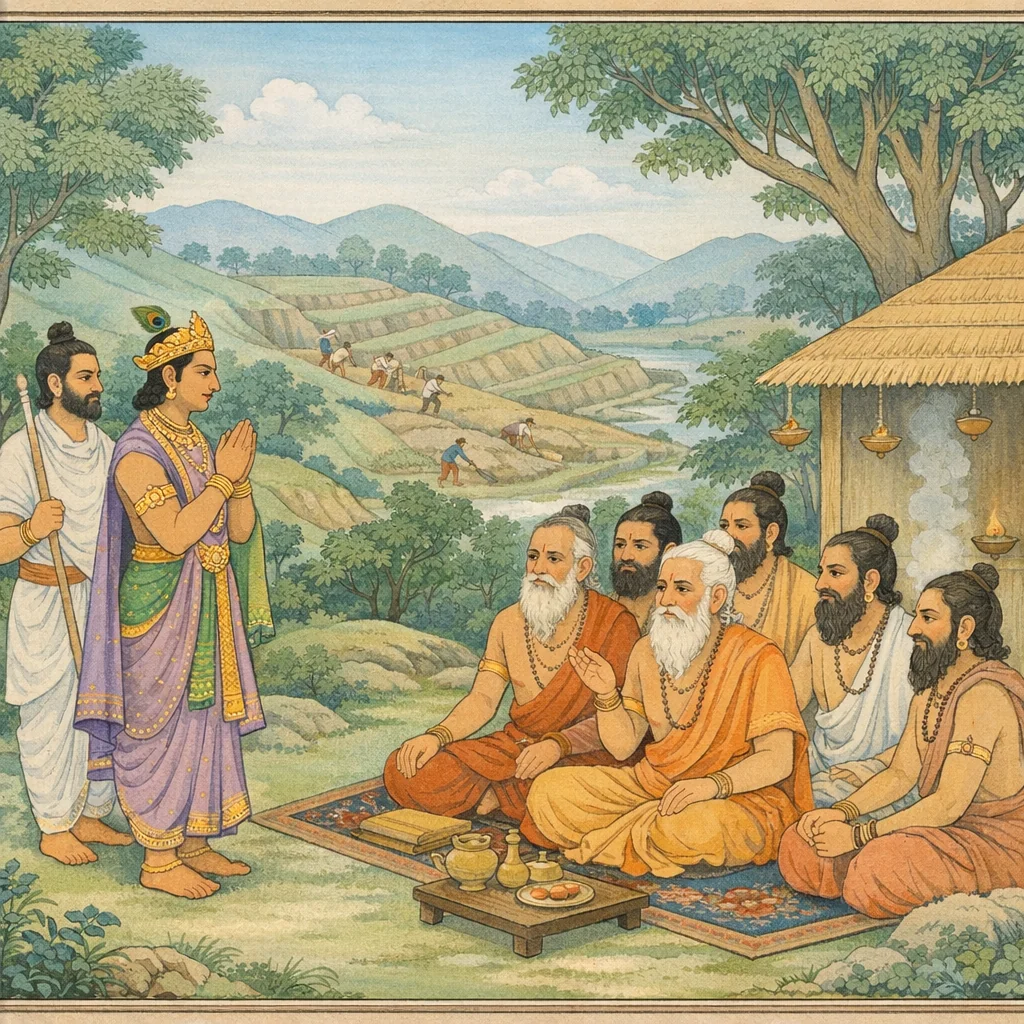
Adhyaya 60
Varṇa-dharma and Rājadharma: Yudhiṣṭhira’s Inquiry and Bhīṣma’s Normative Outline (वर्णधर्म-राजधर्म-प्रश्नोत्तरम्)
Upa-parva: Rājadharmānuśāsana Upa-Parva (राजधर्मानुशासन उपपर्व)
Vaiśaṃpāyana reports Yudhiṣṭhira approaching Bhīṣma with reverence and precise questions on (i) universal duties across varṇas, (ii) varṇa-specific duties within cāturvarṇya, (iii) duties of the four āśramas, and (iv) practical rājadharma: what strengthens the kingdom, the king, and the civic body; what kinds of ministers, allies, ritual specialists, and teachers a ruler should avoid; and whom to trust during emergencies. Bhīṣma begins with invocations to Dharma, Kṛṣṇa (as cosmic ordainer), and the brāhmaṇas, then enumerates cross-varṇa virtues (e.g., non-anger, truthfulness, equitable sharing, forbearance, purity, non-malice, straightforwardness, and maintenance of dependents). He proceeds to outline role-specific norms: brāhmaṇa duties centered on self-restraint and Vedic study/teaching, with ethical management of wealth through giving and shared enjoyment; kṣatriya norms emphasizing protection of subjects, generosity without mendicancy, and steadfastness in sanctioned conflict and suppression of destabilizing violence; vaiśya duties emphasizing clean wealth-accumulation, sacrifice, study, and pastoral/agricultural protection as a delegated trust; and śūdra duties framed as service to the other three varṇas, with prescribed sustenance and limitations on accumulation. The chapter then broadens to ritual theory: the text asserts the centrality of yajña—especially a “faith-based” (śraddhā) sacrificial orientation—arguing that intention and disciplined performance are decisive across social categories, and that sacrificial acts are treated as a major stabilizing institution within the moral-political order.
Chapter Arc: धर्म, अर्थ, काम—इन तीन पुरुषार्थों के बीच एक चौथा, सर्वथा भिन्न लक्ष्य उठ खड़ा होता है: मोक्ष। कथन आरम्भ होते ही श्रोता के मन में प्रश्न जागता है—जो त्रिवर्ग सबको बाँधता है, उससे परे कौन-सा मार्ग मुक्त करता है? → वक्ता मोक्ष को त्रिवर्ग से अलग सिद्ध करते हुए गुण-त्रय (सत्त्व-रजस्-तमस्) और दण्डनीति के त्रिविध परिणाम (स्थान, वृद्धि, क्षय) का विवेचन करता है। फिर नीति-शास्त्र के ‘षड्वर्ग’—आत्मा, देश, काल, उपाय, कार्य, सहायक—को सामने रखकर बताता है कि राज्य-व्यवस्था भी एक सूक्ष्म शास्त्र है, पर उसका प्रयोजन मोक्ष से भिन्न है। → ब्रह्मा द्वारा ‘शुभ शास्त्र’ (दण्डनीति/राजधर्म) की रचना और देवताओं के सम्मुख उसका प्रतिपादन; तथा पृथु से यह प्रतिज्ञा कराना कि वह मन, वाणी और कर्म से पृथ्वी का पालन करेगा—यहीं अध्याय का शिखर है, जहाँ शासन की शक्ति को धर्म-प्रतिज्ञा से बाँधा जाता है। → वेदवादी महर्षियों की स्वीकृति से पृथु का राज्याभिषेक-सा स्थापन होता है; शुक्र उसके पुरोहित बनते हैं। पृथु पृथ्वी की विषमता को समता में बदलता है—राजा का कर्तव्य केवल दण्ड नहीं, लोक-कल्याण और व्यवस्था का समतलीकरण भी है। साथ ही यह संकेत मिलता है कि पुण्य-क्षय पर स्वर्ग से उतरकर दण्डनीति-विशारद राजा के रूप में जन्म लेना भी एक दैवी व्यवस्था है। → राजधर्म की यह स्थापना मोक्ष-मार्ग से कैसे जुड़ती है—क्या दण्डनीति अंततः बन्धन है या लोक-रक्षा के द्वारा मुक्ति का सहायक—यह प्रश्न अगले प्रसंगों के लिए खुला रह जाता है।
Shlokas
Verse 30
चौथा वर्ग मोक्ष है; उसके प्रयोजन और गुण इन तीनों वर्गोसे भिन्न हैं
Bhishma said: “The fourth human aim is liberation (moksha). Its purpose and its qualities are distinct from those of the other three aims.”
Verse 31
मोक्षस्यास्ति त्रिवर्गोडन्य: प्रोक्त: सत्त्वं रजस्तम: । स्थान वृद्धि: क्षयश्वैव त्रिवर्गश्वैव दण्डज:,मोक्षका त्रिवर्ग दूसरा बताया गया है। उसमें सत्त्व, रज और तमकी गणना है। दण्डजनित त्रिवर्ग उससे भिन्न है। स्थान, वृद्धि और क्षय--ये ही उसके भेद हैं (अर्थात् दण्डसे धनियोंकी स्थिति, धर्मात्माओंकी वृद्धि और दुष्टोंका विनाश होता है)
Bhishma said: “Apart from liberation, another triad is taught—sattva, rajas, and tamas. There is also a triad born of punishment (royal discipline): stability of order, the growth of the righteous, and the decline of the wicked.”
Verse 32
आत्मा देशश्व कालकभ्षाप्युपाया: कृत्यमेव च | सहाया: कारणं चैव षड्वर्गो नीतिज: स्मृत:,ब्रह्माजीके नीतिशास्त्रमें आत्मा, देश, काल, उपाय, कार्य और सहायक--इन छ: वर्गोंका वर्णन है। ये छहों नीतिद्वारा संचालित होनेपर उन्नतिके कारण होते हैं
Bhīṣma said: The self (the ruler’s own capacity), the territory, time, the means adopted, the task to be accomplished, allies, and the underlying cause—these are remembered in political ethics as the sixfold set. When guided by sound policy, these factors become the basis of success and advancement.
Verse 33
त्रयी चान्वीक्षिकी चैव वार्ता च भरतर्षभ । दण्डनीतिश्न विपुला विद्यास्तत्र निदर्शिता:,भरतश्रेष्ठ! उस ग्रन्थमें वेदत्रयी (कर्मकाण्ड), आन्वीक्षिकी (ज्ञानकाण्ड), वार्ता (कृषि, गोरक्षा और वाणिज्य) और दण्डनीति--इन विपुल विद्याओंका निरूपण किया गया है
Bhīṣma said: “O bull among the Bharatas, in that treatise are set forth these extensive branches of learning—the three Vedas, rational inquiry (philosophical investigation), practical economics (agriculture, cattle-rearing, and trade), and the science of governance and punishment (statecraft).”
Verse 34
अमात्यरक्षा प्रणिधी राजपुत्रस्य लक्षणम् | चारश्न विविधोपाय: प्रणिधेय: पृथग्विध:,ब्रह्माजीके उस नीतिशास्त्रमें मन्त्रियोंकी रक्षा (उन्हें कोई फोड़ न ले, इसके लिये सतर्कता), प्रणिधि (राजदूत), राजपुत्रके लक्षण, गुप्तचरोंके विचरणके विविध उपाय, विभिन्न स्थानोंमें विभिन्न प्रकारके गुप्तचरोंकी नियुक्ति, साम, दान, भेद, दण्ड और उपेक्षा --इन पाँचों उपायोंका पूर्णरूपसे प्रतिपादन किया गया है
Bhīṣma said: “In the science of polity, one must carefully safeguard the ministers (so that they are not subverted or ‘broken’ by opponents), employ trusted envoys/agents, understand the marks of a worthy prince, and set spies in motion through many different methods—appointing different kinds of secret agents in different places. Thus are fully taught the five practical means of statecraft: conciliation, gifts, division, punishment, and strategic neglect.”
Verse 35
साम भेद: प्रदानं च ततो दण्डश्न पार्थिव | उपेक्षा पञ्चमी चात्र कार्त्स्न्येन समुदाह्यता,ब्रह्माजीके उस नीतिशास्त्रमें मन्त्रियोंकी रक्षा (उन्हें कोई फोड़ न ले, इसके लिये सतर्कता), प्रणिधि (राजदूत), राजपुत्रके लक्षण, गुप्तचरोंके विचरणके विविध उपाय, विभिन्न स्थानोंमें विभिन्न प्रकारके गुप्तचरोंकी नियुक्ति, साम, दान, भेद, दण्ड और उपेक्षा --इन पाँचों उपायोंका पूर्णरूपसे प्रतिपादन किया गया है
Bhishma said: “O king, here the complete set of five statecraft measures is declared in full: conciliation (sāma), division or sowing dissension (bheda), giving of gifts or inducements (pradāna/dāna), punishment or force (daṇḍa), and, as the fifth, strategic disregard or non-intervention (upekṣā).”
Verse 36
मन्त्रश्न वर्णित: कृत्स्नस्तथा भेदार्थ एव च | विशभ्रमश्चैव मन्त्रस्य सिद्ध्यसिद्धौश्व यत् फलम्,सब प्रकारकी मन्त्रणा, भेदनीतिके प्रयोगके प्रयोजन, मन्त्रणामें होनेवाले भ्रम या उसके फूटनेके भय तथा मन्त्रणाकी सिद्धि और असिद्धिके फलका भी इस शास्त्रमें वर्णन है
Bhīṣma said: “In this treatise, the entire discipline of counsel (mantra) is explained—along with the purpose and method of policy through division (bheda-nīti), the confusions and risks that arise within counsel (including the fear of its disclosure), and also the results that follow when counsel succeeds or fails.”
Verse 37
संधिश्ष त्रिविधाभिख्यो हीनो मध्यस्तथोत्तम: । भयसत्कारवित्ताख्य॑ कार्त्स्न्येन परिवर्णितम्,संधिके तीन भेद हैं--उत्तम, मध्यम और अधम, इनकी क्रमश: वित्तसंधि, सत्कारसंधि और भयसंधि--ये तीन संज्ञाएँ हैं। धन लेकर जो संधि की जाती है, वह वित्तसंधि उत्तम है। सत्कार पाकर की हुई दूसरी संधि मध्यम है और भयके कारण की जानेवाली तीसरी संधि अधम मानी गयी है। इन सबका उस ग्रन्थमें विस्तारपूर्वक वर्णन है
Bhishma said: “Treatises describe three kinds of alliance (sandhi): inferior, middling, and superior. These are respectively known as the alliance made from fear, the alliance made for the sake of honor and courteous regard, and the alliance made through wealth or material advantage. Their full characteristics have been set forth in detail in the authoritative texts.”
Verse 38
महाभारत &«€ ७» कक राजासे हीन प्रजाकी ब्रह्माजीसे राजाके लिये प्रार्थना यात्राकालाश्ष चत्वारस्त्रिवर्गस्थ च विस्तर: । विजयो धर्मयुक्तश्व तथार्थविजयश्व ह,शत्रुओंपर चढ़ाई करनेके चार- अवसर, त्रिवर्गके विस्तार, धर्म-विजय, अर्थ-विजय तथा आसुर-विजयका भी कक्त ग्रन्थमें पूर्णरूपसे वर्णन किया गया है। मन्त्री, राष्ट्र, दुर्ग, सेना और कोष--इन पाँच वर्गोंके उत्तम, मध्यम और अधम भेदसे तीन प्रकारके लक्षणोंका भी प्रतिपादन किया गया है
Bhishma said: In this Mahabharata it is fully described how, when the people were left without a king, Brahma prayed for the creation of kingship. It also sets out the four proper occasions for undertaking a royal expedition against enemies, and explains in detail the three aims of life. Further, it distinguishes the kinds of victory—victory grounded in dharma, victory aimed at material gain, and victory of an asuric (unrighteous) kind. It also lays down the threefold criteria—superior, middling, and inferior—for the five pillars of a kingdom: the minister, the realm, the fort, the army, and the treasury.
Verse 39
आसुरश्रैव विजयस्तथा कार्त्स्न्येन वर्णित: । लक्षणं पज्चवर्गस्य त्रिविध॑ चात्र वर्णितम्,शत्रुओंपर चढ़ाई करनेके चार- अवसर, त्रिवर्गके विस्तार, धर्म-विजय, अर्थ-विजय तथा आसुर-विजयका भी कक्त ग्रन्थमें पूर्णरूपसे वर्णन किया गया है। मन्त्री, राष्ट्र, दुर्ग, सेना और कोष--इन पाँच वर्गोंके उत्तम, मध्यम और अधम भेदसे तीन प्रकारके लक्षणोंका भी प्रतिपादन किया गया है
Bhīṣma said: “Here, the ‘āsura’ (ruthless) mode of victory too has been described in full. Likewise, the characteristics of the fivefold state-constituents have been set forth in three grades. Thus the treatise explains, in a complete way, the occasions for attacking an enemy, the scope of the three aims of life, and the distinctions among victories—by dharma, by wealth/power, and by sheer coercive force—together with the superior, middling, and inferior marks of the minister, the realm, the fort, the army, and the treasury.”
Verse 40
प्रकाशश्चाप्रकाशश्न दण्डो5थ परिशब्दित: । प्रकाशो5ष्टविधस्तत्र गुहाश्न बहुविस्तर:,प्रकट और गुप्त दो प्रकारकी सेनाओंका भी वर्णन किया गया है। उनमें प्रकट सेना आठ प्रकारकी बतायी गयी है और गुप्त सेनाका विस्तार बहुत अधिक कहा गया है
Bhishma said: The means of coercion (daṇḍa) is described as being of two kinds—open (manifest) and concealed (unmanifest). Of these, the open form is said to be eightfold, while the concealed form is described as having a very wide and complex range. The teaching frames statecraft ethically: punishment and force must be understood in their visible and hidden operations, so that a ruler restrains wrongdoing without slipping into arbitrary or secretive harm.
Verse 41
रथा नागा हयाश्रैव पादाताश्वैव पाण्डव | विष्टिनविश्चराश्वैव देशिका इति चाष्टमम्
Bhīṣma said: “O Pāṇḍava, these too are counted among the divisions: charioteers, elephant-warriors, horsemen, and foot-soldiers; likewise the viṣṭi (forced laborers/levies), the roaming or irregular troops, and the local guides—this makes the eighth category.”
Verse 42
जज्माजड्म॒श्षोक्ताश्वूर्णणोगा विषादय:,सेनाके गुप्त अड़ हैं जड़म (सर्पादिजनित) और अजड़म (पेड़-पौधोंसे उत्पन्न) विष आदि चूर्णयोग अर्थात् विनाशकारक ओषधियाँ
Bhishma said: There are destructive preparations—poisons and powdered compounds—some derived from living creatures such as serpents, and others derived from plants and trees. When such lethal drugs are secretly placed within an army, they become a hidden means of ruin, undermining righteous conduct by relying on covert harm rather than open, accountable action.
Verse 43
स्पर्शे चाभ्यवहार्ये चाप्युपांशुविविध: स्मृत: । अरिरमित्र उदासीन इत्येते5प्यनुवर्णिता:,यह गोपनीय दण्डसाधन (विष आदि) शत्रुपक्षके लोगोंके वस्त्र आदिके साथ स्पर्श कराने अथवा उनके भोजनमें मिला देनेके उपयोगमें आता है। विभिन्न मन्त्रोंके जपका प्रयोग भी पूर्वोक्त नीतिशास्त्रमें बताया गया है। इसके सिवा इस ग्रन्थमें शत्रु, मित्र और उदासीनका भी बारंबार वर्णन किया गया है
Bhishma said: “In matters of contact and of what is taken as food, a variety of covert (upāṁśu) measures are also recognized. Likewise, the categories ‘enemy’, ‘non-friend’, and ‘neutral’ are repeatedly described.”
Verse 44
कृत्स्ना मार्गगुणाश्वैव तथा भूमिगुणाश्व ह | आत्मरक्षणमाश्वास: सर्गाणां चान्ववेक्षणम्,तथा मार्गके समस्त गुण, भूमिके गुण, आत्मरक्षाके उपाय, आश्वासन तथा रथ आदिके निर्माण और निरीक्षण आदिका भी वर्णन है
Bhīṣma said: “One should fully understand the qualities of roads and likewise the qualities of terrain; also the means of self-protection, the giving of reassurance to one’s people, and the careful inspection of formations and deployments.”
Verse 45
कल्पना विविधाश्वापि नूनागरथवाजिनाम् । व्यूहाश्नव विविधाभिख्या विचित्र युद्धकौशलम्,सेनाको पुष्ट करनेवाले अनेक प्रकारके योग, हाथी, घोड़ा, रथ और मनुष्य-सेनाकी भाँति-भाँतिकी व्यूह-रचना, नाना प्रकारके युद्धकौशल, जैसे ऊपर उछल जाना, नीचे झुककर अपनेको बचा लेना, सावधान होकर भलीभाँति युद्ध करना, कुशलतापूर्वक वहाँसे निकल भागना--इन सब उपायोंका भी इस ग्रन्थमें वर्णन है। भरतश्रेष्ठ! शस्त्रोंके संरक्षण और प्रयोगके ज्ञानका भी उसमें उल्लेख है
Bhīṣma said: “This treatise also describes many kinds of tactical devices for strengthening an army—arrangements involving elephants, chariots, horses, and infantry; numerous named battle-formations; and varied, ingenious skills of warfare: leaping aside, ducking low to save oneself, fighting with alert discipline, and withdrawing skillfully from danger. It further sets forth knowledge for the safeguarding and proper employment of weapons.”
Verse 46
उत्पाताश्व निपाताश्च सुयुद्ध सुपलायितम् | शस्त्राणां पालन ज्ञानं तथैव भरतर्षभ,सेनाको पुष्ट करनेवाले अनेक प्रकारके योग, हाथी, घोड़ा, रथ और मनुष्य-सेनाकी भाँति-भाँतिकी व्यूह-रचना, नाना प्रकारके युद्धकौशल, जैसे ऊपर उछल जाना, नीचे झुककर अपनेको बचा लेना, सावधान होकर भलीभाँति युद्ध करना, कुशलतापूर्वक वहाँसे निकल भागना--इन सब उपायोंका भी इस ग्रन्थमें वर्णन है। भरतश्रेष्ठ! शस्त्रोंके संरक्षण और प्रयोगके ज्ञानका भी उसमें उल्लेख है
Bhishma said: “O bull among the Bharatas, this treatise also describes many practical disciplines that strengthen an army—methods of arranging elephants, horses, chariots, and infantry into varied battle-formations; diverse skills of warfare such as leaping upward, ducking low to protect oneself, fighting with vigilant steadiness, and withdrawing skillfully from the field. It also sets forth knowledge of how weapons are to be safeguarded and properly employed.”
Verse 47
बलव्यसनमुक्त च तथैव बलहर्षणम् | पीडा चापदकालकश्न पत्तिज्ञानं च पाण्डव,पाण्डुकुमार! विपत्तिसे सेनाओंका उद्धार करना, सैनिकोंका हर्ष और उत्साह बढ़ाना, पीड़ा और आपत्तिके समय पैदल सैनिकोंकी स्वामिभक्तिकी परीक्षा करना--इन सब बातोंका उस शास्त्रमें वर्णन किया गया है
Bhīṣma said: “O son of Pāṇḍu, that treatise describes how to deliver armies from calamity, how to raise the soldiers’ joy and ardor, and how, in times of pain and crisis, to test the foot-soldiers’ loyalty to their lord.”
Verse 48
तथा खातविधानं च योग: संचार एव च | चोरैराटविकैश्नोग्रै: परराष्ट्स्य पीडनम्
Bhīṣma said: “Likewise, the digging of pits and the setting of other hidden devices, the use of stratagems, and covert movement as well—together with harassing an enemy kingdom by fierce thieves and forest-raiders—are among the measures employed to afflict a rival state.”
Verse 49
अन्निदैर्गरदैश्वैव प्रतिरूपककारकै: । श्रेणिमुख्योपजापेन वीरुधश्छेदनेन च
Bhīṣma said: “By arsonists, by poisoners, by makers of counterfeit goods, by the corrupt solicitation of guild-leaders, and by the cutting down of creepers and plants—(such acts are counted among grievous wrongs).”
Verse 50
दूषणेन च नागानामातड्कजननेन च । आराधनेन भक्तस्य प्रत्ययोपार्जनेन च
Bhīṣma said: “By censuring the serpents, by causing them fear and distress, by honoring a devoted person, and by winning his trust—through such means (one brings about the intended effect).”
Verse 51
दुर्गके चारों ओर खाईं खुदवाना, सेनाका युद्धके लिये सुसज्जित होना तथा रणपयात्रा करना, चोरों और भयानक जंगली लुटेरोंद्वारा शत्रुके राष्ट्रको पीड़ा देना, आग लगानेवाले, जहर देनेवाले, छद्मवेशधारी लोगोंद्वारा भी शत्रुको हानि पहुँचाना तथा एक-एक शत्रुदलके प्रधान-प्रधान लोगोंमें भेद उत्पन्न करना, फसल और पौधोंको काट लेना, हाथियोंको भड़काना, लोगोंमें आतड़क उत्पन्न करना, शत्रुओंमें अनुरक्त पुरुषको अनुनय आदिके द्वारा फोड़ लेना और शत्रुपक्षके लोगोंमें अपने प्रति विश्वास उत्पन्न कराना आदि उपायोंसे शत्रुके राष्ट्रको पीड़ा देनेकी कलाका भी ब्रह्माजीके उक्त ग्रन्थमें वर्णन किया गया है || ४८-- ५० || सप्ताड्ुस्य च राज्यस्य हासवृद्धिसमञ्जसम् | दूतसामर्थ्यसंयोगात् सराष्ट्रस्य विवर्धनम्,सात अड़ोंसे युक्त राज्यके हास, वृद्धि और समान भावसे स्थिति, दूतके सामर्थ्यसे होनेवाली अपनी और अपने राष्ट्रकी वृद्धि, शत्रु, मित्र और मध्यस्थोंका विस्तारपूर्वक सम्यक् विवेचन, बलवान शत्रुओंको कुचल डालने तथा उनसे टक्कर लेनेकी विधि आदिका उक्त ग्रन्थमें वर्णन किया गया है
Bhishma said: “In the treatise attributed to Brahmā it is also described as a statecraft: to fortify a stronghold by digging moats all around it; to keep the army equipped for battle and to set out on campaigns; to harass an enemy kingdom through thieves and fearsome forest-raiders; to injure the enemy even by arsonists, poisoners, and men in disguise; to sow dissension among the leading chiefs of each enemy contingent; to cut down crops and plants; to provoke elephants; to spread terror among the populace; to win over those within the enemy camp who are attached to one’s side by persuasion and inducements; and to create trust toward oneself among the people of the opposing party. That same work also explains the rise, decline, and balanced maintenance of a kingdom constituted of the seven limbs; the enlargement of one’s own realm and resources through the competence of envoys; a detailed and correct assessment of enemies, allies, and neutrals; and the methods of crushing powerful foes or meeting them in direct confrontation.”
Verse 52
अरिमध्यस्थमित्राणां सम्यक् चोक्त प्रपडचनम् | अवरमर्द: प्रतीघातस्तथैव च बलीयसाम्,सात अड़ोंसे युक्त राज्यके हास, वृद्धि और समान भावसे स्थिति, दूतके सामर्थ्यसे होनेवाली अपनी और अपने राष्ट्रकी वृद्धि, शत्रु, मित्र और मध्यस्थोंका विस्तारपूर्वक सम्यक् विवेचन, बलवान शत्रुओंको कुचल डालने तथा उनसे टक्कर लेनेकी विधि आदिका उक्त ग्रन्थमें वर्णन किया गया है
Bhīṣma said: “In that treatise is set forth, in full and in proper order, a detailed examination of enemies, neutrals, and allies; and likewise the means of crushing an adversary and of meeting the counter-stroke—even when the opponent is stronger.”
Verse 53
व्यवहार: सुसूक्ष्मक्ष तथा कण्टकशोधनम् । श्रमो व्यायामयोगकश्न त्यागो द्रव्यस्य संग्रह:,शासनसम्बन्धी अत्यन्त सूक्ष्म व्यवहार, कण्टक-शोधन (राज्यकार्यमें विघ्न डालनेवालेको उखाड़ फेंकना), परिश्रम, व्यायाम-योग तथा धनके त्याग और संग्रहका भी उसमें प्रतिपादन किया गया है
Bhishma said: In that treatise are set forth, with the utmost subtlety, the practices of governance—“removing thorns” (uprooting those who obstruct the affairs of the realm), toil and discipline, exercise and yoga, and also the renunciation and accumulation of wealth.
Verse 54
अभृतानां च भरणं भृतानां चान्ववेक्षणम् । अर्थस्य काले दानं च व्यसने चाप्रसज्धिता
Bhishma said: The duties of a righteous householder include supporting those who are not yet maintained, looking after those already under one’s care, giving wealth at the proper time, and remaining unshaken and unentangled in times of calamity.
Verse 55
जिनके भरण-पोषणका कोई उपाय न हो, उनके जीवननिर्वाहका प्रबन्ध करना, जिनके भरण-पोषणकी व्यवस्था राज्यकी ओरसे की गयी हो उनकी देखभाल करना, समयपर धनका दान करना, दुर्व्यसनमें आसक्त न होना आदि विविध विषयोंका उस ग्रन्थमें उल्लेख है ।। तथा राजगुणाश्वैव सेनापतिगुणाश्व ह । कारणं च त्रिवर्गस्य गुणदोषास्तथैव च,राजाके गुण, सेनापतिके गुण, अर्थ, धर्म और कामके साधन तथा उनके गुण-दोषका भी उसमें निरूपण किया गया है
Bhishma said: “That treatise lays down many practical duties: arranging sustenance for those who have no means of support; supervising and protecting those whose maintenance has been undertaken by the state; giving wealth in charity at the proper time; and remaining free from addiction to harmful vices. It also sets forth the qualities required of a king and of a commander-in-chief, and explains the foundations of the three aims of life—dharma, artha, and kāma—together with their merits and faults.”
Verse 56
दुश्वैष्टितं च विविध॑ वृत्तिश्वैवानुवर्तिनाम् । शड्कितत्वं च सर्वस्य प्रमादस्य च वर्जनम्,भाँति-भाँतिकी दुश्चेष्ठा, अपने सेवकोंकी जीविकाका विचार, सबके प्रति सशडक रहना, प्रमादका परित्याग करना, अप्राप्त वस्तुको प्राप्त करना, प्राप्त हुई वस्तुको सुरक्षित रखते हुए उसे बढ़ाना और बढ़ी हुई वस्तुका सुपात्रोंको विधिपूर्वक दान देना--यह धनका पहला उपयोग है। धर्मके लिये धनका त्याग उसका दूसरा उपयोग है, कामभोगके लिये उसका व्यय करना तीसरा और संकट-निवारणके लिये उसे खर्च करना उसका चौथा उपयोग है। इन सब बातोंका उस ग्रन्थमें भलीभाँति वर्णन किया गया है
Bhishma said: “One should avoid ill-conceived and misguided undertakings of many kinds; one should also regulate one’s livelihood in accordance with one’s proper means and station. One should remain prudently vigilant toward all and abandon negligence. Such disciplined conduct—careful planning, guardedness, and freedom from carelessness—forms the foundation for the right use and protection of wealth, so that it may be acquired, preserved, increased, and then bestowed in due manner upon worthy recipients.”
Verse 57
अलब्धलाभो लब्धस्य तथैव च विवर्धनम् | प्रदानं च विवृद्धस्य पात्रेभ्यो विधिवत्तत:,भाँति-भाँतिकी दुश्चेष्ठा, अपने सेवकोंकी जीविकाका विचार, सबके प्रति सशडक रहना, प्रमादका परित्याग करना, अप्राप्त वस्तुको प्राप्त करना, प्राप्त हुई वस्तुको सुरक्षित रखते हुए उसे बढ़ाना और बढ़ी हुई वस्तुका सुपात्रोंको विधिपूर्वक दान देना--यह धनका पहला उपयोग है। धर्मके लिये धनका त्याग उसका दूसरा उपयोग है, कामभोगके लिये उसका व्यय करना तीसरा और संकट-निवारणके लिये उसे खर्च करना उसका चौथा उपयोग है। इन सब बातोंका उस ग्रन्थमें भलीभाँति वर्णन किया गया है
Bhishma said: ‘First, one should strive to obtain what has not yet been gained; then protect what has been gained and steadily increase it; and when wealth has grown, one should give it, in the proper manner, to worthy recipients. Such disciplined acquisition, preservation, augmentation, and rightful giving—this is the primary proper employment of wealth.’
Verse 58
विसर्गो<र्थस्य धर्मार्थ कामहैतुकमुच्यते । चतुर्थ व्यसनाघाते तथैवात्रानुवर्णितम्,भाँति-भाँतिकी दुश्चेष्ठा, अपने सेवकोंकी जीविकाका विचार, सबके प्रति सशडक रहना, प्रमादका परित्याग करना, अप्राप्त वस्तुको प्राप्त करना, प्राप्त हुई वस्तुको सुरक्षित रखते हुए उसे बढ़ाना और बढ़ी हुई वस्तुका सुपात्रोंको विधिपूर्वक दान देना--यह धनका पहला उपयोग है। धर्मके लिये धनका त्याग उसका दूसरा उपयोग है, कामभोगके लिये उसका व्यय करना तीसरा और संकट-निवारणके लिये उसे खर्च करना उसका चौथा उपयोग है। इन सब बातोंका उस ग्रन्थमें भलीभाँति वर्णन किया गया है
Bhishma said: “The proper disbursement of wealth is declared to have three aims—dharma (righteous duty), artha (practical welfare), and kāma (legitimate enjoyment). A fourth use is also described: spending in order to ward off calamity. Thus, wealth is to be employed first in sustaining and strengthening one’s means of livelihood and dependents, in vigilant and disciplined conduct, in gaining what is not yet obtained, in protecting and increasing what has been obtained, and in giving the increased wealth, according to rule, to worthy recipients. Next, relinquishing wealth for dharma is its second use; spending it for enjoyment is the third; and expending it to remove distress in times of danger is the fourth.”
Verse 59
क्रोधजानि तथोग्राणि कामजानि तथैव च । दशोक्तानि कुरुश्रेष्ठ व्यसनान्यत्र चैव ह,कुरुश्रेष्ठ! क्रोध और कामसे उत्पन्न होनेवाले जो यहाँ दस प्रकारके भयंकर व्यसन हैं, उनका भी इस ग्रन्थमें उल्लेख है इति श्रीमहाभारते शान्तिपर्वणि राजधर्मानुशासनपर्वणि सूत्रा ध्याये एकोनषष्टितमो5 ध्याय: इस प्रकार श्रीमह्याभारत शान्तिपर्वके अन्तर्गत राजधमनिशासनपर्वमें सूत्राध्ययाविषयक उनसठवाँ अध्याय पूरा हुआ
Bhishma said: “O best of the Kurus, the ten dreadful vices that arise from anger, and likewise those that arise from desire, are also described here.”
Verse 60
मृगयाक्षास्तथा पान स्त्रियश्च भरतर्षभ । कामजान्याहुराचार्य: प्रोक्तानीह स्वयम्भुवा,भरतश्रेष्ठ! नीतिशास्त्रके आचार्योने जो मृगया, द्यूत, मद्यपान और स्त्रीप्रसड़--ये चार प्रकारके कामजनित व्यसन बताये हैं, उन सबका इस ग्रन्थमें ब्रह्माजीने प्रतिपादन किया है
Bhishma said: “O bull of the Bharata line, the teachers of nīti-śāstra declare that the vices born of kāma are four: hunting, gambling with dice, drinking intoxicants, and obsession with women. In this treatise, Brahmā the Self-born (Svayambhū) has set them forth.”
Verse 61
वाक्पारुष्यं तथोग्रत्वं दण्डपारुष्यमेव च | आत्मनो निग्रहस्त्यागो हार्थदूषणमेव च,वाणीकी कटुता, उग्रता, दण्डकी कठोरता, शरीरको कैद कर लेना, किसीको सदाके लिये त्याग देना और आर्थिक हानि पहुँचाना--ये छः: प्रकारके क्रोधजनित व्यसन उक्त ग्रन्थमें बताये गये हैं
Bhishma said: “Harshness of speech, fierce temper, cruelty in punishment, confining a person’s body (restraint or imprisonment), abandoning someone completely, and causing financial harm—these six are declared in the teaching as vices that arise from anger. They show how wrath, when unchecked, spills from inner agitation into words, coercion, social rupture, and material injury.”
Verse 62
यन्त्राणि विविधान्येव क्रियास्तेषां च वर्णिता: । अवमर्द: प्रतीघात: केतनानां च भज्जनम्,नाना प्रकारके यन्त्रों और उनकी क्रियाओंका भी वर्णन किया गया है। शत्रुके राष्ट्रको कुचल देना, उसकी सेनाओंपर चोट करना और उनके निवास-स्थानोंको नष्ट-भ्रष्ट कर देना --इन सब बातोंका भी इस ग्रन्थमें उल्लेख है
Bhishma said: “Various kinds of war-engines are described there, along with the ways they are employed. It also speaks of crushing the enemy’s realm, striking down his forces, and breaking up their encampments and stations.”
Verse 63
चैत्यद्रुमावमर्दश्व॒ रोध: कर्मानुशासनम् | अपस्करो5थ वसनं तथोपायाश्ष वर्णिता:,शत्रुकी राजधानीके चैत्य वृक्षोंका विध्वंस करा देना, उसके निवास-स्थान और नगरपर चारों ओरसे घेरा डालना आदि उपायोंका तथा कृषि एवं शिल्प आदि कर्मोंका उपदेश, रथके विभिन्न अवयवोंका निर्माण, ग्राम और नगर आदिमें निवास करनेकी विधि तथा जीवननिर्वाहके अनेक उपायोंका भी उक्त ग्रन्थमें वर्णन है
Bhishma said: In that treatise are also described the measures of policy and warfare—such as destroying the sacred trees (caitya-trees) of an enemy’s capital, laying siege and blockade around his dwelling-place and city, and other stratagems—along with instruction in productive works like agriculture and crafts, the construction of the various parts of a chariot, the proper way of settling in villages and towns, and many practical means of sustaining life.
Verse 64
पणवानकशडूखानां भेरीणां च युधिष्ठिर । उपार्जनं च द्रव्याणां परिमर्दश्च॒ तानि षघट्,युधिष्ठिर! ढोल, नगारे, शंख, भेरी आदि रणवाद्योंको बजाने, मणि, पशु, पृथ्वी, वस्त्र, दास-दासी तथा सुवर्ण--इन छः प्रकारके द्रव्योंका अपने लिये उपार्जन करने तथा शत्रुपक्षकी इन वस्तुओंका विनाश कर देनेका भी इस शास्त्रमें उल्लेख है
Bhishma said: “O Yudhishthira, this teaching also speaks of sounding the war-instruments—drums, kettledrums, conches, and bherī-drums—and of acquiring for oneself six kinds of valuables, as well as of crushing (i.e., destroying) these same resources when they belong to the enemy.”
Verse 65
लब्धस्य च प्रशमनं सतां चैवाभिपूजनम् । विद्वद्धिरेकीभावश्व दानहोमविधिज्ञता,अपने अधिकारमें आये हुए देशोंमें शान्ति स्थापित करना, सत्पुरुषोंका सत्कार करना, विद्वानोंके साथ एकता (मेल-जोल) बढ़ाना, दान और होमकी विधिको जानना, माड़लिक वस्तुओंका स्पर्श करना, शरीरको वस्त्र और आभूषणोंसे सजाना, भोजनकी व्यवस्था करना और सर्वदा आस्तिक बुद्धि रखना--इन सब बातोंका भी उस ग्रन्थमें वर्णन है
Bhishma said: “The treatise also describes these duties: pacifying and properly administering what has been gained; honoring the virtuous; fostering concord and cooperation with the learned; and knowing the correct procedures for gifts and sacrificial offerings (homa).”
Verse 66
मड़लालम्भनं चैव शरीरस्य प्रतिक्रिया । आहारयोजन चैव नित्यमास्तिक्यमेव च,अपने अधिकारमें आये हुए देशोंमें शान्ति स्थापित करना, सत्पुरुषोंका सत्कार करना, विद्वानोंके साथ एकता (मेल-जोल) बढ़ाना, दान और होमकी विधिको जानना, माड़लिक वस्तुओंका स्पर्श करना, शरीरको वस्त्र और आभूषणोंसे सजाना, भोजनकी व्यवस्था करना और सर्वदा आस्तिक बुद्धि रखना--इन सब बातोंका भी उस ग्रन्थमें वर्णन है
Bhīṣma said: “The treatise also describes supporting and securing one’s realm, the proper care and regimen of the body, the orderly provision of food, and the constant maintenance of a theistic, faith-grounded outlook.”
Verse 67
एकेन च यथोत्थेयं सत्यत्वं मधुरा गिर: । उत्सवानां समाजानां क्रिया: केतनजास्तथा,मनुष्य अकेला होकर भी किस प्रकार उत्थान (उन्नति) करे? इसका विचार, सत्यता, उत्सवों और समाजोंमें मधुर वाणीका प्रयोग तथा गृहसम्बन्धी क्रियाएँ--इन सबका वर्णन किया गया है
Bhishma said: “How a person, even when alone, may rise to prosperity; the steadfastness of truth; the use of sweet and courteous speech in festivals and public gatherings; and the proper conduct of household and social duties—these matters are set forth (here).”
Verse 68
प्रत्यक्षाश्न परोक्षाशक्ष सर्वाधिकरणेष्वथ । वृत्तेर्भरतशार्दूल नित्यं चैवान्ववेक्षणम्,भरतवंशके सिंह युधिष्ठिर! समस्त न्यायालयोंमें जो प्रत्यक्ष और परोक्ष विचार होते हैं तथा वहाँ जो राजकीय पुरुषोंके व्यवहार होते हैं, उन सबका प्रतिदिन निरीक्षण करना चाहिये। इसका भी उक्त शास्त्रमें उल्लेख है
Bhishma said: O Yudhiṣṭhira, tiger among the Bharatas, you should each day keep watch over all judicial matters—those decided by direct evidence and those determined by indirect inference—and also over the conduct and dealings of the king’s officials in those proceedings. Such continual oversight is likewise enjoined in authoritative teaching.
Verse 69
अदण्ड्यत्वं च विप्राणां युक्त्या दण्डनिपातनम् | अनुजीविस्वजातिभ्यो गुणेभ्यश्व समुद्भधव:ः,ब्राह्मणोंको दण्ड न देनेका, अपराधियोंको युक्तिपूर्वक दण्ड देनेका, अपने पीछे जिनकी जीविका चलती हो उनकी, अपने जाति-भाइयोंकी तथा गुणवान् पुरुषोंकी भी उन्नति करनेका उस ग्रन्थमें उल्लेख है
Bhishma said: “In that teaching it is stated that Brahmins are not to be subjected to corporal punishment; that offenders should be punished with sound reasoning and due process; and that one should promote the welfare and advancement of dependents, of one’s own community, and of men distinguished by virtue.”
Verse 70
रक्षणं चैव पौराणां राष्ट्रस्य च विवर्धनम् । मण्डलस्था च या चिन्ता राजन् द्वादशराजिका,राजन! पुरवासियोंकी रक्षा, राज्यकी वृद्धि तथा द्वादश- राजमण्डलोंके विषयमें जो चिन्तन किया जाता है, उसका भी इस ग्रन्थमें उल्लेख हुआ है
Bhishma said: “O King, this treatise also sets forth the protection of the townspeople, the strengthening and expansion of the realm, and the strategic deliberation that pertains to the circle of states—namely, the doctrine concerning the twelve royal factors.”
Verse 71
द्वासप्ततिविधा चैव शरीरस्य प्रतिक्रिया । देशजातिकुलानां च धर्मा: समनुवर्णिता:,वैद्यक शास्त्रके अनुसार बहत्तर प्रकारकी शारीरिक चिकित्सा तथा देश, जाति और कुलके धर्मोका भी भलीभाँति वर्णन किया गया है
Bhishma said: “The medical treatise also describes in full the seventy-two kinds of bodily treatments, and likewise sets forth the customary duties and codes of conduct pertaining to regions, social groups, and lineages.”
Verse 72
धर्मश्चनार्थश्व॒ कामश्न मोक्षश्षात्रानुवर्णिता: | उपायाश्चार्थलिप्सा च विविधा भूरिदक्षिण,प्रचुर दक्षिणा देनेवाले युधिष्ठिर! इस ग्रन्थमें धर्म, अर्थ, काम और मोक्षका, इनकी प्राप्तिके उपायोंका तथा नाना प्रकारकी धन-लिप्साका भी वर्णन है
Bhishma said: In this treatise are set forth dharma and artha, kāma and mokṣa as well—together with the means of attaining them, and also the many forms of craving for wealth. O Yudhiṣṭhira, famed for abundant gifts, all these matters are described here as guidance for righteous living and wise governance.
Verse 73
मूलकर्मक्रिया चात्र मायायोगश्न वर्णित: । दूषणं स्रोतसां चैव वर्णितं चास्थिराम्भसाम्,इस ग्रन्थमें कोशकी वृद्धि करनेवाले जो कृषि, वाणिज्य आदि मूल कर्म हैं, उनके करनेका प्रकार बताया गया है। मायाके प्रयोगकी विधि समझायी गयी है। स्रोततल और अस्थिरजलके दोषोंका वर्णन किया गया है
Bhishma said: “Here the proper method of performing the foundational wealth-producing occupations—such as agriculture and trade—is set forth. The practical application of ‘māyā’ (strategic contrivance) is also explained. Further, the defects and dangers connected with water-courses and with unstable waters are described.”
Verse 74
यैर्यरुपायैलोंकस्तु न चलेदार्यवर्त्मन: । तत् सर्व राजशार्दूल नीतिशास्त्रेडभिवर्णितम्,राजसिंह! जिन-जिन उपायोंद्वारा यह जगत् सन्मार्गसे विचलित न हो, उन सबका इस नीतिशास्त्रमें प्रतिपादन किया गया है
Bhishma said: “O tiger among kings, whatever means and measures keep the world from straying from the noble path—everything of that kind has been set forth in this treatise on polity and ethics.”
Verse 75
एतत् कृत्वा शुभं॑ शास्त्र ततः स भगवान् प्रभु: | देवानुवाच संदृष्ट: सर्वान् शक्रपुरोगमान्,इस शुभ शास्त्रका निर्माण करके जगत्के स्वामी भगवान् ब्रह्मा बड़े प्रसन्न हुए और इन्द्र आदि सम्पूर्ण देवताओंसे इस प्रकार बोले--
Having composed this auspicious treatise, the Blessed Lord and sovereign Brahmā became greatly pleased. Then, after beholding all the gods—led by Śakra (Indra)—he addressed them in these words.
Verse 76
उपकाराय लोकस्य त्रिवर्गस्थापनाय च । नवनीतं सरस्वत्या बुद्धिरेषा प्रभाविता,“देवगण! सम्पूर्ण जगत्के उपकार तथा धर्म, अर्थ एवं कामकी स्थापनाके लिये वाणीका सारभूत यह विचार यहाँ प्रकट किया गया
Bhishma said: “For the welfare of the world, and for establishing the three aims of life—dharma, artha, and kāma—this refined essence, inspired by Sarasvatī, has been set forth as a guiding intelligence. O hosts of gods, for the complete benefit of the whole world and for the firm establishment of dharma, prosperity, and rightful desire, this distilled counsel—the very quintessence of speech—has been revealed here.”
Verse 77
दण्डेन सहिता होषा लोकरक्षणकारिका । निग्रहानुग्रहरता लोकाननुचरिष्यति,“दण्ड-विधानके साथ रहनेवाली यह नीति सम्पूर्ण जगत्की रक्षा करनेवाली है। यह दुष्टोंके निग्रह और साधु पुरुषोंके प्रति अनुग्रहमें तत्पर रहकर सम्पूर्ण जगतमें प्रचलित होगी
Bhīṣma said: “This policy of governance, when joined with the rod of punishment, becomes a protector of the world. Devoted to restraining the wicked and showing favor to the virtuous, it will operate throughout society and keep the people in order.”
Verse 78
दण्डेन नीयते चेदं दण्डं नयति वा पुनः । दण्डनीतिरिति ख्याता त्रीललॉकानभिवर्तते,“इस शास्त्रके अनुसार दण्डके द्वारा जगत्का सन्मार्गपर स्थापन किया जाता है अथवा राजा इसके अनुसार प्रजावर्गमें दण्डकी स्थापना करता है; इसलिये यह विद्या दण्डनीतिके नामसे विख्यात है। इसका तीनों लोकोंमें विस्तार होगा
Bhīṣma said: “By punishment (daṇḍa) this world is guided and kept on the right path; or again, the king, following this teaching, establishes punishment among the people. Therefore this discipline is renowned as ‘Daṇḍanīti’ (the science of governance through just punishment). Its scope extends through all the three worlds.”
Verse 79
षाड्गुण्यगुणसारैषा स्थास्यत्यग्रे महात्मसु । धर्मार्थकाममोक्षाश्ष सकला ह्वात्र शब्दिता:,“यह विद्या संधि-विग्रह आदि छहों गुणोंका सारभूत है। महात्माओंमें इसका स्थान सबसे आगे होगा। इस शास्त्रमें धर्म, अर्थ, काम और मोक्ष--इन चारों पुरुषार्थोका निरूपण किया गया है”
Bhīṣma said: “This teaching is the very essence of the sixfold policy—peace, war, marching, staying, seeking shelter, and dual strategy. Among great-souled men it will stand foremost. In this treatise, all four human aims—dharma, material prosperity, rightful desire, and liberation—are set forth and articulated.”
Verse 80
ततस्तां भगवान् नीति पूर्व जग्राह शड्कर: । बहुरूपो विशालाक्ष: शिव: स्थाणुरुमापति:,तदनन्तर सबसे पहले भगवान् शड्करने इस नीतिशास्त्रको ग्रहण किया। वे बहुरूप, विशालाक्ष, शिव, स्थाणु, उमापति आदि नामोंसे प्रसिद्ध हैं
Then, foremost among the gods, Śaṅkara first received and adopted this teaching on polity and right conduct. He is renowned by many names—of manifold forms, wide-eyed, auspicious Śiva, the steadfast Sthāṇu, and Umāpati, the lord of Umā—signaling the divine authority behind this ethical and political doctrine.
Verse 81
प्रजानामायुषो हासं विज्ञाय भगवान् शिव: । संचिक्षेप ततः शास्त्र महास्त्र ब्रह्मणा कृतम्
Bhīṣma said: When the Blessed Lord Śiva perceived the decline in the lifespan of living beings, he then abridged that treatise—the great divine weapon-system that had been composed by Brahmā—so that it might remain usable and effective in an age of diminishing human capacity.
Verse 82
दशाध्यायसहस्तराणि सुब्रह्मण्यो महातपा:,महातपस्वी सुब्रह्मण्य भगवान् पुरन्दरने जब इसका अध्ययन किया, उस समय इसमें दस हजार अध्याय थे। फिर उन्होंने भी इसका संक्षेप किया, जिससे यह पाँच हजार अध्यायोंका ग्रन्थ हो गया। तात! वही ग्रन्थ “बाहुदनतक” नामक नीतिशास्त्रके रूपमें विख्यात हुआ
When the great ascetic Subrahmaṇya, Purandara (Indra), studied this treatise, it then comprised ten thousand chapters. Thereafter he too abridged it, so that it became a work of five thousand chapters. O son, that very work became renowned as a nīti-śāstra under the name “Bāhudantaka.”
Verse 83
भगवानपि तच्छास्त्रं संचिक्षेप पुरंदर: | सहस्रै: पञ्चभिस्तात यदुक्त बाहुदन्तकम्,महातपस्वी सुब्रह्मण्य भगवान् पुरन्दरने जब इसका अध्ययन किया, उस समय इसमें दस हजार अध्याय थे। फिर उन्होंने भी इसका संक्षेप किया, जिससे यह पाँच हजार अध्यायोंका ग्रन्थ हो गया। तात! वही ग्रन्थ “बाहुदनतक” नामक नीतिशास्त्रके रूपमें विख्यात हुआ
Bhīṣma said: Even the venerable Purandara (Indra) abridged that treatise. Dear one, what was taught as the work called “Bāhudantaka” became a compendium of five thousand sections—an authoritative manual of polity and ethical governance, distilled from a much larger body of instruction.
Verse 84
अध्यायानां सहसैस्तु त्रिभिरेव बृहस्पति: । संचिक्षेपेश्वरो बुद्धया बार्हस्पत्यं तदुच्यते,इसके बाद सामर्थ्यशाली बृहस्पतिने अपनी बुद्धिसे इसका संक्षेप किया, तबसे इसमें तीन हजार अध्याय रह गये। यही “बार्हस्पत्य” नामक नीतिशास्त्र कहलाता है
Bhishma said: ‘But then the mighty Brihaspati, by the power of his intellect, condensed it into just three thousand chapters. From that point onward, this abridged treatise on polity and conduct came to be known as the “Bārhaspatya” (the doctrine of Brihaspati).’
Verse 85
अध्यायानां सहस्नरेण काव्य: संक्षेपमब्रवीत् । तच्छास्त्रममितप्रज्ञो योगाचार्यो महायशा:,फिर महायशस्वी, योगशास्त्रके आचार्य तथा अमित बुद्धिमान् शुक्राचार्यने एक हजार अध्यायोंमें उस शास्त्रका संक्षेप किया
Bhīṣma said: The illustrious teacher of Yoga, Śukrācārya—renowned and of immeasurable intellect—set forth a concise compendium of that doctrine, compressing it into a thousand chapters. In this way, a vast body of teaching was rendered accessible through disciplined summary and authoritative instruction.
Verse 86
एवं लोकानुरोधेन शास्त्रमेतन्महर्षिभि: । संक्षिप्तमायुर्विज्ञाय मर्त्यानां ह्ासमेव च,इस प्रकार मनुष्योंकी आयुका हास होता जानकर जगतके हितके लिये महर्षियोंने इस शास्त्रका संक्षेप किया है
Bhishma said: “Thus, in deference to the needs of the world, the great seers, recognizing both the brevity of human life and its continual decline, condensed this treatise for the welfare of mankind.”
Verse 87
अथ देवा: समागम्य विष्णुमूचु: प्रजापतिम् । एको यो<हति मर्त्येंभ्य: श्रैष्ल्यं वैतं समादिश
Then the gods assembled and addressed Viṣṇu, the Lord of creatures: “Among mortals there is one who surpasses the rest—declare to us clearly who that foremost one is.”
Verse 88
तदनन्तर देवताओंने प्रजापति भगवान् विष्णुके पास जाकर कहा--'भगवन्! मनुष्योंमें जो एक पुरुष सबसे श्रेष्ठ पद प्राप्त करनेका अधिकारी हो, उसका नाम बताइये” ।। ततः संचिन्त्य भगवान् देवो नारायण: प्रभु: । तैजसं वै विरजसं सो5सृजन्मानसं सुतम्,तब प्रभावशाली भगवान् नारायणदेवने भलीभाँति सोच-विचारकर अपने तेजसे एक मानस पुत्रकी सृष्टि की, जो विरजाके नामसे विख्यात हुआ
After this, the gods approached Prajāpati, the Blessed Viṣṇu, and said: “O Lord, tell us the name of that man among human beings who is entitled to attain the highest rank.” Then the Lord, the divine Nārāyaṇa, reflected and, by his own radiance, created a mind-born son—pure and stainless—who became renowned by the name Virajā.
Verse 89
विरजास्तु महाभाग: प्रभुत्वं भुवि नैच्छत । न्यासायैवाभवद् बुद्धि: प्रणीता तस्य पाण्डव,पाण्डुनन्दन! महाभाग विरजाने पृथ्वीपर राजा होनेकी इच्छा नहीं की। उनकी बुद्धिने संन्यास लेनेका ही निश्चय किया
Bhīṣma said: The noble Virajā did not desire sovereignty on the earth. His mind was firmly directed toward renunciation alone—choosing the path of withdrawal from power rather than the pursuit of rule.
Verse 90
कीर्तिमांस्तस्य पुत्रो5भूत् सोडपि पठ्चातिगो5भवत् | कर्दमस्तस्य तु सुत: सोडप्यतप्यन्महत् तप:,विरजाके कीर्तिमान् नामक एक पुत्र हुआ। वह भी पाँचों विषयोंसे ऊपर उठकर मोक्षमार्गका ही अवलम्बन करने लगा। कीर्तिमानके पुत्र हुए कर्दम। वे भी बड़ी भारी तपस्यामें लग गये
Bhīṣma said: “He had a son named Kīrtimān. That son too rose beyond the five objects of sense and took refuge in the path leading to liberation. Kīrtimān then had a son, Kardama; and he also undertook great austerities.”
Verse 91
प्रजापते: कर्दमस्य त्वनज्री नाम वै सुतः । प्रजा रक्षयिता साधुर्दण्डनीतिविशारद:,प्रजापति कर्दमके पुत्रका नाम अनड़ था, जो कालक्रमसे प्रजाका संरक्षण करनेमें समर्थ, साधु तथा दण्डनीतिविद्यामें निपुण हुआ
Bhīṣma said: “Of Prajāpati Kardama there was indeed a son named Anajñrī. In due course he became a capable protector of the people—upright in conduct and highly skilled in the science of governance and punishment (daṇḍanīti).”
Verse 92
अनज़॒पुत्रो5तिबलो नीतिमानभिगम्य वै । प्रतिपेदे महाराज्यमथेन्द्रियवशो 5भवत्,अनड्के पुत्रका नाम था अतिबल। वह भी नीतिशास्त्रका ज्ञाता था, उसने विशाल राज्य प्राप्त किया। राज्य पाकर वह इन्द्रियोंका गुलाम हो गया
Bhīṣma said: “Atibala, the son of Anaṅga, a man versed in statecraft, duly approached and obtained a vast kingdom. Yet, after gaining sovereignty, he fell under the sway of his senses.”
Verse 93
मृत्योस्तु दुहिता राजन् सुनीथा नाम मानसी । प्रख्याता त्रिषु लोकेषु यासौ वेनमजीजनत्,राजन! मृत्युकी एक मानसिक कन्या थी, जिसका नाम था सुनीथा। जो अपने रूप और गुणके लिये तीनों लोकोंमें विख्यात थी। उसीने वेनको जन्म दिया था
Bhishma said: “O king, Death had a mind-born daughter named Sunīthā. Renowned across the three worlds for her form and qualities, she it was who gave birth to Vena.”
Verse 94
त॑ं प्रजासु विधर्माणं रागद्वेषवशानुगम् । मन्त्रपूतै: कुशैर्जष्नुरऋषयो ब्रह्म॒वादिन:,वेन राग-द्वेषके वशीभूत हो प्रजाओंपर अत्याचार करने लगा। तब वेदवादी ऋषियोंने मन्त्रपूत कुशोंद्वारा उसे मार डाला
“That man, acting unrighteously toward his subjects and driven under the sway of passion and hatred, was slain by the Veda-proclaiming sages with blades of kuśa grass empowered by sacred mantras.”
Verse 95
ममन्थुर्दक्षिणं चोरुमृषयस्तस्य मन्त्रतः । ततोअ<सस््य विकृतो जज्ञे हस्वाड़ः पुरुषो भुवि
Bhīṣma said: “By the power of his mantra, the sages churned his right thigh. From that act there arose on earth a deformed man, named Hasvāḍa.”
Verse 96
फिर वे ही ऋषि मन्त्रोच्चारणपूर्वक वेनकी दाहिनी जड़घाका मन्थन करने लगे। उससे इस पृथ्वीपर एक नाटे कदका मनुष्य उत्पन्न हुआ, जिसकी आकृति बेडौल थी ।। दग्थस्थूणाप्रतीकाशो रक्ताक्ष: कृष्णमूर्थज: । निषीदेत्येवमूचुस्तमृषयो ब्रह्मवादिन:,वह जले हुए खम्भेके समान जान पड़ता था। उसकी आँखें लाल और काले बाल थे। वेदवादी महर्षियोंने उसे देखकर कहा--“निषीद” बैठ जाओ
Bhīṣma said: “Then those very sages, after first uttering sacred mantras, began to churn Vena’s right thigh. From it, upon this earth, there arose a short-statured man, misshapen in form. He looked like a burnt pillar, with red eyes and black hair. Seeing him, the Veda-knowing seers addressed him with the word ‘Niṣīda’—‘Sit down.’”
Verse 97
तस्मान्निषादा: सम्भूता: क्रूरा: शैलवनाश्रया: । ये चान्ये विन्धथ्यनिलया म्लेच्छा: शतसहस्रश:,उसीसे पर्वतों और वनोंमें रहनेवाले क्रूर निषादोंकी उत्पत्ति हुई तथा दूसरे जो विन्ध्यगिरिके निवासी लाखों म्लेच्छ थे, उनका भी प्रादुर्भाव हुआ
Bhīṣma said: “From that cause arose the Niṣādas—fierce folk who made their dwelling in mountains and forests. Likewise, countless Mlecchas, in hundreds of thousands, came into being—those who lived in the Vindhya region.”
Verse 98
भूयो<स्य दक्षिणं पार्णिं ममन्थुस्ते महर्षय: । ततः पुरुष उत्पन्नो रूपेणेन्द्र इवापर:,इसके बाद फिर महर्षियोंने वेनके दाहिने हाथका मन्न्थन किया। उससे एक दूसरे पुरुषका प्राकट्य हुआ, जो रूपमें देवराज इन्द्रके समान थे
Bhīṣma said: Once again those great seers churned his right hand. From it there arose another man, whose appearance was like that of Indra himself.
Verse 99
कवची बद्धनिस्त्रिंश: सशर: सशरासन: । वेदवेदाड़विच्चैव धनुर्वेदे च पारग:,वे कवच धारण किये, कमरमें तलवार बाँधे तथा धनुष और बाण लिये प्रकट हुए थे। उन्हें वेदों और वेदान्तोंका पूर्ण ज्ञान था। वे धरनुर्वेदके भी पारड्गत विद्वान थे
Bhishma said: “He appeared clad in armor, with a sword fastened at his waist, carrying arrows and a bow. He possessed complete mastery of the Vedas and the Vedānta, and was also fully accomplished in the science of archery.”
Verse 100
त॑ दण्डनीति: सकला श्रिता राजन् नरोत्तमम् | ततस्तु प्राञ्जलिवीैंन्यो महर्षीस्तानुवाच ह,राजन! नरश्रेष्ठ वेनकुमारको सारी दण्डनीतिका स्वतः ज्ञान हो गया। तब उन्होंने हाथ जोड़कर अन महर्षियोंसे कहा--
Bhīṣma said: “O king, the entire science of governance and punishment (daṇḍanīti) had taken refuge in that best of men. Then Vainya, the son of Vena, with hands joined in reverence, addressed those great seers—”
Verse 101
सुसूक्ष्मा मे समुत्पन्ना बुद्धिर्धर्मार्थदर्शिनी । अनया किं मया कार्य तन्मे तत्त्वेन शंसत,“महात्माओ! धर्म और अर्थका दर्शन करानेवाली अत्यन्त सूक्ष्म बुद्धि मुझे स्वतः प्राप्त हो गयी है। मुझे इस बुद्धिके द्वारा आपलोगोंकी कौन-सी सेवा करनी है, यह मुझे यथार्थ रूपसे बताइये
Vainya said: “O great-souled ones, there has arisen in me of itself a most subtle intelligence that perceives dharma and artha. What shall I do with it? Tell me truly, in accordance with reality.”
Verse 102
यन्मां भवन्तो वक्ष्यन्ति कार्यमर्थसमन्वितम् । तदहं वै करिष्यामि नात्र कार्या विचारणा,“आपलोग मुझे जिस किसी भी प्रयोजनपूर्ण कार्यके लिये आज्ञा देंगे, उसे मैं अवश्य पूरा करूँगा। इसमें कोई अन्यथा विचार नहीं करना चाहिये”
Vainya said: “Whatever task you command me to undertake—so long as it is purposeful and aligned with the good—I shall certainly carry it out. In this, there is no room for hesitation.”
Verse 103
तमूचुस्तत्र देवास्ते ते चैव परमर्षय: । नियतो यत्र धर्मो वै तमशड्क: समाचर,तब वहाँ देवताओं और उन महर्षियोंने उनसे कहा--'वेननन्दन! जिस कार्यमें नियमपूर्वक धर्मकी सिद्धि होती हो, उसे निर्भय होकर करो
Bhishma said: There, the gods and the supreme sages addressed him: “O son of Vena, perform without fear that act in which dharma is fulfilled through disciplined restraint and proper rule.”
Verse 104
प्रियाप्रिये परित्यज्य सम: सर्वेषु जन्तुषु । काम॑ क्रोधं च लोभं च मान चोत्सृज्य दूरत:,'प्रिय और अप्रियका विचार छोड़कर काम, क्रोध, लोभ और मानको दूर हटाकर समस्त प्राणियोंके प्रति समभाव रखो
Bhīṣma said: Setting aside thoughts of what is pleasing and displeasing, cast far away desire, anger, greed, and pride, and maintain an even-minded attitude toward all living beings. In this way one becomes fit for dharma by inner restraint and impartiality.
Verse 105
यश्च धर्मात् प्रविचलेल्लोके कश्नन मानव: । निग्राह्मास्ते स्वबाहुभ्यां शश्वद् धर्ममवेक्षता,“लोकमें जो कोई भी मनुष्य धर्मसे विचलित हो, उसे सनातन धर्मपर दृष्टि रखते हुए अपने बाहुबलसे परास्त करके दण्ड दो
Bhīṣma said: “And if in this world any person strays from dharma, then—keeping one’s gaze fixed on the eternal law—subdue him by the strength of your own arms and administer punishment.”
Verse 106
प्रतिज्ञां चाधिरोहस्व मनसा कर्मणा गिरा । पालयिष्याम्यहं भौम॑ ब्रह्म इत्येव चासकृत्,“साथ ही यह प्रतिज्ञा करो कि “मैं मन, वाणी और क्रियाद्वारा भूतलवर्ती ब्रह्म (वेद) का निरन्तर पालन करूँगा
Bhishma said: “Also, firmly take up this vow: ‘With mind, deed, and speech I shall continually uphold the Brahman that abides upon the earth—namely, the Veda.’”
Verse 107
यश्षात्र धर्मो नित्योक्तो दण्डनीतिव्यपाश्रय: | तमशड्ुक: करिष्यामि स्ववशो न कदाचन,“वेदमें दण्डनीतिसे सम्बन्ध रखनेवाला जो नित्य धर्म बताया गया है, उसका मैं नि:शंक होकर पालन करूँगा। कभी स्वच्छन्द नहीं होऊँगा”
Bhīṣma said: “That eternal duty of the kṣatriya which has been declared—resting upon the science of punishment and governance (daṇḍanīti)—I shall follow without hesitation. I will never act in mere self-will or caprice.”
Verse 108
अदण्ड्या मे द्विजाश्षेति प्रतिजानीहि हे विभो । लोकं च संकरात्कृत्स्नं त्रातास्मीति परंतप,'परंतप प्रभो! साथ ही यह प्रतिज्ञा करो कि “ब्राह्मण मेरे लिये अदण्डनीय होंगे तथा मैं सम्पूर्ण जगत॒के वर्णसंकरता और धर्मसंकरतासे बचाऊँगा'
Bhishma said: “O mighty one, make this vow: ‘For my sake the twice-born (Brahmins) shall be exempt from punishment; and I shall protect the entire world from social and moral confusion (saṅkara).’ O scorcher of foes, let this be your solemn pledge.”
Verse 109
वैन्यस्ततस्तानुवाच देवानृषिपुरोगमान् । ब्राह्मणा मे महाभागा नमस्या: पुरुषर्षभा:,तब वेनकुमारने उन देवताओं तथा उन अग्रवर्ती ऋषियोंसे कहा--“नरश्रेष्ठ महात्माओ! महाभाग ब्राह्मण मेरे लिये सदा वन्दनीय होंगे”
Then Vainya addressed the gods and the sages who stood at their head: “O best of men, O great-souled ones! The illustrious Brāhmaṇas are ever worthy of my reverence.”
Verse 110
एवमस्त्विति वैन्यस्तु तैरुक्तो ब्रह्म॒वादिभि: । पुरोधाश्चाभवत् तस्य शुक्रो ब्रह्ममयों निधि:,उनके ऐसा कहनेपर उन वेदवादी महर्षियोंने उनसे इस प्रकार कहा, 'एवमस्तु"। फिर शुक्राचार्य उनके पुरोहित हुए, जो वैदिक ज्ञानके भण्डार हैं
Bhīṣma said: Thus addressed by those sages who were exponents of the Veda, Vainya assented, saying, “So be it.” Thereafter Śukra became his royal priest—himself a treasury of sacred knowledge—signaling that kingship is to be guided and restrained by brahmanical counsel and Vedic wisdom rather than mere power.
Verse 111
मन्त्रिणो वालखिल्याश्ष सारस्वत्यो गणस्तथा । महर्षिर्भगवान् गर्गस्तस्य सांवत्सरो5भवत्,वालखिल्यगण तथा सरस्वतीतटवर्ती महर्षियोंके समुदायने उनके मन्त्रीका कार्य सँभाला। महर्षि भगवान् गर्ग उनके दरबारके ज्योतिषी हुए
Bhishma said: “The Vālakhilya sages, and likewise the group of sages dwelling on the banks of the Sarasvatī, served as his ministers. The venerable great seer Garga became his ‘sāṁvatsara’—the court astrologer and reckoner of the year.”
Verse 112
आत्मनाष्टम इत्येव श्रुतिरेषा परा नृषु । उत्पन्नौ बन्दिनौ चास्य तत्पूर्वो सूतमागधौ,मनुष्योंमें यह लोकोक्ति प्रसिद्ध है कि स्वयं राजा पृथु भगवान् विष्णुसे आठवीं पीढ़ीमें थे-। उनके जन्मसे पहले ही सूत और मागध नामक दो बन्दी (स्तुतिपाठक) उत्पन्न हुए थे
Bhishma said: “Among men there is a well-known traditional saying: King Pṛthu was, in his own lineage, the eighth generation from Lord Viṣṇu. Even before Pṛthu’s birth, two professional panegyrists (bards) had already come into being for him—Sūta and Māgadha—destined to proclaim his fame.”
Verse 113
तयो: प्रीतो ददौ राजा पृथुर्वैन्य: प्रतापवान् | अनूपदेशं सूताय मगधं मागधाय च,वेनके पुत्र प्रतापी राजा पृथुने उन दोनोंको प्रसन्न होकर पुरस्कार दिया। सूतको अनूप देश सागरतटवर्ती प्राप्त) और मागधको मगध देश प्रदान किया
Bhishma said: Pleased with both of them, King Prithu Vainya, mighty in valor, granted rewards—he bestowed the coastal Anūpa region upon the Sūta, and the land of Magadha upon the Māgadha. The episode underscores a king’s dharma of recognizing service and assigning territories in a way that stabilizes social roles and political order.
Verse 114
समतां वसुधायाश्व स सम्यगुदपादयत् | वैषम्यं हि परं भूमेरासीदिति च न: श्रुतम्,सुना जाता है कि पृथुके समय यह पृथ्वी बहुत ऊँची-नीची थी। उन्होंने ही इसे भलीभाँति समतल बनाया था
Bhishma said: He properly brought the earth to an even, level state. For we have heard that earlier the ground was extremely uneven—full of highs and lows—until his ordering hand made it fit for settled life and righteous governance.
Verse 115
मन्वन्तरेषु सर्वेषु विषमा जायते मही । उज्जहार ततो वैन्य: शिलाजालान् समन्तत:
Bhīṣma said: “In every Manvantara the earth becomes uneven and obstructed. Therefore Vainya (King Pṛthu) cleared away the networks of rocky barriers on all sides, restoring the land’s order and usability.”
Verse 116
स विष्णुना च देवेन शक्रेण विबुधै: सह
Bhīṣma said: He was accompanied by the god Viṣṇu, by Śakra (Indra), and together with the assembled celestial beings—signaling that the action at hand bears divine sanction and is upheld by the highest guardians of dharma.
Verse 117
त॑ साक्षात् पृथिवी भेजे रत्नान्यादाय पाण्डव,पाण्डुनन्दन युधिष्ठिर! उस समय साक्षात् पृथ्वी देवी रत्नोंकी भेंट लेकर उनकी सेवामें उपस्थित हुई थी। सरिताओंके स्वामी समुद्र, पर्वतोंमें श्रेष्ठ हिमवान् तथा देवराज इन्द्रने अक्षय धन समर्पित किया
Bhīṣma said: “O Pāṇḍava, O Yudhiṣṭhira, son of Pāṇḍu! At that time the very Earth herself came in person, bringing jewels as an offering and standing ready in service. The Ocean, lord of rivers, the Himālaya—foremost among mountains—and Indra, king of the gods, likewise presented inexhaustible wealth.”
Verse 118
सागर: सरितां भर्ता हिमवांक्षाचलोत्तम: । शक्रश्न धनमक्षय्यं प्रादात् तस्मै युधिष्ठिर,पाण्डुनन्दन युधिष्ठिर! उस समय साक्षात् पृथ्वी देवी रत्नोंकी भेंट लेकर उनकी सेवामें उपस्थित हुई थी। सरिताओंके स्वामी समुद्र, पर्वतोंमें श्रेष्ठ हिमवान् तथा देवराज इन्द्रने अक्षय धन समर्पित किया
Bhīṣma said: “O Yudhiṣṭhira, son of Pāṇḍu—Ocean, lord of rivers, and Himavān, foremost of mountains, and Śakra (Indra) too, presented him with inexhaustible wealth.”
Verse 119
रुक््मं चापि महामेरु: स्वयं कनकपर्वतः । यक्षराक्षसभर्ता च भगवान् नरवाहनः:
Bhīṣma said: “He is also the golden one; the great Meru itself, the mountain of gold in person; and the blessed Lord Naravāhana, overlord of the Yakṣas and Rākṣasas.”
Verse 120
हया रथाश्न नागाश्न कोटिश: पुरुषास्तथा,प्रादुर्बभूवुर्वैन्यस्य चिन्तनादेव पाण्डव । पाण्डुनन्दन! वेनपुत्र पृथुके चिन्तन करते ही उनकी सेवामें घोड़े, रथ, हाथी और करोड़ों मनुष्य प्रकट हो गये
Bhīṣma said: “O Pāṇḍava, merely by thinking of Vainya (Pṛthu, the son of Vena), horses, chariots, elephants, and countless men manifested at once to serve him.”
Verse 121
न जरा न च दुर्भिक्ष नाधयो व्याधयस्तथा
Bhīṣma said: “There is neither old age, nor famine; nor do afflictions and diseases arise there in that manner.”
Verse 122
सरीसृपेभ्य: स्तेनेभ्यो न चान्योन्यात् कदाचन । भयमुत्पद्यते तत्र तस्य राज्ञोडभिरक्षणात्
From reptiles, from thieves, and even from mutual hostility among people, fear arises there—because that king fails to provide protection.
Verse 123
उनके राज्यमें किसीको बुढ़ापा, दुर्भिक्ष तथा आधि-व्याधिका कष्ट नहीं था। राजाकी ओरसे रक्षाकी समुचित व्यवस्था होनेके कारण वहाँ कभी किसीको सर्पों, चोरों तथा आपसके लोगोंसे भय नहीं प्राप्त होता था ।। आपस्तस्तम्भिरे चास्य समुद्रमभियास्यत: । पर्वताश्न ददुर्मार्ग ध्वजभड़श्च नाभवत्,जिस समय वे समुद्रमें होकर चलते थे, उस समय उसका जल स्थिर हो जाता था। पर्वत उन्हें रास्ता दे देते थे, उनके रथकी ध्वजा कभी टूटी नहीं
Bhīṣma said: In his realm no one suffered the afflictions of old age, famine, or mental and bodily disease. Because the king had arranged proper protection, no one there ever lived in fear of serpents, thieves, or hostile people within the community. And when he travelled upon the sea, its waters became still; the mountains yielded him a passage; and the banner on his chariot was never broken—signs of a rule so righteous and well-ordered that even nature seemed to cooperate with it.
Verse 124
तेनेयं पृथिवी दुग्धा सस्यानि दश सप्त च | यक्षराक्षसनागैश्वापीप्सितं यस्य यस्य यत्,उन्होंने इस पृथ्वीसे सत्रह प्रकारके धान्योंका दोहन किया था, यक्षों, राक्षमों और नागोंमेंसे जिसको जो वस्तु अभीष्ट थी, वह उन्होंने पृथ्वीसे दुह ली थी
Bhīṣma said: By him this Earth was, as it were, “milked”—yielding seventeen kinds of grains. And among Yakṣas, Rākṣasas, and Nāgas, whatever each one desired, that very thing he drew forth from the Earth. The passage portrays a ruler’s power and responsibility to make the land productive and to distribute its resources according to the needs and natures of different beings.
Verse 125
तेन धर्मोत्तरश्चायं कृतो लोको महात्मना । रंजिताश्च प्रजा: सर्वास्तेन राजेति शब्द्यते,उन महात्माने सम्पूर्ण जगतमें धर्मकी प्रधानता स्थापित कर दी थी। उन्होंने समस्त प्रजाओंका रंजन किया था; इसलिये वे “राजा” कहलाते थे
By that great-souled one, this world was made to place Dharma foremost. And because he delighted and won the hearts of all the subjects, he is therefore called a “rājā” (king).
Verse 126
ब्राह्मणानां क्षतत्राणात् तत:ः क्षत्रिय उच्यते । प्रथिता धर्मतश्नेयं पृथिवी बहुभि: स्मृता,ब्राह्मणोंको क्षतिसे बचानेके कारण वे क्षत्रिय कहे जाने लगे। उन्होंने धर्मके द्वारा इस भूमिको प्रथित किया--इसकी ख्याति बढ़ायी; इसलिये बहुसंख्यक मनुष्योंद्वारा यह पृथ्वी” कहलायी
Bhīṣma said: “Because they protect the brāhmaṇas from harm, they are therefore called ‘kṣatriyas’. And since this earth has been made renowned through dharma—its fame established by righteous governance—it is remembered by many as ‘Pṛthivī’ (the famed Earth).”
Verse 127
स्थापनं चाकरोद् विष्णु: स्वयमेव सनातन: । नातिवर्तिष्यते कश्चिद् राज॑स्त्वामिति भारत,भरतनन्दन! स्वयं सनातन भगवान् विष्णुने उनके लिये यह मर्यादा स्थापित की कि “राजन! कोई भी तुम्हारी आज्ञाका उल्लंघन नहीं कर सकेगा”
Bhīṣma said: “The eternal Viṣṇu himself established this ordinance: ‘O king, O Bhārata, no one shall be able to overstep your command.’” The verse underscores that rightful royal authority, when aligned with dharma, is not merely personal power but a divinely grounded boundary meant to secure order and prevent transgression.
Verse 128
तपसा भगवान् विष्णुराविवेश च भूमिपम् । देववन्नरदेवानां नमते यं जगन्नूपम्,राजा पृथुकी तपस्यासे प्रसन्न हो भगवान् विष्णुने स्वयं उनके भीतर प्रवेश किया था। समस्त नरेशोंमेंसे राजा पृुथुकोी ही यह सारा जगत् देवताके समान मस्तक झुकाता था
Bhishma said: By the power of austerity, the Blessed Lord Vishnu entered into that king. Among the godlike rulers of men, he was a king before whom the whole world bowed its head as if before a deity. Thus King Prithuki, steadfast in penance, won the direct favor of Lord Vishnu Himself.
Verse 129
दण्डनीत्या च सततं रक्षितव्य॑ नरेश्वर । नाधर्षयेत् तथा कश्रिच्चारनिष्पन्ददर्शनात्,नरेश्वर! इसलिये तुम्हें गुप्तचर नियुक्त करके राज्यकी अवस्थापर दृष्टिपात करते हुए सदा दण्डनीतिके द्वारा सम्पूर्ण राष्ट्रकी रक्षा करनी चाहिये, जिससे कोई इसपर आक्रमण करनेका साहस न कर सके
Bhīṣma said: “O lord of men, you must continually protect the realm through the policy of punishment and governance (daṇḍanīti). Keep such vigilant oversight—by appointing secret agents and observing the condition of the kingdom—that no one dares to harass or attack it, knowing that your intelligence network is alert and active.”
Verse 130
शुभं हि कर्म राजेन्द्र शुभत्वायोपकल्पते । आत्मना कारणैश्वैव समस्येह महीक्षित:
Bhīṣma said: “O best of kings, a wholesome deed truly conduces to auspiciousness. Here, O ruler of the earth, it is by one’s own self—and by the causes one sets in motion—that one comes to an even, well-settled state.”
Verse 131
विष्णोर्ललाटात् कमलं सौवर्णमभवत् तदा
Bhīṣma said: “Then, from Viṣṇu’s forehead there arose a lotus, golden in hue.”
Verse 132
श्रिय: सकाशादर्शक्ष॒ जातो धर्मेण पाण्डव
Bhīṣma said: “O Pāṇḍava, from the very presence of Śrī (prosperity and auspicious fortune) there arises a clear sign: prosperity is born and sustained through dharma.”
Verse 133
सुकृतस्य क्षयाच्चैव स्वलोकादेत्य मेदिनीम्
Bhīṣma said: “When the merit of one’s good deeds is exhausted, one departs from one’s own heavenly realm and returns again to the earth.”
Verse 134
महत्त्वेन च संयुक्तो वैष्णवेन नरो भुवि
Bhīṣma said: “A man on earth, when endowed with greatness and united with the Vaiṣṇava spirit of devotion to Viṣṇu, becomes truly elevated—his stature is measured not merely by power, but by the dharmic nobility that devotion and moral excellence confer.”
Verse 135
स्थापितं च ततो देवैर्न कश्चिदतिवर्तते । तिष्ठत्येकस्य च वशे त॑ं चेद॑ न विधीयते,तदनन्तर उसे देवताओंद्वारा राजाके पदपर स्थापित हुआ मानकर कोई भी उसकी आज्ञाका उल्लंघन नहीं करता। यह सारा जगत् उस एक ही व्यक्तिके वशमें स्थित रहता है, उसके ऊपर यह जगत् अपना शासन नहीं चला सकता
Bhīṣma said: “Once a king has been installed by the gods, no one dares to overstep his command. The whole world stands under the control of that single ruler; rather, it is not the world that can impose its rule upon him.”
Verse 136
शुभं हि कर्म राजेन्द्र शुभत्वायोपकल्पते । तुल्यस्यैकस्य यस्यायं लोको वचसि तिछते,राजेन्द्र! शुभ कर्मका परिणाम शुभ ही होता है, कभी तो अन्य मनुष्योंके समान होनेपर भी एक-मात्र राजाकी आज्ञामें यह सारा जगत् स्थित रहता है
Bhīṣma said: “O best of kings, truly a good deed conduces to goodness and yields an auspicious result. And it is a wonder: though he is but one person like others, the whole world stands obedient to the command of that single king.”
Verse 137
यो<स्य वै मुखमद्राक्षीत् सौम्यं सोडस्य वशानुग:ः । सुभगं चार्थवन्तं च रूपवन्तं च पश्यति,जिसने राजाका सौम्य मुख देख लिया, वह उसके अधीन हो गया। प्रत्येक मनुष्य राजाको सौभाग्यशाली, धनवान् और रूपवान् देखता है
Bhīṣma said: “Whoever once beholds the king’s gentle, pleasing face becomes subject to his sway. To such a person the king appears fortunate, prosperous, and handsome—his very presence shaping how people judge his worth and authority.”
Verse 138
महत्त्वात् तस्य दण्डस्य नीतिर्विस्पष्टलक्षणा । नयचारश्न विपुलो येन सर्वमिदं ततम्,पूर्वोक्त दण्डकी महत्तासे ही स्पष्ट लक्षणोंवाली नीति तथा न््यायोचित आचारका अधिक प्रचार होता है, जिससे यह सारा जगत् व्याप्त है
Bhīṣma said: “Because of the greatness of that royal chastising power (daṇḍa), the science of governance becomes clearly defined in its marks, and righteous conduct grounded in justice spreads widely—by which this entire world is pervaded and held together.”
Verse 139
आगममश्न पुराणानां महर्षीणां च सम्भव: । तीर्थवंशश्व॒ वंशश्व नक्षत्राणां युधिष्ठिर,युधिष्ठिर! पुराणशास्त्र, महर्षियोंकी उत्पत्ति, तीर्थ-समूह, नक्षत्रसमुदाय, ब्रह्मचर्य आदि चार आश्रम, होता आदि चार प्रकारके ऋत्विजोंसे सम्पन्न होनेवाले यज्ञकर्म, चारों वर्ण और चारों विद्याओंका पूर्वोक्त नीतिशास्त्रमें प्रतिपादन किया गया है
Bhīṣma said: “O Yudhiṣṭhira, the authoritative tradition of the Purāṇas, the origins of the great seers, the lineages connected with sacred pilgrimage-places, and the genealogies and order of the constellations—these have been set forth.”
Verse 140
सकल चातुराश्रम्यं चातुहोंत्रं तथैव च । चातुर्वर्ण्य तथैवात्र चातुर्विद्यं च कीर्तितम्,युधिष्ठिर! पुराणशास्त्र, महर्षियोंकी उत्पत्ति, तीर्थ-समूह, नक्षत्रसमुदाय, ब्रह्मचर्य आदि चार आश्रम, होता आदि चार प्रकारके ऋत्विजोंसे सम्पन्न होनेवाले यज्ञकर्म, चारों वर्ण और चारों विद्याओंका पूर्वोक्त नीतिशास्त्रमें प्रतिपादन किया गया है
Bhishma said: “O Yudhishthira, in this teaching on polity and right conduct, the entire fourfold order of life (the āśramas), the fourfold sacrificial system with its four principal priests, the four social orders (varṇas), and the four branches of learning have all been set forth.”
Verse 141
इतिहासाश्ष वेदाश्न न्याय: कृत्स्नश्न वर्णित: । तपो ज्ञानमहिंसा च सत्यासत्येन य: पर:,इतिहास, वेद, न्याय--इन सबका उसमें पूरा-पूरा वर्णन है। तप, ज्ञान, अहिंसाका तथा जो सत्य, असत्यसे परे है उसका और वृद्धजनोंकी सेवा, दान, शौच, उत्थान तथा समस्त प्राणियोंपर दया आदि सभी विषयोंका उस ग्रन्थमें वर्णन है
Bhishma said: “In that treatise are fully set forth the Itihāsas and the Vedas, and the whole of Nyāya reasoning as well. It also expounds austerity, true knowledge, and non-violence—and that highest principle which transcends both truth and untruth.”
Verse 142
वृद्धोपसेवा दानं च शौचमुत्थानमेव च । सर्वभूतानुकम्पा च सर्वमत्रोपवर्णितम्,इतिहास, वेद, न्याय--इन सबका उसमें पूरा-पूरा वर्णन है। तप, ज्ञान, अहिंसाका तथा जो सत्य, असत्यसे परे है उसका और वृद्धजनोंकी सेवा, दान, शौच, उत्थान तथा समस्त प्राणियोंपर दया आदि सभी विषयोंका उस ग्रन्थमें वर्णन है
Bhishma said: Service to the elders, charity, purity, and diligent exertion—along with compassion toward all beings—everything of this kind is described here.
Verse 143
भुवि चाधोगतं यच्च तच्च सर्व समर्पितम् | तस्मिन् पैतामहे शास्त्रे पाण्डवैतन्न संशय:,पाण्डुनन्दन! अधिक क्या कहा जाय? जो कुछ इस पृथ्वीपर है और जो इसके नीचे है, उस सबका ब्रह्माजीके पूर्वोक्त शास्त्रमें समावेश किया गया है, इसमें संशय नहीं है
Bhishma said: “Whatever exists upon the earth, and whatever lies beneath it as well—all of that has been fully set forth and included in that ancient treatise proclaimed by the Grandsire (Brahmā). O son of Pāṇḍu, there is no doubt of this.”
Verse 144
ततो जगति राजेन्द्र सततं शब्दितं बुधेः देवाश्व नरदेवाश्न तुल्या इति विशाम्पते,राजेन्द्र! प्रजानाथ! तबसे जगतमें विद्वानोंने सदाके लिये यह घोषणा कर दी है कि “देव और नरदेव (राजा) दोनों समान हैं!
Bhīṣma said: “Therefore, O best of kings, the wise have proclaimed throughout the world, for all time, that the gods and the ‘god among men’—the king—are alike. O lord of the people, thus royal authority is to be honored as a sacred trust.”
Verse 145
एतत् ते सर्वमाख्यातं महत्त्वं प्रति राजसु । कार्त्स्येन भरतश्रेष्ठ किमन्यदिह वर्तते,भरतश्रेष्ठ) इस प्रकार राजाओंका जो कुछ महत्त्व है, वह सब मैंने सम्पूर्ण रूपसे तुम्हें बता दिया। अब इस विषयमें तुम्हारे लिये और क्या जानना शेष रह गया है?
Bhīṣma said: “I have now told you in full the entire account of what constitutes true greatness among kings. O best of the Bharatas, what more remains here for you to know on this subject?”
Verse 413
अड्जन्येतानि कौरव्य प्रकाशानि बलस्य तु । कुरुवंशी पाण्डुनन्दन! हाथी, घोड़े, रथ, पैदल, बेगारमें पकड़े गये बोझ ढोनेवाले लोग, नौकारोही, गुप्तचर तथा कर्तव्यका उपदेश करनेवाले गुरु-ये सेनाके प्रकट आठ अड़ हैं
Bhishma said: “O Kauravya, these are the eight manifest components of an army. O scion of the Kuru line, son of Pandu: elephants, horses, chariots, and infantry; those compelled and seized for carrying burdens and service; boatmen and river-transport crews; spies; and teachers who instruct one in duty—these are the army’s eight visible limbs.”
Verse 816
वैशालाक्षमिति प्रोक्त तदिन्द्र: प्रत्यपद्यत । विशालाक्ष भगवान् शिवने प्रजावर्गकी आयुका हास होता जानकर ब्रह्माजीके रचे हुए इस महान् अर्थसे भरे हुए शास्त्रको संक्षिप्त किया था; इसलिये इसका नाम “वैशालाक्ष' हो गया। फिर इसे इन्द्रने ग्रहण किया
Bhishma said: “It was declared to be called ‘Vaiśālākṣa’, and Indra accepted it. The blessed Lord Śiva—known as Viśālākṣa (‘the wide-eyed’)—having understood that the lifespan of the classes of beings was waning, condensed the great, meaning-laden treatise composed by Brahmā. Therefore it came to be known as ‘Vaiśālākṣa’; and thereafter Indra received it.”
Verse 1166
ऋषिभिशभ्ष प्रजापालैब्रह्णैश्वाभिषेचित: । भगवान् विष्णु, देवताओंसहित इन्द्र, ऋषिसमूह, प्रजापतिगण तथा ब्राह्मणोंने पृथुका राजाके पदपर अभिषेक किया
Bhīṣma said: The sages, the guardians of creatures, and the brāhmaṇas performed the royal consecration. Along with the gods—Indra, the host of ṛṣis, the Prajāpatis, and the brāhmaṇas—they anointed Pṛthu and installed him in the office of kingship. Thus kingship is shown as a dharmic trust, made legitimate by spiritual authority and divine sanction, for the protection and ordering of society.
Verse 1193
धर्मे चार्थे च कामे च समर्थ प्रददौ धनम् । सुवर्णमय पर्वत महामेरुने स्वयं आकर उन्हें सुवर्णकी राशि भेंट की। मनुष्योंपर सवारी करनेवाले यक्षराक्षसराज भगवान् कुबेरने भी उन्हें इतना धन दिया, जो उनके धर्म, अर्थ और कामका निर्वाह करनेके लिये पर्याप्त हो
Bhīṣma said: He bestowed wealth sufficient for the pursuit of dharma, artha, and kāma. Even golden Mount Mahāmeru seemed to pour forth heaps of gold as an offering. And Kubera—lord of the Yakṣas and Rākṣasas, famed for his conveyances and mastery over riches—granted such treasure that it fully sufficed to sustain righteous duties, worldly prosperity, and legitimate enjoyments.
Verse 1306
को हेतुर्यद् वशे तिछेललोको दैवादृते गुणात् । राजेन्द्र! चित्त और क्रियाद्वारा समभाव रखनेवाले राजाका किया हुआ शुभ कर्म प्रजाके भलेके लिये ही होता है। उसके दैवी गुणके सिवा और क्या कारण हो सकता है, जिससे सारा देश उस एक ही व्यक्तिके अधीन रहे?
Bhīṣma said: “What cause is there—apart from divine excellence—that the people remain under one man’s control? O best of kings, the auspicious deeds performed by a ruler who maintains even-mindedness in thought and action are done for the welfare of the subjects. Other than his godlike virtues, what reason could there be by which an entire realm comes to be governed under that single person?”
Verse 1313
श्री: सम्भूता यतो देवी पत्नी धर्मस्य धीमत: । उस समय भगवान् विष्णुके ललाटसे एक सुवर्णमय कमल प्रकट हुआ, जिससे बुद्धिमान् धर्मकी पत्नी श्रीदेवीका प्रादुर्भाव हुआ
Bhīṣma said: From the golden lotus that appeared on Lord Viṣṇu’s forehead, the goddess Śrī came into being—she who is known as the consort of the wise deity Dharma. The passage underscores that prosperity and auspiciousness (Śrī) are not random gains but arise from a divine, dharma-aligned source, and are properly grounded when joined to righteousness.
Verse 1326
अथ धर्मस्तथैवार्थ: श्रीक्ष राज्ये प्रतिष्ठिता । पाण्डुनन्दन! धर्मके द्वारा श्रीदेवीसे अर्थकी उत्पत्ति हुई। तदनन्तर धर्म, अर्थ और श्री --तीनों ही राज्यमें प्रतिष्ठित हुए
Bhīṣma said: “Then Dharma, and likewise Artha, and also Śrī became firmly established in the kingdom. O joy of the Pāṇḍus, through Dharma, from the goddess Śrī, wealth (Artha) arises; thereafter Dharma, Artha, and Śrī—all three—stand settled and secure within the realm.”
Verse 1333
पार्थिवो जायते तात दण्डनीतिविशारद: । तात! पुण्यका क्षय होनेपर मनुष्य स्वर्गलोकसे पृथिवीपर आता और दण्डनीतिविशारद राजाके रूपमें जन्म लेता है
Bhīṣma said: “Dear child, when a person’s store of merit is exhausted, he descends from the heavenly world to the earth and is born as a king—one skilled in the science of punishment and governance (daṇḍanīti).”
Verse 1343
बुद्धा भवति संयुक्तो माहात्म्यं चाधिगच्छति । वह मनुष्य इस भूतलपर भगवान् विष्णुकी महत्तासे युक्त तथा बुद्धिसम्पन्न हो विशेष माहात्म्य प्राप्त कर लेता है
Bhishma said: Endowed with awakened understanding and joined to divine greatness, a person comes to attain true eminence. In this context, the teaching is that association with the majesty of Lord Viṣṇu—together with cultivated intelligence—elevates one’s moral stature and leads to exceptional spiritual renown.
Verse 11536
धनुष्कोट्या महाराज तेन शैला विवर्धिता: । महाराज! सभी मन्वन्तरोंमें यह पृथ्वी ऊँची-नीची हो जाती है; उस समय वेनकुमार पृथुने धनुषकी कोटिद्वारा चारों ओरसे शिलासमूहोंको उखाड़ डाला और उन्हें एक स्थानपर संचित कर दिया; इसीलिये पर्वतोंकी लम्बाई, चौड़ाई और ऊँचाई बढ़ गयी
Bhishma said: “O great king, by the very tip of his bow, the mountains were made to grow. In every Manvantara this earth becomes uneven—rising and sinking in places. At such a time, Prithu, the son of Vena, uprooted masses of rocks on all sides with the bow’s tip and gathered them into one place. Therefore the mountains’ length, breadth, and height increased.”
Frequently Asked Questions
How social duty (varṇa-dharma) and governance duty (rājadharma) jointly sustain a polity—i.e., which personal virtues and institutional choices strengthen the king, the kingdom, and the civic body, especially under stress.
That restraint and reliability—non-anger, truth, non-malice, fairness in sharing, purity, and responsibility toward dependents—are presented as foundational, while role-specific work is to be performed without ethical deviation.
Yes. It emphasizes śraddhā (faith/intentional commitment) as a decisive factor in yajña, asserting broad participation in sacrificial duty and implying that disciplined intention shapes the moral valuation of ritual acts.