Adhyaya 32
An exposition on the fruits of charity and on entry into a body (Garbhotpatti, Piṇḍa-śarīra, and Antya-kāla-kriyā)
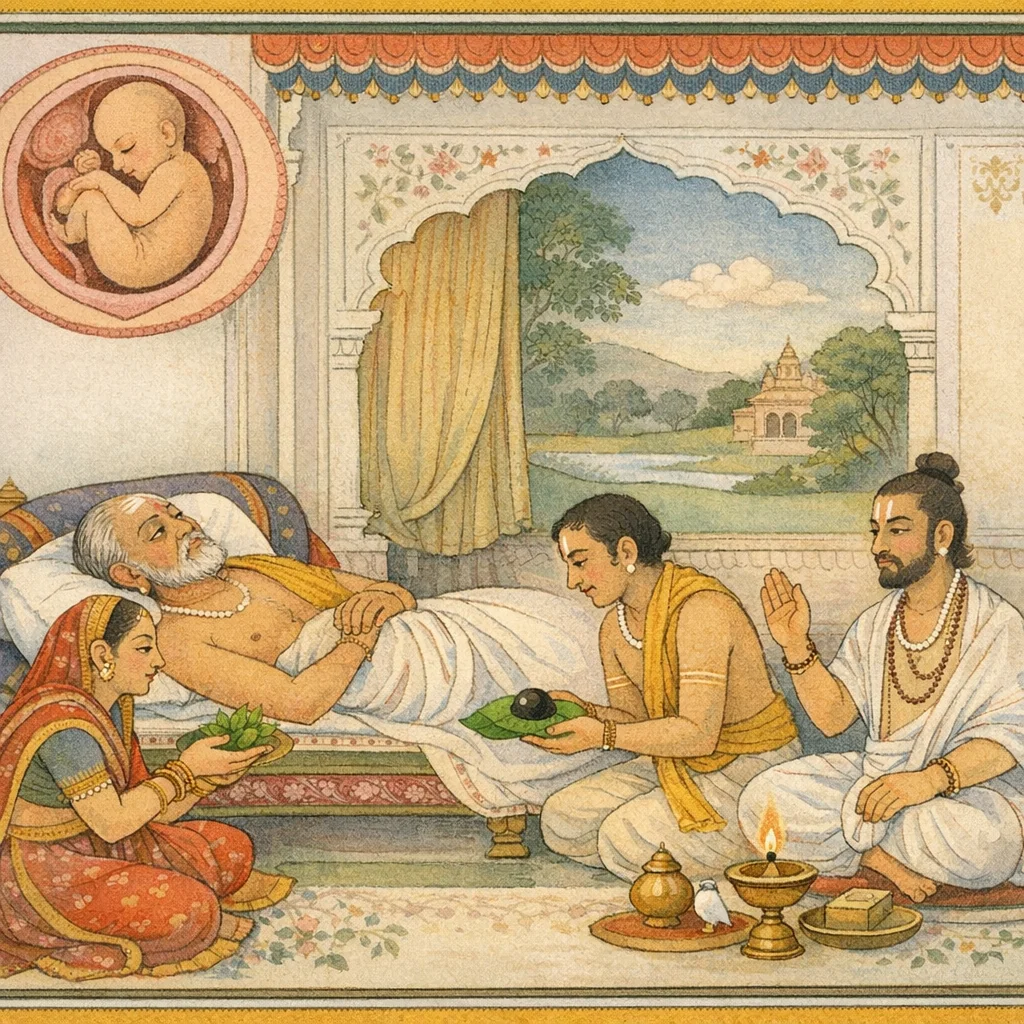
Continuing the Preta Kalpa’s teaching on karma and the soul’s passages, Garuḍa asks Viṣṇu how embodied life begins and how the body’s constituents are formed. Viṣṇu replies with a stepwise account of conception and fetal growth, linking sex-differentiation and temperament to the proportions of śukra–śoṇita and to the parents’ saṅkalpa at the moment of conception. The teaching then expands into yogic physiology—nāḍīs, the ten vāyus, the sense-organs, and elemental qualities—ending in quantitative descriptions of the body and the assertion that pleasure, pain, and destiny arise from one’s own karma. The narrative turns to guidance for one nearing death: purificatory bathing, ritual arrangement, the body’s orientation, placing gold/śālagrāma/tulasī, mantra-japa and charity, whose spiritual “fruits” are explained as Viṣṇu-smaraṇa leading to jñāna. Finally, the chapter teaches the piṇḍa–brahmāṇḍa correspondence, mapping lokas, dvīpas, oceans, and grahas onto the body, and reiterates the inevitability of death and rebirth under karma, preparing for further after-death instruction in later chapters.
Shlokas
Verse 1
दानफ लान्यदेहप्रवेशादिनिरूपणं नामै कत्रिंशो ऽध्यायः तार्क्ष्य उवाच / कथमुत्पद्यते जन्तुर्भूतग्रामे चतुर्विधे / त्वचा रक्तं तथा मांसं मेदो मज्जास्थि जीवितम्
This is the chapter called “An exposition on the fruits of charity and on entry into a body.” Tārkṣya (Garuda) said: “How is a living being produced within the fourfold aggregate of beings? How do skin, blood, flesh, fat, marrow, bone, and the vital life arise?”
Verse 2
पादौ पाणी तथा गुह्यं जिह्वा-केश-नखाः शिरः / सन्धिमार्गाश्च बहुशो रेखा नैकविधास्तथा
The feet and hands, the secret organ, the tongue, hair and nails, and the head—likewise the many passages at the joints, and the numerous lines and markings—are of various kinds.
Verse 3
कामः क्रोधो भयं लज्जा मनो हर्षः सुखासुखम् / चित्रितं छिद्रितञ्चापि नानाजालेन वेष्टितम्
Desire, anger, fear, shame, the mind, joy, and the pairs of pleasure and pain—this inner being is as though painted over, full of openings, and wrapped and entangled in many kinds of nets.
Verse 4
इन्द्रजालमिदं मन्ये संसारे ऽसारसागरे / कर्ता को ऽत्र हृषीकेश संसारे दुः खसंकुले
I deem this worldly existence to be a magician’s illusion—an ocean of saṃsāra devoid of true essence. O Hṛṣīkeśa, in this world crowded with suffering, who indeed is the real doer here?
Verse 5
श्रीविष्णुरुवाच / कथयामि परं गोप्यं कोशस्यास्य विनिर्णयम् / यस्य विज्ञानमात्रेण सर्वज्ञत्वं प्रज्यते
Śrī Viṣṇu said: I shall declare the supreme secret—the decisive discernment of this sheath (kośa). By merely knowing it, omniscience is awakened.
Verse 6
साधु पृष्टं त्वया लोके सदयं जीवकारणम् / वैनतेय शृणुष्व त्वमेकाग्रकृतमानसः
You have asked well in this world, with compassion, about the cause and condition of embodied beings. O Vainateya (Garuda), listen—keep your mind one-pointed and attentive.
Verse 7
ऋतुकाले च नारीणां वर्ज्यं दिनचतुष्टयम् / यतस्तस्मिन् ब्रह्महत्यां पुरा वृत्रसमुत्थिताम्
During a woman’s menstrual period, four days are to be observed as restricted. For in that time, it is said, the ancient sin of brahmahatyā—arising from Vṛtra—was formerly present.
Verse 8
ब्रह्मा शक्रात् समुत्तार्य चतुर्थांशेन दत्तवान् / तावन्नालोक्यते वक्त्रं पापं यावद्वपुः स्थितम्
Brahmā redeemed him from Indra (Śakra) and granted only a fourth part of the due share. So long as the sinful condition of the body remained, the face could not be beheld.
Verse 9
प्रथमे ऽहनि चाण्डाली द्वितीये ब्रह्मघातिनी / तृतीये रजकी ज्ञेया चतुर्थे ऽहनि शुध्यति
On the first day she is regarded as a caṇḍālī; on the second day, as guilty of brahmin-slaying; on the third day, she is known as a washerwoman; and on the fourth day, she becomes purified.
Verse 10
सप्ताहात् पितृदेवानां भवेद्योग्या कृतार्चने / सप्ताहमध्ये यो गर्भस्तत्संम्भूतिर्मलिम्लुचा
After seven days, worship and offerings to the Pitṛ-deities become fit and effective. But if conception (garbha) occurs within that seven-day span, that birth is called “malimluca”—an impure and inauspicious progeny.
Verse 11
निषकसमये पित्रोर्यादृक् चित्तविकल्पना / तादृग्गर्भसमुत्पत्तिर्जायते नात्र संशयः
At the time of conception, whatever disposition of mind and intention arise in the father and mother, a fetus (garbha) of corresponding nature comes into being—of this there is no doubt.
Verse 12
युग्मासु पुत्त्रा जायन्ते स्त्रियो ऽयुग्मासु रात्रिषु / पूर्वसप्तममुत्सृज्य तस्माद्युग्मासु संविशेत्
On even-numbered nights, sons are said to be conceived; on odd-numbered nights, daughters. Therefore, after letting the first seven nights pass, one should unite on even nights.
Verse 13
षोडशर्तुर्निशाः स्त्रीणां सामान्यात् समुदाहृतः / या चतुर्दशमी रात्रिर्गर्भस्तिष्ठति तत्र चेत्
In general, sixteen nights are proclaimed as a woman’s season of fertility. Yet if on the fourteenth night conception takes hold and the embryo abides there, then—by this teaching—a particular outcome is indicated.
Verse 14
गुणभाग्यनिधिः पुत्रस्तत्र जायेत धार्मिकः / सा निशा तत्र सामान्यैर्न लभ्येत खगाधिप
There a son is born— a treasury of virtues and good fortune—steadfast in dharma. Such an auspicious “night” is not attained by ordinary people, O Lord of birds.
Verse 15
प्रायशः सम्भवत्यत्र गर्भस्त्वष्टाहमध्यतः / पञ्चमे ऽहनि नारीणां कार्यं माधुर्यभोजनम्
Generally in this matter, conception occurs around the middle of the eight-day period; and on the fifth day, women are advised to take sweet, nourishing foods.
Verse 16
कटुक्षारञ्च तीक्ष्णञ्च त्याज्यमुष्णञ्च दूरतः / तत्क्षेत्रमोषधीपात्रं बीजञ्चाप्यमृतायितम्
Pungent, alkaline, and overly sharp, irritating substances should be avoided, and hot foods kept at a distance. Then the bodily field becomes a fit vessel for healing herbs, and even the seed of life becomes, as it were, nectar-like—amṛta.
Verse 17
तस्मिन्नुप्त्वा नरः स्वामी सम्यक् फलमवाप्नुयात् / तस्याश्चैवातपो वर्ज्य शीतलं केवलं चरेत्
Having sown in that proper field, a man—the householder—should duly obtain the right fruit. And for her, heat is to be avoided; she should follow only a cooling, soothing regimen.
Verse 18
ताम्बूलपुष्पश्रीखण्डैः संयुक्तः शुचिवस्त्रभृत् / धर्ममादाय मनसि सुतल्पं संविशेत् पुमान्
A man, adorned with betel, flowers, and fragrant sandal-paste, wearing clean garments, should rest upon a good bed—holding dharma firmly within his mind.
Verse 19
निषेकसमये यादृङ्नरचित्तविकल्पना / तादृक्स्वभावसम्भूतिर्जन्तुर्विशति कुक्षिगः
At the time of conception, whatever disposition and intention arise within the man’s mind, a being enters the womb with a nature formed accordingly.
Verse 20
शुक्रसोणितसंयोगे पिण्डोत्पत्तिः प्रजायते / वर्धते जठरे जन्तुस्तारापतिरिवाम्बरे
From the union of semen and blood, a lump-like embryo comes into being; and the living being grows within the womb, like the lord of stars waxing in the sky.
Verse 21
चैतन्यं बीजरूपं हि शुक्रे नित्यं व्यवस्थितम् / कामश्चित्तञ्च शुक्रञ्च यदा ह्येकत्वमाप्नुयुः
Consciousness, indeed, abides perpetually in semen in the form of a seed. And when desire, mind, and semen come into a single unity, conception is set in motion.
Verse 22
तदा द्रावमवाप्नोति योषागर्भाशये नरः / रक्ताधिक्ये भवेन्नारी शुक्राधिक्ये भवेत् पुमान्
Then, within the woman’s womb, the embodied being attains a fluid state. When the mother’s blood predominates, a female is born; when the father’s semen predominates, a male is born.
Verse 23
शुक्रसोणितयो साम्ये गर्भाः षण्डत्वमाप्नुयुः / अहोरात्रेण कलिलं बुद्वदं पञ्चभिदिनैः
When the male seed and the female blood are equal in measure, the embryo attains a neutral sex. Within a day and a night it becomes a gelatinous mass called kalila, and within five days it becomes bubble-like, budbuda.
Verse 24
चतुर्दशे भवेन्मांसं मिश्रधातुसमन्वितम् / घनं मांसञ्च विंशाहे गर्भस्थो वर्धते क्रमात्
On the fourteenth day, flesh comes into being, endowed with a mixture of bodily constituents; and by the twentieth day that flesh becomes compact and dense. Thus the embryo in the womb develops gradually, step by step.
Verse 25
पञ्चविंशतिमे चाह्नि बलं पुष्टिश्च जायते / तथा मासे तु सम्पूर्णे पञ्चतत्त्वं निधारयेत्
On the twenty-fifth day, strength and nourishment arise. Likewise, when a full month is completed, the constitution of the five elements (pañca-tattva) becomes firmly established.
Verse 26
मासद्वये तु सञ्जाते त्वचा मेदश्च जायते / मज्जास्थीनि त्रिभिर्मासैः केशाङ्गुल्यश्चतुर्थके
When the second month is completed, the skin and fat are formed. By the third month, marrow and bones develop, and in the fourth month hair and fingers (and toes) appear.
Verse 27
कर्णौ च नासिके वक्षो जायेरन् मासि पञ्चमे / कण्ठरन्ध्रोदरं षष्ठे गुह्यादिर्मासि सप्तमे
In the fifth month, the ears, the nostrils, and the chest are formed. In the sixth month, the opening of the throat and the abdomen develop; and in the seventh month, the genital organs and the remaining parts arise.
Verse 28
अङ्गप्रत्यङ्गसम्पूर्णो गर्भो मासैरथाष्टभिः / अष्टमे चलते जीवो धात्रीगर्भे पुनः पुनः / नवमेमासि सम्प्राप्ते गर्भस्थौजौ दृढं भवेत्
By the completion of eight months, the embryo becomes fully formed, complete with all major and minor limbs. In the eighth month, the individual soul (jīva) repeatedly stirs and moves within the mother’s womb. When the ninth month arrives, the vitality and strength within the womb become firmly established.
Verse 29
चिकित्सा जायते तस्य गर्भवासपरिक्षये / नारी वाथ नरो वाथ नपुंस्त्वं वाभिजायते
When that period of dwelling in the womb comes to its end, in him arises the impulse toward remedy and self-preservation; and then he is born—either as a woman, or as a man, or as one of indeterminate sex.
Verse 30
शक्तित्रयं विशालाक्षं षाट्कौशिकसमायुतम् / पञ्चेन्द्रियसमोपेतं दशनाडीविभूषितम्
It possesses the threefold power, has wide-ranging perception, is joined with the six sheaths (kośa), is endowed with the five sense-faculties, and is adorned with the ten nāḍīs (subtle channels).
Verse 31
दशप्राणगुणोपेतं यो जानाति स योगवित् / मज्जास्थिशुक्रमांसानि रोम रक्तं बलं तथा
One who understands (the body) as endowed with the qualities of the ten prāṇas (vital airs) is truly a knower of yoga; he knows also its constituents—marrow, bone, semen, flesh, hair, blood, and likewise strength.
Verse 32
षाट्कौशिकमिदं पिण्डं स्याज्जन्तोः पाञ्चभौतिकम् / नवमे दशमे मासि जायते पाञ्चभौतिकः
This embodied mass (piṇḍa) of the living being is said to be “six-layered” and constituted of the five great elements. In the ninth or the tenth month, the being—made of those five elements—comes to birth.
Verse 33
सूतिवातैः समाकृष्टः पीडया विह्वलीकृतः / पुष्टो नाड्याः सुषुम्णाया योषिद्गर्भस्थितस्त्वरन्
Drawn by the winds of birth, overwhelmed by pain and distress, and nourished through the suṣumṇā nāḍī, the jīva—dwelling within a woman’s womb—moves about in haste.
Verse 34
क्षितिर्वारि हविर्भोक्ता पवनाकाशमेव च / एभिर्भूतैः पीडितस्तु निबद्धः स्नायुबन्धनैः
Earth, water, fire—the consumer of oblations (havis), wind, and space: by these elemental forces the being is afflicted; bound fast by the cords of sinews, he remains constrained.
Verse 35
मूलभूता इमे प्रोक्ताः सप्त नाड्यन्तरे स्थिताः / त्वचास्थिनाड्यो रोमाणि मांसञ्चैवात्र पञ्चमम्
These are declared to be the seven fundamental constituents, situated within the network of nāḍīs: skin, bone, nāḍīs (channels), hairs, and here as the fifth, flesh.
Verse 36
एते पञ्च गुणाः प्रोक्ता मया भूमेः खगेश्वर / यथा पञ्च गुणाश्चापस्तथा तच्छृणु काश्यप
O lord of birds, I have explained to you the five qualities of earth. Now, in the same way, listen—O Kāśyapa—to the five qualities of water.
Verse 37
लाला मूत्रं तथा शुक्रं मज्जार रक्तञ्च पञ्चमम् / आपः पञ्चगुणाः प्रोक्ता ज्ञातव्यास्ते प्रयत्नतः
Saliva, urine, semen, marrow, and as the fifth, blood—these are declared to be the fivefold forms of bodily ‘waters’; they should be understood carefully and with effort.
Verse 38
क्षुधा तृषा तथा निद्रा आलस्यं कान्तिरेव च / तेजः पञ्चगुणं प्रोक्तं तार्क्ष्य सर्वत्रयोगिभिः
Hunger, thirst, sleep, lethargy, and radiance—these five are proclaimed by yogins everywhere as the fivefold tejas (vital potency), O Tārkṣya (Garuda).
Verse 39
रागद्वेषौ तथा लज्जा भयं मोहस्तथैव च / इत्येतत् कथितं तार्क्ष्य वायुजं गुणपञ्चकम्
Attachment and aversion, as well as shame, fear, and delusion—these, O Tārkṣya (Garuda), are declared to be the five qualities born of vāyu (the wind principle).
Verse 40
आकुञ्चनं धावनञ्च लङ्घनञ्च प्रसारणम् / निरोधः पञ्चमः प्रोक्तो वायोः पञ्च गुणाः स्मृताः
Contraction, swift running, leaping, and expansion—restraint is declared as the fifth. These are remembered as the five qualities of vāyu (the vital wind).
Verse 41
घोषश्चिन्ता च गाम्भीर्यं श्रवणं सत्यसंक्रमः / आकाशस्य गुणाः पञ्च ज्ञात व्यास्तार्क्ष्य यत्नतः
Sound, inner reflection, depth, the power of hearing, and truthful conveyance—these are the five qualities of ākāśa (ether/space). O Tārkṣya (Garuda), understand them with care.
Verse 42
श्रोत्रं त्वक् चक्षुषी जिह्वा नासा बुद्धीन्द्रियाणि च / पाणी पादौ गुदं प्राक् च गुह्यं कर्मेन्द्रियाणि च
The ear, skin, two eyes, tongue, and nose are the organs of perception; and the hands, feet, anus, the front outlet of excretion (urinary passage), and the genitals are the organs of action.
Verse 43
इडाच पिङ्गला चैव सुषुम्णा च तृतीयका / गान्धारी गजजिह्वा च पूषा चैव यसा तथा
Idā and Piṅgalā, with Suṣumṇā as the third; likewise there are Gāndhārī, Gajajihvā, Pūṣā, and also Yaśā.
Verse 44
अलम्वुशा कुहूश्चैव शङ्खिनी दशमी स्मृता / पिण्ड मध्ये स्थिता ह्येताः प्रधाना दश नाडयः
Alambuśā, Kuhū, and Śaṅkhinī—remembered as the tenth—these are the ten principal nāḍīs, situated within the piṇḍa, the embodied body.
Verse 45
प्राणापानौ समानश्च उदानो व्यान एव च / नागः कूर्मश्च कृकरो देवदत्तो धनञ्जयः
Prāṇa and Apāna, Samāna, Udāna and Vyāna as well—along with Nāga, Kūrma, Kṛkara, Devadatta, and Dhanañjaya—these are the vital airs operating within the being.
Verse 46
इत्येते वायवः प्रोक्ता दश देहेषु सुस्थिताः / केवलं भुक्तमन्नञ्च पुष्टिदं सर्वदेहिनाम्
Thus these ten vital airs (vāyus) have been described, firmly established within bodies. And only the food that is truly eaten becomes the source of nourishment for all embodied beings.
Verse 47
नयते प्राणदो वायुः शरीरे सर्वसन्धिषु / आहारो भुक्तमात्रस्तु वायुना क्रियते द्विधा
The life-giving wind (vāyu) moves through the body in all its joints and channels. Whatever food is merely eaten is, by vāyu, separated and processed into two forms.
Verse 48
स प्रविश्य गुहे सम्यक् पृथगन्नं पृथग्जलम् / ऊर्ध्वमग्नेर्जलं कृत्वा तदन्नञ्च जलोपरि
Having properly entered the (ritual) enclosure, he should keep the food separate and the water separate; placing the water above the fire, he should then set that food upon the water.
Verse 49
अग्नेश्चाधः स्वयं प्राणस्तमग्निञ्च धमेच्छनैः / वायुना धम्यमानो ऽग्निः पृथक्किट्टं पृथग्रसम्
Beneath the digestive fire, prāṇa itself steadily fans that fire. When the fire is thus blown by the vital wind, it separates the dross (kitta) apart and the nutritive essence, rasa, apart.
Verse 50
मलैर्द्वादशभिः किट्टं भिन्नं देहात् पृथग्भवेत् / कर्णाक्षिनासिका जिह्वा दन्तनाभिवपुर्गुदम्
The impure residue, kitta, becomes separated from the body by twelve kinds of filth; and these are distinct: the ears, the eyes, the nose, the tongue, the teeth, the navel, the skin/body, and the anus.
Verse 51
नखा मलाश्रया ह्येते विण्मूत्रञ्चेत्यनन्तकम् / शुक्रशोणितसंयोगादेतत् षाट्कौशिकं स्मृतम्
Nails are indeed supported by bodily impurities; likewise feces and urine are produced without end. From the union of semen (śukra) and blood (śoṇita) this body arises; this teaching is remembered as the Ṣāṭkauśika doctrine.
Verse 52
रोम्णां कोट्यस्तथा तिस्रो ऽप्यर्धकोटि समन्विताः / द्वात्रिंशद्दशनाः प्रोक्ताः सामान्याद्विनतासुत
O son of Vinatā (Garuda), speaking in general terms, it is said that the hairs of the body number three crores with an additional half-crore, and that the teeth are said to be thirty-two.
Verse 53
सप्त लक्षाणि केशाः स्युर्नखाः प्रोक्तास्तु विंशतिः / मांसं पलसहस्रैकं सामान्याद्देहसंस्थितम्
It is said that there are seven lakhs of hairs, and the nails are declared to be twenty. The flesh, in an average human body, is stated to amount to one thousand and one palas, as ordinarily constituted.
Verse 54
रक्तं पलशतं तार्क्ष्यं बुद्धमेव पुरातनैः / पलानि दश मेदश्च त्वचा चैव तु तत्समा
O Tārkṣya (Garuda), the ancients have indeed stated that the quantity of blood is one hundred palas; fat is ten palas, and the skin is of the same measure as that (equal to the fat).
Verse 55
पलद्वादशकं मज्जा महारक्तं पलत्रयम् / शुक्रं द्विकुडवं ज्ञेयं शोणितं कुडवं स्मृतम्
Marrow is said to measure twelve palas; the great (vital) blood measures three palas. Semen should be known as two kuḍavas, while blood (śoṇita) is remembered as one kuḍava.
Verse 56
श्लेष्माणश्च षडूर्ध्वञ्च विण्मूत्रं तत्प्रमाणतः / अस्थ्नां हि ह्यधिकं प्रोक्तं षष्ट्युत्तरशतत्रयात्
Phlegm, and the six substances located above (in the upper region of the body), along with feces and urine—these are described according to their measured quantities. Yet the quantity of bones is said to be greater than three hundred and sixty.
Verse 57
एवं पिण्डः समाख्यातो वैभवं सम्प्रचक्ष्महे / सुखं दुः खं भयं क्षेमं कर्मणैव हि प्राप्यते
Thus the nature of the piṇḍa (the embodied aggregate) has been explained; now we declare its consequent conditions. Pleasure and pain, fear and security—indeed, all these are attained solely through one’s own karma.
Verse 58
अधोमुखं चोर्ध्वपादं गर्भाद्वायुः प्रकर्षति / तले तु करयोर्न्यस्य वर्धते जानुपार्श्वयोः
Within the womb, the vital wind (vāyu) presses the fetus into a posture with the face turned downward and the feet raised upward; placing the palms upon the soles, it grows with the knees drawn up to the sides.
Verse 59
अङ्गुष्ठौ चोपरि न्यस्तौ जान्वारेथ कराङ्गुली / जानुपृष्ठे तथा नेत्रे जानुमध्ये च नासिका
Place the two thumbs above, and set the fingers of the hands upon the knees; keep the eyes directed toward the back ridge of the knees, and the nose aligned toward the space between the knees.
Verse 60
एवं वृद्धिं क्रमाद्याति जन्तुः स्त्रीगर्भसंस्थितः / काठिन्यमस्थीन्यायान्ति भुक्तपीतेन जीवति
Thus, the embodied being, situated in a woman’s womb, gradually attains growth; the bones become firm, and it lives sustained by what is eaten and drunk by the mother.
Verse 61
नाडी वाप्यायनी नाम नाभ्यां तत्र निबध्यते / स्त्रीणां तथान्त्रसुषिरे स निबद्धः प्रजायते
There is a channel (nāḍī) called Vāpyāyanī, which is fastened there at the navel. In women likewise, it is bound within the hollow of the intestines, and from that connection the embryo comes into being.
Verse 62
क्रामन्ति भुक्तपीतानि स्त्रीणां गर्भोदरे तथा / तैराप्यायितदेहो ऽसौ जन्तुर्वृद्धिमुपैति च
So too, within a woman’s womb, the food and drink she consumes pass on to the fetus. Nourished and strengthened by them, that living being grows and increases in size.
Verse 63
स्मृत्यस्तत्र प्रयान्त्यस्य बह्व्यः संसारभूतयः / ततो निर्वेदमायाति पीड्यमान इतस्ततः
There, many memories bound to worldly existence in saṃsāra rush upon him. Then, tormented from every side, he enters nirveda—dispassion and deep revulsion toward saṃsāra.
Verse 64
पुनर्नैवं करिष्यामि भुक्तमात्र इहोदरात् / तथातथा यतिष्यामि गर्भं नाप्नोम्यहं यथा
“Never again will I act like this—living here only to fill my belly. I will strive in every way, so that I may not enter a womb again.”
Verse 65
यानि पूर्वानुभूतानि देवभूतात्मजानि वै
Whatever experiences were previously undergone—arising indeed from the devas, from beings, and from one’s own self-born impressions of the mind—
Verse 66
ततः कालक्रमाज्जन्तुः परिवर्त्यत्वधोमुखः / नवमे दशमे वापि मासि संजायते ततः
Then, in the due course of time, the embodied being turns and becomes head-down; thereafter, in the ninth—or even the tenth—month, it is born.
Verse 67
निष्क्रम्यमाणो वातेन प्राजापत्येन पीड्यते / निष्क्रमते च विलपंस्तदा दुःखनिपीडितः
As the being departs, it is tormented by the prājāpatya wind; and as it leaves, it wails then, crushed beneath suffering.
Verse 68
निष्क्रामंश्चोदरान्मूर्छामसह्यां प्रतिपद्यते / प्राप्नोति चेतनां चासौ वायुस्पर्शसुखान्वितः
As it emerges from the mother’s womb, it is seized by an unbearable swoon; then it regains consciousness, tasting the bliss that comes from the touch of fresh air.
Verse 69
ततस्तं वैष्णवी माया समास्कन्दति मोहिनी / तया विमोहितात्मासौ ज्ञानभ्रंशमवाप्नुते
Then the enchanting Vaiṣṇavī Māyā overtakes him; deluded by her, that self falls into the loss of true knowledge and discernment.
Verse 70
भ्रष्टज्ञानं बालभावे ततो जन्तुः प्रपद्यते / ततः कौमारकावस्थां यौवनं वृद्धतामपि
With knowledge obscured, the embodied being first enters the state of infancy; thereafter it passes into childhood, then youth, and finally old age as well.
Verse 71
पुनश्च तद्वन्मरणं जन्म प्राप्नोति मानवः / ततः संसारचक्रे ऽस्मिन् भ्राम्यते घटयन्त्रवत्
And again, in the same manner, a human being attains death and then birth; thereafter, within this wheel of worldly existence, he keeps revolving like a water-wheel mechanism.
Verse 72
कदाचित्स्वर्गमाप्नोति कदाचिन्निरयं नरः / स्वर्गं च निरयं चैव स्वकर्मफलमश्नुते
At times a person attains heaven, and at times he falls into hell; indeed, he experiences both heaven and hell as the fruits of his own actions.
Verse 73
कदाचिद्भुक्तकर्मा च भुवं स्वल्पेन गच्छति / स्वर्लोके नरके चैव भुक्तप्राये द्विजोत्तमाः
At times, after tasting the fruits of former deeds, a being swiftly passes through the earthly realm; and likewise through heaven and through hell, O best of the twice-born, when the karma is almost wholly exhausted.
Verse 74
नरकेषु महद्दुःखमेतद्यत्स्वर्गवासिनः / दृश्यते नात्र मोदन्ते पात्यमानास्तु नारकैः
In the hells there is a great torment: even the dwellers of heaven are seen there. In that place they do not rejoice; rather, cast down, they become like the denizens of hell.
Verse 75
स्वर्गे ऽपि दुः खमतुलं यदारोहणकालतः / प्रभृत्यहं पतिष्यामीत्येतन्मनसि वर्तते
Even in heaven there is incomparable sorrow, for from the very moment one ascends there, the thought arises in the mind: “From here I shall surely fall.”
Verse 76
नार कांश्चैव सम्प्रेक्ष्य महद्दुः खमवाप्यते / एवं गतिमहं गन्तेत्यहर्निशमनिर्वृतः
Seeing certain men in such a condition, one is seized by great sorrow. Thinking, “I too must go to such a state,” he remains day and night without peace.
Verse 77
गर्भवासे महद्दुः खं जायमानस्य योनिजम् / जातस्य बालभावे ऽपि वृद्धत्वे दुःखमेव च
In the confinement of the womb there is great suffering; at the time of birth the pain born of the womb is severe. After birth, even in childhood there is suffering, and in old age too there is nothing but suffering.
Verse 78
कामेर्ष्याक्रोधसम्बन्धाद्यौवने ऽपि च दुः सहम् / दुःस्वप्नं या वृद्धता च मरणे दुः खमुत्कटम्
Even in youth, suffering is hard to bear, for one is entangled with desire, jealousy, and anger. There are distressing dreams; there is old age; and at death the pain becomes exceedingly intense.
Verse 79
कृष्यमाणश्च याम्यैः स नरके ऽपि च यात्यधः / पुनश्च गर्भाज्जन्म स्यान्मरणं दुष्करं तथा
Dragged along by Yama’s messengers, he falls down into hell. Then again he must take birth from a womb, and likewise death becomes hard to endure.
Verse 80
एवं संसारचक्रे ऽस्मिज्जन्तवो घटयन्त्रवत् / भ्राम्यन्ते प्राक्तनैर्बधैर्बद्धा विध्यन्ति चासकृत्
Thus, in this wheel of transmigration, beings revolve like a water-wheel, bound by the fetters of their former deeds, and they are struck again and again (by suffering and consequence).
Verse 81
नास्ति पक्षिन्सुखं किञ्चित्क्षेत्रे दुः खशताकुले / विनतासुत मोक्षाय यतितव्यं ततो नरैः
O Bird (Garuda), in this realm—crowded with hundreds of sufferings—there is not even the slightest happiness. Therefore, O son of Vinatā, human beings should strive earnestly for liberation (mokṣa).
Verse 82
एतत्ते सर्वमाख्यातं यथा गर्भस्य संस्थितिः / कथयामि क्रमप्रश्रं पृष्टं वा वर्तते स्पृहा
Thus I have told you everything about how the embryo comes to be situated. Now I shall explain, in due order, whatever you ask—according to the questions raised and the desire that arises.
Verse 83
गरुड उवाच / मध्ये कृतमहाप्रश्रद्वयस्याप्तं मयोत्तरम् / प्रश्रस्यापि तृतीयस्य उत्तरं च विधीयताम्
Garuḍa said: “In the midst of our discourse, I have already received from You the answer to the two great questions. Now, let the answer to the third question also be set forth.”
Verse 84
श्रीकृष्ण उवाच / म्रियमाणस्य किं कृत्यमिति त्वं पृष्टवानसि / शृणु तत्रोत्तरं तूक्तं कथयामि समासतः
Śrī Kṛṣṇa said: “You have asked, ‘What should be done for one who is dying?’ Listen—I shall state the answer to that, explaining it briefly.”
Verse 85
आसन्नमरणं ज्ञात्वा पुरुषं स्नापयेत्ततः / गोमूत्रगोमयसुमृत्तीर्थोदककुशोदकैः
Knowing that a man’s death is near, one should then bathe him—using cow’s urine, water mixed with cow-dung, well-purified earth (clay), sacred tīrtha-water, and water infused with kuśa grass.
Verse 86
वाससी परिधार्याथ धौते तु शुचि नी शुभे / दर्भाण्यादौ समास्तीर्य दक्षिणाग्रान्विकीर्य च
Then, having put on two washed garments—clean and auspicious—one should first spread darbha grass and scatter it with its tips facing south.
Verse 87
तिलान् गोमयलिप्तायां भूमौ तत्र निवेशयेत्
One should place sesame seeds there, upon ground that has been smeared with cow-dung.
Verse 88
प्रागुदक्शिरसं वापि मुखे स्वर्णं विनिः क्षेपेत् / शालग्रामशिला तत्र तुलसी च खगेश्वर
O Khageśvara (Garuda), having laid the dying person with the head turned toward the east or toward the north, one should place gold into the mouth; and there too one should place a Śālagrāma stone and tulasī.
Verse 89
विधेया सन्निधौ सर्पिर्दीपं प्रज्वालयेत्पुनः / नमो भगवते वासुदेवायेति जपस्तथा
Then, in the prescribed presence of the rite, one should again light a ghee-lamp; and likewise repeat the japa: “Oṁ, salutations to the Blessed Lord Vāsudeva.”
Verse 90
आदौ तु प्रणवं कृत्वा पूजादाने ततः स्मृते / समभ्यर्च्य हृषीकेशं पुष्पधूपादिभिस्ततः
First one should utter the Praṇava, “Oṁ”. Then, as prescribed for worship and charitable offering, one should duly honor Hṛṣīkeśa (Viṣṇu), worshipping Him thereafter with flowers, incense, and similar offerings.
Verse 91
प्रणिपातैः स्तवैः पुण्यैर्ध्या नयोगेन पूजयेत् / दत्त्वा दानं च विप्रेभ्यो दीनानाथेभ्य एव च
One should worship the Lord with prostrations, with holy hymns, and through the discipline of meditation; and one should also give gifts in charity—to the learned brāhmaṇas and indeed to the poor and the helpless.
Verse 92
पुत्त्रे मित्रे कलत्रे च क्षेत्रधान्यधनादिषु / निवर्तयेन्ममत्वं च विष्णोः पादौ हृदि स्मरन्
While remembering Lord Viṣṇu’s feet within the heart, one should withdraw the sense of ‘mine-ness’ toward one’s son, friends, spouse, fields, grain, wealth, and other possessions.
Verse 93
उच्चैः पुरुषसूक्तं च यदि श्रेष्ठापदस्तदा / पुत्त्राद्याः प्रपठेयुस्ते म्रियमाणे निजे जने
If the dying person can still utter the sacred words, then the Puruṣa Sūkta should be recited aloud; at that time, when one’s own kinsman is dying, the sons and other family members should recite it for him.
Verse 94
एतत्ते सर्वमाख्यातं कृत्यं मृत्यावुपस्थिते / फलमप्यस्य कृत्स्नस्य समासात्ते वदाम्यहम्
Thus I have fully explained to you what should be done when death is at hand; now I shall tell you, in brief, the complete fruit of all these rites.
Verse 95
स्नानेन शुचिताप्राप्तिरपावित्र्यहृतिस्ततः / ततो विष्णोः स्मृतिस्तस्य ज्ञानात्सर्वफलप्रदा
By bathing, one attains purity and the removal of impurity. From that arises remembrance of Viṣṇu; and from that remembrance comes true knowledge, which bestows every spiritual fruit.
Verse 96
दर्भतूली नयेत्स्वर्गमातुरं तु न संशयः / तिलैर्दर्भैश्च निः क्षिप्तैः स्नानं क्रतुमयं भवेत्
A bed or support made of kuśa grass surely leads the dying person to heaven—there is no doubt. And when the bath is performed with sesame seeds and kuśa grass strewn into the water, that bathing becomes equivalent to a sacrificial rite.
Verse 97
ब्रह्मा विष्णुश्च रुद्रश्च श्रीर्हुताशस्तथैव च / मण्डले चोपतिष्ठन्ति तस्मात्कुर्वीत मण्डलम्
Brahmā, Viṣṇu, Rudra, Śrī (Lakṣmī), and Hutāśa (Agni) all take their place within the ritual maṇḍala; therefore one should prepare and establish a maṇḍala.
Verse 98
प्रागुदग्वा कृतेनेह शिरसा लोकमुत्तमम् / व्रजते यदि पापस्याल्पत्वं पुंसो भवेत्खग
O Khaga (Garuda), if here a person is laid with the head turned toward the east or the north, he goes to the highest world; thereby his sin becomes slight, greatly diminished.
Verse 99
पञ्चरत्ने मुखे मुक्ते जिवे ज्ञानं प्ररोहति / तुलसी ब्राह्मणा गावो विष्णुरेकादशी खग
At the time of release, when the five sacred “jewels” are placed at the mouth, knowledge sprouts within the departing soul. These supports are Tulasi, Brahmins, cows, Lord Vishnu, and Ekadashi—O bird (Garuda).
Verse 100
पञ्च प्रवहणान्येव भवाब्धौ मज्जतां नृणाम् / विष्णुरेकादशी गीता तुलसी विप्रधेनवः
For people sinking in the ocean of worldly existence, there are indeed five conveyances across it: devotion to Lord Vishnu, observance of Ekadashi, recitation of the Gita, veneration of Tulasi, and service to Brahmins and cows.
Verse 101
असारे दुर्गसंसारे षट्पदी भक्तिदायिनी / नमो भगवते वासुदेवायेति जपन्नरः
In this insubstantial and hard-to-cross cycle of worldly existence, the six-word mantra bestows devotion: one who repeats, “Namo Bhagavate Vāsudevāya—obeisance to the Blessed Lord Vāsudeva,” is led toward liberation.
Verse 102
ओङ्कारपूर्वं सायुज्यं प्राप्नुयान्नात्र संशयः / पूजयापि च मल्लोकप्राप्तिराराद्दिवं व्रजेत्
By beginning with the sacred syllable Oṁ, one attains sāyujya (union); of this there is no doubt. And even through worship, one gains entry to My world and swiftly goes to heaven.
Verse 103
बन्धाभावे ममत्वेतु ज्ञानं पुरुषसूक्ततः / यस्ययस्याधिकत्वं तु साधनेष्वेषु काश्यप
When bondage is absent, the sense of “mine” also falls away; then true knowledge arises from the teaching of the Supreme Person. O Kāśyapa, among these spiritual means, whichever is predominant for a person becomes that individual’s chief aid.
Verse 104
तत्तत्फलस्याप्याधिक्यं भवतीत्यवधारय / दातव्यानि यथाशक्त्या प्रीतो ऽसौ सर्वदा भवेत्
Know for certain that the fruit of each such act becomes even greater. Therefore one should give these gifts according to one’s capacity; by doing so, (the Lord/the recipient) remains ever pleased.
Verse 105
एतत्ते सर्वमाख्यातं स्नानादिषु फलं मया / ब्रह्माण्डे ये गुणाः सन्ति शरीरे ते व्यवस्थिताः
Thus I have fully explained to you the fruits of bathing and related observances. Whatever qualities exist in the Brahmāṇḍa (the cosmic egg, the universe) are likewise arranged and present within the body.
Verse 106
पातालभूधरा लोकास्तथान्ये द्वीपसागराः / आदित्यादिग्रहाः सर्वे पिण्डमध्ये व्यवस्थिताः
The nether regions of Pātāla and the supporting mountains, the worlds, and likewise the other continents and oceans—along with all the celestial bodies beginning with the Sun—are all said to be arranged within the piṇḍa, the embodied microcosm.
Verse 107
पादाधस्तु तलं ज्ञेयं पादोर्ध्वं वितलं तथा / जानुभ्यां सुतलं विद्धि सक्थिदेशे महातलम्
Know Tala to be below the feet, and Vitala just above the feet. Understand Sutala to be at the knees, and Mahātala in the region of the thighs.
Verse 108
तथा तलातलञ्चोरौ गुह्यदेशे रसातलम् / पातालं कटिसंस्थन्तु पादादौ लक्षयेद्बुधः
Likewise, the wise should know Talātala in the thighs, Rasātala in the secret (genital) region, and Pātāla as established at the hips—thus discerning these nether realms as mapped upon the lower parts of the body.
Verse 109
भूर्लोकं नाभिमध्ये तु भुवर्लोकं तदूर्ध्वतः / स्वर्गलोकं हृदये विद्यात् कण्ठदेशे महस्तथा
Know Bhūrloka in the region of the navel, and above it Bhuvarloka. Understand Svargaloka to abide in the heart, and likewise Maharloka in the region of the throat.
Verse 110
जनलोकं वक्त्रदेशे तपोलोकं ललाटके / सत्यलोकं महारन्ध्रे भुवनानि चतुर्दश
Janaloka is in the region of the mouth; Tapoloka in the forehead; and Satyaloka in the great aperture at the crown of the head. Thus are the fourteen worlds (bhuvanas) arranged within the cosmic or subtle body.
Verse 111
त्रिकोणे संस्थितो मेरुरधः कोणे च मन्दरः / दक्षिणे चेव कैलासो वामभागे हिमाचलः
In the triangular (northern) quarter stands Mount Meru; in the lower corner is Mount Mandara. To the south is Mount Kailāsa, and on the left side lies Himācala, the Himalayan mountain.
Verse 112
निषधश्चोर्ध्वभागे च दक्षिणे गन्धमादनः / मलयो (रमणो) वामरेखायां सप्तैते कुलपर्वताः
Niṣadha lies in the upper region, and to the south is Gandhamādana. Malaya—also called Ramaṇa—stands upon the left boundary line. These are seven, renowned as the clan-mountains (kulaparvatas).
Verse 113
अस्थिस्थाने स्थितो जम्बूः शाको मज्जासु संस्थितः / कुशद्वीपः स्थितो मांसे क्रौञ्चद्वीपः शिरास्थितः
In the realm of the bones abides Jambū-dvīpa; within the marrow is established Śāka-dvīpa. Kuśa-dvīpa is set in the flesh, and Krauñca-dvīpa is situated in the nāḍīs, the bodily channels.
Verse 114
त्वचायां शाल्मलिद्वापो प्लक्षः रोम्णां च सञ्चये / नखस्थः पुष्करद्वीपः सागरास्तदनन्तरम्
In the skin is likened Śālmalī-dvīpa, and in the gathering of the body’s hairs is Plakṣa-dvīpa. In the nails is Puṣkara-dvīpa; and immediately beyond these lie the encircling oceans.
Verse 115
क्षारोदश्च तथा मूत्रे क्षारे क्षीरोदसागरः / सुरोदधिश्च श्लेष्मस्थः मज्जायां घृतसागरः
In urine there is likewise a “salt-ocean”; in bile is the Milk-Ocean. In phlegm abides the ocean of surā, the intoxicating liquor, and in the marrow is the ocean of ghee.
Verse 116
रसोदधिं रसे विद्याच्छोणिते दधिसगरम् / स्वादुलं लम्बिकास्थाने गर्भोदं शुक्रसंस्थितम्
One should know the “ocean of rasa” to be present in the bodily juices; and in the blood, the “sea of curd.” In the region of the lambikā, the uvula, is the sweet-tasting essence; and the “water of the womb” is situated within the semen.
Verse 117
नादचक्रे स्थितः सूर्यो बिन्दुचक्रे च चन्द्रमाः / लोचनस्थः कुजो ज्ञेयो हृदये च बुधः स्मृतः
The Sun is stationed in the Nāda-cakra, and the Moon in the Bindu-cakra. Mars is to be known as abiding in the eyes, and Mercury is remembered as residing in the heart.
Verse 118
विष्णुस्थाने गुरुं विद्याच्छ्रुक्रे शुक्रो व्यवस्थितः / नाभिस्थाने स्थितो मन्दो मुखे राहुः स्थितः सदा
Know that Jupiter (Guru) abides in the place of Viṣṇu; Venus (Śukra) is stationed in the semen; Saturn (Manda) is situated in the navel-region; and Rāhu ever remains in the mouth.
Verse 119
पायु (द) स्थाने स्थितः केतुः शरीरे ग्रहमण्डलम् / विभक्तञ्च समाख्यातमापादतलमस्तकम्
Ketu is situated in the region of the anus; thus, the entire sphere of planets is described as being distributed within the body, from the soles of the feet up to the head.
Verse 120
उत्पन्ना ये हि संसारे म्रियन्ते ते न संशयः / बुभुक्षा च तृषा रौद्रा दाहोद्भूता च मूर्छना
Indeed, all who are born in this world certainly die—there is no doubt. Along with that, fierce hunger and burning thirst arise, and fainting brought on by scorching heat also occurs.
Verse 121
यत्र पीडास्त्विमा रौद्रास्ता वै वृश्चिकदंशजाः / विनाशः पूर्णकाले च जायते सर्वदेहिनाम्
There, these fierce torments indeed arise from the stings of scorpions; and at the appointed completion of time, dissolution (death) comes to all embodied beings.
Verse 122
अग्रे अग्रे हि धावन्ति यमलोकगतस्यवै / तप्तवालुकमध्येन प्रज्वलद्वह्निमध्यतः
Indeed, they keep running onward and onward—those who have gone to Yama’s realm—through the midst of scorching sand and amid blazing fire.
Verse 123
केशग्राहैः समाक्रान्ता नीयन्ते यमकिङ्करैः / पापिष्ठास्त्वधमास्तार्क्ष्य दयाधर्मविविर्जिताः
Seized by the hair, they are dragged away by Yama’s servants. O Tārkṣya (Garuda), these are the most sinful and lowest of men—bereft of compassion and of dharma.
Verse 124
यमलोके वसन्त्येते कुट्यां जन्म न विद्यते / एवं सञ्जायते तार्क्ष्य मर्त्ये जन्तुः स्वकर्मभिः
Those beings dwell in Yama’s realm; there is no fresh birth for them there. Thus, O Tārkṣya (Garuda), a creature is born again in the mortal world, driven by its own karma.
Verse 125
उत्पन्ना ये हि संसारे म्रियन्ते ते न संशयः / आयुः कर्म च वित्तञ्च विद्या निधनमेव च
All who are born in this world certainly die—of this there is no doubt. Lifespan, karma (and its fruits), wealth, and even learning inevitably come to their end.
Verse 126
पञ्चैतानि हि सृज्यन्ते गर्भस्थस्यैव देहिनः / कर्मणा जायते जन्तुः कर्मणैव प्रलीयते
Indeed, these five are produced for the embodied being while still in the womb. A creature is born through karma, and through karma alone it comes to dissolution.
Verse 127
सुखं दुः खं भयं क्षेमं कर्मणैवाभिपद्यते / अधोमुखं चोर्ध्वपादं गर्भाद्वायुः प्रकर्षति
Happiness and sorrow, fear and safety—one attains these solely through one’s own karma. And from within the womb, the vital wind forcefully draws the fetus, face downward and feet upward, toward birth.
Verse 128
जन्मतो वैष्णवी माया संमोहयति सत्वरम् / स्वकर्मकृतसम्बन्धो जन्तुर्जन्म प्रपद्यते
From the very moment of birth, the Lord’s Vaiṣṇavī māyā swiftly deludes the being; bound by the ties fashioned by its own past deeds, the creature enters yet another birth.
Verse 129
सुकृतादुत्तमो भोगभोग्यवान् सुकुले भवेत् / यथायथा दुष्कृतं तत् कुले हीने प्रजायते
From meritorious deeds (sukṛta), one becomes excellent—endowed with enjoyments and the means of enjoyment—and is born in a noble family. But in proportion to one’s evil deeds (duṣkṛta), one is born into an inferior lineage.
Verse 130
दरिद्रो व्याधितो मूर्खः पापकृद्दुः खभाजनम् / अतः परं किमर्थं ते कथयामि खगेश्वर
Such a one becomes poor, diseased, foolish, a doer of sin, and a vessel of suffering. Beyond this, for what purpose should I tell you more, O Lord of birds?
Frequently Asked Questions
The chapter prescribes purificatory bathing (with gomūtra, gomaya-water, purified earth, tīrtha-water, and kuśa-infused water), placing the person on darbha with tips facing south, orienting the head east or north, placing gold and also śālagrāma and tulasī at the mouth, lighting a ghee lamp, chanting “oṁ namo bhagavate vāsudevāya,” worshiping Viṣṇu, giving charity, and withdrawing mamakāra (mine-ness) from family and possessions while fixing the heart on Viṣṇu’s feet.
It states that whatever bhāva and saṅkalpa arise in father and mother at the moment of conception, a fetus of corresponding nature manifests. This is framed as a lawful correspondence between mind, seed (śukra), and the entering jīva under karma—so psychological intention is treated as a causal condition shaping embodiment.
The chapter describes the embodied mass (piṇḍa) as constituted from the five great elements and as ‘six-layered,’ alongside its sensory faculties, nāḍīs, and vāyus. In this context, the phrasing functions to emphasize that embodiment is a composite sheath-structure—an organized covering through which the jīva experiences karma—rather than an ultimate self.