Adhyaya 213
Ācāra-Nirṇaya: Varṇa-Āśrama Dharma, Śauca, Snāna, Sandhyā, Japa, Tarpaṇa, and Gṛhastha-Dinacaryā
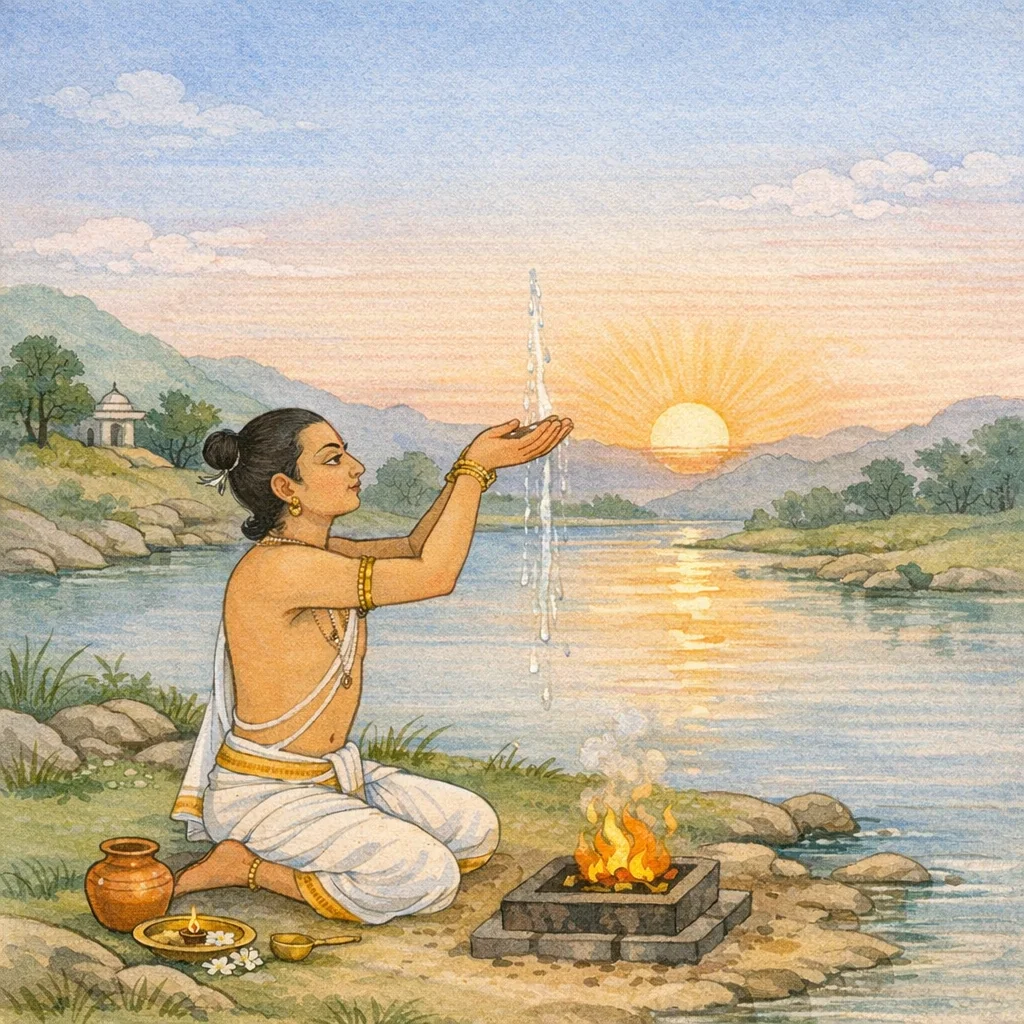
Continuing the Purāṇic transmission of dharma-teachings, Sūta tells Śaunaka a framework of right conduct (ācāra) traced from Hari’s instruction through Brahmā to Vyāsa. The chapter grounds dharma in Śruti, Smṛti, and śiṣṭācāra, lists core virtues—satya, dāna, dayā, dama—and links dharma with jñāna and mokṣa. It describes varṇa livelihoods and āśrama duties (from brahmacarya to parivrājya), then turns to the gṛhastha’s daily regimen: rising at brahma-muhūrta, performing Sandhyā, rules for elimination, śauca measures with earth and water, ācamana and aṅga-sparśa touch-purifications, dental hygiene, and the primacy of the dawn bath. It explains sins to be washed away, the necessity of Sandhyā to protect Sūrya from the Mandehas, the merit of self-performed homa, and the centrality of Oṃ and Gāyatrī japa. It further covers worship order, tarpaṇa procedure, ethics of giving, types of wealth, and concludes by promising heavenly merit to those who recite or hear this ācāra-teaching—presenting daily discipline as the bridge to later discussions of rite, purity, and dharmic living.
Shlokas
Verse 1
ऽध्यायः सूत उवाच / हरेः श्रुत्वाब्रवीद्ब्रह्मा यथा व्यासाय शौनक / ब्राह्मणादिसमाचारं सर्वदं ते तथा वदे
Sūta said: O Śaunaka, having heard the teaching of Hari, Brahmā spoke to Vyāsa; in the same way I shall tell you the proper conduct and right observances, beginning with those of the brāhmaṇas, bestowing every benefit.
Verse 2
श्रुतिस्मृती तु विज्ञाय श्रौतं कर्म समाचरेत् / श्रौतं कर्म न चेदुक्तं तदा स्मार्तं समाचरेत्
Having rightly understood the Śruti and the Smṛti, one should perform the Śrauta rites ordained by the Veda. If, for a given matter, no Śrauta procedure is stated, then one should perform the Smārta rite grounded in tradition.
Verse 3
तत्राप्यशक्तः करणे सदाचारं चरेद्वुधः / श्रुतिस्मृती ह विप्राणां लोचने कर्मदर्शने
Even there, if one lacks the ability to perform the act, the wise should still abide in right conduct (sadācāra). For brāhmaṇas, the Śruti and the Smṛti are indeed the two eyes by which deeds are discerned and judged.
Verse 4
श्रुत्युक्तः परमो धर्मः स्मृतिशास्त्रगतो ऽपरः / सिष्टाचारेण संप्राप्तस्त्रयो धर्माः सनातनाः
The highest Dharma is that taught in the Śruti (the Veda); another is that found in the Smṛti-śāstras; and the third is that established through the conduct of the virtuous and learned. These three are the eternal forms of Dharma.
Verse 5
सत्यं दानं दयालोभो विद्येज्या पूजनं दमः / अष्टौ तानि पवित्राणि शिष्टाचारस्य लक्षणम्
Truthfulness, charity, compassionate generosity, reverence for learning and for worship, honoring the worthy, and self-restraint—these eight are sacred; they are the defining marks of śiṣṭācāra, righteous and cultured conduct.
Verse 6
तेजोमयानि पूर्वेषां शरीराणीन्द्रियाणि च / न लिप्यते पातकेन पद्मपत्रमिवाम्भसा
The bodies and sense-faculties of the pure ones of old are fashioned of radiance; therefore sin does not stain them—just as water does not wet the lotus leaf.
Verse 7
निवासमुख्या वर्णानां धर्माचाराः प्रकीर्तिताः / सत्यं यज्ञस्तपो दानमेतद्धर्मस्य लक्षणम्
The righteous codes of conduct for the social orders—beginning with proper dwelling and livelihood—have been proclaimed. Truth, yajña (sacrificial worship), tapas (austerity), and dāna (charitable giving): these are the marks of Dharma.
Verse 8
अदत्तस्यानुपादानं दानमध्ययनं जपः / विद्या वित्तं तपः शौचं कुले जन्म त्वरोगिता
Not taking what has not been given; dāna (charity); study of sacred teaching; japa, the repetition of mantra; learning; wealth; tapas (austerity); purity; birth in a good family; and freedom from illness—these are counted as virtues and auspicious endowments.
Verse 9
संसारोच्छित्तिहेतुश्च धर्मादेव प्रवर्तते / धर्मात्सुखं च ज्ञानं च ज्ञानान्मोक्षो ऽधिगम्यते
The cause that ends the bondage of saṃsāra arises from Dharma alone. From Dharma come happiness and true knowledge; and from knowledge, mokṣa—liberation—is attained.
Verse 10
इज्याध्ययनदानानि यथाशास्त्रं सनातनः / ब्रह्मक्षत्त्रियवैश्यानां सामान्यो धर्म उच्यते
Worship through sacrificial rites (ijyā/yajña), study, and dāna (charitable giving)—performed in accordance with the śāstras—are declared to be the eternal, common Dharma for Brahmins, Kshatriyas, and Vaishyas.
Verse 11
याजनाध्ययने शुद्धे विशुद्धाच्च प्रतिग्रहः / वृत्तित्रयमिदं प्राहुर्मुनयः श्रेष्ठवर्णिनः
The sages declare that three pure means of livelihood for the best among the twice-born are: officiating at yajñas, studying and teaching sacred learning, and accepting gifts only from those who are themselves pure.
Verse 12
शस्त्रेणाजीवनं राज्ञो भूतानाञ्चाभिरक्षणम् / पाशुपाल्यं कृषिः पण्यं वैश्यस्याजीवनं स्मृतम्
A king’s livelihood is by bearing arms and by protecting all living beings. Cattle-rearing, agriculture, and trade are remembered as the means of livelihood for a Vaiśya.
Verse 13
शूद्रस्य द्विजशुश्रूषा द्विजानामनुपूर्वशः / गुरौ वासो ऽग्निशुश्रूषा स्वाध्यायो ब्रह्मचारिणः
For a Śūdra, the prescribed duty is service to the twice-born (dvija), in proper order. For a brahmacārin (student), the duties are dwelling with the teacher, tending the sacred fire, and daily study of the Veda.
Verse 14
त्रिः स्नाता स्नापिता भैक्ष्यं गुरौ प्राणान्तिकी स्थितिः / समेखलो जटी दण्डी मुण्डी वा गुरुसंश्रयः
He should bathe three times a day, help keep others purified (by assisting in their bathing), live on alms, and remain devoted to his teacher even unto life’s end. Wearing a single waist-cord, with matted hair, carrying a staff, or with a shaven head—he should take refuge in the Guru.
Verse 15
अग्निहोत्रोपचरणं जीवनं च स्वकर्मभिः / धर्मदारेषु कल्पेत पर्ववर्जं रतिक्रियाः
One should maintain the Agnihotra and sustain one’s life through one’s own rightful work. Sexual union should be undertaken only with one’s lawful wife, avoiding it on sacred observance days (parva-days).
Verse 16
देवपित्रतितिभ्यश्च पूजादिष्वनुकल्पनम् / श्रुतिस्मृत्यर्थसंस्थानं धर्मो ऽयं गृहमेधिनः
To make due provisions for worship and related rites for the gods, the ancestors (pitṛs), and guests, and to ground one’s conduct in the intent of Śruti and Smṛti—this is the dharma of the householder (gṛhamedhin).
Verse 17
जटित्वमग्निहोत्रत्वं भूशय्याजिनधारणम् / वने वासः पयोमूलनीवारफलवृत्तिता
Matted locks (jaṭā), the keeping of the sacred Agnihotra fire-offering, sleeping upon bare ground, wearing a deerskin, dwelling in the forest, and living on milk, roots, wild rice, and fruits—these are the outward marks of an ascetic life.
Verse 18
प्रतिषिद्धान्निवृत्तिश्च त्रिः स्नानं व्रतधारिता / देवतातिथिपूजा च धर्मो ऽयं वनवासिनः
Refraining from forbidden food, bathing three times daily, holding fast to one’s vows (vrata), and worshipping the deities as well as honoring worthy guests—this is the dharma of those who dwell in the forest.
Verse 19
सर्वारम्भपरित्यागो भिक्षान्नं वृक्षमूलता / निष्परिग्रहताद्रोहः समता सर्वजन्तुषु
Renouncing all new undertakings, living on alms, dwelling at the foot of a tree, possessing nothing, being free from malice, and holding equal-mindedness toward all beings—these are the marks of disciplined detachment.
Verse 20
प्रियाप्रियपरिष्वङ्गेसुखदुः खाधिकारिता / सबाह्याभ्यन्तरे शौचं वाग्यमो ध्यानचारिता
True happiness and true sorrow are governed by one’s clinging to the embrace of what is dear and what is not dear. Outer and inner purity, restraint of speech, and a life of meditation—these are the disciplines that lead to steadiness and right conduct.
Verse 21
सर्वैद्रियसमाहारो धारणाध्याननित्यता / भावसंशुद्धिरेत्येष परिव्राड्धर्म उच्यते
The drawing-in of all the senses, constant practice of dhāraṇā and dhyāna, and the purification of one’s inner disposition—this is what is called the dharma of the wandering renunciate (parivrājaka).
Verse 22
अहिंसा सूनृता वाणी सत्यशौचे क्षमा दया / वर्णिनां लिङ्गिनां चैव सामान्यो धर्म उच्यते
Non-violence, gentle and truthful speech, truthfulness and purity, forgiveness, and compassion—these are declared to be the universal dharma common to all, whether householders of the social orders or renunciants bearing the outward marks of ascetic life.
Verse 23
यथोक्तकारिणः सर्वे प्रयान्ति परमां गतिम् / आ बोधात्स्वपनं यावत् गृहिधर्मं च वच्मि ते
All who act exactly as enjoined attain the highest state. From the moment of waking until the time of sleep, I shall tell you the duties of a householder.
Verse 24
ब्राह्मे मुहूर्ते बुध्येत धर्मार्थौ चानुचिन्तयेत् / कायक्लेशांश्च तन्मूलान्वेदतत्त्वार्थमेव च
One should awaken at the brāhma-muhūrta (the sacred pre-dawn hour) and reflect upon dharma and artha. One should also contemplate bodily afflictions and their root causes, and the true purport of Vedic reality.
Verse 25
शर्वर्यन्ते समुत्थाय कृतशौचः समाहितः / स्नात्वा सन्ध्यामुपासीत सर्वकालमतन्द्रितः
At the end of the night, rising up, purified and composed, one should bathe and perform worship of the Sandhyā (twilight prayers) at all times, remaining ever vigilant and unlazy.
Verse 26
प्रातः सन्ध्यामुपा सीत दन्तधावनपूर्विकाम् / उभे मूत्रपुरीषे च दिवा कुर्यादुदङ्मुखः
In the morning one should perform the Sandhyā worship, having first cleaned the teeth. And during the daytime, one should attend to both urination and defecation facing north.
Verse 27
रात्रौ च दक्षिणे कुर्यादुभे सन्ध्ये यथा दिवा / छायायामन्धकारे वा रात्रौ वाहनि वा द्विजः
Even at night, the twice-born (dvija) should perform both Sandhyā rites facing south, just as by day—whether in shade or in darkness, and even while traveling at night.
Verse 28
यथा तु समुखः कुर्यात्प्राणबाधाभयेषु च / गोमयाङ्गारवल्मीकफालाकृष्टे शुभे
Likewise, when there is danger to life or fear of harm, one should proceed facing straight ahead. And it is deemed auspicious to encounter or step upon cow-dung, live embers, an anthill (valmīka), or ground freshly turned by the ploughshare.
Verse 29
मार्गोपजीव्यच्छायासु न मूत्रं च पुरीषकम् / अन्तर्जलाद्देवगृहाद्वल्मीकान्मूषिकस्थलात्
One should not urinate or defecate on public pathways, in places where people earn their livelihood, or in shade used by others. One should also keep away from water-reservoirs, temples (devagṛha), anthills (valmīka), and places inhabited by mice.
Verse 30
परेषां शौचशिष्टाच्च श्मशानाच्च मृदं त्यजेत् / एकां लिङ्गे मृदं दद्याद्वाम हस्ते मृदं द्विधा
One should discard (avoid using) earth or clay left over from another person’s purification, and also earth taken from a cremation ground (śmaśāna). For cleansing, one portion of earth is applied to the genital organ, and two portions to the left hand.
Verse 31
उभयोर्द्वे च दातव्ये मूत्रशौचं प्रचक्षते / एकां लिङ्गे गुदे तिस्त्रस्तथा वामकरे दश
For both hands, two rinses are prescribed—this is declared to be the purification after urination. One rinse is given for the genital organ, three for the anus, and likewise ten for the left hand.
Verse 32
पञ्च पादे दशैकस्मिन्करयोः सप्तमृत्तिकाः / अर्धप्रसृतिमात्रा तु प्रथमा मृत्तिका स्मृता
Five portions are to be applied to the feet, ten to one (designated) part, and seven portions of clay to the hands. The first portion of clay is said to measure only half a prasṛti.
Verse 33
द्वितीया च तृतीया च तदर्धा परिकीर्तिता / उपविष्टस्तु विण्मूत्रं कर्तुं यस्तु न विन्दति
The second and the third (time-spans) are thus taught, and half of that is also mentioned. But one who, even after sitting down, is unable to pass stool or urine is said to be in that condition.
Verse 34
स कुर्यादर्धशौचं तु स्वस्य शौचस्य सर्वदा / दिवा शौचस्य रात्र्यर्धं यद्वा पादो विधीयते
He should always observe for himself half of the prescribed purification period (ardha-śauca). If death or impurity occurs by day, the night counts as half; alternatively, it is sometimes prescribed as only a quarter (pāda) of the full period.
Verse 35
स्वस्थस्य तु यथोद्दिष्टमार्तः कुर्याद्यथाबलम् / वसा शुक्रमसृङ् मज्जा लाला विण्मूत्रकर्णविट्
Whatever has been prescribed for a healthy person, an afflicted person should perform according to his strength. (The bodily substances referred to are:) fat, semen, blood, marrow, saliva, feces, urine, and ear-wax.
Verse 36
श्लेष्माश्रदूषिका स्वेदो द्वादशैते नृणां मलाः / मन्येत यावता शुद्धिं तावच्छौचं समाचरेत्
Phlegm, tears, nasal mucus, and sweat—these are counted among the twelve bodily impurities of human beings. Therefore, one should observe rules of cleanliness for as long as one considers oneself to have attained purity.
Verse 37
प्रमाणं शौचसंख्याया नादिष्टैरवशिष्यते / शौचं तु द्विविधं प्रोक्तं बाह्यमाभ्यन्तरं तथा
When the prescribed rules are not observed, no fixed measure remains for counting acts of purification. Śauca (purity) is declared to be of two kinds: external and internal.
Verse 38
मृज्जलाभ्यां स्मृतं बाह्यं भावशुद्धिरथान्तरम् / त्रिराचामेदपः पूर्वं द्विः प्रमृज्यात्ततो मुखम्
External purity is taught as cleansing with earth (or ash) and water; inner purity is the purification of one’s intention. First one should perform ācamana with water three times, and then wipe the face twice.
Verse 39
संमृज्याङ्गुष्ठमूलेन त्रिभिरास्यमुपस्पृशेत् / अङ्गुष्ठेन प्रदेशिन्या घ्राणं पश्चादनन्तरम्
After wiping (the hand), one should touch the mouth with the base of the thumb together with the three fingers; thereafter, without delay, one should touch the nostrils with the thumb and the forefinger.
Verse 40
अङ्गुष्ठानामिकाभ्यां च चक्षुः श्रोत्रे पुनः पुनः / कनिष्ठाङ्गष्ठयोर्नाभिं हृदयं तु तलेन वै
With the thumb and ring-finger, one should repeatedly touch (purify) the eyes and the ears; with the little finger and the thumb, the navel; and with the palm indeed, the heart-region.
Verse 41
सर्वाभिस्तु शिरः पश्चाद्बाहू चाग्रेण संस्पृशेत् / ऋचो यजूंषि सामानि त्रिः पठन्प्रीणयेत्क्रमात्
With those sacred utterances one should touch the head from behind and the arms from the front; then, reciting in order the Ṛk, Yajus, and Sāman three times, one should duly satisfy and sanctify them step by step.
Verse 42
इतिहासपुराणानि वेदाङ्गानि वेदाङ्गानि यथाक्रमम्
In proper order one should study the Itihāsas and Purāṇas, and likewise the Vedāṅgas—each in its prescribed sequence.
Verse 43
खं मुखे नासिके वायुं नेत्रे सूर्यं श्रुती (तीर्दि) दिशः / प्राणग्रन्थिमथो नाभिं ब्रह्माणं हृदये स्पृशेत्
One should contemplate space in the mouth, wind in the nostrils, the Sun in the eyes, and the directions in the ears; then place awareness upon the vital knot, the navel, and Brahmā in the heart.
Verse 44
रुद्रं मूर्ध्ना समालभ्य प्रीणात्यथ शिखामृषीन् / बाहू यमेन्द्रवरुणकुबेरवसुधानलान्
By touching and consecrating the head one propitiates Rudra; then, by sanctifying the topknot (śikhā), one pleases the sages. By sanctifying the arms, one propitiates Yama, Indra, Varuṇa, Kubera, Vasudhā (Earth), and Agni.
Verse 45
अभ्युक्ष्य चरणौ विष्णुमिन्द्रं विष्णु करद्वयम् / अग्निर्वायुश्च सूर्येन्दुगिरयो ऽङ्गुलिपर्वसु
Having ritually sprinkled water, one should contemplate Viṣṇu in the feet; Indra and Viṣṇu in the two hands; and in the joints of the fingers remember Agni, Vāyu, the Sun, the Moon, and the mountains.
Verse 46
गङ्गाद्याः सरितस्तासु या रेखाः करमध्यगाः / उषः काले तु संप्राप्ते शौचं कृत्वा यथार्थवत्
Among sacred rivers such as the Gaṅgā are those holy lines that run through the middle of the palm; when the time of dawn has arrived, one should perform purification (śauca) properly, in the prescribed manner.
Verse 47
ततः स्नानर्ं प्कुर्वीत दन्तधावनपूर्वकम् / मुखे पर्युषिते नित्यं भवत्यप्रयतो नरः
Thereafter one should perform the purifying bath (snāna), preceded by cleansing the teeth. If the mouth remains stale and unpurified each day, a man becomes unfit and negligent in purity and discipline.
Verse 48
तस्मात्सर्वप्रयत्नेन कुर्याद्वै दन्तघावनम् / कदम्बबिल्वखदिरकरवीरवटार्जुनाः
Therefore, with every effort one should indeed cleanse the teeth; twigs of kadamba, bilva, khadira, karavīra, vaṭa, and arjuna are recommended for this purpose.
Verse 49
यूथी च बृहती जाती करञ्जार्कातिमुक्तकाः / जम्बूमधूका पामार्गशिरीषोदुम्बरासनाः
Also mentioned are yūthī, bṛhatī, and jātī; karañja, arka, and atimuktaka; as well as jambū and madhūka, pāmārga, śirīṣa, udumbara, and āsana—these are the plants and trees enumerated here.
Verse 50
क्षीरिकण्टकिवृक्षाद्याः प्रशस्ता दन्तधावने / कटुतिक्तकषायाश्च धनारोग्यसुखप्रदाः
Plants such as the kṣīrikaṇṭakī tree and others are praised for cleansing the teeth; being pungent, bitter, and astringent in taste, they bestow prosperity, health, and well-being.
Verse 51
प्रक्षाल्य भुक्त्वा च शुचौ देशे त्यक्त्वा तदाचामेत् / अमायां च तथा षष्ठ्यां नवम्यां प्रतिपद्यपि
Having washed (hands, feet, and mouth), one should eat in a clean place; and after finishing, one should perform ācamana, the ritual sipping of water. This is to be observed especially on amāvāsyā (new-moon day), on ṣaṣṭhī (the sixth lunar day), on navamī (the ninth), and also on pratipad (the first lunar day).
Verse 52
वर्जयेद्दन्तकाष्ठन्तु तथैवार्कस्य वासरे / अभावे दन्त काष्ठस्य निषिद्धायां तथा तिथौ
One should avoid the tooth-stick (dantakāṣṭha), and likewise refrain from it on the Sun’s day (Sunday). If a tooth-stick is unavailable, then on prohibited lunar dates (niṣiddhā tithi) also one should abstain.
Verse 53
अषां द्वादशगण्डूषैः कुर्वीत मुखशोधनम् / प्रातः स्नानं प्रशंसन्ति दृष्टादृष्टकरं हितम्
With twelve rinses of water one should cleanse the mouth. Bathing at dawn is praised as wholesome, bestowing good results both seen (worldly) and unseen (spiritual).
Verse 54
सर्वमर् हति शुद्धात्मा प्रातः स्नायी जपादिकम् / अत्यन्तमलिनः कायो नवच्छिद्रसमन्वितः
One whose soul is pure is worthy of every dharmic duty—dawn-bathing, japa, and related observances. Yet the body is exceedingly impure, furnished with nine openings.
Verse 55
स्त्रवत्येष दिवा रात्रौ प्रातः स्नानं विशोधनम् / मनः प्रसादजननं रूपसौभाग्यवर्धनम्
It flows forth by day and by night; bathing at dawn is purification. It brings serenity to the mind and increases beauty and good fortune.
Verse 56
शोकदुः खप्रशमनं गङ्गास्नानवदाचरेत् / अद्य हस्ते तु नक्षत्रे दशम्यां ज्येष्ठके सिते
To soothe grief and suffering, one should perform this observance as though bathing in the Gaṅgā. Today—when the nakṣatra is Hasta, on the tenth tithi, in the bright fortnight of the month Jyeṣṭha—it is especially to be undertaken.
Verse 57
दशपाप हरायां च अदत्वा दानकल्मषम् / विरुद्धाचरणं हिंसा परदारोपसेवनम्
These are counted among the ten sins: taking what belongs to another; the stain of withholding dāna—failing to give when one ought; conduct opposed to dharma; violence (hiṃsā); and consorting with another’s spouse.
Verse 58
पारुष्यानृतपैशुन्यमसम्बद्धाभिभाषणम् / परद्रव्याभिधानं च मनसानिष्टचिन्तनम्
Harsh speech, falsehood, slander, and incoherent talk; speaking of or laying claim to another’s wealth; and, within the mind, dwelling on harmful and undesirable thoughts—these are counted among sinful tendencies.
Verse 59
एतद्दशाघघातार्थं गङ्गास्नानं करोम्यहम् / प्रातः संक्षेपतः स्नानं वानप्रस्थगृहस्थयोः
“To destroy these ten sins, I perform a bath in the Gaṅgā. In brief: the morning bath is prescribed for the householder (gṛhastha) and the forest-dweller (vānaprastha).”
Verse 60
यतेस्त्रिषवणं स्नानं सकृत्त ब्रह्मचारिणः / आचम्य तीर्थमावाह्य स्नायात्स्मृत्वाव्ययं हरिम्
For the yati (ascetic), bathing is prescribed three times a day; for the brahmacārin, once. Having performed ācamana and invoked the sanctity of a tīrtha, one should bathe while remembering Hari, the imperishable Lord.
Verse 61
तिस्रः कोट्यस्तु विज्ञेया मन्देहा नाम राक्षसाः / उदयन्तं दुरात्मानः सूर्यमिच्छन्ति खादितुम्
Know that they are three koṭis in number—the Rākṣasas called Mandehas. Those wicked-souled beings desire to devour the Sun as it rises.
Verse 62
स हन्ति सूर्यं सन्ध्यायां नोपास्तिं कुरुते तु यः / दहन्ति मन्त्रपूतेन तोयेनानलरूपिणा
Whoever does not perform the prescribed worship at the time of Sandhyā is said to “kill the Sun”; such a one is burned by water sanctified with mantras, taking on the form of fire.
Verse 63
अहोरात्रस्य यः सन्धिः सा सन्ध्या भवतीति ह / द्विनाडिका भवेत्सन्ध्या यावद्भवति दर्शनम्
The junction of day and night is indeed called “Sandhyā”. Sandhyā lasts for two nāḍikās—so long as there remains visibility (of the sun’s presence).
Verse 64
गन्ध्याकर्मावसाने तु स्वयं होमो विधीयते / स्वयं होमफलं यत्तु तदन्येन न जायते
At the conclusion of the gandhya rite (of fragrance/anointing), one should perform the homa oneself. The merit born of one’s own homa is unique; it does not arise in the same way when done by another.
Verse 65
ऋत्विक्पुत्रो गुरुर्भ्राता भागिनेयो ऽथ विट्पतिः / एभिरेव हुतं यत्तु तद्धुतं स्वयमेव हि
The son of the officiating priest (ṛtvij), the guru, a brother, a sister’s son, and the head of one’s community—whatever oblation is offered through these persons is indeed regarded as offered by oneself.
Verse 66
ब्रह्मा वै गार्हपत्याग्निर्दक्षणाग्निस्त्रिलोचनः / विष्णुराहवनीयाग्निः कुमारः सत्य उच्यते
Brahmā indeed is the Gārhapatya fire (the household fire); the three-eyed one (Śiva) is the Dakṣiṇa fire; Viṣṇu is the Āhavanīya fire (the offering fire); and Kumāra (Skanda) is said to be Truth.
Verse 67
कृत्वा होमं यथाकालं सौरान्मन्त्राञ्जपेत्ततः / समाहितात्मा सावित्रीं प्रणवं च यथोदितम्
Having performed the homa, the fire-offering, at the proper time, one should thereafter recite the solar mantras; with a collected mind, one should also repeat the Sāvitrī (Gāyatrī) and the sacred syllable Oṃ, as prescribed.
Verse 68
प्रणवे नित्ययुक्तस्य व्याहृतीषु च सप्तसु / त्रिपदायां च सावित्र्यां न भयं विद्यते क्वचित्
For one who is constantly devoted to the sacred syllable Oṃ, to the seven vyāhṛtis, and to the three-footed Sāvitrī (Gāyatrī), fear does not arise anywhere at all.
Verse 69
गायत्त्रीं यो जपेन्नित्यं कल्यमुत्थाय मानवः / लिप्यते न स पापेन पद्मपत्रमिवाम्भसा
A person who rises at dawn and daily recites the Gāyatrī is not tainted by sin—just as a lotus leaf is not wetted by water.
Verse 70
श्वेतवर्णा समुद्दिष्टा कौशैयवसना तथा / अक्षसूत्रधरा देवी पद्मासनगता शुभा
She is described as white in complexion, clad in silk garments; the auspicious Goddess holds a rosary (akṣa-sūtra) and is seated upon a lotus-seat.
Verse 71
आवाह्य यजुपानेन तेजो ऽसीति विधानतः / एतद्यजुः पुरा दैवैर्दृष्टिदर्शनकाङ्क्षिभिः
Having invoked the sacred presence with the Yajus-recitation in accordance with the prescribed rule—uttering, “You are tejas, splendour”—this Yajus-formula was formerly perceived by the Devas who longed for vision and direct realization.
Verse 72
आदित्यमण्डलान्तः स्थां ब्रह्मलोकस्थितामपि / तत्रावाह्य जपित्वातो नमस्काराद्विसर्जयेत्
Having invoked there the sacred presence abiding within the solar orb—indeed even that established in Brahmaloka—one should then recite the mantra; thereafter, with reverential namaskāra, one should ritually dismiss the invoked presence.
Verse 73
पूर्वाह्न एव कुर्वीत देवतानां च पूजनम् / न विष्णोः परमो देवस्तस्मात्तं पूजयेत्सदा
One should perform the worship of the deities in the forenoon itself. For there is no deity higher than Viṣṇu; therefore one should always worship Him.
Verse 74
ब्रह्मविष्णुशिवान्देवान्न पृथग्भावयेत्सुधीः / लोके ऽस्मिन्मङ्गलान्यष्टौ ब्राह्मणो गौर्हुताशनः
A wise person should not conceive Brahmā, Viṣṇu, and Śiva—and the gods—as separate from one another. In this world there are eight auspicious supports; among them are the Brāhmaṇa, the cow, and the sacred fire.
Verse 75
हिरण्यं सर्पिरादित्य आपो राजा तथाष्टमः / एतानि सततं पश्येदर्चयेच्च प्रदक्षिणम्
One should constantly behold and worship with reverence—performing pradakṣiṇa as well—these: gold, ghee, the Sun, water, and the King as the eighth object of veneration.
Verse 76
वेदस्याध्ययनं पूर्वं विचारोभ्यसनं जपः / तद्दानं चैव शिष्यभ्यो वेदाभ्यासो हि पञ्चधा
The discipline of Vedic practice is indeed fivefold: first, study of the Veda; then reflective inquiry; repeated practice; recitation as japa; and also the gifting of that knowledge by imparting it to one’s disciples.
Verse 77
वेदार्थं यज्ञशास्त्राणि धर्मशास्त्राणि चैव हि / मूल्येन लेखयित्वा यो दद्याद्याति स वैदिकम्
Whoever, at his own expense, has the meanings of the Vedas—together with the treatises on yajña and the Dharma-śāstras—written down and then donates those manuscripts, attains the Vedic, meritorious state.
Verse 78
ब्रह्मदानसमं पुण्यं प्राप्नोति द्विगुणीकृतम्
One attains merit equal to brahma-dāna—the gift of sacred knowledge—and that merit is doubled.
Verse 79
मृतीये च तथा भागे पोष्यवर्गार्थसाधनम् / माता पिता गुरुर्भ्राता प्रजा दीनाः समाश्रिताः
Likewise, a third portion should be set aside to support those who must be maintained—one’s mother and father, one’s teacher, one’s brother, one’s dependents and subjects, and the helpless who have taken refuge.
Verse 80
अभ्यागतो ऽतिथिश्चाग्निः पोष्यवर्गा उदाहृतः / भरणं पोष्यवर्गस्य प्रशस्तं स्वर्गसाधनम्
The guest who arrives is declared to be verily like Fire (Agni) and is included among those who must be cared for. Supporting and sustaining those who are to be cared for is praised as a means to attain heaven.
Verse 81
भरणं पोष्य वर्गस्य तस्माद्यत्नेन कारयेत् / स जीवति वरश्चैको बहुभिर्योपजीव्यति
Therefore one should diligently provide maintenance for those dependent upon him; for that single excellent person truly lives by whom many others are able to live.
Verse 82
जीवन्तो मृतकास्त्वन्ये पुरुषाः स्वोदरम्भराः / स्वकीयोदरपूर्तिश्च कुक्कुरस्यापि विद्यते
Though alive, some men are as good as dead—those who live only to fill their own belly; for even a dog can fill its own stomach.
Verse 83
अर्थेभ्यो ऽपि विवृद्धेभ्यः सम्भूतेभ्यस्ततस्ततः / क्रियाः सर्वाः प्रवर्तन्ते पर्वतेभ्य इवापगाः
From resources—wealth and means—once they have increased and arisen from various sources, all actions and undertakings begin to flow forth, just as rivers stream down from mountains.
Verse 84
सर्वरत्नाकरा भूमिर्धान्यानि पशवः स्त्रियः / अर्थस्य कार्ययोगित्वादर्थ इत्यभिधीयते
Land, a repository of all gems, along with grains, cattle, and women—because they are fit to accomplish one’s purposes—are collectively designated as ‘artha’ (material means, wealth).
Verse 85
अद्रोहेणैव भूतानामल्पद्रोहेण वा पुनः / या वृत्तिस्तां समास्थाय विप्रो जीवेदनापदि
Without harming living beings—or at least with the least possible harm—whatever livelihood accords with that, a Brahmin should adopt and live by it, so long as there is no emergency.
Verse 86
धनं तु त्रिविधं ज्ञेयं शुक्लं शबलमेव च / कृष्णं च तस्य विज्ञेयो विभागः सप्तधा पृथक्
Wealth should be understood as threefold—pure (white), mixed (variegated), and dark (black). Moreover, its division is to be known separately in seven distinct ways.
Verse 87
क्रमायत्तं प्रीतिदत्तं प्राप्तं च सह भार्यया / अविशेषेण सर्वेषां वर्णानां त्रिविधं धनम्
For all the varṇas alike, wealth is of three kinds: that gained by due succession (inheritance), that given out of affection, and that obtained together with one’s wife (marital property, dowry, and allied gains).
Verse 88
वैशेषिकं धनं दृष्टं ब्राह्मणस्य त्रिलक्षणम् / याजनाध्यापने नित्यं विशुद्धश्च (द्धाच्च) प्रतिग्रहः
The distinctive, proper wealth of a brāhmaṇa is known by three marks: constant officiation at sacrifices (yajña), constant teaching of sacred learning, and acceptance of gifts (pratigraha) only when they are pure, rightly obtained, and ritually clean.
Verse 89
त्रिविधं क्षत्रियस्यापि प्राहुर्वैशेषिकं धनम् / शुद्धार्थं लब्धकरजं दण्डाप्तं जयजं तथा
They declare that even for a Kṣatriya there are three distinctive kinds of wealth: pure and rightful wealth, wealth obtained as taxes and revenue, and wealth gained through penalties and also through victory in war.
Verse 90
वैशेषिकं धनं दृष्टं वैश्यस्यापि विलक्षणम् / कृषिगोरक्षवाणिज्यं शूद्रस्यैभ्यस्त्वनुग्रहात्
A distinct form of wealth is indeed seen as especially characteristic of the Vaiśya: agriculture, protection of cattle, and trade. The Śūdra too may pursue these, through the favor and allowance of those (higher orders).
Verse 91
कुसीदकृषिवाणिज्यं प्रकुर्वीत स्वयं परम् (कृतम्) / आपत्काले स्वयं कुर्वन्नैनसा युज्यते द्विजः
A twice-born man (dvija) should not personally take up usury, agriculture, or trade as his principal occupation. Yet in a time of distress, if he himself does so, he becomes bound up with sin.
Verse 92
बहवो वर्तनोपाया ऋषिभिः परिकीर्तिताः / सर्वेषामपि चैवैषां कुसीदमधिकं विदुः
The sages have proclaimed many means of livelihood; yet among them all they know usury—lending for interest (kusīda)—to be the most excessive and blameworthy.
Verse 93
अनावृष्ट्या राजभयान्मूषिकाद्यैरुपद्रवैः / कृष्यादिके भवेद्बाधा सा कुसीदे न विद्यते
In farming and similar livelihoods, obstacles arise from drought, fear of the king, and afflictions such as rats and other pests; but such hindrances are not found in usury (kusīda).
Verse 94
शुक्लपक्षे तथा कृष्णे रजन्यां दिवसेपि वा / उष्णे वर्षति शीते वा वर्धनं न निवर्तते
Whether in the bright fortnight or the dark, whether by night or by day—whether in heat, in rain, or in cold—its increase does not cease.
Verse 95
देशं गतानां या वृद्धिर्नानापण्योपजीविनाम् / कुसीदं कुर्वतः सम्यक् संस्थितस्यैव जायते
The increase of profit that comes to those who journey to other lands—living by many kinds of trade—likewise arises only for one who is securely established and practices interest-lending (kusīda) in the proper way.
Verse 96
लब्धलाभः पितॄन्देवान्ब्राह्मणांश्चैव पूजयेत् / ते तृप्तास्तस्य तद्दोषं शमयन्ति न संशयः
Having obtained gains, one should honor the Pitṛs (ancestors), the Devas, and the Brāhmaṇas. When they are satisfied, they surely pacify that person’s very fault (doṣa), without doubt.
Verse 97
वणिक्कुसीदं दद्याद्यो वस्त्रं गाङ्काञ्चनादिकम् / कृषीवलो ऽन्नपानादियानशय्यासनानि च
A merchant should give in charity capital for trade and lending, as well as cloth and goods such as cows and gold. A farmer should give food and drink, and also conveyances, beds, and seats.
Verse 98
राजभ्यो विंशतिं दत्त्वा पशुस्वर्णादिकं शतम् / पादेनास्य च यावक्यं कुर्यात्संचयमात्मवान्
Having given twenty (as due) to kings and a hundred consisting of cattle, gold, and the like, a self-controlled person should set aside for himself, reserving one quarter as savings, as far as his means allow.
Verse 99
अर्धेन चात्मभरणं नित्यनैमित्तिकांन्वितम् / पादं चेत्यर्थयामस्य मूलभूतं विवर्धयेत्
With one half one should maintain oneself, while remaining engaged in obligatory daily and occasional duties; and with one quarter one should pursue rightful aims—thus one should steadily strengthen the very foundation of a meaningful life.
Verse 100
विद्या शिल्पं भूतिः सेवा गोरक्षा विपणिः कृषिः / वृत्तिर्भैक्ष्यं कुसीदं च दश जीवनहेतवः
Learning, craftsmanship, prosperity, service, protection of cattle, trade, agriculture, livelihood through one’s calling, mendicancy, and moneylending—these are the ten means by which people sustain life.
Verse 101
प्रतिग्रहार्जिता विप्रे क्षत्रिये शस्त्रनिर्जिता / वैश्ये न्यायार्जिताः स्वार्थाः शूद्रे शुश्रूषयार्जिताः
For a brāhmaṇa, wealth is properly obtained through receiving gifts (pratigraha); for a kṣatriya, through victory by arms; for a vaiśya, through gains earned by lawful and just means; and for a śūdra, through earnings acquired by service.
Verse 102
नदी बहूदका शाकमृत्पर्णानि समित्कुशाः / आग्नेयो ब्रह्मघोषश्च विप्राणां धनमुत्तमम्
For Brahmanas, the highest wealth is: a river abundant in water; vegetables and edible greens; earth and leaves for sacred use; firewood and kuśa grass for rites; the holy fire of Agni; and the Vedic chant (brahma-ghoṣa).
Verse 103
अयाचितोपपन्ने तु नास्ति दोषः प्रतिग्रहे / अमृतं तद्विदुर्देवास्तस्मात्तन्नैव वर्जयेत्
When a gift comes of its own accord, unasked, there is no fault in accepting it. The Devas know such unsolicited offering to be like nectar; therefore one should not reject it.
Verse 104
गुरुद्रव्यांश्चौज्जिहीर्षुरर्चिष्यन्दे वतातिथीन् / सर्वतः प्रतिगृह्णीयान्न तुष्येत्तु स्वयं ततः
One who seeks valuable goods, while outwardly honoring the gods and guests, may accept offerings from every side; yet he should not become self-satisfied or complacent because of it.
Verse 105
साधुतः प्रतिगृह्णीयादथ वासाधुतो द्विजः / गुणवानल्पदोषश्च निर्गुणो हि निमज्जति
A twice-born should accept (a gift) from a virtuous person—or even from one not wholly virtuous—if he is endowed with good qualities and only minor faults; for one devoid of virtue truly sinks into ruin.
Verse 106
एवं त्वक्षवृत्त्या वा कृत्वा भरणमात्मनः / कुर्याद्विशुद्धिं परतः प्रायश्चित्तं द्विजोत्तमः
Thus, even if he maintains himself by austere gleaning, the best of the twice-born should thereafter undertake prāyaścitta (expiation) for purification.
Verse 107
चतुर्थे च तथा भागे स्नानार्थं मृद माहरेत् / तिलपुष्पकुशादीनि स्नानं चाकृत्रिमे जले
In the fourth portion (of the prescribed rite or time), one should bring pure earth (clean clay/soil) for bathing; and, taking sesame, flowers, kuśa grass and the like, one should bathe in natural water, not in water made artificial.
Verse 108
नित्यं नैमित्तिकं काम्यं क्रियाङ्गं मलकर्षणम् / मार्जनाचमावगाहाश्चाष्टस्नानं प्रकीर्तितम्
The baths and purifications are proclaimed to be eightfold: the daily bath; the occasional, cause-based bath (naimittika); the desire-motivated bath for a sought result (kāmya); the bath performed as a limb of a rite; the scrubbing that removes impurity; cleansing by wiping or smearing; ācamanam, the purificatory sipping of water; and immersion in water.
Verse 109
अस्नातस्तु पुमान्नार्हे जपाग्निहवनादिषु / प्रातः स्नानं तदर्थं तु नित्यस्नानं प्रकीर्तितम्
A man who has not bathed is unfit for acts such as japa (mantra-recitation), fire-offerings (homa), and the like. Therefore the morning bath, performed for that purpose, is declared to be the daily obligatory bath.
Verse 110
चाण्डालशवविष्ठाद्यान्स्पृष्ट्वा स्नानं रजस्वलाम् / स्नानार्हस्तु यदा स्नाति स्नानं नैमित्तिकं हि तत्
After touching a caṇḍāla, a corpse, excrement, and the like—or after contact with a menstruating woman—when one who is obliged to bathe performs bathing, that bath is indeed a naimittika (occasioned) purification.
Verse 111
पुष्यस्नानादिकं स्नानं दैवज्ञविधिचोदितम् / तद्धि काम्यं समुद्दिष्टं नाकामस्तत्प्रयोजयेत्
Bathing rites such as the Puṣya-bath (Puṣya-snāna), prescribed according to the rules enjoined by an astrologer (daivajña), are described as kāmya acts—performed to obtain a desired result. Therefore, one who is free of such desires should not undertake them.
Verse 112
जप्तुकामः पवित्राणि अर्चिष्यन्देवतातिथीन् / स्नानं समाचरेद्यस्तु क्रियाङ्गं तच्च कीर्तितम्
One who wishes to perform japa, employ purifying substances, worship the deities, and honor guests should first undertake bathing; this bathing is declared an essential limb of the rite.
Verse 113
मलापकर्षणार्थाय प्रवृत्तिस्तत्र नान्यथा / सरः सुदेवखातेषु तीर्थेषु च नदीषु च
This practice of bathing is undertaken solely for the removal of impurity—there is no other purpose. It is to be done in lakes and ponds, at tīrthas (holy bathing-places), and in rivers, including reservoirs said to have been dug by the gods.
Verse 114
स्नानमेव क्रिया यस्मात्क्रियास्नानमतः परम् / अद्भिर्गात्राणि शुध्यन्ति तीर्थस्नानात्फलं लभेत्
Bathing itself is a sacred act; therefore ritual bathing is regarded as supremely important. By water the limbs of the body are purified, and by bathing at a tīrtha one attains the promised spiritual fruit.
Verse 115
मार्जनान्मज्जनैर्मन्त्रैः पापमाशु प्रणश्यति / नित्यं नैमित्तिकं चापि क्रियाङ्गं मलकर्षणम्
By sprinkling purificatory water, by bathing, and by mantra-recitation, sin quickly perishes. Such cleansing—the removal of impurity—is an integral limb of both daily (nitya) and occasional (naimittika) rites.
Verse 116
तीर्थाभावे तु कर्तव्यमुष्णोदकपरोदकैः / भूमिष्ठादुद्धृतं पुण्यं ततः प्रस्त्रवणोदकम्
When a tīrtha is not available, the rite should be performed with hot water and other suitable waters. Water drawn up from the ground is considered meritorious; next in value is spring-water or trickling-flow water.
Verse 117
ततो ऽपि सारसं पुण्यं तस्मान्नादेयमुच्यते / तीर्थतोयं ततः पुण्यं गागं पुण्यं तु सर्वतः
More meritorious still is the holy water of a lake; therefore it is said it should not be refused. More meritorious than that is the water of a tīrtha, a sacred ford; and the Gaṅgā is indeed meritorious in every way, everywhere.
Verse 118
गागं पयः पुनात्याशु पापमामरणान्तिकम् / गयायां च कुरुक्षेत्रे यत्तोयं समुपस्थितम्
The water of the Gaṅgā (Gaṅgā) swiftly purifies the sins that cling to one up to the very brink of death; likewise, the water obtained at Gayā and at Kurukṣetra is supremely purifying.
Verse 119
तस्मात्तु गाङ्गमपरं जानीयात्तोयमुत्तमम् / पुत्रजन्मनि योगेषु तथा संक्रमणे रवेः
Therefore one should know the water of the Gaṅgā (Gaṅgā) as supremely excellent above all others—especially at the birth of a son, on auspicious yogas, and at the Sun’s saṅkramaṇa (solar transit).
Verse 120
राहोश्च दर्शने स्नानं प्रशस्तं निशि नान्यथा / उषस्युषसि यत्स्नानं सन्ध्यायामुदिते रवौ
When Rāhu (Rāhu) is seen—meaning at an eclipse—bathing is praised at night and not otherwise. Likewise, the bathing prescribed at dawn is to be done at dawn, and at sandhyā, at twilight when the Sun has risen.
Verse 121
प्राजापत्येन तत्तुल्यं महापातकनाशनम् / यत्फलं द्वादशाब्दानि प्राजापत्ये कृते भवेत्
The Prājāpatya (Prājāpatya) expiation is equal in effect and destroys great sins; the merit that would arise from performing the Prājāpatya observance for twelve years is obtained thereby.
Verse 122
प्रातः स्नायी तदाप्नोति वर्षेण श्रद्धयान्वितः / य इच्छेद्विपुलान् भोगांश्चन्द्रसूर्यग्रहोपमान्
One who bathes at dawn, endowed with śraddhā (faith), attains the desired fruit within a year—if he seeks abundant enjoyments, comparable to the splendor of the Moon, the Sun, and the heavenly spheres.
Verse 123
प्रातः स्नायी भवेन्नित्यं मासौ द्वौ माघफाल्गुनौ / यस्तु माघं समासाद्य प्रातः स्नायी हविष्यभुक्
In the two months of Māgha and Phālguna, one should bathe each day at dawn. And whoever, upon Māgha’s arrival, bathes early and lives on havis (simple sacrificial fare), gains dharmic merit.
Verse 124
मातरं पितरं वापि भ्रातरं सुहृदं गुरुम्
Whether it be one’s mother or father, a brother, a benevolent friend, or one’s teacher (guru)—even these are included.
Verse 125
यमुद्दिश्य निमज्जेत द्वादशांशं लभेत्तु सः / तुष्यत्यामलकैर्विष्णुरेकादश्या विशेषतः
One who immerses himself in bathing with Yama in mind obtains a twelfth share of the merit. Yet by offering āmalakī (Indian gooseberry), Viṣṇu is especially pleased—most particularly on Ekādaśī.
Verse 126
श्रीकामः सर्वदा स्नानं कुर्वोतामलकैर्नरः / सन्तापः कीर्तिरल्पायुर्धनं निधनमेव च
A man who longs for śrī—prosperity and auspiciousness—should always bathe using āmalaka (Indian gooseberry). From it arise various outcomes: hardship, fame, short life, wealth, and even death.
Verse 127
आरोग्यं सर्वकामाप्तिरभ्यङ्गाद्भास्करादिषु / उपोषितस्य व्रतिनः कृत्तकेशस्य नापितैः
Health and the fulfillment of every desired aim arise from an oil-massage performed on auspicious days such as Sunday and the like; it is enjoined for one who is fasting, observing a vow (vrata), and has had the hair cut by barbers.
Verse 128
तावच्छ्रीस्तिष्ठति प्रीता यावत्तैलं न संस्पृशेत् / एवं स्नात्वा पितॄन्देवान्मनुष्यांस्तर्पयेन्नरः
Prosperity—Śrī—abides lovingly with a person only so long as, after bathing, one does not touch oil. Having bathed in this way, a man should then perform tarpaṇa—ritual offerings of satisfaction—for the Pitṛs (ancestors), the Devas, and also for human beings.
Verse 129
नाभिमात्रे जले स्थित्वा चिन्तयेदूर्जमानसः / आगच्छन्तु मे पितर इमं गृह्णन्त्वपोञ्जलिम्
Standing in water up to the navel, with a steady and energized mind, one should contemplate and pray: “May my Pitṛs come; may they accept this handful of water, offered with joined palms.”
Verse 130
त्रींस्त्रीनेवाञ्जलीन्दद्यादाकाशे दक्षिणे तथा / वसित्वा वसनं शुष्कं स्थलस्था स्तर्णबर्हिषि
One should offer three handfuls of water (añjali) three times to the southern quarter, as if into the open sky. Then, wearing dry clothing, one should remain seated on a clean, dry spot upon spread sacred grass (barhis).
Verse 131
विधिज्ञास्तर्पणं कुर्युर्न पात्रे तु कदाचन / यदपां क्रूरमांसात्तु यदमेध्यं तु किञ्चन
Those who know the proper rites should perform tarpaṇa, but never using an unfit vessel—nor with water polluted by contact with raw meat or by anything impure whatsoever.
Verse 132
अशान्तं मलिनं यच्च तत्सर्वमपगच्छतु / गृहीत्वानेन मन्त्रेण तोयं सव्येन पाणिना
May whatever is restless and whatever is impure—may all of that depart. Taking water with this mantra, one should hold it in the left hand.
Verse 133
प्रक्षिपोद्दिशि नैरृत्यां रक्षो ऽपहतये तु तत् / निषिद्धभक्षणाद्यत्तु पापाद्यच्च प्रतिग्रहात्
One should cast it toward the south‑west direction, for the warding off of rākṣasas. And (it also removes) whatever sin arises from eating what is forbidden and the sin that arises from accepting improper gifts.
Verse 134
दुष्कृतं यच्च मे किञ्चिद्बाङ्मनः कायकर्मभिः / पुनातु मे तदिन्द्रस्तु वरुणः सबृहस्पतिः
Whatever wrongdoing of mine there may be—done by speech, by mind, or by bodily actions—may Indra, Varuṇa, and Bṛhaspati together purify me of that.
Verse 135
सविता च भगश्चैव मुनयः सनकादयः / आब्रह्मस्तम्बपर्यन्तं जगत्तृप्यत्विति ब्रुवन्
Savitṛ and Bhaga, and also the sages beginning with Sanaka, declare: “May the whole world—from Brahmā down to the very blade of grass—be satisfied.”
Verse 136
क्षिपेदबञ्जलींस्त्रीस्तु कुर्वन्संक्षेपतर्पणम् / सुराणामर्चनं कुर्याद्ब्रह्मा दीनाममत्सरी
A woman should offer the water-libations (tarpaṇa) in a concise manner, without forming the full cupped handful (añjali). The officiant (brāhmaṇa), free from envy and compassionate to the distressed, should perform arcanā—worship of the Devas.
Verse 137
ब्राह्मवैष्णवरौद्रैश्च सावित्रैर्मैत्रवारुणैः / तल्लिङ्गैरर्चयेन्मन्त्रैः सर्वदेवान्नमस्य च
With mantras pertaining to Brahmā, to Viṣṇu, and to Rudra—and also with the Sāvitra, Maitra, and Vāruṇa mantras—one should worship according to their respective signs and ritual formulae, and likewise bow in reverence to all the gods.
Verse 138
नमस्कारेण पुष्पाणि विन्यसेत्तु पृथक्पृथक् / सर्वदेवमयं विष्णुं भास्करं चाप्यथार्चयेत्
With reverent salutations, one should place the flowers one by one, separately; then one should worship Viṣṇu—who embodies all the gods—and also worship Bhāskara, the Sun.
Verse 139
दद्यात्पुरुषसूक्तेन यः पुष्पाण्यप एव वा / अर्चितं स्याज्जगादिदं तेन सर्वं चराचरम्
Whoever offers flowers—or even only water—while reciting the Puruṣa Sūkta, thereby worships this entire universe; for by that Supreme Puruṣa all that is moving and unmoving is pervaded and sustained.
Verse 140
अन्यैश्च तान्त्रिकैर्मन्त्रैः पूजयेच्च जनार्दनम् / आदावर्घ्यं प्रदातव्यं ततः पश्चाद्विलेपनम्
And with other Tantric mantras as well, one should worship Janārdana (Lord Viṣṇu). First the arghya, the ceremonial water-offering, should be presented; thereafter the anointing should be performed.
Verse 141
ततः पुष्पाञ्जलिं धूपमु पहारफलानि च / स्नानमन्तर्जले चैव मार्जनाचमनं तथा
Thereafter, one should offer a handful of flowers (puṣpāñjali), incense (dhūpa), and offerings with fruits; and one should also perform the ritual bath (snāna) in water, along with cleansing (mārjana) and ācamana, the purifying sipping of water.
Verse 142
जलाभिमन्त्रणं यच्च तीर्थस्य परिकल्पयेत् / अघमर्षणसूक्तेन त्रिवारं त्वेव नित्यशः
The consecration of water—when preparing sacred tīrtha-water—should be done by reciting the Aghamarṣaṇa hymn exactly three times, every day without fail.
Verse 143
स्नाने चरितमित्येतत्समुद्दिष्टं महात्मभिः / ब्रह्मक्षत्रविशां चैव मन्त्रवत्स्नानमिष्यते
Thus the proper conduct to be observed during bathing has been taught by the great sages. For Brāhmaṇas, Kṣatriyas, and Vaiśyas, bathing accompanied by sacred mantras is enjoined.
Verse 144
तूष्णीमेव तु शूद्रस्य सनमस्कारकं स्मृतम् / अध्यापनं ब्रह्मयज्ञः पितृयज्ञस्तु तर्पणम्
For a Śūdra, silent reverence alone is remembered as the proper form of respectful salutation. Teaching sacred knowledge is the Brahma-yajña, and offering libations—tarpaṇa—is the Pitṛ-yajña.
Verse 145
होमो दैवी बलिर्भौतो न यज्ञो ऽतिथिपूजनम् / गवा गोष्ठे दशगुणं अग्न्यगारे शताधिकम्
Homa is an offering to the gods; bali is an offering to living beings. Honoring a guest should not be regarded as a mere sacrifice. A cow given in charity yields tenfold merit when given at a cowshed, and more than a hundredfold when given at the agni-house, the abode of the sacred fire.
Verse 146
सिद्धक्षेत्रेषु तीर्थेषु देवतायतनेषु च / सहस्रशतकोटीनामनन्तं विष्णुसन्निधौ
In siddha-kṣetras, at tīrthas, and in the temples of the gods as well—near the presence of Viṣṇu—the benefit is limitless, surpassing even thousands, hundreds, and crores of ordinary merits.
Verse 147
पञ्चमे च तथा भागे संविभागो यथार्थतः / पितृदे वमनुष्याणां कोटीनां चोपदिश्यते
Likewise, in the fifth portion, the distribution is taught exactly as it truly is—the allotted shares for the Pitṛs, for the Devas, and for human beings, even reckoned in koṭis (vast multitudes).
Verse 148
ब्राह्मणेभ्यः प्रदायाग्र यः सुहृद्भिः सहाश्नुते / स प्रेत्य लभते स्वर्गमन्नदानं समाचरन्
One who first offers food to the Brāhmaṇas and then eats together with his friends—practising anna-dāna, the gift of food—attains heaven after death.
Verse 149
पूर्वं मधुरमश्रीयाल्लवणाम्लौ च मध्यतः / कटुतिक्तकषायांश्च पयश्चैव तथान्ततः
One should begin with sweet food; in the middle take salty and sour tastes; then pungent, bitter, and astringent tastes—while milk should also be taken at the end.
Verse 150
शाकं च रात्रौ भूमिष्ठमत्यन्तं च विवर्जयेत् / नचैकरससेवायां प्रसज्जेत कदाचन
One should avoid leafy vegetables at night, and completely avoid food that has fallen on the ground. And one should never become addicted to indulging in a single taste.
Verse 151
समृतं ब्राह्मणस्यान्नं क्षत्रियान्नं पयः स्मृतम् / वैश्यस्य चान्नमेवान्नं शूद्रान्नं रुधिरं स्मृतम्
It is taught that a Brāhmaṇa’s ‘food’ is nectar-like; a Kṣatriya’s is milk; a Vaiśya’s is food-grain itself; and a Śūdra’s food is said to be blood.
Verse 152
अमावासी वसेदत्र एकहायनमेव वा
One who keeps the Amāvāsyā vow should dwell here—either for one day and night, or even for a full year.
Verse 153
तत्र श्रीश्चैव लक्ष्मीश्च वसते नात्र संशयः / उदरे गार्हपत्याग्निः पृष्ठदेशे तु दक्षिणः
There, Śrī and Lakṣmī indeed reside—of this there is no doubt. In the belly dwells the Gārhapatya fire, and in the region of the back is the Dakṣiṇa fire.
Verse 154
आस्ये चाहवनीयो ऽग्निः सत्यः पर्व च मूर्धनि / यः पञ्चाग्नीनिमान्वेद आहिताग्निः स उच्यते
In the mouth is the Āhavanīya fire; on the crown of the head are Truth and the sacred junction (parvan). One who knows these five fires is called an Āhitāgni, a consecrated maintainer of the sacred fires.
Verse 155
शरिरमापः सोमं च विविधं चान्नमुच्यते / प्राणो ह्यग्निस्तथादित्यस्त्रिभोक्ता एक एव तु
The body is said to be made of water, of Soma, and of various kinds of food. Yet prāṇa is truly Agni and also the Sun (Āditya); the one Reality alone becomes the threefold enjoyer.
Verse 156
अन्नं बलाय मे भूमेरपामग्न्यनिलस्य च / भवत्येतत्परिणतौ ममाप्यव्याहतं सुखम्
Food becomes strength for me—and also for the earth, the waters, fire, and the wind; and as it is transformed (in digestion and use), it results in unimpeded well-being for me too.
Verse 157
हस्तेन परिमार्ज्याथ कुर्यात्ताम्बूलभक्षणम् / श्रवणं चेतिहासस्य तत्कुर्यात्सुसमाहितः
Then, after wiping the mouth with the hand, one should chew tāmbūla (betel). And one should listen to the sacred narratives (itihāsa) with full attentiveness and composed mind.
Verse 158
ततः सन्ध्यामुपासीत स्नात्वा वै पश्चिमां नरः
Thereafter, having bathed, the man should duly perform the Sandhyā worship facing the western direction.
Verse 159
एतद्वा दिवसे प्रोक्तमनुष्ठानं मया द्विज / आचारं यः पठेद्विद्वाञ्छृणुयात्स दिवंव्रजेत् / आचारादिर्धर्मकर्ता केशवो हि स्मृतो द्विज
O twice-born one, this daily discipline has been taught by me. The learned person who recites this teaching on ācāra (right conduct), or who listens to it, goes to heaven. For Keśava (Viṣṇu), O twice-born, is remembered as the very origin of right conduct and the establisher of Dharma.
Frequently Asked Questions
It prescribes rising at brahma-muhūrta, contemplation of dharma/artha and bodily afflictions, bathing and performing Sandhyā at proper times, maintaining cleanliness (teeth-cleaning, śauca rules), performing homa and solar/Gāyatrī recitations, worship and hospitality, and concluding with evening Sandhyā—structuring the entire day as nitya-karma.
External purity is cleansing with earth/ash and water, while internal purity is the purification of intention (bhāva/saṅkalpa). The text treats both as necessary: bodily cleanliness enables mantra and rite, and inner clarity secures dharmic fruit.
Dawn bath is praised as cleansing, beauty- and serenity-giving, and as immediate preparation for japa and worship. Sandhyā is treated as a cosmic duty safeguarding Sūrya from hostile forces (Mandehas); neglect is condemned to underscore that personal discipline participates in maintaining ṛta (cosmic order).
It classifies wealth as pure, mixed, and dark, and details varṇa-appropriate means of livelihood. It discourages twice-born from usury/agriculture/trade as primary occupations except in distress, praises non-harmful livelihood, and ties prosperity to duties like honoring Devas, Pitṛs, Brāhmaṇas, and supporting dependents and guests.