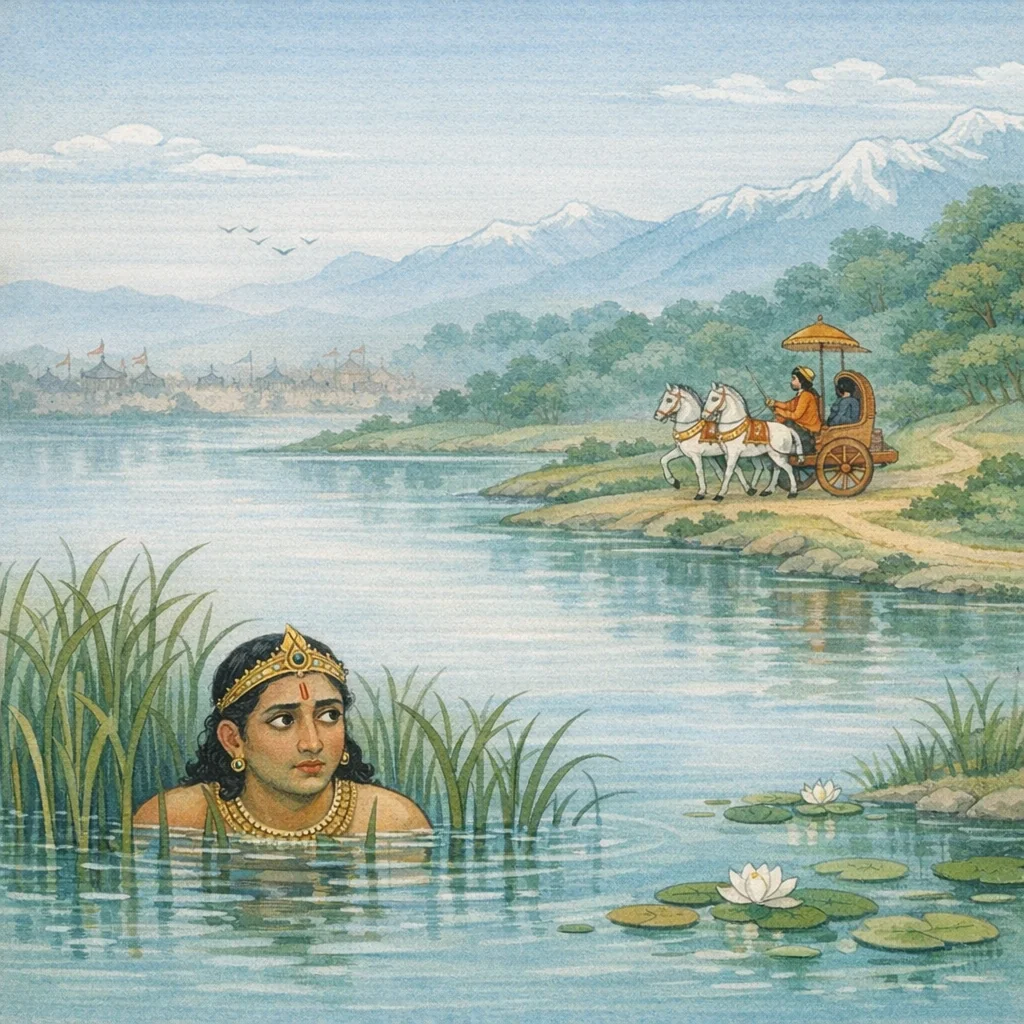
Adhyaya 29
द्वैपायनह्रदे दुर्योधनान्वेषणम् / The Search for Duryodhana at Dvaipāyana Lake
Upa-parva: Dvaipāyana-hrada-praveśa (Episode: Duryodhana’s concealment in the lake)
Dhṛtarāṣṭra questions Saṃjaya about the actions of the Kaurava remnants after the general destruction of forces. Saṃjaya reports that Kṛpa, Kṛtavarmā, and Aśvatthāman, alarmed by the victorious Pāṇḍava uproar and finding the camp emptied, move to a lake where Duryodhana lies concealed in the waters, sustaining the water by māyā. They exhort him to rise and fight Yudhiṣṭhira, framing the alternatives of sovereignty or ascent to heaven through death. Duryodhana acknowledges their survival, argues for postponement due to exhaustion and wounds, and proposes resting one night before renewed combat. Aśvatthāman vows—invoking merit from ritual, charity, truth, and japa—that he will strike the Somakas/Pāñcālas and will not remove his armor until that objective is fulfilled. Hunters arrive seeking water, overhear the confidential exchange, recognize Duryodhana’s location, and decide to inform the Pāṇḍavas for reward. They report to Bhīmasena, who compensates them and informs Yudhiṣṭhira. The Pāṇḍavas and allies raise shouts and proceed rapidly to the famed Dvaipāyana lake, while the three Kaurava survivors, permitted by Duryodhana, withdraw and rest beneath a banyan, anxious about what will follow.
Chapter Arc: रणभूमि में बचे-खुचे कौरव दल सहदेव को घेरकर शक्ति-ऋष्टि-प्रास उठाते हैं; सहदेव की विजय को अक्षुण्ण रखने का संकल्प लेकर धनंजय गाण्डीव तानता है। → अर्जुन का प्रतिरोध कौरवों की अंतिम आशा पर वज्र-प्रहार बनता है—हाथी, घोड़े और पदाति चारों ओर से टूटते हैं; उधर पराजय की धूल में दुर्योधन अपने प्राण और प्रतिष्ठा बचाने हेतु सरोवर (हृद) की ओर हटने का निर्णय करता है। → दुर्योधन का ‘हृद’ में प्रवेश और संजय को संदेश—“राजा से कहना, तुम्हारा पुत्र हृद में प्रविष्ट हुआ”—यह क्षण युद्ध के शोर को अचानक एक भयावह मौन में बदल देता है, मानो कौरव-भाग्य जल के नीचे छिप गया हो। → संजय कैद/बन्धन से छूटकर नगर की ओर लौटता है; वह दुर्योधन का कुशल-समाचार और संदेश सुनाता है। विदुर अश्रुपूरित नेत्रों से उपस्थित होते हैं और युयुत्सु से सत्य का विस्तृत कारण पूछते हैं—अब रण का वृत्तान्त राजसभा/अन्तःपुर तक पहुँचने लगता है। → विदुर का प्रश्न—“एतद् वै कारणं सर्व विस्तरेण निवेदय”—आगामी अध्याय के लिए द्वार खोल देता है: दुर्योधन के छिपने का परिणाम क्या होगा, और शेष योद्धा किस निर्णय पर पहुँचेंगे?
Shlokas
Verse 1
अफ-७#कर- (हृदप्रवेशपर्व) एकोनत्रिशो< ध्याय: बची हुई समस्त कौरव-सेनाका वध, संजयका कैदसे छूटना, दुर्योधनका सरोवरमें प्रवेश तथा युयुत्सुका राजमहिलाओंके साथ हस्तिनापुरमें जाना संजय उवाच ततः क्रुद्धा महाराज सौबलस्य पदानुगा: । त्यक्त्वा जीवितमाक्रन्दे पाण्डवान् पर्यवारयन्,संजय कहते हैं--महाराज! तदनन्तर शकुनिके अनुचर क्रोधमें भर गये और प्राणोंका मोह छोड़कर उन्होंने उस महासमरमें पाण्डवोंको चारों ओरसे घेर लिया
Sañjaya said: Then, O King, the followers of Saubala (Śakuni), inflamed with wrath, casting aside all attachment to life, surrounded the Pāṇḍavas on every side amid the tumult of battle. The verse underscores the war-ethic of desperate loyalty and vengeance, where rage and factional allegiance drive men to abandon self-preservation and press the fight to its fatal end.
Verse 2
तानर्जुन: प्रत्यगृह्ञात् सहदेवजये धृतः । भीमसेनश्व तेजस्वी क्रुद्धाशीविषदर्शन:,उस समय सहदेवकी विजयको सुरक्षित रखनेका दृढ़ निश्चय लेकर अर्जुनने उन समस्त सैनिकोंको आगे बढ़नेसे रोका। उनके साथ तेजस्वी भीमसेन भी थे, जो कुपित हुए विषधर सर्पके समान दिखायी देते थे
Verse 3
शक्त्यष्टिप्रासहस्तानां सहदेवं जिघांसताम् | संकल्पमकरोन्मोघं गाण्डीवेन धनंजय:,सहदेवको मारनेकी इच्छासे शक्ति, ऋष्टि और प्रास हाथमें लेकर आक्रमण करनेवाले उन समस्त योद्धाओंका संकल्प अर्जुनने गाण्डीव धनुषके द्वारा व्यर्थ कर दिया
Sañjaya said: Those warriors, weapons in hand—śaktis, aṣṭis, and prāsas—rushed forward intent on killing Sahadeva. But Dhanañjaya (Arjuna), wielding the Gāṇḍīva, rendered their resolve futile, thwarting the attempt and protecting his ally amid the press of battle.
Verse 4
संगृहीतायुधान् बाहूनू योधानामधिधावताम् । भल्लैश्विच्छेद बीभत्सु: शिरांस्पपि हयानपि,सहदेवपर धावा करनेवाले उन योद्धाओंकी अस्त्र-शस्त्रयुक्त भुजाओं, मस्तकों और उनके घोड़ोंको भी अर्जुनने भल्लोंसे काट गिराया
Sañjaya said: As the warriors charged forward with weapons in hand, Bībhatsu (Arjuna) cut down with sharp bhalla-arrows their weapon-bearing arms, their heads, and even their horses—checking their onrush through precise and unsparing force in the midst of battle.
Verse 5
ते हयाः प्रत्यपद्यन्त वसुधां विगतासव: । चरता लोकवीरेण प्रहता: सव्यसाचिना,रणभूमिमें विचरते हुए विश्वविख्यात वीर सव्यसाची अर्जुनके द्वारा मारे गये वे घोड़े और घुड़सवार प्राणहीन होकर पृथ्वीपर गिर पड़े
Sanjaya said: Struck down by the world-renowned hero Savyasācin (Arjuna) as he ranged across the battlefield, those horses collapsed to the earth, their life-breath departed. The scene underscores the grim inevitability of war, where even noble steeds become casualties amid a warrior’s relentless duty in combat.
Verse 6
ततो दुर्योधनो राजा दृष्टवा स्वबलसंक्षयम् | हतशेषान् समानीय क्रुद्धो रथगणान् बहून्
Sañjaya said: Then King Duryodhana, seeing the depletion of his own forces, gathered together the remnants who had survived the slaughter; and, inflamed with anger, he mustered many companies of chariot-warriors. The verse highlights how, when power wanes, a ruler may respond not with reflection or restraint but with wrath and renewed escalation—an ethically fraught turn in the logic of war.
Verse 7
कुण्जरांश्व हयांश्वैव पादातां श्व समन्ततः । उवाच सहितानू् सर्वान् धार्तराष्ट्र इदं वच:
Sañjaya said: Then Dhṛtarāṣṭra addressed all those assembled on every side—elephants, horses, and the foot-soldiers—speaking these words. In the charged moral atmosphere of war, the king’s address signals an attempt to direct and steady his forces, even as the conflict tests duty, loyalty, and restraint.
Verse 8
अपनी सेनाका इस प्रकार संहार होता देख राजा दुर्योधनको बड़ा क्रोध हुआ। उसने मरनेसे बचे हुए बहुत-से रथियों, हाथीसवारों, घुड़सवारों और पैदलोंको सब ओरसे एकत्र करके उन सबसे इस प्रकार कहा-- |। समासाद्य रणे सर्वान् पाण्डवान् ससुहृदगणान् । पाज्चाल्यं चापि सबल॑ हत्वा शीघ्र न्यवर्तत,“वीरो! तुम सब लोग रणभूमिमें समस्त पाण्डवों तथा उनके मित्रोंसे भिड़कर उन्हें मार डालो और पांचालराज धृष्टद्युम्मका भी सेनासहित संहार करके शीघ्र लौट आओ'
Sañjaya said: Seeing his army being destroyed in this manner, King Duryodhana was seized by fierce anger. Gathering from every side the surviving chariot-warriors, elephant-riders, horsemen, and foot-soldiers, he commanded them: “Heroes, engage in battle with all the Pāṇḍavas together with their allied friends; slay them, and also kill the Pāñcāla leader along with his forces, then return quickly.” The verse underscores the hardening of resolve in war: rage and desperation drive Duryodhana toward an annihilative command, intensifying the ethical tragedy of fratricidal conflict.
Verse 9
तस्य ते शिरसा गृहा वचन युद्धदुर्मदा: । अभ्युद्ययू रणे पार्थास्तव पुत्रस्य शासनात्
Sañjaya said: At your son’s command, the Pārthas—made fiercely arrogant by the intoxication of war—rose up for battle, taking his words upon their heads in acceptance and resolve.
Verse 10
राजन! आपके पुत्रकी आज्ञासे उसके उस वचनको शिरोधार्य करके वे रणदुर्मद योद्धा युद्धके लिये आगे बढ़े ।। तानभ्यापतत: शीघ्र॑ं हतशेषान् महारणे । शरैराशीविषाकारै: पाण्डवा: समवाकिरन्
Sañjaya said: “O King, obeying your son’s command and taking his words upon their heads as binding, those warriors—maddened by the pride of battle—advanced to fight. As they rushed forward swiftly, the remnants of the already-smitten host in that great combat were showered by the Pāṇḍavas with arrows shaped like venomous serpents.”
Verse 12
अश्वैरविपरिधावद्धिः सैन्येन रजसा वृते
Sañjaya said: “With horses rushing about in every direction, the army became enveloped in a cloud of dust.”
Verse 13
उस महासमरमें शीघ्रतापूर्वक आक्रमण करनेवाले मरनेसे बचे हुए उन सैनिकोंपर समस्त पाण्डवोंने विषधर सर्पके समान आकारवाले बाणोंकी वर्षा आरम्भ कर दी ।। तत् सैन्यं भरतश्रेष्ठ मुहूर्तेन महात्मभि: । अवध्यत रणं प्राप्य त्रातारं नाभ्यविन्दत,न प्राज्ञायन्त समरे दिश: सप्रदिशस्तथा । चारों ओर दौड़ते हुए घोड़ों तथा सेनाके द्वारा उड़ायी हुई धूलसे वहाँका सारा प्रदेश छा गया था। अतः समरभूमिमें दिशाओं तथा विदिशाओंका कुछ पता नहीं चलता था ।। १२६ || ततस्तु पाण्डवानीकान्नि:सृत्य बहवो जना: भारत! पाण्डव-सेनासे बहुत-से सैनिकोंने निकलकर युद्धमें एक ही मुहूर्तके भीतर आपके सम्पूर्ण योद्धाओंका संहार कर डाला। भरतनन्दन! उस समय आपकी वह सेना सर्वथा नष्ट हो गयी। उसमेंसे एक भी योद्धा बच न सका
Sanjaya said: In that great battle, the Pandavas swiftly began to shower arrows—shaped like venomous serpents—upon those surviving soldiers who were rushing forward in attack. O best of the Bharatas, within a mere moment the great warriors struck down that host as it entered the fray; finding no protector, it could not be saved. In the turmoil of combat they could not discern the directions or the intermediate quarters. Horses racing in every direction and the dust raised by the army blanketed the entire region, so that on the battlefield no sense of orientation remained. The passage underscores the moral desolation of war: when leadership and protection collapse, even courage turns into confusion, and the mass of men is consumed by the impersonal momentum of violence.
Verse 14
अभ्यघ्नंस्तावकान् युद्धे मुहूर्तादिव भारत । ततो नि:शेषमभवत् तत् सैन्यं तव भारत,भारत! पाण्डव-सेनासे बहुत-से सैनिकोंने निकलकर युद्धमें एक ही मुहूर्तके भीतर आपके सम्पूर्ण योद्धाओंका संहार कर डाला। भरतनन्दन! उस समय आपकी वह सेना सर्वथा नष्ट हो गयी। उसमेंसे एक भी योद्धा बच न सका
Sañjaya said: “O Bhārata, the Pāṇḍava forces struck down your men in battle as though within a single muhūrta. Then, O Bhārata, your army was left without remainder—completely destroyed, with none of your warriors surviving.”
Verse 15
अक्षौहिण्य: समेतास्तु तव पुत्रस्य भारत । एकादश हता युद्धे ता: प्रभो पाण्डुसृजयै:,प्रभो! भरतवंशी नरेश! आपके पुत्रके पास ग्यारह अक्षौहिणी सेनाएँ थीं; परन्तु युद्धमें पाण्डवों और सूंजयोंने उन सबका विनाश कर डाला
Sañjaya said: O Bhārata, your son had eleven complete akṣauhiṇīs assembled. Yet in the war, O lord, the Pāṇḍavas together with the Sṛñjayas destroyed them all—underscoring how amassed power and numbers collapse when opposed by resolute, dharma-aligned adversaries and the inexorability of war’s moral and human cost.
Verse 16
तेषु राजसहस्रेषु तावकेषु महात्मसु । एको दुर्योधनो राजन्नदृश्यत भुशं क्षत:,राजन! आपके दलके उन सहस्रों महामनस्वी राजाओंमें एकमात्र दुर्योधन ही उस समय दिखायी देता था; परंतु वह भी बहुत घायल हो चुका था
Sañjaya said: “Among those thousands of high-souled kings on your side, O King, only Duryodhana was then to be seen—and even he was grievously wounded.” The line underscores the moral desolation of war: power and numbers collapse into solitude, and the leader who pursued victory at any cost is left visible chiefly through the mark of suffering.
Verse 17
ततो वीक्ष्य दिश: सर्वा दृष्टवा शून्यां च मेदिनीम् विहीन: सर्वयोधैश्व पाण्डवान् वीक्ष्य संयुगे,उस समय उसे सम्पूर्ण दिशाएँ और सारी पृथ्वी सूनी दिखायी दी। वह अपने समस्त योद्धाओंसे हीन हो चुका था। महाराज! दुर्योधनने युद्धस्थलमें पाण्डवोंको सर्वथा प्रसन्न, सफलमनोरथ और सब ओरसे सिंहनाद करते देख तथा उन महामनस्वी वीरोंके बाणोंकी सनसनाहट सुनकर शोकसे संतप्त हो वहाँसे भाग जानेका विचार किया। उसके पास न तो सेना थी और न कोई सवारी ही
Then, looking in every direction and seeing the earth lying desolate, he realized he had been stripped of all his warriors. And when, on the battlefield, he beheld the Pāṇḍavas—exultant, their aims fulfilled, roaring on all sides like lions—hearing too the whirring rush of those great-souled heroes’ arrows, Duryodhana, scorched by grief, resolved to flee from that place, for he had neither an army left nor even a mount.
Verse 18
मुदितान् सर्वतः सिद्धान् नर्दमानान् समन्ततः । बाणशब्दरवांश्रैव श्रुत्वा तेषां महात्मनाम्,उस समय उसे सम्पूर्ण दिशाएँ और सारी पृथ्वी सूनी दिखायी दी। वह अपने समस्त योद्धाओंसे हीन हो चुका था। महाराज! दुर्योधनने युद्धस्थलमें पाण्डवोंको सर्वथा प्रसन्न, सफलमनोरथ और सब ओरसे सिंहनाद करते देख तथा उन महामनस्वी वीरोंके बाणोंकी सनसनाहट सुनकर शोकसे संतप्त हो वहाँसे भाग जानेका विचार किया। उसके पास न तो सेना थी और न कोई सवारी ही
Sanjaya said: Seeing the Pandava heroes everywhere exultant and fully accomplished in their aims, roaring on all sides like lions, and hearing the whirring, resounding noise of their arrows, Duryodhana—overwhelmed by grief—resolved to flee from that place. In that moment, the directions and the whole earth seemed empty to him, for he had been deprived of his warriors; he had neither an army nor even a mount to rely upon.
Verse 19
दुर्योधनो महाराज कश्मलेनाभिसंवृत: । अपयाने मनश्षुक्रे विहीनबलवाहन:,उस समय उसे सम्पूर्ण दिशाएँ और सारी पृथ्वी सूनी दिखायी दी। वह अपने समस्त योद्धाओंसे हीन हो चुका था। महाराज! दुर्योधनने युद्धस्थलमें पाण्डवोंको सर्वथा प्रसन्न, सफलमनोरथ और सब ओरसे सिंहनाद करते देख तथा उन महामनस्वी वीरोंके बाणोंकी सनसनाहट सुनकर शोकसे संतप्त हो वहाँसे भाग जानेका विचार किया। उसके पास न तो सेना थी और न कोई सवारी ही
Sañjaya said: O King, Duryodhana, overwhelmed by despair, turned his mind toward retreat. Deprived of both army and conveyance, he was shaken at heart—seeing the Pāṇḍavas on the battlefield exultant and successful in their aims, roaring on every side like lions, and hearing the whistling rush of the arrows of those high-souled heroes. Stricken with grief, he resolved to flee from that place.
Verse 20
धृतराष्ट उवाच निहते मामके सैन्ये नि:शेषे शिबिरे कृते । पाण्डवानां बले सूत कि नु शेषमभूत् तदा
Dhṛtarāṣṭra said: “When my army had been slain to the last man and the camp had been utterly destroyed, O Sūta, what then remained of the Pāṇḍavas’ strength?”
Verse 21
धृतराष्ट्रने पूछा--सूत! जब मेरी सेना मार डाली गयी और सारी छावनी सूनी कर दी गयी, उस समय पाण्डवोंकी सेनामें कितने सैनिक शेष रह गये थे? ।। एतनमे पृच्छतो ब्रूहि कुशलो हासि संजय । यच्च दुर्योधनो मन्द: कृतवांस्तनयो मम
Dhṛtarāṣṭra said: “O Sūta! When my entire army had been slain and the whole camp left desolate, how many warriors still remained in the Pāṇḍavas’ host? Tell me this, as I ask—O Sañjaya, you are skilled in reporting. And also tell me what my dull-witted son Duryodhana did.”
Verse 22
संजय उवाच रथानां द्वे सहस्रे तु सप्त नागशतानि च,संजयने कहा--राजन्! पाण्डवोंकी विशाल सेनामें-से केवल दो हजार रथ, सात सौ हाथी, पाँच हजार घोड़े और दस हजार पैदल बच गये थे
Sañjaya said: “O King, in the vast army of the Pāṇḍavas, only two thousand chariots and seven hundred elephants remained.” The statement underscores the catastrophic attrition of war and the moral weight of victory purchased through immense loss.
Verse 23
पज्च चाश्व॒सहस्त्राणि पत्तीनां च शतं शता: । एतच्छेषमभूद् राजन् पाण्डवानां महद् बलम्,संजयने कहा--राजन्! पाण्डवोंकी विशाल सेनामें-से केवल दो हजार रथ, सात सौ हाथी, पाँच हजार घोड़े और दस हजार पैदल बच गये थे
Sañjaya said: “O King, this alone remained of the Pandavas’ great host—five thousand horses and hundreds upon hundreds of foot-soldiers.” In the grim arithmetic of war, the verse underscores how even a ‘mighty army’ is reduced to a remnant, reminding the listener that power and pride are fragile before the consequences of adharma-driven conflict.
Verse 24
परिगृहा हि यद् युद्धे धृष्टहुम्नो व्यवस्थित: । एकाकी भरतमश्रेष्ठ ततो दुर्योधनो नृूप:,इन सबको साथ लेकर सेनापति धृष्टद्युम्न युद्धभूमिमें खड़े थे। उधर राजा दुर्योधन अकेला हो गया था
Sañjaya said: “For when Dhṛṣṭadyumna stood firm on the battlefield, surrounded by his supporting forces, O best of the Bharatas, King Duryodhana was left alone.”
Verse 25
नापश्यत् समरे कंचित् सहायं रथिनां वर: । नर्दमानान् परान् दृष्टवा स्वबलस्य च संक्षयम्,महाराज! रथियोंमें श्रेष्ठ दुर्योधनने जब समरभूमिमें अपने किसी सहायकको न देखकर शत्रुओंको गर्जते देखा और अपनी सेनाके विनाशपर दृष्टिपात किया, तब वह अकेला भूपाल अपने मरे हुए घोड़ेको वहीं छोड़कर भयके मारे पूर्व दिशाकी ओर भाग चला
Sañjaya said: O King, the foremost of chariot-warriors, Duryodhana, saw no ally of his anywhere on the battlefield. Seeing the enemy host roaring and beholding the wasting away of his own forces, he—alone—abandoned his slain horses there and, seized by fear, fled toward the eastern quarter. The moment underscores how pride and reliance on power collapse when support, morale, and righteous grounding fail in the crisis of war.
Verse 26
तथा दृष्टवा महाराज एक: स पृथिवीपति: । हतं स्वहयमुत्सृज्य प्राड्मुख: प्राद्रवद् भयात्,महाराज! रथियोंमें श्रेष्ठ दुर्योधनने जब समरभूमिमें अपने किसी सहायकको न देखकर शत्रुओंको गर्जते देखा और अपनी सेनाके विनाशपर दृष्टिपात किया, तब वह अकेला भूपाल अपने मरे हुए घोड़ेको वहीं छोड़कर भयके मारे पूर्व दिशाकी ओर भाग चला
Sañjaya said: Seeing this, O great king, that sovereign—now left alone—abandoned his own horse, which had been slain, and, facing east, fled in fear. The verse underscores the moral collapse that can follow when pride and reliance on force replace steadiness of mind: once support and confidence vanish, even a ruler is driven to panic and flight amid the ruin of his army.
Verse 27
एकादशचमूभर्ता पुत्रो दुर्योधनस्तव । गदामादाय तेजस्वी पदाति: प्रस्थितो हृदम्,जो किसी समय ग्यारह अक्षौहिणी सेनाका सेनापति था, वही आपका तेजस्वी पुत्र दुर्योधन अब गदा लेकर पैदल ही सरोवरकी ओर भागा जा रहा था
Sañjaya said: Your son Duryodhana—once the commander who bore responsibility for the eleven battle-divisions—now, though still proud and radiant with martial spirit, took up his mace and went on foot toward the lake. The line underscores the moral reversal of war: a leader who once commanded vast forces is reduced to solitary flight, driven by fear, exhaustion, and the consequences of adharma.
Verse 28
नातिदूरं ततो गत्वा पद्भ्यामेव नराधिप: । सस्मार वचन क्षत्तुर्धमशीलस्य धीमत:,अपने पैरोंसे ही थोड़ी ही दूर जानेके पश्चात् राजा दुर्योधनको धर्मशील बुद्धिमान् विदुरजीकी कही हुई बातें याद आने लगीं
Sañjaya said: After going only a short distance from there on foot, the king (Duryodhana) began to recall the words spoken by Vidura—the wise chamberlain, steadfast in dharma—words that now pressed upon his mind amid the moral weight of the war.
Verse 29
इदं नूनं महाप्राज्ञो विदुरो दृष्टवान् पुरा । महद् वैशसमस्माकं क्षत्रियाणां च संयुगे,इति श्रीमहाभारते शल्यपर्वणि ह्ृदप्रवेशपर्वणि एकोनत्रिंशो5ध्याय:
Sañjaya said: Surely the great-minded Vidura foresaw this long ago—this vast calamity that has befallen us and the warrior order in the very midst of battle. Thus, in the Śrī Mahābhārata, in the Śalya Parva, in the section called Hṛdapraveśa, the twenty-ninth chapter.
Verse 30
वह मन-ही-मन सोचने लगा कि हमारा और इन क्षत्रियोंका जो महान् संहार हुआ है, इसे महाज्ञानी विदुरजीने अवश्य पहले ही देख और समझ लिया था |। एवं विचिन्तयानस्तु प्रविविक्षु्हदं नृप: । दुःखसंतप्तह्दयो दृष्टवा राजन् बलक्षयम्,राजन्! अपनी सेनाका संहार देखकर इस प्रकार चिन्ता करते हुए राजा दुर्योधनका हृदय दुःख और शोकसे संतप्त हो उठा था। उसने सरोवरमें प्रवेश करनेका विचार किया
Sañjaya said: As he pondered thus, the king—his heart scorched by grief—seeing the ruin of his forces, resolved in his mind to enter the lake, seeking concealment after the great destruction.
Verse 31
पाण्डवास्तु महाराज धृष्टद्युम्नपुरोगमा: । अभ्यद्रवन्त संक्रुद्धास्तव राजन् बल॑ प्रति,महाराज! धृष्टद्युम्न आदि पाण्डवोंने अत्यन्त कुपित होकर आपकी सेनापर धावा किया था तथा शक्ति, ऋष्टि और प्रास हाथमें लेकर गर्जना करनेवाले आपके योद्धाओंका सारा संकल्प अर्जुनने अपने गाण्डीव धनुषसे व्यर्थ कर दिया था
Sañjaya said: “O great king, the Pāṇḍavas—led in the van by Dhṛṣṭadyumna—rushed forward in fierce anger against your army, O ruler.” The line underscores the war’s escalating fury: disciplined formations give way to wrath-driven charges, intensifying the moral weight of leadership and the consequences of enmity sustained to its end.
Verse 32
शक्त्यूष्टिप्रासहस्तानां बलानामभिगर्जताम् । संकल्पमकरोन्मोघं गाण्डीवेन धनंजय:,महाराज! धृष्टद्युम्न आदि पाण्डवोंने अत्यन्त कुपित होकर आपकी सेनापर धावा किया था तथा शक्ति, ऋष्टि और प्रास हाथमें लेकर गर्जना करनेवाले आपके योद्धाओंका सारा संकल्प अर्जुनने अपने गाण्डीव धनुषसे व्यर्थ कर दिया था
Sanjaya said: O King, as your troops—brandishing spears, uṣṭis, and prāsas—roared in challenge, Dhanañjaya (Arjuna) made their entire resolve futile with his Gāṇḍīva bow. In the larger movement of the battle, the Pandava onset (led from the front by figures such as Dhṛṣṭadyumna) meets a decisive counter: Arjuna’s disciplined archery breaks the enemy’s momentum, showing how skill and steadiness can nullify mere ferocity and noise on the battlefield.
Verse 33
तान् हत्वा निशितैर्बाणै: सामात्यान् सह बन्धुभि: | रथे श्वेतहये तिष्ठन्नर्जुनो बह्नशो भत,अपने पैने बाणोंसे बन्धुओं और मन्त्रियोंसहित उन योद्धाओंका संहार करके श्वेत घोड़ोंवाले रथपर स्थित हुए अर्जुनकी बड़ी शोभा हो रही थी
Sañjaya said: Having slain those warriors with his sharp arrows—together with their ministers and kinsmen—Arjuna, standing firm upon his chariot drawn by white horses, shone with striking splendor. The verse underscores the grim clarity of battlefield duty: decisive action in war brings visible glory, even as it is inseparable from the moral weight of killing one’s own relations and their supporters.
Verse 34
सुबलस्य हते पुत्रे सवाजिरथकुज्जरे । महावनमिव च्छिन्नम भवत् तावकं॑ बलम्,घोड़े, रथ और हाथियोंसहित सुबलपुत्रके मारे जानेपर आपकी सेना कटे हुए विशाल वनके समान प्रतीत होती थी
Sañjaya said: When Subala’s son was slain—along with horses, chariots, and elephants—your army appeared like a vast forest that has been cut down, its strength suddenly reduced and its order broken by the fall of a key warrior.
Verse 35
अनेकशतसाहस्रे बले दुर्योधनस्य ह । नान्यो महारथो राजन् जीवमानो व्यदृश्यत,राजन! दुर्योधनकी कई लाख सेनामेंसे द्रोणपुत्र वीर अश्वत्थामा, कृतवर्मा, गौतमवंशी कृपाचार्य तथा आपके पुत्र राजा दुर्योधनके अतिरिक्त दूसरा कोई महारथी जीवित नहीं दिखायी देता था
Sañjaya said: “O King, within Duryodhana’s host—once numbering many hundreds of thousands—no living great chariot-warrior could be seen, save Droṇa’s son, the valiant Aśvatthāmā, Kṛtavarmā, Kṛpa of the Gautama lineage, and your son King Duryodhana.”
Verse 36
द्रोणपुत्रादृते वीरात् तथैव कृतवर्मण: । कृपाच्च गौतमादू राजन् पार्थिवाच्च तवात्मजात्,राजन! दुर्योधनकी कई लाख सेनामेंसे द्रोणपुत्र वीर अश्वत्थामा, कृतवर्मा, गौतमवंशी कृपाचार्य तथा आपके पुत्र राजा दुर्योधनके अतिरिक्त दूसरा कोई महारथी जीवित नहीं दिखायी देता था
Verse 37
धृष्टद्युम्नस्तु मां दृष्टया हसन् सात्यकिमब्रवीत् । किमनेन गृहीतेन नानेनार्थो5स्ति जीवता,उस समय मुझे कैदमें पड़ा हुआ देखकर हँसते हुए धृष्टद्युम्नने सात्यकिसे कहा --“ इसको कैद करके क्या करना है? इसके जीवित रहनेसे अपना कोई लाभ नहीं है!
Sañjaya said: Seeing me held captive, Dhṛṣṭadyumna laughed and spoke to Sātyaki: “What is the use of keeping this man seized? So long as he lives, there is no advantage to be gained from him.” The remark reflects the hardening of judgment in war, where a prisoner is weighed not by inherent worth but by perceived utility, raising an implicit ethical tension about the treatment of the helpless.
Verse 38
धृष्टद्युम्नवच: श्रुत्वा शिनेर्नप्ता महारथ: । उद्यम्य निशितं खडगं हन्तुं मामुद्यतस्तदा,धृष्टद्युम्मकी बात सुनकर शिनिपौत्र महारथी सात्यकि तीखी तलवार उठाकर उसी क्षण मुझे मार डालनेके लिये उद्यत हो गये
Sañjaya said: Hearing the words of Dhṛṣṭadyumna, the great chariot-warrior Sātyaki—grandson of Śini—raised his sharpened sword and at that moment stood poised to strike me down. The scene underscores how, amid the fury of war, even speech can ignite immediate violence, testing restraint and right conduct.
Verse 39
तमागम्य महाप्राज्ञ: कृष्णद्वैपायनो<ब्रवीत् । मुच्यतां संजयो जीवन्न हन्तव्य: कथंचन,उस समय महाज्ञानी श्रीकृष्णद्वैयायन व्यासजी सहसा आकर बोले--'संजयको जीवित छोड़ दो। यह किसी प्रकार वधके योग्य नहीं है”
Then the great sage Kṛṣṇa Dvaipāyana (Vyāsa) suddenly arrived and declared: “Release Sañjaya alive. He must not be slain under any circumstances.” In the midst of war’s fury, Vyāsa’s command asserts a higher ethical restraint—protecting a non-combatant messenger and upholding dharma over vengeance.
Verse 40
द्वैधायनवच: श्रुत्वा शिनेर्नप्ता कृताञ्जलि: । ततो मामब्रवीन्मुक्त्वा स्वस्ति संजय साधय,हाथ जोड़े हुए शिनिपौत्र सात्यकिने व्यासजीकी वह बात सुनकर मुझे कैदसे मुक्त करके कहा--'संजय! तुम्हारा कल्याण हो। जाओ, अपना अभीष्ट साधन करो”
Sañjaya said: Hearing the words of Dvaidhāyana (Vyāsa), Śini’s grandson Sātyaki, with hands joined in reverence, then released me and said, “May you be well, Sañjaya. Go—accomplish your intended purpose.” The moment highlights restraint and respect for sacred counsel even amid the harshness of war, and it shows a warrior’s capacity for dharmic conduct toward an opponent’s messenger.
Verse 41
अनुज्ञातस्त्वहं तेन न्यस्तवर्मा निरायुध: । प्रातिष्ठं येन नगरं सायाद्वले रुधिरोक्षित:,उनके इस प्रकार आज्ञा देनेपर मैंने कवच उतार दिया और अस्त्र-शस्त्रोंसे रहित हो सायंकालके समय नगरकी ओर प्रस्थित हुआ। उस समय मेरा सारा शरीर रक्तसे भीगा हुआ था
Sañjaya said: “Thus permitted by him, I took off my armour and, unarmed, set out toward the city at evening. At that time my whole body was drenched with blood.”
Verse 42
क्रोशमात्रमपक्रान्तं गदापाणिमवस्थितम् । एकं दुर्योधन राजन्नपश्यं भृशविक्षतम्,राजन्! एक कोस आनेपर मैंने भागे हुए दुर्योधनको गदा हाथमें लिये अकेला खड़ा देखा। उसके शरीरपर बहुत-से घाव हो गये थे
Sañjaya said: “O King, when I had withdrawn about a krośa, I saw Duryodhana standing alone, mace in hand, grievously wounded. Though he had retreated from the press of battle, he remained poised to face what must come—an image of the war’s bitter end, where pride, endurance, and the consequences of adharma converge upon a solitary survivor.”
Verse 43
स तु मामश्रुपूर्णाक्षो नाशक्नोदभिवीक्षितुम् । उपप्रैक्षत मां दृष्टवा तथा दीनमवस्थितम्,मुझपर दृष्टि पड़ते ही उसके नेत्रोंमें आँसू भर आये। वह अच्छी तरह मेरी ओर देख न सका। मैं उस समय दीनभावसे खड़ा था। वह मेरी उस अवस्थापर दृष्टिपात करता रहा
But he, his eyes brimming with tears, could not bring himself to look steadily at me. Seeing me standing there in such a pitiable state, he kept casting glances toward me. The moment his gaze fell upon me, his eyes filled with tears—revealing the weight of grief and the moral strain borne by those who must witness and report the calamities of war.
Verse 44
त॑ चाहमपि शोचन्तं दृष्टवेैकाकिनमाहवे । मुहूर्त नाशकं वक्तुमतिदुःखपरिप्लुत:,मैं भी युद्धक्षेत्रमें अकेले शोकमग्न हुए दुर्योधनको देखकर अत्यन्त दुःखशोकमें डूब गया और दो घड़ीतक कोई बात मुँहसे न निकाल सका
Sañjaya said: Seeing him—alone on the battlefield and sunk in grief—I too was overcome by sorrow, and for a while I could not bring myself to speak a single word. The moment reveals how war’s devastation silences even the witness, as compassion and despair eclipse the impulse to report or justify events.
Verse 45
(यस्य मूर्थाभिषिक्तानां सहस्नं मणिमौलिनाम् । आह्वत्य च करं सर्व स्वस्य वै वशमागतम् ।। चतु:सागरपर्यन्ता पृथिवी रत्नभूषिता । कर्णेनैकेन यस्यार्थे करमाहारिता पुरा ।। यस्याज्ञा परराष्ट्रेषु कर्णेनिव प्रसारिता । नाभवद् यस्य शस्त्रेषु खेदो राज्ञ: प्रशासत: ।। आसीनो हास्तिनपुरे क्षेमं राज्यमकण्टकम् | अन्वपालयदैश्वर्यात् कुबेरमपि नास्मरत् ।। भवनाद् भवन राजन प्रयातु: पृथिवीपते । देवालयप्रवेशे च पन्था यस्य हिरण्मय: ।। आरुह्दैरावतप्रख्यं नागमिन्द्रसमो बली । विभूत्या सुमहत्या यः प्रयाति पृथिवीपति: ।। त॑ भृशक्षतमिन्द्राभं पदभ्यामेव धरातले । तिष्ठन्तमेकं दृष्टवा तु ममाभूत् क्लेश उत्तम: ।। तस्य चैवंविधस्यास्य जगन्नाथस्य भूपते: । विपदप्रतिमाभूद् या बलीयान् विधिरेव हि ।।) मस्तकपर मुकुट धारण करनेवाले सहसौरों मूर्धाभिषिक्त नरेश जिसके लिये भेंट लाकर देते थे और वे सब-के-सब जिसकी अधीनता स्वीकार कर चुके थे, पूर्वकालमें एकमात्र वीर कर्णने जिसके लिये चारों समुद्रोंतक फैली हुई इस रत्नभूषित पृथ्वीसे कर वसूल किया था, कर्णने ही दूसरे राष्ट्रों जिसकी आज्ञाका प्रसार किया था, जिस राजाको राज्य-शासन करते समय कभी हथियार उठानेका कष्ट नहीं सहन करना पड़ा था, जो हस्तिनापुरमें ही रहकर अपने कल्याणमय निष्कण्टक राज्यका निरन्तर पालन करता था, जिसने अपने ऐश्वर्यसे कुबेरको भी भुला दिया था, राजन! पृथ्वीनाथ! एक घरसे दूसरे घरमें जाने अथवा देवालयमें प्रवेश करनेके हेतु जिसके लिये सुवर्णमय मार्ग बनाया गया था, जो इन्द्रके समान बलवान् भूपाल ऐरावतके समान कान्तिमान् गजराजपर आरूढ़ हो महान् ऐश्वर्यके साथ यात्रा करता था, उसी इन्द्र-तुल्य तेजस्वी राजा दुर्योधनको अत्यन्त घायल हो पाँव-पयादे ही पृथ्वीपर अकेला खड़ा देख मुझे महान् क्लेश हुआ। ऐसे प्रतापी और सम्पूर्ण जगत्के स्वामी इस भूपालको जो अनुपम विपत्ति प्राप्त हुई, उसे देखकर कहना पड़ता है कि “विधाता ही सबसे बड़ा बलवान है'। ततोअस्मै तदहं सर्वमुक्तवान् ग्रहणं तदा । द्वैपायनप्रसादाच्च जीवतो मोक्षमाहवे,तत्पश्चात् मैंने युद्धमें अपने पकड़े जाने और व्यासजीकी कृपासे जीवित छूटनेका सारा समाचार उससे कह सुनाया
Sañjaya said: “He for whom thousands of consecrated kings, their heads crowned with jeweled diadems, brought tribute and accepted subordination; for whose sake Karṇa alone once collected taxes from this jewel-adorned earth bounded by the four seas; whose command Karṇa spread among rival realms; who, while ruling, never had to weary himself by taking up weapons; who, seated in Hastināpura, protected a secure, thornless kingdom and, through sheer splendor, made even Kubera seem forgettable; for whom, O king, golden pathways were laid from house to house and even into temples; who, Indra-like in strength, would ride an elephant like Airāvata and travel with immense magnificence— “When I saw that same Indra-bright Duryodhana, grievously wounded, standing alone on the bare earth on his own feet, I was overwhelmed with anguish. For such a mighty lord of the world to meet a calamity without parallel shows that Fate alone is the stronger. “Then I told him everything—how I had been captured, and how, by the grace of Dvaipāyana (Vyāsa), I was released alive from the battle.”
Verse 46
स मुहूर्तमिव ध्यात्वा प्रतिलभ्य च चेतनाम् | क्रातृश्न सर्वसैन्यानि पर्यपृच्छत मां ततः,उसने दो घड़ीतक कुछ सोच-विचारकर सचेत होनेपर मुझसे अपने भाइयों तथा सम्पूर्ण सेनाओंका समाचार पूछा
Sañjaya said: After reflecting for a brief while, and then regaining consciousness, he questioned me about his brothers and about the condition of all the armies—seeking to understand what had become of them in the wake of the battle.
Verse 47
तस्मै तदहमाचक्षे सर्व प्रत्यक्षदर्शिवान् । भ्रातृश्न निहतान् सर्वान् सैन्यं च विनिपातितम्,मैंने भी जो कुछ आँखों देखा था, वह सब कुछ उसे इस प्रकार बताया--“नरेश्वर! तुम्हारे सारे भाई मार डाले गये और समस्त सेनाका भी संहार हो गया। रणभूमिसे प्रस्थान करते समय व्यासजीने मुझसे कहा था कि “तुम्हारे पक्षमें तीन ही महारथी बच गये हैं!
Sañjaya said: “Therefore I reported to him everything exactly as I had witnessed it with my own eyes: ‘O king, all your brothers have been slain, and the entire army has been laid low.’”
Verse 48
त्रयः किल रथा: शिष्टास्तावकानां नराधिप । इति प्रस्थानकाले मां कृष्णद्वेपायनोडब्रवीत्,मैंने भी जो कुछ आँखों देखा था, वह सब कुछ उसे इस प्रकार बताया--“नरेश्वर! तुम्हारे सारे भाई मार डाले गये और समस्त सेनाका भी संहार हो गया। रणभूमिसे प्रस्थान करते समय व्यासजीने मुझसे कहा था कि “तुम्हारे पक्षमें तीन ही महारथी बच गये हैं!
Sanjaya said: “O king, only three chariot-warriors of your side are said to remain. Thus, at the time of departing from the battlefield, Kṛṣṇa Dvaipāyana (Vyāsa) spoke to me.” In this moment, the narrative underscores the moral weight of war’s outcome: the near-total destruction of kin and armies, and the stark reckoning that follows adharma-driven conflict.
Verse 49
स दीर्घमिव नि:श्वस्य प्रत्यवेक्ष्य पुन: पुनः । असीौ मां पाणिना स्पृष्टवा पुत्रस्ते पर्यभाषत,यह सुनकर आपके पुत्रने लंबी साँस खींचकर बारंबार मेरी ओर देखा और हाथसे मेरा स्पर्श करके इस प्रकार कहा--'संजय! इस संग्राममें तुम्हारे सिवा दूसरा कोई मेरा आत्मीय जन सम्भवत: जीवित नहीं है; क्योंकि मैं यहाँ दूसरे किसी स्वजनको देख नहीं रहा हूँ। उधर पाण्डव अपने सहायकोंसे सम्पन्न हैं
Sanjaya said: Heaving a long sigh, and looking back at me again and again, your son touched me with his hand and then spoke. The moment frames a warrior’s isolation amid the ruin of kin: in the moral darkness of war, he searches for a remaining bond of intimacy and testimony, even as the opposing side appears sustained by allies and cohesion.
Verse 50
त्वदन्यो नेह संग्रामे कशक्षिज्जीवति संजय । द्वितीयं नेह पश्यामि ससहायाशक्ष पाण्डवा:,यह सुनकर आपके पुत्रने लंबी साँस खींचकर बारंबार मेरी ओर देखा और हाथसे मेरा स्पर्श करके इस प्रकार कहा--'संजय! इस संग्राममें तुम्हारे सिवा दूसरा कोई मेरा आत्मीय जन सम्भवत: जीवित नहीं है; क्योंकि मैं यहाँ दूसरे किसी स्वजनको देख नहीं रहा हूँ। उधर पाण्डव अपने सहायकोंसे सम्पन्न हैं
Sañjaya said: “In this battle, apart from you, Sañjaya, I see no one who might still be alive as one dear to me; for here I do not perceive any other kinsman. Meanwhile, the Pāṇḍavas stand supported by their allies.”
Verse 51
ब्रूया: संजय राजान प्रज्ञाचक्षुषमी श्वरम् । दुर्योधनस्तव सुतः प्रविष्टो हृदमित्युत,“संजय! तुम प्रज्ञाचक्षु ऐश्वर्यशशाली महाराजसे कहना कि “आपका पुत्र दुर्योधन वैसे पराक्रमी सुहृदों, पुत्रों और भ्राताओंसे हीन होकर सरोवरमें प्रवेश कर गया है। जब पाण्डवोंने मेरा राज्य हर लिया, तब इस दयनीय दशामें मेरे-जैसा कौन पुरुष जीवन धारण कर सकता है?” संजय! तुम ये सारी बातें कहना और यह भी बताना कि “दुर्योधन उस महासंग्रामसे जीवित बचकर पानीसे भरे हुए इस सरोवरमें छिपा है और उसका सारा शरीर अत्यन्त घायल हो गया है'
Sañjaya said: “O Sañjaya, tell the king—wise in insight though bereft of sight, and sovereign in power—this: ‘Your son Duryodhana has entered the lake.’” In the surrounding narrative sense, the message conveys Duryodhana’s collapse into concealment after the ruin of his cause: deprived of allies and kin, wounded and overwhelmed by defeat, he hides in the waters, voicing the despair that life itself seems unbearable when kingdom, honor, and support have been stripped away.
Verse 52
सुहृद्धिस्तादृशैहीन: पुत्रै््नातृभिरेव च । पाण्डवैश्व हते राज्ये को नु जीवेत मादृूश:,“संजय! तुम प्रज्ञाचक्षु ऐश्वर्यशशाली महाराजसे कहना कि “आपका पुत्र दुर्योधन वैसे पराक्रमी सुहृदों, पुत्रों और भ्राताओंसे हीन होकर सरोवरमें प्रवेश कर गया है। जब पाण्डवोंने मेरा राज्य हर लिया, तब इस दयनीय दशामें मेरे-जैसा कौन पुरुष जीवन धारण कर सकता है?” संजय! तुम ये सारी बातें कहना और यह भी बताना कि “दुर्योधन उस महासंग्रामसे जीवित बचकर पानीसे भरे हुए इस सरोवरमें छिपा है और उसका सारा शरीर अत्यन्त घायल हो गया है'
Sanjaya said: “Bereft of such valiant well-wishers, and deprived of sons and brothers as well, and with my kingdom destroyed by the Pandavas—who, in a misery like mine, could still go on living?”
Verse 53
आचक्षीथा: सर्वमिदं मां च मुक्त महाहवात् । अस्मिंस्तोयहदे गुप्तं जीवन्तं भृशविक्षतम्,“संजय! तुम प्रज्ञाचक्षु ऐश्वर्यशशाली महाराजसे कहना कि “आपका पुत्र दुर्योधन वैसे पराक्रमी सुहृदों, पुत्रों और भ्राताओंसे हीन होकर सरोवरमें प्रवेश कर गया है। जब पाण्डवोंने मेरा राज्य हर लिया, तब इस दयनीय दशामें मेरे-जैसा कौन पुरुष जीवन धारण कर सकता है?” संजय! तुम ये सारी बातें कहना और यह भी बताना कि “दुर्योधन उस महासंग्रामसे जीवित बचकर पानीसे भरे हुए इस सरोवरमें छिपा है और उसका सारा शरीर अत्यन्त घायल हो गया है'
Sañjaya said: “Tell him all this, and tell him also about me, escaped from that great battle: that Duryodhana is alive, but grievously wounded, and lies hidden in this lake filled with water.”
Verse 54
विश्रामके लिये सरोवरमें छिपे हुए दुर्योधन एवमुक््त्वा महाराज प्राविशत् त॑ महाह्दम् अस्तम्भयत तोयं च मायया मनुजाधिप:,महाराज! ऐसा कहकर राजा दुर्योधनने उस महान् सरोवरमें प्रवेश किया और मायासे उसका पानी बाँध दिया
Sanjaya said: “O King, having spoken thus about Duryodhana who was concealed in the lake to take rest, Duryodhana entered that vast reservoir; and by his magical power the lord of men held back and stilled its waters.”
Verse 55
तस्मिन् ह॒दं प्रविष्टे तु त्रीन् रथान् श्रान्तवाहनान् | अपश्यं सहितानेकस्तं देशं समुपेयुष:,जब दुर्योधन सरोवरमें समा गया, उसके बाद अकेले खड़े हुए मैंने अपने पक्षके तीन महारथियोंको वहाँ उपस्थित देखा, जो एक साथ उस स्थानपर आ पहुँचे थे। उन तीनोंके घोड़े थक गये थे
Verse 56
कृपं शारद्वतं वीरं द्रौ्णिंच रथिनां वरम् । भोजं च कृतवर्माणं सहितान् शरविक्षतान्,उनके नाम इस प्रकार हैं--शरद्वानके पुत्र वीर कृपाचार्य, रथियोंमें श्रेष्ठ द्रोणकुमार अश्वत्थामा तथा भोजवंशी कृतवर्मा। ये सब लोग एक साथ थे और बाणोंसे क्षत-विक्षत हो रहे थे
Sañjaya said: “There were together the valiant Kṛpa, son of Śaradvat; Droṇa’s son Aśvatthāman, foremost among chariot-warriors; and Kṛtavarmā of the Bhoja line—each of them wounded and torn by showers of arrows.”
Verse 57
ते सर्वे मामभिप्रेक्ष्य तूर्णमश्चाननोदयन् । उपायाय तु मामूचुर्दिष्ट्या जीवसि संजय,मुझे देखते ही उन तीनोंने शीघ्रतापूर्वक अपने घोड़े बढ़ाये और निकट आकर मुझसे कहा--'संजय! सौभाग्यकी बात है कि तुम जीवित हो”
Sañjaya said: Seeing me, all of them at once urged their horses forward in haste. Drawing near, they addressed me, saying, “Sañjaya, it is indeed a blessing that you are still alive.”
Verse 58
अपृच्छंश्वैव मां सर्वे पुत्र तव जनाधिपम् । कच्चिद् दुर्योधनो राजा स नो जीवति संजय,फिर उन सबने आपके पुत्र राजा दुर्योधनका समाचार पूछा--'संजय! क्या हमारे राजा दुर्योधन जीवित हैं?”
Sañjaya said: Then all of them questioned me about your son, the lord of men: “Sañjaya, is King Duryodhana still alive for us?” Their anxious inquiry reveals how the fate of a single ruler had become the moral and strategic pivot of the war’s closing phase.
Verse 59
आख्यातवानहं तेभ्यस्तदा कुशलिनं नृपम् । तच्चैव सर्वमाचक्ष॑ यन्मां दुर्योधनो5ब्रवीत्
Sañjaya said: “At that time I informed them that the king was safe and well. And I reported in full to them exactly what Duryodhana had said to me.”
Verse 60
अभश्र॒त्थामा तु तद् राजन् निशम्य वचनं मम
Sañjaya said: “O King, Aśvatthāmā, having heard those words of mine, then…”
Verse 61
त॑ हृदं विपुलं प्रेक्ष्य करुणं पर्यदेवयत् । अहोधिक् स न जानाति जीवतो<स्मान् नराधिप:
Sañjaya said: Seeing that broad chest, he lamented in deep compassion: “Alas, shame! That king does not realize that we are still alive.”
Verse 62
पर्याप्ता हि वयं तेन सह योधयितुं परान् । राजन! मेरी बात सुनकर अश्वत्थामाने उस विशाल सरोवरकी ओर देखा और करुण विलाप करते हुए कहा--'अहो! धिक्कार है, राजा दुर्योधन नहीं जानते हैं कि हम सब जीवित हैं। उनके साथ रहकर हमलोग शत्रुओंसे जूझनेके लिये पर्याप्त हैं! || ६०-६१ ह$ ।। ते तु तत्र चिरं काल॑ विलप्य च महारथा:
Sanjaya said: "We are indeed sufficient, O king, to fight the enemy when we are together with him." Hearing my words, Ashvatthaman looked toward that vast lake and, lamenting piteously, said: "Alas! Shame! King Duryodhana does not know that we are still alive. Remaining with him, we are fully able to contend with the foes." Then those great chariot-warriors, having lamented there for a long time, (continued...).
Verse 63
प्राद्रवन् रथिनां श्रेष्ठा दृष्टवा पाण्डुसुतान् रणे । तत्पश्चात् वे महारथी दीर्घकालतक वहाँ विलाप करते रहे। फिर रणभूमिमें पाण्डवोंको आते देख वे रथियोंमें श्रेष्ठ तीनों वीर वहाँसे भाग निकले ।। ६२ ई ।। ते तु मां रथमारोप्य कृपस्य सुपरिष्कृतम्,सर्वे विचुक्रुशु: श्रुत्वा पुत्राणां तव संक्षयम् । मरनेसे बचे हुए वे तीनों रथी मुझे भी कृपाचार्यके सुसज्जित रथपर बिठाकर छावनीतक ले आये। सूर्य अस्ताचलपर जा चुके थे। वहाँ छावनीके पहरेदार भयसे घबराये हुए थे। आपके पुत्रोंक विनाशका समाचार सुनकर वे सभी फूट-फूटकर रोने लगे
Sanjaya said: Seeing the sons of Pandu advancing on the battlefield, those foremost among chariot-warriors fled. Then the three surviving great chariot-fighters placed me upon the well-equipped chariot of Kripa and brought me back to the camp. When they heard of the destruction of your sons, all of them broke down and cried aloud—an image of how war’s pride collapses into grief when adharma-driven ambition meets its inevitable ruin.
Verse 64
सेनानिवेशमाजम्मुर्हतशेषास्त्रयो रथा: । तत्र गुल्मा: परित्रस्ता: सूर्य चास्तमिते सति
Sañjaya said: The three surviving chariots, all that remained after the slaughter, made their way back to the army’s encampment. There, the troops stood in shaken disorder; and with the sun having set, fear and confusion spread through the ranks—an image of war’s moral collapse, where victory is measured not by righteousness but by what is left after ruin.
Verse 65
ततो वृद्धा महाराज योषितां रक्षिणो नरा:
Sañjaya said: Then, O great king, the aged men—those appointed as protectors of the women—(came forward/acted accordingly).
Verse 66
तत्र विक्रोशमानानां रुदतीनां च सर्वश:
There, on every side, cries of anguish rose up—people wailing aloud and weeping everywhere—revealing the battlefield’s human cost and the collapse of ordinary bonds under the pressure of war.
Verse 67
प्रादुरासीन्महान् शब्द: श्रुत्वा तद् बलसंक्षयम् । ततस्ता योषितो राजन क्रन्दन्त्यो वै मुहुर्मुहु:
Sañjaya said: A great uproar arose when the loss of that army was heard. Then, O King, the women began to wail, crying out again and again—an image of war’s human cost as grief spreads beyond the battlefield into the homes of the fallen.
Verse 68
कुरर्य इव शब्देन नादयन्त्यो महीतलम् | उस समय वहाँ अपने पतियोंको पुकारती और रोती-बिलखती हुई राजमहिलाओंका महान् आर्तनाद सब ओर गूँज उठा। राजन! अपनी सेना और पतियोंके संहारका समाचार सुनकर वे राजकुलकी युवतियाँ अपने आर्तनादसे भूतलको प्रतिध्वनित करती हुई बारंबार कुररीकी भाँति विलाप करने लगीं || ६६-६७ $ || आजलसघ्नु: करजैश्वापि पाणिभिश्न शिरांस्युत
Sañjaya said: With cries like those of a kurarī-bird, the royal women made the very earth resound. Hearing the tidings that their husbands and the army had been slain, the young women of noble houses repeatedly wailed, their lamentation echoing across the ground—an image that underscores the moral cost of war, where victory is inseparable from widespread grief.
Verse 69
लुलुचुश्न तदा केशान् क्रोशन्त्यस्तत्र तत्र ह हाहाकारविनादिन्यो विनिध्नन्त्य उरांसि च
Sañjaya said: Then, wailing here and there, they tore at their hair; raising cries of “hā-hā,” they beat their own chests—an outpouring of grief that lays bare the human cost of war and the collapse of ordinary restraint in the face of irreparable loss.
Verse 70
शोचन्त्यस्तत्र रुरुदु: क्रन्दमाना विशाम्पते । वे जहाँ-तहाँ हाहाकार करती हुई अपने ऊपर नखोंसे आघात करने, हाथोंसे सिर और छाती पीटने तथा केश नोचने लगीं। प्रजानाथ! शोकमें ड्रबकर पतिको पुकारती हुई वे रानियाँ करुण स्वरसे क्रन्दन करने लगीं ।। ततो दुर्योधनामात्या: साश्रुकण्ठा भृशातुरा:
Sañjaya said: Lamenting there, they wept aloud, crying out in anguish, O lord of the people. Then the women of Duryodhana’s household—throats choked with tears and overwhelmed by intense distress—raised a piteous wail. The scene underscores the human cost of adharma-driven war: victory and defeat alike culminate in grief, and the private suffering of families becomes the final testimony to the ruin brought by pride and violence.
Verse 71
प्रजानाथ! उनके साथ हाथोंमें बेंतकी छड़ी लिये द्वारपाल भी चल रहे थे। रानियोंकी रक्षामें नियुक्त हुए सेवक शुभ्र एवं बहुमूल्य बिछौने लेकर शीघ्रतापूर्वक नगरकी ओर चलने लगे
O lord of the people, along with them the palace gatekeepers also proceeded, holding canes in their hands. The attendants appointed to guard the queens quickly set out toward the city, carrying bright, costly bedding—signs of orderly protection and royal decorum maintained even amid crisis.
Verse 72
शयनीयानि शुभ्राणि स्पर्थ्यास्तरणवन्ति च । समादाय ययुस्तूर्ण नगरं दाररक्षिण:,प्रजानाथ! उनके साथ हाथोंमें बेंतकी छड़ी लिये द्वारपाल भी चल रहे थे। रानियोंकी रक्षामें नियुक्त हुए सेवक शुभ्र एवं बहुमूल्य बिछौने लेकर शीघ्रतापूर्वक नगरकी ओर चलने लगे
Sañjaya said: Taking up bright, clean bedding—along with valuable coverings and spreads—the attendants appointed to guard the women’s quarters hurried toward the city; and with them went the gatekeepers, staffs in hand, maintaining order and protection. The scene underscores disciplined service and the duty of protection amid the turbulence of war-time movement.
Verse 73
राजदारानुपादाय प्रययुर्नगरं प्रति । इससे दुर्योधनके मन्त्रियोंका गला भर आया और वे अत्यन्त व्याकुल हो राजमहिलाओंको साथ ले नगरकी और चल दिये || ७० $ ।। वेत्रव्यासक्तहस्ताक्ष द्वाराध्यक्षा विशाम्पते,आस्थायाश्वतरीयुक्तान् स्यन्दनानपरे पुन: । स्वान् स्वान् दारानुपादाय प्रययुर्नगरं प्रति अन्य बहुत-से राजकीय पुरुष खच्चरियोंसे जुते हुए रथोंपर आरूढ़ हो अपनी-अपनी रक्षामें स्थित स्त्रियोंको लेकर नगरकी ओर यात्रा करने लगे
Sañjaya said: Taking the royal women with them, they set out toward the city. And, O lord of the people, the gate-wardens too—staffs in hand—while others again mounted chariots yoked with mules; each, taking his own women under protection, departed for the city. The scene conveys the anxious withdrawal of the courtly household from danger, where duty becomes the safeguarding of dependents amid the chaos of war.
Verse 74
अदृष्टपूर्वा या नार्यो भास्करेणापि वेश्मसु । ददृशुस्ता महाराज जना याता: पुरं प्रति,महाराज! जिन राजमहिलाओंको महलोंमें रहते समय पहले सूर्यदेवने भी नहीं देखा होगा, उन्हें ही नगरकी ओर जाते हुए साधारण लोग भी देख रहे थे
Sañjaya said: O King, those women whom even the Sun had never before beheld while they remained within their palaces—those very royal ladies were now being seen by ordinary townsfolk as they went out toward the city. The verse underscores the collapse of royal seclusion and dignity under the pressures of war and calamity, when social boundaries that once protected honor and privacy are forcibly undone.
Verse 75
ता: स्त्रियो भरतश्रेष्ठ सौकुमार्यसमन्विता: । प्रययुर्नगरं तूर्ण हतस्वजनबान्धवा:
Sañjaya said: O best of the Bharatas, those delicate and tender women—bereft of their own people and kinsmen who had been slain—hurried back to the city. The verse underscores the human cost of war: the vulnerable are left to carry grief and displacement after the fall of their protectors.
Verse 76
भरतश्रेष्ठ जिनके स्वजन और बान्धव मारे गये थे, वे सुकुमारी स्त्रियाँ तीव्र गतिसे नगरकी ओर जा रही थीं ।। आगोपालाविपालेभ्यो द्रवन्तो नगरं प्रति । ययुर्मनुष्या: सम्भ्रान्ता भीमसेनभयार्दिता:,उस समय भीमसेनके भयसे पीड़ित हो सभी मनुष्य गायों और भेड़ोंके चरवाहेतक घबराकर नगरकी ओर भाग रहे थे
Sanjaya said: Stricken with fear of Bhimasena, people fled in panic toward the city—everyone, from cowherds and shepherds onward—rushing as if safety lay only behind the city’s walls. The scene underscores how war’s violence spills beyond the battlefield, shaking ordinary life and driving even the most humble workers into terror and flight.
Verse 77
अपि चैषां भयं तीव्र पार्थेभ्यो5 भूत् सुदारुणम् । प्रेक्षमाणास्तदान्योन्यमाधावन्नगरं प्रति,उन्हें कुन्तीके पुत्रोंसे दारुण एवं तीव्र भय प्राप्त हुआ था। वे एक-दूसरेकी ओर देखते हुए नगरकी ओर भागने लगे
Sañjaya said: A fierce and dreadful fear of the Pārthas seized them. Then, glancing at one another, they fled in haste toward the city—fear breaking their resolve amid the press of war.
Verse 78
तस्मिंस्तथा वर्तमाने विद्रवे भूशदारुणे । युयुत्सु: शोकसम्मूढ: प्राप्तकालमचिन्तयत्,जब इस प्रकार अति भयंकर भगदड़ मची हुई थी, उस समय युयुत्सु शोकसे मूर्च्छित हो मन-ही-मन समयोचित कर्तव्यका विचार करने लगा--
Sanjaya said: While that dreadful rout was thus in progress—terrifying to behold—Yuyutsu, overwhelmed and bewildered by grief, began to reflect inwardly on what duty the moment demanded.
Verse 79
जितो दुर्योधन: संख्ये पाण्डवैर्भीमविक्रमै: । एकादशचमूभर्ता भ्रातरश्नास्य सूदिता:,“भयंकर पराक्रमी पाण्डवोंने ग्यारह अक्षौहिणी सेनाके स्वामी राजा दुर्योधनको युद्धमें परास्त कर दिया और उसके भाइयोंको भी मार डाला
Sanjaya said: In the battle, Duryodhana—lord of eleven armies—was defeated by the Pandavas of Bhima-like might; and his brothers too were slain. The verse underscores the grim moral culmination of adharma-driven ambition: power amassed for unrighteous ends collapses amid the inexorable consequences of war.
Verse 80
हताश्न कुरव: सर्वे भीष्मद्रोणपुर:सरा: । अहमेको विमुक्तस्तु भाग्ययोगाद् यदृच्छया,'भीष्म और द्रोणाचार्य जिनके अगुआ थे, वे समस्त कौरव मारे गये। अकस्मात् भाग्य- योगसे अकेला मैं ही बच गया हूँ
Sañjaya said: All the Kurus have been slain—those who had Bhīṣma and Droṇa at their head. By a strange turn of fate, by the conjunction of destiny and sheer happenstance, I alone have escaped. The statement carries the bitter ethical weight of war’s outcome: even the presence of the greatest elders and teachers cannot shield an unrighteous cause from ruin, and survival itself may come without merit, as an inscrutable remainder of destiny.
Verse 81
विद्रुतानि च सर्वाणि शिबिराणि समन्तत: । इतस्तत: पलायन्ते हतनाथा हतौजस:,“सारे शिविरके लोग सब ओर भाग गये। स्वामीके मारे जानेसे हतोत्साह होकर सभी सेवक इधर-उधर पलायन कर रहे हैं
Sañjaya said: All the encampments were thrown into flight on every side. Leaderless after their lord had been slain, the attendants—stripped of courage and strength—ran away in all directions. The verse underscores how, in war, the fall of a commander can collapse morale and order, turning a force into a scattered multitude.
Verse 82
अदृष्टपूर्वा दुःखारता भयव्याकुललोचना: । हरिणा इव वित्रस्ता वीक्षमाणा दिशो दश
Sañjaya said: They were seized by a grief never before experienced, their eyes trembling with fear; like startled deer, they kept looking about in all ten directions—an image of minds unmoored by the shock of war and the sudden collapse of confidence.
Verse 83
दुर्योधनस्य सचिवा ये केचिदवशेषिता: । राजदारानुपादाय प्रययुर्नगरं प्रति
Sañjaya said: Those ministers of Duryodhana who still remained, taking the royal ladies with them, departed toward the city. In the wake of ruin, the verse highlights the instinct to preserve what is left—especially the vulnerable—while also underscoring the moral cost of a kingship that ends in flight and protection rather than righteous stability.
Verse 84
“उन सबकी ऐसी अवस्था हो गयी है, जैसी पहले कभी नहीं देखी गयी। सभी दुःखसे आतुर हैं और सबके नेत्र भयसे व्याकुल हो उठे हैं। सभी लोग भयभीत मृगोंके समान दसों दिशाओंकी ओर देख रहे हैं। दुर्योधनके मन्त्रियोंमेसे जो कोई बच गये हैं, वे राजमहिलाओंको साथ लेकर नगरकी ओर जा रहे हैं ।। प्राप्तकालमहं मन्ये प्रवेशं तैः सह प्रभुम् । युधिष्ठटिरमनुज्ञाय वासुदेव॑ तथैव च,“मैं राजा युधिष्ठिर और वसुदेवनन्दन श्रीकृष्णकी आज्ञा लेकर उन मन्त्रियोंके साथ ही नगरमें प्रवेश करूँ, यही मुझे समयोचित कर्तव्य जान पड़ता है”
Sañjaya said: “I deem it timely and proper that I enter the city together with those surviving ministers, but only after obtaining the permission of King Yudhiṣṭhira and likewise of Vāsudeva (Kṛṣṇa).” In the ethical frame of the epic, the line underscores restraint after victory: even in a moment of chaos and fear, one should act with authorization, propriety, and regard for rightful sovereignty rather than by impulse or opportunism.
Verse 85
एतमर्थ महाबाहुरुभयो: स न्यवेदयत् । तस्य प्रीतो5भवद् राजा नित्यं करुणवेदिता
Sañjaya said: The mighty-armed one conveyed this matter to both parties. The king, ever sensitive to compassion, was pleased with him for that.
Verse 86
ततः स रथमास्थाय द्रुतमश्चानचोदयत्
Sañjaya said: Then he mounted his chariot and swiftly urged on the horses—pressing forward with decisive haste amid the urgency of battle.
Verse 87
तैश्वेव सहित: क्षिप्रमस्तं गच्छति भास्करे
Sañjaya said: And together with them, the Sun quickly goes down to the western horizon—marking the close of the day and signaling a decisive turn in the battle’s unfolding events.
Verse 88
अपश्यत महाप्राज्ञं विदुरं साश्रुलोचनम्
Sañjaya said: He saw the greatly wise Vidura, his eyes filled with tears—an image of grief and moral anguish amid the ruin brought by war.
Verse 89
तमब्रवीत् सत्यधृति: प्रणतं त्वग्रत: स्थितम्,एतद् वै कारणं सर्व विस्तरेण निवेदय । सत्यपरायण विदुरने प्रणाम करके सामने खड़े हुए युयुत्सुसे कहा--“बेटा! बड़े सौभाग्यकी बात है कि कौरवोंके इस विकट संहारमें भी तुम जीवित बच गये हो; परंतु राजा युधिष्ठिरके हस्तिनापुरमें प्रवेश करनेसे पहले ही तुम यहाँ कैसे चले आये? यह सारा कारण मुझे विस्तारपूर्वक बताओ'
Satyadhṛti (Vidura) addressed him, who stood before him with reverent obeisance: “Tell me in full detail the entire reason for this. It is indeed a great fortune that you have survived the dreadful slaughter of the Kauravas; yet how have you come here even before King Yudhiṣṭhira’s entry into Hastināpura? Explain to me the whole cause at length.”
Verse 90
दिष्ट्या कुरुक्षये वृत्ते अस्मिंस्त्वं पुत्र जीवसि । विना राज्ञ: प्रवेशाद् वै किमसि त्वमिहागत:
Sanjaya said: “It is indeed fortunate that, after this battle at Kurukṣetra has taken place, you are still alive, my son. But without entering the presence of the king, why have you come here?”
Verse 91
युयुत्युर्वाच निहते शकुनौ तत्र सज्ञातिसुतबान्धवे,युयुत्सुने कहा--चाचाजी! जाति, भाई और पुत्रसहित शकुनिके मारे जानेपर जिसके शेष परिवार नष्ट हो गये थे, वह राजा दुर्योधन अपने घोड़ेको युद्धभूमिमें ही छोड़कर भयके मारे पूर्व दिशाकी ओर भाग गया
Sañjaya said: When Śakuni was slain there—along with his kinsmen, sons, and allies—King Duryodhana, seeing his remaining support shattered, abandoned his horse on the battlefield itself and, driven by fear, fled toward the eastern direction. The moment underscores how reliance on unrighteous counsel and fragile alliances collapses under the moral weight of war, leaving even a powerful ruler to choose flight over steadfastness.
Verse 92
हतशेषपरीवारो राजा दुर्योधनस्तत: । स्वकं स हयमुत्सृज्य प्राडुमुख: प्राद्रवद् भयात्,युयुत्सुने कहा--चाचाजी! जाति, भाई और पुत्रसहित शकुनिके मारे जानेपर जिसके शेष परिवार नष्ट हो गये थे, वह राजा दुर्योधन अपने घोड़ेको युद्धभूमिमें ही छोड़कर भयके मारे पूर्व दिशाकी ओर भाग गया
Sañjaya said: Then King Duryodhana—his remaining retinue shattered—abandoned his own horse on the battlefield and, driven by fear, fled facing east. The verse underscores the moral collapse that follows adharma: when one’s support is destroyed and courage fails, even a king deserts the very instruments of war and runs for life.
Verse 93
अफक्रान्ते तु नृपतौ स्कन्धावारनिवेशनात् | भयव्याकुलितं सर्व प्राद्रवन्नगरं प्रति,राजाके छावनीसे दूर भाग जानेपर सब लोग भयसे व्याकुल हो राजधानीकी ओर भाग चले
Sañjaya said: When the king had withdrawn far from the army-camp, everyone became shaken with fear and fled toward the city. The verse underscores how, in war, the perceived absence of royal protection can dissolve collective steadiness into panic and flight.
Verse 94
ततो राज्ञ: कलत्राणि भ्रातृणां चास्य सर्वतः | वाहनेषु समारोप्य अध्यक्षा: प्राद्रवन्ू भयात्,तब राजा तथा उनके भाइयोंकी पत्नियोंकों सब ओरसे सवारियोंपर बिठाकर अन्तःपुरके अध्यक्ष भी भयके मारे भाग खड़े हुए
Sañjaya said: Then, placing the king’s wives and also the wives of his brothers on vehicles from every side, the supervisors of the inner apartments fled in panic out of fear. The scene underscores how, when war’s terror breaches the palace, even those charged with protection abandon duty and seek safety.
Verse 95
ततो<हं समनुज्ञाप्य राजानं सहकेशवम् | प्रविष्टो हास्तिनपुरं रक्षल्लोंकान् प्रधावितान्,तदनन्तर मैं भगवान् श्रीकृष्ण और राजा युधिष्ठिरकी आज्ञा लेकर भागे हुए लोगोंकी रक्षाके लिये हस्तिनापुरमें चला आया हूँ
Sañjaya said: “Then, having obtained permission from the king, together with Keśava (Kṛṣṇa), I entered Hāstinapura in order to protect the people who had fled in panic.”
Verse 96
एतच्छुत्वा तु वचन वैश्यापुत्रेण भाषितम् । प्राप्तकालमिति ज्ञात्वा विदुर: सर्वधर्मवित्,रक्षित: कुलधर्मश्च॒ सानुक्रोशतया त्वया । वैश्यापुत्र युयुत्सुकी कही हुई यह बात सुनकर और इसे समयोचित जानकर सम्पूर्ण धर्मोंके ज्ञाता तथा अमेय आत्मबलसे सम्पन्न विदुरजीने युयुत्सुकी भूरि-भूरि प्रशंसा की एवं इस प्रकार कहा--“भरतवंशियोंके इस विनाशके समय जो यह समयोचित कर्तव्य प्राप्त था, वह सब बताकर अपनी दयालुताके कारण तुमने कुल-धर्मकी रक्षा की है
Sañjaya said: Hearing these words spoken by the son of a Vaiśya, Vidura—knower of all dharmas—recognized them as timely and fitting. Moved by compassion, you have safeguarded the dharma of the family. Thus, after hearing what Yuyutsu had said and judging it appropriate to the crisis, Vidura, endowed with immeasurable inner strength, praised Yuyutsu repeatedly and declared: “At this hour of the Bharatas’ destruction, you have set forth the duty demanded by the moment; out of compassion you have protected the family’s dharma.”
Verse 97
अपूजयदमेयात्मा युयुत्सुं वाक्यमब्रवीत् | प्राप्तकालमिदं सर्व ब्रुवता भरतक्षये
Sañjaya said: The noble-hearted one, of immeasurable spirit, honored Yuyutsu and then spoke these words: “All this has come at the appointed time,” he said, as the Bharatas moved toward their destruction. The verse underscores the grim inevitability of war’s culmination and frames the ensuing counsel as timely, duty-bound speech amid a collapsing lineage.
Verse 98
दिष्ट्या त्वामिह संग्रामादस्माद् वीरक्षयात् पुरम्
Sañjaya said: “By good fortune, you have come here to the city, having escaped this battle—this place of the slaughter of heroes.”
Verse 99
अन्धस्य नृपतेर्यष्टिलुब्धस्यादीर्घदर्शिन:,“लोभी, अदूरदर्शी और अन्धे राजाके लिये तुम लाठीके सहारे हो। मैंने उनसे युद्ध रोकनेके लिये बारंबार याचना की थी, परंतु दैवसे उनकी बुद्धि मारी गयी थी; इसलिये उन्होंने मेरी बात नहीं सुनी। आज वे संकटसे पीड़ित हैं, बेटा! इस अवस्थामें एकमात्र तुम्हीं उन्हें सहारा देनेके लिये जीवित हो
Sanjaya said: “For that blind king—greedy for the staff’s support and lacking far-sighted judgment—you are the very prop he leans on. Again and again I pleaded with him to stop the war, but by fate his understanding was struck down; therefore he did not heed my words. Today he is crushed by calamity, my son. In this condition, you alone remain alive to be his support.”
Verse 100
बहुशो याच्यमानस्य दैवोपहतचेतस: । त्वमेको व्यसनार्तस्य प्रियसे पुत्र सर्वथा,“लोभी, अदूरदर्शी और अन्धे राजाके लिये तुम लाठीके सहारे हो। मैंने उनसे युद्ध रोकनेके लिये बारंबार याचना की थी, परंतु दैवसे उनकी बुद्धि मारी गयी थी; इसलिये उन्होंने मेरी बात नहीं सुनी। आज वे संकटसे पीड़ित हैं, बेटा! इस अवस्थामें एकमात्र तुम्हीं उन्हें सहारा देनेके लिये जीवित हो
Sañjaya said: “Though I pleaded with him again and again, his mind had been struck down by fate. Therefore he did not heed my counsel to stop the war. Now, afflicted by calamity, he is in distress; and you alone, my son, remain as the one dear support for him in every way.”
Verse 101
अद्य त्वमिह विश्रान्त: श्वोडभिगन्ता युधिष्ठिरम् । एतावदुकत्वा वचन विदुर: साश्रुलोचन:
Sañjaya said: “Today you should rest here; tomorrow you will go to Yudhiṣṭhira.” Having said only this much, Vidura—his eyes filled with tears—fell silent, overcome by grief and concern for what righteousness now demanded amid the ruin of war.
Verse 102
युयुत्सुं समनुप्राप्य प्रविवेश नृपक्षयम् । पौरजानपदैर्दुःखाद्धाहेति भूशनादितम्,“आज यहीं विश्राम करो। कल सबेरे युधिष्ठिरके पास चले जाना” ऐसा कहकर नेत्रोंमें आँसू भरे विदुरजीने युयुत्सुको साथ लेकर राजमहलमें प्रवेश किया। वह भवन नगर और जनपदके लोगोंद्वारा दुःखपूर्वक किये जानेवाले हाहाकार एवं भयंकर आर्तनादसे गूँज उठा था
Sañjaya said: Having met Yuyutsu, Vidura entered the royal palace. The whole residence resounded with the anguished cries of the townspeople and villagers—lamenting in grief with repeated wails of “Alas!” In tears, Vidura urged Yuyutsu to rest there for the night and to go to Yudhiṣṭhira at daybreak—an act that underscores compassion and moral steadiness amid the ruin brought by war.
Verse 103
निरानन्द गतश्रीकं हृताराममिवाशयम् | शून्यरूपमपध्वस्तं दुःखाद दुःखतरो5भवत्,वहाँ न तो आनन्द था और न वैभवजनित शोभा ही दृष्टिगोचर होती थी। वह राजभवन उस जलाशयके समान जनशून्य और विध्वस्त-सा जान पड़ता था, जिसके तटका उद्यान नष्ट हो गया हो। वहाँ पहुँचकर विदुरजी दुःखसे अत्यन्त खिन्न हो गये
Sañjaya said: The royal residence appeared devoid of joy and stripped of its former splendor. It looked like a reservoir whose delight has been taken away—empty in aspect and as if ruined. On reaching that place, Vidura became overwhelmed, his sorrow turning into still deeper grief, for the house that once embodied order and prosperity now stood as a hollow sign of loss.
Verse 104
विदुर: सर्वधर्मज्ञो विक््लवेनान्तरात्मना | विवेश नगरे राजन् नि:शश्वास शनै: शनै:,राजन! सम्पूर्ण धर्मोके ज्ञाता विदुरजीने व्याकुल अन्त:ःकरणसे नगरमें प्रवेश किया और धीरे-धीरे वे लंबी साँस खींचने लगे
Sañjaya said: O King, Vidura—knower of the whole range of dharma—entered the city with an inwardly shaken heart, and he began to breathe out long, slow sighs again and again. The scene underscores the moral weight of events: even the wisest counselor is distressed as righteousness and kinship are strained by the unfolding war.
Verse 105
युयुत्सुरपि तां रात्रि स्वगृहे न्यवसत् तदा । वन्द्यमान: स्वकैश्वापि नाभ्यनन्दत् सुदु:खित: । चिन्तयान: क्षयं तीव्रं भरतानां परस्परम्,युयुत्सु भी उस रातमें अपने घरपर ही रहे। उनके मनमें अत्यन्त दुःख था, इसलिये वे स्वजनोंद्वारा वन्दित होनेपर भी प्रसन्न नहीं हुए। इस पारस्परिक युद्धसे भरतवंशियोंका जो घोर संहार हुआ था, उसीकी चिन्तामें वे निमग्न हो गये थे
Sañjaya said: That night too, Yuyutsu stayed in his own house. Deeply afflicted with grief, he found no joy even when honored by his own people. His mind remained absorbed in brooding over the terrible mutual destruction of the Bharatas brought about by their internecine war.
Verse 116
प्रतिष्ठमानं तु भयान्नावतिष्ठति दंशितम् । भरतश्रेष्ठ! वह सेना युद्धस्थलमें आकर महात्मा पाण्डवोंद्वारा दो ही घड़ीमें मार डाली गयी। उस समय उसे कोई भी अपना रक्षक नहीं मिला। वह युद्धके लिये कवच बाँधकर प्रस्थित तो हुई, किंतु भयके मारे वहाँ टिक न सकी
Sanjaya said: O best of the Bharatas, even when armed and ready, that force could not hold its ground because fear overcame it. Having come onto the battlefield, the army was cut down by the high-souled Pandavas in the space of only two ghaṭikās. At that time it found no protector of its own. Though it had set out for battle after fastening its armor, it could not remain there, driven back by fear.
Verse 216
बलक्षयं तथा दृष्टवा स एक: पृथिवीपति: । संजय! मैं यह बात पूछ रहा हूँ, तुम मुझे बताओ; क्योंकि यह सब बतानेमें तुम कुशल हो। अपनी सेनाका संहार हुआ देखकर अकेले बचे हुए मेरे मूर्ख पुत्र राजा दुर्योधनने क्या किया?
Dhṛtarāṣṭra said: “Seeing the ruin of his forces, that lone king of the earth—Sañjaya, I ask you this; tell me, for you are skilled in recounting all that has happened—when he beheld the destruction of his army, what did my deluded son, King Duryodhana, do, left all alone?”
Verse 643
सर्वे विचुक्रुशु: श्रुत्वा पुत्राणां तव संक्षयम् । मरनेसे बचे हुए वे तीनों रथी मुझे भी कृपाचार्यके सुसज्जित रथपर बिठाकर छावनीतक ले आये। सूर्य अस्ताचलपर जा चुके थे। वहाँ छावनीके पहरेदार भयसे घबराये हुए थे। आपके पुत्रोंक विनाशका समाचार सुनकर वे सभी फूट-फूटकर रोने लगे
Sanjaya said: Hearing of the destruction of your sons, all of them cried out in grief. The camp-guards, shaken with fear as the sun had already set, broke into loud lamentation when the news of your sons’ ruin reached them—showing how war’s outcomes shatter not only warriors but the entire community that depends on them.
Verse 653
राजदारानुपादाय प्रययुर्नगरं प्रति । महाराज! तदनन्तर स्ट्रियोंकी रक्षामें नियुक्त हुए वृद्ध पुरुषोंने राजकुलकी महिलाओंको साथ लेकर नगरकी ओर प्रस्थान करनेकी तैयारी की
Sañjaya said: “Taking the royal wives with them, they set out toward the city. O great king, thereafter the elderly men appointed to safeguard the women gathered the ladies of the royal household and made ready to depart for the city.”
Verse 853
परिष्वज्य महाबाहुर्वैश्यापुत्रं व्यसर्जयत् । ऐसा सोचकर महाबाहु युयुत्सुने उन दोनोंके सामने अपना विचार प्रकट किया। उसकी बात सुनकर निरन्तर करुणाका अनुभव करनेवाले महाबाहु राजा युधिष्छिर बहुत प्रसन्न हुए और उन्होंने वैश्यकुमारीके पुत्र युयुत्सुको छातीसे लगाकर बिदा कर दिया
Sañjaya said: Having embraced the son of the Vaiśyā, the mighty-armed king dismissed him. After Yuyutsu openly expressed his resolve before them, Yudhiṣṭhira—ever moved by compassion—was greatly pleased; he drew Yuyutsu, the Vaiśyā woman’s son, to his chest in approval and then sent him forth, affirming the ethical worth of sincere allegiance to dharma even amid the confusions of war and birth-status.
Verse 863
संवाहयितवांश्वापि राजदारानू् पुरं प्रति । तत्पश्चात् उसने रथपर बैठाकर तुरंत ही अपने घोड़े बढ़ाये और राजकुलकी स्त्रियोंको राजधानीमें पहुँचा दिया
Sañjaya said: Having also escorted the royal women toward the city, he then quickly set them upon the chariot, urged his horses on at once, and ensured that the women of the royal household were brought safely to the capital. The moment underscores a warrior’s duty to protect the vulnerable even amid the upheaval of war.
Verse 873
प्रविष्टो हास्तिनपुरं बाष्पकण्ठो5श्रुलोचन: । सूर्यके अस्त होते-होते नेत्रोंसे आँसू बहाते हुए उसने उन सबके साथ हस्तिनापुरमें प्रवेश किया। उस समय उसका गला भर आया था
Sañjaya said: With his throat choked by sobs and his eyes wet with tears, he entered Hāstinapura in the company of the others. As the sun was setting, tears kept streaming from his eyes; at that moment his voice failed him, overwhelmed by grief and the moral weight of what had come to pass.
Verse 883
राज्ञ: समीपान्निष्क्रान्तं शोकोपहतचेतसम् । राजन! वहाँ उसने आपके पाससे निकले हुए महाज्ञानी विदुरजीका दर्शन किया, जिनके नेत्रोंमें आँसू भरे हुए थे और मन शोकमें डूबा हुआ था
Sañjaya said: “O King, as he came out from your presence with his mind struck down by grief, he there beheld the great sage Vidura—his eyes filled with tears and his heart submerged in sorrow.” The scene underscores how even the wisest are shaken when dharma is eclipsed by fratricidal ruin, and how grief becomes a moral witness to the collapse of a kingdom’s order.
Verse 976
रक्षित: कुलधर्मश्च॒ सानुक्रोशतया त्वया । वैश्यापुत्र युयुत्सुकी कही हुई यह बात सुनकर और इसे समयोचित जानकर सम्पूर्ण धर्मोंके ज्ञाता तथा अमेय आत्मबलसे सम्पन्न विदुरजीने युयुत्सुकी भूरि-भूरि प्रशंसा की एवं इस प्रकार कहा--“भरतवंशियोंके इस विनाशके समय जो यह समयोचित कर्तव्य प्राप्त था, वह सब बताकर अपनी दयालुताके कारण तुमने कुल-धर्मकी रक्षा की है
Sañjaya said: “Through your compassionate disposition, the dharma of the family-line has been preserved.” Hearing Yuyutsu’s words and judging them timely and fitting, Vidura—knower of all dharmas and endowed with immeasurable strength of spirit—praised Yuyutsu again and again and spoke thus: “At this hour of the Bharatas’ destruction, you have clearly stated the duty that was appropriate to the moment; and, out of mercy, you have safeguarded the dharma of the clan.”
Verse 986
समागतमपकश्याम हाांशुमन्तमिव प्रजा: । “वीरोंका विनाश करनेवाले इस संग्रामसे बचकर तुम कुशलपूर्वक नगरमें लौट आये-- इस अवस्थामें हमने तुम्हें उसी प्रकार देखा है, जैसे रात्रिके अन्तमें प्रजा भगवान् भास्करका दर्शन करती है
Sanjaya said: "We have seen you return, safe and gathered back to us, like the radiant sun appearing to the people at the end of night. Having escaped this battle that brings about the destruction of heroes, you have come back to the city in good health. In this condition we behold you as people behold the blessed Sun after darkness has passed."
Verse 5936
हृद॑ चैवाहमाचक्ष॑ यं प्रविष्टो नराधिप: । तब मैंने उन लोगोंसे दुर्योधनका कुशल-समाचार बताया तथा दुर्योधनने मुझे जो संदेश दिया था, वह भी सब उनसे कह सुनाया और जिस सरोवरमें वह घुसा था, उसका भी पता बता दिया
Sañjaya said: “I also disclosed the very lake into which the king had entered.” In context, Sañjaya reports to the gathered warriors that he conveyed Duryodhana’s welfare, delivered the message Duryodhana had entrusted to him, and revealed the location of the lake where Duryodhana lay concealed—an act that advances the final, morally fraught confrontation by turning secrecy into disclosure amid the collapse of restraint in war.
Verse 9036
एतद् वै कारणं सर्व विस्तरेण निवेदय । सत्यपरायण विदुरने प्रणाम करके सामने खड़े हुए युयुत्सुसे कहा--“बेटा! बड़े सौभाग्यकी बात है कि कौरवोंके इस विकट संहारमें भी तुम जीवित बच गये हो; परंतु राजा युधिष्ठिरके हस्तिनापुरमें प्रवेश करनेसे पहले ही तुम यहाँ कैसे चले आये? यह सारा कारण मुझे विस्तारपूर्वक बताओ'
Sanjaya said: “Tell me the whole reason for this in full detail.” Then Vidura—steadfast in truth—bowed, stood before Yuyutsu, and said: “My son, it is indeed a great piece of good fortune that you have survived even amid this dreadful slaughter of the Kauravas. But how is it that you have come here even before King Yudhishthira’s entry into Hastinapura? Explain to me, in detail, the entire cause of this.”
Frequently Asked Questions
The dilemma concerns whether a ruler should accept immediate combat as a duty of kṣatra-dharma or delay engagement for recuperation, and how concealment affects perceived legitimacy and responsibility after large-scale loss.
The chapter illustrates the interplay of intention, counsel, and circumstance: vows and resolve can intensify action, yet strategic judgment about timing and capacity shapes outcomes; agency operates within constraints described as daiva-yoga.
No explicit phalaśruti appears here; the chapter’s significance is primarily narrative and ethical, positioning the audience for the culminating confrontation by explaining concealment, discovery, and mobilization.