Adhyaya 22
Cosmic Appointments, Viṣṇu’s Vibhūtis, Fourfold Operation, and the Symbolism of Ornaments and Weapons
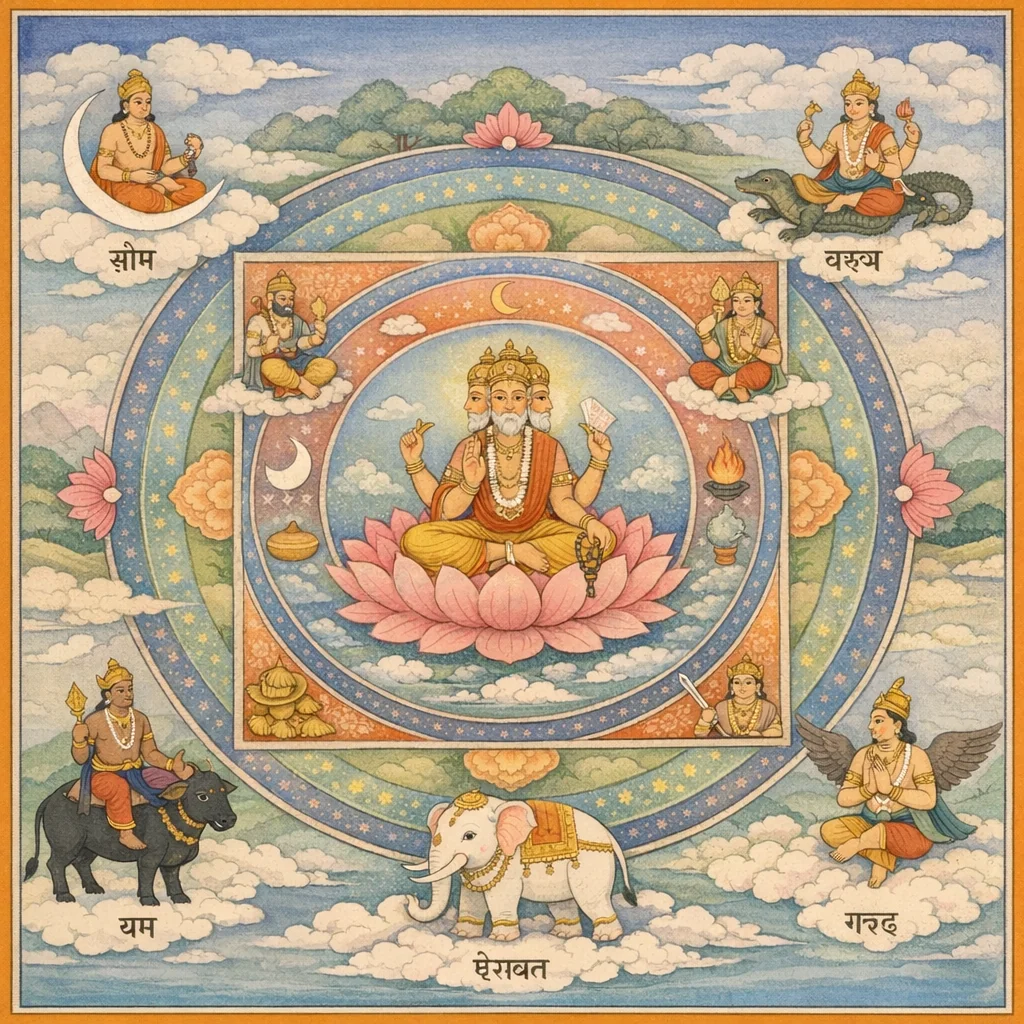
Parāśara tells Maitreya that after Pṛthu’s anointing, Brahmā allotted spheres of rule: Soma over stars and planets, Brāhmaṇas, herbs, sacrifice and tapas; Varuṇa over the waters; Kubera over royal wealth; Prahlāda as lord of Daityas and Dānavas; with Yama over the Pitṛs and Airāvata over elephants. He appoints directional guardians—Sudhanvan (east), Śaṅkhapada (south), Ketumān (west), Hiraṇyaromā (north)—and declares that all rulers of past, present, and future are aṁśa-vibhūtis of Viṣṇu. The teaching then turns doctrinal: apart from Hari none can truly sustain; Janārdana works through creation, preservation, and dissolution by the guṇas, described as a fourfold division in each cosmic phase (Brahmā/progenitors/Kāla/beings; Viṣṇu/Manus/Kāla/beings; Rudra/death-forms/Kāla/beings). Asked about Brahman’s fourfold nature and the supreme abode, Parāśara outlines graded means, end, and knowledge culminating in nirguṇa realization, and distinguishes kṣara from akṣara. Finally, he links cosmological categories to Viṣṇu’s ornaments and weapons (Kaustubha, Śrīvatsa, gadā, śaṅkha, Śārṅga, cakra, Vaijayantī, sword) and concludes with the fruit of hearing this ‘first portion’ of the Purāṇa.
Shlokas
Verse 1
यदाभिषिक्तः स पृथुः पूर्वं राज्ये महर्षिभिः ततः क्रमेण राज्यानि ददौ लोकपितामहः
When Pṛthu was first anointed to kingship by the great seers, then that grandsire of the world, in due order, apportioned and bestowed the several realms of governance.
Verse 2
नक्षत्रग्रहविप्राणां वीरुधां चाप्य् अशेषतः सोमं राज्ये ऽदधद् ब्रह्मा यज्ञानां तपसाम् अपि
Then Brahmā installed Soma in sovereignty—over the lunar mansions and the planets, over the Brāhmaṇas, and over all medicinal plants without exception; and he established Soma as the presiding lord of sacrifices and of austerities as well.
Verse 3
राज्ञां वैश्रवणं राज्ये जलानां वरुणं तथा आदित्यानां पतिं विष्णुं वसूनाम् अथ पावकम्
In kingship among kings, He is Vaiśravaṇa (Kubera); among the waters, He is Varuṇa; among the Ādityas, He is Vishnu, their lord; and among the Vasus, He is Pāvaka, the purifying fire.
Verse 4
प्रजापतीनां दक्षं तु वासवं मरुताम् अपि दैत्यानां दानवानां च प्रह्लादम् अधिपं ददौ
He appointed Dakṣa as the lord among the Prajāpatis; Vāsava (Indra) as the sovereign of the Maruts; and Prahlāda as the ruler over the Daityas and Dānavas.
Verse 5
पितॄणां धर्मराजानं यमं राज्ये ऽभ्यषेचयत् ऐरावतं गजेन्द्राणाम् अशेषाणां पतिं ददौ
He installed Yama—the righteous king of Dharma—as the sovereign ruler over the realm of the Fathers (the Pitṛs); and he bestowed upon Airāvata lordship as the chief of all elephant-kings.
Verse 6
पतत्रिणां च गरुडं देवानाम् अपि वासवम् उच्चैःश्रवसम् अश्वानां वृषभं तु गवाम् अपि
Among birds, He is Garuḍa; among the gods, He is Vāsava (Indra). Among horses, He is Uccaiḥśravas; and among cattle, He is the bull—thus the Supreme Lord is known through the highest excellence in every order of life.
Verse 8
एवं विभज्य राज्यानि दिशां पालान् अनन्तरम् प्रजापतिपतिर् ब्रह्मा स्थापयाम् आस सर्वतः
Thus, having apportioned the realms, Brahmā—the lord of the Prajāpatis—thereafter established on every side the guardians of the directions.
Verse 9
पूर्वस्यां दिशि राजानं वैराजस्य प्रजापतेः दिशापालं सुधन्वानं राजानं सो ऽभ्यषेचयत्
In the eastern quarter, he consecrated King Sudhanvan—of the line of the Prajāpati Vairāja—as the guardian sovereign of that direction.
Verse 10
दक्षिणस्यां दिशि तथा कर्दमस्य प्रजापतेः पुत्रं शङ्खपदं नाम राजानं सो ऽभ्यषेचयत्
In the southern quarter as well, he consecrated as king Śaṅkhapada, son of the Prajāpati Kardama.
Verse 11
पश्चिमस्यां दिशि तथा रजसः पुत्रम् अच्युतम् केतुमन्तं महात्मानं राजानम् अभिषिक्तवान्
Likewise, in the western quarter, he consecrated as king the great-souled Ketumān—Acyuta, the son of Rajas.
Verse 12
तथा हिरण्यरोमाणं पर्जन्यस्य प्रजापतेः उदीच्यां दिशि दुर्धर्षं राजानं सो ऽभ्यषेचयत्
In the same manner, he consecrated Hiraṇyaromā—born of Parjanya, the Prajāpati—as the unconquerable king set to preside over the northern quarter.
Verse 13
तैर् इयं पृथिवी सर्वा सप्तद्वीपा सकानना यथाप्रदेशम् अद्यापि धर्मतः परिपाल्यते
By them, this whole Earth—together with its seven continents and its forests—has, even to this day, been safeguarded in every region according to the rule of Dharma.
Verse 14
एते सर्वे प्रवृत्तस्य स्थितौ विष्णोर् महात्मनः विभूतिभूता राजानो ये चान्ये मुनिसत्तम
O best of sages, all these kings—and the others as well—are but manifestations of the glorious powers of great-souled Viṣṇu, who set the world in motion and abides as its sustaining order.
Verse 15
ये भविष्यन्ति ये भूताः सर्वभूतेश्वरा द्विज ते सर्वे सर्वभूतस्य विष्णोर् अंशा द्विजोत्तम
O best of the twice-born, those yet to be born and those already existing—all who are called lords among beings—each is but a portion (aṁśa) of Viṣṇu, the Lord of all creatures.
Verse 16
ये तु देवाधिपतयो ये च दैत्याधिपास् तथा दानवानां च ये नाथा ये नाथाः पिशिताशिनाम्
And those who are lords among the gods; likewise the chiefs among the Daityas; the rulers of the Dānavas; and even the leaders of flesh-eating beings—whoever they may be—
Verse 17
पशूनां ये च पतयः पतयो ये च पक्षिणाम् मनुष्याणां च सर्पाणां नागानां चाधिपास् तु ये
All who stand as lords among cattle and beasts, all who rule among birds, and all who preside over humans—together with those who govern serpents and the Nāgas—each is but an office within the single, all-pervading sovereignty of the Supreme Lord.
Verse 18
वृक्षाणां पर्वतानां च ग्रहाणां चापि ये ऽधिपाः अतीता वर्तमानाश् च ये भविष्यन्ति चापरे ते सर्वे सर्वभूतस्य विष्णोर् अंशसमुद्भवाः
All presiding powers over trees, mountains, and the planets—of past, present, and future alike—are born from a portion of Viṣṇu, the indwelling Lord of all beings.
Verse 19
न हि पालनसामर्थ्यम् ऋते सर्वेश्वरं हरिम् स्थितौ स्थितं महाप्राज्ञ भवत्य् अन्यस्य कस्यचित्
O great-minded one, apart from Hari, the Lord of all, none has the power to sustain; in preservation itself, He alone stands established.
Verse 20
सृजत्य् एष जगत् सृष्टौ स्थितौ पाति सनातनः हन्ति चैवान्तकत्वे च रजःसत्त्वादिसंश्रयः
He, the Eternal One, creates the universe at creation, preserves it in continuance, and destroys it at dissolution; resting upon rajas, sattva, and the other guṇas, He alone acts.
Verse 21
चतुर्विभागः संसृष्टौ चतुर्धा संस्थितः स्थितौ प्रलयं च करोत्य् अन्ते चतुर्भेदो जनार्दनः
In creation Janārdana manifests in a fourfold division; in preservation He abides in four modes; and at the end He brings dissolution—thus His workings are spoken of as fourfold.
Verse 22
एकेनांशेन ब्रह्मासौ भवत्य् अव्यक्तमूर्तिमान् मरीचिमिश्राः पतयः प्रजानाम् अन्यभागतः
By one portion of His being He becomes Brahmā, of unmanifest form; by another portion arise Marīci and the other Prajāpatis, lords of progeny over the generations of creatures.
Verse 23
कालस् तृतीयस् तस्यांशः सर्वभूतानि चापरः इत्थं चतुर्धा संसृष्टौ वर्तते ऽसौ रजोगुणः
Time is His third portion, and another portion is all living beings. Thus, in creation, rajo-guṇa operates in a fourfold way.
Verse 24
एकांशेनास्थितो विष्णुः करोति परिपालनम् मन्वादिरूपी चान्येन कालरूपो ऽपरेण च
By one portion Vishnu abides and sustains. By another He appears as Manu and the rulers of the ages; and by yet another He becomes Time itself.
Verse 25
सर्वभूतेषु चान्येन संस्थितः कुरुते स्थितिम् सत्त्वं गुणं समाश्रित्य जगतः पुरुषोत्तमः
By another portion He dwells within all beings and establishes the world’s stability. Puruṣottama, taking refuge in sattva-guṇa, upholds the universe.
Verse 26
आश्रित्य तमसो वृत्तिम् अन्तकाले तथा प्रभुः रुद्रस्वरूपी भगवान् एकांशेन भवत्य् अजः
At the time of dissolution, the Sovereign Lord takes on the mode of tamas. Though unborn, Bhagavān becomes Rudra in form, manifesting by a single portion of Himself.
Verse 27
अग्न्यन्तकादिरूपेण भागेनान्येन वर्तते कालस्वरूपो भागो ऽन्यः सर्वभूतानि चापरः
By another portion He abides as Agni and Antaka (Death). Another portion stands as Time itself, and yet another is the totality of all beings.
Verse 28
विनाशं कुर्वतस् तस्य चतुर्धैवं महात्मनः विभागकल्पना ब्रह्मन् कथ्यते सार्वकालिकी
O Brahmin, when that great-souled Lord brings about dissolution, the teaching of His fourfold division is declared an eternal principle, true for all times.
Verse 29
ब्रह्मा दक्षादयः कालस् तथैवाखिलजन्तवः विभूतयो हरेर् एता जगतः सृष्टिहेतवः
Brahmā, Dakṣa and the other progenitors, Time itself, and all living beings—these are the vibhūtis of Hari, the causes through which the universe’s creation comes to pass.
Verse 30
विष्णुर् मन्वादयः कालः सर्वभूतानि च द्विज स्थितेर् निमित्तभूतस्य विष्णोर् एता विभूतयः
O twice-born, Viṣṇu, the Manus and the rest, Time itself, and all beings—these are the vibhūtis of Viṣṇu, who is the causal ground and sustaining instrument of the world’s continuance.
Verse 31
रुद्रः कालो ऽन्तकाद्याश् च समस्ताश् चैव जन्तवः चतुर्धा प्रलयायैता जनार्दनविभूतयः
Rudra; Time itself; Death and its dread powers; and all living beings—these are the four forces by which dissolution proceeds; in truth they are the vibhūtis of Janārdana (Viṣṇu).
Verse 32
जगदादौ तथा मध्ये सृष्टिर् आप्रलयाद् द्विज धात्रा मरीचिमिश्रैश् च क्रियते जन्तुभिस् तथा
O twice-born, at the beginning of the world and again in its intermediate cycles, creation continues until dissolution; it is carried out by Dhātṛ together with Marīci and the rest, and likewise through the agency of embodied beings.
Verse 33
ब्रह्मा सृजत्य् आदिकाले मरीचिप्रमुखास् ततः उत्पादयन्त्य् अपत्यानि जन्तवश् च प्रतिक्षणम्
At the dawn of time Brahmā brings forth creation; thereafter Marīci and the other primordial sages beget progeny, and living beings, moment after moment, continue generation without cease.
Verse 34
कालेन न विना ब्रह्मा सृष्टिनिष्पादको द्विज न प्रजापतयः सर्वे न चैवाखिलजन्तवः
O twice-born one, without Time (Kāla) even Brahmā cannot accomplish creation; nor can all the Prajāpatis beget progeny—indeed, without Time none among the myriad beings can manifest at all.
Verse 35
एवम् एव विभागो ऽयं स्थिताव् अप्य् उपदिश्यते चतुर्धा देवदेवस्य मैत्रेय प्रलये तथा
So too is this very principle of differentiation taught even in the state of preservation: the Lord of gods, O Maitreya, is understood there as fourfold as well—and likewise in the time of dissolution.
Verse 36
यत् किंचित् सृज्यते येन सत्त्वजातेन वै द्विज तस्य सृज्यस्य संभूतौ तत् सर्वं वै हरेस् तनुः
O twice-born one, whatever is brought forth by any being endowed with sattva—indeed, in the very arising of that created thing, all of it is truly the body of Hari.
Verse 37
हन्ति यावत् क्वचित् किंचित् भूतं स्थावरजङ्गमम् जनार्दनस्य तद् रौद्रं मैत्रेयान्तकरं वपुः
So long as it strikes down, wherever it may be, any being—whether immovable or moving—this is the fierce, wrathful form of Janārdana; O Maitreya, it is a body that brings all things to their end.
Verse 38
एवम् एव जगत्स्रष्टा जगत्पाता तथा जगत् जगद्भक्षयिता देवः समस्तस्य जनार्दनः
Thus, Janārdana—the Divine Lord of all—alone is the creator of the universe, the protector of the universe, and likewise the one who consumes it in dissolution: the single sovereign over all existence.
Verse 39
सर्गस्थित्यन्तकालेषु त्रिधैवं संप्रवर्तते गुणप्रवृत्त्या परमं पदं तस्यागुणं महत्
At the times of creation, preservation, and dissolution, He proceeds in a threefold way; yet amid the play of the guṇas, His supreme station remains the Great, nirguṇa—beyond all qualities.
Verse 40
तच् च ज्ञानमयं व्यापि स्वसंवेद्यम् अनौपमम् चतुष्प्रकारं तद् अपि स्वरूपं परमात्मनः
That highest truth is of the very essence of consciousness and knowledge—all-pervading, self-luminous, known by itself, and without equal. Even this very nature of the Supreme Self is spoken of as fourfold.
Verse 41
चतुष्प्रकारतां तस्य ब्रह्मभूतस्य वै मुने त्वाम् आचक्ष्व यथान्यायं यद् उक्तं परमं पदम्
O sage, explain to me—rightly and in due order—the fourfold nature of that Brahman, and the Supreme Abode spoken of as the highest state.
Verse 42
मैत्रेय कारणं प्रोक्तं साधनं सर्ववस्तुषु साध्यं च वस्त्व् अभिमतं यत् साधयितुम् आत्मनः
O Maitreya, the ‘cause’ has been declared, and likewise the ‘means’ with regard to all things; and also the ‘attainable end’—that desired goal which one seeks to accomplish for oneself.
Verse 43
योगिनो मुक्तिकामस्य प्राणायामादि साधनम् साध्यं च परमं ब्रह्म पुनर् नावर्तते यतः
For the yogin who longs for liberation, disciplines beginning with breath-control are the means; and the goal to be realized is the Supreme Brahman—having attained That, one does not return again to worldly recurrence.
Verse 44
साधनालम्बनं ज्ञानं मुक्तये योगिनां हि यत् स भेदः प्रथमस् तस्य ज्ञानभूतस्य वै मुने
O sage, that knowledge which serves as the supporting instrument for yogins on the way to liberation—of that knowledge itself, the first division is now declared.
Verse 45
युञ्जतः क्लेशमुक्त्यर्थं साध्यं यद् ब्रह्मयोगिनः तदालम्बनविज्ञानं द्वितीयो ऽंशो महामुने
O great sage, for the Brahma-yogin who is striving for release from afflictions, that goal which is to be accomplished is attained through the knowledge of the proper support (ālambana) for meditation—this is the second division.
Verse 46
उभयोस् त्व् अविभागेन साध्यसाधनयोर् हि यत् विज्ञानम् अद्वैतमयं तद्भागो ऽन्यो मयोदितः
But that knowledge which, by seeing no division between the two—means and end, practice and attainment—shines as wholly non-dual: that is another aspect, which I have now declared.
Verse 47
ज्ञानत्रयस्य चैतस्य विशेषो यो महामुने तन् निराकरणद्वारदर्शितात्मस्वरूपवत्
O great sage, the distinctive purport of this threefold knowledge is this: it is like the true nature of the Self—made evident through the gateway of negation, by rejecting all that is not the Self.
Verse 48
निर्व्यापारम् अनाख्येयं व्याप्तिमात्रम् अनौपमम् आत्मसंबोधविषयं सत्तामात्रम् अलक्षणम्
He is actionless, beyond all telling; sheer all-pervasion, without any comparison. He is knowable only through direct inner awakening—mere Being itself, without mark or attribute.
Verse 49
प्रशान्तम् अभयं शुद्धं दुर्विभाव्यम् असंश्रयम् विष्णोर् ज्ञानमयस्योक्तं तज् ज्ञानं परमं पदम्
That supreme state is declared to be the knowledge of Vishnu, whose very essence is consciousness: utterly tranquil, fearless, pure, beyond ordinary conception, and dependent on nothing. That knowledge itself is the highest abode.
Verse 50
तत्राज्ञाननिरोधेन योगिनो यान्ति ये लयम् संसारकर्षणोप्तौ ते यान्ति निर्बीजतां द्विज
There, by arresting ignorance, those yogins who enter dissolution—though once sown in the field ploughed by worldly existence—attain, O twice-born, the seedless state, where no further germ of rebirth remains.
Verse 51
एवंप्रकारम् अमलं नित्यं व्यापकम् अक्षयम् समस्तहेयरहितं विष्ण्वाख्यं परमं पदम्
Such, indeed, is that supreme station called ‘Vishnu’: stainless and ever-existent, all-pervading and imperishable—utterly free from every defect and all that is to be rejected.
Verse 52
तद् ब्रह्म परमं योगी यतो नावर्तते पुनः अपुण्यपुण्योपरमे क्षीणक्लेशो ऽतिनिर्मलः
That is the Supreme Brahman, realized by the highest yogin; having reached it, one never returns again. When the opposites of demerit and merit are transcended, afflictions are exhausted, and consciousness becomes utterly stainless.
Verse 53
द्वे रूपे ब्रह्मणस् तस्य मूर्तं चामूर्तम् एव च क्षराक्षरस्वरूपे ते सर्वभूतेषु च स्थिते
Of that Supreme Brahman there are two modes: the manifest (formed) and the unmanifest (formless). These are known as the perishable and the imperishable; and both, in their own manner, abide within all beings.
Verse 54
अक्षरं तत् परं ब्रह्म क्षरं सर्वम् इदं जगत् एकदेशस्थितस्येन्दोर् ज्योत्स्ना विस्तारिणी यथा परस्य ब्रह्मणः शक्तिस् तथैतद् अखिलं जगत्
That Supreme Brahman is imperishable; this entire universe is perishable. As the moon, abiding in one place, spreads its radiance far and wide, so this whole cosmos is the expansive śakti of the Supreme Brahman.
Verse 55
तत्राप्य् आसन्नदूरत्वाद् बहुत्वस्वल्पतामयः ज्योत्स्नाभेदो ऽस्ति तच्छक्तेस् तद्वन् मैत्रेय विद्यते
Even there, due to nearness and distance, moonlight seems ‘more’ or ‘less’—a difference only in manifestation. So too, O Maitreya, the śakti of that Reality is one in essence, yet perceived as varied according to condition and standpoint.
Verse 56
ब्रह्मविष्णुशिवा ब्रह्मन् प्रधाना ब्रह्मशक्तयः ततश् च देवा मैत्रेय न्यूना दक्षादयस् ततः
O Brāhmaṇa, the foremost powers of Brahman are Brahmā, Viṣṇu, and Śiva. From them, O Maitreya, arise the hosts of gods; and after them come the lesser divine orders—beginning with Dakṣa and the rest—emanating in succession.
Verse 57
ततो मनुष्याः पशवो मृगपक्षिसरीसृपाः न्यूना न्यूनतराश् चैव वृक्षगुल्मादयस् ततः
Thereafter came human beings; then beasts; then deer, birds, and creeping reptiles—each succeeding order less endowed than the former; and after these arose trees, shrubs, and the rest. Thus, by the sovereign ordinance of Viṣṇu, capacity and station were apportioned in graded measure within the cosmic order.
Verse 58
तद् एतद् अक्षयं नित्यं जगन् मुनिवराखिलम् आविर्भावतिरोभावजन्मनाशविकल्पवत्
Thus, O best of sages, this entire universe is imperishable and eternal; yet it is spoken of as though it undergoes alternations of appearing and disappearing, of birth and destruction.
Verse 59
सर्वशक्तिमयो विष्णुः स्वरूपं ब्रह्मणो ऽपरम् मूर्तं यद् योगिभिः पूर्वं योगारम्भेषु चिन्त्यते
Vishnu is the very embodiment of all powers—the unsurpassed essential nature of Brahman. At the commencement of yoga, the yogins first contemplate His manifest, tangible form.
Verse 60
सालम्बनो महायोगः सबीजो यत्र संस्थितः मनस्य् अव्याहते सम्यग् युञ्जतां जायते मुने
O sage, when the mind becomes unobstructed and steady, there arises in those who practice rightly that Great Yoga which is ‘with a support’ (ālambana) and ‘with a seed’ (bīja), firmly established in its object of meditation.
Verse 61
स परः सर्वशक्तीनां ब्रह्मणः समनन्तरः मूर्तं ब्रह्म महाभाग सर्वब्रह्ममयो हरिः
He is the Supreme—the source behind all powers, not other than Brahman. O noble one, Hari is Brahman made manifest in form, in whom all that is called ‘Brahman’ is wholly present and pervading.
Verse 62
तत्र सर्वम् इदं प्रोतम् ओतं चैवाखिलं जगत् ततो जगज् जगत् तस्मिन् स जगच् चाखिलं मुने
In Him, all this is strung and woven—indeed, the entire universe. From Him the world arises; within Him the world abides; and He, O sage, is wholly present within the world as well.
Verse 63
क्षराक्षरमयो विष्णुर् बिभर्त्य् अखिलम् ईश्वरः पुरुषाव्याकृतमयं भूषणास्त्रस्वरूपवत्
Vishnu—the Lord—whose being is both perishable and imperishable, sustains the entire universe. He bears within Himself the Purusha and the Unmanifest (Avyākṛta), as though they were His very ornaments and weapons.
Verse 64
भूषणास्त्रस्वरूपस्थं यद् एतद् अखिलं जगत् बिभर्ति भगवान् विष्णुस् तन् ममाख्यातुम् अर्हसि
Please explain to me how this entire universe—abiding in the very forms of His ornaments and weapons—is borne and sustained by Bhagavān Viṣṇu.
Verse 65
नमस् कृत्वाप्रमेयाय विष्णवे प्रभविष्णवे कथयामि यथाख्यातं वसिष्ठेन ममाभवत्
Having bowed in reverence to Vishnu—immeasurable, and the very source from whom all arises—I shall now relate it exactly as it was told to me by Vasiṣṭha.
Verse 66
आत्मानम् अस्य जगतो निर्लेपम् अगुणामलम् बिभर्ति कौस्तुभमणिस्वरूपं भगवान् हरिः
Bhagavān Hari bears, in the form of the Kaustubha gem, the very Self of this universe—untouched by anything, beyond the guṇas, and stainless in its purity.
Verse 67
श्रीवत्ससंस्थानधरम् अनन्ते च समाश्रितम् प्रधानं बुद्धिर् अप्य् आस्ते गदारूपेण माधवे
In Mādhava—who bears the sacred Śrīvatsa mark upon His chest and rests upon Ananta—even Pradhāna (primordial Nature) and Buddhi (cosmic Intellect) abide, assuming the form of His mace.
Verse 68
भूतादिम् इन्द्रियादिं च द्विधाहंकारम् ईश्वरः बिभर्ति शङ्खरूपेण शार्ङ्गरूपेण च स्थितम्
The Sovereign Lord, abiding as the conch and as the Śārṅga bow, upholds within Himself the twofold ego-principle—the primal source of the elements and the primal source of the senses.
Verse 69
चलत्स्वरूपम् अत्यन्तं जवेनान्तरितानिलम् चक्रस्वरूपं च मनो धत्ते विष्णुकरे स्थितम्
Let the mind contemplate the discus-form abiding in Viṣṇu’s hand—ever in motion, whirling with surpassing speed, its course veiling even the wind—so awareness may become steady in the Supreme’s sovereign power.
Verse 70
पञ्चरूपा तु या माला वैजयन्ती गदाभृतः सा भूतहेतुसंघाता भूतमाला च वै द्विज
O twice-born, the fivefold Vaijayantī garland worn by the wielder of the mace is the very aggregate of the causes of beings—indeed, a garland formed of the elements themselves.
Verse 71
यानीन्द्रियाण्य् अशेषाणि बुद्धिकर्मात्मकानि वै शररूपाण्य् अशेषाणि तानि धत्ते जनार्दनः
All the senses without exception—together with the faculties of intellect and action—and all embodied forms: it is Janārdana who bears them, sustains them, and holds them in being.
Verse 72
बिभर्ति यच् चासिरत्नम् अच्युतो ऽत्यन्तनिर्मलम् विद्यामयं तु तज् ज्ञानम् अविद्याचर्मसंस्थितम्
That flawless, utterly stainless sword-jewel which Acyuta bears is, in truth, knowledge itself—formed of sacred wisdom—set within the sheath of ignorance.
Verse 73
इत्थं पुमान् प्रधानं च बुद्ध्यहंकारम् एव च भूतानि च हृषीकेशे मनः सर्वेन्द्रियाणि च विद्याविद्ये च मैत्रेय सर्वम् एतत् समाश्रितम्
Thus, O Maitreya, the puruṣa and pradhāna, buddhi and ahaṃkāra, the bhūtas, the manas and all the senses—indeed both vidyā and avidyā—everything rests upon Hṛṣīkeśa (Viṣṇu), the inner ruler and supreme support of the universe.
Verse 74
अस्त्रभूषणसंस्थानस्वरूपं रूपवर्जितः बिभर्ति मायारूपो ऽसौ श्रेयसे प्राणिनां हरिः
Though truly beyond all form, Hari, by His own māyā-power, bears the very configurations known as weapons, ornaments, and divine attributes—solely for the highest good of living beings.
Verse 75
सविकारं प्रधानं च पुमांसं चाखिलं जगत् बिभर्ति पुण्डरीकाक्षस् तद् एवं परमेश्वरः
The Lotus-eyed Lord upholds pradhāna with all its transformations, upholds the puruṣa, and upholds the entire universe; thus indeed is He the Supreme Lord, the sustainer of all that is.
Verse 76
या विद्या या तथाविद्या यत् सद् यच् चासद् अव्यये तत् सर्वं सर्वभूतेशे मैत्रेय मधुसूदने
Whatever is knowledge and whatever appears as ignorance; whatever is real and whatever is unreal—O Maitreya—all of it, without remainder, abides in the Imperishable One, Madhusūdana, Lord of all beings.
Verse 77
कलाकाष्ठानिमेषादिदिनर्त्वयनहायनैः कालस्वरूपो भगवान् अपारो हरिर् अव्ययः
Through the measures of time—kalā, kāṣṭhā, nimeṣa, and the rest; through day and night, the seasons, the solar courses, and the years—Bhagavān Hari is known as the very form of Time: boundless, yet Himself imperishable.
Verse 78
भूर्लोको ऽथ भुवर्लोकः स्वर्लोको मुनिसत्तम महर् जनस् तपः सत्यं सप्तलोकान् इमान् विभुः
Bhūrloka, then Bhuvarloka and Svarga—O best of sages—followed by Maharloka, Janaloka, Tapoloka, and Satyaloka: these are the seven worlds, established and pervaded by the all-powerful Lord.
Verse 79
लोकात्ममूर्तिः सर्वेषां पूर्वेषाम् अपि पूर्वजः आधारः सर्वविद्यानां स्वयम् एव हरिः स्थितः
Hari Himself abides as the very form of the world’s inner Self—older than all the ancients, the first progenitor even of those who came before; the sustaining ground of every branch of knowledge, He alone stands established as the ultimate support.
Verse 80
देवमानुषपश्वादिस्वरूपैर् बहुभिर् विभुः स्थितः सर्वेश्वरो ऽनन्तो भूतमूर्तिर् अमूर्तिमान्
The all-pervading Lord abides in countless forms—of gods, humans, beasts, and the rest. He is the sovereign of all, the Infinite; He becomes embodied as all beings, yet in His highest reality He remains unembodied and beyond form.
Verse 81
ऋचो यजूंषि सामानि तथैवाथर्वणानि च इतिहासोपवेदाश् च वेदान्तेषु तथोक्तयः
The Ṛk-verses, the Yajus-formulas, the Sāman-chants, and likewise the Atharvan hymns—together with the Itihāsas and the Upavedas—are also spoken of in the Vedānta as belonging to that same Vedic revelation.
Verse 82
वेदाङ्गानि समस्तानि मन्वादिगदितानि च शास्त्राण्य् अशेषाण्य् आख्यानान्य् अनुवाकाश् च ये क्वचित्
All the Vedāṅgas in their entirety, and the teachings proclaimed beginning with the Manvantaras; all the treatises without remainder, the ancient narratives, and whatever subsidiary recitations are found anywhere—(all these are encompassed in this sacred account, ordered under the sovereignty of the Supreme Lord).
Verse 83
काव्यालापाश् च ये केचिद् गीतकान्य् अखिलानि च शब्दमूर्तिधरस्यैतद् वपुर् विष्णोर् महात्मनः
Whatever poetic utterances there are, and all songs of every kind—these too are the very body of great-souled Viṣṇu, who bears the form of Śabda, the living Word.
Verse 84
यानि मूर्तान्य् अमूर्तानि यान्य् अत्रान्यत्र वा क्वचित् सन्ति वै वस्तुजातानि तानि सर्वाणि तद्वपुः
Whatever exists—whether with form or without form, whether here or elsewhere, in any place at all—every class of entity that is found: all of that, indeed, is His very body.
Verse 85
अहं हरिः सर्वम् इदं जनार्दनो नान्यत् ततः कारणकार्यजातम् ईदृङ् मनो यस्य न तस्य भूयो भवोद्भवा द्वन्द्वगदा भवन्ति
“I am Hari; I am all this. I am Janārdana. Apart from Me there exists nothing whatsoever—neither the causes nor the entire multitude of effects. For the one whose mind is established in this vision, the afflictions born of duality do not arise again from the cycle of becoming.”
Verse 86
इत्य् एष ते ऽंशः प्रथमः पुराणस्यास्य वै द्विज यथावत् कथितो यस्मिञ् श्रुते पापैर् विमुच्यते
Thus, O twice-born sage, I have duly related to you this first portion of this Purāṇa—hearing which, one is released from sins.
Verse 87
कार्त्तिक्यां पुष्करस्नाने द्वादशाब्दे तु यत् फलम् तद् अस्य श्रवणे सर्वं मैत्रेयाप्नोति मानवः
O Maitreya, whatever merit is gained by bathing at Puṣkara in the month of Kārttika for twelve years—every bit of that fruit is obtained by a person simply by listening to this sacred account.
Verse 88
देवर्षिपितृगन्धर्वयक्षादीनां च संभवम् भवन्ति शृण्वतः पुंसो देवाद्या वरदा मुने
O sage, for the person who listens with faith, the origins of the deva‑ṛṣis, the Pitṛs, the Gandharvas, the Yakṣas, and the rest are made manifest; and the Devas and other celestial orders become bestowers of boons to such a hearer.
Frequently Asked Questions
Because governance, preservation, and lordship are not independent capacities; they function as vibhūtis (manifested potencies) of the one Supreme Hari. The chapter explicitly states that without the सर्वेश्वर (Hari) no other being truly has the power to sustain (pālana-sāmarthya).
For creation it is taught as Brahmā, the Prajāpatis (Marīci and others), Kāla (Time), and all beings; for preservation as Viṣṇu, Manu and the age-ordainers, Kāla, and all beings; for dissolution as Rudra, Death-forms (Antaka etc.), Kāla, and all beings—each set presented as Janārdana’s operative vibhūtis.
Parāśara states that the Supreme Brahman is akṣara (imperishable) while the universe is kṣara (perishable). The cosmos is compared to moonlight spreading from the moon: the world is described as the śakti-expansion of Brahman, appearing as ‘more/less’ by standpoint (nearness/distance) though one in essence.
It provides a contemplative theology (ālambana) where metaphysical principles—puruṣa, pradhāna, buddhi, ahaṃkāra, bhūtas, mind and senses, vidyā/avidyā—are understood as resting in Viṣṇu, reinforcing Him as both immanent support and transcendent Brahman, and offering a meditative entry-point for yoga.