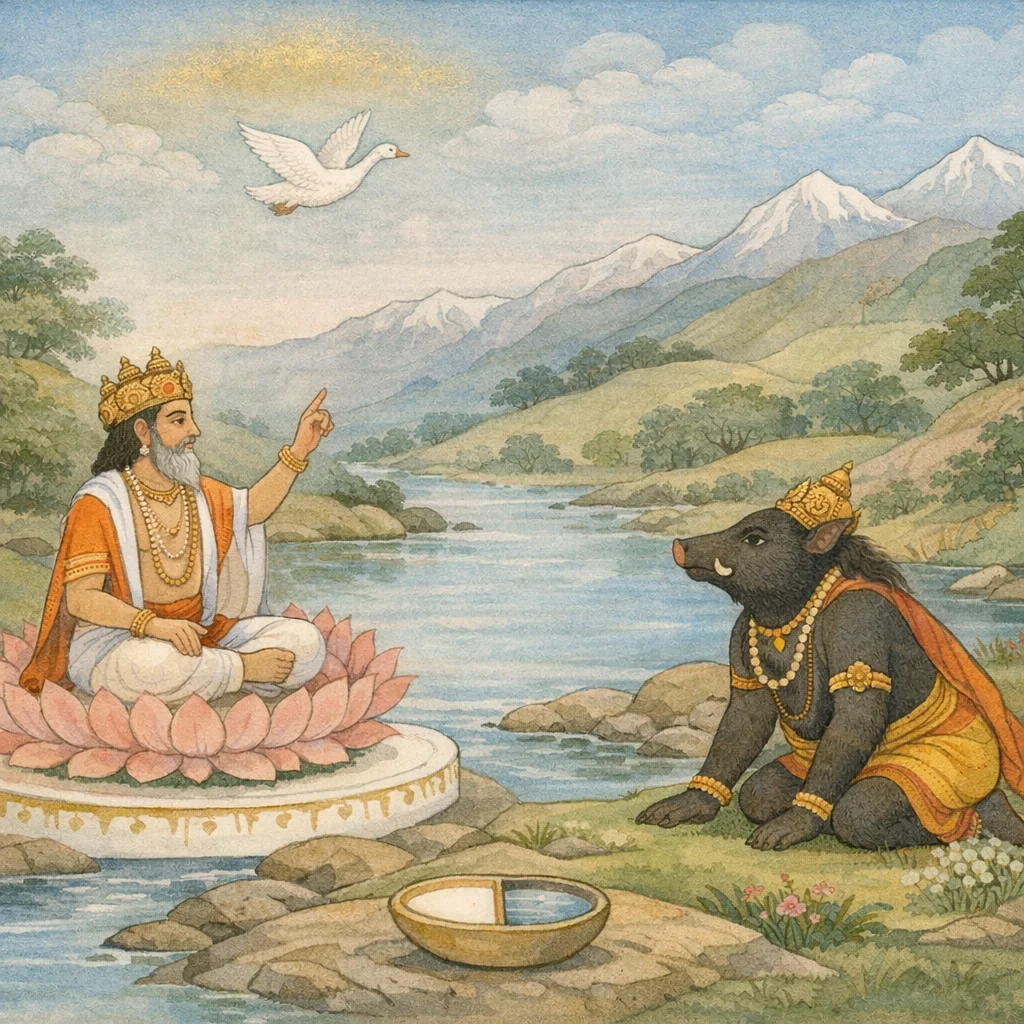
हंस-वराह-रूपग्रहण-कारणम् (The Reason for Assuming the Swan and Boar Forms)
Adhyāya 15 continues the discourse after the liṅga episode. Nārada praises Brahmā for the purifying Śaiva account already heard and asks for a precise narration of what followed, especially the sequence of events and the method of creation. Brahmā replies that when Śiva, in His eternal form, became hidden, he and Viṣṇu felt great relief and joy. Intending to create and govern the worlds, Brahmā then assumed the haṃsa (swan) form and Viṣṇu the varāha (boar) form. Nārada raises a doctrinal doubt: why choose these forms over others? Introduced by Sūta, Brahmā first devoutly remembers Śiva’s feet and then explains the symbolic and functional reason—beginning with the haṃsa’s steady upward movement and its emblematic discernment of tattva and atattva, likened to separating milk from water. The chapter thus justifies divine embodiments as meaningful signs that encode cosmological tasks and spiritual principles, reaffirming Śiva’s primacy and the Purāṇic intent to instruct.
Shlokas
Verse 1
नारद उवाच । विधे विधे महाभाग धन्यस्त्वं सुरसत्तम । श्राविताद्याद्भुता शैवकथा परमपावनी
Nārada said: “O Vidhātṛ (Brahmā), O Vidhātṛ! O greatly fortunate one, best among the gods—blessed indeed are you, for today you have caused me to hear this wondrous, supremely purifying sacred narrative of Śiva.”
Verse 2
तत्राद्भुता महादिव्या लिंगोत्पत्तिः श्रुता शुभा । श्रुत्वा यस्याः प्रभावं च दुःखनाशो भवेदिह
There, one hears the wondrous, supremely divine and auspicious account of the manifestation of the Liṅga. By hearing it and realizing its spiritual power, sorrow is destroyed here, in this very life.
Verse 3
अनंतरं च यज्जातं माहात्म्यं चरितं तथा । सृष्टेश्चैव प्रकारं च कथय त्वं विशेषतः
And then, tell in detail what happened next—its glory and the account of events—and explain, in particular, the manner in which creation (sṛṣṭi) unfolded.
Verse 4
ब्रह्मोवाच । सम्यक् पृष्टे च भवता यज्जातं तदनंतरम् । कथयिष्यामि संक्षेपाद्यथा पूर्वं श्रुतं मया
Brahmā said: “You have questioned well about what occurred immediately thereafter. I shall relate it succinctly, just as I heard it in former times.”
Verse 5
अंतर्हिते तदा देवे शिवरूपे सनातने । अहं विष्णुश्च विप्रेन्द्र अधिकं सुखमाप्तवान्
When that eternal Deva—who had the form of Śiva—became hidden from view, O best of brāhmaṇas, then I and Viṣṇu attained an even greater peace and bliss.
Verse 6
मया च विष्णुना रूपं हंसवाराहयोस्तदा । संवृतं तु ततस्ताभ्यां लोकसर्गावनेच्छया
Then, desiring the creation and protection of the worlds, Viṣṇu and I assumed the forms of Haṃsa (the swan) and Varāha (the boar), and became embodied in those very manifestations.
Verse 7
नारद उवाच । विधे ब्रह्मन् महाप्राज्ञ संशयो हृदि मे महान् । कृपां कृत्वातुलां शीघ्रं तं नाशयितुमर्हसि
Nārada said: O Ordainer (Brahmā), O Brahman, O greatly wise one—there is a great doubt in my heart. Showing incomparable compassion, swiftly dispel it.
Verse 8
हंसवाराहयो रूपं युवाभ्यां च धृतं कथम् । अन्यद्रूपं विहायैव किमत्र वद कारणम्
How is it that you two have assumed the forms of Haṃsa (the swan) and Varāha (the boar)? Setting aside your other forms, tell me—what is the reason for this here?
Verse 9
सूत उवाच । इत्येतद्वचनं श्रुत्वा नारदस्य महात्मनः । स्मृत्वा शिवपदांभोजं ब्रह्मा सादरमब्रवीत्
Sūta said: Hearing these words of the great-souled Nārada, Brahmā—remembering the lotus-feet of Śiva—then spoke with reverent attention.
Verse 10
ब्रह्मोवाच । हंसस्य चोर्द्ध्वगमने गतिर्भवति निश्चला । तत्त्वातत्त्वविवेकोऽस्ति जलदुग्धविभागवत्
Brahmā said: “When the Haṃsa (the realized soul) moves upward, its course becomes unwavering. In it arises discernment between the Real and the unreal—like the separation of milk from water.”
Verse 11
अज्ञानज्ञानयोस्तत्त्वं विवेचयति हंसकः । हंसरूपं धृतं तेन ब्रह्मणा सृष्टिकारिणा
The Haṁsa, the discriminating soul, discerns the true essence of ignorance and of knowledge. Therefore Brahmā, the Creator, assumed the form of the Haṁsa, so that creation might proceed through right discernment.
Verse 12
विवेको नैव लब्धश्च यतो हंसो व्यलीयत । शिवस्वरूपतत्त्वस्य ज्योतिरूपस्य नारद
Because true discernment was not attained, the Haṃsa—the subtle soul-mind—dissolved away. O Nārada, this occurs when one fails to realize the essential reality of Śiva’s own nature, Śiva who is the very form of Light (Jyoti).
Verse 13
सृष्टिप्रवृत्तिकामस्य कथं ज्ञानं प्रजायते । यतो लब्धो विवेकोऽपि न मया हंसरूपिणा
For one driven by the urge to set creation in motion, how can true knowledge arise? Even I—though in the form of the Haṃsa—have not attained that discerning wisdom by which Reality is rightly known.
Verse 14
गमनेऽधो वराहस्य गतिर्भवति निश्चला । धृतं वाराहरूपं हि विष्णुना वनचारिणा
As the Boar moved downward, his course became steady and unwavering. Indeed, Viṣṇu—the forest-roaming Lord—had assumed the form of a boar (Varāha) for this descent.
Verse 15
अथवा भवकल्पार्थं तद्रूपं हि प्रकल्पितम् । विष्णुना च वराहस्य भुवनावनकारिणा
Or else, for the purpose of sustaining the cycle of becoming (the cosmic aeon), that very form was indeed devised—by Viṣṇu, who assumed the form of the Boar (Varāha), the protector and upholder of the worlds.
Verse 16
यद्दिनं हि समारभ्य तद्रूपं धृतवान्हरिः । तद्दिनं प्रति कल्पोऽसौ कल्पो वाराहसंज्ञकः
From the very day on which Hari (Viṣṇu) assumed that particular form, that aeon is reckoned from that day onward; and that kalpa is known by the name “Vārāha Kalpa.”
Verse 17
तदिच्छा वा यदा जाता ताभ्यां रूपं हि धारणे । तद्दिनं प्रतिकल्पोऽसौ कल्पो वाराहसंज्ञक्
When that will arose, the two of them assumed a form for the purpose of sustaining (the creation). That very day became a subsidiary aeon (pratikalpa), known as the Varāha Kalpa.
Verse 18
इति प्रश्नोत्तरं दत्तं प्रस्तुतं शृणु नारद । स्मृत्वा शिवपदांभोजं वक्ष्ये सृष्टिविधिं मुने
Thus, having given the question and its answer, now listen to what follows, O Nārada. Remembering the lotus-feet of Śiva, I shall declare to you, O sage, the method by which creation unfolds.
Verse 19
अंतर्हिते महादेवे त्वहं लोकपितामहः । तदीयं वचनं कर्तुमध्यायन्ध्यानतत्परः
When Mahādeva withdrew from sight, I—Brahmā, the grandsire of the worlds—became intent on study and meditation, so that I might carry out His command.
Verse 20
नमस्कृत्य तदा शंभुं ज्ञानं प्राप्य हरेस्तदा । आनंदं परमं गत्वा सृष्टिं कर्तुं मनो दधे
Then, having bowed to Śambhu and received divine knowledge from Hari (Viṣṇu), he attained supreme bliss; thereafter he set his mind on carrying out the work of creation.
Verse 21
विष्णुश्चापि तदा तत्र प्रणिपत्य सदाशिवम् । उपदिश्य च मां तात ह्यंतर्धानमुपागतः
Then Viṣṇu also, there and then, bowed down to Sadāśiva; and after instructing me, dear one, he disappeared from sight.
Verse 22
ब्रह्माण्डाच्च बहिर्गत्वा प्राप्य शम्भोरनुग्रहम् । वैकुंठनगरं गत्वा तत्रोवास हरिस्सदा
Having gone out beyond the cosmic egg (the universe), and having obtained the grace of Śambhu (Lord Śiva), Hari (Viṣṇu) went to the city of Vaikuṇṭha and dwelt there ever after.
Verse 23
अहं स्मृत्वा शिवं तत्र विष्णुं वै सृष्टिकाम्यया । पूर्वं सृष्टं जलं यच्च तत्रांजलिमुदाक्षिपम्
Desiring creation, I there remembered Lord Śiva and indeed Viṣṇu; and taking up in my joined palms the water that had been created first, I lifted it up there.
Verse 24
अतोऽण्डमभवत्तत्र चतुर्विंशतिसंज्ञ कम् । विराड्रूपमभूद्विप्र जलरूपमपश्यतः
Thereupon, in that primeval condition, the cosmic Egg came into being, known as the “twenty-fourfold” (constituted of the twenty-four principles). O brāhmaṇa, it became the form of Virāṭ, the Cosmic Person, though in appearance it seemed as water.
Verse 25
ततस्संशयमापन्नस्तपस्तेपे सुदारुणम् । द्वादशाब्दमहं तत्र विष्णुध्यानपरायणः
Then, having fallen into doubt, I undertook there an exceedingly severe austerity for twelve years, wholly devoted to meditation upon Viṣṇu.
Verse 26
तस्मिंश्च समये तात प्रादुर्भूतो हरिस्स्वयम् । मामुवाच महाप्रीत्या मदंगं संस्पृशन्मुदा
Then, dear one, at that very moment Hari (Viṣṇu) himself manifested. With great affection he spoke to me, joyfully touching my body.
Verse 27
विष्णुरुवाच । वरं ब्रूहि प्रसन्नोऽस्मि नादेयो विद्यते तव । ब्रह्मञ्छंभुप्रसादेन सर्वं दातुं समर्थकः
Viṣṇu said: “Speak your boon; I am pleased. There is nothing that cannot be granted to you. O Brahman, by the grace of Śambhu (Śiva) I am able to bestow everything.”
Verse 28
ब्रह्मोवाच । युक्तमेतन्महाभाग दत्तोऽहं शंभुना च ते । तदुक्तं याचते मेऽद्य देहि विष्णो नमोऽस्तु ते
Brahmā said: “This is indeed fitting, O greatly fortunate one. I have been entrusted to you by Śambhu. Therefore today I request what was spoken and ordained. Grant it, O Viṣṇu—obeisance be to you.”
Verse 29
विराड्रूपमिदं ह्यंडं चतुर्विंशतिसंज्ञकम् । न चैतन्यं भवत्यादौ जडीभूतं प्रदृश्यते
This cosmic Egg, whose form is the Virāṭ, is known as the “twenty-fourfold principle.” In the beginning it does not possess consciousness; it is seen as inert, having become mere matter.
Verse 30
प्रादुर्भूतो भवानद्य शिवानुग्रहतो हरे । प्राप्तं शंकरसंभूत्या ह्यण्डं चैतन्यमावह
O Hari, today you have manifested by Śiva’s grace. Through Śaṅkara’s emergence the cosmic Egg has been obtained; now infuse that Egg with consciousness—life and awareness.
Verse 31
इत्युक्ते च महाविष्णुश्शंभोराज्ञापरायणः । अनंतरूपमास्थाय प्रविवेश तदंडकम्
When this was spoken, great Viṣṇu—wholly devoted to Śambhu’s command—assumed his endless form, Ananta, and entered that cosmic Egg.
Verse 32
सहस्रशीर्षा पुरुषस्सहस्राक्षः सहस्रपात् । स भूमिं सर्वतस्पृत्वा तदण्डं व्याप्तवानिति
That Cosmic Person—of a thousand heads, a thousand eyes, and a thousand feet—pervaded the earth on every side; touching it all around, he completely filled and encompassed that cosmic Egg, the universe.
Verse 33
प्रविष्टे विष्णुना तस्मिन्नण्डे सम्यक्स्तुतेन मे । सचेतनमभूदण्डं चतुर्विंशतिसंज्ञकम्
When Viṣṇu entered that cosmic Egg—having duly praised Me—the Egg became sentient and active, and it came to be known as the “twenty-fourfold” structure.
Verse 34
पातालादि समारभ्य सप्तलोकाधिपः स्वयम् । राजते स्म हरिस्तत्र वैराजः पुरुषः प्रभुः
Beginning from Pātāla and extending through the seven worlds, Hari Himself—the sovereign Lord of all the lokas—shone there as the mighty Virāṭ (Vairāja) Puruṣa, the supreme ruler.
Verse 35
कैलासनगरं रम्यं सर्वोपरि विराजितम् । निवासार्थं निजस्यैव पंचवक्त्र श्चकार ह
For His own dwelling, the Five-faced Lord fashioned the delightful city of Kailāsa, resplendent above all others.
Verse 36
ब्रह्मांडस्य तथा नाशे वैकुण्ठस्य च तस्य च । कदाचिदेव देवर्षे नाशो नास्ति तयोरिह
O divine sage, when the dissolution of the cosmic egg (the brahmāṇḍa) occurs, Vaikuṇṭha and that supreme abode do not truly perish; here, there is never destruction for those two—only the worlds below undergo dissolution.
Verse 37
सत्यं पदमुपाश्रित्य स्थितोऽहं मुनिसत्तम । सृष्टिकामोऽभवं तात महादेवाज्ञया ह्यहम्
Taking refuge in the true, imperishable state, I remained established there, O best of sages. Then, dear one, by the command of Mahādeva, I became intent upon creation.
Verse 38
सिसृक्षोरथ मे प्रादुरभवत्पापसर्गकः । अविद्यापंचकस्तात बुद्धिपूर्वस्तमोपमः
When I desired to create, there arose from me the creation called the ‘pāpa-sarga’ (the dark current of bondage). O dear one, it was the fivefold Avidyā, preceded by Buddhi, and resembling dense darkness.
Verse 39
ततः प्रसन्नचित्तोऽहमसृजं स्थावराभिधम् । मुख्यसर्गं च निस्संगमध्यायं शंभुशासनात्
Then, with a tranquil and delighted mind, I brought forth the creation called Sthāvara, the immobile beings; and by Śambhu’s command I also set in motion the principal act of creation—detached, unbound by worldly clinging.
Verse 40
तं दृष्ट्वा मे सिसृक्षोश्च ज्ञात्वा साधकमात्मनः । सर्गोऽवर्तत दुःखाढ्यस्तिर्यक्स्रोता न साधकः
Seeing him, and knowing that I was intent on creation and that he could accomplish my purpose, the process of creation began to proceed; yet it became filled with sorrow, flowing downward in a tamas-bound current, and was not conducive to spiritual accomplishment.
Verse 41
तं चासाधकमाज्ञाय पुनश्चिंतयतश्च मे । अभवत्सात्त्विकस्सर्ग ऊर्ध्वस्रोता इति द्रुतम्
Knowing him to be unfit for accomplishment, and as I reflected again, there swiftly arose the sāttvika creation, called the ‘upward-flowing’ (ūrdhva-srotas).
Verse 42
देवसर्गः प्रतिख्यातस्सत्योऽतीव सुखावहः । तमप्यसाधकं मत्वाऽचिंतयं प्रभुमात्मनः
The creation of the gods was well-renowned, true in its order, and exceedingly conducive to worldly happiness. Yet, considering even that inadequate for the highest accomplishment, he contemplated the Supreme Lord—his own inner Master.
Verse 43
प्रादुरासीत्ततस्सर्गो राजसः शंकराज्ञया । अवाक्स्रोता इति ख्यातो मानुषः परसाधकः
Then, by Śaṅkara’s command, the rājasa creation manifested. It became renowned as the “Avāksrotā” stream—human in form—capable of higher spiritual accomplishment.
Verse 44
महादेवाज्ञया सर्गस्ततो भूतादिकोऽभवत् । इति पंचविधा सृष्टिः प्रवृत्ता वै कृता मया
By Mahādeva’s command, the process of creation proceeded; thereafter the creation beginning with the elements came into being. Thus, this fivefold creation was set in motion and carried out by me.
Verse 45
त्रयस्सर्गाः प्रकृत्याश्च ब्रह्मणः परिकीर्तिताः । तत्राद्यो महतस्सर्गो द्वितीयः सूक्ष्मभौतिकः
Three creations are spoken of—arising from Prakṛti and from Brahmā. Of these, the first is the creation of Mahat (cosmic intellect), and the second is the subtle creation of the elemental principles.
Verse 46
वैकारिकस्तृतीयश्च इत्येते प्रकृतास्त्रयः । एवं चाष्टविधास्सर्गाः प्रकृतेर्वेकृतैः सह
“The third is called the Vaikārika; thus these three are the Prākṛta (nature-born) creations. In this way, along with the Vaikṛta (modified) creations, the emanations of Prakṛti are said to be of eight kinds.”
Verse 47
कौमारो नवमः प्रोक्तः प्राकृतो वैकृतश्च सः । एषामवांतरो भेदो मया वक्तुं न शक्यते
The ninth is proclaimed as the Kaumāra creation; it is of two kinds—Prākṛta, arising from primordial Prakṛti, and Vaikṛta, arising from modification. The subtler divisions within these I cannot fully set forth.
Verse 48
अल्पत्वादुपयोगस्य वच्मि सर्गं द्विजात्मकम् । कौमारः सनकादीनां यत्र सर्गो महानभूत्
Since its practical relevance is slight, I shall speak briefly of the creation of the ‘twice-born’ in spirit. This is the Kaumāra creation, wherein the great emanation of Sanaka and the other Kumāras came to be.
Verse 49
सनकाद्याः सुता मे हि मानसा ब्रह्मसंमिताः । महावैराग्यसंपन्ना अभवन्पंच सुव्रताः
Sanaka and the others were indeed my mind-born sons—Brahman-like in purity and stature. Endowed with great dispassion, those five became steadfast in their noble vows.
Verse 50
मयाज्ञप्ता अपि च ते संसारविमुखा बुधाः । शिवध्यानैकमनसो न सृष्टौ चक्रिरे मतिम्
Though commanded by me, those wise ones—turned away from worldly becoming—kept their minds fixed solely on meditation upon Śiva, and they did not set their intention upon creation.
Verse 51
प्रत्युत्तरं च तदनु श्रुत्वाहं मुनिसत्तम । अकार्षं क्रोधमत्युग्रं मोहमाप्तश्च नारद
O best of sages, after hearing that reply, I was seized by exceedingly fierce anger and fell into delusion, O Nārada.
Verse 52
कुद्धस्य मोहितस्याथ विह्वलस्य मुने मम । क्रोधेन खलु नेत्राभ्यां प्रापतन्नश्रुबिंदवः
O sage, when I was seized by anger—bewildered and shaken—then indeed, from both my eyes, tear-drops fell forth because of that wrath.
Verse 53
तस्मिन्नवसरे तत्र स्मृतेन मनसा मया । प्रबोधितोहं त्वरितमागतेना हि विष्णुना
At that very moment, there—when I had recollected it within my mind—I was at once awakened by Viṣṇu, who had swiftly arrived.
Verse 54
तपः कुरु शिवस्येति हरिणा शिक्षितोऽप्यहम् । तपोकारी महद्घोरं परमं मुनिसत्तम
“Even I was instructed by Hari (Viṣṇu), ‘Perform austerity for Śiva.’ O best of sages, I then undertook the supreme, most formidable great tapas—directed to Lord Śiva.”
Verse 55
तपस्यतश्च सृष्ट्यर्थं भ्रुवोर्घ्राणस्य मध्यतः । अविमुक्ताभिधाद्देशात्स्वकीयान्मे विशेषतः
While I was performing austerities for the purpose of creation, from the region between my eyebrows and the middle of my nose—especially from My own sacred place known as Avimukta—a divine manifestation emerged.
Verse 56
त्रिमूर्तीनां महेशस्य प्रादुरासीद्घृणानिधिः । आर्द्धनारीश्वरो भूत्वा पूर्णाशस्सकलेश्वरः
From Maheśa—the Great Lord among the Trimūrti—there manifested the treasure-house of compassion. Becoming Ardhanārīśvara, He appeared as the all-complete Lord, the sovereign of all manifested forms and powers.
Verse 57
तमजं शंकरं साक्षात्तेजोराशिमुमापतिम् । सर्वज्ञं सर्वकर्तारं नीललोहितसंज्ञकम्
Then he beheld Śaṅkara—unborn and directly manifest—an immense mass of divine radiance, the Lord of Umā; the all-knowing, the doer of all, renowned by the name Nīlalohita.
Verse 58
दृष्ट्वा नत्वा महाभक्त्या स्तुत्वाहं तु प्रहर्षितः । अवोचं देवदेवेशं सृज त्वं विविधाः प्रजाः
Having beheld Him, I bowed with great devotion; praising Him, I was filled with joy. Then I said to the Lord of lords: “Create, O You, the many and varied beings.”
Verse 59
श्रुत्वा मम वचस्सोथ देवदेवो महेश्वरः । ससर्ज स्वात्मनस्तुल्यान्रुद्रो रुद्रगणान्बहून
Hearing my words, then the God of gods, Maheśvara—the Rudra—created many hosts of Rudras, beings equal to His own nature.
Verse 60
अवोचं पुनरेवेशं महारुद्रं महेश्वरम् । जन्ममृत्युभयाविष्टास्सृज देव प्रजा इति
Then I spoke again to that Lord—Mahārudra, Maheśvara: “O Deva, create living beings, for they are overwhelmed by the fear of birth and death.”
Verse 61
एवं श्रुत्वा महादेवो मद्वचः करुणानिधिः । प्रहस्योवाच मां सद्यः प्रहस्य मुनिसत्तम
Having thus heard my words, Mahādeva—the ocean of compassion—smiled, and at once spoke to me with a smile, O best of sages.
Verse 62
महादेव उवाच । जन्ममृत्युभयाविष्टा नाहं स्रक्ष्ये प्रजा विधे । अशोभनाः कर्मवशा विमग्ना दुःखवारिधौ
Mahādeva said: “O Vidhi (Brahmā), I will not create progeny that is seized by the fear of birth and death—inauspicious in disposition, helplessly driven by karma, and sunk in the ocean of sorrow.”
Verse 63
अहं दुःखोदधौ मग्ना उद्धरिष्यामि च प्रजाः । सम्यक्ज्ञानप्रदानेन गुरुमूर्तिपरिग्रहः
“I shall rescue the creatures sunk in the ocean of sorrow. By bestowing right and complete knowledge, I assume the form of the Guru.”
Verse 64
त्वमेव सृज दुःखाढ्याः प्रजास्सर्वाः प्रजापते । मदाज्ञया न बद्धस्त्वं मायया संभविष्यसि
“You alone, O Prajāpati, create all beings—those in whom sorrow is abundant. By My command you will not be bound by Māyā; you shall come forth as creator without becoming entangled.”
Verse 65
ब्रह्मोवाच । इत्युक्त्वा मां स भगवान्सुश्रीमान्नीललोहितः । सगणः पश्यतो मे हि द्रुतमंतर्दधे हरः
Brahmā said: “Having spoken thus to me, that Blessed Lord—the auspicious Nīlalohita, blue-and-red-hued—together with His gaṇas, vanished swiftly from my sight even as I watched. Thus did Hara withdraw Himself.”
Frequently Asked Questions
The continuation after the liṅga episode: Śiva becomes hidden, and Brahmā and Viṣṇu, intending world-creation and governance, assume the haṃsa and varāha forms; Nārada questions the rationale.
Haṃsa signifies steady upward movement and discriminative knowledge (tattva–atattva viveka), classically illustrated by the metaphor of separating milk from water—an emblem of refined discernment.
Brahmā-as-haṃsa and Viṣṇu-as-varāha are presented as purposeful embodiments tied to cosmological function and symbolic doctrine, reinforcing that divine forms communicate principles, not merely narrative spectacle.