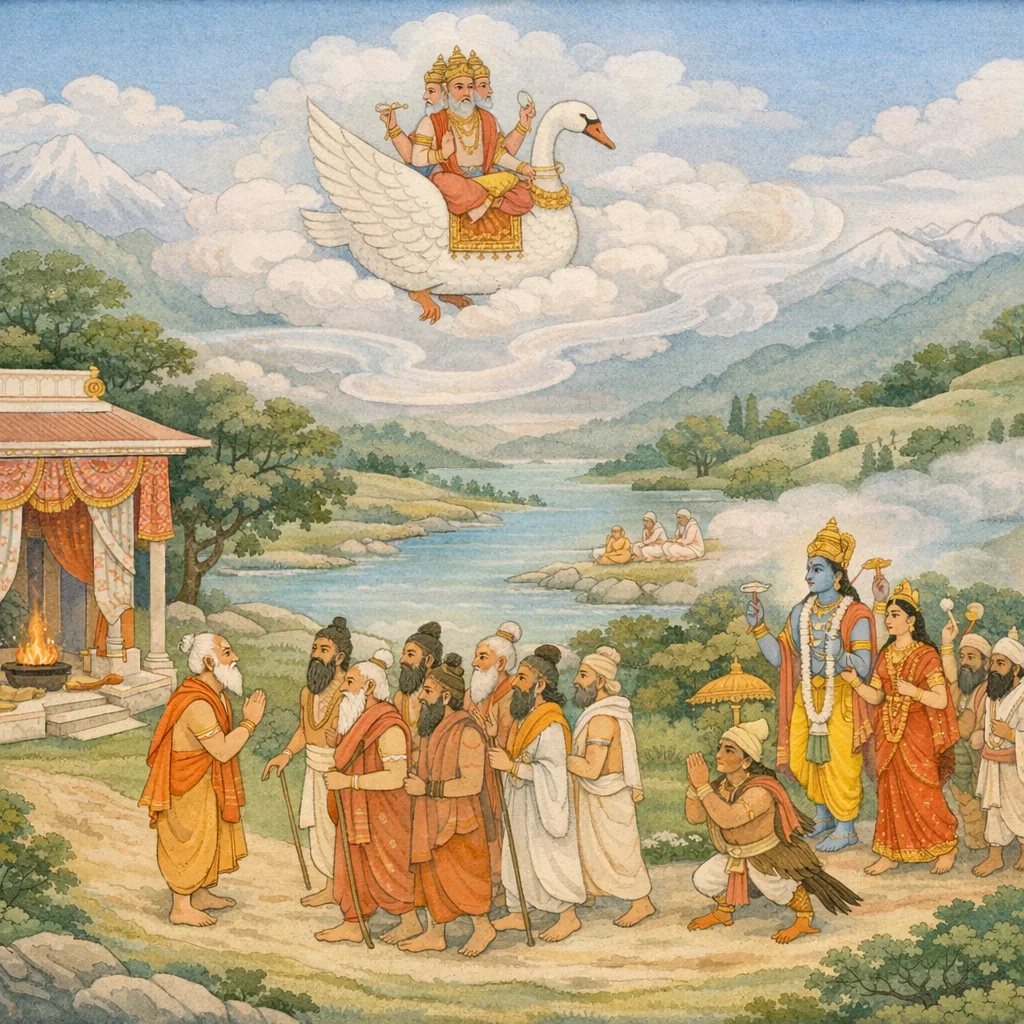
दक्षयज्ञे मुनिदेवसमागमः / The Gathering of Sages and Gods at Dakṣa’s Sacrifice
This chapter begins with Brahmā describing the grand yajña begun by Dakṣa, where many devarṣis and sages are formally invited and assembled. The wide attendance—ṛṣis such as Agastya, Kaśyapa, Vāmadeva, Bhṛgu, Dadhīci, Vyāsa, Bhāradvāja, Gautama, and others—highlights the sacrifice’s Vedic authority and prestige. The devas and lokapālas also arrive, yet are portrayed as participating under the veil of Śiva’s māyā, hinting that the outward splendor conceals a deeper disorder. Brahmā is brought from Satyaloka and honored; Viṣṇu is requested from Vaikuṇṭha and comes with attendants, making the gathering cosmically eminent. Dakṣa receives the guests with reverence and provides divine residences said to be fashioned by Tvaṣṭṛ, emphasizing lavish ritual hospitality. The narration serves as a staging of the sacrificial assembly, while quietly preparing for the critique of Dakṣa’s inner disposition and the coming rupture caused by Śiva’s non-recognition.
Shlokas
Verse 1
ब्रह्मोवाच । एकदा तु मुने तेन यज्ञः प्रारंभितो महान् । तत्राहूतास्तदा सर्वे दीक्षितेन सुरर्षयः
Brahmā said: “O sage, once he commenced a great yajña, a mighty sacrifice. At that time all the divine seers were invited there by the dīkṣita, the consecrated officiant of the rite.”
Verse 2
महर्षयोऽखिलास्तत्र निर्जराश्च समागताः । यद्यज्ञकरणार्थं हि शिवमायाविमोहितः
There, all the great sages and the deathless gods assembled. Truly, deluded by Śiva’s Māyā, he set about performing the sacrifice (yajña).
Verse 3
अगस्त्यः कश्यपोत्रिश्च वामदेवस्तथा भृगुः । दधीचिर्भगवान् व्यासो भारद्वाजोऽथ गौतमः
Agastya, Kaśyapa, Utri, Vāmadeva, and Bhṛgu; the venerable Dadhīci, Bhagavān Vyāsa, Bhāradvāja, and also Gautama—these great seers were present, remembered among the exalted knowers of dharma devoted to Śiva.
Verse 4
पैलः पराशरो गर्गो भार्गवः ककुपस्सितः । सुमंतुत्रिककंकाश्च वैशंपायन एव च
Paila, Parāśara, Garga, Bhārgava, Kakupassita, Sumantu, Trikakaṅka, and also Vaiśampāyana—these sages too were present and are being enumerated.
Verse 5
एते चान्ये च बहवो मुनयो हर्षिता ययु । मम पुत्रस्य दक्षस्य सदारास्ससुता मखम्
These and many other sages, delighted at heart, went to the makha (yajña) of my son Dakṣa—a rite attended by his wives and accompanied by his daughters.
Verse 6
तथा सर्वे सुरगणा लोकपाला महोदयाः । तथोपनिर्जरास्सर्वे स्वापकारबलान्विताः
Likewise, all the hosts of gods and the exalted guardians of the worlds—and also all the other divine beings—were present, each endowed with the strength suited to his own divine function.
Verse 7
सत्यलोकात्समानीतो नुतोहं विश्वकारकः । ससुतस्स परीवारो मूर्तवेदापिसंयुतः
“Brought here from Satyaloka, I—Brahmā, the maker of the manifested universe—was duly worshipped, together with my son and my attendants, and also accompanied by the embodied Vedas.”
Verse 8
वैकुंठाच्च तथा विष्णुस्संप्रार्थ्य विविधादरात् । सपार्षदपरीवारस्समानीतो मखं प्रति
Then Viṣṇu too was respectfully entreated at Vaikuṇṭha in many courteous ways, and he—together with his attendants and retinue—was brought to the sacrificial arena. From the Shaiva standpoint, even the great deities participate within the bounds of sacred rite, while the supreme fruit of sacrifice ultimately depends upon Śiva, the Lord of all.
Verse 9
एवमन्ये समायाता दक्षयज्ञं विमोहिताः । सत्कृतास्तेन दक्षेन सर्वे ते हि दुरात्मना
In the same manner, many others came to Daksha’s sacrifice, their minds deluded. All of them were honoured by Daksha—indeed, by that evil-minded one.
Verse 10
भवनानि महार्हाणि सुप्रभाणि महांति च । त्वष्ट्रा कृतानि दिव्यानि तेभ्यो दत्तानि तेन वै
He bestowed upon them truly divine mansions—costly, radiant, and vast—fashioned by Tvaṣṭṛ himself.
Verse 11
तेषु सर्वेषु धिष्ण्येषु यथायोग्यं च संस्थिताः । सन्मानिता अराजंस्ते सकला विष्णुना मया
In all those sacred abodes, they were duly stationed according to their proper fitness. Honoured in every way by me—Vishnu—they all began to shine forth in splendour.
Verse 12
वर्त्तमाने महायज्ञे तीर्थे कनखले तदा । ऋत्विजश्च कृतास्तेन भृग्वाद्याश्च तपोधनाः
At that time, when the great sacrifice was in progress at the sacred tīrtha of Kanakhala, Dakṣa had appointed as officiating priests (ṛtvij) the austere sages—Bhṛgu and others—abounding in spiritual merit.
Verse 13
अधिष्ठाता स्वयं विष्णुस्सह सर्वमरुद्गणैः । अहं तत्राऽभवं ब्रह्मा त्रयीविधिनिदर्शकः
There, the presiding lord was Viṣṇu himself, accompanied by all the hosts of the Maruts; and I too was present there as Brahmā, the one who demonstrates the ordinances of the Vedic triad.
Verse 14
तथैव सर्वदिक्पाला द्वारपालाश्च रक्षकाः । सायुधास्सपरीवाराः कुतूहलकरास्सदा
Likewise, all the guardians of the directions (dikpālas), the gatekeepers, and the protectors—armed and accompanied by their attendants—were ever present, continually stirring awe and wonder.
Verse 15
उपतस्थे स्वयं यज्ञस्सुरूपस्तस्य चाध्वरे । सर्वे महामुनिश्रेष्ठाः स्वयं वेदधराऽभवन्
In that sacrificial rite, Yajña himself appeared in a beautiful form; and all the foremost great sages, of their own accord, became bearers and upholders of the Vedas.
Verse 16
तनूनपादपि निजं चक्रे रूपं सहस्रशः । हविषा ग्रहणायाशु तस्मिन् यज्ञे महोत्सवे
In that great sacrificial festival, Tanūnapāt swiftly assumed his own form in a thousand ways, in order to receive and partake of the oblations (havis).
Verse 17
अष्टाशीतिसहस्राणि जुह्वति सह ऋत्विजः । उद्गातारश्चतुषष्टि सहस्राणि सुरर्षयः
Along with the officiating priests, eighty-eight thousand offered oblations into the sacred fire; and sixty-four thousand divine seer-singers (udgātṛs) chanted in unison.
Verse 18
अध्वर्यवोथ होतारस्तावन्तो नारदादयः । सप्तर्षयस्समा गाथाः कुर्वंति स्म पृथक्पृथक्
Then the Adhvaryu priests and the Hotṛ priests—along with Nārada and others—together with the Seven Ṛṣis, each in his own way, began composing and reciting harmonious hymns of praise in that sacred assembly.
Verse 19
गंधर्वविद्याधरसिद्धसंघानादित्यसंघान् सगणान् सयज्ञान् । संख्यावरान्नागचरान् समस्तान् वव्रे स दक्षो हि महाध्वरे स्वे
For his own great sacrifice (mahādhvara), Dakṣa invited everyone without exception—hosts of Gandharvas, Vidyādharas, and Siddhas; the companies of the Ādityas; the various gaṇas and sacrificial attendants; and even the foremost among the multitudes of Nāga-beings.
Verse 20
द्विजर्षिराजर्षिसुरर्षिसंघा नृपास्समित्राः सचिवास्स सैन्याः । वसुप्रमुख्या गणदेवताश्च सर्वे वृतास्तेन मखोपवेत्त्राः
Bands of Brahmin sages, royal seers, and divine rishis; kings with their friends, ministers, and armies; and the hosts of attendant deities headed by the Vasus—all were invited by him as honored guests to the sacrificial rite.
Verse 21
दीक्षायुक्तस्तदा दक्षः कृतकौतुकमंगलः । भार्यया सहितो रेजे कृतस्वस्त्ययनो भृशम्
Then Dakṣa, having received dīkṣā (ritual initiation) and having had the auspicious protective rites and celebratory ceremonies performed, shone forth exceedingly—accompanied by his wife and fully secured by blessings for well-being.
Verse 22
तस्मिन् यज्ञे वृतश्शंभुर्न दक्षेण दुरात्मना । कपालीति विनिश्चित्य तस्य यज्ञार्हता न हि
In that sacrifice, the evil-minded Dakṣa did not invite Śambhu (Śiva). Having decided, “He is Kapālī, the skull-bearer,” he declared that Śiva was not worthy of a share in the sacrifice.
Verse 23
कपालिभार्येति सती दयिता स्वसुतापि च । नाहूता यज्ञविषये दक्षेणागुणदर्शिना
Though Satī was the beloved wife of Kapālī (Śiva) and also Dakṣa’s own daughter, when the matter of the yajña arose, Dakṣa—who saw only faults and did not discern Śiva’s true greatness—did not invite her.
Verse 24
एवं प्रवर्तमाने हि दक्षयज्ञे महोत्सवे । स्वकार्यलग्नास्तत्रासन् सर्वे तेऽध्वरसंमताः
Thus, as Dakṣa’s sacrificial rite proceeded like a grand festival, all who were approved for the offering remained there, absorbed in their own ritual duties.
Verse 25
एतस्मिन्नंतरेऽदृष्ट्वा तत्र वै शंकरं प्रभुम् । प्रोद्विग्नमानसश्शैवो दधीचो वाक्यमब्रवीत्
Just then, not seeing Lord Śaṅkara there, the Śaiva sage Dadhīci—his mind stirred with anxious concern—spoke these words.
Verse 26
दधीच उवाच । सर्वे शृणुत मद्वाक्यं देवर्षिप्रमुखा मुदा । कस्मान्नैवागतश्शंभुरस्मिन् यज्ञे महोत्सवे
Dadhīca said: “All of you—led by the divine sages—listen with glad hearts to my words. Why has Śambhu (Lord Śiva) not come at all to this great sacrificial festival (yajña)?”
Verse 27
इति श्रीशिवमहापुराणे द्वितीयायां रुद्रसंहितायां द्वितीये सतीखंडे यज्ञप्रारंभो नाम सप्तविंशोऽध्यायः
Thus ends the twenty-seventh chapter, titled “The Commencement of the Sacrifice,” in the second section (Rudra Saṃhitā) of the Śrī Śiva Mahāpurāṇa, within its second subdivision, the Satī Khaṇḍa.
Verse 28
येनैव सर्वाण्यपि मंगलानि भवंति शंसन्ति महाविपश्चितः । सोऽसौ न दृष्टोऽत्र पुमान् पुराणो वृषध्वजो नीलगलः परेशः
He by whom alone all auspiciousness comes to be—whom the great seers continually praise—He, that Primeval Person, the Lord with the bull as His banner, the blue-throated Supreme Ruler, is not seen here at all.
Verse 29
अमंगलान्येव च मंगलानि भवंति येनाधिगतानि दक्षः । त्रिपंचकेनाप्यथ मंगलानि भवंति सद्यः परतः पुराणि
By Him—through whom Dakṣa came to regard even inauspicious happenings as auspicious—so too, by the mere ‘tri-pañcaka’ (the sacred formula of three and five), auspiciousness arises at once; and thereafter, the ancient merits unfold in due course.
Verse 30
तस्मात्त्वयैव कर्तव्यमाह्वानं परमेशितुः । त्वरितं ब्रह्मणा वापि विष्णुना प्रभुविष्णुना
Therefore, it is for you alone to perform the immediate invocation (āvāhana) of the Supreme Lord, Parameśvara. Do it quickly—either through Brahmā or through Viṣṇu, the mighty Lord Viṣṇu.
Verse 31
इन्द्रेण लोकपालैश्च द्विजैस्सिद्धैस्सहाधुना । सर्वथाऽऽनयनीयोसौ शंकरो यज्ञपूर्त्तये
Indra—together with the guardians of the worlds, the twice-born sages, the Siddhas, and the saintly ones—declared that Śaṅkara must, by every means, be brought there for the completion of the sacrifice.
Verse 32
सर्वैर्भवद्भिर्गंतव्यं यत्र देवो महेश्वरः । दाक्षायण्या समं शम्भुमानयध्वं त्वरान्विताः
“All of you must go to the place where the God Maheśvara (Mahādeva) is. Together with Dakṣāyaṇī, quickly bring Śambhu here without delay.”
Verse 33
तेन सर्वं पवित्रं स्याच्छम्भुना परमात्मना । अत्रागतेन देवेशास्सांबेन परमात्मना
By Śambhu, the Supreme Self (Paramātman), everything becomes sanctified. For the Lord of the gods, the Supreme Self, has come here together with Ambā, the Divine Consort.
Verse 34
यस्य स्मृत्या च नामोक्त्या समग्रं सुकृतं भवेत् । तस्मात्सर्वप्रयत्नेन ह्यानेतव्यो वृषध्वजः
By merely remembering Him and uttering His Name, one’s entire store of merit becomes complete. Therefore, with every possible effort, Vṛṣadhvaja—Lord Śiva, whose banner bears the bull—should indeed be invoked and welcomed.
Verse 35
समागते शंकरेऽत्र पावनो हि भवेन्मखः । भविष्यत्यन्यथाऽपूर्णः सत्यमेतद्ब्रवीम्यहम्
When Śaṅkara is present here, this sacrificial rite indeed becomes purifying and sanctified. Otherwise, it will remain incomplete—this is the truth, and I say it plainly.
Verse 36
ब्रह्मोवाच । तस्य तद्वचनं श्रुत्वा दक्षो रोषसमन्वितः । उवाच त्वरितं मूढः प्रहसन्निव दुष्टधीः
Brahmā said: Hearing those words, Dakṣa—filled with anger—spoke at once. Deluded and of wicked intent, he spoke as though laughing in mockery.
Verse 37
मूलं विष्णुर्देवतानां यत्र धर्मस्सनातनः । समानीतो मया सम्यक् किमूनं यज्ञकर्मणि
“Viṣṇu is the very root of the gods, and with him abides the eternal Dharma. I have duly brought him here with full propriety—what, then, is lacking in the rites of this sacrifice?”
Verse 38
यस्मिन्वेदाश्च यज्ञाश्च कर्माणि विविधानि च । प्रतिष्ठितानि सर्वाणि सोऽसौ विष्णुरिहागतः
“He in whom the Vedas, the sacrificial rites, and the many forms of prescribed actions are all firmly established—indeed that very Viṣṇu has come here. (Yet, in the Śaiva vision, these Vedic rites ultimately find their steadiness and fulfillment only when aligned with the Supreme Lord Śiva, the inner ruler of all.)”}]}
Verse 39
सत्यलोकात्समायातो ब्रह्मा लोकपितामहः । वेदैस्सोपनिषद्भिश्च विविधैरागमैस्सह
Brahmā, the grandsire of the worlds, came down from Satyaloka—accompanied by the Vedas, the Upaniṣads, and diverse Āgamas, the revealed scriptures.
Verse 40
तथा सुरगणैस्साकमागतस्सुरराट् स्वयम् । तथा यूयं समायाता ऋषयो वीतकल्मषाः
Likewise, the king of the gods himself has arrived with the hosts of devas. In the same way, you sages—cleansed of sin—have also assembled here.
Verse 41
येये यज्ञोचिताश्शांताः पात्रभूतास्समागताः । वेदवेदार्थतत्त्वज्ञास्सर्वे यूयं दृढव्रताः
All of you assembled here—fit for this yajña, tranquil in conduct, worthy recipients, and knowers of the true purport of the Vedas and their meanings—are indeed steadfast in your sacred vows.
Verse 42
अत्रैव च किमस्माकं रुद्रेणापि प्रयोजनम् । कन्या दत्ता मया विप्र ब्रह्मणा नोदितेन हि
“And besides, what need have we of Rudra at all? O brāhmaṇa, I have already given away my daughter—indeed, at Brahmā’s own urging.”
Verse 43
हरोऽकुलीनोसौ विप्र पितृमातृविवर्जितः । भूतप्रेतपिशाचानां पतिरेको दुरत्ययः
O brāhmaṇa, that Hara is said to be of no noble lineage and to be without father or mother; He alone is the formidable Lord of bhūtas, pretas, and piśācas—one difficult to overcome.
Verse 44
आत्मसंभावितो मूढ स्तब्धो मौनी समत्सरः । कर्मण्यस्मिन्न योग्योसौ नानीतो हि मयाऽधुना
He is self-conceited, deluded, stiff with pride, given to obstinate silence, and envious. He is not fit for this sacred rite; therefore I have not brought him here now.
Verse 45
तस्मात्त्वमीदृशं वाक्यं पुनर्वाच्यं न हि क्वचित् । सर्वेर्भवद्भिः कर्तव्यो यज्ञो मे सफलो महान्
Therefore, you must never repeat such words again at any time. Rather, all of you should perform my great sacrifice, so that it becomes truly fruitful and auspicious.
Verse 46
ब्रह्मोवाच । एतच्छ्रुत्वा वचस्तस्य दधीचो वाक्यमब्रवीत् । सर्वेषां शृण्वतां देवमुनीनां सारसं युतम्
Brahmā said: Having heard his words, Dadhīci spoke a reply—an essence-filled utterance—while all the divine sages listened attentively.
Verse 47
दधीच उवाच । अयज्ञोयं महाजातो विना तेन शिवेन हि । विनाशोपि विशेषेण ह्यत्र ते हि भविष्यति
Dadhīca said: “This has indeed become a great ‘non-sacrifice,’ for it is performed without that Lord Śiva. Therefore, here a marked destruction will surely befall you.”
Verse 48
एवमुक्त्वा दधीचोसावेक एव विनिर्गतः । यज्ञवाटाच्च दक्षस्य त्वरितः स्वाश्रमं ययौ
Having spoken thus, the sage Dadhīci departed alone. From Dakṣa’s sacrificial enclosure he quickly went back to his own hermitage.
Verse 49
ततोन्ये शांकरा ये च मुख्याश्शिवमतानुगाः । निर्ययुस्स्वाश्रमान् सद्यश्शापं दत्त्वा तथैव च
Then the other eminent Śaiva devotees—foremost followers of Śiva’s doctrine—immediately came forth from their own hermitages, and likewise pronounced a curse.
Verse 50
मुनौ विनिर्गते तस्मिन् मखादन्येषु दुष्टधीः । शिवद्रोही मुनीन् दक्षः प्रहसन्निदमब्रवीत्
When that sage had departed, and the other participants had also left the sacrificial arena, Dakṣa—of wicked understanding and hostile to Śiva—laughed and spoke these words to the sages.
Verse 51
दक्ष उवाच । गतः शिवप्रियो विप्रो दधीचो नाम नामतः । अन्ये तथाविधा ये च गतास्ते मम चाध्वरात्
Dakṣa said: “The Brahmin Dadhīci—renowned by name and dear to Lord Śiva—has departed. Others of the same kind have also left my sacrificial rite.”
Verse 52
एतच्छुभतरं जातं संमतं मे हि सर्वथा । सत्यं ब्रवीमि देवेश सुराश्च मुनयस्तथा
“This has indeed turned out to be most auspicious, and I fully approve of it. O Lord of the Devas, I speak the truth—so too do the gods and the sages.”
Verse 53
विनष्टचित्ता मंदाश्च मिथ्यावादरताः खलाः । वेदबाह्या दुराचारास्त्याज्यास्ते मखकर्मणि
Those whose minds are ruined, who are dull, who delight in false speech and are malicious—who stand outside the Vedic path and behave with corrupt conduct—such people are to be excluded from sacrificial rites and ritual duties.
Verse 54
वेदवादरता यूयं सर्वे विष्णुपुरोगमाः । यज्ञं मे सफलं विप्रास्सुराः कुर्वंतु माऽचिरम्
You all are devoted to the Vedic ordinances, with Viṣṇu as your leader. O brāhmaṇas, may the gods soon make my sacrifice fruitful and successful.
Verse 55
ब्रह्मोवाच । इत्याकर्ण्य वचस्तस्य शिवमायाविमोहिताः । यन्मखे देवयजनं चक्रुस्सर्वे सुरर्षयः
Brahmā said: Hearing those words, all the gods and divine seers—bewildered by Śiva’s māyā—performed the worship of the deities in that sacrifice.
Verse 56
इति तन्मखशापो हि वर्णितो मे मुनीश्वर । यज्ञविध्वंसयोगोपि प्रोच्यते शृणु सादरम्
Thus, O best of sages, I have described to you that curse connected with the sacrifice. Now I shall also explain—listen with reverence—the sequence of events by which that yajña came to be destroyed.
Frequently Asked Questions
The formal commencement of Dakṣa’s grand yajña and the arrival/honoring of major ṛṣis, devas, Brahmā, and Viṣṇu—establishing the sacrificial assembly before the later conflict.
It signals that even authoritative ritual actors can be spiritually veiled; the yajña’s outward perfection may conceal a metaphysical error—especially when Śiva is not properly acknowledged.
Cosmic offices and presences are emphasized: Brahmā (creator, from Satyaloka), Viṣṇu (preserver, from Vaikuṇṭha with attendants), lokapālas (world-guardians), and Tvaṣṭṛ as divine artisan providing residences.