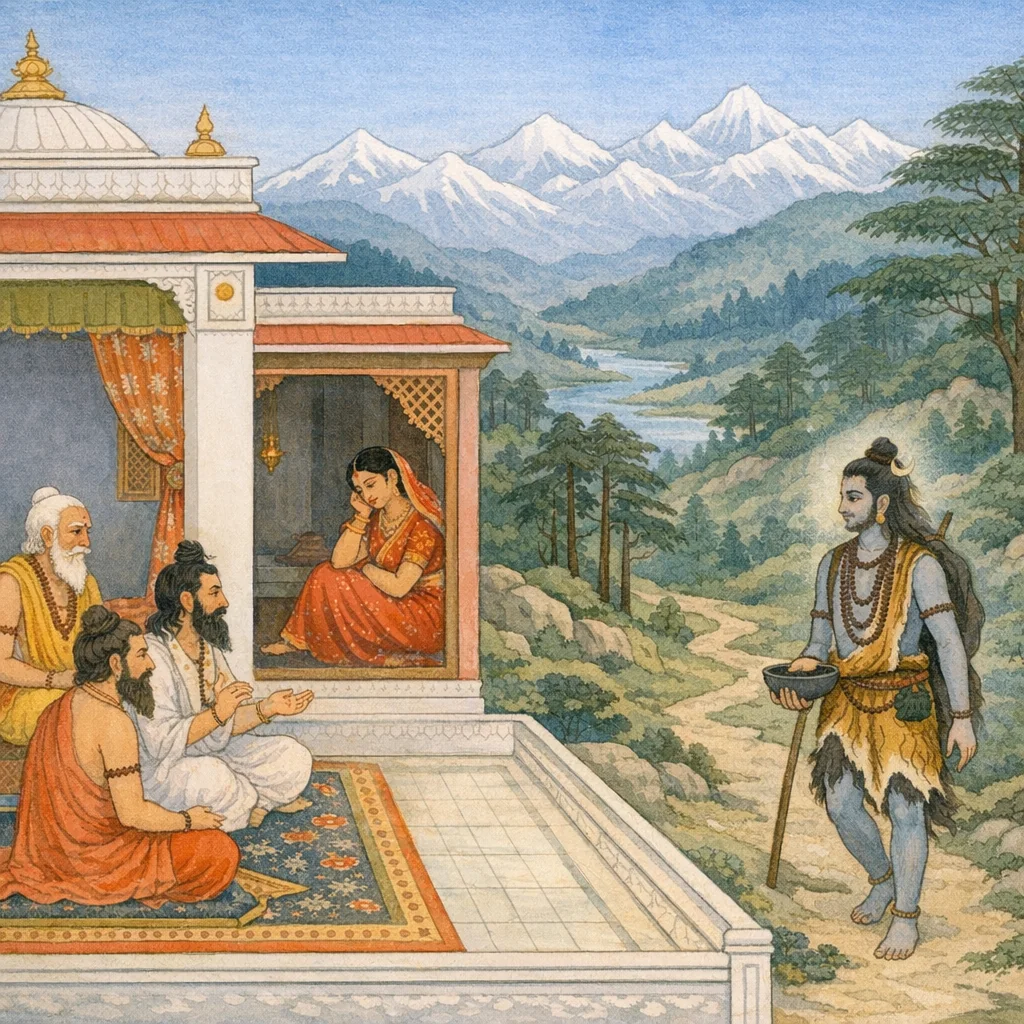
शिवशिवयोर्जगत्पितृमातृत्व-प्रतिपादनं तथा मेनायाः विमोहः (Śiva–Śivā as Cosmic Father and Mother; Menā’s Delusion and the Sages’ Intervention)
Adhyāya 33 begins with the ṛṣis urging Himālaya to give his daughter to Śaṅkara, declaring a cosmic truth: Śiva is the Father of the world (jagatpitā) and Śivā is the Mother of the world (jaganmātā), so this marriage is not merely social but ontological. They promise that by this act Himālaya’s birth becomes “sārthaka” and his status is greatly exalted. Brahmā recounts Himālaya’s reply: he had already consented in accord with Girīśa’s will, yet a disturbing influence arose—a Vaiṣṇava-leaning brāhmaṇa spoke “viparīta” words about Śiva, causing a reversal of understanding. Menā thus becomes jñānabhraṣṭā, refuses the marriage to Rudra appearing as a bhikṣu-yogin, withdraws to a kopāgāra, and remains obstinate despite counsel. Himālaya too admits delusion, unwilling to offer his daughter to Maheśa in a “beggar” form, and falls silent among the sages. The saptarṣis then praise Śiva’s māyā as the force behind this confusion and send Arundhatī—renowned for wisdom and conjugal rectitude—swiftly to Menā and Pārvatī with her husband’s instruction, to restore right understanding and return events to the ordained union.
Shlokas
Verse 1
ऋषय ऊचुः । जगत्पिता शिवः प्रोक्तो जगन्माता शिवा मता । तस्माद्देया त्वया कन्या शंकराय महात्मने
The sages said: “Śiva is declared to be the Father of the universe, and Śivā is regarded as the Mother of the universe. Therefore, you should give your daughter in marriage to Śaṅkara, the great-souled Lord.”
Verse 2
एवं कृत्वा हिमगिरे सार्थकं ते भवेज्जनुः । जगद्गुरोर्गुरुस्त्वं हि भविष्यसि न संशयः
O daughter of the Himālaya, by doing thus, your birth will become truly fulfilled. Indeed, you will become the very guru of the Guru of the world (Lord Śiva)—of this there is no doubt.
Verse 3
ब्रह्मोवाच । एवं वचनमाकर्ण्य सप्तर्षीणां मुनीश्वर । प्रणम्य तान्करौ बद्ध्वा गिरिराजोऽब्रवीदिदम्
Brahmā said: O best of sages, hearing these words of the Seven Ṛṣis, the Lord of Mountains bowed to them; with hands joined in reverence, he spoke as follows.
Verse 4
हिमालय उवाच । सप्तर्षयो महाभागा भवद्भिर्यदुदीरितम् । तत्प्रमाणीकृतं मे हि पुरैव गिरिशेच्छया
Himālaya said: “O greatly fortunate Seven Sages, what you have spoken I had long ago accepted as authoritative, in accordance with the wish of Girīśa (Lord Śiva).”
Verse 5
इदानीमेक आगत्य विप्रो वैष्णवधर्मवान् । शिवमुद्दिश्य सुप्रीत्या विपरीतं वचोऽब्रवीत्
Just then a certain brāhmaṇa arrived—one devoted to Vaiṣṇava religious observances—and, though addressing Śiva with apparent cordiality, he spoke words that were contrary (to the truth and proper devotion).
Verse 6
तदारभ्य शिवामाता ज्ञानभ्रष्टा बभूव ह । सुताविवाहं रुद्रेण योगिना तेन नेच्छति
From that moment onward, the Mother of Śivā was bereft of right discernment; therefore she did not wish her daughter’s marriage with Rudra, the ascetic Yogin.
Verse 7
कोपागारमगात्सा हि सुतप्ता मलिनाम्बरा । कृत्वा महाहठं विप्रा बोध्यमानापिऽनाबुधत्
O brāhmaṇas, she—burning with inner anguish and clad in soiled garments—went into the chamber of anger. Having taken up a great stubborn resolve, she would not heed, even though she was counselled again and again.
Verse 9
अहं च ज्ञानविभ्रष्टो जातोहं सत्यमीर्य्यते । दातुं सुतां महेशाय नेच्छामि भिक्षुरूपिणे । ब्रह्मोवाचैत्युक्त्वा शैलराजस्तु शिवमायाविमोहितः । तूष्णीं बभूव तत्रस्थो मुनीनां मध्यतो मुने
“I too have become one whose discernment is confounded—this is truly so. I do not wish to give my daughter to Maheśa while He is in the guise of a beggar.” Brahmā said: Having spoken thus, the lord of the mountains—deluded by Śiva’s māyā—stood there amid the sages, O muni, and became silent.
Verse 10
सर्वे सप्तर्षयस्ते हि शिवमायां प्रशस्य वै । प्रेषयामासुरथ तां मेनकां प्रत्यरुन्धतीम्
Indeed, all those Seven Ṛṣis praised the wondrous power of Śiva’s Māyā; and then they sent Menakā to Arundhatī, to approach her with their message.
Verse 11
अथ पत्युस्समादाय निदेशं ज्ञानदा हि सा । जगामारुन्धती तूर्णं यत्र मेना च पार्वती
Then Arundhatī—she who bestows true understanding—having accepted her husband’s instruction, quickly went to the place where Menā and Pārvatī were.
Verse 12
गत्वा ददर्श मेनां तां शयानां शोकमूर्च्छिताम् । उवाच मधुरं साध्वी सावधाना हितं वचः
Going there, she saw Menā lying down, fainted in grief. The virtuous lady then spoke—gently, attentively, and with words meant for Menā’s true welfare.
Verse 13
अरुन्धत्युवाच । उत्तिष्ठ मेनके साध्वि त्वद्गृहेऽहमरुन्धती । आगता मुनयश्चापि सप्तायाताः कृपालवः
Arundhatī said: “Rise, O virtuous Menakā. I, Arundhatī, have come to your home. The sages too have arrived—seven compassionate ones have come here.”
Verse 14
ब्रह्मोवाच । अरुन्धतीस्वरं श्रुत्वा शीघ्रमुत्थाय मेनका । उवाच शिरसा नत्वा तां पद्मामिव तेजसा
Brahmā said: Hearing the voice of Arundhatī, Menakā quickly rose. Bowing her head in reverence, she spoke to her—radiant with splendor like a lotus.
Verse 15
मेनोवाच । अहोद्य किमिदं पुण्यमस्माकं पुण्यजन्मनाम् । वधूर्जगद्विधेः पत्नी वसिष्ठस्यागतेह वै
Mena said: “Ah! What great merit has come to us today—we who are born of a virtuous lineage! For truly the bride, the consort of the Ordainer of the universe, has come here indeed, together with Vasiṣṭha.”
Verse 16
किमर्थमागता देवि तन्मे ब्रूहि विशेषतः । अहं दासीसमा ते हि ससुता करुणां कुरु
O Goddess, for what purpose have you come? Tell me clearly and in detail. I am as your maidservant, together with my son; please show compassion to us.
Verse 17
ब्रह्मोवाच । इत्युक्त्वा मेनकां साध्वी बोधयित्वा च तां बहु । तथागता च सुप्रीत्या सास्ते यत्रर्षयोऽपि ते
Brahmā said: Having spoken thus, the virtuous lady (Pārvatī) instructed Menakā at length. Then, filled with great joy, she went to the place where those sages also were staying.
Verse 18
अथ शैलेश्वरं ते च बोधयामासुरादरात् । स्मृत्वा शिवपदद्वन्द्वं सर्वे वाक्यविशारदाः
Then, with reverent earnestness, they roused Śaileśvara; and all those skilled in speech, remembering the pair of Śiva’s sacred words, addressed him.
Verse 19
ऋषय ऊचुः । शैलेन्द्र श्रूयतां वाक्यमस्माकं शुभकारणम् । शिवाय पार्वतीं देहि संहर्त्तुः श्वशुरो भव
The sages said: “O lord of mountains, please hear our words that bring auspiciousness. Give Pārvatī to Śiva in marriage, and become the father-in-law of the Destroyer (Saṃhartā).”
Verse 20
अयाचितारं सर्वेशं प्रार्थयामास यत्नतः । तारकस्य विनाशाय ब्रह्मासम्बंधकर्म्मणि
With earnest effort, he prayed to the Lord of all—who needs no one to solicit Him—seeking the destruction of Tāraka, in an act undertaken in connection with Brahmā’s ordained task.
Verse 21
नोत्सुको दारसंयोगे शंकरो योगिनां वरः । विधेः प्रार्थनया देवस्तव कन्यां ग्रहीष्यति
Śaṅkara, the foremost among yogins, is not eager for marital union. Yet, at the prayerful request of Vidhātā (Brahmā), that Divine Lord will accept your daughter in marriage.
Verse 22
दुहितुस्ते तपस्तप्तं प्रतिज्ञानं चकार सा । हेतुद्वयेन योगीन्द्रो विवाहं च करिष्यति
Your daughter has performed austere tapas and has also made a firm vow. For these two reasons, the Lord of Yogins (Śiva) will indeed accept the marriage.
Verse 23
ब्रह्मोवाच । ऋषीणां वचनं श्रुत्वा प्रहस्य स हिमालयः । उवाच किञ्चिद्भीतस्तु परं विनयपूर्वकम्
Brahmā said: Hearing the words of the sages, Himālaya smiled; yet, being somewhat afraid, he spoke with the utmost humility and courtesy.
Verse 24
हिमालय उवाच । शिवस्य राजसामग्रीं न हि पश्यामि काञ्चन । कञ्चिदाश्रयमैश्वर्यं कं वा स्वजनबान्धवम्
Himālaya said: “In Śiva I see no royal accoutrements at all—no seat of worldly sovereignty to lean upon, and no circle of kinsmen and relatives.”
Verse 25
नेच्छाम्यति विनिर्लिप्तयोगिने स्वां सुतामहम् । यूयं वेदविधातुश्च पुत्रा वदत निश्चितम्
“I do not at all wish to give my own daughter to that utterly unattached Yogin. You, my sons—ordainers of the Vedic way—speak decisively what is to be done.”
Verse 26
वरायाननुरूपाय पिता कन्यां ददाति चेत् । कामान्मोहाद्भयाल्लोभात्स नष्टो नरकं यजेत्
If a father gives his daughter to a groom who is not suitable for her—out of desire, delusion, fear, or greed—he becomes spiritually ruined and goes to hell.
Verse 27
न हि दास्याम्यहं कन्यामिच्छया शूलपाणये । यद्विधानं भवेद्योग्यमृषयस्त द्विधीयताम्
“I will not give my daughter to Śūlapāṇi (Śiva) merely according to personal whim. O sages, whatever procedure is proper and fitting according to sacred ordinance—let that be duly prescribed and carried out.”
Verse 28
ब्रह्मोवाच । इत्याकर्ण्य वचस्तस्य हिमागस्य मुनीश्वर । प्रत्युवाच वसिष्ठस्तं तेषां वाक्यविशारद
Brahmā said: O best of sages, having thus heard the words of Himālaya, Vasiṣṭha—skilled among them in the proper use of speech—replied to him.
Verse 29
वसिष्ठ उवाच । शृणु शैलेश मद्वाक्यं सर्वथा ते हितावहम् । धर्माविरुद्धं सत्यश्च परत्रेह मुदावहम्
Vasiṣṭha said: “O Lord of the mountain, listen to my words; they are wholly for your welfare. They are not opposed to dharma, they are true, and they bring joy both here in this world and in the hereafter.”
Verse 30
वचनं त्रिविधं शैल लौकिके वैदिकेऽपि च । सर्वं जानाति शास्त्रज्ञो निर्मलज्ञानचक्षुषा
O Mountain-born one, speech is of three kinds—whether in worldly usage or in the Vedic domain. The knower of the scriptures understands it all, seeing through the stainless eye of true knowledge.
Verse 31
असत्यमहितं पश्चात्सांप्रतं श्रुतिसुन्दरम् । सुबुद्धिर्वक्ति शत्रुर्हि हितं नैव कदाचन
What is untrue and harmful may later be spoken as if it were presently ‘beautiful to the ear.’ But a foe—even if intelligent—never truly speaks what is beneficial to you at any time.
Verse 32
आदावप्रीतिजनकं परिणामे सुखावहम् । दयालुर्धमशीलो हि बोधयत्येव बांधवः
A true kinsman—compassionate and established in dharma—may at first speak words that cause displeasure, yet in the end they bring well-being and happiness; therefore he certainly admonishes and awakens one to the right path.
Verse 33
इति श्रीशिवमहापुराणे द्वितीयायां रुद्रसंहितायां तृतीये पार्वतीखण्डे गिरिसांत्वनोनाम त्रयस्त्रिंशोऽध्यायः
Thus ends the thirty-third chapter, called “Girisāṃtvanā” (the Consolation of the Mountain), in the Pārvatīkhaṇḍa (third section) of the Rudra Saṃhitā (second division) of the revered Śiva Mahāpurāṇa.
Verse 34
एवञ्च त्रिविधं शैल नीतिशास्त्रोदितं वचः । कथ्यतां त्रिषु मध्ये किं ब्रुवे वाक्यं त्वदीप्सितम्
Thus, O Mountain, this counsel taught in the nīti-śāstra, the science of right conduct, is threefold. Tell me—among these three, which course do you desire? What words shall I speak in accordance with your wish?
Verse 35
ब्राह्मसम्पद्विहीनश्च शंकरस्त्रिदशेश्वरः । तत्त्वज्ञानसमुद्रेषु सन्निमग्नैकमानसः
Though devoid of worldly Brahminical prosperity and social splendor, Śaṅkara—the Lord of the gods—remained with a single, unwavering mind, wholly immersed in the ocean of true knowledge of Reality.
Verse 36
ज्ञानानन्दस्येश्वरस्य ब्राह्मवस्तुषु का स्पृहा । गृही ददाति स्वसुतां राज्यसम्पत्तिशालिने
What desire could the Lord—whose very nature is the bliss of pure knowledge—have for worldly possessions? Yet a householder gives his own daughter in marriage to one endowed with kingship and prosperity.
Verse 37
कन्यकां दुःखिने दत्त्वा कन्याघाती भवेत्पिता । को वेद शंकरो दुःखी कुबेरो यस्य किंकरः
By giving one’s daughter to a sorrowful, wretched man, a father becomes, as it were, a slayer of his own daughter. Who can say that Śaṅkara is “unfortunate,” when Kubera himself stands as His attendant?
Verse 38
भ्रूभङ्गलीलया सृष्टिं स्रष्टुं हर्त्तुं क्षमो हि सः । निर्गुणः परमात्मा च परेशः प्रकृतेः परः
By the mere sportive play of His brow, He is indeed capable of creating the universe and dissolving it. He is the attributeless Supreme Self, the Supreme Lord, transcending Prakṛti (material nature).
Verse 39
यस्य च त्रिविधा मूर्त्तिर्विधा तुस्सृष्टिकर्मणि । सृष्टिस्थित्यन्तजननी ब्रह्मविष्णुहराभिधा
He whose form is threefold, established for the work of creation—she who gives rise to creation, preservation, and dissolution—is known by the names Brahmā, Viṣṇu, and Hara.
Verse 40
ब्रह्मा च ब्रह्मलोकस्थो विष्णुः क्षीरोदवासकृत् । हरः कैलासनिलयः सर्वाः शिवविभूतयः
Brahmā abides in Brahma-loka; Viṣṇu dwells upon the Ocean of Milk; and Hara resides on Kailāsa—yet all these abodes and powers are, in truth, manifestations of Śiva’s sovereign glory (vibhūti).
Verse 41
धत्ते च त्रिविधा मूर्ती प्रकृतिः शिवसम्भवा । अंशेन लीलया सृष्टौ कलया बहुधा अपि
And the Prakṛti that arises from Śiva assumes a threefold embodiment. In creation, She manifests playfully (līlā) by a portion (aṁśa), and also in many ways through Her powers and phases (kalā).
Verse 42
मुखोद्भवा स्वयं वाणी वागधिष्ठातृदेवता । वक्षःस्थलोद्भवा लक्ष्मीस्सर्वसम्पत्स्वरूपिणी
From His mouth arose Vāṇī herself—the presiding goddess of speech; and from His chest arose Lakṣmī, whose very nature is the fullness of all prosperity and auspicious fortune.
Verse 43
शिवा तेजस्सु देवानामाविर्भावं चकार सा । निहत्य दानवान्सर्वान्देवेभ्यश्च श्रियं ददौ
Śivā (Pārvatī), manifesting herself as radiant power within the very splendour of the gods, appeared among them; and after slaying all the Dānavas, she bestowed prosperity and divine fortune (śrī) upon the Devas.
Verse 44
प्राप कल्पान्तरे जन्म जठरे दक्ष योषितः । नाम्ना सती हरं प्राप दक्षस्तस्मै ददौ च ताम्
In another cycle of time (a later kalpa), she was born in the womb of Dakṣa’s wife. Named Satī, she attained Lord Hara (Śiva); and Dakṣa gave her to Him in sacred marriage.
Verse 45
देहं तत्याज योगेन श्रुत्वा सा भर्तृनिन्दनम् । साद्य त्वत्तस्तु मेनायां जज्ञे जठरतश्शिवा
Hearing the disparagement of her Lord, she abandoned her body through yogic power. Then indeed, from you she was promptly born again—Śivā—within Menā’s womb.
Verse 46
शिवा शिवस्य पत्नीयं शैल जन्मनिजन्मनि । कल्पेकल्पे बुद्धिरूपा ज्ञानिनां जननी परा
She is Śivā, the consort of Śiva—born again and again as the Mountain’s daughter. In every kalpa she appears as the very form of higher buddhi, the supreme Mother of the wise, guiding them to liberating knowledge.
Verse 47
जायते स्म सदा सिद्धा सिद्धिदा सिद्धिरूपिणी । सत्या अस्थि चिताभस्म भक्त्या धत्ते हरस्स्वयम्
She is ever born as the Siddhā—bestower of siddhis, embodiment of spiritual accomplishment. Truly: Hara Himself (Śiva), out of bhakti, bears the sacred bhasma from the funeral pyre and the bone-ashes.
Verse 48
अतस्त्वं स्वेच्छया कन्यां देहि भद्रां हराय च । अथवा सा स्वयं कान्तस्थाने यास्यत्यदास्यसि
Therefore, of your own free will, give the auspicious maiden to Hara (Śiva). Otherwise, she will go of her own accord to her beloved’s abode; then you will have to give her away.
Verse 49
कृत्वा प्रतिज्ञां देवेशो दृष्ट्वा क्लेशमसंख्यकम् । दुहितुस्ते तपःस्थानमाजगाम द्विजात्मकः
Having made his resolve, the Lord of the gods—seeing your daughter’s countless hardships—came to the place where she was performing tapas, assuming the form of a brahmin, a dvija (twice-born).
Verse 50
तामाश्वास्य वरं दत्त्वा जगाम निजमन्दिरम् । तत्प्रार्थनावशाच्छम्भुर्ययाचे त्वां शिवां गिरे
Having consoled her and granted her a boon, he returned to his own abode. Then, moved by her earnest supplication, Śambhu sought you—O auspicious Śivā, daughter of the mountain.
Verse 51
अंगीकृतं युवाभ्यां तच्छिवभक्तिरतात्मना । विपरीतमतिर्जाता वद कस्माद्गिरीश्वर
O Girīśvara, you accepted it with a heart absorbed in Śiva-bhakti; why, then, has an opposite intention arisen? Tell me—what is the reason?
Verse 52
तद्गत्वा प्रभुणा देव प्रार्थितेन त्वदन्तिकम् । प्रस्थापिता वयं शीघ्रं ह्यृषयस्साप्यरुन्धती
“Having gone there, O Deva, we were earnestly entreated by the Lord and promptly dispatched to your presence—(we) the sages, along with Arundhatī.”
Verse 53
शिक्षयामो वयं त्वा हि दत्त्वा रुद्राय पार्वतीम् । एवंकृते महानन्दो भविष्यति गिरे तव
“Indeed, we shall instruct you: give Pārvatī to Rudra. When this is done, O Mountain, great bliss will arise for you.”
Verse 54
शिवां शिवाय शैलेन्द्र स्वेच्छया चेन्न दास्यसि । भविता तद्विवाहोऽत्र भवितव्यबलेन हि
O Lord of the mountains, if you do not willingly give Śivā (Pārvatī) to Śiva, then even so, their marriage will indeed take place here—by the irresistible force of what is destined.
Verse 55
वरं ददौ शिवायै स तपन्त्यै तात शंकरः । नहीश्वरप्रतिज्ञातं विपरीताय कल्पते
O dear one, Śaṅkara granted a boon to Śivā (Pārvatī) as she performed austerities; for what has been vowed by the Lord can never turn out otherwise, nor become contrary to His divine resolve.
Verse 56
अहो प्रतिज्ञा दुर्लंघ्या साधूनामीशवर्तिनाम् । सर्वेषां जगतां मध्ये किमीशस्य पुनर्गिरे
Ah! The vow of the virtuous, who abide under the Lord’s governance, is indeed hard to transgress. In all the worlds, what power could make the Lord speak again otherwise?
Verse 57
एको महेन्द्रश्शैलानां पक्षांश्चिच्छेद लीलया । पार्वती लीलया मेरोश्शृङ्गभङ्गं चकार च
By mere play, Mahendra alone clipped the ‘wings’ of the mountains; and likewise, by her own sportive power (līlā), Pārvatī even broke the peak of Meru.
Verse 58
एकार्थे नहि शैलेश नाश्यास्सर्वा हि सम्पदः । एकं त्यजेत्कुलस्यार्थे श्रुतिरेषा सनातनी
O Lord of the mountains, when a single aim is not upheld, all prosperity indeed perishes. For the welfare of the family, one should renounce even one; this is the eternal teaching of the Śruti.
Verse 59
दत्त्वा विप्राय स्वसुतामनरण्यो नृपेश्वर । ब्राह्मणाद्भयमापन्नो ररक्ष निजसम्पदम्
Having given his own daughter to a brāhmaṇa, King Anaraṇya—overcome by fear of that brāhmaṇa’s power—guarded his own wealth and possessions.
Verse 60
तमाशु बोधयामासुर्नीतिशास्त्रविदो जनाः । ब्रह्मशापाद्विभीताश्च गुरवो ज्ञातिसत्तमाः
Then those people, well-versed in the treatises on right conduct, quickly instructed him. The elders and preceptors, the noblest among his kinsmen, were also frightened of Brahmā’s curse and therefore hastened to counsel him.
Verse 61
शैलराज त्वमप्येव सुतां दत्त्वा शिवाय च । रक्ष सर्वान्बंधुवर्गान्वशं कुरु सुरानपि
O King of Mountains, you too, having given your daughter to Śiva, protect all your kinsmen; and bring even the gods under your favorable sway.
Verse 62
ब्रह्मोवाच । इत्याकर्ण्य वसिष्ठस्य वचनं स प्रह स्य च । पप्रच्छ नृपवार्त्ताश्च हृदयेन विदूयता
Brahmā said: Having thus heard Vasiṣṭha’s words, he smiled; yet, with a heart burning within, he questioned him further about the king’s condition and affairs.
Verse 63
हिमालय उवाच । कस्य वंशोद्भवो ब्रह्मन्ननरण्यो नृपश्चसः । सुतां दत्त्वा स च कथं ररक्षाखिलसम्पदः
Himālaya said: “O Brahman, from what lineage was that king Anaraṇya born? And after giving his daughter in marriage, how did he preserve and protect all his prosperity and possessions?”
Verse 64
ब्रह्मोवाच । इति श्रुत्वा वसिष्ठस्तु शैलवाक्यं प्रसन्नधीः । प्रोवाच गिरये तस्मै नृपवार्त्ता सुखावहाम्
Brahmā said: Having thus heard the words of the Mountain, Vasiṣṭha—his mind serene and pleased—spoke to that mountain, conveying agreeable and joy-bringing news concerning the king.
Frequently Asked Questions
The sages press Himālaya to offer Pārvatī to Śiva, but a contrary Vaiṣṇava-leaning brāhmaṇa’s words trigger Menā’s and Himālaya’s hesitation; the saptarṣis then dispatch Arundhatī to restore clarity and consent.
It frames the marriage as a metaphysical reunification of the cosmic principles (consciousness and power), making the household act (kanyādāna) a symbol of cosmic order rather than a merely human alliance.
Śiva’s māyā: delusion is portrayed not simply as error but as a divine, pedagogical mechanism that requires discernment and authoritative counsel to resolve.