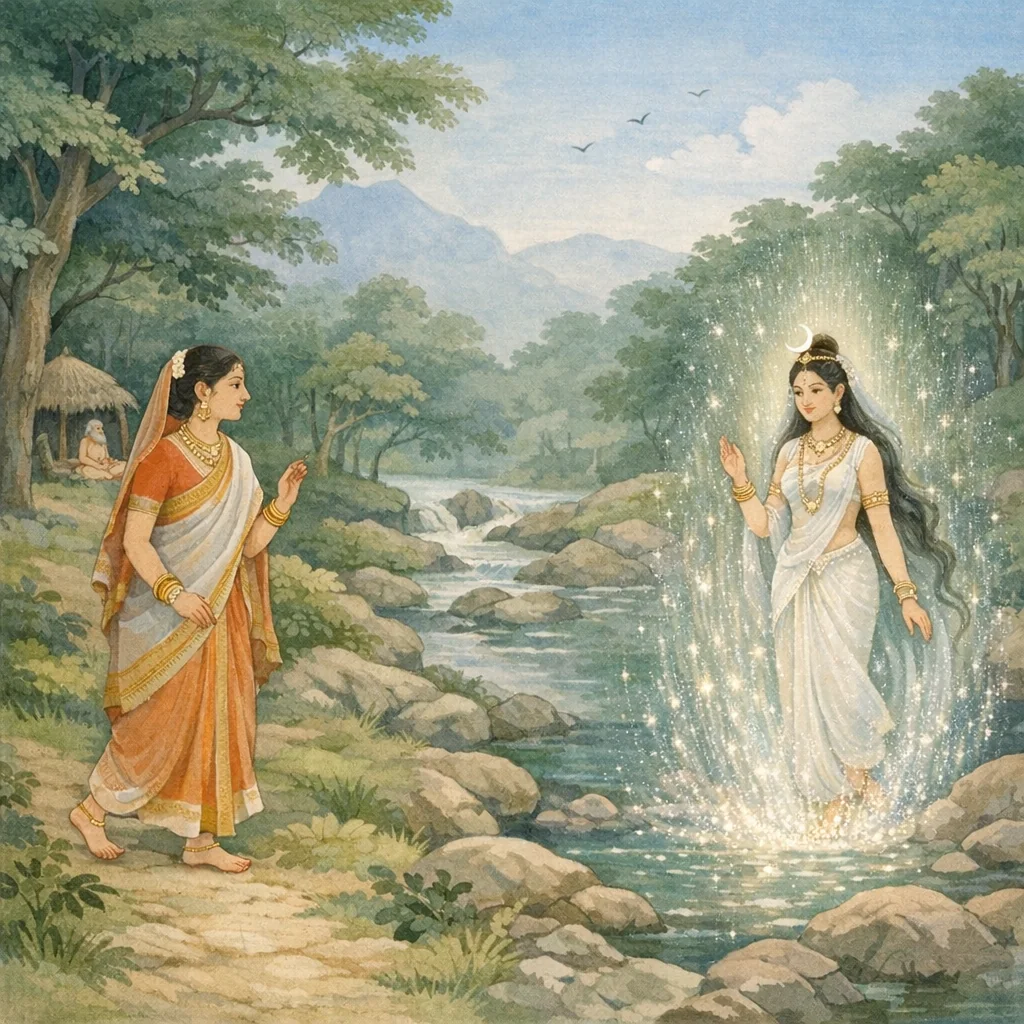
अत्रीश्वरमाहात्म्यवर्णनम् (Atrīśvara-māhātmya-varṇanam) — “Account of the Greatness of Atrīśvara”
Narrated by Sūta, this chapter begins in the household-ascetic setting of the sage Atri, foremost among the knowers of Brahman. When Atri asks for water, his wife Anasūyā takes her kamaṇḍalu into the forest and faces a practical yet spiritual question: where can water be found. In that liminal moment, Gaṅgā appears as a divinized, personified river-goddess (saridvarā devī) and speaks with her. The dialogue serves as a māhātmya prologue, as Gaṅgā states that she has come after witnessing service to Śiva and recognizing Anasūyā’s sādhvī-dharma. The narrative thus weaves together the ideal of the ṛṣi-gṛhastha, sacred geography with Gaṅgā as a mobile tīrtha, and Śaiva theology in which Śiva, the Parātman, draws divine agencies through worship. In its inner sense, it teaches that purity of conduct and devotion “attract” tīrtha-power, establishing Atrīśvara as a Śaiva holy place where river sanctity and liṅga-centered grace converge.
Shlokas
Verse 1
सूत उवाच । कदाचित्स ऋषिश्रेष्ठो ह्यत्रिर्ब्रह्मविदां वरः । जागृतश्च जलं देहि प्रत्युवाच प्रियामिति
Sūta said: Once, the excellent sage Atri—foremost among the knowers of Brahman—awoke and said to his beloved wife, “Give me water.”
Verse 2
सापि साध्वी त्ववश्यं च गृहीत्वाथ कमण्डलुम् । जगाम विपिने तत्र जलं मे नीयते कुतः
That chaste and virtuous lady, compelled by your insistence, took up the kamaṇḍalu, the water-pot, and went into the forest. Yet there she wondered, “From where shall water be brought for me?”
Verse 3
किं करोमि क्व गच्छामि कुतो नीयेत वै जलम् । इति विस्मयमापन्ना तां गंगां हि ददर्श सा
Overcome with bewilderment, she thought, “What shall I do? Where shall I go? From where can water truly be brought?” In that state of wonder, she beheld the sacred Gaṅgā.
Verse 4
तामनुव्रजती यावत् साब्रवीच्च सदा हि ताम् । गंगा सरिद्वरा देवी बिभ्रती सुन्दरां तनुम्
As she continued to follow, the divine Gaṅgā—foremost among rivers—, bearing a beautiful form, ever addressed her and spoke.
Verse 5
गंगोवाच । प्रसन्नास्मि च ते देवि कुत्र यासि वदाधुना । धन्या त्वं सुभगे सत्यं तवाज्ञां च करोम्यहम्
Gaṅgā said: “O Goddess, I am pleased with you. Tell me now—where are you going? Truly, O auspicious one, you are blessed. Indeed, I shall carry out your command.”
Verse 6
सूत उवाच । तद्वचश्च तदा श्रुत्वा ऋषिपत्नी तपस्विनी । प्रत्युवाच वचः प्रीत्या स्वयं सुचकिता द्विजाः
Sūta said: Having then heard those words, the ascetic wife of the sage—herself startled—replied with affection, addressing the twice-born (brahmins).
Verse 7
अनसूयोवाच । का त्वं कमलपत्राक्षि कुतो वा त्वं समागता । तथ्यं ब्रूहि कृपां कृत्वा साध्वी सुप्रवदा सती
Anasūyā said: “Who are you, O lotus-petaled-eyed lady? From where have you come here? Please, out of compassion, speak the truth. O virtuous and truthful woman, speak clearly.”
Verse 8
सूत उवाच । इत्युक्ते च तया तत्र मुनिपत्न्या मुनीश्वराः । सरिद्वरा दिव्यरूपा गंगा वाक्यमथाब्रवीत्
Sūta said: When the sage’s wife had spoken thus there, O best of sages, then Gaṅgā—the foremost of rivers, of divine form—began to speak.
Verse 9
गंगोवाच । स्वामिनः सेवनं दृष्ट्वा शिवस्य च परात्मनः । साध्वि धर्मं च ते दृष्ट्वा स्थितास्मि तव सन्निधौ
Gaṅgā said: “O virtuous one, having witnessed your devoted service to Lord Śiva—the Supreme Self—and having seen your righteous conduct, I have come and remain here in your presence.”
Verse 10
अहं गंगा समायाता भजनात्ते शुचिस्मिते । वशीभूता ह्यहं जाता यदिच्छसि वृणीष्व तत्
I am Gaṅgā. I have come here because of your worship, O you of the pure smile. Truly, I have become compliant to your will—whatever you desire, choose that boon.
Verse 11
सूत उवाच । इत्युक्ते गंगया साध्वी नमस्कृत्य पुरः स्थिता । उवाचेति जलं देहि चेत्प्रसन्ना ममाऽधुना
Sūta said: Thus having spoken, the virtuous Goddess Gaṅgā bowed in reverence, stood before him, and said, “If you are pleased with me now, then grant me the water.”
Verse 12
इत्येतद्वचनं श्रुत्वा गर्तं कुर्ष्विति साऽब्रवीत् । शीघ्रं चायाच्च तत्कृत्वा स्थिता तत्क्षणमात्रतः
Hearing these words, she said, “Dig a pit.” He quickly came, did so, and she remained there for only a moment.
Verse 13
तत्र सा च प्रविष्टा च जलरूपमभूत्तदा । आश्चर्य्यं परमं गत्वा गृहीतं च जलं तया
Entering that place, she then assumed the form of water. In utmost wonder, she took up that water.
Verse 14
उवाच वचनं चैतल्लोकानां सुखहेतवे । अनसूया मुनेः पत्नी दिव्यरूपां सरिद्वराम्
For the happiness and welfare of all beings, Anasūyā—the sage’s wife—spoke these words, addressing that best of rivers, radiant in a divine form.
Verse 15
अनसूयोवाच । यदि त्वं सुप्रसन्ना मे वर्तसे च कृपामयि । स्थातव्यं च त्वया तावन्मत्स्वामी यावदा व्रजेत्
Anasūyā said: “O compassionate one, if you are truly gracious and favorable to me, then you must remain here until my lord (husband) departs.”
Verse 16
सूत उवाच । इति श्रुत्वानसूयाया वचनं सुखदं सताम् । गंगोवाच प्रसन्नाति ह्यत्रेर्दास्यसि मेऽनघे
Sūta said: Having heard Anasūyā’s auspicious words that delight the holy, Gaṅgā, greatly pleased, said, “O sinless one, you shall indeed be given to me as the wife of Atri.”
Verse 17
इत्युक्ते च तया तत्र ह्यनपायि कृतन्तथा । स्वामिने तज्जलं दिव्यं दत्त्वा तत्पुरतः स्थिता
When she spoke thus there, the unfailing one acted accordingly. Having offered that divine water to her lord, she stood before him.
Verse 18
स ऋषिश्चापि सुप्रीत्या स्वाचम्य विधिपूर्वकम् । पपौ दिव्यं जलं तच्च पीत्वा सुखमवाप ह
That sage too, with great joy, first performed ācamana according to proper rite; then he drank that divine water, and upon drinking it he attained ease and well-being.
Verse 19
अहो नित्यं जलं यच्च पीयते तज्जलं न हि । विचार्येति च तेनाशु परितश्चावलोकितम्
“Alas! That which is drunk every day as ‘water’ is not truly water at all.” Thinking thus, he quickly looked all around to discern the truth.
Verse 20
शुष्कान्वृक्षान्समालोक्य दिशो रूक्षतरास्तथा । उवाच तामृषिश्रेष्ठो न जातं वर्षणं पुनः
Seeing the trees dried up and the quarters grown even more parched, that best of sages said: “Again, no rainfall has come to pass.”
Verse 21
तदुक्तं तत्समाकर्ण्य नेतिनेति प्रियान्तदा । तामुवाच पुनः सोऽपि जलं नीतं कुतस्त्वया
Hearing what had been said, the beloved replied at that time, “Not so, not so.” Then he again spoke to her: “From where have you brought this water?”
Verse 22
इत्युक्ते तु तदा तेन विस्मयं परमं गता । अनसूया स्वमनसि सचिन्ता तु मुनीश्वराः
When he had spoken thus, Anasūyā was overcome with the greatest wonder; and the venerable sages, too, became inwardly thoughtful within their own minds.
Verse 23
निवेद्यते मया चेद्वै तदोत्कर्षो भवेन्मम । निवेद्यते यदा नैव व्रतभङ्गो भवेन्मम
If I formally offer myself, that becomes my spiritual elevation. But if nothing is offered at all, then my vow (vrata) is not broken.
Verse 24
नोभयं च तथा स्याद्वै निवेद्यं तत्तथा मम । इति यावद्विचार्येत तावत्पृष्टा पुनः पुनः
“Let there be no fear; that very matter should indeed be reported to me.” Thus, as long as she kept reflecting on it, she was questioned again and again.
Verse 25
अथानुग्रहतः शंभोः प्राप्तबुद्धिः पतिव्रता । उवाच श्रूयतां स्वामिन्यज्जातं कथयामि ते
Then, by the grace of Śambhu, that devoted chaste wife regained right understanding and said: “O mistress, please listen; I shall tell you what has just happened.”
Verse 26
अनसूयोवाच । शंकरस्य प्रतापाच्च तवैव सुकृतैस्तथा । गंगा समागतात्रैव तदीयं सलिलन्त्विदम्
Anasūyā said: “By the majesty of Śaṅkara, and also by your own accumulated merit, the Gaṅgā has come here herself; this water is truly her sacred stream.”
Verse 27
सूत उवाच । एवं वचस्तदा श्रुत्वा मुनिर्विस्मयमानसः । प्रियामुवाच सुप्रीत्या शंकरं मनसा स्मरन्
Sūta said: Having heard those words, the sage—his mind filled with wonder—lovingly addressed his beloved, while inwardly remembering Śaṅkara, Lord Śiva.
Verse 28
अत्रिरुवाच । प्रिये सुन्दरि त्वं सत्यमथ वाचं व्यलीककाम् । ब्रवीषि च यथार्थं त्वं न मन्ये दुर्लभन्त्विदम्
Atri said: “Beloved, fair one, you speak words that are truthful and free from deceit; indeed, you speak rightly. Yet I do not consider this matter to be easily attainable.”
Verse 29
असाध्यं योगिभिर्यच्च देवैरपि सदा शुभे । तच्चैवाद्य कथं जातं विस्मयः परमो मम
O auspicious one, that which is ever unattainable even to yogins and even to the gods—how has that very thing come about today? Great indeed is my wonder.
Verse 30
यद्येवं दृश्यते चेद्वै तन्मयेहं न चान्यथा । इति तद्वचनं श्रुत्वा प्रत्युवाच पतिप्रिया
“If this indeed is what is seen, then I am truly made of That alone—nothing else.” Hearing those words, the beloved wife replied in return.
Verse 31
अनसूयोवाच । आगम्यतां मया सार्द्धं त्वया नाथ महामुने । सरिद्वराया गंगाया द्रष्टुमिच्छा भवेद्यदि
Anasūyā said: “O revered great sage, my lord—if you truly wish to behold Gaṅgā, the foremost of rivers, then come with me.”
Verse 32
सूत उवाच । इत्युक्त्वा तु समादाय पतिं तं सा पतिव्रता । गता द्रुतं शिवं स्मृत्वा यत्र गंगा सरिद्वरा
Sūta said: Having spoken thus, that devoted wife took her husband with her and quickly went forth, remembering Lord Śiva, to the place where the Gaṅgā—the foremost of rivers—flows.
Verse 33
दर्शयामास तां तत्र गंगां पत्ये पतिव्रता । गर्ते च संस्थितां तत्र स्वयं दिव्यस्वरूपिणीम्
There, that devoted, faithful wife showed her husband the Goddess Gaṅgā—who, of her own accord, in a radiant divine form, was standing there within a hollow (pit).
Verse 34
तत्र गत्वा ऋषिश्रेष्ठो गर्तं च जलपूरितम् । आकण्ठं सुन्दरं दृष्ट्वा धन्येयमिति चाब्रवीत्
Having gone there, the best of sages beheld a beautiful pit filled with water up to the neck. Seeing it, he declared, “Truly, I am blessed indeed.”
Verse 35
किं मदीयं तपश्चैव किमन्येषां पुनस्तदा । इत्युक्तो मुनिशार्दूलो भक्त्या तुष्टाव तां तदा
“What is my own austerity—and what, then, are the austerities of others?” Thus addressed, the tiger among sages, filled with devotion, praised Her at that very moment.
Verse 36
ततो हि स मुनिस्तत्र सुस्नातः सुभगे जले । आचम्य पुनरेवात्र स्तुतिं चक्रे पुनः पुनः
Thereupon, that sage bathed well in the auspicious waters there. Having performed ācamana once again, he repeatedly offered hymns of praise—again and again—right at that sacred spot.
Verse 37
अनसूयापि संस्नाता सुन्दरे तज्जले तदा । नित्यं चक्रे मुनिः कर्म सानसूयापि सुव्रता
Then Anasūyā too bathed in that beautiful water. The sage regularly performed his daily rites, and the virtuous Anasūyā, steadfast in her vows, did so as well.
Verse 38
ततस्सोवाच तां गंगा गम्यते स्वस्थलं मया । इत्युक्ते च पुनः साध्वी तामुवाच सरिद्वराम्
Then he said to the Gaṅgā: “I shall go to my own proper abode.” After he had spoken thus, the virtuous lady again addressed that best of rivers.
Verse 39
अनसूयोवाच । यदि प्रसन्ना देवेशि यद्यस्ति च कृपा मयि । त्वया स्थेयं निश्चलत्वादस्मिन्देवि तपोवने
Anasūyā said: “If you are pleased, O Goddess, and if there is compassion in you toward me, then, O Devi, you should remain here in this sacred grove of austerities, steady and unmoving.”
Verse 40
महतां च स्वभावश्च नांगीकृत्य परित्यजेत् । इत्युक्ता च करौ बद्ध्वा तां तुष्टाव पुनःपुनः
“One should not abandon the natural disposition of the great.” Having been told thus, he folded his hands and again and again praised her with devotion.
Verse 41
ऋषिश्चापि तथोवाच त्वया स्थेयं सरिद्वरे । सानुकूला भव त्वं हि सनाथान्देवि नः कुरु
The sage then spoke thus: “O Goddess, you must remain here at this most excellent river-ford. Be gracious and favorable to us, and make us protected—provided with a sure refuge.”
Verse 42
तदीयं तद्वचः श्रुत्वा रम्यं गंगा सरिद्वरा । प्रसन्नमानसा गंगाऽनसूयां वाक्यमब्रवीत्
Hearing those pleasing words, the lovely Gaṅgā—the foremost of rivers—became serene in mind, and then spoke these words to Anasūyā.
Verse 43
गंगोवाच । शंकरार्चनसंभूतफलं वर्षस्य यच्छसि । स्वामिनश्च तदा स्थास्ये देवानामुपकारणात
Gaṅgā said: “O Lord, since you bestow the fruit produced by the worship of Śaṅkara for the whole year, I too shall remain there at that time, for the benefit of the gods.”
Verse 44
तथा दानैर्न मे तुष्टिस्तीर्थस्नानैस्तथा च वै । यज्ञैस्तथाथ वा योगैर्यथा पातिव्रतेन च
“I am not so pleased by gifts (charity), nor by bathing at sacred tīrthas, nor by sacrifices, nor even by yogic disciplines, as I am by the steadfast chastity and devoted fidelity (pātivratya) of a virtuous wife.”
Verse 45
पतिव्रतां यथा दृष्ट्वा मनसः प्रीणनं भवेत् । तथा नान्यैरुपायैश्च सत्यं मे व्याहृतं सति
“O Sati, just as the very sight of a devoted, faithful wife brings delight to the mind, so too my mind is pleased in that way—and not by any other means. This truth I have spoken to you, O virtuous one.”
Verse 46
पतिव्रतां स्त्रियं दृष्ट्वा पापनाशो भवेन्मम । शुद्धा जाता विशेषेण गौरीतुल्या पतिव्रता
“Upon seeing a devoted wife (pativratā), may my sins be destroyed. May I be purified in a special way—for she is a pativratā, comparable to Goddess Gaurī herself.”
Verse 47
तस्माच्च यदि लोकस्य हिताय तत्प्रयच्छसि । तर्ह्यहं स्थिरतां यास्ये यदि कल्याणमिच्छसि
“Therefore, if you would grant that for the welfare of the world, then I shall attain steadfastness—if you truly desire what is auspicious.”
Verse 48
सूत उवाच । इत्येवं वचनं श्रुत्वाऽनसूया सा पतिव्रता । गंगायै प्रददौ पुण्यं सर्वं तद्वर्षसंभवम्
Sūta said: Having heard those words, Anasūyā—the devoted wife (pativratā)—bestowed upon the Goddess Gaṅgā all the accumulated merit that had arisen from that year.
Verse 49
महतां च स्वभावो हि परेषां हितमावहेत् । सुवर्णं चन्दनं चेक्षुरसस्तत्र निदर्शनम्
Indeed, the very nature of the great is to bring about the welfare of others. Gold, sandalwood, and sugarcane-juice are cited here as illustrations of this beneficent character.
Verse 50
एतद्दृष्ट्वानसूयं तत्कर्म पातिव्रतं महत् । प्रसन्नोभून्महादेवः पार्थिवादाविराशु वै
Seeing Anasūyā and that great act of pātivratā, steadfast wifely fidelity, Mahādeva was pleased and swiftly manifested from the Pārthiva, the earthen form.
Verse 51
शंभुरुवाच । दृष्ट्वा ते कर्म साध्व्येतत् प्रसन्नोऽस्मि पतिव्रते । वरं ब्रूहि प्रिये मत्तो यतः प्रियतरासि मे
Śambhu said: “Seeing this virtuous deed of yours, O chaste and faithful one, I am pleased. Beloved, ask a boon from Me, for you are dearer to Me than all.”
Verse 52
अथ तौ दम्पती शंभुमभूतां सुन्दराकृतिम् । पञ्चवक्त्रादिसंयुक्तं हरं प्रेक्ष्य सुविस्मितौ
Then that husband and wife beheld Śambhu—of a wondrously beautiful form—Hara endowed with the five faces and other divine marks; seeing Him, they were filled with awe and astonishment.
Verse 53
नत्वा स्तुत्वा करौ बद्ध्वा महाभक्तिसमन्वितौ । अवोचेतां समभ्यर्च्य शंकरं लोकशंकरम्
Having bowed down, praised Him, and joined their hands in reverent supplication—filled with great devotion—they duly worshipped Śaṅkara, the benefactor of the worlds, and then spoke.
Verse 54
दम्पती ऊचतुः । यदि प्रसन्नो देवेश प्रसन्ना जगदम्बिका । अस्मिंस्तपोवने तिष्ठ लोकानां सुखदो भव
The couple said: “O Lord of the gods, if You are pleased—and if Jagadambikā, the Mother of the universe, is also pleased—then abide in this grove of austerities and become the giver of happiness to all the worlds.”
Verse 55
प्रसन्ना च तदा गंगा प्रसन्नश्च शिवस्तदा । उभौ तौ च स्थितौ तत्र यत्रासीदृषिसत्तमः
Then Gaṅgā became serene and gracious, and Śiva too was pleased. Both of them remained there, at the very place where the foremost of sages was present.
Verse 56
अत्रीश्वरश्च नाम्नासीदीश्वरः परदुःखहा । गंगा सापि स्थिता तत्र तदा गर्तेथ मायया
There was a sacred manifestation of the Lord there, known by the name Atrīśvara, the remover of others’ suffering. The river Gaṅgā too was present there; then, by the Lord’s māyā, she entered a pit at that place.
Verse 57
तद्दिनं हि समारभ्य तत्राक्षय्यजलं सदा । हस्तमात्रे हि तद्गर्ते गंगा मन्दाकिनी ह्यभूत्
From that very day onward, that place has ever held an unfailing flow of water. Indeed, within that tiny pit—only a hand’s measure—the sacred Gaṅgā herself manifested there as Mandākinī.
Verse 58
तत्रैव ऋषयो दिव्याः समाजग्मुस्सहांगनाः । तीर्थात्तीर्थाच्च ते सर्वे ते पुरा निर्गता द्विजाः
Right there, the radiant sages arrived together with their wives. Those twice-born ones—who had set out earlier—came on pilgrimage, moving from one tīrtha to another, from sacred ford to sacred ford.
Verse 59
यवाश्च व्रीहयश्चैव यज्ञयागपरायणाः । युक्ता ऋषिवरैस्तैश्च होमं चक्रुश्च ते जनाः
With barley and rice as offerings, devoted to yajña and sacrificial worship, those people—properly guided by the foremost sages—performed the homa, the oblation into the sacred fire.
Verse 60
कर्मभिस्तैश्च संतुष्टा वृष्टिं चक्रुर्घनास्तदा । आनन्दः परमो लोके बभूवातिमुनीश्वराः
Pleased by those righteous acts, the clouds then poured down rain. Thus, O foremost of sages, supreme joy arose throughout the world.
Verse 61
अत्रीश्वरस्य माहात्म्यमित्युक्तं वः सुखावहम् । भुक्तिमुक्तिप्रदं सर्वकामदं भक्ति वर्द्धनम्
Thus have I told you the glory of Atrīśvara, which brings well-being and joy. It bestows worldly enjoyment and liberation, grants every worthy desire, and increases devotion.
Frequently Asked Questions
The chapter presents Anasūyā’s forest encounter with Gaṅgā, who declares she is drawn by the sight of devotion to Śiva and by Anasūyā’s righteous conduct—an argument that tīrtha-power and divine proximity are activated by Śaiva bhakti and ethical purity.
The kamaṇḍalu signifies portable ascetic authority and ritual readiness; the forest marks a liminal testing-ground; Gaṅgā as a speaking deity symbolizes tīrtha as conscious grace, implying that sacred waters are not merely physical but embodiments of Śiva-aligned purity and anugraha.
Śiva is highlighted primarily as parātman—the supreme inner reality whose worship and service regulate the movement of divine agencies (here, Gaṅgā). No distinct iconographic form of Śiva or explicit Gaurī manifestation is foregrounded in the sampled verses, though the episode prepares the theological ground for Atrīśvara as a Śaiva sacred locus.