दशशैवव्रतप्रश्नः — Inquiry into the Ten Principal Śaiva Vratas
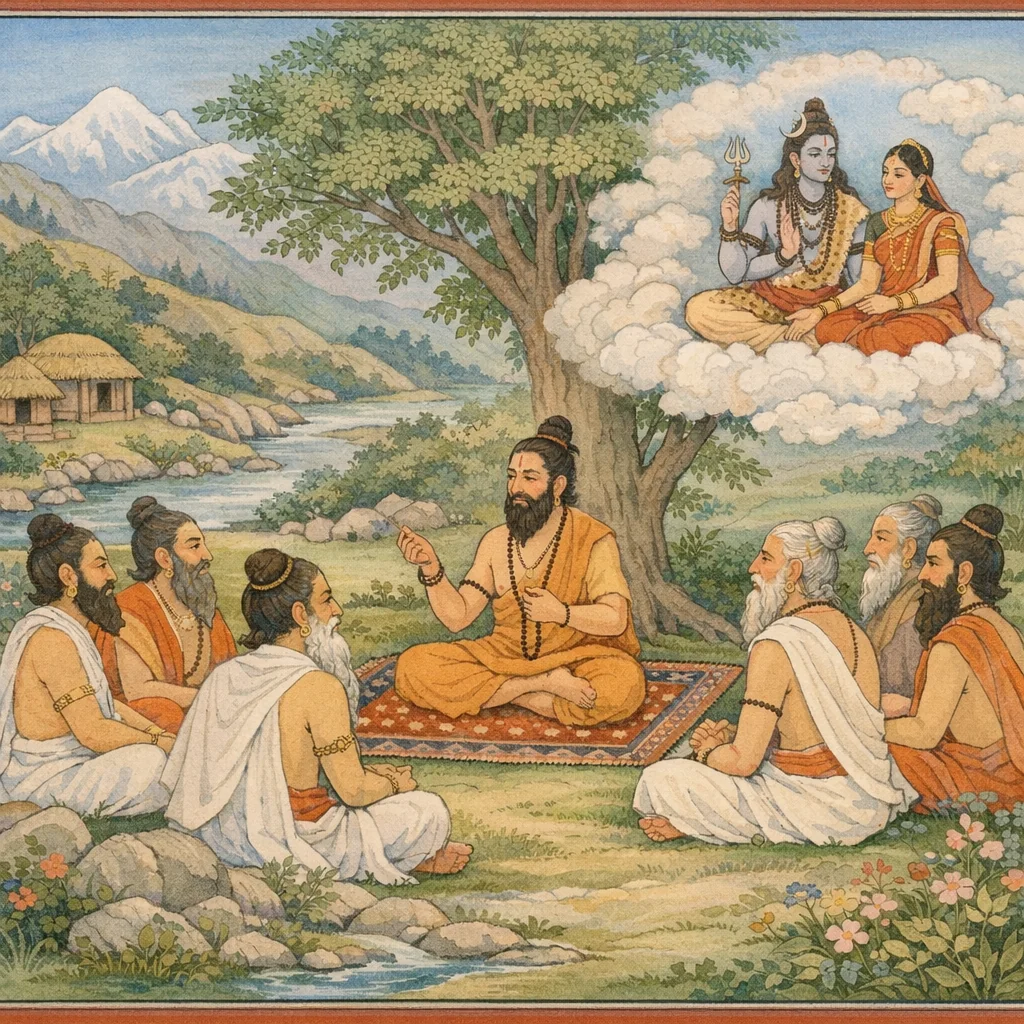
Adhyāya 38 begins with the ṛṣis praising Sūta for conveying the auspicious Maheśvara-kathā, then pressing their question: which vrata pleases Śiva so that devotees gain both bhukti and mukti. Sūta says the matter was asked earlier in a divine setting and that he will recount what he has heard, declaring the narration pāpa-hāraka, sin-removing, for those who listen. The teaching then turns to Śiva’s own reply: many vratas bestow these fruits, yet a foremost set is to be known as ten (daśa), acknowledged by authorities skilled in the Jābāla-śruti. The chapter thus establishes a ritual taxonomy and injunction—legitimizing a canonical list of ten Śaiva vow-observances, to be performed with careful effort (yatnena), and grounding their authority through the chain of transmission (ṛṣi → Sūta → prior divine inquiry → Śiva), preparing for later details on structure, eligibility, and results.
Shlokas
Verse 1
ऋषय ऊचुः । धन्योऽसि कृतकृत्योऽसि जीवितं सफलं तव । यच्छ्रावयसि नस्तात महेश्वरकथां शुभाम्
The sages said: “Blessed are you; your duties have found fulfillment, and your life is truly fruitful—because, dear one, you make us hear this auspicious sacred account of Maheśvara (Lord Śiva).”
Verse 2
बहुभिश्चर्षिभि स्सूत श्रुतं यद्यपि वस्तु सत् । सन्देहो न मतोऽस्माकं तदेतत्कथयामि ते
O Sūta, although this true matter has indeed been heard by many sages, no doubt remains in our minds; therefore, I shall relate that very account to you.
Verse 3
केन व्रतेन सन्तुष्टः शिवो यच्छति सत्सुखम् । कुशलश्शिवकृत्ये त्वं तस्मात्पृच्छामहे वयम्
By what sacred vow (vrata) does Lord Śiva become pleased and bestow true, auspicious bliss? You are well-versed in Śiva’s rites and duties; therefore, we ask you this.
Verse 4
भुक्तिर्मुक्तिश्च लभ्येत भक्तैर्येन व्रतेन वै । तद्वद त्वं विशेषेण व्यासशिष्य नमोऽस्तु ते
By whatever vow the devotees surely attain both worldly enjoyment (bhukti) and liberation (mukti)—please tell us that, in particular. O disciple of Vyāsa, salutations be to you.
Verse 5
सूत उवाच । सम्यक्पृष्टमृषिश्रेष्ठा भवद्भिः करुणात्मभिः । स्मृत्वा शिवपदांभोजं कथयामि यथाश्रुतम्
Sūta said: O best of sages, you compassionate ones have asked well. Remembering the lotus-like feet of Śiva, I shall relate it exactly as I have heard.
Verse 6
यथा भवद्भिः पृच्छेत तथा पृष्टं हि वेधसा । हरिणा शिवया चैव तथा वै शंकरं प्रति
Just as you have inquired, so indeed was the same question asked of Śaṅkara—by the Creator (Brahmā), by Hari (Viṣṇu), and also by Śivā (Pārvatī).
Verse 7
कस्मिंश्चित्समये तैस्तु पृष्टं च परमात्मने । केन व्रतेन सन्तुष्टो भुक्तिं मुक्तिं च यच्छसि
At a certain time, they questioned the Supreme Self: “By which sacred vow are You pleased, O Lord, granting both worldly enjoyment (bhukti) and liberation (mukti)?”
Verse 8
इति पृष्टस्तदा तैस्तु हरिणा तेन वै तदा । तदहं कथयाम्यद्य शृण्वतां पापहारकम्
Thus, when I was questioned then by them—and by Hari (Viṣṇu) at that time—I shall now recount it. Listen: it is a narration that destroys sin for those who hear it.
Verse 9
शिव उवाच । भूरि व्रतानि मे सन्ति भुक्तिमुक्तिप्रदानि च । मुख्यानि तत्र ज्ञेयानि दशसंख्यानि तानि वै
Śiva said: “Many vows of mine exist, bestowing both worldly enjoyment (bhukti) and liberation (mukti). Among them, the principal ones should be known—truly, they are ten in number.”
Verse 10
दश शैवव्रतान्याहुर्जाबालश्रुतिपारगाः । तानि व्रतानि यत्नेन कार्याण्येव द्विजैस्सदा
Those who are well-versed in the Jābāla Śruti declare that there are ten Śaiva observances (vratas) devoted to Śiva. Therefore, the twice-born should always perform those sacred vows with diligent care.
Verse 11
प्रत्यष्टम्यां प्रयत्नेन कर्तव्यं नक्तभोजनम् । कालाष्टम्यां विशेषेण हरे त्याज्यं हि भोजनम्
On the day preceding the Aṣṭamī, one should diligently observe naktabhojana, eating only at night. But on the Kālāṣṭamī in particular, O Hara, food is to be wholly renounced.
Verse 12
एकादश्यां सितायां तु त्याज्यं विष्णो हि भोजनम् । असितायां तु भोक्तव्यं नक्तमभ्यर्च्य मां हरे
O Viṣṇu, on the bright (waxing) Ekādaśī one should abstain from eating. But on the dark (waning) Ekādaśī one may partake of food at night—after worshipping Me, O Hari.
Verse 13
त्रयोदश्यां सितायां तु कर्तव्यं निशि भोजनम् । असितायां तु भूतायां तत्र कार्यं शिवव्रतैः
On the thirteenth lunar day (Trayodaśī) in the bright fortnight, one should take the meal at night. But when that thirteenth day falls in the dark fortnight, then the observances of Śiva’s vow should be performed on that occasion as prescribed.
Verse 14
निशि यत्नेन कर्तव्यं भोजनं सोमवासरे । उभयोः पक्षयोर्विष्णो सर्वस्मिञ्छिव तत्परैः
On Mondays, one should carefully take one’s meal at night. O Viṣṇu, those devoted to Śiva should observe this discipline in both fortnights (waxing and waning) and at all times, remaining intent on Śiva.
Verse 15
व्रतेष्वेतेषु सर्वेषु शैवा भोज्याः प्रयत्नतः । यथाशक्ति द्विजश्रेष्ठा व्रतसंपूर्तिहेतवे
In all these observances, devotees devoted to Śiva should be fed with care and sincere effort, O best of the twice-born, according to one’s capacity; for such feeding becomes a means to the proper completion and fruit of the vow.
Verse 16
व्रतान्येतानि नियमात्कर्तव्यानि द्विजन्मभिः । व्रतान्येतानि तु त्यक्त्वा जायन्ते तस्करा द्विजाः
These vows must be performed with discipline by the twice-born. But if these vows are abandoned, those very twice-born become thieves—robbers of their own dharma.
Verse 17
मुक्तिमार्गप्रवीणैश्च कर्तव्यं नियमादिति । मुक्तेस्तु प्रापकं चैव चतुष्टयमुदाहृतम्
Those skilled in the path of liberation declare that it must be practiced with disciplined observance. Indeed, they have taught a fourfold means that leads to moksha—freedom through the grace-oriented way of Śiva.
Verse 18
शिवार्चनं रुद्रजपं उपवासश्शिवालये । वाराणस्यां च मरणं मुक्तिरेषा सनातनी
Worship of Śiva, repetition of Rudra-mantras, and fasting in a Śiva-temple—and also dying in Vārāṇasī: this is the eternal liberation (mokṣa).
Verse 19
अष्टमी सोमवारे च कृष्णपक्षे चतुर्दशी । शिवतुष्टिकरं चैतन्नात्र कार्या विचारणा
When the eighth lunar day falls on a Monday, and when the fourteenth day occurs in the dark fortnight, this observance is assuredly a cause of Lord Śiva’s satisfaction; about it there is no need for any further deliberation.
Verse 20
चतुर्ष्वपि बलिष्ठं हि शिवरात्रिव्रतं हरे । तस्मात्तदेव कर्तव्यं भुक्तिमुक्तिफलेप्सुभिः
O Hari, among the four principal vows, the Śivarātri vow is indeed the most powerful. Therefore, those who seek the fruits of worldly enjoyment and liberation (mokṣa) should certainly undertake that vow as the foremost practice.
Verse 21
एतस्माच्च मतादन्यन्नास्ति नृणां हितावहम् । एतद्व्रतन्तु सर्वेषां धर्मसाधनमुत्तमम्
Apart from this observance taught by me, there is nothing else that is more truly beneficial for human beings. Indeed, this vow is the supreme means for all to accomplish dharma.
Verse 22
निष्कामानां सकामानां सर्वेषां च नृणान्तथा । वर्णानामाश्रमाणां च स्त्रीबालानां तथा हरे
O Hari, this holy observance and worship is for all people alike—those without desire and those with desire; for everyone everywhere; for all varṇas and all āśramas, and likewise for women and children as well.
Verse 23
दासानां दासिकानां च देवादीनां तथैव च । शरीरिणां च सर्वेषां हितमेतद्व्रतं वरम्
For male and female servants, and likewise for the devas and other beings—indeed for all embodied creatures—this excellent vow is beneficial.
Verse 24
माघस्य ह्यसिते पक्षे विशिष्टा सातिकीर्तिता । निशीथव्यापिनी ग्राह्या हत्याकोटिविनाशिनी
In the dark fortnight of the month of Māgha, this observance—known as the Sātī—has been declared especially exalted. It should be undertaken when it extends through midnight (niśītha); it destroys even crores of sins arising from acts of killing.
Verse 25
तद्दिने चैव यत्कार्यं प्रातरारभ्य केशव । श्रूयतान्तन्मनो दत्त्वा सुप्रीत्या कथयामि ते
O Keśava, listen with your mind fully attentive. I shall gladly tell you what is to be done on that day, beginning from the early morning.
Verse 26
प्रातरुत्थाय मेधावी परमानन्दसंयुतः । समाचरेन्नित्यकृत्यं स्नानादिकमतन्द्रितः
Rising early in the morning, the wise devotee—endowed with the supreme bliss (that comes from Shiva-oriented discipline)—should diligently perform the daily obligatory duties, beginning with bathing and related purifying acts.
Verse 27
शिवालये ततो गत्वा पूजयित्वा यथाविधि । नमस्कृत्य शिवं पश्चात्संकल्पं सम्यगाचरेत्
Then, having gone to Śiva’s temple and worshipped Him according to the prescribed rite, one should bow to Lord Śiva; thereafter, one should properly undertake the saṅkalpa—the solemn devotional resolve.
Verse 28
देवदेव महादेव नीलकण्ठ नमोऽस्तु ते । कर्तुमिच्छाम्यहं देव शिवरात्रिव्रतं तव
O God of gods, O Mahādeva, O Nīlakaṇṭha—salutations to You. O Lord, I desire to undertake Your Śivarātri vow (vrata).
Verse 29
तव प्रभावाद्देवेश निर्विघ्नेन भवेदिति । कामाद्याः शत्रवो मां वै पीडां कुर्वन्तु नैव हि
O Lord of the gods, by the power of Your grace may all proceed without obstacles; and may the enemies that begin with desire—lust and the rest—never afflict me with suffering.
Verse 30
एवं संकल्पमास्थाय पूजाद्रव्यं समाहरेत् । सुस्थले चैव यल्लिंगं प्रसिद्धं चागमेषु वै
Having thus taken up the proper saṅkalpa (sacred resolve), one should gather the materials for worship. One should then worship that Liṅga which is established in a good and pure place, and which is well-known and validated in the Āgamas.
Verse 31
रात्रौ तत्र स्वयं गत्वा संपाद्य विधिमुत्तमम् । शिवस्य दक्षिणे भागे पश्चिमे वा स्थले शुभे
Going there personally at night, one should duly perform the excellent rite; in an auspicious spot—either to the right side of Śiva or on the western side—the worship is to be arranged.
Verse 32
निधाय चैव तद्द्रव्यं पूजार्थं शिवसन्निधौ । पुनः स्नायात्तदा तत्र विधिपूर्वं नरोत्तमः
Having placed those offering-materials there in the very presence of Śiva for the sake of worship, the best of men should then bathe again on that spot, in accordance with the prescribed rite.
Verse 33
परिधाय शुभं वस्त्रमन्तर्वासश्शुभन्तथा । आचम्य च त्रिवारं हि पूजारंभं समाचरेत्
Having put on clean and auspicious outer garments, and likewise a pure inner cloth, one should perform ācamana three times and then duly commence the worship.
Verse 34
यस्य मंत्रस्य यद्द्रव्यं तेन पूजां समाचरेत् । अमंत्रकं न कर्तव्यं पूजनं तु हरस्य च
With whatever offering is prescribed for a given mantra, one should perform the worship using that very substance. The worship of Hara (Lord Śiva) should never be done without mantra.
Verse 35
गीतैर्वाद्यैस्तथा नृत्यैर्भक्तिभावसमन्वितः । पूजनं प्रथमे यामे कृत्वा मंत्रं जपेद्बुधः
Filled with devotional feeling, one should worship Śiva in the first watch of the night with hymns, instrumental music, and dance; having thus performed the pūjā, the wise devotee should then repeat the mantra in japa.
Verse 36
पार्थिवं च तदा श्रेष्ठं विदध्यान्मंत्रवान्यदि । कृतनित्यक्रियः पश्चात्पार्थिवं च समर्चयेत्
Then, if he is one empowered with mantra, he should fashion an excellent Pārthiva Liṅga, an earthen liṅga. After completing his daily obligatory rites, he should thereafter worship that earthen liṅga with due reverence.
Verse 37
प्रथमं पार्थिवं कृत्वा पश्चात्स्थापनमाचरेत् । स्तोत्रैर्नानाविधैर्देवं तोषयेद्वृषभध्वजम्
First, having fashioned an earthen (pārthiva) liṅga, one should thereafter perform its proper installation. With many kinds of hymns, one should gratify the God—Śiva, whose banner bears the bull.
Verse 38
इति श्रीशिवमहापुराणे चतुर्थ्यां कोटिरुद्रसंहितायां व्याधेश्वरमाहात्म्ये शिवरात्रिव्रतमहिमनिरूपणंनामाष्टत्रिंशोऽध्यायः
Thus, in the Śrī Śiva Mahāpurāṇa, in the Fourth section—the Koṭirudra-saṃhitā—within the “Vyādheśvara Māhātmya,” ends the thirty-eighth chapter entitled “The Exposition of the Glory of the Śivarātri Vow.”
Verse 39
चतुर्ष्वपि च यामेषु मूर्तीनां च चतुष्टयम् । कृत्वावाहनपूर्वं हि विसर्गावधि वै क्रमात्
In each of the four watches of the day, one should, in due order, first invoke the four manifestations (of the Lord), and then continue the rite step by step until the concluding dismissal (visarga).
Verse 40
कार्यं जागरणं प्रीत्या महोत्सव समन्वितम् । प्रातः स्नात्वा पुनस्तत्र स्थापयेत्पूजयेच्छिवम्
With loving devotion one should keep a night-long vigil, accompanied by a grand sacred festival. Then, at dawn, having bathed, one should again install there the holy emblem (liṅga) and worship Lord Śiva.
Verse 41
ततः संप्रार्थयेच्छंभुं नतस्कन्धः कृताञ्जलिः । कृतसम्पूर्ण व्रतको नत्वा तं च पुनः पुनः
Thereafter, with shoulders bowed and palms joined in reverence, having duly completed the vow in full, one should earnestly pray to Śambhu (Lord Śiva), bowing to Him again and again.
Verse 42
नियमो यो महादेव कृतश्चैव त्वदाज्ञया । विसृज्यते मया स्वामिन्व्रतं जातमनुत्तमम्
O Mahādeva, the discipline I undertook solely by Your command—O Lord and Master—I now lay aside; the unsurpassed vow has been fulfilled.
Verse 43
व्रतेनानेन देवेश यथाशक्तिकृतेन च । सन्तुष्टो भव शर्वाद्य कृपां कुरु ममोपरि
O Lord of the gods, by this vow performed according to my ability—O Śarva, the primal Lord—be pleased, and bestow Your grace upon me.
Verse 44
पुष्पाञ्जलिं शिवे दत्त्वा दद्याद्दानं यथाविधि । नमस्कृत्य शिवायैव नियमं तं विसर्जयेत्
Having offered a handful of flowers (puṣpāñjali) to Lord Śiva, one should then give charity in the prescribed manner. After bowing to Śiva alone, one should ritually conclude and release that sacred vow or observance.
Verse 45
यथाशक्ति द्विजाञ्छैवान्यतिनश्च विशेषतः । भोजयित्वा सुसन्तोष्य स्वयं भोजनमाचरेत्
According to one’s capacity, one should feed the dvijas, and especially the Śaiva ascetics, gratifying them fully; only after satisfying them should one partake of one’s own meal.
Verse 46
यामेयामे यथा पूजा कार्या भक्तवरैर्हरे । शिवरात्रौ विशेषेण तामहं कथयामि ते
O Hari, I shall tell you how the foremost devotees should perform worship in each watch of the night—especially on the sacred night of Śivarātri.
Verse 47
प्रथमे चैव यामे च स्थापितं पार्थिवं हरे । पूजयेत्परया भक्त्या सूपचारैरनेकशः
In the first watch (yāma) as well, one should worship Hara’s earthen (pārthiva) Liṅga, duly installed, with supreme devotion, offering many excellent upacāras and services.
Verse 48
पंचद्रव्यैश्च प्रथमं पूजनीयो हरस्सदा । तस्य तस्य च मन्त्रेण पृथग्द्रव्यं समर्पयेत्
Hara (Lord Śiva) should always be worshipped first with the five ritual substances; and with the respective mantra for each, one should offer each substance separately.
Verse 49
तच्च द्रव्यं समर्प्यैव जलधारां ददेत वै । पश्चाच्च जलधाराभिर्द्रव्याणुत्तारयेद्बुधः
Having first offered that sacred substance, one should indeed pour a steady stream of water. Thereafter, the wise devotee should wash away the remaining offerings by continuous streams of water.
Verse 50
शतमष्टोत्तरं मन्त्रं पठित्वा जलधारया । पूजयेच्च शिवं तत्र निर्गुणं गुणरूपिणम्
Having recited the mantra one hundred and eight times, one should worship Śiva there by pouring a continuous stream of water—Śiva who is beyond qualities (nirguṇa) and yet, for devotees, assumes forms with qualities (saguṇa).
Verse 51
गुरुदत्तेन मंत्रेण पूजयेद्वृषभध्जम् । अन्यथा नाममंत्रेण पूजयेद्वै सदाशिवम्
One should worship the Lord whose banner bears the Bull (Śiva) with the mantra bestowed by one’s Guru. Otherwise, one should worship Sadāśiva with His name-mantra.
Verse 52
चन्दनेन विचित्रेण तण्डुलैश्चाप्यखण्डितैः । कृष्णैश्चैव तिलैः पूजा कार्या शंभोः परात्मनः
With fragrant, variegated sandal paste, with unbroken grains of rice, and also with black sesame seeds, one should perform worship of Śambhu—the Supreme Self—who is the indwelling Lord.
Verse 53
पुष्पैश्च शतपत्रैश्च करवीरैस्तथा पुनः । अष्टभिर्नाममंत्रैश्चार्पयेत्पुष्पाणि शंकरे
With flowers—especially the hundred-petalled lotus and also oleander—one should again offer flowers to Śaṅkara, accompanied by the eight name-mantras.
Verse 54
भवः शर्वस्तथा रुद्रः पुनः पशुपतिस्तथा । उग्रो महांस्तथा भीम ईशान इति तानि वै
He is Bhava, and also Śarva; again, Rudra and likewise Paśupati. He is Ugra, Mahān, and Bhīma—these indeed are His names—and (also) Īśāna.
Verse 55
श्रीपूर्वैश्च चतुर्थ्यंतैर्नामभिः पूजयेच्छिवम् । पश्चाद्धूपं च दीपं च नैवेद्यं च ततः परम्
One should worship Lord Śiva with names that begin with “Śrī” and end in the dative case; thereafter, one should offer incense and a lamp, and then, after that, the food-offering (naivedya).
Verse 56
आद्ये यामे च नैवेद्यं पक्वान्नं कारयेद्बुधः । अर्घं च श्रीफलं दत्त्वा ताम्बूलं च निवेदयेत्
In the first watch of the day, the wise devotee should arrange cooked food as the naivedya (offering). Having then presented arghya (a respectful water-offering) and a coconut, he should also offer tāmbūla (betel) to Lord Śiva.
Verse 57
नमस्कारं ततो ध्यानं जपः प्रोक्तो गुरोर्मनोः । अन्यथा पंचवर्णेन तोषयेत्तेन शंकरम्
First offer reverent salutation; then meditate; and then perform japa of the mantra taught by one’s guru. Otherwise, one should please Śaṅkara with that five-syllabled (Pañcākṣarī) mantra.
Verse 58
धेनुमुद्रां प्रदर्श्याथ सुजलैस्तर्पणं चरेत् । पंचब्राह्मणभोजं च कल्पयेद्वै यथाबलम्
Then, showing the Dhenumudrā, one should perform tarpaṇa with pure water. Thereafter, according to one’s capacity, one should arrange the feeding of five brāhmaṇas—an offering that upholds dharma and pleases Lord Śiva.
Verse 59
महोत्सवश्च कर्तव्यो यावद्यामो भवेदिह । ततः पूजाफलं तस्मै निवेद्य च विसर्जयेत्
A great festival should be observed here for as long as the appointed watch of time lasts. Thereafter, having offered to Him the fruit of the worship, one should respectfully conclude the rite and take leave.
Verse 60
पुनर्द्वितीये यामे च संकल्पं सुसमा चरेत् । अथवैकदैव संकल्प्य कुर्यात्पूजां तथाविधाम्
Again, in the second watch, one should properly undertake the saṅkalpa (solemn resolve) with due steadiness. Or else, having made the resolve just once, one should perform the worship in that very prescribed manner.
Verse 61
द्रव्यैः पूर्वैस्तथा पूजां कृत्वा धारां समर्पयेत् । पूर्वतो द्विगुणं मंत्रं समुच्चार्यार्चयेच्छिवम्
Having performed worship with the offerings mentioned earlier, one should then present the dhārā, the continuous libation. Thereafter, reciting the mantra twice as much as before, one should duly adore Lord Śiva.
Verse 62
पूर्वैस्तिलयवैश्चाथ कमलैः पूजयेच्छिवम् । बिल्वपत्रैर्विशेषेण पूजयेत्परमेश्वरम्
With the offerings prescribed earlier—sesame and barley—and also with lotuses, one should worship Śiva; and most especially, one should worship the Supreme Lord, Parameśvara, with bilva leaves.
Verse 63
अर्घ्यं च बीजपूरेण नैवेद्यं पायसन्तथा । मंत्रावृत्तिस्तु द्विगुणा पूर्वतोऽपि जनार्दन
Offer the arghya with a citron fruit (bījapūra), and likewise present sweet rice (pāyasa) as naivedya. And, O Janārdana, the repetition of the mantra should be done twice as much as before.
Verse 64
ततश्च ब्राह्मणानां हि भोज्यो संकल्पमाचरेत् । अन्यत्सर्वं तथा कुर्याद्यावच्च द्वितयावधि
Thereafter, one should make a solemn vow to feed the Brāhmaṇas. All other rites too should be performed in the same prescribed manner, continuing until the two-day observance is completed.
Verse 65
यामे प्राप्ते तृतीये च पूर्ववत्पूजनं चरेत् । यवस्थाने च गोधूमाः पुष्पाण्यर्कभवानि च
When the third watch of the day arrives, one should perform the worship as before. And where barley was to be offered, one should instead offer wheat, together with flowers born of the arka plant.
Verse 66
धूपैश्च विविधैस्तत्र दीपैर्नानाविधैरपि । नैवेद्यापूपकैर्विष्णो शाकैर्नानाविधैरपि
There, with many kinds of fragrant incense and with lamps of various sorts, and also with offerings of food—cakes (apūpaka) and many kinds of cooked vegetables—O Viṣṇu, the worship was performed.
Verse 67
कृत्वैव चाथ कर्पूरैरारार्तिक विधिं चरेत । अर्घ्यं सदाडिमं दद्याद्द्विगुणं जपमाचरेत्
Then, having performed the ārati rite with camphor, one should proceed according to the prescribed method. One should offer arghya with pomegranate, and then practice japa (mantra-recitation) in double measure.
Verse 68
ततश्च ब्रह्मभोजस्य संकल्पं च सदक्षिणम् । उत्सवं पूर्ववत्कुर्या द्यावद्यामावधिर्भवेत्
Thereafter, one should make the solemn saṅkalpa for the Brahmin-feast and provide it together with the due dakṣiṇā. Then one should conduct the festival as before, continuing it until the appointed period of the yāmas is completed.
Verse 69
यामे चतुर्थे संप्राते कुर्यात्तस्य विसर्जनम् । प्रयोगादि पुनः कृत्वा पूजां विधिवदाचरेत्
At the fourth yāma, as dawn arrives, one should perform its visarjana (formal ritual dismissal). Then, having again completed the prescribed preliminaries of the rite, one should continue the worship in the proper, scriptural manner.
Verse 70
माषैः प्रियंगुभिर्मुद्गैस्सप्तधान्यैस्तथाथवा । शंखीपुष्पैर्बिल्वपत्रैः पूजयेत्परमेश्वरम्
One should worship Parameśvara (Lord Śiva) by offering māṣa (black gram), priyaṅgu grain, mudga (green gram), and the seven kinds of grains; or else by offering śaṃkhī flowers and bilva leaves. Such simple, sattvic offerings, made with devotion, please the Lord who grants grace and liberation.
Verse 71
नैवेद्यं तत्र दद्याद्वै मधुरैर्विविधैरपि । अथवा चैव माषान्नैस्तोषयेच्च सदाशिवम्
There one should indeed offer naivedya—various sweet preparations. Or else, by offering a meal of māṣa (black gram), one should please Sadāśiva.
Verse 72
अर्घं दद्यात्कदल्याश्च फलेनैवाथवा हरे । विविधैश्च फलैश्चैव दद्यादर्घ्यं शिवाय च
One should offer arghya with the fruit of the banana plant; or else, O Hari, one may offer it with various kinds of fruits. Thus arghya should indeed be offered to Lord Śiva.
Verse 73
पूर्वतो द्विगुणं कुर्यान्मंत्रजापं नरोत्तमः । संकल्पं ब्रह्मभोजस्य यथाशक्ति चरेद्बुधः
O best among men, one should now perform twice the amount of mantra-japa as before. The wise devotee should also undertake the saṅkalpa of feeding the brāhmaṇas (brahma-bhojana), carrying it out according to one’s capacity, so that Śiva’s worship is completed with right intention, discipline, and reverence.
Verse 74
गीतैर्वाद्यैस्तथा नृत्यैर्नयेत्कालं च भक्तितः । महोत्सवैर्भक्तजनैर्यावत्स्यादरुणोदयः
With devotion, one should pass the time with sacred songs, instrumental music, and dance—celebrated in grand festivals by gatherings of devotees—until the auspicious dawn appears.
Verse 75
उदये च तथा जाते पुनस्स्नात्वार्चयेच्छिवम् । नानापूजोपहारैश्च स्वाभिषेकमथाचरेत्
When dawn has arrived, one should bathe again and worship Lord Śiva. Then, with various offerings and articles of worship, one should perform the prescribed rite of self-ablution (svābhiṣeka).
Verse 76
नानाविधानि दानानि भोज्यं च विविधन्तथा । ब्राह्मणानां यतीनां च कर्तव्यं यामसंख्यया
One should offer many kinds of gifts, and likewise various kinds of food, to Brahmins and to yatis (ascetics), doing so according to the prescribed divisions of the day (yāmas).
Verse 77
शंकराय नमस्कृत्य पुष्पाञ्जलिमथाचरेत् । प्रार्थयेत्सुस्तुतिं कृत्वा मन्त्रैरेतैर्विचक्षणः
Having bowed to Śaṅkara, one should then offer a handful of flowers. The discerning devotee should pray, first uttering a fitting hymn of praise, using these very mantras.
Verse 78
तावकस्त्वद्गतप्राणस्त्वच्चित्तोऽहं सदा मृड । कृपानिधे इति ज्ञात्वा यथा योग्यं तथा कुरु
O Mr̥ḍa, benevolent Śiva, I am Yours alone—my life-breath rests in You and my mind is ever fixed on You. O treasury of compassion, knowing this, do for me whatever is truly fitting.
Verse 79
अज्ञानाद्यदि वा ज्ञानाज्जपपूजादिकं मया । कृपानिधित्वाज्ज्ञात्वैव भूतनाथ प्रसीद मे
Whether I have performed japa, worship, and other rites out of ignorance or with true understanding—O Bhūtanātha, knowing that You are a treasury of compassion, be gracious to me.
Verse 80
अनेनैवोपवासेन यज्जातं फलमेव च । तेनैव प्रीयतां देवः शंकरः सुखदायकः
By this very fast, whatever fruit has been obtained—by that same merit may the Deity, Śaṅkara, the bestower of happiness, be pleased.
Verse 81
कुले मम महादेव भजनं तेऽस्तु सर्वदा । माभूत्तस्य कुले जन्म यत्र त्वं नहि देवता
O Mahādeva, may Your worship ever remain in my lineage. May I never be born into a family where You are not revered as the Divine Lord.
Verse 82
पुष्पांजलिं समर्प्यैवं तिलकाशिष एव च । गृह्णीयाद्ब्राह्मणेभ्यश्च ततश्शंभुं विसर्जयेत्
Thus, having offered a handful of flowers and received the auspicious tilaka and blessing, one should accept the benedictions of the Brāhmaṇas; thereafter, with reverence, conclude the worship and ritually dismiss Śambhu (Lord Śiva).
Verse 83
एवं व्रतं कृतं येन तस्माद्दूरो हरो न हि । न शक्यते फलं वक्तुं नादेयं विद्यते मम
Whoever performs this vow in this manner—Hara (Śiva) is never far from that person. Its fruit cannot truly be spoken; for Me, there is nothing that cannot be granted to such a devotee.
Verse 84
अनायासतया चेद्वै कृतं व्रतमिदम्परम् । तस्य वै मुक्तिबीजं च जातं नात्र विचारणा
If this supreme vow is performed even with little effort and without strain, it surely becomes the seed of liberation (mokṣa) for that person—of this there is no doubt.
Verse 85
प्रतिमासं व्रतं चैव कर्तव्यं भक्तितो नरैः । उद्यापनविधिं पश्चात्कृत्वा सांगफलं लभेत्
Men should indeed observe this vow every month with devotion. Thereafter, having duly performed the concluding rite (udyāpana) according to rule, one attains the complete fruit of the observance, in all its parts.
Verse 86
व्रतस्य करणान्नूनं शिवोऽहं सर्वदुःखहा । दद्मि भुक्तिं च मुक्तिं च सर्वं वै वाञ्छितं फलम्
By the performance of this vow, I—Śiva, the remover of all sorrows—surely bestow both worldly enjoyment (bhukti) and liberation (mukti), and indeed every desired fruit.
Verse 87
सूत उवाच । इति शिववचनं निशम्य विष्णुर्हिततरमद्भुतमाजगाम धाम । तदनु व्रतमुत्तमं जनेषु समचरदात्महितेषु चैतदेव
Sūta said: Having heard these words of Śiva, Viṣṇu—greatly delighted and filled with wonder—returned to his own abode. Thereafter, for the welfare of beings and for the true good of the Self, he himself practiced this most excellent vow among people.
Verse 88
कदाचिन्नारदायाथ शिवरात्रिव्रतन्त्विदम् । भुक्तिमुक्तिप्रदं दिव्यं कथयामास केशवः
Once, Keśava (Viṣṇu) narrated to Nārada this divine observance of Śivarātri—an auspicious vow that bestows both bhukti (worldly fulfillment) and mukti (liberation).
Frequently Asked Questions
It argues that vrata-śāstra is not merely auxiliary piety but a primary Śaiva means for attaining both worldly fulfillment and liberation, with Śiva himself authorizing a canonical set of ten principal observances.
The pairing implies a Śaiva integration of artha/kāma outcomes with soteriology: disciplined devotion is portrayed as capable of reconfiguring karmic causality (yielding bhukti) while simultaneously orienting consciousness toward Śiva (yielding mukti), collapsing the usual divide between ritual merit and liberation.
Śiva appears as Maheśvara (auspicious narrative focus), Śaṅkara (the beneficent grantor), and Paramātman (supreme principle), emphasizing both personal deity and metaphysical ultimacy in the authorization of Śaiva vratas.