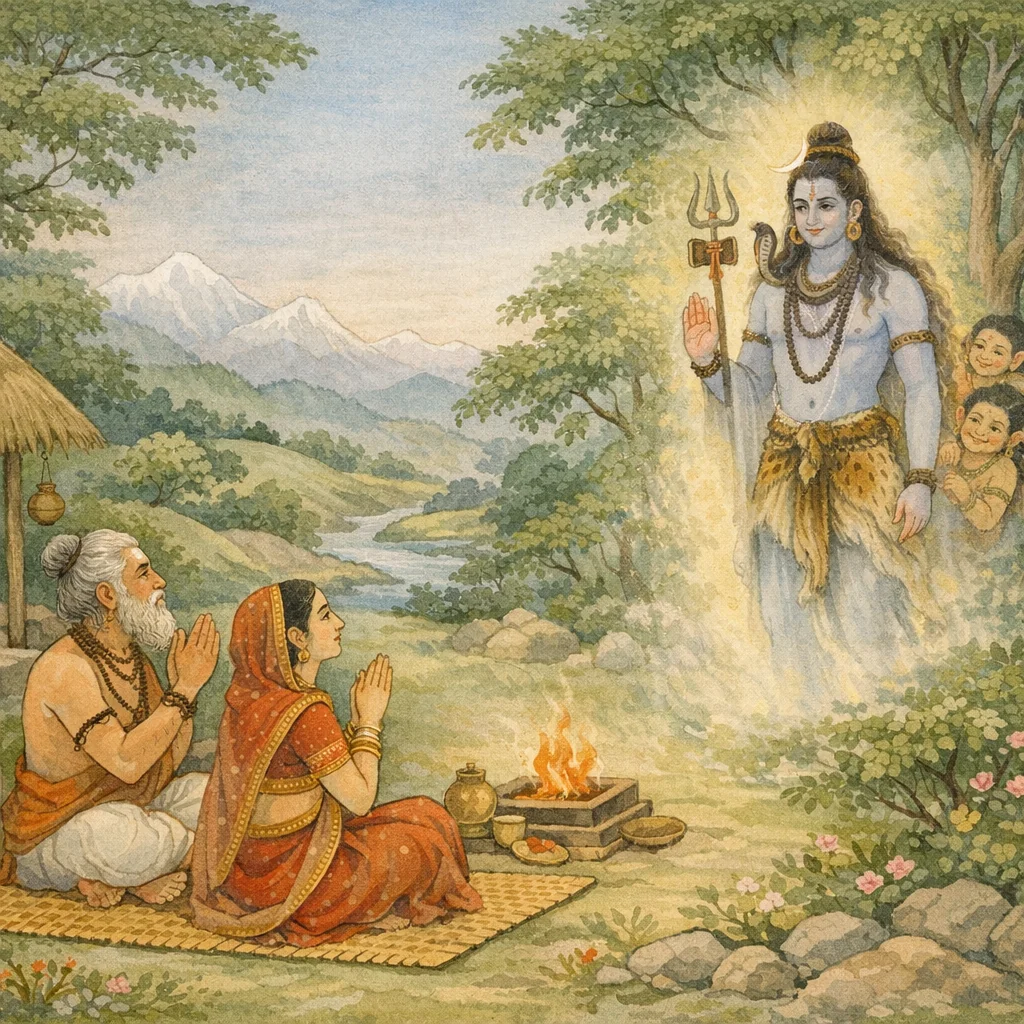
गौतमस्य शिवदर्शनं पापक्षयवचनं च | Gautama’s Vision of Śiva and the Teaching on Sin and Purification
Adhyāya 26, narrated by Sūta, culminates in Śiva’s epiphany before the sage Gautama and a teaching on purity. Pleased with the devotion performed by Gautama together with his wife, Śiva appears with his gaṇas and, as a treasury of compassion, invites the sage to ask a boon. Gautama beholds Śaṃbhu’s auspicious form, offers praise, and prays for the removal of sin, wishing to become niṣpāpa, free from fault. Śiva replies that Gautama is inherently pure and steadfast in bhakti; a devotee established in devotion should not be regarded as sinful, and even the devotee’s darśana purifies others. Śiva then places the moral burden on hostile wrongdoers—durātmans—whose misconduct rebounds upon themselves, while He remains benefactor to the good and punisher of the wicked. The chapter thus conveys a Shaiva doctrine of anugraha and daṇḍa: grace responds to disciplined devotion, and harming devotees is a uniquely grave transgression. Purification arises through proximity to Śiva (darśana), truthful bhakti, and divine adjudication of malice.
Shlokas
Verse 1
सूत उवाच । एवं कृते तु ऋषिणा सस्त्रीकेन द्विजाश्शिवः । आविर्बभूव स शिवः प्रसन्नस्सगणस्तदा
Sūta said: When the sage—together with his wife—had thus performed the rite, Lord Śiva manifested before the twice-born. Then that Śiva, gracious and pleased, appeared along with His attendant hosts.
Verse 2
अथ प्रसन्नस्स शिवो वरं ब्रूहि महामुने । प्रसन्नोऽहं सुभक्त्या त इत्युवाच कृपानिधिः
Then Lord Śiva, well pleased, said to the great sage: “Speak—ask for a boon. I am satisfied by your pure devotion.” Thus spoke Śiva, the very treasury of compassion.
Verse 3
तदा तत्सुंदरं रूपं दृष्ट्वा शंभोर्महात्मनः । प्रणम्य शंकरं भक्त्या स्तुतिं चक्रे मुदान्वितः
Then, beholding that exceedingly beautiful form of the great-souled Śambhu, he bowed to Śaṅkara with devotion and, filled with joy, began to offer hymns of praise.
Verse 4
स्तुत्वा बहु प्रणम्येशं बद्धाञ्जलिपुटः स्थितः । निष्पापं कुरु मां देवाब्रवीदिति स गौतमः
Having offered abundant praise and repeatedly bowing to the Lord, Gautama stood with folded hands and said to the Deva: “O Lord, make me free from sin.”
Verse 5
सूत उवाच । इत्याकर्ण्य वचस्तस्य गौतमस्य महात्मनः । सुप्रसन्नतरो भूत्वा शिवो वाक्यमुपाददे
Sūta said: Having thus heard the words of the great-souled Gautama, Lord Śiva—becoming even more gracious and fully pleased—then spoke in reply.
Verse 6
शिव उवाच । धन्योऽसि कृतकृत्योऽसि निष्पापोऽसि सदा मुने । एतैर्दुष्टैः किल त्वं च च्छलितोऽसि खिलात्मभिः
Śiva said: “Blessed are you; your life’s purpose is fulfilled; you are ever sinless, O sage. Yet indeed you have been deceived by these wicked ones of perverse disposition.”
Verse 7
त्वदीयदर्शनाल्लोका निष्पापाश्च भवंति हि । किं पुनस्त्वं सपापोऽसि मद्भक्तिनिरतस्सदा
By the mere sight of you, people indeed become free from sin. How then could you yourself be sinful—since you are ever steadfast in devotion (bhakti) to Me, Śiva?
Verse 8
उपद्रवस्त्वयि मुने यैः कृतस्तु दुरात्मभिः । ते पापाश्च दुराचारा हत्यावंतस्त एव हि
O sage, those wicked-souled men who brought harm upon you are truly sinful and of evil conduct; indeed, they themselves are perpetrators of murderous wrongdoing.
Verse 9
एतेषां दर्शनादन्ये पापिष्ठाः संभवंतु च । कृतघ्नाश्च तथा जाता नैतेषां निष्कृतिः क्वचित्
By merely seeing such people, others too may become even more sinful; and they themselves turn into the ungrateful. For them, there is no expiation at any time.
Verse 10
सूत उवाच । इत्युक्त्वा शंकरस्तस्मै तेषां दुश्चरितं तदा । बहूवाच प्रभुर्विप्राः सत्कदोऽसत्सु दंडदः
Sūta said: Having spoken thus to him, Śaṅkara then described in detail their evil conduct at that time. O brāhmaṇas, the Lord—who rewards the righteous and chastises the wicked—spoke at length.
Verse 11
शर्वोक्तमिति स श्रुत्वा सुविस्मितमना ऋषिः । सुप्रणम्य शिवं भक्त्या सांजलिः पुनरब्रवीत्
Hearing those words spoken by Śarva (Lord Śiva), the sage—his mind filled with wonder—bowed deeply to Śiva with devotion, and with folded hands spoke again.
Verse 12
गौतम उवाच । ऋषिभिस्तैर्महेशान ह्युपकारः कृतो महान् । यद्येवं न कृतं तैस्तु दर्शनं ते कुतो भवेत्
Gautama said: “O Maheśāna, those sages rendered you a great service indeed. Had they not acted in this manner, how could they have obtained your divine vision (darśana)?”
Verse 13
धन्यास्ते ऋषयो यैस्तु मह्यं शुभतरं कृतम् । तद्दुराचरणादेव मम स्वार्थो महानभूत्
“Blessed are those sages by whom something most auspicious was done for me. Indeed, even through that wrongful conduct, a great purpose of my own was fulfilled.”
Verse 14
सूत उवाच । इत्येवं तद्वचश्श्रुत्वा सुप्रसन्नो महेश्वरः । गौतमं प्रत्युवाचाशु कृपादृष्ट्या विलोक्य च
Sūta said: Having thus heard those words, Mahādeva (Maheśvara), becoming exceedingly pleased, at once replied to Gautama—gazing upon him with a compassionate, grace-filled look.
Verse 15
शिव उवाच । ऋषि धन्योसि विप्रेंद्र ऋषे श्रेष्ठतरोऽसि वै । ज्ञात्वा मां सुप्रसन्नं हि वृणु त्वं वरमुत्तमम्
Śiva said: “O sage, best among the brāhmaṇas, you are blessed; indeed, you are the most excellent of seers. Knowing Me to be wholly gracious and pleased, choose now the highest boon.”
Verse 16
सूत उवाच । गौतमोऽपि विचार्यैव लोके विश्रुतमित्युत । अन्यथा न भवेदेव तस्मादुक्तं समाचरेत्
Sūta said: Having reflected, Gautama too affirmed, “Indeed, this is renowned in the world; it cannot be otherwise.” Therefore, one should duly practice exactly as has been prescribed.
Verse 17
निश्चित्यैवं मुनिश्रेष्ठो गौतमश्शिवभक्तिमान् । सांजलिर्नतशीर्षो हि शंकरं वाक्यमब्रवीत्
Having thus arrived at a firm resolve, the foremost sage Gautama—devoted to Śiva—bowed with folded hands and lowered head, and then spoke these words to Śaṅkara.
Verse 18
गौतम उवाच । सत्यं नाथ ब्रवीषि त्वं तथापि पंचभिः कृतम् । नान्यथा भवतीत्यत्र यज्जातं जायतां तु तत्
Gautama said: “True indeed, O Lord, is what you speak. Yet, since it has been done by the five, it cannot be otherwise. Therefore, let that which has arisen here come fully to fruition.”
Verse 19
यदि प्रसन्नो देवेश गंगा च दीयतां मम । कुरु लोकोपकारं हि नमस्तेऽस्तु नमोऽस्तु ते
O Lord of the gods, if You are pleased, then grant the Gaṅgā to me. Do this for the welfare of the worlds. Salutations to You—again and again I bow to You.
Verse 20
सूत उवाच । इत्युक्त्वा वचनं तस्य धृत्वा वै पादपंकजम् । नमश्चकार देवेशं गौतमो लोककाम्यया
Sūta said: Having spoken thus, Gautama—clasping the Lord’s lotus-like feet—bowed in reverence to Śiva, the Lord of the gods, desiring the welfare and fulfillment of the world.
Verse 21
ततस्तु शंकरो देवः पृथिव्याश्च दिवश्च सः । सारं चैव समुद्धृत्य रक्षितं पूर्वमेव तत्
Then Lord Śaṅkara—the Divine One—drew forth the very essence of earth and heaven, and preserved that same essence beforehand for the protection and welfare of the worlds.
Verse 22
विवाहे ब्रह्मणा दत्तमवशिष्टं च किंचन । तत्तस्मै दत्तवाञ्च्छंभुर्मुनये भक्तवत्सलः
Whatever little remained of the gifts bestowed by Brahmā at the wedding, Śambhu—ever affectionate to his devotees—granted that remainder to the sage.
Verse 23
गंगाजलं तदा तत्र स्त्रीरूपमभवत्परम् । तस्याश्चैव ऋषिश्रेष्ठः स्तुतिं कृत्वा नतिं व्यधात्
Then, in that very place, the water of the Gaṅgā assumed a most wondrous feminine form. Beholding her, the foremost of sages offered praise and, in reverent humility, bowed down.
Verse 24
गौतम उवाच । धन्यासि कृतकृत्यासि पावितं भुवनं त्वया । मां च पावय गंगे त्वं पततं निरये ध्रुवम्
Gautama said: “Blessed are you; your sacred task is fulfilled. By you the worlds have been purified. O Gaṅgā, purify me also—for I am surely falling into Naraka (hell).”
Verse 25
सूत उवाच । शंभुश्चापि तदोवाच सर्वेषां हितकृच्छृणु । गंगे गौतममेनं त्वं पावयस्व मदाज्ञया
Sūta said: Then Śambhu (Lord Śiva) also spoke: “Hear, O you who work for the welfare of all. O Gaṅgā, by My command, purify this Gautama.”
Verse 26
इति श्री शिवमहापुराणे चतुर्थ्यां कोटिरुद्रसंहितायां । त्र्यंबकेश्वरमाहात्म्यवर्णनं नाम षड्विंशोऽध्यायः
Thus, in the Śrī Śiva Mahāpurāṇa, in the Fourth—Koṭirudra-saṃhitā—ends the twenty-sixth chapter, entitled “The Description of the Glory of Tryambakeśvara.”
Verse 27
गंगोवाच । ऋषिं तु पावयित्वाहं परिवारयुतं प्रभो । गमिष्यामि निजस्थानं वचस्सत्यं ब्रवीमि ह
Gaṅgā said: “O Lord, after I have purified this sage—together with his attendants—I shall depart to my own abode. Truly I speak these words.”
Verse 28
सूत उवाच । इत्युक्तो गंगया तत्र महेशो भक्तवत्सलः । लोकोपकरणार्थाय पुनर्गगां वचोऽब्रवीत्
Sūta said: Thus addressed there by Gaṅgā, Maheśa—ever affectionate to His devotees—again spoke words to Gaṅgā, intending the welfare and benefit of the worlds.
Verse 29
शिव उवाच । त्वया स्थातव्यमत्रैव व्रजेद्यावत्कलिर्युगः । वैवस्वतो मनुर्देवि ह्यष्टाविंशत्तमो भवेत्
Śiva said: “O Goddess, remain right here until the Kali Yuga has passed. Then you may depart—when Vaivasvata Manu, O Devi, becomes the twenty-eighth Manu.”
Verse 30
सूत उवाच । इति श्रुत्वा वचस्तस्य स्वामिनश्शंकरस्य तत् । प्रत्युवाच पुनर्गंगा पावनी सा सरिद्वरा
Sūta said: Having thus heard those words of her Lord, Śaṅkara, the purifying Gaṅgā—best among rivers—spoke again in reply.
Verse 31
गंगोवाच । माहात्म्यमधिकं चेत्स्यान्मम स्वामिन्महेश्वर । सर्वेभ्यश्च तदा स्थास्ये धरायां त्रिपुरान्तकः
Gaṅgā said: “O Maheśvara, my Lord—if my greatness is to be proclaimed as superior, then, O Tripurāntaka, I shall indeed remain on the earth for the benefit of all.”
Verse 32
किं चान्यच्च शृणु स्वामिन्वपुषा सुन्दरेण ह । तिष्ठ त्वं मत्समीपे वै सगणसांबिकः प्रभो
And further, listen, O Lord: assuming Your beautiful form, remain here close to me—O Sovereign—together with Your attendants and with Ambikā (the Divine Mother).
Verse 33
सूत उवाच । एवं तस्या वचः श्रुत्वा शंकरो भक्तवत्सलः । लोकोपकरणार्थाय पुनर्गंगां वचोब्रवीत्
Sūta said: Having thus heard her words, Śaṅkara—ever affectionate to His devotees—again spoke to Gaṅgā, with the intention of benefiting the world.
Verse 34
शिव उवाच । धन्यासि श्रूयतां गंगे ह्यहं भिन्नस्त्वया न हि । तथापि स्थीयते ह्यत्र स्थीयतां च त्वयापि हि
Śiva said: “Blessed are you, O Gaṅgā—listen. I am not truly separate from you. Yet, for the sake of this sacred manifestation, I shall remain established here; therefore you too should remain established here as well.”
Verse 35
सूत उवाच । इत्येवं वचनं श्रुत्वा स्वामिनः परमेशितुः । प्रसन्नमानसा भूत्वा गंगा च प्रत्यपूजयत्
Sūta said: Having thus heard the words of her Lord, the Supreme Ruler (Śiva), Gaṅgā—her heart made serene and joyful—reverently worshipped Him in return.
Verse 36
एतस्मिन्नंतरे देवा ऋषयश्च पुरातनाः । सुतार्थान्यप्यनेकानि क्षेत्राणि विविधानि च
Meanwhile, the gods and the ancient ṛṣis also set forth to many sacred regions and diverse holy pilgrimage-sites, for auspicious purposes and spiritual aims.
Verse 37
आगत्य गौतमं सर्वे गंगां च गिरिशं तथा । जयजयेति भाषंतः पूजयामासुरादरात्
Then all of them approached Gautama, and also Gaṅgā and Girīśa (Lord Śiva). Crying out “Victory! Victory!”, they reverently worshipped them with heartfelt devotion.
Verse 38
ततस्ते निर्जरा सर्वे तेषां चक्रुः स्तुतिं मुदा । करान् बद्ध्वा नतस्कंधा हरिब्रह्मादयस्तदा
Then all those immortal gods joyfully offered hymns of praise. At that very moment, Hari (Viṣṇu), Brahmā, and the others—joining their palms and bowing in humility—began to extol Him.
Verse 39
गंगा प्रसन्ना तेभ्यश्च गिरिशश्चोचतुस्तदा । वरं ब्रूत सुरश्रेष्ठा दद्वो वः प्रियकाम्यया
Then Gaṅgā, pleased with them, and Girīśa (Lord Śiva) said: “O best among the gods, declare your boon. To fulfill what is dear to you, we shall grant it.”
Verse 40
देवा ऊचुः । यदि प्रसन्नो देवेश प्रसन्ना त्वं सरिद्वरे । स्थातव्यमत्र कृपया नः प्रियार्थं तथा नृणाम्
The Devas said: “O Lord of the gods, if You are truly pleased—if You are gracious here at this most excellent river—then, out of compassion, remain here, to fulfill what is dear to us and also for the welfare of humankind.”
Verse 41
गंगोवाच । यूयं सर्वप्रियार्थं च तिष्ठथात्र न किं पुनः । गौतमं क्षालयित्वाहं गमिष्यामि यथागतम्
Gaṅgā said: “You all remain here for the sake of what is dear to everyone—why doubt it any further? After washing (purifying) Gautama, I shall depart, returning as I came.”
Verse 42
भवत्सु मे विशेषोत्र ज्ञेयश्चैव कथं सुराः । तत्प्रमाणं कृतं चेत्स्यात्तदा तिष्ठाम्यसंशयम्
“O Devas, how indeed is my distinction among you to be known here? If a proper proof is established for that, then I shall remain—without any doubt.”
Verse 43
सर्वे ऊचुः । सिंहराशौ यदा स्याद्वै गुरुस्सर्वसुहृत्तमः । तदा वयं च सर्वे त्वागमिष्यामो न संशयः
All of them said: “When Guru—Bṛhaspati (Jupiter), the greatest well-wisher of all—comes to be in Leo, then all of us too will surely come to you; of this there is no doubt.”
Verse 44
एकादश च वर्षाणि लोकानां पातकं त्विह । क्षालितं यद्भवेदेवं मलिनास्स्मः सरिद्वरे
“Indeed, the sins of the people here, accumulated for eleven years, are washed away in this manner. Yet we are still impure—O best of rivers.”
Verse 45
तस्यैव क्षालनाय त्वायास्यामस्सर्वथा प्रिये । त्वत्सकाशं महादेवि प्रोच्यते सत्यमादरात्
Beloved, we shall surely come to you for the very purpose of cleansing it. O Mahādevī, in your presence the truth is spoken with reverent sincerity.
Verse 46
अनुग्रहाय लोकानामस्माकं प्रियकाम्यया । स्थातव्यं शंकरेणापि त्वया चैव सरिद्वरे
For the sake of showing grace to the worlds—and to fulfill what is dear to us—you, O best of rivers, should remain here; and Śaṅkara (Lord Śiva) too should abide here along with you.
Verse 47
यावत्सिंहे गुरुश्चैव स्थास्यामस्तावदेव हि । त्वयि स्नानं त्रिकालं च शंकरस्य च दर्शनम्
“So long as we remain here at Siṁha-tīrtha, O revered preceptor, during that very time there will be bathing here three times a day and the blessed sight (darśana) of Śaṅkara (Lord Śiva).”
Verse 48
कृत्वा स्वपापं निखिलं विमोक्ष्यामो न संशयः । स्वदेशांश्च गमिष्यामो भवच्छासनतो वयम्
Having performed this act of surrender and obedience, we shall be freed from all our own sins—of this there is no doubt. And by your command, we shall return to our own lands.
Verse 49
सूत उवाच । इत्येवं प्रार्थितस्तैस्तु गौतमेन महर्षिणा । स्थितोऽसौ शंकरः प्रीत्या स्थिता सा च सरिद्वरा
Sūta said: Thus entreated by them—by the great sage Gautama—Śaṅkara, pleased at heart, remained there; and that most excellent river also stayed there.
Verse 50
सा गंगा गौतमी नाम्ना लिंगं त्र्यंबकमीरितम् । ख्याता ख्यातं बभूवाथ महापातकनाशनम्
That Gaṅgā became renowned by the name “Gautamī,” and the Liṅga was proclaimed as “Tryambaka.” Thus both became celebrated as the destroyers of the greatest sins.
Verse 51
तद्दिनं हि समारभ्य सिंहस्थे च बृहस्पतौ । आयांति सर्वतीर्थानि क्षेत्राणि देवतानि च
Indeed, from that very day onward—when Bṛhaspati (Jupiter) is stationed in Leo—all tīrthas, all holy kṣetras, and even the deities are said to come there.
Verse 52
सरांसि पुष्करादीनि गंगाद्यास्सरितस्तथा । वासुदेवादयो देवाः संति वै गोतमीतटे
At the bank of the Gautamī (Godāvarī) are present sacred lakes such as Puṣkara, and holy rivers beginning with the Gaṅgā; and the gods too—headed by Vāsudeva—indeed abide there.
Verse 53
यावत्तत्र स्थितानीह तावत्तेषां फलं न हि । स्वप्रदेशे समायातास्तर्ह्येतेषां फलं भवेत्
So long as they remain there, the spiritual fruit does not manifest here. But when they return to their own land, then the fruit of those acts truly arises for them.
Verse 54
ज्योतिर्लिंगमिदं प्रोक्तं त्र्यंबकं नाम विश्रुतम् । स्थितं तटे हि गौतम्या महापातकनाशनम्
This Jyotirliṅga is declared to be renowned by the name Tryambaka. It stands upon the bank of the river Gautamī, and it is the destroyer of the gravest sins.
Verse 55
यः पश्येद्भक्तितो ज्योतिर्लिंगं त्र्यंबकनामकम् । पूजयेत्प्रणमेत्स्तुत्वा सर्वपापैः प्रमुच्यते
Whoever, with devotion, beholds the Jyotirliṅga known as Tryambaka, and then worships it, bows down, and offers praise—such a person is released from all sins.
Verse 56
ज्योतिर्लिंगं त्र्यंबकं हि पूजितं गौतमेन ह । सर्वकामप्रदं चात्र परत्र परमुक्तिदम्
Indeed, the Jyotirliṅga of Tryambaka was worshipped by Gautama. Here it grants the fulfillment of all worthy desires, and in the hereafter it bestows the supreme liberation (moksha).
Verse 57
इति वश्च समाख्यातं यत्पृष्टोऽहं मुनीश्वराः । किमन्यदिच्छथ श्रोतुं तद् ब्रूयां वो न संशयः
Thus, O lordly sages, I have fully explained to you what you asked me. What else do you wish to hear? Tell me—without doubt, I shall speak it to you.
Frequently Asked Questions
Śiva directly manifests before Gautama, invites a boon, and argues that a devotee devoted to Śiva is inherently purified; wrongdoing lies with those who harass or deceive the devotee, who incur severe demerit.
Darśana functions as a purificatory conduit: proximity to Śiva (and, by extension, to steadfast devotees) transmits śuddhi, reframing purity as relational and grace-mediated rather than merely juridical or external.
Śiva is foregrounded as prasanna-kṛpānidhi (the gracious, pleased lord) and as satkada/asatsu-daṇḍada (benefactor of the good and punisher of the wicked), integrating compassion with moral governance.