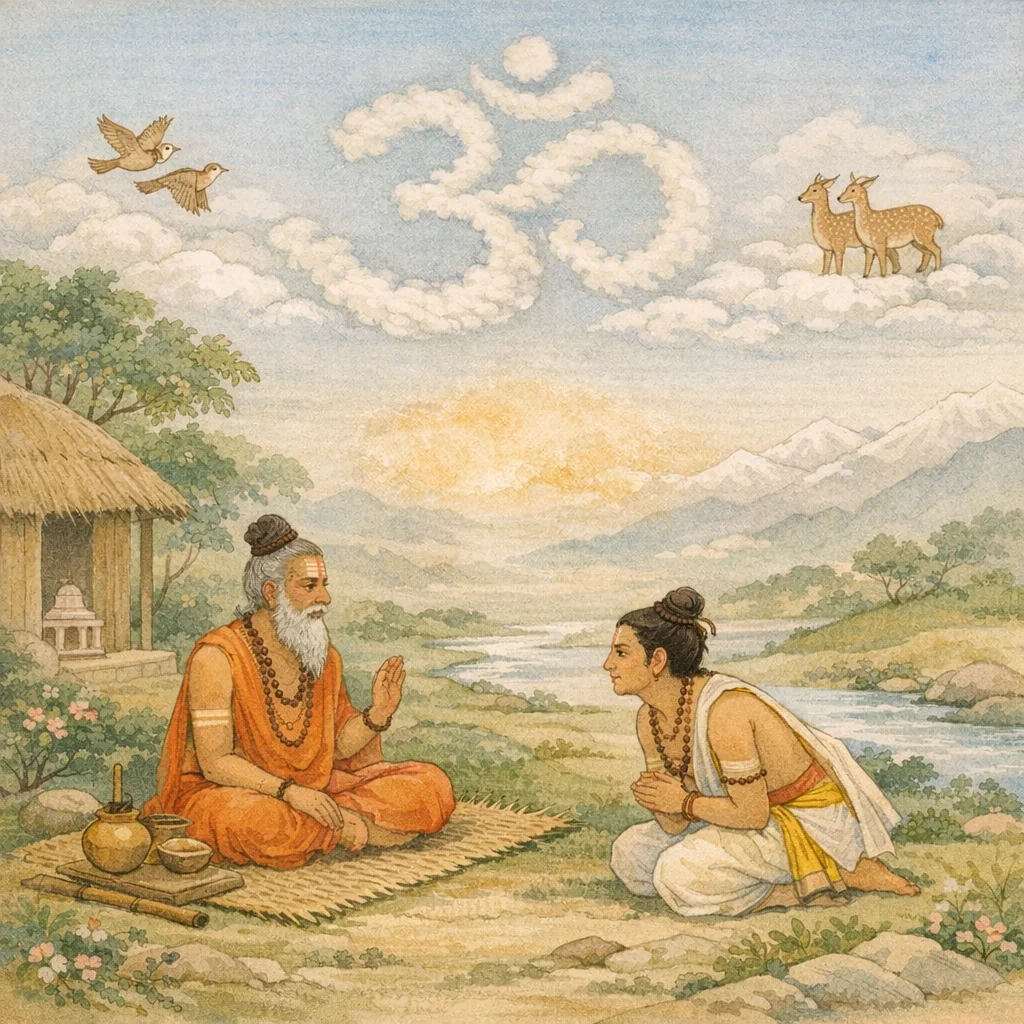
Paramātma-Svarūpa-Nirṇaya: Strī–Puṃ–Napuṃsaka-Vicāra (Inquiry into the Supreme Self and Gendered Forms)
Adhyāya 16 unfolds as a teaching dialogue. Sūta describes how a learned disciple moves from received Vedic instruction to a subtler metaphysical inquiry. Vāmadeva, having “drunk” from the guru’s mouth the nectar-like meaning of the praṇava (oṃ), says his former doubt is cleared, yet asks a deeper question: the world is plainly formed in paired modes—strī/puṃ (female/male)—from Sadāśiva down to the tiniest beings. If the jagat everywhere displays sexual polarity, what is its eternal cause (kāraṇa): female, male, neuter (napuṃsaka), mixed, or something beyond all such categories? The chapter thus stages a classical Shaiva examination of the relation between ultimate reality (Paramātman), manifest differentiation (nāma-rūpa), and the embodied instruments of knowing (body, senses, mind, intellect, ego) that generate dispute. The cited verses place controversy not in the Self’s nature but in embodied cognition, urging one to see the limits of ordinary vyavahāra (“I know,” “I do”) and to re-center on the all-pervading Self, self-evidently established as the inner reality of all (sarvātma-saṃsiddha).
Shlokas
Verse 1
सूत उवाच । श्रुत्वोपदिष्टं गुरुणा वेदार्थं मुनिपुंगवः । परमात्मनि संदिग्धं परिपप्रच्छ सादरम्
Sūta said: Having heard from his guru the purport of the Vedas, that foremost of sages—still doubtful regarding the Supreme Self—reverently questioned (his teacher) again.
Verse 2
वामदेव उवाच । ज्ञानशक्तिधर स्वामिन्परमानन्दविग्रह । प्रणवार्थामृतं पीतं श्रीमुखख्जात्परिस्रुतम्
Vāmadeva said: “O Lord who bears the śakti of divine knowledge, O Master whose very form is supreme bliss—having drunk the nectar of the meaning of the Praṇava (Oṃ), which has flowed forth from Your auspicious mouth…”
Verse 3
दृढप्रज्ञश्च जातोऽस्मि संदेहो विगतो मम । किंचिदन्यन्महासेन पृच्छामि त्वां शृणु प्रभो
I have now become steady in understanding, and my doubt has been dispelled. Yet, O Mahāsena, I wish to ask You something else—listen, O Lord.
Verse 4
सदाशिवादिकीटांतरूपस्य जगतः स्थितिः । स्त्रीपुंरूपेण सर्वत्र दृश्यते न हि संशयः
From Sadāśiva down to the tiniest worm, the universe endures in manifold forms. Everywhere it is seen as the paired manifestation of the feminine and the masculine—of this there is no doubt.
Verse 5
एवं रूपस्य जगतः कारणं यत्सनातनम् । स्त्रीरूपं तत्किमाहोस्वित्पुरुषो वा नपुंसकम्
Thus, that eternal Reality which is the cause of this universe of forms—should it be understood as having a feminine form, or as male, or as neither (beyond gender)?
Verse 6
उत मिश्रं किमन्यद्वा न जातस्तत्र निर्णयः । बहुधा विवदन्तीह विद्वांसश्शास्त्रमोहिताः
Or whether it is a mixed doctrine, or something else—on that point no settled conclusion has arisen. Here, learned men, deluded by mere scriptural disputation, argue in many ways.
Verse 7
जगत्सृष्टिविधायिन्यः श्रुतयो जगता सह । विष्णुब्रह्मादयो देवाः सिद्धाश्च न विदन्ति हि
Even the Vedas, which set forth the principles of the world’s creation, do not fully know that Supreme Reality—nor does the universe itself. Indeed, even gods such as Viṣṇu and Brahmā, and the perfected Siddhas, do not truly comprehend Him.
Verse 8
यथैक्यभावं गच्छेयुरेतदन्यच्च वेदय । जानामीति करोमीति व्यवहारः प्रदृश्यते
Know this too: even as beings move toward the sense of oneness, worldly convention still appears—spoken as “I know” and “I do”—though that unity is being approached.
Verse 9
स हि सर्वात्मसंसिद्धो विवादो नात्र कस्यचित् । सर्वदेहेन्द्रियमनोबुध्यहंकारसंभवः
Indeed, this is a truth established in the Self of all; there is no room here for anyone’s dispute. For the sense of individuality and contention arises from the whole apparatus of body, senses, mind, intellect, and ego.
Verse 10
आहोस्वि दात्मनोरूपं महानत्रापि संशयः । द्वयमेतद्धि सर्व्वेषां विवादास्पदमद्भुतम्
Or else, concerning the very form of the Supreme Self, a great doubt remains here as well. Indeed, this pair of issues becomes, for everyone, a wondrous ground for dispute.
Verse 11
उत्पाट्याज्ञानसंभूतं संशयाख्यं विषद्रुमम् । शिवाद्वैतमहाकल्पवृक्षभूमिर्यथाभवेत्
Uproot the poisonous tree called “doubt,” born of ignorance, so that one may become fertile ground for the great wish-fulfilling tree of Śiva’s non-dual Reality.
Verse 12
चित्तं मम यथा देव बोध्योऽस्मि कृपया तव । कृपातस्तव देवेश दृढज्ञानी भवा म्यहम्
O Deva, may my mind become fit to be awakened by Your grace. O Lord of the gods, through Your compassion may I become established in unwavering spiritual knowledge.
Verse 14
सुब्रह्मण्य उवाच । एतदेव मुने गुह्यं शिवेन परिभाषितम् । अम्बायाः शृण्वतो देव्या वामदेव ममापि हि
Subrahmaṇya said: “O sage, this very teaching is the secret that was explained by Śiva—while the Goddess Ambā was listening, and while Vāmadeva and I too were hearing.”
Verse 15
तस्याः स्तन्यं तदा पीत्वा संतृप्तोऽस्मि मुहुर्मुहुः । श्रुतवान्निश्चलं तद्वै निश्चितं मे विचारितम्
Having then drunk her breast-milk, I have again and again become fully satisfied. And having heard that unwavering truth, I have reflected upon it, and it stands firmly concluded in my mind.
Verse 16
इति श्रीशिवमहापुराणे षष्ठ्यां कैलाससंहितायां शिवतत्त्ववर्णनन्नाम षोडशोऽध्यायः
Thus, in the holy Śiva Mahāpurāṇa, in the Sixth—Kailāsa Saṃhitā—ends the sixteenth chapter called “The Description of the Principle (Tattva) of Śiva.”
Verse 17
कर्मास्ति तत्त्वादारभ्य शास्त्रवादस्सुविस्तरः । यथाविवेकं श्रोतव्यो ज्ञानिना ज्ञानदो मुने
O sage, the scriptural exposition is very extensive—beginning from the principles of reality (tattva) and extending even to the domain of action (karma). A knower should listen to it with proper discernment, for it bestows true knowledge.
Verse 18
त्वयोपदिष्टा ये शिष्यास्तत्र को वा भवत्समः । कपिलादिषु शास्त्रेषु भ्रमंत्यद्यापि तेऽधमाः
Among those disciples instructed by you, who could possibly be your equal? Yet those wretched ones still wander even today through the treatises of Kapila and other such doctrines—straying from the true path of Śiva.
Verse 19
ते शप्ता मुनिभिः षड्भिश्शिवनिन्दा पराः पुरा । न श्रोतव्या हि तद्वार्त्ता तेऽन्यथावादिनो यतः
In former times, those people—bent on reviling Śiva—were cursed by six sages. Therefore their talk should certainly not be heard, for they speak perverse and misleading doctrines.
Verse 20
अनुमानप्रयोगस्याप्यवकाशो न विद्यते । पंचावयवयुक्तस्य स तु धूमस्य दर्शनात्
Here, even the occasion to employ inference (anumāna) does not arise; for that inferential process is set in motion by perceiving smoke and proceeds as a five-membered syllogism (pañcāvayava).
Verse 21
पर्व्वतस्याग्निमद्भावं वदंत्यत्रापि सुव्रत । प्रत्यक्षस्य प्रपंचस्य दर्शनालंबनं त्वतः
O virtuous one, here too they say that the mountain holds fire within. From this it is understood that the visible world, directly perceived, rests upon an underlying support—an inner, unseen potency that makes perception and manifestation possible.
Verse 22
ज्ञातव्यः परमेशानः परमात्मा न संशयः । स्त्रीपुंरूपमयं विश्वं प्रत्यक्षेणैव दृश्यते
Know Parameśāna to be the Supreme Self—of this there is no doubt. The entire universe, consisting of the forms of female and male, is indeed seen directly as His manifestation.
Verse 23
षट्कोशरूपः पिण्डो हि तत्र चाद्यत्रयम्भवेत् । मात्रंशजं पुनश्चान्यत्पित्रंशजमिति श्रुतिः
Indeed, the embodied being (piṇḍa) is of the nature of six sheaths (kośas); and among these, the first three arise therefrom. The remaining are heard in the śruti to be derived—some from the mother’s portion and others from the father’s portion.
Verse 24
एवं सर्वशरीरेषु स्त्रीपुंभावविदो जनाः । परमात्मन्यपि मुने स्त्रीपुंभावं विदुर्बुधा
Thus, among all embodied beings, people who discern the feminine and masculine conditions likewise—O sage—recognize even in the Supreme Self the powers of “female” and “male,” as the wise understand.
Verse 25
निवर्त्तनं जगत्त्वस्य चिच्छब्देन विधीयते । त्रिलिंगवर्त्ती सच्छब्दः पुरुषोत्र विधीयताम्
The withdrawal (dissolution) of the state of worldliness is taught by the word “Cit” (pure Consciousness). And here the word “Sat” is to be understood as the Puruṣa who abides in the threefold liṅga—thus it is to be established.
Verse 27
प्रकाशवाची स भवेत्सत्प्रकाश इति स्फुटम् । ज्ञानशब्दस्य पर्य्यायश्चिच्छब्दः स्त्रीत्वमागतः
She is the utterer of Light; therefore she is clearly called “Sat-prakāśa” (true illumination). The word “Cit” is a synonym of “jñāna” (knowledge), and here it is presented in the feminine form.
Verse 28
प्रकाशश्चिच्च मिथुनं जगत्कारणतां गतम् । सच्चिदात्मन्यपि तथा जगत्कारणतां गतम्
Light (prakāśa) and consciousness (cit)—this paired unity attains the status of being the cause of the universe. Likewise, in the reality whose nature is Being-and-Consciousness (sat–cit), it too is spoken of as having become the cause of the universe.
Verse 29
एकत्रैव शिवश्शक्तिरिति भावो विधीयते । तैलवर्त्त्यादिमालिन्यात्प्रकाशस्यापि वर्त्तते
It is affirmed that Śiva and Śakti are together as one reality. Yet, because of impurities such as oil and the wick, even the light (that should shine unobstructed) is seen to behave differently, as though limited or affected.
Verse 30
मालिन्यमशिवत्वं च चिताग्न्यादिषु दृश्यते । एवं विवर्त्तकत्वेन शिवत्वं श्रुतिचोदितम्
Impurity and even “inauspiciousness” are seen in things such as the funeral pyre and fire. Yet, by the principle of vivarta (apparent transformation), their very Śiva-nature is affirmed, as the Vedas teach.
Verse 31
जीवाश्रितायाश्चिच्छक्तेर्दौर्बल्यं विद्यते सदा । तन्निवृत्यर्थमेवात्र शक्तित्वं सार्वकालिकम्
The cit-śakti, the power of consciousness as it abides in the individual soul, is ever found to be weakened. Therefore, precisely to remove that limitation, the Lord’s Śakti is here taught as eternally operative, at all times.
Verse 32
बलवाञ्छक्तिमांश्चेति व्यवहारः प्रदृश्यते । लोके वेदे च ससतं वामदेव महामुने
O great sage Vāmadeva, in both the world and the Veda, common usage constantly recognizes (a Lord) as “the Powerful” and “the Possessor of Śakti.”
Verse 33
एवं शिवत्वं शक्तित्वं परमात्मनि दर्शितम् । शिवशक्त्योस्तु संयोगादानंदस्सततोदितः
Thus, the state of being Shiva and the state of being Shakti are shown to abide in the Supreme Self. Indeed, from the union of Shiva and Shakti, ever-arising bliss continuously manifests.
Verse 34
अतो मुने तमुद्दिश्य मुनयः क्षीणकल्मषाः । शिवे मनस्समाधाय प्राप्ताश्शिवमनामयम्
Therefore, O sage, fixing their aim upon Him, those seers—whose impurities had been exhausted—collected their minds in samādhi upon Śiva and attained Śiva, the stainless, sorrowless state.
Verse 35
सर्वात्मत्वं तयोरेवं ब्रह्मेत्युपनिषत्सु च । गीयते ब्रह्मशब्देन बृंहिधात्वर्थगोचरम्
Thus, the all-pervasive Selfhood of those two is sung in the Upaniṣads as “Brahman”; for the word “Brahman” denotes that reality whose very sense is the root bṛṃh—“to expand, to pervade, to make vast.”
Verse 36
बृंहणत्वं बृहत्त्वं च शंभ्वाख्यविग्रहे । पंचब्रह्ममये विश्वप्रतीतिर्ब्रह्म शब्दिता
In the form known as Śambhu are present both the power of expansion and the state of vastness. And the manifestation by which the universe is apprehended—being constituted of the Five Brahmas—is designated by the name “Brahman.”
Verse 37
प्रतिलोमात्मके हंसे वक्ष्यामि प्रणवोद्भवम् । तव स्नेहाद्वामदेव सावधानतया शृणु
O Vāmadeva, out of affection for you I shall explain the arising of the Pranava (Om) within the Haṃsa principle—even in its reverse order. Listen with full attentiveness.
Verse 38
व्यंजनस्य सकारस्य हकारस्य च वर्जनात् । ओमित्येव भवेत्स्थूलो वाचकः परमात्मनः
When the consonantal elements—specifically the letters ‘sa’ and ‘ha’—are set aside, what remains is ‘Om’ alone; and that ‘Om’ becomes the manifest (gross) designator and uttered Name of the Supreme Self.
Verse 39
महामन्त्रस्स विज्ञेयो मुनिभिस्तत्त्वदर्शिभिः । तत्र सूक्ष्मो महामन्त्रस्तदुद्धारं वदामि ते
This is to be known as the Great Mantra, as realized by sages who behold the truth. Within it there is a subtle Great Mantra; its extraction and proper formulation I shall now tell you.
Verse 40
आद्ये त्रिपंचरूपे च स्वरे षोडशके त्रिषु । महामन्त्रो भवेदादौ स सकारो भवेद्यदा
In the beginning—within the triad-and-fivefold form, and within the three sets of the sixteen vowels—when the syllable “sa” arises first, it becomes the great Mantra at the outset.
Verse 41
हंसस्य प्रतिलोमः स्यात्सकारार्थश्शिवः स्मृतः । शक्त्यात्मको महामन्त्रवाच्यः स्यादिति निर्णयः
The reverse of “haṃsa” becomes “sa-ha”; the syllable “sa” is remembered to signify Śiva. And “ha” is of the nature of Śakti. Thus, it is concluded that this (sa-ha) is what the Great Mantra truly denotes.
Verse 42
गुरूपदेश काले तु सोहंशक्त्यात्मकश्शिवः । इति जीवपरो भूयान्महामन्त्रस्तदा पशुः
At the time of the Guru’s instruction, Śiva—whose very nature is the power expressed as “So’ham” (“I am He”)—is to be realized. Thus, for the bound soul (jīva) this becomes the supreme Great Mantra; and in that condition the individual is called the paśu (the bound being).
Verse 43
शक्त्यात्मकश्शिवांशश्च शिवैक्याच्छिवसाम्यभाक् । प्रज्ञानं ब्रह्मवाक्ये तु प्रज्ञानार्थः प्रदृश्यते
That (self) which is of the nature of Śakti is also a portion of Śiva; and through oneness with Śiva it attains equality with Śiva. Therefore, in the Brahma‑sentence “prajñānam brahma” (Consciousness is Brahman), the intended meaning is seen to be that very supreme Consciousness (as Śiva).
Verse 44
प्रज्ञानशब्दश्चैतन्यपर्य्यायस्स्यान्न संशयः । चैतन्यमात्मेति मुने शिवसूत्रं प्रवर्त्तितम्
O sage, there is no doubt that the word “prajñāna” is a synonym of Consciousness (caitanya). Declaring that “Consciousness itself is the Self,” the Śiva-sūtra is thus set forth—teaching the Pati (Śiva) as the luminous inner Self who grants liberation to the bound soul.
Verse 45
चैतन्यमिति विश्वस्य सर्वज्ञानक्रियात्मकम् । स्वातन्त्र्यं तत्स्वभावो यः स आत्मा परिकीर्त्तितः
That which is called Consciousness—pervading the universe as the very essence of all knowing and all activity—and whose inherent nature is Freedom (self-sovereignty): that is proclaimed to be the Ātman.
Verse 46
इत्यादिशिवसूत्राणां वार्तिकं कथितं मया । ज्ञानं बंध इतीदं तु द्वितीयं सूत्रमीशितुः
“Thus have I explained the gloss (vārttika) on the Śiva-sūtras beginning in this way. Now, ‘Knowledge itself is bondage’—this indeed is the second aphorism of the Lord (Īśa).”
Verse 47
ज्ञानमित्यात्मनस्तस्य किंचिज्ज्ञानक्रियात्मकम् । इत्याहाद्यपदेनेशः पशुवर्गस्य लक्षणम्
By the opening term “jñānam (knowledge),” the Lord indicates that the individual self possesses a limited measure of knowledge and capacity for action. Thus, through that first word, Īśa states the defining mark of the class called paśu (the bound soul).
Verse 48
एतद्द्वयं पराशक्तेः प्रथमं स्पंदतां गतम् । एतामेव परां शक्तिं श्वेताश्वतरशाखिनः
This pair (of principles) is the first vibration that arose from the Supreme Power. That very Supreme Śakti is what the followers of the Śvetāśvatara (Upaniṣad) tradition proclaim.
Verse 49
स्वाभाविकी ज्ञानबलक्रिया चेत्यस्तुवन्मुदा । ज्ञानक्रियेच्छारूपं हि शंभोर्दृष्टित्रयं विदुः
Joyfully they praised that innate (power) which is of the nature of knowledge, strength, and action. For the wise know Śambhu’s threefold ‘vision’ (dṛṣṭi) to be manifest as knowledge (jñāna), action (kriyā), and will (icchā).
Verse 50
एतन्मनोमध्यगं सदिन्द्रियज्ञानगोचरम् । अनुप्रविश्य जानाति करोति च पशुः सदा
Entering into this reality that abides in the midst of the mind and is ever within the range of sense-perception and cognition, the bound soul (paśu) continually knows and acts.
Verse 51
तस्मादात्मन एवेदं रूपमित्येव निश्चितम् । प्रपंचार्थं प्रवक्ष्यामि प्रणवै क्यप्रदर्शनम्
Therefore it is firmly concluded that this form indeed arises from the Self (Ātman) alone. Now, for the sake of explaining manifestation in the world-process, I shall expound the essential oneness revealed by the Praṇava (Oṁ).
Verse 52
ओंमितीदं सर्वमिति श्रुतिराह सनातनी । तस्माद्वेतीत्युपक्रम्य जगत्सृष्टिः प्रक्रीर्तिता
The eternal Śruti declares, “Om—this indeed is all.” Therefore, beginning from that primordial principle, the creation of the universe is expounded.
Verse 53
तस्याः श्रुतेस्तु तात्पर्यं वक्ष्यामि श्रूयतामिदम् । तव स्नेहाद्वामदेव विवेकार्थविजृंभितम्
Now I shall explain the true purport of that Śruti—listen to this. O Vāmadeva, out of affection for you, this teaching is unfolded so that discriminative insight (viveka) may awaken.
Verse 54
शिवशक्तिसमायोगः परमात्मेति निश्चितम् । पराशक्तेस्तु संजाता चिच्छक्तिस्तु तदुद्भवा
It is firmly established that the Supreme Self (Paramātman) is the perfect union of Śiva and Śakti. From the Supreme Power (Parāśakti) arises the power of consciousness (Cit-śakti), and from that, all manifestation proceeds.
Verse 55
आनन्दशक्तिस्तज्जास्यादिच्छाशक्तिस्तदुद्भवा । ज्ञानशक्तिस्ततो जाता क्रियाश क्तिस्तु पंचमी । एताभ्य एव संजाता निवृत्त्याद्याः कला मुने
From that supreme Reality arises the Power of Bliss (Ānanda-śakti); from it is born the Power of Will (Icchā-śakti). Thereafter arises the Power of Knowledge (Jñāna-śakti), and as the fifth is the Power of Action (Kriyā-śakti). From these alone, O sage, are produced the kalās beginning with Nivṛtti.
Verse 56
चिदानन्दसमुत्पन्नौ नादबिन्दू प्रकीर्त्तितौ । इच्छाशक्तेर्मकारस्तु ज्ञानशक्तेस्तु पंचमः
Arising from Consciousness and Bliss, the two principles are proclaimed as Nāda and Bindu. Among these, the letter “ma” is of the nature of the Power of Will (icchā-śakti), while the fifth (syllable/letter) pertains to the Power of Knowledge (jñāna-śakti).
Verse 57
स्वरः क्रियाशक्तिजातो ह्यकारस्तु मुनीश्वर । इत्युक्ता प्रणवोत्पत्तिः पंचब्रह्मोद्भवं शृणु
O lord among sages, the vowel-sound—namely the letter “A”—arises from the Power of Action (kriyā-śakti). Thus has the origin of the Praṇava (Oṃ) been declared; now hear its manifestation as proceeding from the Five Brahmans, the fivefold aspects of Śiva.
Verse 58
शिवादीशान उत्पन्नस्ततस्तत्पुरुषोद्भवः । ततोऽघोरस्ततो वामस्सद्योजातोद्भवस्ततः
From Śiva, Īśāna came forth; from Him arose Tatpuruṣa. Thereafter Aghora manifested; then Vāma appeared; and from that, Sadyojāta was born.
Verse 59
एतस्मान्मातृकादष्टत्रिंशन्मातृसमुद्भ वः । ईशानाच्छान्त्यतीताख्या कला जाताथ पूरुषात् । उत्पद्यते शान्तिकला विद्याऽघोरसमुद्भवा
From this Mother-source, Mātṛkā, arises the set of thirty-eight principles born of the Mothers. From Īśāna is born the kalā known as “Śāntyatītā” (beyond peace); and from Puruṣa arises the kalā of Śānti (peace). The Vidyā springs forth from Aghora.
Verse 60
प्रतिष्ठा च निवृत्तिश्च वाम सद्योद्भवे मते । ईशाच्चिच्छक्तिमुखतो विभोर्मिथुनपञ्चकम्
According to the doctrine, Pratiṣṭhā and Nivṛtti are assigned to Vāma and Sadyojāta. From Īśāna onward—beginning with Cit-Śakti—there is thus taught the Lord’s set of five paired principles (mithuna-pañcaka).
Verse 61
अनुग्रहादिकृत्यानां हेतुः पञ्चकमिष्यते । तद्विद्भिर्मुनिभिः प्राज्ञैर्वरतत्त्वप्रदर्शिभिः
For the divine acts beginning with grace (anugraha) and the rest, a set of five causes is accepted. This has been taught by wise sages who know these principles and who reveal the highest truth concerning the Supreme Lord’s boons.
Verse 62
वाच्यवाचकसम्बन्धान्मिथुनत्वमुपेयुषि । कलावर्णस्वरूपेऽस्मिन्पञ्चके भूतपञ्चकम्
Through the relation between the expressed meaning (vācya) and the expressing word (vācaka), a paired unity is formed. In this pentad—whose nature is kalā (power/measure), varṇa (phoneme), and svarūpa (essential form)—the five great elements are also present as a fivefold set.
Verse 63
वियदादि क्रमादासीदुत्पन्नम्मुनिपुङ्गव । आद्यं मिथुनमारभ्य पञ्चमं यन्मयं विदुः
O foremost of sages, beginning with ether and proceeding in due order, the manifested creation came into being. From the first pair onward, the fifth is known by the wise to be constituted of that very essence.
Verse 64
शब्दैकगुण आकाशः शब्दस्पर्शगुणो मरुत् । शब्दस्पर्शरूपगुणप्रधानो वह्निरुच्यते
Ether (ākāśa) is said to possess sound as its sole quality. Wind (marut) possesses the qualities of sound and touch. Fire (vahni) is declared to be predominantly characterized by the qualities of sound, touch, and form (visibility).
Verse 65
शब्दस्पर्शरूपरसगुणकं सलिलं स्मृतम् । शब्द्स्पर्शरूपरसगन्धाढ्या पृथिवी स्मृता
Water (salila) is taught to possess the qualities of sound, touch, form, and taste; and Earth (pṛthivī) is taught to be endowed with sound, touch, form, taste, and smell.
Verse 66
व्यापकत्वञ्च भूतानामिदमेव प्रकीर्तितम् । व्याप्यत्वं वैपरीत्येन गन्धादिक्रमतो भवेत्
Thus the pervading nature (vyāpakatva) of the elements is declared to be exactly this; their being pervaded (vyāpyatva) arises in the reverse order, beginning with smell and the rest of the qualities.
Verse 67
भूतपञ्चकरूपोऽयम्प्रपञ्चः परिकीर्त्यते । विराट् सर्वसमष्ट्यात्मा ब्रह्माण्डमिति च स्फुटम्
This manifest universe is proclaimed to be of the nature of the five elements. And that Cosmic Being, Virāṭ—the collective Self of all totalities—is clearly spoken of as “Brahmāṇḍa,” the cosmic egg.
Verse 68
पृथिवीतत्त्वमारभ्य शिवतत्त्वावधि क्रमात् । निलीय तत्त्वसंदोहे जीव एव विलीयते
Beginning with the earth-principle and proceeding step by step up to the Śiva-principle, when one enters and is absorbed into the aggregate of tattvas, the individual soul (jīva) itself is dissolved—its sense of separateness subsiding in Śiva.
Verse 69
संशक्तिकः पुनस्सृष्टौ शक्तिद्वारा विनिर्गतः । स्थूलप्रपञ्चरूपेण तिष्ठत्याप्रलयं सुखम्
Then, at the time of renewed creation, the principle called Saṃśaktika emerges through Śakti; assuming the form of the gross, manifest universe, it abides in ease until pralaya (dissolution).
Verse 70
निजेच्छया जगत्सृष्टमुद्युक्तस्य महेशितुः । प्रथमो यः परिस्पन्दश्शिव तत्त्वन्तदुच्यते
When the Great Lord, by His own free will, turns toward the creation of the universe, the very first stir or movement that arises—this is called the principle of Śiva (Śiva-tattva).
Verse 71
एषैवेच्छाशक्तितत्वं सर्वकृत्यानुवर्तनात् । ज्ञानक्रियाशक्तियुग्मे ज्ञानाधिक्ये सदाशिवः
This indeed is the principle of Icchā-Śakti, the Power of Will, for it presides over and directs all functions. And where the paired powers of Knowledge and Action are present, when Knowledge predominates, that state is called Sadāśiva.
Verse 72
महेश्वरं क्रियोद्रेके तत्त्वं विद्धि मुनीश्वर । ज्ञानक्रियाशक्तिसाम्यं शुद्धविद्यात्मकं मतम्
O lord among sages, know Mahēśvara-tattva to be that principle in which the power of action predominates; and the equilibrium of the powers of knowledge and action is held to be the nature of Śuddhavidyā.
Verse 73
स्वाङ्गरूपेषु भावेषु मायातत्त्वविभेदधीः । शिवो यदा निजं रूपं परमैश्वर्य्यपूर्वकम्
When Śiva—whose discerning awareness distinguishes the categories (tattvas) of Māyā within the manifested states that appear as His own limbs—reveals His own essential form, He does so preceded by supreme sovereignty (paramaiśvarya).
Verse 74
निगृह्य माययाशेषपदार्थग्राहको भवेत् । तदा पुरुष इत्याख्या तत्सृष्ट्वेत्यभवच्छ्रुतिः
When, constrained by Māyā, one becomes the experiencer who apprehends all objects within manifestation, then one is designated “Puruṣa”; therefore the śruti declared, “having created that (world/manifestation)….”
Verse 75
अयमेव हि संसारी मायया मोहितः पशुः । शिवज्ञानविहीनो हि नानाकर्मविमूढधीः
Indeed, this very transmigrating being is the bound soul, the “paśu,” deluded by Māyā. Devoid of Śiva-knowledge, the mind grows confused, wandering amid countless actions (karma).
Verse 76
शिवादभिन्नं न जगदात्मानं भिन्नमित्यपि । जानतोऽस्य पशोरेव मोहो भवति न प्रभो
Even if the bound soul, the paśu, understands, “The Self of the universe is not different from Śiva,” yet still thinks, “It is different,” delusion belongs only to the paśu—not to the Lord (Prabhu).
Verse 77
यथैन्द्रजालिकस्यापि योगिनो न भवेद्भ्रमः । गुरुणा ज्ञापितैश्वर्यश्शिवो भवति चिद्धनः
Just as a yogin is not deluded by an illusionist’s tricks, so too, when the Guru makes known Śiva’s Lordship, Śiva is realized as the very wealth of Consciousness—pure, luminous Awareness itself.
Verse 78
सर्वकर्तृत्वरूपा च सर्वजत्वस्वरूपिणी । पूर्णत्वरूपान्नित्यत्वव्यापकत्व स्वरूपिणी
She is the very form of universal agency, the power by which all acts are accomplished, and the very essence of all beings. She is fullness itself—eternal by nature—and her true nature is all-pervasiveness.
Verse 79
शिवस्य शक्तयः पञ्च संकुचदूपभास्कराः
The five powers of Śiva are like suns whose radiance contracts and expands, revealing His sovereignty through the play of manifestation and withdrawal.
Verse 80
अपि संकोचरूपेण विभांत्य इति नित्यशः । पशोः कलाख्य विद्येति रागकालौ नियत्यपि । तत्त्वपञ्चकरूपेण भवत्यत्र कलेति सा
Indeed, by taking the form of contraction (saṃkoca), it shines forth perpetually, yet in a limited way. In the bound soul (paśu) that power is called Vidyā named Kalā, and it operates together with Rāga, Kāla, and Niyati. Here, that same Kalā becomes manifest as the five tattvas, the fivefold principle.
Verse 81
किंचित्कर्तृत्त्त्वहेतुस्स्यात्किंचित्तत्त्वैकसाधनम् । सा तु विद्या भवेद्रागो विषयेष्वनुरंजकः
Some knowledge becomes a cause of the sense of doership, while some becomes the sole means to realize the true Reality. That is called Vidyā; whereas rāga is the attachment that delights in and clings to sense-objects.
Verse 82
कालो हि भावभावानां भासानां भासनात्मकः । क्रमावच्छेदको भूत्वा भूतादिरिति कथ्यते
Time indeed is the very principle by which all states and their transformations, and all appearances and their manifestation, are made known. Becoming the limiter that marks out sequence and division, it is therefore spoken of as the origin of beings, the beginning of manifested existence.
Verse 83
इदन्तु मम कर्तव्यमिदन्नेति नियामिका । नियतिस्स्याद्विभोश्शक्तिस्तदाक्षेपात्पतेत्पशुः
“‘This is to be done by me; this is not’—the force that regulates such notions is called Niyati. Niyati is the Lord’s (Vibhu’s) power; and by its compelling projection, the bound soul (paśu) falls into limitation.”
Verse 84
एतत्पंचकमेवास्य स्वरूपा वारकत्वतः । पञ्चकञ्चुकमाख्यातमन्तरंगं च साधनम्
This very set of five, because it veils his true nature, is called the “five-fold sheath” (pañcakañcuka); and it is also proclaimed to be an inner means (antaraṅga-sādhana) to be understood and transcended.
Verse 93
सूत उवाच । श्रुत्वैवं मुनिना पृष्टं वचो वेदान्तनिर्वृतम् । रहस्यं प्रभुराहेदं किंचित्प्रहसिताननः
Sūta said: Having thus heard the sage’s question—words steeped in Vedāntic serenity—the Lord, with a gently smiling face, spoke this secret teaching.
Frequently Asked Questions
The chapter presents a theological argument framed as Vāmadeva’s question: since the cosmos appears everywhere in strī/puṃ forms, what is the eternal cause—female, male, neuter, mixed, or transcendent? The argument moves toward locating ‘debate’ in the psycho-physical complex (senses–mind–intellect–ego) rather than in the Self’s nature.
Praṇava (oṃ) is treated as ‘amṛta’—a condensed symbol of ultimate meaning received through guru-transmission. The strī/puṃ polarity functions as a symbol of manifest differentiation, while the critique of ‘I know/I do’ discourse indicates the esoteric move from conventional identity (ahaṃkāra-based agency) to recognition of the all-pervading Self (sarvātman).
The sampled portion foregrounds Sadāśiva as the upper bound of the manifest spectrum (‘from Sadāśiva to insects’) rather than a narrative avatāra. The emphasis is on Shiva as Paramātman and the principle by which forms (including gendered forms) are intelligible, implying Śakti’s role without centering a single iconographic form of Gaurī in the cited verses.