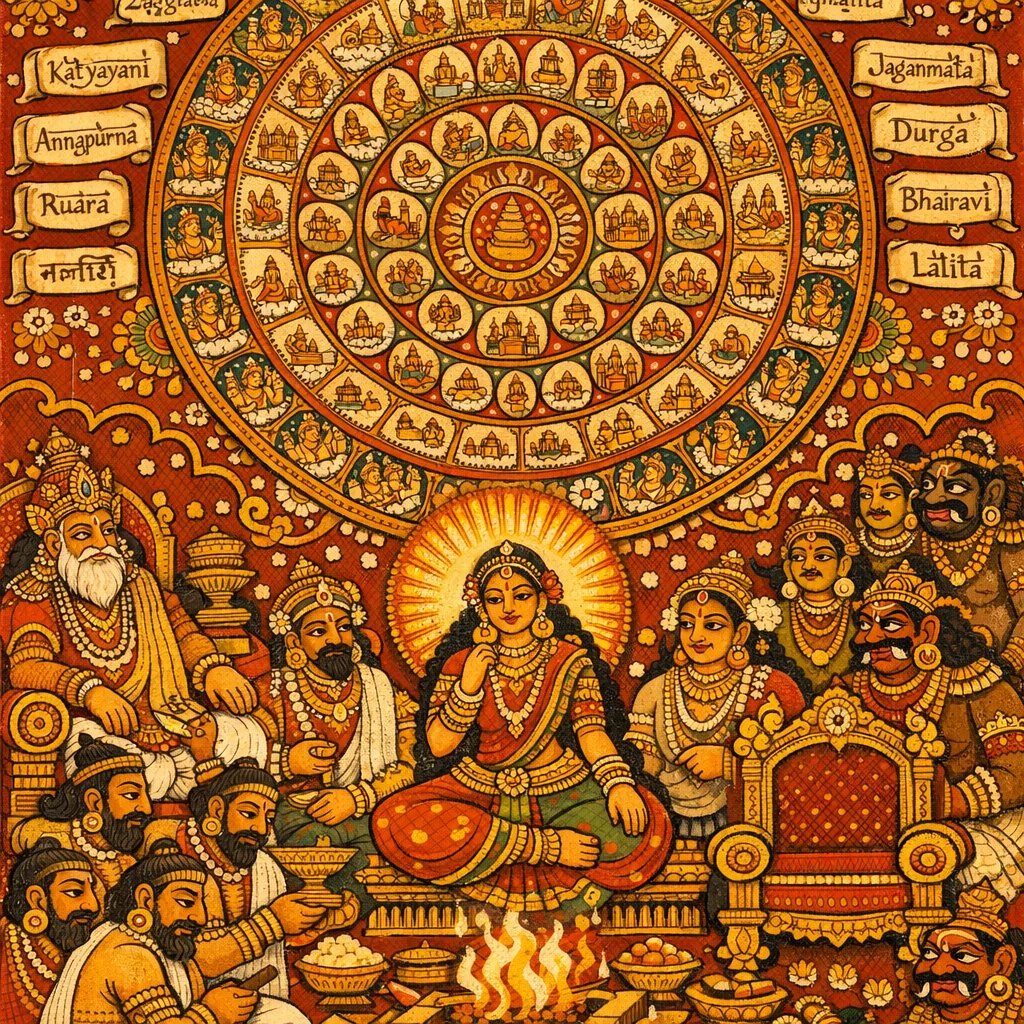
Adhyaya 13: Lineage of the Pitṛs, Satī’s Self-Immolation, and the Goddess’s 108 Names & Tīrthas
पितृवंशवर्णनं, सतीदाहः, देवी-नामाष्टोत्तर-तीर्थकथनम्
Speaker: Vaivasvata Manu, Lord Matsya, Rishis, Suta, The Goddess (Devī/Satī)
Manu asks Matsya about the lineage of the Pitṛs and the special śrāddha-deity status of Ravi and Soma. Matsya answers by classifying the Pitṛ-gaṇas (seven in heaven; formless and embodied), linking Pitṛ doctrine to yogic attainment and advising that śrāddha-gifts be directed to yogins. The chapter then turns to the Himavat–Menā genealogy (including Umā and her sisters). The ṛṣis question Sūta about Dakṣāyaṇī (Satī): why she immolated herself and how she is reborn as Himavat’s daughter. Sūta recounts Dakṣa’s yajña, Rudra’s non-invitation, Satī’s resolve and yogic self-burning, Dakṣa’s remorse, and the Goddess’s teaching on her omnipresence. She lists her epithets across tīrthas in a 108-name/108-site scheme, promises purification by hearing and remembering and great merit by bathing and darśana, and concludes with the fruits of recitation, śrāddha-dāna, and protection where the written text is worshipped.
Key Concepts
Shlokas in Adhyaya 13
Verse 1
*मनुरुवाच भगवञ्श्रोतुमिच्छामि पितॄणां वंशमुत्तमम् रवेश्च श्राद्धदेवत्वं सोमस्य च विशेषतः //
Manu said: “O Blessed Lord, I desire to hear the excellent lineage of the Pitṛs (ancestral fathers), and in particular the divine status of Ravi (the Sun) as presiding deity of Śrāddha, and also that of Soma (the Moon), with its distinctive details.”
Verse 2
*मत्स्य उवाच हन्त ते कथयिष्यामि पितॄणां वंशमुत्तमम् स्वर्गे पितृगणाः सप्त त्रयस्तेषाममूर्तयः //
Matsya said: “Come, I shall tell you the excellent lineage and orders of the Pitṛs (ancestral fathers). In heaven there are seven groups of Pitṛs; among them, three are formless (without embodied shape).”
Verse 3
मूर्तिमन्तो ऽथ चत्वारः सर्वेषाममितौजसः अमूर्तयः पितृगणा वैराजस्य प्रजापतेः //
Then there were four embodied (manifest) ones, all of immeasurable splendor; and there were also the formless hosts of the Pitṛs, belonging to Vairāja, the Prajāpati (lord of progeny).
Verse 4
जयन्ति यान्देवगणा वैराजा इति विश्रुताः ये चैते योगविभ्रष्टाः प्राप्य लोकान्सनातनान् //
Victorious indeed are those hosts of gods famed as the Vairājas; and even those who have fallen away from yoga attain the eternal worlds.
Verse 5
पुनर्ब्रह्मदिनान्ते तु जायन्ते ब्रह्मवादिनः सम्प्राप्य तां स्मृतिं भूयो योगं सांख्यमनुत्तमम् //
Then, at the close of Brahmā’s day, the expounders of Brahman are born again; regaining that former remembrance, they once more attain the unsurpassed disciplines of Yoga and Sāṅkhya.
Verse 6
सिद्धिं प्रयान्ति योगेन पुनरावृत्तिदुर्लभाम् योगिनामेव देयानि तस्माच्छ्राद्धानि दातृभिः //
Through yoga they attain the supreme accomplishment from which return is difficult—liberation beyond rebirth. Therefore, donors should offer śrāddha-gifts specifically to yogins.
Verse 7
एतेषां मानसी कन्या पत्नी हिमवतो मता मैनाकस्तस्य दायादः क्रौञ्चस्तस्याग्रजो ऽभवत् क्रौञ्चद्वीपः स्मृतो येन चतुर्थो घृतसंवृतः //
Among these, a mind-born maiden (Mānasī) is regarded as the wife of Himavat. From her, Maināka became his descendant, and Krauñca was born as Maināka’s elder brother. It is after Krauñca that the land known as Krauñca-dvīpa is remembered—the fourth continent, said to be encircled by a sea of clarified butter (ghṛta).
Verse 8
मेना च सुषुवे तिस्रः कन्या योगवतीस्ततः उमैकपर्णापर्णा च तीव्रव्रतपरायणाः //
And Menā then gave birth to three daughters, all endowed with yogic power—Umā, Ekaparṇā, and Aparṇā—who were devoted to severe vows and austerities.
Verse 9
रुद्रस्यैका सितस्यैका जैगीषव्यस्य चापरा दत्ता हिमवता बालाः सर्वा लोके तपो ऽधिकाः //
One maiden was given to Rudra, one to Sita, and another to Jaigīṣavya. Those daughters bestowed by Himavat were all, in this world, pre-eminent in ascetic power (tapas).
Verse 10
*ऋषय ऊचुः कस्माद्दाक्षायणी पूर्वं ददाहात्मानमात्मना हिमवद्दुहिता तद्वत् कथं जाता महीतले //
The sages said: For what reason did Dakṣāyaṇī (Satī) formerly burn herself by her own resolve? And how did she, as the daughter of Himavat, come to be born again upon the earth in that same manner?
Verse 11
संहरन्ती किमुक्तासौ सुता वा ब्रह्मसूनुना दक्षेण लोकजननी सूत विस्तरतो वद //
O Sūta, explain in detail: when Dakṣa—the son of Brahmā—spoke of the World-Mother, did he call her “Saṃharantī” (the Dissolver), or did he declare her to be his daughter?
Verse 12
*सूत उवाच दक्षस्य यज्ञे वितते प्रभूतवरदक्षिणे समाहूतेषु देवेषु प्रोवाच पितरं सती //
Sūta said: When Dakṣa’s sacrifice (yajña) had been set in motion—abounding in excellent gifts and sacrificial fees (dakṣiṇā)—and the gods had been invited and assembled, Satī addressed her father.
Verse 13
किमर्थं तात भर्ता मे यज्ञे ऽस्मिन्नाभिमन्त्रितः अयोग्य इति तामाह दक्षो यज्ञेषु शूलभृत् //
She said: “For what reason, dear father, was my husband not invited to this sacrifice?” Thus she spoke. Dakṣa, while conducting the sacrificial rites, told her, “He is unfit.” (So it was said of the trident-bearing Lord.)
Verse 14
उपसंहारकृद्रुद्रस् तेनामङ्गलभागयम् चुकोपाथ सती देहं त्यक्ष्यामीति त्वदुद्भवम् //
Rudra, the agent of dissolution, became enraged at that ill-omened turn of events. Then Satī—O you born of that line—declared, “I shall abandon this body.”
Verse 15
दशानां त्वं च भविता पितॄणामेकपुत्रकः क्षत्रियत्वे ऽश्वमेधे च रुद्रात्त्वं नाशमेष्यसि //
You will become the sole son for ten forefathers; established in the Kshatriya estate and through the Aśvamedha sacrifice, by Rudra’s grace you will not meet with destruction.
Verse 16
इत्युक्त्वा योगमास्थाय स्वदेहोद्भवतेजसा निर्दहन्ती तदात्मानं सदेवासुरकिंनरैः //
Having spoken thus, she entered into yogic absorption; and by the fiery radiance arising from her own body, she burned up her very self, while the gods, the asuras, and the kinnaras looked on.
Verse 17
किं किमेतदिति प्रोक्ता गन्धर्वगणगुह्यकैः उपगम्याब्रवीद्दक्षः प्रणिपत्याथ दुःखितः //
When the Gandharvas, their companies, and the Guhyakas asked, “What is this—what has happened?”, Dakṣa approached them and, bowing down, spoke in sorrow.
Verse 18
त्वमस्य जगतो माता जगत्सौभाग्यदेवता दुहितृत्वं गता देवि ममानुग्रहकाम्यया //
You are the Mother of this universe—the very divinity of the world’s good fortune. O Goddess, desiring to bestow your grace upon me, you have assumed the role of a daughter.
Verse 19
न त्वया रहितं किंचिद् ब्रह्माण्डे सचराचरम् प्रसादं कुरु धर्मज्ञे न मां त्यक्तुमिहार्हसि //
Nothing whatsoever in this entire cosmos—moving or unmoving—exists apart from you. O knower of Dharma, be gracious; you should not abandon me here.
Verse 20
प्राह देवी यदारब्धं तत्कार्यं मे न संशयः किंत्ववश्यं त्वया मर्त्ये हतयज्ञेन शूलिना //
The Goddess said: “Whatever has been undertaken must indeed be brought to completion—of this I have no doubt. Yet it is inevitable that, in the mortal realm, you—Śūlin, the trident-bearer—will become the slayer of the sacrifice (yajña).”
Verse 21
प्रसादे लोकसृष्ट्यर्थं तपः कार्यं ममान्तिके प्रजापतिस्त्वं भविता दशानामङ्गजो ऽप्यलम् //
By my grace, for the sake of bringing about the creation of the worlds, you must perform austerity (tapas) in my presence; you shall become a Prajāpati—indeed a progenitor among the ten Prajāpatis—and also a mind-born son, fully empowered.
Verse 22
मदंशेनाङ्गना षष्टिर् भविष्यन्त्यङ्गजास्तव मत्संनिधौ तपः कुर्वन् प्राप्स्यसे योगमुत्तमम् //
By a portion of my own power, sixty maidens shall become the mothers of your sons. And by performing austerities in my very presence, you will attain the highest Yoga.
Verse 23
एवमुक्तो ऽब्रवीद्दक्षः केषु केषु मयानघे तीर्थेषु च त्वं द्रष्टव्या स्तोतव्या कैश्च नामभिः //
Thus addressed, Dakṣa said: “O sinless one (anaghe), at which sacred fords (tīrthas) should you be beheld, and by what names should you be praised?”
Verse 24
*देव्युवाच सर्वदा सर्वभूतेषु द्रष्टव्या सर्वतो भुवि सर्वलोकेषु यत्किंचिद् रहितं न मया विना //
The Goddess said: “At all times I am to be beheld within all beings, everywhere on earth and throughout all worlds. Whatever exists—nothing at all is devoid of Me.”
Verse 25
तथापि येषु स्थानेषु द्रष्टव्या सिद्धिमीप्सुभिः स्मर्तव्या भूतिकामैर् वा तानि वक्ष्यामि तत्त्वतः //
Even so, I shall now truthfully describe those sacred places which seekers of spiritual attainment should visit, or which those desiring worldly prosperity should at least remember.
Verse 26
वाराणस्यां विशालाक्षी नैमिषे लिङ्गधारिणी प्रयागे ललिता देवी कामाक्षी गन्धमादने मानसे कुमुदा नाम विश्वकाया तथाम्बरे //
In Vārāṇasī she is known as Viśālākṣī; in Naimiṣa as Liṅgadhāriṇī; in Prayāga as the Goddess Lalitā; in Gandhamādana as Kāmākṣī; at Mānasasaras she is named Kumudā; and in the sky-realm she is likewise Viśvakāyā.
Verse 27
गोमन्ते गोमती नाम मन्दरे कामचारिणी मदोत्कटा चैत्ररथे जयन्ती हस्तिनापुरे //
At Gomanta (mountain) is the holy river named Gomatī; at Mandara is Kāmacāriṇī; at Caitraratha is Madotkaṭā; and at Hastināpura is Jayantī.
Verse 28
कान्यकुब्जे तथा गौरी रम्भा मलयपर्वते एकाम्भके कीर्तिमती विश्वां विश्वेश्वरे विदुः //
In Kānyakubja she is indeed known as Gaurī; on Mount Malaya as Rambhā; at Ekāmbhaka as Kīrtimatī; and at Viśveśvara they know her as Viśvā.
Verse 29
पुष्करे पुरुहूतेति केदारे मार्गदायिनी नन्दा हिमवतः पृष्ठे गोकर्णे भद्रकर्णिका //
In Puṣkara she is called “Puruhūtā”; at Kedāra she is known as “Mārgadāyinī” (the one who shows the path). She is “Nandā” upon the slopes of the Himālaya, and at Gokarṇa she is called “Bhadrakarṇikā.”
Verse 30
स्थानेश्वरे भवानी तु बिल्वले बिल्वपत्त्रिका श्रीशैले माधवी नाम भद्रा भद्रेश्वरे तथा //
At Sthāneśvara she is Bhavānī; at Bilvala she is Bilvapattrikā; at Śrīśaila she is called Mādhavī; and likewise at Bhadreśvara she is known as Bhadrā.
Verse 31
जया वराहशैले तु कामला कमलालये रुद्रकोट्यां च रुद्राणी काली कालञ्जरे गिरौ //
At Varāhaśaila she is known as Jayā; at Kamalālaya as Kāmalā; at Rudrakoṭī as Rudrāṇī; and on Mount Kālañjara she is called Kālī.
Verse 32
महालिङ्गे तु कपिला मर्कोटे मुकुटेश्वरी शालग्रामे महादेवी शिवलिङ्गे जलप्रिया //
In the Mahāliṅga she is known as Kapilā; in Markoṭa as Mukuṭeśvarī; in Śālagrāma as Mahādevī; and in the Śiva-liṅga she is called Jalapriyā, “she who delights in water for abhiṣeka (ritual ablution).”
Verse 33
मायापुर्यां कुमारी तु संताने ललिता तथा उत्पलाक्षी सहस्राक्षे कमलाक्षे महोत्पला //
In Māyāpurī she is known as Kumārī; in Saṃtāna as Lalitā; in Sahasrākṣa as Utpalākṣī; and in Kamalākṣa as Mahotpalā.
Verse 34
गङ्गायां मङ्गला नाम विमिला पुरुषोत्तमे विपाशायाम् अमोघाक्षी पाटला पुण्ड्रवर्धने //
On the Gaṅgā the Goddess is named Maṅgalā; at Puruṣottama she is Vimalā; on the Vipāśā she is Amoghākṣī; and in Puṇḍravardhana she is Pāṭalā.
Verse 35
नारायणी सुपार्श्वे तु विकूटे भद्रसुन्दरी विपुले विपुला नाम कल्याणी मलयाचले //
At Mount Supārśva she is known as Nārāyaṇī; at Vikūṭa as Bhadrasundarī; at Vipula as Vipulā; and on Mount Malaya as Kalyāṇī.
Verse 36
कोटवी कोटितीर्थे तु सुगन्धा माधवे वने गोदाश्रमे त्रिसंध्या तु गङ्गाद्वारे रतिप्रिया //
At Koṭitīrtha she is present as Koṭavī; in the Mādhava forest as Sugandhā; at Godāśrama as Trisaṃdhyā; and at Gaṅgādvāra, the Gate of the Gaṅgā, as Ratipriyā.
Verse 37
शिवकुण्डे शिवानन्दा नन्दिनी देविकातटे रुक्मिणी द्वारवत्यां तु राधा वृन्दावने वने //
At Śiva-kuṇḍa she is known as Śivānandā; on the bank of the Devikā she is called Nandinī; in Dvāravatī she is Rukmiṇī; and in the forest of Vṛndāvana she is Rādhā.
Verse 38
देवकी मथुरायां तु पाताले परमेश्वरी चित्रकूटे तथा सीता विन्ध्ये विन्ध्याधिवासिनी //
In Mathurā she is known as Devakī; in Pātāla she is the Supreme Goddess, Parameśvarī. Likewise, at Citrakūṭa she is Sītā; and in the Vindhya range she abides as Vindhyavāsinī, the indwelling Lady of the Vindhyas.
Verse 39
सह्याद्राव् एकवीरा तु हरिश्चन्द्रे तु चन्द्रिका रमणा रामतीर्थे तु यमुनायां मृगावती //
In the Sahya mountains she is known as Ekavīrā; at Hariścandra she is Candrikā; at Ramaṇā she is worshipped as Ramaṇā; at Rāma-tīrtha she is present as Yamunā; and on the bank of the Yamunā she is revered as Mṛgāvatī.
Verse 40
करवीरे महालक्ष्मीर् उमा देवी विनायके अरोगा वैद्यनाथे तु महाकाले महेश्वरी //
In Karavīra she is Mahālakṣmī; at Vināyaka she is the Goddess Umā; at Vaidyanātha she is called Arogā (the Bestower of health); and at Mahākāla she is known as Maheśvarī.
Verse 41
अभयेत्युष्णतीर्थेषु चामृता विन्ध्यकन्दरे माण्डव्ये माण्डवी नाम स्वाहा माहेश्वरे पुरे //
Among the hot-water sacred fords is (the tirtha) called Abhayā; in the caves of the Vindhya is (the tirtha) called Amṛtā; at Māṇḍavya is one named Māṇḍavī; and in the city of Maheśvara is (the tirtha) called Svāhā.
Verse 42
छागलाण्डे प्रचण्डा तु चण्डिका मकरन्दके सोमेश्वरे वरारोहा प्रभासे पुष्करावती //
At Chāgalāṇḍa she is (known as) Pracaṇḍā; at Makarandaka she is Caṇḍikā; at Someśvara she is Varārohā; and at Prabhāsa she is Puṣkarāvatī.
Verse 43
देवमाता सरस्वत्यां पारावारतटे मता महालये महाभागा पयोष्ण्यां पिङ्गलेश्वरी //
She is revered as Devamātā on the Sarasvatī; on the shore of the Western Ocean she is known as Matā; at Mahālaya she is the greatly fortunate Mahābhāgā; and on the Payosṇī river she is Piṅgaleśvarī.
Verse 44
सिंहिका कृतशौचे तु कार्त्तिकेये यशस्करी उत्पलावर्तके लोला सुभद्रा शोणसंगमे //
At Kṛtaśauca there is (the sacred place) Siṃhikā; at Kārttikeya, (the tirtha called) Yaśaskarī, bestowing fame; at Utpalāvartaka, (the tirtha named) Lolā; and at the confluence of the Śoṇa, (the tirtha named) Subhadrā.
Verse 45
माता सिद्धपुरे लक्ष्मीर् अङ्गना भरताश्रमे जालंधरे विश्वमुखी तारा किष्किन्धपर्वते //
The Divine Mother is worshipped as Lakṣmī at Siddhapura; as Aṅganā at Bharata’s hermitage; as Viśvamukhī at Jālandhara; and as Tārā on the Kiṣkindhā mountain.
Verse 46
देवदारुवने पुष्टिर् मेधा काश्मीरमण्डले भीमा देवी हिमाद्रौ तु पुष्टिर्विश्वेश्वरे तथा //
In the Devadāru forest she is Puṣṭi; in the realm of Kāśmīra she is Medhā. In the Himālaya the Goddess is known as Bhīmā; and likewise at Viśveśvara she is Puṣṭi.
Verse 47
कपालमोचने शुद्धिर् माता कायावरोहणे शङ्खोद्धारे ध्वनिर्नाम धृतिः पिण्डारके तथा //
At Kapālamocana there is Śuddhi, purification; at Kāyāvarohaṇa the Mother Goddess abides. At Śaṅkhoddhāra, “Dhvani”—the sacred sound—is itself the name; and at Piṇḍāraka likewise dwells Dhṛti, steadfastness.
Verse 48
काला तु चन्द्रभागायाम् अच्छोदे शिवकारिणी वेणायाममृता नाम बदर्यामुर्वशी तथा //
In the river Candrabhāgā she is known as Kālā; at the Acchoda lake she is called Śivakāriṇī, the doer of auspicious good; in the river Veṇā she is named Amṛtā; and at Badarī likewise she is known as Urvaśī.
Verse 49
ओषधी चोत्तरकुरौ कुशद्वीपे कुशोदका मन्मथा हेमकूटे तु मुकुटे सत्यवादिनी //
In Uttarakuru there is (a region or river) named Oṣadhī; in Kuśadvīpa, one called Kuśodakā; in Hemakūṭa there is Manmathā; and in Mukuta there is Satyavādinī, she who speaks truth.
Verse 50
अश्वत्थे वन्दनीया तु निधिर्वैश्रवणालये गायत्री वेदवदने पार्वती शिवसंनिधौ //
At the aśvattha (sacred fig) tree, reverence is indeed to be offered; treasure is to be recognized in the abode of Vaiśravaṇa (Kubera); Gāyatrī is to be honored at the beginning of Vedic recitation; and Pārvatī is to be worshipped in the very presence of Śiva.
Verse 51
देवलोके तथेन्द्राणी ब्रह्मास्येषु सरस्वती सूर्यबिम्बे प्रभा नाम मातॄणां वैष्णवी मता //
In the realm of the gods is Indrāṇī; upon the face of Brahmā is Sarasvatī; in the orb of the Sun is the radiance named Prabhā; and among the Mother-goddesses she is regarded as Vaiṣṇavī.
Verse 52
अरुन्धती सतीनां तु रामासु च तिलोत्तमा चित्ते ब्रह्मकला नाम शक्तिः सर्वशरीरिणाम् //
Among chaste and faithful wives she is Arundhatī; among women of beauty and good fortune she is Ramā, and also Tilottamā. In the mind of all embodied beings, that power is known as Brahmakalā.
Verse 53
एतदुद्देशतः प्रोक्तं नामाष्टशतमुत्तमम् अष्टोत्तरं च तीर्थानां शतमेतदुदाहृतम् //
Thus, in brief, the supreme set of one hundred and eight names has been declared; and likewise this set of one hundred and eight sacred pilgrimage-sites (tīrthas) has been recited.
Verse 54
यः स्मरेच्छृणुयाद् वापि सर्वपापैः प्रमुच्यते एषु तीर्थेषु यः कृत्वा स्नानं पश्यति मां नरः //
Whoever remembers (these sacred places), or even hears (their account), is released from all sins. And that man who, having bathed in these tīrthas, beholds Me (the Lord), attains this purifying merit.
Verse 55
सर्वपापविनिर्मुक्तः कल्पं शिवपुरे वसेत् यस्तु मत्परमं कालं करोत्येतेषु मानवः //
Freed from all sins, that human who—during these (prescribed observances)—spends his time with Me as his highest refuge shall dwell for a full kalpa in Śiva’s city.
Verse 56
स भित्त्वा ब्रह्मसदनं पदमभ्येति शांकरम् नाम्नामष्टशतं यस्तु श्रावयेच्छिवसंनिधौ //
He, breaking through even Brahmā’s celestial abode, attains the supreme state of Śaṅkara—whoever causes the recital of the eight-and-a-hundred names (of Śiva) to be heard in Śiva’s very presence.
Verse 57
तृतीयायामथाष्टम्यां बहुपुत्रो भवेन्नरः गोदाने श्राद्धदाने वा अहन्य् अहनि वा बुधः //
On the third lunar day, and likewise on the eighth, a man becomes blessed with many sons. Whether by gifting a cow or by making offerings in a śrāddha-gift, the wise person should perform such giving day after day (when possible).
Verse 58
देवार्चनविधौ विद्वान् पठन् ब्रह्माधिगच्छति एवं वदन्ती सा तत्र ददाहात्मानम् आत्मना //
A learned man who recites (this teaching) in the proper procedure of deity-worship attains Brahman. Saying thus, she then, in that very place, burned her own self by her own power.
Verse 59
स्वायम्भुवो ऽपि कालेन दक्षः प्राचेतसो ऽभवत् पार्वती साभवद्देवी शिवदेहार्धधारिणी //
In the course of time, even Daksha—(once known as) Svāyambhuva—became (reborn as) Daksha, the son of Prācetas. And the Goddess Pārvatī came to be, the divine one who bears half of Śiva’s body.
Verse 60
मेनागर्भसमुत्पन्ना भुक्तमुक्तिफलप्रदा अरुन्धती जपन्त्येतत् प्राप योगमनुत्तमम् //
Arundhatī—born from Menā’s womb, bestower of the fruits of worldly enjoyment and liberation—by reciting this sacred formula attained the unsurpassed state of yoga.
Verse 61
पुरूरवाश्च राजर्षिलोके व्यजेयताम् अगात् ययातिः पुत्रलाभं च धनलाभं च भार्गवः //
Purūravas attained renown in the world of the royal seers (rājarṣis), and Yayāti likewise achieved fame. The Bhārgava—sage of Bhṛgu’s line—became a bestower of gains: the gaining of sons and the gaining of wealth.
Verse 62
तथान्ये देवदैत्याश्च ब्राह्मणाः क्षत्रियास्तथा वैश्याः शूद्राश्च बहवः सिद्धिमीयुर्यथेप्सिताम् //
So too, many others—gods and daityas alike, and also brāhmaṇas, kṣatriyas, vaiśyas, and śūdras—attained the perfection they had desired.
Verse 63
यत्रैतल्लिखितं तिष्ठेत् पूज्यते देवसंनिधौ न तत्र शोको दौर्गत्यं कदाचिदपि जायते //
Wherever this sacred text remains written and is worshipped in the presence of the deity, in that place neither sorrow nor misfortune ever arises.
Frequently Asked Questions
The chapter teaches a ritual-and-realization hierarchy: understand the Pitṛ orders and perform Śrāddha with discernment—especially directing gifts to yogins—while also grounding devotion in the Goddess’s omnipresence. It further prescribes a practical bhakti/pilgrimage framework via the Goddess’s 108 names and 108 tīrthas, promising purification through hearing, remembering, bathing, and recitation, and protection where the text is installed and worshipped.
Genealogy appears in the Pitṛ lineage and the Himavat–Menā progeny line (Umā and her sisters), while Dharma is expressed through Śrāddha norms, dāna-eligibility (yogins), and tīrtha/recitation merits. Vāstu/architecture is not a core focus in this adhyāya; instead, it emphasizes sacred geography (tīrthas) and ritual practice.
In Sūta’s narration, Satī confronts Dakṣa because Rudra (her husband) is not invited to the sacrifice and is deemed “unfit.” The insult and the ominous turn of the yajña provoke a crisis; Satī resolves to abandon her body and, entering yogic absorption, burns herself by the inner fire born of her own radiance, witnessed by gods and other beings.
It describes seven heavenly Pitṛ groups, distinguishing formless (amūrta) and embodied (mūrta) orders, and ties Pitṛ cosmology to yogic attainment. Because yoga yields a supreme accomplishment “difficult to return from,” the text recommends that donors give śrāddha-gifts specifically to yogins.
The chapter states that merely remembering or hearing the tīrthas removes sins, and that bathing at these sites and beholding the deity yields purifying merit. It also claims extended residence in Śiva’s city for the devoted, attainment of Śaṅkara’s supreme state for those who cause the 108-name recital to be heard in Śiva’s presence, and freedom from sorrow and misfortune wherever the written text is kept and worshipped.