Adhyaya 22
Svapnādhāya (Dream-Chapter): Causes, Forms, Nourishment, and Liberation of Pretas
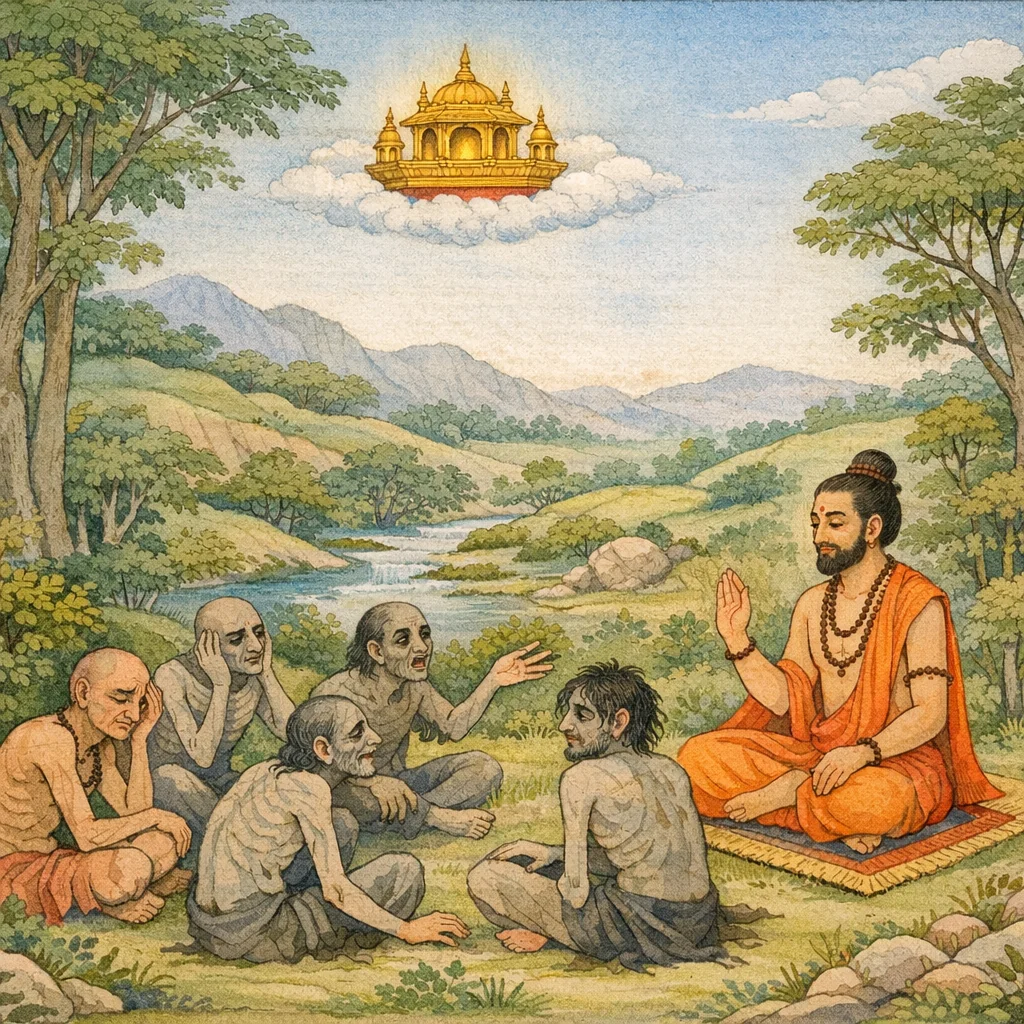
Continuing the Preta-kalpa’s teaching on the afterlife, Garuḍa asks the Lord how pretas arise, what forms they take, where they dwell, and what sustains them. The Lord answers with a twofold guide: (1) dharmic works that yield merit—public water works, temples, rest-houses, and food halls—and (2) karmic causes that lead to preta-bhāva, such as encroaching on communal lands, neglecting śrāddha-related duties, committing mahāpātakas, betrayal, abandoning blameless dependent women, and deaths marked by violence, impurity, or lack of Viṣṇu-smṛti. The discourse then turns to an ancient account through Yudhiṣṭhira and Bhīṣma: a forest ascetic meets five terrifying pretas who say their names and distorted bodies mirror their misdeeds, and that their “food” is impure remnants found where household dharma has collapsed. The ascetic teaches preventive disciplines—fasts, major vratas, sacrifices, charity, and social meritorious acts—after which celestial signs appear and the pretas ascend in vimānas, showing release through contact with learned speech and recitation of merit. The chapter ends by returning to Garuḍa’s trembling concern, preparing further questions.
Shlokas
Verse 1
स्वप्नाध्यायो नामैकविंशो ऽध्यायः गरुड उवाच / सम्भवन्ति कथं प्रेताः केन तेषां गतिर्भवेत् / कीदृक्तेषां भवेद्रूपं भोजनं किं भवेत्प्रभो
“This is the chapter called the Dream-Chapter.” Garuḍa said: “How do the pretas (departed beings) come into being? By what means do they attain their course or destination? What is their form like, and what food do they have, O Lord?”
Verse 2
सुप्रीतास्ते कथं प्रेताः क्व तिष्ठन्ति सुरेश्वर / प्रसन्नः कृपया देव प्रश्रमेनं वदस्व मे
O Lord of the gods, how do those departed beings (pretas) become well-pleased? Where do they abide? O Deva, be gracious and, with compassion, answer this question of mine.
Verse 3
श्रीभगवानुवाच / पापकर्मरता ये वै पूर्वकर्मवशानुगाः / जायन्ते ते मृताः प्रेतास्ताञ्छृणुष्व वदाम्यहम्
The Blessed Lord said: Those who delight in sinful deeds, driven by the force of former karma—when they die, they are born as pretas, restless departed spirits. Listen; I shall explain them to you.
Verse 4
वापीकूपतडागांश्च आरामं सुरमन्दिरम् / प्रपां सद्म सुवृक्षांश्च तथा भोजनशालिकाः
Wells, stepwells, and ponds; pleasure-groves and temples of the gods; water-rest houses (prapā), dwellings, good shade-giving trees, and likewise halls where food is served—these are spoken of as meritorious works.
Verse 5
पितृपैतामहं धर्मं किक्रीणाति स पापभाक् / मृतः प्रेतत्वमाप्नोति यावदाभूतसंप्लवम्
One who sells off or barters away the dharma of the ancestors and forefathers becomes a sharer in sin; and after death he attains the state of a preta, remaining so until the dissolution at the end of the cosmic cycle.
Verse 6
गोचरं ग्रामसीमां तडागारामगह्वरम् / कर्षयन्ति च ये लोभात्प्रेतास्ते वै भवन्ति हि
Those who, out of greed, encroach upon and seize cattle-grazing grounds, village boundary lands, ponds, gardens, and ravines—such people indeed become pretas after death.
Verse 7
चण्डालादुदकात्सर्पाद्ब्राह्मणाद्बैद्युताग्नितः / दंष्ट्रिभ्यश्च पशुभ्यश्च मरणं पापकर्मिणाम्
Sinners meet death through many agencies—through a caṇḍāla, through water, through a serpent, through a brāhmaṇa, through lightning or fire, and also through fanged creatures and animals.
Verse 8
उद्बन्धनमृता ये च विषशस्त्रहताश्च ये / आत्मोपघातिनो ये च विषूच्यादिहतास्तथा
Those who die by hanging, those slain by poison or by weapons, those who destroy themselves (suicide), and likewise those who perish from cholera and similar afflictions—these all are counted among sudden and untimely deaths.
Verse 9
महारोगैर्मृता ये च पापरोगैश्च दस्युभिः / असंस्कृतप्रमीता ये विहिताचारवर्जिताः
Those who die from grievous diseases, from afflictions born of sin, or at the hands of robbers; and those who die without receiving the prescribed saṃskāras, bereft of the ordained disciplines of conduct (ācāra)—such persons are described here.
Verse 10
वृषोत्सर्गादिलुप्ताश्चलुप्तमासिकपिण्डकाः / यस्यानयति शूद्रोग्निं तृणकाष्ठहवींषि सः
Those who have neglected rites such as vṛṣotsarga (the bull-offering), and whose monthly piṇḍa offerings have lapsed—such a person is one for whom a Śūdra brings the sacred fire, together with grass, firewood, and the havis of oblation.
Verse 11
पतनात्पर्वतानां च भित्तिपातेन ये मृताः / रजस्वलादिदोषैश्च न च भूमौ मताश्च ये
Those who die by falling from mountains, or by the collapse of a wall, and those who die under faults such as contact with a menstruating woman and similar impurities—these too are counted among those who did not die upon the ground, that is, those who met an irregular and inauspicious death.
Verse 12
अन्तरिक्षे मृता ये च विष्णुस्मरणवर्जिताः / सूतकैः श्वादिसंपर्कैः प्रेतभावा इह क्षितौ
Those who die in mid-air (an unnatural death) without remembrance of Viṣṇu—through states of impurity (sūtaka) and contact with dogs and the like—remain here on earth in the condition of wandering pretas.
Verse 13
एवमादिभिरन्यैश्च कुमृत्युवशगाश्च ये / ते सर्वे प्रेतयोनिस्था विचरन्ति मरुस्थले
Those who, in this manner and in other such ways, fall under the power of an inauspicious, untimely death—all of them remain in the state of a preta, a restless departed spirit, and wander through desolate regions like a desert.
Verse 14
मातरं भगिनीं भार्यां स्नुषां दुहितरं तथा / अदृष्टदोषां त्यजति स प्रेतो जायतेध्रुवम्
One who abandons his mother, sister, wife, daughter-in-law, or daughter—women in whom no fault is found—certainly becomes a preta, a restless departed spirit.
Verse 15
भ्रातृध्रुग्ब्रह्महा गोघ्नः सुरापो गुरुतल्पगः / हेमक्षौमहरस्तार्क्ष्य स वै प्रेतत्वमाप्नुयात्
O Tārkṣya (Garuda), one who betrays a brother, kills a brāhmaṇa, slays a cow, drinks intoxicants, violates the teacher’s bed, or steals gold and fine linen—such a person indeed attains the state of a preta, a restless departed spirit.
Verse 16
न्यासापहर्ता मित्रध्रुक् परदाररतस्तथा / विश्वासघाती क्रूरस्तु स प्रेतो जायते ध्रुवम्
One who steals what has been entrusted, betrays a friend, is addicted to another man’s wife, and treacherously violates trust—such a cruel person is certainly born as a preta after death.
Verse 17
कुलमार्गांश्च सन्त्यज्य परधर्मरतस्तथा / विद्यावृत्तविहीनश्च स प्रेतो जायतेध्रुवम्
Abandoning the righteous customs of one’s lineage, delighting in another’s improper dharma, and being devoid of learning and right conduct—such a person certainly becomes a preta, a restless departed spirit.
Verse 18
अत्रैवोदाहरन्तीममितिहासं पुरातनम् / युधिष्ठिरस्य संवादं भीष्मेण सह सुव्रत / तदहं कथयिष्यामि यच्छ्रुत्वा सौख्यमाप्नुयात्
Here itself I shall cite an ancient sacred account: the dialogue of Yudhiṣṭhira with Bhīṣma, O you of good vows. That I shall now relate—by hearing which one may attain peace and well-being.
Verse 19
युधिष्ठिर उवाच / केन कर्मविपाकेन प्रेतत्वमुपजायते / केन वा मुच्यते कस्मात्तन्मे ब्रूहि पितामह / यच्छ्रुत्वा न पुनर्मोहमेवं यास्या मि सुव्रत
Yudhiṣṭhira said: “By what fruition of actions does the state of being a preta arise? And by what means is one released from it—why and how? Tell me that, O Grandfather. Having heard it, O firm-in-vows one, I shall not fall again into such delusion.”
Verse 20
भीष्म उवाच / येनैव जायते प्रेतो येनैव स विमुच्यते / प्राप्नोति नरकं घोरं दुस्तरं दैवतैरपि
Bhīṣma said: By that very cause a being becomes a preta, and by that very cause he is also released. By it he attains a dreadful hell—one that is difficult to cross even for the gods.
Verse 21
सततं श्रवणाद्यस्य पुण्यश्रवणकीर्तनात् / मानवा विप्रमुच्यन्ते आपन्नाः प्रेतयोनिषु
By constant listening and related devotional practices—through the meritorious hearing and recitation (of sacred teachings)—human beings who have fallen into the state of pretas are swiftly set free.
Verse 22
श्रूयते हि पुरा वत्स ब्राह्मणः शंसितव्रतः / नाम्ना सन्तप्तकः ख्यात स्तपोर्ऽथे वनमाश्रितः
It is indeed heard of from ancient times, dear child, that there was a Brahmin of praised vows; he was known by the name Santaptaka, and for the sake of austerity he took refuge in the forest.
Verse 23
स्वाध्याययुक्तो होमेन यो (या) गयुक्तो दयान्वितः / यजन्स सकलान्यज्ञान्युक्त्या कालं च विक्षिपन्
One who is devoted to svādhyāya (sacred study), performs homa (fire oblations), is engaged in mantra-recitation and devotional song, and is filled with compassion—by rightly performing all yajñas and by wisely using time without squandering it, fulfills dharma.
Verse 24
ब्रहामचर्यसमायुक्तो युक्तस्तपसि मार्दवे / परलोकभयोपेतः सत्यशौचैश्च निर्मलः
Endowed with brahmacarya, disciplined in tapas and gentleness, possessed of a wholesome fear of the world beyond, and purified by truthfulness and purity—such a one remains stainless.
Verse 25
युक्तो ऽहि गुरुवाक्येन युक्तश्चातिथिपूजने / आत्मयोगे सदोद्युक्तः सर्वद्वन्द्वविवर्जितः
Indeed, he is aligned with the Guru’s word and devoted to honoring the guest; ever intent upon ātma-yoga, he is free from all pairs of opposites.
Verse 26
योगाभ्यासे सदा युक्तः संसारविजिगीषया / एवंवृत्तः सदाचारो मोक्षकाङ्क्षी जितेन्द्रियः
Always engaged in the practice of yoga, intent on conquering saṃsāra; living in such a way—virtuous in sadācāra, longing for mokṣa, and having mastered the senses—one becomes fit for the highest good.
Verse 27
बहून्यब्दानि विजने वने तस्य गतानि वै / तस्य बुद्धिस्ततो जाता तीर्थानुगमनं प्रति
Many years indeed passed for him in a lonely, secluded forest; then his understanding awakened, turning toward the undertaking of pilgrimage to the sacred tīrthas.
Verse 28
पुण्यैस्तीर्थजलैरेव शोषयिष्ये कलेवरम् / स तीर्थेत्वरितं स्नात्वा तपस्वी भास्करोदये / कृतजाप्यनमस्कारो ह्यध्वानं प्रत्यपद्यत
“With the meritorious waters of the sacred tīrthas alone shall I dry up (wear away) this bodily frame.” Having quickly bathed at the tīrtha at sunrise, the ascetic—after completing his japa and reverent namaskāras—set forth upon his journey.
Verse 29
एकस्मिन्दिवसे विप्रो मार्गभ्रष्टो महातपाः / ददर्शाध्वनि गच्छन्स पञ्च प्रेतान् सुदारुणान्
One day, a brāhmaṇa—great in austerity—having lost his way, saw on the road as he walked five exceedingly dreadful pretas (restless spirits).
Verse 30
अरण्ये निर्जने देशे संकटे वृक्षवर्जिते / पञ्चैतान्विकृताकारान्दृष्ट्वा वै घोरदर्शनान् / ईषत्सन्त्रस्तहृदयो ऽतिष्ठदुन्मील्य लोचने
In a forest—lonely, perilous, and devoid of trees—having seen those five with distorted forms and terrifying appearance, his heart was slightly shaken with fear; he stood still, opening his eyes wide.
Verse 31
अवलम्ब्य ततो धैर्यं भयमुत्सृज्य दूरतः / पप्रच्छ मधुराभाषी के यूयं विकृताननाः
Then, steadying himself with courage and casting fear far away, the sweet-spoken one asked: “Who are you, with such distorted, fearsome faces?”
Verse 32
किञ्चाशुभं कृतं कर्म येन प्राप्ताः स्थ वैकृतम् / कथं वा चैकतः कर्म प्रस्थिताः कुत्र निश्चितम्
“What inauspicious deed did you commit, by which you have come to this afflicted, distorted state? And how is it that you have set out driven by karma alone—where, indeed, is your destination determined?”
Verse 33
प्रेतराज उवाच / स्वैः स्वैस्तु कर्मभिः प्राप्तं प्रेतत्वं हि द्विजोत्तम / परद्रोहरताः सर्वे पापमृत्युवशं गताः
The King of the Pretas said: “O best of the twice-born, the state of being a preta is truly attained by each through one’s own deeds. All who are intent on harming others fall under the dominion of sinful death.”
Verse 34
क्षुत्पिपासार्दिता नित्यं प्रेतत्वं समुपागताः / हतवाक्या हतश्रीका हत संज्ञा विचेतसः
Afflicted constantly by hunger and thirst, they have entered the state of a preta. Their speech is broken, their dignity and radiance are lost; their awareness is shattered and their minds are bewildered.
Verse 35
न जानीमो दिशं तात विदिशं चातिदुः खिताः / क्व नु गच्छामहे मूढाः पिशाचाः कर्मजा वयम्
“O dear one, we do not know any direction—nor even the byways—being overwhelmed with sorrow. Where indeed shall we go? We are deluded; we are piśācas, born of our own karma.”
Verse 36
न माता न पितास्माकं प्रेतत्वं कर्मभिः स्वकैः / प्राप्ताः स्म सहसा जातदुः खोद्वेगसमाकुलम्
Neither mother nor father is truly ours here; by our own deeds we have attained the state of a preta. We have suddenly fallen into a condition overwhelmed by newly-arisen sorrow and agitation.
Verse 37
दर्शनेन च ते ब्रह्मन्मुदिताप्यायिता वयम् / मुहूर्तन्तिष्ठ वक्ष्यामि वृत्तान्तं सर्वमादितः
O Brahman, by seeing you we have become joyful and refreshed. Stay here for a moment; I shall tell you the entire account from the beginning.
Verse 38
अहं पर्युषितो नाम एष सूचीमुखस्तथा / शीघ्रगो रोघ (ह) कश्चैव पञ्चमो लेखकः स्मतृतः
“I am called Paryuṣita; this one is likewise named Sūcīmukha. Another is Śīghraga, and also Rogha(ha). These are remembered as the fifth class of Yama’s scribes, the keepers of the record.”
Verse 39
एवं नाम्ना च सर्वे वै संप्राप्ताः प्रेततां वयम् / ब्राह्मण उवाच / प्रेतानां कर्मजातानां कथं वै नामसम्भवः / किञ्चित्कारणमुदिश्य येन ब्रूयाः स्वनामकान्
“Thus, indeed, by those very names, all of us have attained the state of being pretas.” The Brāhmaṇa said: “For pretas—whose conditions arise from their own deeds—how do these names come to be? Indicate the specific cause by which you speak of each one by his own particular name.”
Verse 40
प्रेतराज उवाच / मया स्वादु सदा भुक्तं दत्तं पर्युषितं द्विज
The Lord of the departed said: “O twice-born, whatever is given after I have already eaten what is sweet and long enjoyed—whatever is offered as food kept overnight, as stale—such a gift is spoken of in this way.”
Verse 41
शीघ्रं गच्छति विप्रेण याचितः क्षुधितेन वै / एतत्कारणमुद्दिश्य नाम पर्युषितं मम
When a hungry one requests it through a brāhmaṇa, the offering reaches swiftly indeed. For this very reason, my name is “Paryuṣita,” the one connected with a delay of a single night.
Verse 42
शीघ्रं गच्छति विप्रेण याचितः क्षुधितेन वै / एतत्कारणमुद्दिश्य शीघ्रगो ऽयं द्विजोत्तम
When a hungry brāhmaṇa requests it, the gift goes swiftly to him. For this very reason, O best of the twice-born, it is called “Śīghraga,” the swift-goer.
Verse 43
सूचिता बहवो ऽनेन विप्रा अन्नाधिकाङ्क्षया / एतत्कारणमुद्दिश्य एष सूचिमुखः स्मृतः
By this fault, many Brahmins have been denounced, driven by excessive craving for food. Pointing to this very cause, this hell is remembered as “Sūcīmukha” (Needle-faced).
Verse 44
एकाकी मिष्टमश्राति पोष्यवर्गमृते सदा / ब्राह्मणानामभावेन रोध (ह) कस्तेन चोच्यते
A man eats sweets alone, ever excluding those who ought to be maintained and supported; and when Brahmanas are absent, by whom can the proper restraint of such conduct truly be spoken?
Verse 45
पुरायं मौनमास्थाय याचितो विलिखेद्भुवम् / तेन कर्मविपाकेन लेखको नाम चोच्यते
Formerly, observing silence (mauna), when requested he would write records upon the earth; by the fruition of that karma, he is therefore called “Lekhaka,” the scribe.
Verse 46
प्रेतत्वं कर्मभावेन प्राप्तं नामानि च द्विज / मेषाननो लेखको ऽयं रोध (ह) कः पर्वताननः
O twice-born one, the state of being a preta is attained according to one’s karmic disposition, and accordingly various names are assigned. (Some are called) “Ram-faced”; this one is “Lekhaka,” the scribe; (others are known as) “Rodha/Ha” and “Mountain-faced.”
Verse 47
शीघ्रगः पुशुवक्त्रश्च सूचकः सूचिवक्त्रवान् / दुःखिता नितरां स्वमिन्पश्य रूपविपर्ययम्
One becomes swift-footed yet animal-faced; the informer becomes needle-faced. O master, behold this reversal of form—how intensely they suffer.
Verse 48
कृत्वा मायामयं रूपं विचरामो महीतले / सर्वे च विकृताकारा लम्बोष्ठा विकृताननाः
Assuming illusory forms, we wander upon the earth; all of us appear distorted—our lips hanging and our faces disfigured.
Verse 49
बृहच्छरीरिणो रौद्रा जाताः स्वेनैव कर्मणा / एतत्ते सर्वमाख्यातं प्रेतत्वे कारणं मया
Those who possess a grossly enlarged body and a fierce nature become so solely through their own actions. Thus, I have explained to you in full the cause of becoming a preta.
Verse 50
ज्ञानिनो ऽपि वयं सर्वे जाताः स्म तव दर्शनात् / यत्र ते श्रवणे श्रद्धा तत्पृच्छ कथयामि ते
By merely beholding you, all of us have become wise indeed. Therefore, whatever you have faith to hear—ask about that; I will explain it to you.
Verse 51
ब्राह्मण उवाच / ये जीवा भुवि जीवन्ति सर्वे ऽप्याहारमूलकाः / युष्माकमपिचाहारं श्रोतुमिच्छामि तत्त्वतः
The Brāhmaṇa said: All beings who live upon the earth are sustained by food as their very basis. Therefore, I too wish to hear—truthfully and in principle—about your (proper) food.
Verse 52
प्रेता ऊचुः / यदि ते श्रवणे श्रद्धा आहाराणां द्विजोत्तम / अस्माकं तु महीभाग शृणुत्वं सुसमाहितः
The Pretas said: “O best of the twice-born, if you have faith in hearing about the food-offerings, then, O noble one, listen to our account with a fully collected mind.”
Verse 53
ब्राह्मण उवाच / कथयन्तु महाप्रेता आहारं च पृथक्पृथक् / इत्युक्तां ब्राह्मणेनेममूचुः प्रेताः पृथकपृथक्
The Brāhmaṇa said: “Let the great pretas describe, each one separately, the food (they receive).” Thus addressed by the Brāhmaṇa, the pretas then spoke—each in turn, separately.
Verse 54
प्रेता ऊचुः / शृणु चाहारमस्माकं सर्वसत्त्बविगर्हितम् / यच्छ्रुत्वा गर्हसे ब्रह्मन् भूयोभूयश्च गर्हितम्
The pretas said: “Listen to our food—food condemned by all beings. Hearing of it, O Brahmin, you reproach us again and again, and it is indeed ever-reproachable.”
Verse 55
श्लेष्ममूत्रपुरीषोत्थं शरीराणां मलैः सह / उच्छिष्टैश्चैव चान्यैश्च प्रेतानां भोजनं भवेत्
For pretas, their food becomes that which arises from phlegm, urine, and feces—together with the body’s filth—along with leftovers and other such impure remnants.
Verse 56
गृहाणि चाप्यशौचानि प्रकीर्णोपस्कराणि च / मलिनानि प्रसूतानि प्रेता भुञ्जन्ति तत्र वै
In houses that remain impure, with household articles strewn about—filthy and defiled by childbirth—there indeed the pretas (restless departed spirits) partake (feed).
Verse 57
नास्ति सत्यं गृहे यत्र न शौचं न च संयमः / पतितैर्दस्युभिः सङ्गः प्रेता भुञ्जन्ति तत्र वै
In a house where there is no truthfulness, no purity, and no self-restraint—and where there is association with the fallen and with thieves—there indeed the pretas (unquiet spirits) partake (of the offerings/food).
Verse 58
बलिमन्त्रविहीनानि होमहीनानि यानि च / स्वाध्याय व्रतहीनानि प्रेता भुञ्जन्ति तत्र वै
Offerings made without the proper mantras, rites performed without the homa of the sacred fire, and acts devoid of svādhyāya and vrata—there indeed the pretas, the restless departed, consume and take their share.
Verse 59
न लज्जा न च मर्यादा यदात्र स्त्रीजितो गृही / गुरवो यत्र पूज्या न प्रेता भुञ्जन्ति तत्र वै
Where there is neither modesty nor proper decorum—where the householder is ruled by a woman and elders and teachers are not honored—there indeed the pretas do not partake of the offerings.
Verse 60
यत्र लोभस्तथा क्रोधो निद्रा शोको भयं मदः / आलस्यं कलहो नित्यं प्रेता भुञ्जन्ति तत्र वै
Where greed and anger prevail—along with drowsiness, grief, fear, and intoxication—where laziness and constant quarrelling are present, there indeed the pretas take it as their ‘food’ and grow in strength.
Verse 61
भर्तृहीना च या नारी परवीर्यं निषेवते / बीजं मूत्रसमायुर्क्त प्रेता भुञ्जन्ति तत्तु वै
A woman who, being without a husband, resorts to the seed of another man—her offspring’s seed, mingled with urine, is indeed what the pretas consume as their portion.
Verse 62
लज्जा मे जायते तात वदतो भोजनं स्वकम् / यत्स्त्रीरजो योनिगतं प्रेता भुञ्जन्ति तत्तु वै
O dear one, I feel ashamed even to speak of their food: the pretas indeed consume the menstrual discharge of women found in the yoni, the genital passage.
Verse 63
निर्विण्णाः प्रेतभावेन पृच्छामि त्वां दृढव्रत / यथा न भविता प्रेतस्तन्मे वद तपोधन / नित्यं मृत्युर्वरं जन्तोः प्रेतत्वं मा भवेत्क्वचित्
Afflicted by the condition of being a preta, I ask you, O ascetic firm in vow: tell me how one may not become a preta. For a living being, death is ever preferable; may the preta-state never arise at any time.
Verse 64
ब्राह्मण उवाच / उपवासपरो नित्यं कृच्छ्रचान्द्रायणे रतः / व्रतैश्च विविधैः पूतो न प्रेतो जायते नरः
The Brāhmaṇa said: A man ever devoted to fasting, engaged in the austerities of Kṛcchra and Cāndrāyaṇa, and purified by various sacred vows—does not become a preta.
Verse 65
एकादश्यां व्रतं कुर्वञ्जागरेण समन्वितम् / अपरैः सुकृतैः पूतो न प्रेतो न प्रेतो जायते नरः
A man who observes the Ekādaśī fast together with keeping vigil, and who is purified by other meritorious deeds as well, does not become a preta—indeed, he is not born into the preta-state.
Verse 66
इष्ट्वा वै वाश्वमेधादीन्दद्याद्दानानि यो नरः / आरामोद्यानवाप्यादेः प्रपायाश्चैव कारकः
That man who has performed great sacrifices such as the Aśvamedha, who gives charitable gifts, and who also establishes public works—gardens, pleasure-groves, tanks or ponds and the like, as well as drinking-water stations—is praised for such meritorious deeds.
Verse 67
कुमारीं ब्राह्मणानां तु विवाहयति शक्तितः / विद्यादो ऽभयदश्चैव न प्रेतो जायते नरः
A man who, according to his capacity, arranges the marriage of a Brahmin maiden—and who also bestows learning and grants fearlessness (abhaya)—does not become a preta.
Verse 68
शूद्रान्नेन तु भुक्तेन जठरस्थेन यो मृतः / दुर्मृत्युना मृतो यश्च स प्रेतो जायते नरः
A man who dies while food obtained from a Śūdra (improper or forbidden food) still lies undigested in his belly, or who dies by an inauspicious and violent death, is born as a preta, a restless departed spirit.
Verse 69
अयाज्ययाजकश्चैव याज्यानां च विवर्जकः / कारुभिश्च रतो नित्यं स प्रेतो जायते नरः
A man who performs sacrificial rites for those unfit to be served, who refuses to officiate for those who are fit, and who is ever devoted to degrading and improper occupations—such a one is born as a preta after death.
Verse 70
कृत्वा मद्यपसम्पर्कं मद्यपस्त्रीनिषेवणम् / अज्ञानाद्भक्षयन्मांसं स प्रेतो जायते नरः
A man who keeps the company of drunkards, consorts with the women of drunkards, and—out of ignorance—eats meat, is born as a preta, a restless departed spirit.
Verse 71
देवद्रव्यं च ब्रह्मस्वं गुरुद्रव्यं तथैव च / कन्यां ददाति शुल्केन स प्रेतो जायते नरः
A man who misappropriates wealth belonging to the Devas, property meant for Brahmins, or the possessions of one’s guru—and who gives a maiden in marriage for a price—becomes a preta, a restless departed spirit.
Verse 72
मातरं भगिनीं भार्यां स्नुषां दुहितरं तथाः / अदृष्टदोषास्त्यजति स प्रेतो जादृ
Having become a preta, the departed one abandons even his mother, sister, wife, daughter-in-law, and daughter—though no fault is seen in them; such is the condition of that death-bound state.
Verse 73
न्यासापहर्ता मित्रध्रुक्परदाररतः सदा / विश्वासघाती कूटश्च स प्रेदृ
One who misappropriates entrusted property, betrays friends, is ever addicted to another’s spouse, breaks trust, and is deceitful—such a person becomes a sinner fit for the torments of the preta-state after death.
Verse 74
भ्रातृध्रुग्ब्रह्महा गोघ्नः सुरापो गुरुतल्पगः / कुलमार्गं परित्यज्य ह्यनृतोक्तौ सदा रतः / हर्ता हेम्नश्च भूमेश्च स प्रेदृ
One who betrays his brother, slays a brāhmaṇa, kills a cow, drinks intoxicants, violates the teacher’s bed, abandons the righteous conduct of the family line, delights always in false speech, and steals gold or land—such a person becomes a preta, a restless departed spirit.
Verse 75
भीष्म उवाच / एवं ब्रुवति वै विप्रे आकाशे दुन्दुभिस्वनः / अपतत्पुष्पवर्षं च देवर्मुक्तं द्विजोपरि
Bhīṣma said: As the brāhmaṇa spoke thus, the sound of celestial drums arose in the sky, and a shower of flowers, released by the gods, fell upon that twice-born one.
Verse 76
पञ्च देवविमानानि प्रेतानामागतानि वै / स्वर्गं गता विमानैस्ते दिव्यैः संपृच्छ्य तं मुनिम्
Indeed, five divine aerial chariots arrived for those departed spirits. Ascending to heaven in those radiant vimānas, they then questioned that sage.
Verse 77
ज्ञानं विप्रस्य सम्भाषात्पुण्यसंकीर्तनेन च / प्रेताः पापविनिर्मुक्ताः परं पदमवाप्नुयुः
Through conversing with a learned brāhmaṇa and through the recitation of sacred merits, the pretas are freed from sins and attain the supreme state.
Verse 78
सूत उवाच / इदमाख्यानकं श्रुत्वा कम्पितो ऽश्वत्थपत्रवत् / मानुषाणां हितार्थाय गरुडः पृष्टवान्पुनः
Sūta said: Hearing this account, Garuḍa trembled like a leaf of the sacred aśvattha tree; and for the welfare of humankind, he questioned again.
Frequently Asked Questions
The chapter groups deaths by violence, accident, suicide, sudden afflictions, impurity contacts, and dying without Viṣṇu-smṛti as inauspicious conditions that can bind the departed to wandering preta existence. The doctrinal point is not mere accidentology; it is that karmic predispositions, ritual neglect, and dharmic collapse manifest as destabilized death conditions, producing a restless intermediate state rather than a settled post-mortem trajectory.
The narrative uses onomastics as ethical pedagogy: each name encodes a specific fault in giving, restraint, or conduct (especially food-related greed and improper offering). The chapter presents these names as ‘karmic diagnostics’—a way to read distorted post-death identity as the externalization of inner dispositions, reinforcing the Purāṇic principle that form and fate follow karma.
The text highlights sustained fasting and austerities (Kṛcchra, Cāndrāyaṇa), Ekādaśī fasting with night vigil, major sacrifices (e.g., Aśvamedha as an idealized marker), dāna (charity), and establishing public welfare works (ponds, gardens, water stations). It also implies that maintaining śauca, truthfulness, proper mantra-rite performance, and honoring elders/teachers keeps the household environment from becoming a ‘feeding ground’ for preta influences.