Adhyaya 24
Lord Śiva Instructs the Pracetās (Śiva-stuti and the Path of Bhakti)
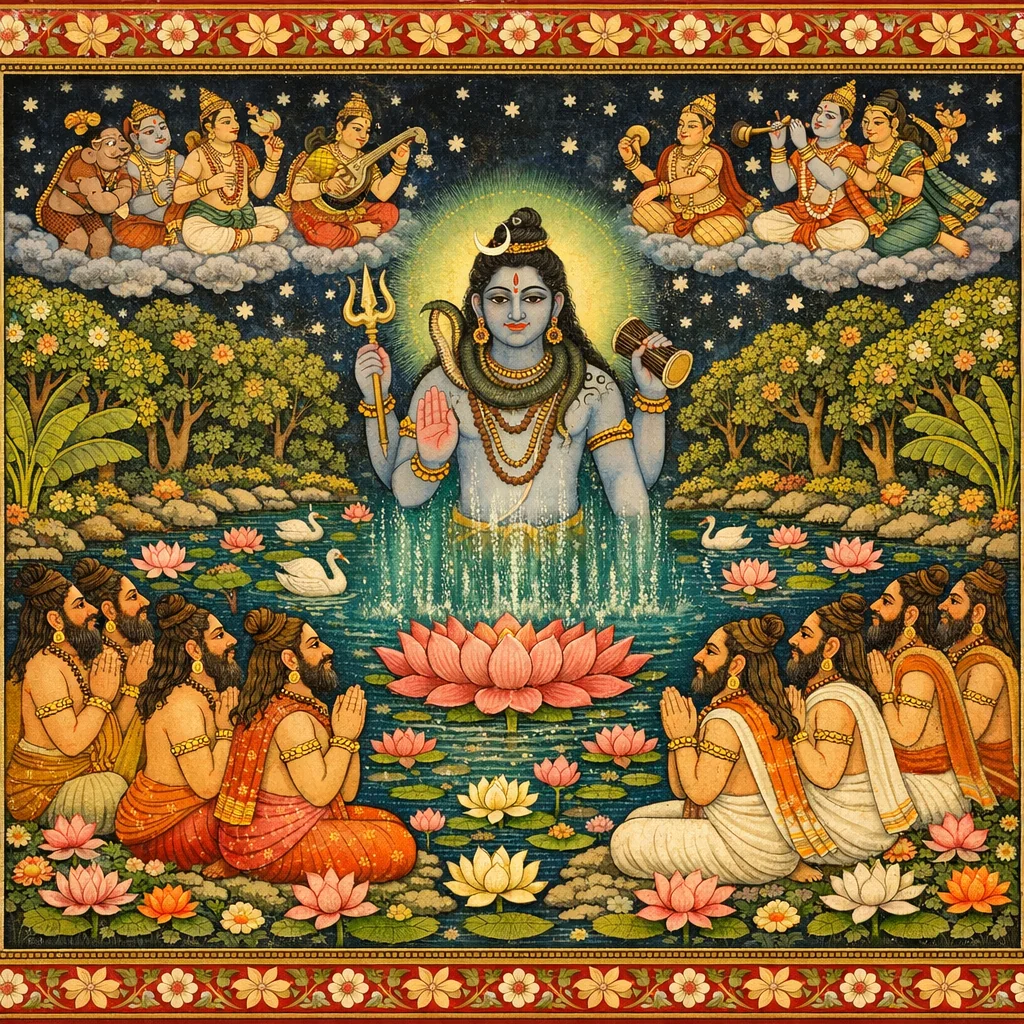
This chapter continues the post-Pṛthu dynasty. Vijitāśva (Antardhāna) becomes emperor, assigns the quarters to his brothers, and—though powerful—shows restraint toward Indra, then retires into sacrifice and attains the Lord’s abode through intelligent devotional service. His son Havirdhāna fathers Barhiṣat, later famed as Prācīnabarhi for spreading kuśa grass in yajñas. By Brahmā’s order, Prācīnabarhi marries Śatadruti and begets ten sons, the Pracetās, commissioned to generate progeny. Traveling west, they reach a vast lotus lake filled with celestial music, from which Lord Śiva appears with his associates. Pleased with their piety, Śiva declares his devotion to Kṛṣṇa/Viṣṇu, teaches that surrendered bhakti surpasses seeking advancement through demigods, and recites a potent stotra describing the Lord’s cosmic functions, His expansions (Saṅkarṣaṇa, Pradyumna, Aniruddha), and His exquisite personal form beloved by devotees. He instructs the Pracetās to chant and meditate on this prayer as their yogic method, promising swift perfection and freedom from karma, setting the stage for their long austerities and the next phase of creation through devotion.
Shlokas
Verse 1
मैत्रेय उवाच विजिताश्वोऽधिराजासीत्पृथुपुत्र: पृथुश्रवा: । यवीयोभ्योऽददात्काष्ठा भ्रातृभ्यो भ्रातृवत्सल: ॥ १ ॥
Maitreya said: Vijitāśva, Pṛthu’s son named Pṛthuśravā, became emperor. Affectionate to his brothers, he allotted them various quarters to govern.
Verse 2
हर्यक्षायादिशत्प्राचीं धूम्रकेशाय दक्षिणाम् । प्रतीचीं वृकसंज्ञाय तुर्यां द्रविणसे विभु: ॥ २ ॥
That powerful emperor assigned the east to Haryakṣa, the south to Dhūmrakeśa, the west to Vṛka, and the north to Draviṇa to govern.
Verse 3
अन्तर्धानगतिं शक्राल्लब्ध्वान्तर्धानसंज्ञित: । अपत्यत्रयमाधत्त शिखण्डिन्यां सुसम्मतम् ॥ ३ ॥
Formerly, Mahārāja Vijitāśva pleased Indra, the king of heaven, and from him received the title “Antardhāna.” His wife was named Śikhaṇḍinī, and by her he begot three virtuous sons.
Verse 4
पावक: पवमानश्च शुचिरित्यग्नय: पुरा । वसिष्ठशापादुत्पन्ना: पुनर्योगगतिं गता: ॥ ४ ॥
Mahārāja Antardhāna’s three sons were named Pāvaka, Pavamāna, and Śuci. Formerly they were fire demigods, but by the curse of the great sage Vasiṣṭha they took birth as the king’s sons; then, attaining the goal of mystic yoga, they again became established as the fire-gods.
Verse 5
अन्तर्धानो नभस्वत्यां हविर्धानमविन्दत । य इन्द्रमश्वहर्तारं विद्वानपि न जघ्निवान् ॥ ५ ॥
Mahārāja Antardhāna had another wife, named Nabhasvatī, and by her he begot a son named Havirdhāna. Though he knew that Indra was stealing his father’s sacrificial horse, out of magnanimity he did not kill him.
Verse 6
राज्ञां वृत्तिं करादानदण्डशुल्कादिदारुणाम् । मन्यमानो दीर्घसत्त्रव्याजेन विससर्ज ह ॥ ६ ॥
Considering the royal duties of collecting taxes, punishing citizens, and imposing heavy fines and tolls to be harsh, he was unwilling to carry them out. Therefore, under the pretext of performing a long satra sacrifice, he withdrew from such tasks and engaged in various sacrificial rites.
Verse 7
तत्रापि हंसं पुरुषं परमात्मानमात्मदृक् । यजंस्तल्लोकतामाप कुशलेन समाधिना ॥ ७ ॥
Though engaged in sacrifices, he was self-realized. With skillful samādhi he rendered bhakti to the Paramātmā, the Supreme Purusha, like a haṁsa, who removes the fears of His devotees; thus, absorbed in ecstasy, he easily attained the Lord’s own world.
Verse 8
हविर्धानाद्धविर्धानी विदुरासूत षट्सुतान् । बर्हिषदं गयं शुक्लं कृष्णं सत्यं जितव्रतम् ॥ ८ ॥
Havirdhāna, the son of Mahārāja Antardhāna, had a wife named Havirdhānī; O Vidura, she bore six sons—Barhiṣat, Gaya, Śukla, Kṛṣṇa, Satya, and Jitavrata.
Verse 9
बर्हिषत् सुमहाभागो हाविर्धानि: प्रजापति: । क्रियाकाण्डेषु निष्णातो योगेषु च कुरूद्वह ॥ ९ ॥
The sage Maitreya continued: O Vidura, Havirdhāna’s most illustrious son Barhiṣat was expert in the rites of sacrifice and also skilled in mystic yoga; by his exalted qualities he became renowned as Prajāpati.
Verse 10
यस्येदं देवयजनमनुयज्ञं वितन्वत: । प्राचीनाग्रै: कुशैरासीदास्तृतं वसुधातलम् ॥ १० ॥
He performed many sacrifices of worship, and as he spread the rites far and wide, he scattered kuśa grass with its tips pointing east, carpeting the earth with sacred blades.
Verse 11
सामुद्रीं देवदेवोक्तामुपयेमे शतद्रुतिम् । यां वीक्ष्य चारुसर्वाङ्गीं किशोरीं सुष्ठ्वलङ्कृताम् । परिक्रमन्तीमुद्वाहे चकमेऽग्नि: शुकीमिव ॥ ११ ॥
By the order of Brahmā, the lord of the devas, (Barhiṣat) married Śatadruti, the ocean’s daughter. Seeing her—beautiful in every limb, youthful, and adorned with fitting garments—when she circumambulated the wedding arena, Agni, the fire-god, became enamored and longed for her company, just as he had once desired Śukī.
Verse 12
विबुधासुरगन्धर्वमुनिसिद्धनरोरगा: । विजिता: सूर्यया दिक्षु क्वणयन्त्यैव नूपुरै: ॥ १२ ॥
As Śatadruti was being wed, the devas, asuras, gandharvas, sages, siddhas, humans, and nāgas—though all exalted—were captivated in every direction by the sweet tinkling of her anklebells.
Verse 13
प्राचीनबर्हिष: पुत्रा: शतद्रुत्यां दशाभवन् । तुल्यनामव्रता: सर्वे धर्मस्नाता: प्रचेतस: ॥ १३ ॥
King Prācīnabarhi begot ten sons in the womb of Śatadruti. All were equal in name and vow, steadfast in dharma, and renowned as the Pracetās.
Verse 14
पित्रादिष्टा: प्रजासर्गे तपसेऽर्णवमाविशन् । दशवर्षसहस्राणि तपसार्चंस्तपस्पतिम् ॥ १४ ॥
Ordered by their father to create progeny, the Pracetās entered the ocean. For ten thousand years they performed austerities, worshiping the Lord of all tapas—Bhagavān, the Supreme Personality of Godhead.
Verse 15
यदुक्तं पथि दृष्टेन गिरिशेन प्रसीदता । तद्ध्यायन्तो जपन्तश्च पूजयन्तश्च संयता: ॥ १५ ॥
The teaching spoken on the way by the merciful Girīśa (Lord Śiva) they carefully embraced—meditating upon it, chanting it in japa, and worshiping with disciplined attention.
Verse 16
विदुर उवाच प्रचेतसां गिरित्रेण यथासीत्पथि सङ्गम: । यदुताह हर: प्रीतस्तन्नो ब्रह्मन् वदार्थवत् ॥ १६ ॥
Vidura said: O brāhmaṇa, how did the Pracetās meet Giritra (Lord Śiva) on the way? How did Hara become so pleased, and what instruction did he give them? Kindly describe these meaningful talks to us.
Verse 17
सङ्गम: खलु विप्रर्षे शिवेनेह शरीरिणाम् । दुर्लभो मुनयो दध्युरसङ्गाद्यमभीप्सितम् ॥ १७ ॥
O best of brāhmaṇas, for embodied beings trapped within this material frame, personal contact with Lord Śiva is indeed rare. Even great sages free from attachment, though absorbed in meditation longing for such a meeting, do not attain it easily.
Verse 18
आत्मारामोऽपि यस्त्वस्य लोककल्पस्य राधसे । शक्त्या युक्तो विचरति घोरया भगवान् भव: ॥ १८ ॥
Bhagavān Bhava (Lord Śiva) is self-satisfied; yet for the welfare of the world he moves everywhere, ever engaged, accompanied by formidable śaktis such as Kālī and Durgā.
Verse 19
मैत्रेय उवाच प्रचेतस: पितुर्वाक्यं शिरसादाय साधव: । दिशं प्रतीचीं प्रययुस्तपस्यादृतचेतस: ॥ १९ ॥
Maitreya said: The virtuous Pracetās accepted their father’s words as sacred command, and with steady hearts they went westward to perform tapasya.
Verse 20
ससमुद्रमुप विस्तीर्णमपश्यन् सुमहत्सर: । महन्मन इव स्वच्छं प्रसन्नसलिलाशयम् ॥ २० ॥
While traveling, the Pracetās saw a vast lake, almost like the ocean. Its water was clear and tranquil, like the mind of a great soul.
Verse 21
नीलरक्तोत्पलाम्भोजकह्लारेन्दीवराकरम् । हंससारसचक्राह्वकारण्डवनिकूजितम् ॥ २१ ॥
That great lake was filled with many lotuses—blue and red, utpala, kumuda, and indīvara—and along its shores swans, cranes, cakravākas, kāraṇḍavas, and other water birds sang sweetly.
Verse 22
मत्तभ्रमरसौस्वर्यहृष्टरोमलताङ्घ्रिपम् । पद्मकोशरजो दिक्षु विक्षिपत्पवनोत्सवम् ॥ २२ ॥
All around the lake were trees and creepers, enlivened by the sweet humming of intoxicated bees. Lotus pollen was carried by the wind in every direction, making the place seem like a festival.
Verse 23
तत्र गान्धर्वमाकर्ण्य दिव्यमार्गमनोहरम् । विसिस्म्यू राजपुत्रास्ते मृदङ्गपणवाद्यनु ॥ २३ ॥
There they heard celestial Gandharva music, enchanting to the ear; and as the orderly, sweet sounds of mṛdaṅgas, paṇavas, and other drums resounded, the king’s sons were struck with great wonder.
Verse 24
तर्ह्येव सरसस्तस्मान्निष्क्रामन्तं सहानुगम् । उपगीयमानममरप्रवरं विबुधानुगै: ॥ २४ ॥ तप्तहेमनिकायाभं शितिकण्ठं त्रिलोचनम् । प्रसादसुमुखं वीक्ष्य प्रणेमुर्जातकौतुका: ॥ २५ ॥
Just then, from that lake emerged Lord Śiva—the foremost among the demigods—accompanied by his associates, while the celestial beings sang his praises. His body shone like molten gold; his throat was bluish, he bore three eyes, and his face was serene and merciful. Seeing him, the Pracetās, filled with wonder, at once fell down and offered obeisances.
Verse 25
तर्ह्येव सरसस्तस्मान्निष्क्रामन्तं सहानुगम् । उपगीयमानममरप्रवरं विबुधानुगै: ॥ २४ ॥ तप्तहेमनिकायाभं शितिकण्ठं त्रिलोचनम् । प्रसादसुमुखं वीक्ष्य प्रणेमुर्जातकौतुका: ॥ २५ ॥
Beholding Lord Śiva—radiant like molten gold, blue-throated, three-eyed, and with a gracious, merciful face—the Pracetās were filled with wonder and bowed down in full obeisance at the Lord’s lotus feet.
Verse 26
स तान् प्रपन्नार्तिहरो भगवान्धर्मवत्सल: । धर्मज्ञान् शीलसम्पन्नान् प्रीत: प्रीतानुवाच ह ॥ २६ ॥
Lord Śiva, the remover of the distress of those who take shelter and the well-wisher of dharma, was greatly pleased with those princes—knowers of righteousness and endowed with gentle conduct—and, in his joy, spoke to them as follows.
Verse 27
श्रीरुद्र उवाच यूयं वेदिषद: पुत्रा विदितं वश्चिकीर्षितम् । अनुग्रहाय भद्रं व एवं मे दर्शनं कृतम् ॥ २७ ॥
Śrī Rudra said: You are all the sons of Vediṣad (King Prācīnabarhi), and I know well what you intend to do. For your welfare, and to bestow my grace upon you, I have made myself visible to you.
Verse 28
य: परं रंहस: साक्षात्त्रिरगुणाज्जीवसंज्ञितात् । भगवन्तं वासुदेवं प्रपन्न: स प्रियो हि मे ॥ २८ ॥
Whoever surrenders to Bhagavān Vāsudeva, Śrī Kṛṣṇa—the supreme controller of material nature and of the living being—is truly very dear to me.
Verse 29
स्वधर्मनिष्ठ: शतजन्मभि: पुमान् विरिञ्चतामेति तत: परं हि माम् । अव्याकृतं भागवतोऽथ वैष्णवं पदं यथाहं विबुधा: कलात्यये ॥ २९ ॥
One who remains fixed in his own duty for a hundred births becomes qualified for the post of Brahmā, and if he becomes still more qualified he may approach me. But the bhāgavata who directly surrenders to Śrī Kṛṣṇa—Viṣṇu—in pure, unalloyed devotion is at once elevated to the unmanifest Vaiṣṇava abode, the spiritual planets; I and the other devas attain that realm after this material world is destroyed.
Verse 30
अथ भागवता यूयं प्रिया: स्थ भगवान् यथा । न मद्भागवतानां च प्रेयानन्योऽस्ति कर्हिचित् ॥ ३० ॥
You are all bhāgavatas, devotees of the Lord; therefore I honor and cherish you as I do the Supreme Lord Himself. And to my devotees, no one is ever dearer than I am.
Verse 31
इदं विविक्तं जप्तव्यं पवित्रं मङ्गलं परम् । नि:श्रेयसकरं चापि श्रूयतां तद्वदामि व: ॥ ३१ ॥
Now I shall chant a mantra that is transcendental, pure, and supremely auspicious, and that bestows the highest good. Please listen carefully to what I am about to speak.
Verse 32
मैत्रेय उवाच इत्यनुक्रोशहृदयो भगवानाह ताञ्छिव: । बद्धाञ्जलीन् राजपुत्रान्नारायणपरो वच: ॥ ३२ ॥
Maitreya said: Out of his causeless mercy, Bhagavān Śiva—an exalted devotee of Lord Nārāyaṇa—continued speaking to the king’s sons, who stood before him with folded hands.
Verse 33
श्रीरुद्र उवाच जितं त आत्मविद्वर्यस्वस्तये स्वस्तिरस्तु मे । भवताराधसा राद्धं सर्वस्मा आत्मने नम: ॥ ३३ ॥
Śrī Rudra said: O Supreme Personality of Godhead, all glory unto You. You are the foremost among the self-realized, ever auspicious to the realized; therefore be auspicious to me as well. By Your all-perfect instructions worship is fulfilled. You are the Paramātmā, so I offer my obeisances unto You, the supreme living being.
Verse 34
नम: पङ्कजनाभाय भूतसूक्ष्मेन्द्रियात्मने । वासुदेवाय शान्ताय कूटस्थाय स्वरोचिषे ॥ ३४ ॥
Obeisances to the Lord with the lotus navel, the indwelling master of the subtle elements and of the senses. Obeisances to all-pervading Vāsudeva—supremely peaceful, unchanging (kūṭastha), and self-effulgent.
Verse 35
सङ्कर्षणाय सूक्ष्माय दुरन्तायान्तकाय च । नमो विश्वप्रबोधाय प्रद्युम्नायान्तरात्मने ॥ ३५ ॥
Obeisances to Saṅkarṣaṇa, the subtle source of material ingredients, lord of integration and dissolution—unconquerable and the bringer of the end. Obeisances to Pradyumna, who awakens the universe, the presiding Deity of intelligence, and the indwelling Self.
Verse 36
नमो नमोऽनिरुद्धाय हृषीकेशेन्द्रियात्मने । नम: परमहंसाय पूर्णाय निभृतात्मने ॥ ३६ ॥
Again and again I offer obeisances to Aniruddha, Hṛṣīkeśa—the master of the senses and the director of the mind. Obeisances to the Paramahaṁsa, the all-complete Lord, who abides in deep inner stillness.
Verse 37
स्वर्गापवर्गद्वाराय नित्यं शुचिषदे नम: । नमो हिरण्यवीर्याय चातुर्होत्राय तन्तवे ॥ ३७ ॥
Obeisances to the Lord who opens the doors to the heavenly realms and to liberation (apavarga), who eternally dwells within the pure heart. Obeisances to Him whose potency is like gold (hiraṇya-vīrya), who, as sacred fire, sustains the Vedic sacrifices beginning with the cātur-hotra.
Verse 38
नम ऊर्ज इषे त्रय्या: पतये यज्ञरेतसे । तृप्तिदाय च जीवानां नम: सर्वरसात्मने ॥ ३८ ॥
My Lord, You sustain the Pitṛlokas and all the devas; You preside over the moon and are the master of the three Vedas. You are the original source of satisfaction for all living beings; unto You, the very essence of all rasa, I offer my obeisances.
Verse 39
सर्वसत्त्वात्मदेहाय विशेषाय स्थवीयसे । नमस्त्रैलोक्यपालाय सह ओजोबलाय च ॥ ३९ ॥
My Lord, You are the vast universal form that contains within Yourself the bodies of all living beings. You are distinct and supremely great. O protector of the three worlds, endowed with vigor and strength, I offer You my obeisances.
Verse 40
अर्थलिङ्गाय नभसे नमोऽन्तर्बहिरात्मने । नम: पुण्याय लोकाय अमुष्मै भूरिवर्चसे ॥ ४० ॥
My Lord, by expanding Your transcendental vibrations You reveal the true meaning of all things. You are the all-pervading sky within and without, and the ultimate goal of pious deeds in this world and beyond. To You, of abundant splendor, I offer obeisances again and again.
Verse 41
प्रवृत्ताय निवृत्ताय पितृदेवाय कर्मणे । नमोऽधर्मविपाकाय मृत्यवे दु:खदाय च ॥ ४१ ॥
My Lord, You witness the results of pious deeds; You are both inclination and renunciation, and the actions that arise from them. And because the ripening of irreligion brings forth miserable conditions, You also appear as death. I offer You my obeisances.
Verse 42
नमस्त आशिषामीश मनवे कारणात्मने । नमो धर्माय बृहते कृष्णायाकुण्ठमेधसे । पुरुषाय पुराणाय साङ्ख्ययोगेश्वराय च ॥ ४२ ॥
O Lord, You are the supreme bestower of blessings, the primordial Manu, and the cause of all causes. Obeisances to You as the great Dharma; obeisances to Lord Kṛṣṇa, whose intelligence is never checked by any condition. To the original Puruṣa, the most ancient Person, and the Lord of Sāṅkhya and Yoga, I offer my reverences again and again.
Verse 43
शक्तित्रयसमेताय मीढुषेऽहङ्कृतात्मने । चेतआकूतिरूपाय नमो वाचो विभूतये ॥ ४३ ॥
O Lord, endowed with the three potencies, You are the supreme controller of karma—of action, the senses’ activity, and its results—and thus the master of body, mind, and senses. You also rule over ego, known as Rudra, and You are the source of sacred knowledge and the power by which Vedic injunctions are enacted. I offer my obeisance to You.
Verse 44
दर्शनं नो दिदृक्षूणां देहि भागवतार्चितम् । रूपं प्रियतमं स्वानां सर्वेन्द्रियगुणाञ्जनम् ॥ ४४ ॥
O Lord, we long for Your darśana; please grant us the vision of that form worshiped by Your Bhāgavata devotees. Though You have many forms, reveal the one most dear to Your own, the form that perfectly satisfies all the senses.
Verse 45
स्निग्धप्रावृड्घनश्यामं सर्वसौन्दर्यसङ्ग्रहम् । चार्वायतचतुर्बाहु सुजातरुचिराननम् ॥ ४५ ॥ पद्मकोशपलाशाक्षं सुन्दरभ्रु सुनासिकम् । सुद्विजं सुकपोलास्यं समकर्णविभूषणम् ॥ ४६ ॥
The Lord’s beauty is like a dark, lustrous rain cloud; He is the very treasury of all loveliness. He bears four arms and a supremely charming face—eyes like lotus petals, graceful brows, and a noble, raised nose. His teeth shine, his cheeks enchant, and both ears are evenly adorned with ornaments.
Verse 46
स्निग्धप्रावृड्घनश्यामं सर्वसौन्दर्यसङ्ग्रहम् । चार्वायतचतुर्बाहु सुजातरुचिराननम् ॥ ४५ ॥ पद्मकोशपलाशाक्षं सुन्दरभ्रु सुनासिकम् । सुद्विजं सुकपोलास्यं समकर्णविभूषणम् ॥ ४६ ॥
The Lord’s beauty is like a dark, lustrous rain cloud; He is the very treasury of all loveliness. He bears four arms and a supremely charming face—eyes like lotus petals, graceful brows, and a noble, raised nose. His teeth shine, his cheeks enchant, and both ears are evenly adorned with ornaments.
Verse 47
प्रीतिप्रहसितापाङ्गमलकै रूपशोभितम् । लसत्पङ्कजकिञ्जल्कदुकूलं मृष्टकुण्डलम् ॥ ४७ ॥ स्फुरत्किरीटवलयहारनूपुरमेखलम् । शङ्खचक्रगदापद्ममालामण्युत्तमर्द्धिमत् ॥ ४८ ॥
The Lord becomes supremely beautiful by His open, merciful smile and the sidelong glance He casts upon His devotees. His black hair curls in graceful locks, and His yellow garment, fluttering in the wind, shines like saffron pollen from lotus flowers. His glittering earrings, radiant crown, bracelets, necklaces, ankle bells, and waist-belt—together with conchshell, disc, club, lotus, and jeweled garlands—enhance the natural splendor of the Kaustubha jewel upon His chest.
Verse 48
प्रीतिप्रहसितापाङ्गमलकै रूपशोभितम् । लसत्पङ्कजकिञ्जल्कदुकूलं मृष्टकुण्डलम् ॥ ४७ ॥ स्फुरत्किरीटवलयहारनूपुरमेखलम् । शङ्खचक्रगदापद्ममालामण्युत्तमर्द्धिमत् ॥ ४८ ॥
The Lord shines with superlative beauty by His loving, merciful smile and His gracious sidelong glance upon His devotees. His black, curling hair and His yellow garment, waving in the wind, resemble saffron pollen drifting from lotus flowers. His glittering earrings, crown, bracelets, necklaces, garland, anklebells, and waist-belt—together with the conchshell, disc, club, and lotus, and with radiant gems—enhance the natural splendor of the Kaustubha jewel upon His chest.
Verse 49
सिंहस्कन्धत्विषो बिभ्रत्सौभगग्रीवकौस्तुभम् । श्रियानपायिन्या क्षिप्तनिकषाश्मोरसोल्लसत् ॥ ४९ ॥
The Lord bears the radiance of lionlike shoulders, upon which garlands, necklaces, and shoulder ornaments ever glitter. Upon His auspicious neck shines the Kaustubha jewel, and on His dark chest appears the Śrīvatsa mark, the sign of Goddess Śrī (Lakṣmī). The brilliance of that mark surpasses even the golden streak upon a touchstone for testing gold, as though defeating the touchstone itself.
Verse 50
पूररेचकसंविग्नवलिवल्गुदलोदरम् । प्रतिसङ्क्रामयद्विश्वं नाभ्यावर्तगभीरया ॥ ५० ॥
The Lord’s abdomen is adorned with three graceful ripples of flesh. Rounded like a banyan leaf, it becomes all the more charming as those ripples move with His inhaling and exhaling. The whirl within His navel is so deep that it seems the entire universe has sprouted from it—and yet longs to return there again.
Verse 51
श्यामश्रोण्यधिरोचिष्णुदुकूलस्वर्णमेखलम् । समचार्वङ्घ्रिजङ्घोरुनिम्नजानुसुदर्शनम् ॥ ५१ ॥
The lower part of the Lord’s waist is dark, covered by yellow garments and a belt adorned with golden embroidery. His symmetrical lotus feet, calves, thighs, and knee joints are extraordinarily beautiful. Indeed, the Lord’s entire form appears perfectly built and harmoniously proportioned.
Verse 52
पदा शरत्पद्मपलाशरोचिषा नखद्युभिर्नोऽन्तरघं विधुन्वता । प्रदर्शय स्वीयमपास्तसाध्वसं पदं गुरो मार्गगुरुस्तमोजुषाम् ॥ ५२ ॥
O Lord, my Guru, Your two lotus feet shine like the blossoming petals of the autumn lotus. The radiance of the nails upon those feet at once dispels the inner darkness of the conditioned soul. Please reveal to me Your own form—the form that removes all fear and all gloom from the heart of the devotee. O Lord, You are the supreme spiritual master of all; thus those covered by the darkness of ignorance may be enlightened by Your guidance.
Verse 53
एतद्रूपमनुध्येयमात्मशुद्धिमभीप्सताम् । यद्भक्तियोगोऽभयद: स्वधर्ममनुतिष्ठताम् ॥ ५३ ॥
Those who long for inner purification should always meditate upon Your lotus feet. Those who faithfully perform their own duty and seek freedom from fear should take shelter of this path of bhakti-yoga.
Verse 54
भवान् भक्तिमता लभ्यो दुर्लभ: सर्वदेहिनाम् । स्वाराज्यस्याप्यभिमत एकान्तेनात्मविद्गति: ॥ ५४ ॥
My Lord, You are easily attained by one endowed with bhakti, yet You are difficult to attain for embodied beings in general. More desirable even than heavenly sovereignty, You alone are the supreme destination of those absorbed in exclusive self-realization.
Verse 55
तं दुराराध्यमाराध्य सतामपि दुरापया । एकान्तभक्त्या को वाञ्छेत्पादमूलं विना बहि: ॥ ५५ ॥
My Lord, You are difficult to worship by other means, and even the saintly attain You only with great difficulty. Yet You are satisfied by exclusive devotion alone; who, seeking life’s perfection, would desire any other path apart from the shelter of Your feet?
Verse 56
यत्र निर्विष्टमरणं कृतान्तो नाभिमन्यते । विश्वं विध्वंसयन् वीर्यशौर्यविस्फूर्जितभ्रुवा ॥ ५६ ॥
For one who has taken complete shelter at Your lotus feet, even death loses its claim, and Kṛtānta—time personified—does not dare approach. Yet that very time, by a mere movement of Your eyebrows, can destroy the whole universe in an instant.
Verse 57
क्षणार्धेनापि तुलये न स्वर्गं नापुनर्भवम् । भगवत्सङ्गिसङ्गस्य मर्त्यानां किमुताशिष: ॥ ५७ ॥
If one somehow gains the association of a devotee, even for a fraction of a moment, he no longer deems heaven or even liberation without return to be comparable. What interest, then, could he have in the boons of the demigods, who remain subject to birth and death?
Verse 58
अथानघाङ्घ्रेस्तव कीर्तितीर्थयो- रन्तर्बहि:स्नानविधूतपाप्मनाम् । भूतेष्वनुक्रोशसुसत्त्वशीलिनां स्यात्सङ्गमोऽनुग्रह एष नस्तव ॥ ५८ ॥
My Lord, Your spotless lotus feet are the source of all auspiciousness and the destroyer of sinful taint. Please bless me with the association of Your devotees—purified within and without by worship of Your feet and merciful to the conditioned souls—for that, I know, is Your true benediction.
Verse 59
न यस्य चित्तं बहिरर्थविभ्रमं तमोगुहायां च विशुद्धमाविशत् । यद्भक्तियोगानुगृहीतमञ्जसा मुनिर्विचष्टे ननु तत्र ते गतिम् ॥ ५९ ॥
A devotee whose heart is fully cleansed by bhakti-yoga and favored by Bhakti-devī is not bewildered by the external energy, like a dark well. Thus freed from material taint, he joyfully understands Your name, fame, form, and divine pastimes.
Verse 60
यत्रेदं व्यज्यते विश्वं विश्वस्मिन्नवभाति यत् । तत् त्वं ब्रह्म परं ज्योतिराकाशमिव विस्तृतम् ॥ ६० ॥
My Lord, the impersonal Brahman spreads everywhere like sunlight or the sky, and within it the whole universe is manifested and shines. That supreme Brahman, that supreme effulgence, is You.
Verse 61
यो माययेदं पुरुरूपयासृजद् बिभर्ति भूय: क्षपयत्यविक्रिय: । यद्भेदबुद्धि: सदिवात्मदु:स्थया त्वमात्मतन्त्रं भगवन् प्रतीमहि ॥ ६१ ॥
My Lord Bhagavān, by Your māyā-śakti in many forms You create this cosmos, sustain it as if permanent, and at last dissolve it; yet You remain unchanged. The living beings, distressed within, imagine a separation from You, but I perceive You as the fully independent Paramātmā.
Verse 62
क्रियाकलापैरिदमेव योगिन: श्रद्धान्विता: साधु यजन्ति सिद्धये । भूतेन्द्रियान्त:करणोपलक्षितं वेदे च तन्त्रे च त एव कोविदा: ॥ ६२ ॥
My Lord, Your universal form comprises the five elements, the senses, mind, intelligence, material false ego, and Paramātmā—Your partial expansion who directs all. Even non-devotional yogīs, such as karma-yogīs and jñāna-yogīs, worship You through their respective duties with faith, seeking perfection. The Vedas and the Veda-following śāstras declare everywhere that You alone are to be worshiped; this is the expert conclusion of all the Vedas.
Verse 63
त्वमेक आद्य: पुरुष: सुप्तशक्ति- स्तया रज:सत्त्वतमो विभिद्यते । महानहं खं मरुदग्निवार्धरा: सुरर्षयो भूतगणा इदं यत: ॥ ६३ ॥
My Lord, You alone are the primeval Supreme Person, the cause of all causes. Before creation Your māyā-śakti lies dormant; when it is stirred, the three guṇas—sattva, rajas, and tamas—begin to act, and the mahat, false ego, ether, air, fire, water, earth, along with the devas and saintly sages, become manifest. Thus this material world comes into being.
Verse 64
सृष्टं स्वशक्त्येदमनुप्रविष्ट- श्चचतुर्विधं पुरमात्मांशकेन । अथो विदुस्तं पुरुषं सन्तमन्त- र्भुङ्क्ते हृषीकैर्मधु सारघं य: ॥ ६४ ॥
My Lord, having created this world by Your own potencies, You then enter it by Your plenary portion and dwell in four kinds of forms. Abiding in the hearts of all beings, You know how they seek enjoyment through the senses. The so‑called happiness of this creation is like bees relishing honey stored in the comb.
Verse 65
स एष लोकानतिचण्डवेगो विकर्षसि त्वं खलु कालयान: । भूतानि भूतैरनुमेयतत्त्वो घनावलीर्वायुरिवाविषह्य: ॥ ६५ ॥
My Lord, You, as Time, move with a fearsome force and draw all worlds onward. Your absolute rule is not directly perceived, yet from the workings of the world one can infer that everything is destroyed in due course—one being consumed by another. Time scatters all things, just as the wind disperses clouds across the sky.
Verse 66
प्रमत्तमुच्चैरिति कृत्यचिन्तया प्रवृद्धलोभं विषयेषु लालसम् । त्वमप्रमत्त: सहसाभिपद्यसे क्षुल्लेलिहानोऽहिरिवाखुमन्तक: ॥ ६६ ॥
My Lord, the living beings, maddened by plans and duties, grow ever more greedy and hanker after sense objects. Yet You are ever alert; in due time You suddenly seize them—like a snake that catches a mouse and effortlessly swallows it.
Verse 67
कस्त्वत्पदाब्जं विजहाति पण्डितो यस्तेऽवमानव्ययमानकेतन: । विशङ्कयास्मद्गुरुरर्चति स्म यद् विनोपपत्तिं मनवश्चतुर्दश ॥ ६७ ॥
My Lord, what learned person would ever abandon Your lotus feet, knowing that without worship of You his whole life is wasted and ruined? Even our father and spiritual master, Lord Brahmā, worshiped You without hesitation, and the fourteen Manus followed in his footsteps.
Verse 68
अथ त्वमसि नो ब्रह्मन् परमात्मन् विपश्चिताम् । विश्वं रुद्रभयध्वस्तमकुतश्चिद्भया गति: ॥ ६८ ॥
O Brahman, O Paramātmā, the truly learned know You as the Supreme Brahman and the indwelling Supersoul. Though the universe fears Rudra, the destroyer, for the wise devotees You are the fearless refuge and final destination.
Verse 69
इदं जपत भद्रं वो विशुद्धा नृपनन्दना: । स्वधर्ममनुतिष्ठन्तो भगवत्यर्पिताशया: ॥ ६९ ॥
O sons of the King, perform your royal duty with a purified heart. Chant this stotra with the mind fixed on the Lord’s lotus feet; it will bring you all auspiciousness, for Bhagavān will be pleased with you.
Verse 70
तमेवात्मानमात्मस्थं सर्वभूतेष्ववस्थितम् । पूजयध्वं गृणन्तश्च ध्यायन्तश्चासकृद्धरिम् ॥ ७० ॥
Hari, the Supreme Personality of Godhead, is situated in the heart of all beings—and within your own hearts as well. Therefore worship Him, sing His glories, and meditate on Hari unceasingly.
Verse 71
योगादेशमुपासाद्य धारयन्तो मुनिव्रता: । समाहितधिय: सर्व एतदभ्यसतादृता: ॥ ७१ ॥
O princes, in the form of a prayer I have set forth the yoga of chanting the holy name. Keep this stotra within your minds, take the vow of sages, and in quietness— with reverence and attentive focus—practice this method.
Verse 72
इदमाह पुरास्माकं भगवान् विश्वसृक्पति: । भृग्वादीनामात्मजानां सिसृक्षु: संसिसृक्षताम् ॥ ७२ ॥
This prayer was first spoken to us by Bhagavān Brahmā, the lord of all creators. His sons, headed by Bhṛgu, who desired to create, were also instructed in this stotra for the work of creation.
Verse 73
ते वयं नोदिता: सर्वे प्रजासर्गे प्रजेश्वरा: । अनेन ध्वस्ततमस: सिसृक्ष्मो विविधा: प्रजा: ॥ ७३ ॥
When Lord Brahmā commanded all of us Prajāpatis to generate the living beings, we offered praises to Bhagavān, the Supreme Personality of Godhead; the darkness of ignorance was destroyed, and thus we could create many varieties of creatures.
Verse 74
अथेदं नित्यदा युक्तो जपन्नवहित: पुमान् । अचिराच्छ्रेय आप्नोति वासुदेवपरायण: ॥ ७४ ॥
A devotee devoted to Vāsudeva, whose mind is always absorbed in Him, and who chants this stotra with careful attention and reverence, quickly attains the highest good—the supreme perfection of life.
Verse 75
श्रेयसामिह सर्वेषां ज्ञानं नि:श्रेयसं परम् । सुखं तरति दुष्पारं ज्ञाननौर्व्यसनार्णवम् ॥ ७५ ॥
In this material world there are many kinds of attainments, yet among them knowledge is held to be the highest good, for only by the boat of knowledge can one cross the hard-to-pass ocean of ignorance.
Verse 76
य इमं श्रद्धया युक्तो मद्गीतं भगवत्स्तवम् । अधीयानो दुराराध्यं हरिमाराधयत्यसौ ॥ ७६ ॥
Although worship and devotional service to Lord Hari are difficult, one who, with faith, recites or reads this Bhagavān-stotra composed and sung by me can very easily obtain the mercy of the Supreme Personality of Godhead.
Verse 77
विन्दते पुरुषोऽमुष्माद्यद्यदिच्छत्यसत्वरम् । मद्गीतगीतात्सुप्रीताच्छ्रेयसामेकवल्लभात् ॥ ७७ ॥
The Supreme Personality of Godhead is the most beloved goal of all auspicious benedictions. One who sings this song sung by me pleases the Lord; fixed in devotional service, such a devotee can obtain from the Supreme whatever he desires.
Verse 78
इदं य: कल्य उत्थाय प्राञ्जलि: श्रद्धयान्वित: । शृणुयाच्छ्रावयेन्मर्त्यो मुच्यते कर्मबन्धनै: ॥ ७८ ॥
A devotee who rises at dawn, folds his hands in faith, hears these prayers sung by Lord Śiva, and enables others to hear them as well, is certainly freed from the bondage of fruitive karma.
Verse 79
गीतं मयेदं नरदेवनन्दना: परस्य पुंस: परमात्मन: स्तवम् । जपन्त एकाग्रधियस्तपो महत् चरध्वमन्ते तत आप्स्यथेप्सितम् ॥ ७९ ॥
My dear sons of the King, this hymn I have sung is a praise meant to please the Supreme Person, the Paramātmā. Chant it with one-pointed mind; it is as potent as great austerity. In time your life will be fulfilled, and you will surely attain all that you seek.
Frequently Asked Questions
Because they were obedient and pious princes acting under their father’s order, they became fit recipients of divine guidance. Lord Śiva, as protector of sādhus and foremost Vaiṣṇava, manifested to redirect their mission of progeny-creation from mere prajā-vṛddhi (population increase) through karma to creation empowered by bhakti—ensuring their austerity would culminate in devotion to Hari rather than fruitive ambition.
The episode highlights the tension between kṣatriya administration and the saintly king’s compassion. Antardhāna’s restraint toward Indra reflects tolerance and freedom from envy, while his reluctance to punish and tax indicates detachment from coercive power. The Bhāgavata frames his resolution—engagement in sacrifice combined with realized devotional service—as the mature integration of duty with transcendence, culminating in attainment of the Lord’s planet.
Śiva explicitly states that those surrendered to Kṛṣṇa are dearest to him and that pure devotion grants immediate access to spiritual realms, whereas even exalted demigods attain those realms only after cosmic dissolution. The stotra positions demigods within the Lord’s governance but establishes Viṣṇu/Kṛṣṇa as the ultimate object of worship taught by the Vedas, with Śiva modeling ideal devotion.
Śiva presents the stotra as a mantra-like discipline: hear attentively, chant with reverence, fix the mind on the Lord’s lotus feet and personal form, and maintain continuous remembrance. He describes it as a form of nāma-yoga and stotra-sādhana that purifies the heart, frees one from bondage to karma, and quickly grants the highest perfection when practiced regularly (especially morning recitation and sharing with others).