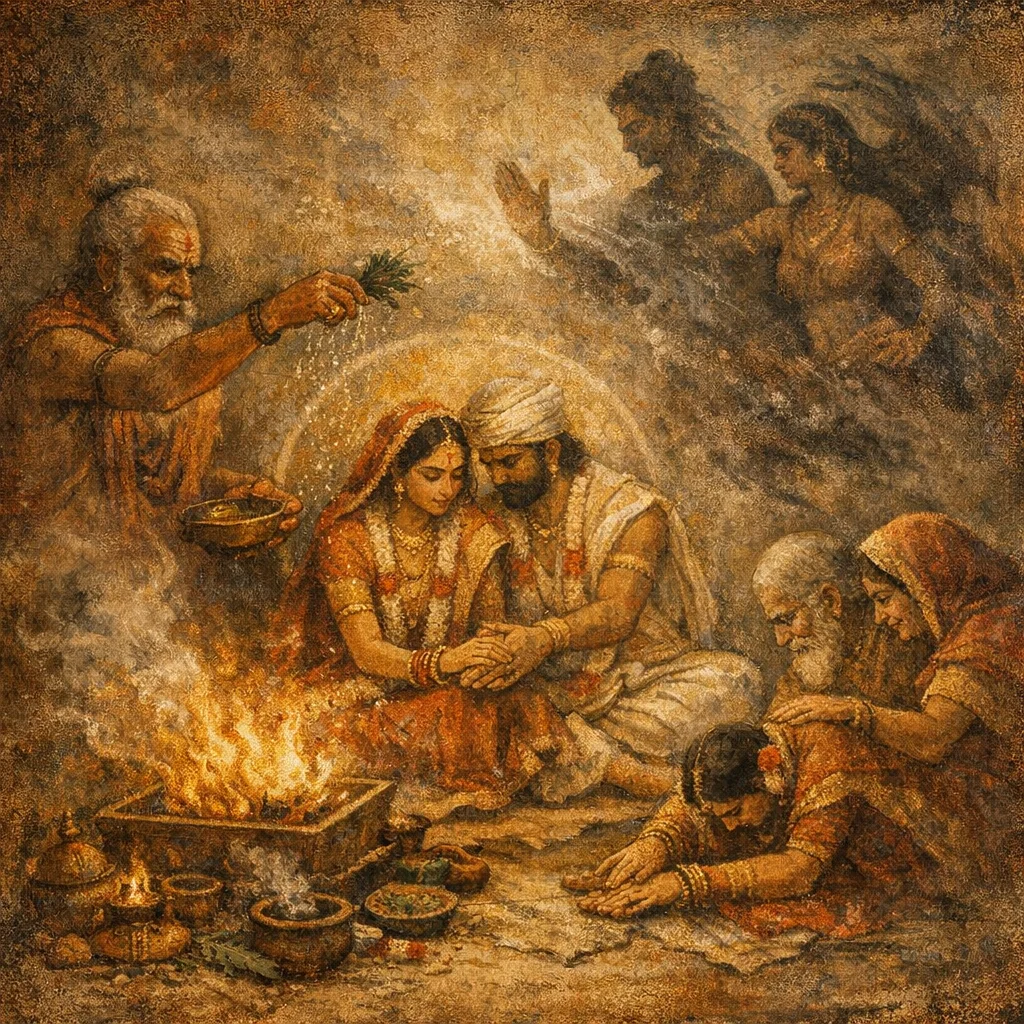
Sukta 2
Rishi: Traditionally associated with marriage-hymn seers (Atharvanic transmission; specific r̥ṣi attribution varies by anukramaṇī)
Devata: Soma, Gandharva, Agni, and the human husband as ritual agents
Chandas: Anuṣṭubh (predominant marriage-meter in AV/ṚV parallels)
Mantras
Mantra 1
विवाह-प्रकरणम्। ६९ त्र्यवसाना षट् पदाऽतिशक्वरी,७१ बृहती। तुभ्यमग्रे पर्यवहन्त्सूर्यां वहतुना सह। स नः पतिभ्यो जायां दा अग्ने प्रजया सह
For thee, in the beginning, they led Sūryā about, together with the bridal train. So do thou, O Agni, grant unto our husbands a wife, together with progeny.
Mantra 2
पुनः पत्नीमग्निरदादायुषा सह वर्चसा । दीर्घायुरस्या यः पतिर्जीवाति शरदः शतम्
Anew hath Agni given the wife, together with life and with splendour. Long-lived is her husband, who liveth on a hundred autumns.
Mantra 3
सोमस्य जाया प्रथमं गन्धर्वस्तेऽपरः पतिः । तृतीयो अग्निष्टे पतिस्तुरीयस्ते मनुष्यजाः
Soma is thy spouse in the first estate; the Gandharva is thy next lord. Third is Agni for thy husband; fourth, the man-born (mortal) is thy mate.
Mantra 4
सोमो ददद् गन्धर्वाय गन्धर्वो दददग्नये । रयिं च पुत्रांस्चादादग्निर्मह्यमथो इमाम्
Soma gave her to the Gandharva; the Gandharva gave her to Agni. And Agni, receiving her for me, bestowed wealth and sons—yea, this very bride.
Mantra 5
आ वामगन्त्सुमतिर्वाजिनीवसू न्यश्विना हृत्सु कामा अरंसत । अभूतं गोपा मिथुना शुभस्पती प्रिया अर्यम्णो दुर्यां अशीमहि
To you hath come good favour, O ye wealthy prize-bestowers: within our hearts, O Aśvins, desires have found their seat. Be ye the guarding pair, O lords of splendour; in Aryaman’s dear house may we attain our home-bliss.
Mantra 6
सा मन्दसाना मनसा शिवेन रयिं धेहि सर्ववीरं वचस्यऽम्। सुगं तीर्थं सुप्रपाणं शुभस्पती स्थाणुं पथिष्ठामप दुर्मतिं हतम्
With mind benign and gladdening, set thou in place our wealth, all-heroed, rich in potent speech. Grant easy passage, a good ford, fair drinking-water, O lords of splendour; smite far away the evil thought, the stump that stands within the path.
Mantra 7
या ओषधयो या नद्यो३ यानि क्षेत्राणि या वना । तास्त्वा वधु प्रजावतीं पत्ये रक्षन्तु रक्षसः
What herbs there be, what rivers, what fields, what forests—let them, O bride, protect thee, rich in offspring, for thy husband, from the Rakṣas-fiends.
Mantra 8
एमं पन्थामरुक्षाम सुगं स्वस्तिवाहनम्। यस्मिन् वीरो न रिष्यत्यन्येषां विन्दते वसु
This path we make unharmful—easy of passage, a bearer of welfare—whereon the man is not smitten, and from others wins him wealth.
Mantra 9
इदं सु मे नरः शृणुत ययाशिषा दंपती वाममश्नुतः । ये गन्धर्वा अप्सरसश्च देवीरेषु वानस्पत्येषु येऽधि तस्थुः । स्योनास्ते अस्यै वध्वै भवन्तु मा हिंसिषुर्वहतुमुह्यमानम्
Hear ye, O men, this word of mine, by which benediction the wedded pair may win them good. The Gandharvas and the Apsarases, the goddesses, who have taken station upon these wooden things—kindly to this bride let them become; let them not harm the bridal bearing as she is borne along.
Mantra 10
ये वध्वश्चन्द्रं वहतुं यक्ष्मा यन्ति जनाँ अनु । पुनस्तान् यज्ञिया देवा नयन्तु यत आगताः
What wasting ills, in bridal guise, pursue the shining bridal-bearing, following the folk—those let the sacrifice-worthy Gods lead back again, to the place from which they came.
Mantra 11
मा विदन् परिपन्थिनो य आसीदन्ति दंपती । सुगेन दुर्गमतीतामप द्रान्त्वरातयः
Let not the waylayers find the wedded pair that lie in wait: by an easy path let them pass the hard pass; away let the hostilities run.
Mantra 12
सं काशयामि वहतुं ब्रह्मणा गृहैरघोरेण चक्षुषा मित्रियेण । पर्याणद्धं विश्वरूपं यदस्ति स्योनं पतिभ्यः सविता तत् कृणोतु
I make the bridal-bearing wholly manifest, with sacred power, with the home, with benign eye, with friendly accord. Whatso is bound about, of every form and furnishing—let Savitar make that kindly for the husbands.
Mantra 13
शिवा नारीयमस्तमागन्निमं धाता लोकमस्यै दिदेश । तामर्यमा भगो अश्विनोभा प्रजापतिः प्रजया वर्धयन्तु
Auspicious hath this bride come home; for her hath Dhātṛ assigned this ordered sphere. Her may Aryaman and Bhaga, both Aśvins, and Prajāpati increase with progeny.
Mantra 14
आत्मन्वत्युर्वरा नारीयमागन् तस्यां नरो वपत बीजमस्याम्। सा वः प्रजां जनयद् वक्षणाभ्यो बिभ्रती दुग्धमृषभस्य रेतः
Life-laden, a fruitful field, this bride hath come: therein, O men, sow ye the seed within her. May she for you bring forth progeny from out her flanks, bearing the milk-like seed of the bull.
Mantra 15
प्रति तिष्ठ विराडसि विष्णुरिवेह सरस्वति । सिनीवालि प्र जायतां भगस्य सुमतावसत्
Stand forth: thou art Virāj; like Viṣṇu here, O Sarasvatī. O Sinīvālī, let it be brought to birth, with Bhaga’s kindly favour and with aid.
Mantra 16
उद् व ऊर्मिः शम्या हन्त्वापो योक्त्राणि मुञ्चत । मादुष्कृतौ व्येनसावघ्न्यावशुनमारताम्
Up let the wave, in peace, smite forth; ye Waters, loosen ye the yoke-bonds. Not in ill-doing—away from sin: drive off the dog; let the inviolable (cow/innocent) be unharmed; let it depart.
Mantra 17
अघोरचक्षुरपतिघ्नी स्योना शग्मा सुशेवा सुयमा गृहेभ्यः । वीरसूर्देवकामा सं त्वयैधिषीमहि सुमनस्यमाना
Gentle-eyed, husband-sparing, gracious, strong, most kindly, well-guiding for our homes—hero-bearing, god-desiring—together with thee may we wax and prosper, being of one good mind.
Mantra 18
अदेवृघ्न्यपतिघ्नीहैधि शिवा पशुभ्यः सुयमा सुवर्चाः । प्रजावती वीरसूर्देवकामा स्योनेममग्निं गार्हपत्यं सपर्य
Be here one who harms not the husband’s folk, who slays not her lord; thrive—benign to the cattle, well-ordered, of fair splendour. Rich in offspring, a mother of heroes, god-desiring—honour thou this kindly Gārhapatya Fire.
Mantra 19
उत् तिष्ठेतः किमिच्छन्तीदमागा अहं त्वेडे अभिभूः स्वाद् गृहात्। शून्यैषी निरृते याजगन्थोत्तिष्ठाराते प्र पत मेह रंस्थाः
Up, rise! What seeking hast thou come to this place? I address thee, overpowering thee—away from our own house. Thou emptiness-seeker, to Nirṛti thou hast gone: arise, O Arāti; fly forth—linger not here.
Mantra 20
यदा गार्हपत्यमसपर्यैत् पूर्वमग्निं वधूरियम्। अधा सरस्वत्यै नारि पितृभ्यश्च नमस्कुरु
When this bride hath first done honour to Agni, the Gārhapatya, then, O woman, make reverence unto Sarasvatī and unto the Fathers.
Mantra 21
शर्म वर्मैतदा हरास्यै नार्या उपस्तिरे । सिनीवालि प्र जायतां भगस्य सुमतावसत्
Bring hither this comfort, this armour, to be a spread beneath this woman. O Sinīvālī, let her bring forth abundantly, under Bhaga’s kindly favour and his aid.
Mantra 22
यं बल्बजं न्यस्यथ चर्म चोपस्तृणीथन । तदा रोहतु सुप्रजा या कन्या विन्दते पतिम्
What balbaja ye lay down, and what hide ye spread beneath—thereby let good offspring spring up for the maiden who obtaineth a husband.
Mantra 23
उप स्तृणीहि बल्बजमधि चर्मणि रोहिते । तत्रोपविश्य सुप्रजा इममग्निं सपर्यतु
Spread thou the balbaja-strewing upon the hide, O Red One. Thereon, when she hath sat her down, let the well-offspringed woman do reverence unto this Agni.
Mantra 24
आ रोह चर्मोप सीदाग्निमेष देवो हन्ति रक्षांसि सर्वा । इह प्रजां जनय पत्ये अस्मै सुज्यैष्ठ्यो भवत् पुत्रस्त एषः
Ascend the hide; sit thee down hard by the Fire. This God smiteth all the Rakshases. Here beget thou offspring for this thy lord: may there be good pre-eminence; this shall be thy son.
Mantra 25
वि तिष्ठन्तां मातुरस्या उपस्थान्नानारूपाः पशवो जायमानाः । सुमङ्गल्युप सीदेममग्निं संपत्नी प्रति भूषेह देवान्
Forth from this mother’s lap let cattle, manifold in form, stand up—still being born. O auspicious wife, sit thou down beside this Agni; as true consort do thou here do honor unto the Gods.
Mantra 26
सुमङ्गली प्रतरणी गृहाणां सुशेवा पत्ये श्वशुराय शंभूः । स्योना श्वश्र्वै प्र गृहान् विशेमान्
Auspicious, bearing us safely through the houses, kindly in service—be thou a maker of peace to husband and to father-in-law. Gentle to thy mother-in-law, may we enter forth into the home.
Mantra 27
स्योना भव श्वशुरेभ्यः स्योना पत्ये गृहेभ्यः । स्योनास्यै सर्वस्यै विशे स्योना पुष्टायैषां भव
Be gentle to the fathers-in-law; gentle to thy husband, gentle in the home. Gentle to all this folk, gentle for their thriving—be thou so.
Mantra 28
सुमङ्गलीरियं वधूरिमां समेत पश्यत । सौभाग्यमस्यै दत्त्वा दौर्भाग्यैर्विपरेतन
Assemble and behold this bride, most auspicious. Having bestowed good fortune upon her, with your ill-fortunes depart ye hence.
Mantra 29
या दुर्हार्दो युवतयो याश्चेह जरतीरपि । वर्चो न्वस्यै सं दत्ताथास्तं विपरेतन
Ye young women of ill will, and ye old women also who are here—now give her lustre; then, homeward, depart ye hence.
Mantra 30
रुक्मप्रस्तरणं वह्यं विश्वा रूपाणि बिभ्रतम्। आरोहत् सूर्या सावित्री बृहते सौभगाय कम्
The gold-bespread, to be borne, bearing all fair forms—Sūryā, Sāvitrī, mounted it, for mighty good fortune and for bliss.
Mantra 31
आ रोह तल्पं सुमनस्यमानेह प्रजां जनय पत्ये अस्मै। इन्द्राणीव सुबुधा बुध्यमाना ज्योतिरग्रा उषसः प्रति जागरासि
Mount thou the couch, of gracious mind; here generate offspring for this thy lord. Like Indrāṇī, well-awake, awakening, with light before thee, thou watchest toward the Dawns.
Mantra 32
देवा अग्रे न्यपद्यन्त पत्नीः समस्पृशन्त तन्वऽस्तनूभिः । सूर्येव नारि विश्वरूपा महित्वा प्रजावती पत्या सं भवेह
The gods of old took wives and touched in union body with body. Like the Sun, O woman, manifold in form, in majesty—be here with thy husband wholly joined, rich in offspring.
Mantra 33
उत् तिष्ठेतो विश्वावसो नमसेडामहे त्वा । जामिमिच्छ पितृषदं न्यक्तां स ते भागो जनुषा तस्य विद्धि
Up, stand thou forth from hence, O Viśvāvasu: with reverence we hymn thee. Seek thou thy proper mate, the one that sitteth with the Fathers, turned away; that is thy portion by birth—know thou that portion.
Mantra 34
अप्सरसः सधमादं मदन्ति हविर्धानमन्तरा सूर्यं च । तास्ते जनित्रमभि ताः परेहि नमस्ते गन्धर्वर्तुना कृणोमि
The Apsarases make merry in the common revel, betwixt the offerings-place and the Sun. Unto thy birthplace—unto those—depart thou: obeisance to thee, O Gandharva; with ordered season do I effect it.
Mantra 35
नमो गन्धर्वस्य नमसे नमो भामाय चक्षुषे च कृण्मः । विश्वावसो ब्रह्मणा ते नमोऽभि जाया अप्सरसः परेहि
Obeisance to the Gandharva—obeisance we render; obeisance to his dread splendor and to his eye. O Viśvāvasu, with sacred spell to thee is obeisance: as touching the wife, O Apsarases, depart ye hence.
Mantra 36
राया वयं सुमनसः स्यामोदितो गन्धर्वमावीवृताम । अगन्त्स देवः परमं सधस्थमगन्म यत्र प्रतिरन्त आयुः
With wealth may we be of gracious mind; the risen Gandharva—let the way be opened. That god hath gone unto his highest station; we have attained the place where life is held and prolonged.
Mantra 37
सं पितरावृत्विये सृजेथां माता पिता च रेतसो भवाथः । मर्य इव योषामधिरोहयैनां प्रजां कृण्वाथामिह पुष्यतं रयिम्
Together, in due season, let the two parents send forth; mother and father, be ye possessed of seed. As a young man upon a young wife mount thou her: beget ye offspring here, and nourish ye wealth to thrive.
Mantra 38
तां पूषंछिवतमामेरयस्व यस्यां बीजं मनुष्या३वपन्ति । या न ऊरू उशती विश्रयाति यस्यामुशन्तः प्रहरेम शेपः
Her—O Pūṣan—most gracious, do thou impel and lead, in whom men sow the seed. She who, desiring, spreads her thighs for us—within whom, desiring, we should thrust the virile member.
Mantra 39
आ रोहोरुमुप धत्स्व हस्तं परि ष्वजस्व जायां सुमनस्यमानः । प्रजां कृण्वाथामिह मोदमानौ दीर्घं वामायुः सविता कृणोतु
Ascend the thigh; set thy hand thereon; embrace thy wife about, with kindly mind. Beget ye here offspring, rejoicing together: may Savitar make for you a long life-time.
Mantra 40
आ वां प्रजां जनयतु प्रजापतिरहोरात्राभ्यां समनक्त्वर्यमा। अदुर्मङ्गली पतिलोकमा विशेमं शं नो भव द्विपदे शं चतुष्पदे
May Prajāpati beget for you two progeny; may Aryaman with day and night anoint you wholly. Un-ill-omened, may I enter the husband’s world: be welfare unto us—welfare to the two-footed, welfare to the four-footed.
Mantra 41
देवैर्दत्तं मनुना साकमेतद् वाधूयं वासो वध्वऽश्च वस्त्रम्। यो ब्रह्मणे चिकितुषे ददाति स इद् रक्षांसि तल्पानि हन्ति
Given by the Gods, with Manu joined, is this—the bridal garment, the bride’s raiment. Whoso to the knowing Brahman gives it, he verily smites the demons from the beds.
Mantra 42
यं मे दत्तो ब्रह्मभागं वधूयोर्वाधूयं वासो वध्वऽश्च वस्त्रम्। युवं ब्रह्मणेऽनुमन्यमानौ बृहस्पते साकमिन्द्रश्च दत्तम्
That which is given to me as Brahman’s portion—the bridal garment, the bride’s cloth—this, approving, ye two have given unto the Brahman, O Bṛhaspati, and Indra together.
Mantra 43
स्योनाद्योनेरधि बध्यमानौ हसामुदौ महसा मोदमानौ । सुगू सुपुत्रौ सुगृहौ तराथो जीवावुषसो विभातीः
From an auspicious seat, from the womb’s own source, bound fast upon it, smiling, glad, rejoicing in great might: faring well, rich in goodly sons, possessed of a good home, may ye twain pass safely through—alive through the dawning days that shine.
Mantra 44
नवं वसानः सुरभिः सुवासा उदागां जीव उषसो विभातीः । आण्डात् पतत्रीवामुक्षि विश्वस्मादेनसस्परि
Clad in new raiment, fragrant, well-attired, let him go forth, alive, through dawning days that shine. From out the egg, as ’twere a winged thing, sprinkle him free from every taint of sin.
Mantra 45
शुम्भनी द्यावापृथिवी अन्तिसुम्ने महिव्रते । आपः सप्त सुस्रुवुर्देवीस्ता नो मुञ्चन्त्वंहसः
Adorning Heaven and Earth, near with kindly grace, steadfast in mighty ordinance—forth have the Seven Waters flowed, the Goddesses: let them release us from distress and sin.
Mantra 46
सूर्यायै देवेभ्यो मित्राय वरुणाय च । ये भूतस्य प्रचेतसस्तेभ्य इदमकरं नमः
To Sūryā, to the Gods, to Mitra and to Varuṇa—who are foreknowing of all that is—unto them have I performed this act: obeisance be it.
Mantra 47
य ऋते चिदभिश्रिषः पुरा जत्रुभ्य आतृदः । संधाता संधिं मघवा पुरूवसुर्निष्कर्ता विह्रुतं पुनः
He who, even without aid, of old thrust off the assailing pressure from the throat—Maghavan, rich in many treasures, the joiner who makes the bond, the deliverer—let him restore again what hath been disordered.
Mantra 48
अपास्मत् तम उच्छतु नीलं पिशङ्गमुत लोहितं यत्। निर्दहनी या पृषातक्य१स्मिन् तां स्थाणावध्या सजामि
Away from us let the darkness mount and vanish—what is blue, what is tawny, yea what is red. The consuming Pṛṣātakī, that burning-out power which is herein, her do I bind fast upon the stump.
Mantra 49
यावतीः कृत्या उपवासने यावन्तो राज्ञो वरुणस्य पाशाः । व्यृद्धयो या असमृद्धयो या अस्मिन् ता स्थाणावधि सादयामि
What sorceries soever are within the dwelling, what nooses of king Varuṇa there be—what failures, what prosperless states are herein, those do I cause to settle down upon the stump.
Mantra 50
या मे प्रियतमा तनूः सा मे बिभाय वाससः । तस्याग्रे त्वं वनस्पते नीविं कृणुष्व मा वयं रिषाम
She who is my dearest body, she is in fear of the garment. At its fore, O Lord of the Forest, do thou make fast the girdle, that we be not harmed.
Mantra 51
ये अन्ता यावतीः सिचो य ओतवो ये च तन्तवः । वासो यत् पत्नीभिरुतं तन्नः स्योनमुप स्पृशात्
What ends there are, what seams soever, what weavings and what threads—what garment is with the wives; may that touch us with benign and homely grace.
Mantra 52
उशतीः कन्यला इमाः पितृलोकात् पतिं यतीः । अव दीक्षामसृक्षत स्वाहा
These eager maidens, faring from the Fathers’ world unto a husband, have cast away the consecration—svāhā!
Mantra 53
बृहस्पतिनावसृष्टां विश्वे देवा अधारयन्। वर्चो गोषु प्रविष्टं यत् तेनेमां सं सृजामसि
Sent forth by Bṛhaspati, all the Gods have stablished it: the splendour that hath entered into the kine—with that same do we now join this woman fast.
Mantra 54
बृहस्पतिनावसृष्टां विश्वे देवा अधारयन्। तेजो गोषु प्रविष्टं यत् तेनेमां सं सृजामसि
Sent forth by Bṛhaspati, all the Gods have stablished it: the fiery vigour that hath entered into the kine—with that same do we now join this woman fast.
Mantra 55
बृहस्पतिनावसृष्टां विश्वे देवा अधारयन्। भजो गोषु प्रविष्टो यस्तेनेमां सं सृजामसि
Sent forth by Bṛhaspati, all the Gods have stablished it: the goodly portion that hath entered into the kine—with that same do we now join this woman fast.
Mantra 56
बृहस्पतिनावसृष्टां विश्वे देवा अधारयन्। यशो गोषु प्रविष्टं यत् तेनेमां सं सृजामसि
Sent forth by Bṛhaspati, all the Gods have stablished it: the fame that hath entered into the kine—with that same do we now join this woman fast.
Mantra 57
बृहस्पतिनावसृष्टां विश्वे देवा अधारयन्। पयो गोषु प्रविष्टं यत् तेनेमां सं सृजामसि
Sent forth by Bṛhaspati, all the Gods have stablished it: the milk that hath entered into the kine—with that same do we now join this woman fast.
Mantra 58
बृहस्पतिनावसृष्टां विश्वे देवा अधारयन्। रसो गोषु प्रविष्टो यस्तेनेमां सं सृजामसि
Discharged by Bṛhaspati, all the Gods have upheld it. The sap that hath entered the kine—therewith we duly set this woman/this state in order.
Mantra 59
यदीमे केशिनो जना गृहे ते समनर्तिषू रोदेन कृण्वन्तो३घम्। अग्निष्ट्वा तस्मादेनसः सविता च प्र मुञ्चताम्
If these long-haired folk, within thy house, amid the common dance, by wailing make mischief—Agni from that, and Savitar likewise, shall loose thee forth from taint of sin.
Mantra 60
यदीयं दुहिता तव विकेश्यरुदद् गृहे रोदेन कृण्वत्य१घम्। अग्निष्ट्वा तस्मादेनसः सविता च प्र मुञ्चताम्
If this thy daughter, with hair unbound, hath wailed within the house and by her crying wrought mischief—Agni from that, and Savitar likewise, shall loose thee forth from taint of sin.
Mantra 61
यज्जामयो यद् युवतयो गृहे ते समनर्तिषू रोदेन कृण्वतीरघम्। अग्निष्ट्वा तस्मादेनसः सविता च प्र मुञ्चताम्
Whatsoever thy womenfolk, whatsoever thy young maidens, within the house, amid the common dance, by wailing may work mischief—Agni from that, and Savitar likewise, shall loose thee forth from taint of sin.
Mantra 62
यत् ते प्रजायां पशुषु यद् वा गृहेषु निष्ठितमघकृद्भिरघं कृतम्। अग्निष्ट्वा तस्मादेनसः सविता च प्र मुञ्चताम्
What harm, by harm-doers wrought, is lodged within thy offspring, in thy cattle, or established in thy houses—Agni from that, and Savitar likewise, shall loose thee forth from taint of sin.
Mantra 63
इयं नार्युप ब्रूते पूल्यान्यावपन्तिका। दीर्घायुरस्तु मे पतिर्जीवाति शरदः शतम्
This bride speaks forth: ‘As women winnow out the chaff, so let my husband be long-lived; let him live a hundred autumns.’
Mantra 64
इहेमाविन्द्र सं नुद चक्रवाकेव दंपती । प्रजयैनौ स्वस्तकौ विश्वमायुर्व्यऽश्नुताम्
Here, O Indra, drive these two together, like the cakravāka pair, the wedded lords; with progeny let them, in welfare, attain the whole of life.
Mantra 65
यदासन्द्यामुपधाने यद् वोपवासने कृतम्। विवाहे कृत्यां यां चक्रुरास्नाने तां नि दध्मसि
Whatsoever, on the seat, on the pillow, or in your garment-covering, hath been wrought; the witchcraft which they have made at the wedding, at the bathing—this we lay down and put away.
Mantra 66
यद् दुष्कृतं यच्छमलं विवाहे वहतौ च यत्। तत् संभलस्य कम्बले मृज्महे दुरितं वयम्
What ill-performed act, what stain there be in the wedding, and what in the bringing-on—this evil we wipe away upon the sambhala’s blanket-wrap.
Mantra 67
संभले मलं सादयित्वा कम्बले दुरितं वयम्। अभूम यज्ञियाः शुद्धाः प्र ण आयूंषि तारिषत्
Having caused the filth to settle in the sambhala, the evil in the blanket, we have become purified and fit for sacrifice: may our life-spans be borne safely onward and prolonged.
Mantra 68
कृत्रिमः कण्टकः शतदन् य एषः । अपास्याः केश्यं मलमप शीर्षण्यं लिखात्
This fashioned thorn, this hundred-toothed point—let it scrape away, cast off, the hair-born filth, the head’s impurity.
Mantra 69
अङ्गादङ्गाद् वयमस्या अप यक्ष्मं नि दध्मसि । तन्मा प्रापत् पृथिवीं मोत देवान् दिवं मा प्रापदुर्व१न्तरिक्षम्। अपो मा प्रापन्मलमेतदग्ने यमं मा प्रापत् पितॄंश्च सर्वान्
From limb to limb of her we lay the wasting sickness down and away. Let it not come unto me; let it not reach the Earth, nor yet the Gods; let it not reach Heaven, nor the wide Mid-air. Let not the Waters be reached by this defilement, O Agni; let it not come unto Yama, nor unto all the Fathers.
Mantra 70
सं त्वा नह्यामि पयसा पृथिव्याः सं त्वा नह्यामि पयसौषधीनाम्। सं त्वा नह्यामि प्रजया धनेन सा संनद्धा सनुहि वाजमेमम्
I bind thee fast with Earth’s own milk; I bind thee fast with the milk of herbs. I bind thee fast with offspring and with riches: so, well-girded, win thou this prize of strength.
Mantra 71
अमोऽहमस्मि सा त्वं सामाहमस्म्यृक् त्वं द्यौरहं पृथिवी त्वम्। ताविह सं भवाव प्रजामा जनयावहै
I am the strength; thou art she, the Sāman. I am the Ṛc; thou art Heaven; I am Earth, thou. Here may we two become conjoined; may we two bring forth offspring.
Mantra 72
जनियन्ति नावग्रवः पुत्रियन्ति सुदानवः । अरिष्टासू सचेवहि बृहते वाजसातये
The low-lamenting beget not; the liberal givers long for sons. With women safe and unscathed do thou consort, for the winning of the mighty prize of strength.
Mantra 73
ये पितरो वधूदर्शा इमं वहतुमागमन्। ते अस्यै वध्वै संपत्न्यै प्रजावच्छर्म यच्छन्तु
The Fathers who came, bride-beholding, unto this bridal leading-forth—may they bestow on her, on this bride as rightful consort, shelter that is rich in offspring.
Mantra 74
येदं पूर्वागन् रशनायमाना प्रजामस्यै द्रविणं चेह दत्त्वा। तां वहन्त्वगतस्यानु पन्थां विराडियं सुप्रजा अत्यजैषीत्
They who went before in this, girt with the cord, having here bestowed on her offspring and wealth—let them lead her along the path of him who hath gone before: this Virāj, rich in good progeny, hath won the victory.
Mantra 75
प्र बुध्यस्व सुबुधा बुध्यमाना दीर्घायुत्वाय शतशारदाय । गृहान् गच्छ गृहपत्नी यथासो दीर्घं त आयुः सविता कृणोतु
Awake thou forth, well-wakened, waking unto long life, unto a hundred autumns. Go to the homes, as household-mistress, that Savitar may make thy life long.
Frequently Asked Questions
It expresses a ritual sequence of guardianship. Soma sanctifies, the Gandharva guards the liminal sexuality of maidenhood, Agni witnesses and installs the bride in the household, and only then does the human husband receive her in lawful marriage.
The Gārhapatya is the stable domestic hearth that ‘holds’ the household. Honoring it makes the marriage socially and ritually anchored, and it becomes the ongoing witness for prosperity, harmony, and fertility.
Both: its shāntika force protects the bride and marriage from harmful/illicit influences, and its paustika aim seeks prosperity—cattle, radiance, household order—and abundant offspring (praja), ideally ‘heroic’ children (vīrasū).