Adhyaya 6
स्वाध्याय-योगोपदेशः तथा केशिध्वज-खाण्डिक्य-उपाख्यानम् (Yoga through Study and Restraint; The Keśidhvaja–Khāṇḍikya Narrative Frame)
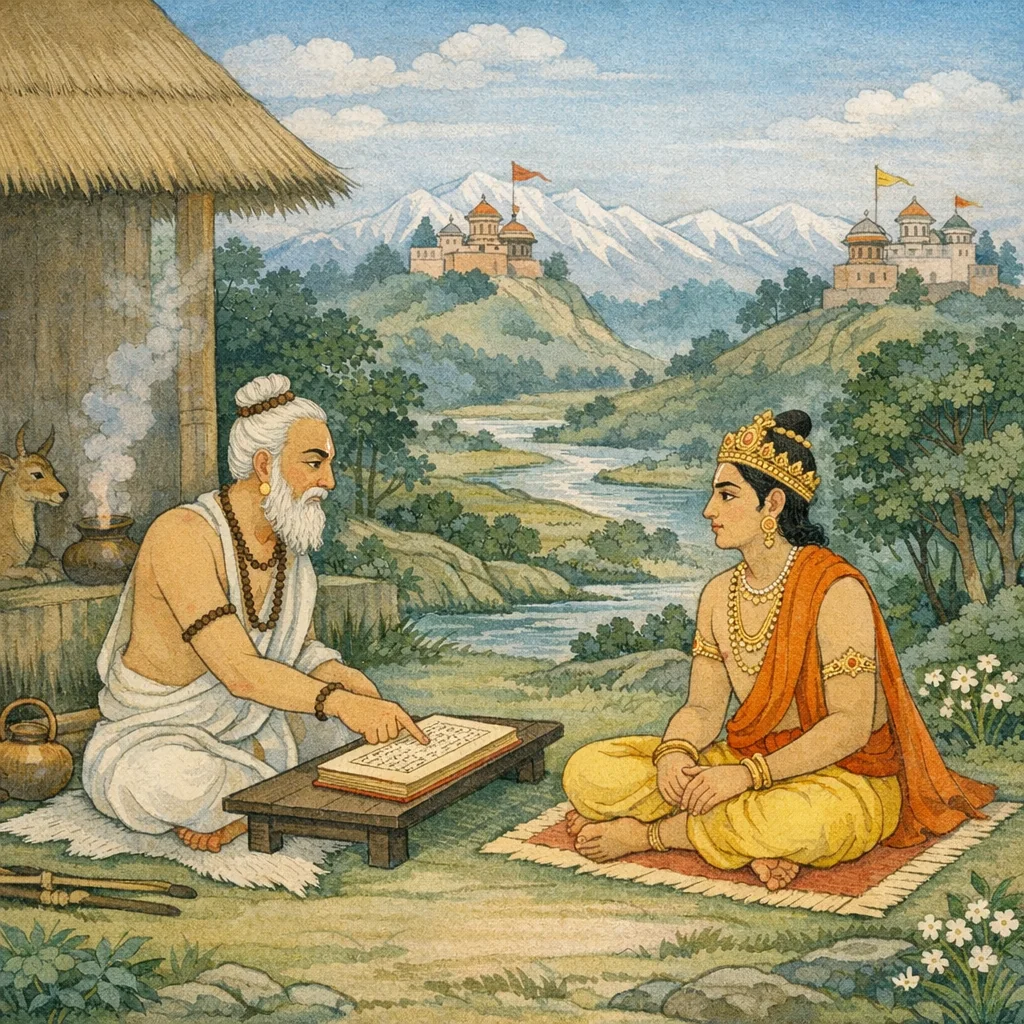
Parāśara teaches that Puruṣottama is realized through svādhyāya and saṃyama; study and yoga ripen one another until the Paramātman becomes self-evident beyond the senses. Maitreya asks for a clear account of that yoga, and Parāśara introduces an earlier royal-sage precedent: Keśidhvaja taught yoga to Khāṇḍikya, linked with Janaka traditions. Khāṇḍikya excels in the path of karma, Keśidhvaja in ātma-vidyā; rivalry leads to Khāṇḍikya’s loss of kingdom and forest exile. During a sacrifice a tiger kills the Dharmadhenu, and the search for prāyaścitta ultimately requires consulting the defeated Khāṇḍikya. An ethical debate follows—kill an enemy for earthly rule or spare him for higher-world victory. The episode turns toward discipleship as Keśidhvaja seeks instruction and offers guru-dakṣiṇā, with yoga-teaching revealed as the true ‘payment’ that pacifies suffering.
Shlokas
Verse 1
स्वाध्यायसंयमाभ्यां स दृश्यते पुरुषोत्तमः तत्प्राप्तिकारणं ब्रह्म तद् एतद् इति पठ्यते
Through sacred self-study and disciplined restraint, that Supreme Person (Puruṣottama) is truly perceived. The cause by which He is attained is Brahman—thus is it recited: “That indeed is This.”
Verse 2
स्वाध्यायाद् योगम् आसीत योगात् स्वाध्यायम् आचरेत् स्वाध्याययोगसंपत्त्या परमात्मा प्रकाशते
From sacred study one should enter into yoga, and from yoga one should return again to sacred study. Through the ripened excellence born of study and yogic discipline together, the Supreme Self shines forth—self-revealed and near.
Verse 3
तदीक्षणाय स्वाध्यायश् चक्षुर् योगस् तथापरम् न मांसचक्षुषा द्रष्टुं ब्रह्मभूतः स शक्यते
For the beholding of That Supreme Reality, sacred self-study (svādhyāya) is the eye, and yoga too is the highest means. For He who is of the nature of Brahman cannot be seen with the fleshly eye.
Verse 4
भगवंस् तम् अहं योगं ज्ञातुम् इच्छामि तं वद ज्ञाते यत्राखिलाधारं पश्येयं परमेश्वरम्
O Blessed One, I yearn to know that Yoga; declare it to me—by knowing it may I behold the Supreme Lord, the support of all that is.
Verse 5
यथा केशिध्वजः प्राह खाण्डिक्याय महात्मने जनकाय पुरा योगं तथाहं कथयामि ते
As Keśidhvaja once taught the Yoga discipline to the great-souled Khāṇḍikya and to King Janaka of old, so now I shall declare that Yoga to you.
Verse 6
खाण्डिक्यः को ऽभवद् ब्रह्मन् को वा केशिध्वजो ऽभवत् कथं तयोश् च संवादो योगसंबन्धवान् अभूत्
O revered Brahman, who indeed was Khāṇḍikya, and who was Keśidhvaja? And how did a dialogue arise between them that was truly connected with Yoga?
Verse 7
धर्मध्वजो वै जनकस् तस्य पुत्रो ऽमितध्वजः कृतध्वजश् च नाम्नासीत् सदाध्यात्मरतिर् नृपः
There was a king named Dharmadhvaja; his son was Amitadhvaja. And there was another ruler, famed as Kṛtadhvaja, ever devoted to contemplation of the inner Self.
Verse 8
कृतध्वजस्य पुत्रो ऽभूत् ख्यातः केशिध्वजो द्विज पुत्रो ऽमितध्वजस्यापि खाण्डिक्यजनको ऽभवत्
O twice-born, Kṛtadhvaja had a renowned son named Keśidhvaja. And Amitadhvaja too had a son, celebrated as the father (janaka) of Khāṇḍikya.
Verse 9
कर्ममार्गे ऽति खाण्डिक्यः पृथिव्याम् अभवत् कृती केशिध्वजो ऽप्य् अतीवासीद् आत्मविद्याविशारदः
On the path of ritual duty, Khāṇḍikya became greatly accomplished upon the earth; and Keśidhvaja too was pre-eminent, supremely skilled in the wisdom of the Self.
Verse 10
ताव् उभाव् अपि चैवास्तां विजिगीषू परस्परम् केशिध्वजेन खाण्डिक्यः स्वराज्याद् अवरोपितः
Thus both remained bound in mutual ambition, each yearning to conquer the other; and Khāṇḍikya was cast down from his own sovereign realm by Keśidhvaja.
Verse 11
पुरोधसा मन्त्रिभिश् च समवेतो ऽल्पसाधनः राज्यान् निराकृतः सो ऽथ दुर्गारण्यचरो ऽभवत्
Though joined by his royal priest and ministers, yet with scant resources he was driven out from the kingdom; and then he became a wanderer in harsh, forbidding forests.
Verse 12
इयाज सो ऽपि सुबहून् यज्ञाञ् \ज्ञानव्यपाश्रयः ब्रह्मविद्याम् अधिष्ठाय तर्तुं मृत्युम् अविद्यया
He too performed many sacrifices; yet, taking refuge in true knowledge and grounded in Brahma-vidyā, he sought to cross beyond death—for death is born of ignorance.
Verse 13
एकदा वर्तमानस्य यागे योगविदां वर धर्मधेनुं जघानोग्रः शार्दूलो विजने वने
Once, while a sacrifice was in progress—O best of those who know yoga—in a lonely forest a fierce tiger struck down Dharmadhenu, the cow of righteousness.
Verse 14
ततो राजा हतां ज्ञात्वा धेनुं व्याघ्रेण ऋत्विजः प्रायश्चित्तं स पप्रच्छ किम् अत्रेति विधीयते
Then the king, learning that the cow had been slain by a tiger, asked the officiating priests about expiation: “What atonement is prescribed here—what should be done in this case?”
Verse 15
ते चोचुर् न वयं विद्मः कशेरुः पृच्छ्यताम् इति कशेरुर् अपि तेनोक्तस् तथेति प्राह भार्गवम्
They replied, “We do not know; ask Kaśeru.” Addressed in this way, Kaśeru too answered the Bhārgava, “So be it,” consenting to be questioned and to speak.
Verse 16
शुनकं पृच्छ राजेन्द्र नाहं वेद्मि स वेत्स्यति स गत्वा तम् अपृच्छच् च सो ऽप्य् आह शृणु यन् मुने
“Ask Śunaka, O lord of kings; I do not know—he will know.” Having gone and questioned him, he too replied, “Listen, O sage, to what I shall say.”
Verse 17
न कशेरुर् न चैवाहं न चान्यः साम्प्रतं भुवि वेत्त्य् एक एव त्वच्छत्रुः खाण्डिक्यो यो जितस् त्वया
Neither Kaśeru, nor I myself, nor anyone else upon the earth at this time truly knows it—only one does: Khāṇḍikya, your enemy, whom you have already subdued.
Verse 18
स चाह तं प्रयाम्य् एष प्रष्टुम् आत्मरिपुं मुने प्राप्त एव मया यज्ञो यदि मां स हनिष्यति
And he said: “I shall go to him, O sage, to question that enemy of my own self. If he should kill me, then the sacrifice I have obtained will indeed be fulfilled.”
Verse 19
प्रायश्चित्तं स चेत् पृष्टो वदिष्यति रिपुर् मम ततश् चाविकलो यागो मुनिश्रेष्ठ भविष्यति
If he is questioned, that foe of mine will surely declare the proper expiation; then, O best of sages, the sacrifice will proceed unbroken, its rite restored to wholeness.
Verse 20
इत्य् उक्त्वा रथम् आरुह्य कृष्णाजिनधरो नृपः वनं जगाम यत्रास्ते खाण्डिक्यः स महामतिः
Having spoken thus, the king—clad in a black antelope-skin—mounted his chariot and went to the forest, to where the great-souled sage Khāṇḍikya dwelt.
Verse 21
तम् आयान्तं समालोक्य खाण्डिक्यो रिपुम् आत्मनः प्रोवाच क्रोधताम्राक्षः समारोपितकार्मुकः
Seeing his own enemy approaching, Khāṇḍikya—his eyes reddened with anger and his bow already strung and raised—spoke out.
Verse 22
कृष्णाजिनं त्वं कवचम् आबध्यास्मान् निहंस्यसि कृष्णाजिनधरे वेत्सि न मयि प्रहरिष्यति
“You think that by fastening on a black antelope-skin as your armour you will strike us down. But know this, O wearer of the black antelope-skin: he will not be able to hurl his blow against me.”
Verse 23
मृगाणां वद पृष्ठेषु मूढ कृष्णाजिनं न किम् येषां मया त्वया चोग्राः प्रहिताः शितसायकाः
“Fool—on the backs of deer, is there not the black antelope-skin? Upon those very creatures, you and I have loosed fierce, razor-pointed arrows.”
Verse 24
स त्वाम् अहं हनिष्यामि न मे जीवन् विमोक्ष्यसे आतताय्य् असि दुर्बुद्धे मम राज्यहरो रिपुः
I will strike you down—alive you shall not escape from me. You are an ātatāyin, a wicked aggressor; O evil-minded one, you are my enemy, the usurper who has stolen my kingdom.
Verse 25
खाण्डिक्य संशयं प्रष्टुं भवन्तम् अहम् आगतः न त्वां हन्तुं विचार्यैतत् कोपं बाणं विमुञ्च वा
O Khāṇḍikya, I have come before you to ask and resolve a doubt. I have not come to slay you—understand this clearly. Therefore, abandon your wrath, and release (put down) the arrow you have readied.
Verse 26
ततः स मन्त्रिभिः सार्धम् एकान्ते सपुरोहितैः मन्त्रयाम् आस खाण्डिक्यः सर्वैर् एव महामतिः
Then Khāṇḍikya—broad-minded and discerning—withdrew to a private place and, together with his ministers and household priests, took counsel with them all.
Verse 27
तम् ऊचुर् मन्त्रिणो वध्यो रिपुर् एष वशं गतः हते तु पृथिवी सर्वा तव वश्या भविष्यति
Then the ministers said to him: “This enemy has now fallen under your power—he should be put to death. For once he is slain, the whole earth will become obedient to your rule.”
Verse 28
खाण्डिक्यश् चाह तान् सर्वान् एवम् एतन् न संशयः हते तु पृथिवी सर्वा मम वश्या भविष्यति
Then Khāṇḍikya said to them all: “So it is—of this there is no doubt. When he is slain, the entire earth will come under my dominion.”
Verse 29
परलोकजयस् तस्य पृथिवी सकला मम न हन्मि चेल् लोकजयो मम त्व् अस्य वसुंधरा
His is the victory in the world beyond; the whole earth is mine. If I do not strike him down, the victory in this world will be his—yet this earth remains mine.
Verse 30
परलोकजयो ऽनन्तः स्वल्पकालो महीजयः तस्माद् एनं न हनिष्ये यत् पृच्छति वदामि तत्
Victory in the worlds beyond is without end, while conquest of the earth lasts only a little while. Therefore I shall not slay him; whatever he asks, that I will answer.
Verse 31
ततस् तम् अभ्युपेत्याह खाण्डिक्यजनको रिपुम् प्रष्टव्यं यत् त्वया सर्वं तत् पृच्छस्व वदाम्य् अहम्
Then, approaching that foe, Khāṇḍikya’s father addressed him: “Whatever you wish to ask—ask it all without reserve; I shall tell you.”
Verse 32
ततः सर्वं यथावृत्तं धर्मधेनुवधं द्विज कथयित्वा स पप्रच्छ प्रायश्चित्तं हि तद्गतम्
Then, O twice-born one, having narrated everything exactly as it had occurred—how the ‘cow of Dharma’ was slain—he asked about the expiation appropriate to that very deed.
Verse 33
स चाचष्ट यथान्यायं द्विज केशिध्वजाय तत् प्रायश्चित्तम् अशेषेण यद् वै तत्र विधीयते
And the brahmin then explained to Keśidhvaja—according to the rule of sacred law—every detail of the expiation ordained for that matter, leaving nothing unsaid.
Verse 34
विदितार्थः स तेनैव अनुज्ञातो महात्मना यागभूमिम् उपागम्य चक्रे सर्वाः क्रियाः क्रमात्
Having fully understood the matter and received the permission of that great-souled one, he approached the sacrificial ground and, in the order enjoined by dharma, performed all the rites in due sequence.
Verse 35
क्रमेण विधिवद् यागं नीत्वा सो ऽवभृथाप्लुतः कृतकृत्यस् ततो भूत्वा चिन्तयाम् आस पार्थिवः
Having, step by step and in full accordance with sacred rule, brought the sacrifice to completion, he then performed the concluding avabhṛtha ablution. His duty fulfilled, the king thereafter fell into deep reflection.
Verse 36
पूजिता ऋत्विजः सर्वे सदस्या मानिता मया तथैवार्थिजनो ऽप्य् अर्थैर् योजितो ऽभिमतैर् मया
All the officiating priests were duly worshipped by me, and the members of the sacred assembly were honored as well. Likewise, those who came seeking aid were satisfied by me with wealth, granted according to their rightful wishes.
Verse 37
यथार्हम् अत्र लोकस्य मया सर्वं विचेष्टितम् अनिष्पन्नक्रियं चेतस् तथापि मम किं यथा
In this world I have exerted myself in every way befitting my station; yet my mind remains as though my aims were unfulfilled. Even so—what is there for me to gain, and how could it be otherwise?
Verse 38
इत्थं संचिन्तयन्न् एव सस्मार स महीपतिः खाण्डिक्याय न दत्तेति मया वै गुरुदक्षिणा
While reflecting thus, the king suddenly remembered: “Indeed, I have not yet given the teacher’s fee—the guru-dakṣiṇā—to Khāṇḍikya.”
Verse 39
स जगाम ततो भूयो रथम् आरुह्य पार्थिवः मैत्रेय दुर्गगहनं खाण्डिक्यो यत्र संस्थितः
Then, O Maitreya, the king once more mounted his chariot and set out toward that dense, formidable wilderness where Khāṇḍikya was stationed.
Verse 40
खाण्डिक्यो ऽपि पुनर् दृष्ट्वा तम् आयान्तं धृतायुधः तस्थौ हन्तुं कृतमतिस् तम् आह स पुनर् नृपः
Khāṇḍikya too, seeing him approach again, stood with weapon in hand, his resolve set on killing him; yet the king addressed him once more.
Verse 41
भो नाहं ते ऽपकाराय प्राप्तः खाण्डिक्य मा क्रुधः गुरोर् निष्क्रयदानाय माम् अवेहि त्वम् आगतम्
“O Khāṇḍikya, I have not come to harm you—do not be angry. Know that I have come to pay the ransom for your teacher.”
Verse 42
निष्पादितो मया यागः सम्यक् त्वदुपदेशतः सो ऽहं ते दातुम् इच्छामि वृणुष्व गुरुदक्षिणाम्
“By your instruction I have duly and perfectly completed the sacrificial rite. Therefore I wish to give you what is due; choose the gurudakṣiṇā you desire.”
Verse 43
भूयः स मन्त्रिभिः सार्धं मन्त्रयाम् आस पार्थिवः गुरुनिष्कृतिकामो ऽत्र किम् अयं प्रार्थ्यताम् इति
Then the king again deliberated with his ministers: “Wishing to be freed from the burden of my offence against the guru, what should we ask of him here, so that expiation may be fulfilled?”
Verse 44
तम् ऊचुर् मन्त्रिणो राज्यम् अशेषं प्रार्थ्यताम् अयम् कृतिभिः प्रार्थ्यते राज्यम् अनायासितसैनिकैः
His ministers said: “Entreat this man to accept the whole kingdom. For sovereignty, when sought by the capable—whose forces are already gathered without strain—is desired not as a burdensome conquest, but as a rightful duty in accord with dharma.”
Verse 45
प्रहस्य तान् आह नृपः स खाण्डिक्यो महामतिः स्वल्पकालं महीराज्यं मादृशैः प्रार्थ्यते कथम्
Smiling, the great-minded king Khāṇḍikya said: “How could men such as I beg for dominion over the earth—this kingship that endures only a little while? Royal power is fleeting.”
Verse 46
एवम् एतद् भवन्तो ऽत्र अर्थसाधनमन्त्रिणः परमार्थः कथं को ऽत्र यूयं नात्र विचक्षणाः
So it is indeed. You are counsellors skilled in securing worldly ends; but the Supreme Truth (paramārtha)—how is it to be grasped here? Who truly knows it? In this matter, you are not discerning.
Verse 47
इत्य् उक्त्वा समुपेत्यैनं स तु केशिध्वजं नृपम् उवाच किम् अवश्यं त्वं ददासि गुरुदक्षिणाम्
Having spoken thus, he approached King Keśidhvaja and asked: “What, as a matter of obligation, will you give as guru-dakṣiṇā—the due offering to the teacher?”
Verse 48
बाढम् इत्य् एव तेनोक्तः खाण्डिक्यस् तम् अथाब्रवीत् भवान् अध्यात्मविज्ञानपरमार्थविचक्षणः
When he replied, “So be it,” Khāṇḍikya said: “Sir, you are discerning in the inner knowledge of the Ātman and in the Supreme Truth (paramārtha).”
Verse 49
यदि चेद् दीयते मह्यं भवता गुरुनिष्क्रयः तत् क्लेशप्रशमायालं यत् कर्म तद् उदीरय
If indeed you would grant me the means to be released from the burden of what is due to the teacher, then declare to me that practice—sufficient in itself—that brings the pacification of suffering.
Frequently Asked Questions
The Purāṇic narrative functions as a pedagogical frame: it shows how ritual power and political ambition are insufficient without ātma-vidyā, and how true yoga is transmitted through a guru–śiṣya exchange grounded in dharma and renunciation.
Svādhyāya (disciplined sacred study) and saṃyama (restraint), complemented by yoga; together they become the ‘eye’ by which Brahman—beyond the fleshly eye—is realized.
The immediate concern is ritual expiation, but the narrative evolves into a deeper question of what truly pacifies suffering—leading from external rite (karma) to inner discipline (yoga) and knowledge (jñāna) as the highest remedy.