द्विजेश्वरावतारः (The Manifestation of Shiva as Dvijeśvara)
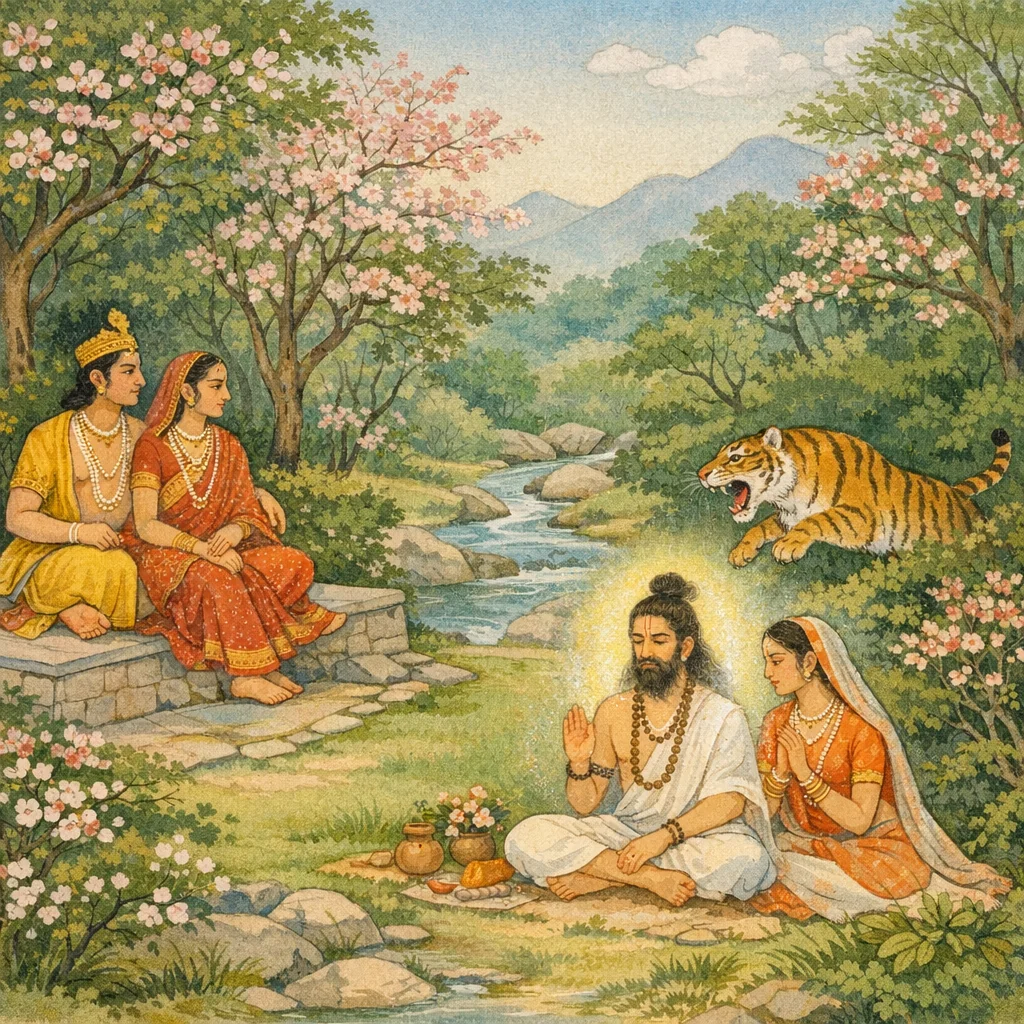
This adhyāya, spoken by Nandīśvara, proclaims an exposition of Śiva Paramātman’s “Dvijeśvara-avatāra,” a revelatory descent meant to test the firmness of dharma. It recalls King Bhadrāyu, once blessed by Śiva in the form of Ṛṣabha, by whose power he conquers foes and gains the throne. The setting is grounded through Queen Kīrtimālinī (daughter of Candrāṃgada, born of Sīmantinī), establishing the genealogical and social frame for the moral trial. In spring the king enters a dense, lovely forest with his beloved for recreation. There Parameśvara Śaṅkara, with Śivā, begins a deliberate līlā: they appear as a brāhmaṇa couple (dvija-dampatī) and conjure, by māyā, a tiger to evoke fear, flight, and pleas for refuge. The impending encounter is designed to reveal the king’s response under distress and apparent vulnerability, turning royal virtue into a Śaiva lesson on grace, illusion (māyā), and discerning true dharma under pressure.
Shlokas
Verse 1
नन्दीश्वर उवाच । शृणु तात प्रवक्ष्यामि शिवस्य परमात्मनः । द्विजेश्वरावतारं च सशिवं सुखदं सताम्
Nandīśvara said: “Listen, dear one. Now I shall proclaim the incarnation of Śiva, the Supreme Self—His manifestation as the lord among the twice-born—an auspicious tale that bestows happiness upon the virtuous.”
Verse 2
यः पूर्वं वर्णितस्तात भद्रायुर्नृपसत्तमः । यस्मिन्नृषभरूपेणानुग्रहं कृतवाञ्छिवः
O dear one, that Bhadrāyu—the best among kings—who was described earlier, is the very person to whom Śiva, taking the form of the bull Ṛṣabha, once granted His compassionate grace.
Verse 3
तद्धर्मस्य परीक्षार्थं पुनराविर्बभूव सः । द्विजेश्वरस्वरूपेण तदेव कथयाम्यहम्
In order to test the truth of that dharma, He manifested once again; assuming the form of Dvijeśvara, a lordly Brahmin, I shall now recount that very account.
Verse 4
ऋषभस्य प्रभावेण शत्रूञ्जित्वा रणे प्रभुः । प्राप्तसिंहासनस्तात भद्रायुः संबभूव ह
By the potency of Ṛṣabha, the mighty lord conquered his enemies in battle; and, having attained the royal throne, O dear one, he came to be known as Bhadrāyu.
Verse 5
चन्द्रांगदस्य तनया सीमन्तिन्याः शुभांगजा । पत्नी तस्याभवद्ब्रह्मन्सुसाध्वी कीर्तिमालिनी
O Brahmin, Śubhāṅgajā—the daughter of Candrāṅgada, born of Sīmantinī—became his wife; she was a supremely virtuous and devoted woman named Kīrtimālinī.
Verse 6
स भद्रायुः कदाचित्स्वप्रियया गहनं वनम् । प्राविशत्संविहारार्थं वसन्तसमये मुने
O sage, once Bhadrāyu, together with his beloved, entered a dense forest in the season of spring, intending to enjoy a leisurely outing.
Verse 7
अथ तस्मिन्वने रम्ये विजहार स भूपतिः । शरणागतपालिन्या तमास्यप्रियया सह
Then, in that delightful forest, the king sported and dwelt in ease, together with his beloved Tamāsya-priyā, the protectress of those who seek refuge.
Verse 8
अथ तद्धर्मदृढतां प्रतीक्षन्परमेश्वरः । लीलां चकार तत्रैव शिवया सह शङ्करः
Then the Supreme Lord, awaiting the firm establishment of that dharma, enacted a divine play right there—Śaṅkara together with Śivā.
Verse 9
शिवा शिवश्च भूत्वोभौ तद्वने द्विजदम्पती । व्याघ्रं मायामयं कृत्वाविर्भूतौ निजलीलया
Śivā (Pārvatī) and Śiva, becoming a brahmin couple in that forest, manifested—by their own divine play—after fashioning a tiger made of māyā.
Verse 10
अथाविदूरे तस्यैव द्रवन्तौ भयविह्वलौ । अन्वीयमानौ व्याघ्रेण रुदन्तौ तौ बभूवतुः
Then, not far from that very place, the two were running, shaken with fear. Pursued by a tiger, they began to wail as they fled.
Verse 11
अथ विद्धौ च तौ तात भद्रायुः स महीपतिः । ददर्श क्रन्दमानौ हि शरण्यः क्षत्रियर्षभः
Then, O dear one, King Bhadrāyu—best among kṣatriyas and a true giver of refuge—saw those two, wounded and indeed crying out in distress.
Verse 12
अथ तौ मुनिशार्दूलः स्वमायाद्विजदम्पती । भद्रायुषं महाराजमूचतुर्भयविह्वलौ
Then that tiger among sages, by his own mystic power, together with the brahmin couple—both trembling with fear—addressed the great King Bhadrāyuṣa.
Verse 13
द्विजदम्पती ऊचतुः । पाहि पाहि महाराज नावुभौ धर्मवित्तम । एष आयाति शार्दूलो जग्धुमावां महाप्रभो
The brahmin couple said: “Protect us, protect us, O great king—O knower of dharma! A tiger is coming to devour us, O mighty lord.”
Verse 14
एष हिंस्रः कालसमः सर्वप्राणिभयङ्करः । यावन्न खादति प्राप्य तावन्नौ रक्ष धर्मवित्
“He is violent, like Kāla—Time itself—terrifying to all living beings. Before he seizes us and devours us, protect us, O knower of dharma.”
Verse 15
नन्दीश्वर उवाच । इत्थमाक्रन्दितं श्रुत्वा तयोश्च नृपतीश्वरः । अति शीघ्रं महावीरः स यावद्धनुराददे
Nandīśvara said: Hearing that lamentation, the lord of kings—the great hero—at once, with utmost swiftness, took up his bow (to act).
Verse 16
तावदभ्येत्य शार्दूलस्त्वरमाणोतिमायिकः । स तस्य द्विजवर्य्यस्य मध्ये जग्राह तां वधूम्
Just then the tiger—swift and exceedingly deceptive—rushed in; and in the very midst of that excellent brāhmaṇa, he seized the bride.
Verse 17
हे नाथनाथ हे कान्त हा शम्भो हा जगद्गुरो । इति रोरूयमाणां तां व्याघ्रो जग्रास भीषणः
Crying out, “O Lord of lords! O Beloved! Alas, O Śambhu! Alas, O Guru of the world!”—as she wailed in this way, a terrifying tiger seized and devoured her.
Verse 18
तावत्स राजा निशितैर्भल्लैर्व्याघ्रमताडयत् । न स तैर्विव्यथे किंचिद्गिरीन्द्र इव वृष्टिभिः
Then the king struck the tiger with sharp arrows. Yet it did not suffer in the least from them—like the lord of mountains, unmoved by showers of rain.
Verse 19
स शार्दूलो महासत्त्वो राज्ञः स्वैरकृतव्यथः । बलादाकृष्य तां नारीमपाक्रमत सत्वरः
That mighty and ferocious tiger, having caused distress to the king by his own will, forcibly seized that woman and swiftly fled away.
Verse 20
व्याघ्रेणापहृतां नारीं वीक्ष्य विप्रोतिविस्मितः । लौकिकीं गतिमाश्रित्य रुरोदाति मुहुर्मुहुः
Seeing the woman carried off by a tiger, the brāhmaṇa was utterly astonished. Falling into an ordinary worldly state of mind, he wept again and again.
Verse 21
रुदित्वा चिरकालं च स विप्रो माययेश्वरः । भद्रायुषं महीपालं प्रोवाच मदहारकः
Having wept for a long time, that Brahmin—who, through his divine māyā, was the Lord himself, the remover of pride—then addressed King Bhadrāyuṣa, ruler of the earth.
Verse 22
द्विजेश्वर उवाच । राजन्क ते महास्त्राणि क्व ते त्राणं महद्धनुः । क्व ते द्वादशसाहस्रमहानागायुतम्बलम्
The foremost of the twice-born said: “O King, where are your mighty weapons? Where is your protective armour and your great bow? Where is that vast force—twelve thousand mighty elephants and countless troops?”
Verse 23
किन्ते खड्गेन शङ्खेन किं ते मंत्रास्त्रविद्यया । किं सत्त्वेन महास्त्राणां किं प्रभावेण भूयसा
What use to you is a sword or a conch? What use is your knowledge of mantra-weapons? What is the value of the might of great missiles, and what even is the use of excessive power—when the Lord’s higher reality is approached by devotion and true knowledge, not by mere force?
Verse 24
तत्सर्वं विफलं जातं यच्चान्यत्त्वयि तिष्ठति । यस्त्वं वनौकसां घातं न निवारयितुं क्षमः
All that has become fruitless—indeed, whatever else abides in you—since you are not capable of preventing the slaughter of the forest-dwellers. Authority without the power to protect becomes empty.
Verse 25
क्षत्रस्यायं परो धर्मो क्षताच्च परिरक्षणम् । तस्मिन्कुलोचिते धर्मे नष्टे त्वज्जीवितेन किम्
For a kṣatriya, this is the highest dharma: to protect from injury and to safeguard the realm. If that duty—proper to your lineage—has been lost, what value is there in your very life?
Verse 26
आर्तानां शरणाप्तानां त्राणं कुर्वन्ति पार्थिवाः । प्राणैरर्थैश्च धर्मज्ञास्तद्विना च मृतोपमा
Righteous kings, knowing dharma, protect the distressed who have come seeking refuge—even at the cost of their own lives and wealth. Without this duty of protection, they are as good as dead.
Verse 27
आर्तत्राणविहीनानां जीवितान्मरणं वरम् । धनिनान्पानहीनानां गार्हस्थ्याद्भिक्षुता वरम्
For those who are devoid of any refuge or rescue in times of distress, death is preferable to life. And for wealthy men who lack even the means of proper sustenance, a mendicant’s life is preferable to householdership.
Verse 28
वरं विषाशनं प्राज्ञैर्वरमग्निप्रवेशनम् । कृपणानामनाथानां दीनानामपरक्षणात्
The wise declare that it is better to swallow poison, better even to enter the fire, than to fail to protect the wretched, the helpless, and the afflicted.
Verse 29
नन्दीश्वर उवाच । इत्थं विलपितं तस्य स्ववीर्य्यस्य च गर्हणम् । निशम्य नृपतिः शोकादात्मन्येवमचिन्तयत्
Nandīśvara said: Hearing him lament thus, and hearing also his self-reproach concerning his own prowess, the king—overwhelmed with sorrow—reflected within himself as follows.
Verse 30
अहो मे पौरुषं नष्टमद्य देवविपर्ययात् । अद्य कीर्तिश्च मे नष्टा पातकम्प्राप्तमुत्कटम्
Alas! My manly strength is ruined today, for the gods have turned adverse. Today my fame too is destroyed; I have fallen into a dreadful sin.
Verse 31
धर्मः कुलोचितो नष्टो मन्दभाग्यस्य दुर्मतेः । नूनं मे सम्पदो राज्यमायुष्यं क्षयमेष्यति
The righteous conduct befitting my lineage has been ruined by my own wicked mind and ill fortune. Surely now my prosperity, my kingdom, and even my lifespan will decline.
Verse 32
अद्य चैनं द्विजन्मानं हतदारं शुचार्दितम् । हतशोकं करिष्यामि दत्त्वा प्राणानतिप्रियान्
Today I shall free this twice-born man—bereft of his wife and tormented by grief—from his sorrow, even by offering up my own most dearly loved life-breath.
Verse 33
इति निश्चित्य मनसा स भद्रायुर्नृपोत्तमः । पतित्वा पादयोस्तस्य बभाषे परिसान्त्वयन्
Having thus resolved in his mind, that excellent king Bhadrāyu fell at his feet and then spoke, offering words of gentle reassurance and appeasement.
Verse 34
भद्रायुरुवाच । कृपां कृत्वा मयि ब्रह्मन् क्षत्रबन्धौ हतौजसि । शोकन्त्यज महाप्राज्ञ दास्याम्यद्य तु वाञ्छितम्
Bhadrāyu said: “O Brahmin, show compassion to me. This kṣatriya is now but a ‘kinsman of warriors,’ his might destroyed—cast away your grief, O greatly wise one. Today I shall grant what you desire.”
Verse 35
इदं राज्यमियं राज्ञी ममेदञ्च कलेवरम् । त्वदधीनमिदं सर्वं किन्तेऽभिलषितं वरम्
“This kingdom, this queen, and even this body of mine—everything is under your authority. Tell me, then: what boon do you desire?”
Verse 36
ब्राह्मण उवाच । किमादर्शेन चान्धस्य किं गृहेर्भैक्ष्यजीविनः । किम्पुस्तकेन मूढस्य निस्त्रीकस्य धनेन किम्
The Brāhmaṇa said: “What use is a mirror to the blind? What use is a house to one who lives by begging? What use is a book to a fool? And what use is wealth to one who has no wife?”
Verse 37
अतोऽहं हतपत्नीको भुक्तभोगो न कर्हिचित् । इमान्तवाग्रमहिषीं कामये दीयतामिति
“Therefore I am one whose wife has been taken away; I have never truly tasted the fruit of pleasure. I desire this foremost queen—let her be given to me,” he said.
Verse 38
दाता रसान्तवित्तस्य राज्यस्य गजवाजिनाम् । आत्मदेहस्य यस्यापि कलत्रस्य न कर्हिचित्
He may be a giver of refined wealth and treasure, of kingdoms, of elephants and horses; yet he never truly gives away his own self—his very body—nor even his wife, at any time.
Verse 39
परदारोपभोगेन यत्पापं समुपार्जितम् । न तत्क्षालयितुं शक्यं प्रायश्चित्तशतैरपि
The sin accumulated by violating another’s spouse and indulging in such forbidden enjoyment cannot be washed away—even by hundreds of acts of expiation.
Verse 40
ब्राह्मण उवाच । आस्तां ब्रह्मवधं घोरमपि मद्यनिषेवणम् । तपसा विधमिष्यामि किं पुनः पारदारिकम्
The Brāhmaṇa said: “Let alone the dreadful sin of brahmin-slaying, and even the drinking of intoxicants—by austerity I shall destroy them. How much more, then, the sin of violating another’s marriage?”
Verse 41
तस्मात्प्रयच्छ भार्यां स्वामियां कामो न मेऽपरः । अरक्षणाद्भयार्तानां गन्तासि निरयन्ध्रुवम्
Therefore, hand over the wife to her rightful lord— I desire nothing else. If, through your failure to protect those who are terrified and seeking refuge, harm befalls them, you will surely go to hell.
Verse 42
नन्दीश्वर उवाच । इति विप्रगिरा भीतश्चिन्तयामास पार्थिवः । अरक्षणान्महापापं पत्नीदानन्ततो वरम्
Nandīśvara said: Thus, frightened by the words of the brāhmaṇa, the king reflected: “Neglecting protection (of one who seeks refuge) is a great sin; therefore, giving my wife (in response to the brāhmaṇa’s demand) is the better course.”
Verse 43
अतः पत्नीं द्विजाग्र्याय दत्त्वा निर्मुक्तकिल्विषः । सद्यो वह्निं प्रवेक्ष्यामि कीर्तिश्च विदिता भवेत्
“Therefore, having given my wife to that foremost of brāhmaṇas, I shall be freed from sin. I will at once enter the fire, and my fame will become well known.”
Verse 44
इति निश्चित्य मनसा समुज्ज्वाल्य हुताशनम् । तमाहूय द्विजं चक्रे पत्नीदानं सहोदकम्
Thus resolved in his heart, he kindled the sacred fire; then, summoning the twice-born priest, he performed the rite of giving his daughter in marriage (kanyādāna), together with the prescribed water-offering.
Verse 45
स्वयं स्नातः शुचिर्भूत्वा प्रणम्य विबुधेश्वरान् । तमग्निं त्रिः परिक्रम्य शिवं दध्यौ समाहितः
Having bathed and become pure, he bowed to the lords among the gods. Then, circumambulating that sacred fire three times, steady in mind, he meditated upon Lord Śiva.
Verse 46
तमथाग्निं पतिष्यन्तं स्वपदासक्तचेतसम् । प्रत्यषेधत विश्वेशः प्रादुर्भूतो द्विजेश्वरः
Then, as he was about to fall into the fire—his mind fixed upon his own vow—the Lord of the universe, Viśveśa (Śiva), manifested before him in the form of the foremost brāhmaṇa and restrained him.
Verse 47
तमीश्वरं पञ्चमुखं त्रिनेत्रं पिनाकिनं चन्द्रकलावतंसम् । प्रलम्बपिंगासुजटाकलापं मध्याह्नसद्भास्करकोटितेजसम्
I beheld that Supreme Lord—five-faced and three-eyed, wielder of the Pināka bow, adorned with the crescent moon; bearing long, tawny matted locks, and blazing with the splendor of ten million mid-day suns.
Verse 48
मृणालगौरं गजचर्मवाससं गंगातरङ्गोक्षितमौलिदेशकम् । नागेन्द्रहारावलिकण्ठभूषणं किरीटकाच्यंगदकंकणोज्ज्वलम्
He is fair as a lotus-stalk, clad in an elephant-hide, with the region of His matted crown sprinkled by the waves of the Gaṅgā. His neck is adorned with a garland of the serpent-king, and He shines with a diadem, armlets, and bracelets—revealing Śiva’s supremely auspicious saguṇa form for the devotee’s contemplation.
Verse 49
शूलासिखट्वांगकुठारचर्ममृगाभयाष्टांगपिनाकहस्तम् । वृषोपरिस्थं शितिकण्ठभूषणं प्रोद्भूतमग्रे स नृपो ददर्श
Before him, the king beheld the Lord suddenly made manifest in radiant splendor—seated upon the bull—adorned with the emblems of the Blue-throated One, and bearing in His hands the trident, sword, skull-topped staff, axe, hide, deer, the gesture of fearlessness, and the Pināka bow.
Verse 50
ततोम्बराद्द्रुतं पेतुर्द्दिव्याः कुसुमवृष्टयः । प्रणेदुर्देवतूर्य्याणि देव्यश्च ननृतुर्जगुः
Then, from the sky, swift showers of divine flowers fell. Celestial instruments resounded, and the goddesses danced and sang, proclaiming auspiciousness as Lord Śiva’s manifest glory was celebrated.
Verse 51
तत्राजग्मुः स्तूयमाना हरिर्ब्रह्मा तथासुराः । इन्द्रादयो नारदाद्या मुनयश्चापरेऽपि च
There, as hymns of praise were being sung, Hari (Viṣṇu) and Brahmā arrived, along with the Asuras; Indra and the other Devas came as well, and Nārada with other sages too.
Verse 52
तदोत्सवो महानासीत्तत्र भक्तिप्रवर्धनः । सति पश्यति भूपाले भक्तिनम्रीकृताञ्जलौ
That festival there became truly grand, and it powerfully increased devotion. As Satī looked on, the king—hands joined in reverent añjali, humbled by bhakti—stood before her in worship.
Verse 53
तद्दर्शनानन्दविजृम्भिताशयः प्रवृद्धवाष्पाम्बुविलिप्तगात्रः । प्रहृष्टरोमा स हि गद्गदाक्षरस्तुष्टाव गीर्भिर्मुकुलीकृतांजलिः
His heart expanded with the bliss of beholding Śiva; his body was moistened by streaming tears; his hairs stood on end—his voice trembling and words faltering—he praised the Lord with hymns, hands folded in reverent añjali.
Verse 54
ततस्स भगवान्राज्ञा संस्तुतः परमेश्वरः । प्रसन्नः सह पार्वत्या तमुवाच दयानिधिः
Then the Supreme Lord, Parameśvara, praised by the king, became gracious; and, together with Pārvatī, that ocean of compassion spoke to him.
Verse 55
राजंस्ते परितुष्टोहं भक्त्या त्वद्धर्मतोऽधिकम् । वरं ब्रूहि सपत्नीकम्प्रयच्छामि न संशयः
O King, I am fully pleased with you—more by your devotion than by the mere performance of duty. Speak the boon you desire; I shall grant it to you along with your queen—of this there is no doubt.
Verse 56
तव भावपरीक्षार्थं द्विजो भूत्वाहमागतः । व्याघ्रेण या परिग्रस्ता साक्षाद्देवी शिवा हि सा
To test the true disposition of your heart, I have come here in the form of a brāhmaṇa. And she whom the tiger has seized—know her to be none other than Devī Śivā herself, manifest before you.
Verse 57
व्याघ्रो मायामयो यस्ते शरैरक्षत विग्रहः । धीरतान्द्रष्टुकामस्ते पत्नी याचितवानहम्
That tiger was a manifestation of Your māyā; though struck by arrows, his form remained uninjured. Desiring to behold the steadfast courage of Your consort, I requested Your wife.
Verse 58
नन्दीश्वर उवाच । इत्याकर्ण्य प्रभोर्वाक्यं स भद्रायुर्महीपतिः । पुन प्रणम्य संस्तूय स्वामिनं नतकोऽब्रवीत्
Nandīśvara said: Having thus heard the words of the Lord, King Bhadrāyu again bowed down, praised his Master, and—standing with humility—spoke.
Verse 59
भद्रायुरुवाच एक एव वरो नाथ यद्भवान्परमेश्वरः । भवतापप्रतप्तस्य मम प्रत्यक्षतां गतः
Bhadrāyu said: “O Lord, this alone is the boon—that You, the Supreme Īśvara, have come into my direct presence, for I was scorched by the burning afflictions of saṃsāra.”
Verse 60
यद्ददासि पुनर्नाथ वरं स्वकृपया प्रभो । वृणेहं परमं त्यक्तो वरं हि वरदर्षभात्
O Lord, O Master—whatever boon You may grant again by Your own compassion, I choose that supreme boon alone, setting aside all other boons; for from You, the Bull among boon-givers, the highest gift is to be sought.
Verse 61
वज्रबाहुः पिता मे हि सप त्नीको महेश्वर । सपत्नीकस्त्वहं नाथ सदा त्वत्पादसेवकः
O Maheśvara, Vajrabāhu is indeed my father, and he dwells together with his wife. O Lord, I too am with my wife, and I am ever a servant at Your feet.
Verse 62
वैश्यः पद्माकरो नाम तत्पुत्रस्सनयाभिधः । सर्वानेतान्महेशान सदा त्वं पार्श्वगान्कुरु
“There was a Vaiśya named Padmākara, and his son was called Sanaya. O Maheśāna, make all of these ever remain as attendants at Your side.”
Verse 63
नन्दीश्वर उवाच । अथ राज्ञी च तत्पत्नी प्रमत्ता कीर्तिमालिनी । भक्त्या प्रसाद्य गिरिशं ययाचे वरमुत्तमम्
Nandīśvara said: Then the queen—his wife—Pramattā Kīrtimālinī, having pleased Lord Girīśa (Śiva) through devotion, asked Him for an excellent boon.
Verse 64
सत्युवाच । चन्द्रांगदो मम पिता माता सीमन्तिनी च मे । तयोर्याचे महादेव त्वत्पाश्वे सन्निधिं मुदा
Satī said: “Candrāṅgada is my father, and Sīmantinī is my mother. O Mahādeva, with joy I beseech You—grant them the blessed grace to dwell in Your holy presence, close by Your side.”
Verse 65
नन्दीश्वर उवाच । एवमस्त्विति गौरीशः प्रसन्नो भक्तवत्सलः । तयोः कामवरन्दत्त्वा क्षणादन्तर्हितोऽभवत्
Nandīśvara said: “So be it.” Thus the Lord of Gaurī—pleased, and ever tender toward His devotees—granted the pair the boon their hearts desired, and in an instant vanished from sight.
Verse 66
भद्रायुरपि सुप्रीत्या प्रसादम्प्राप्य शूलिनः । सहितः कीर्तिमालिन्या बुभुजे विषयान्बहून्
Bhadrāyu too, having won through deep devotion the gracious favour (prasāda) of Lord Śiva, the Trident-bearer, lived together with Kīrtimālinī and enjoyed many lawful worldly experiences—sustained by Śiva’s benediction.
Verse 67
कृत्वा वर्षायुतराज्यमव्याहतपराक्रमः । राज्यं विक्षिप्य तनये जगाम शिवसन्निधिम्
Having ruled for ten thousand years with undiminished valor, he entrusted the kingdom to his son and then departed to the presence of Lord Śiva.
Verse 68
चन्द्रांगदोपि राजेन्द्रो राज्ञी सीमन्तिनी च सा । भक्त्या संपूज्य गिरिशं जग्मतुः शाम्भवं पदम्
King Candrāṅgada, lord of kings, and his queen Sīmantinī—having devoutly worshipped Girīśa (Lord Śiva, the Lord of the Mountain)—attained the Śāmbhava state, the supreme abode of Śiva.
Verse 69
द्विजेश्वरावतारस्ते वर्णितः परमो मया । महेश्वरस्य भद्रायुपरमानन्ददः प्रभो
O Lord, I have now described to you the supreme incarnation known as Dvijeśa, the Lord of the twice-born. It bestows auspicious longevity and the highest bliss, and is dear to Mahādeva (Maheśvara).
Verse 70
इदं चरित्रं परमं पवित्रं शिवावतारस्य पवित्रकीर्त्तेः । द्विजेशसंज्ञस्य महाद्भुतं हि शृण्वन्पठञ्शम्भुपदम्प्रयाति
This supremely purifying and sacred account—of the Śiva-incarnation whose fame is itself holy, known as Dvijeśa—is truly most wondrous. Whoever listens to it or recites it attains the state (abode) of Śambhu.
Verse 71
य इदं शृणुयान्नित्यं श्रावयेद्वा समाहितः । न श्चोतति स्वधर्मात्स परत्र लभते गतिम्
Whoever regularly listens to this sacred teaching, or with a collected mind causes it to be recited for others, does not fall away from one’s own dharma, and in the world beyond attains the true and auspicious path (liberation).
Frequently Asked Questions
Śiva and Śivā orchestrate a dharma-test (parīkṣā) by appearing as a brāhmaṇa couple and unleashing a māyā-constructed tiger, setting up a crisis scenario to evaluate Bhadrāyu’s conduct toward the vulnerable and his readiness for refuge-oriented righteousness.
The ‘māyā-tiger’ functions as a controlled apparition of fear and confusion, indicating that crises can be pedagogical veils through which Śiva reveals true dharma; the dvija-couple disguise underscores divinity’s accessibility in ordinary social forms and the need for discernment beyond appearances.
Śiva is highlighted as Dvijeśvara (appearing in a dvija/brāhmaṇa modality) alongside Śivā, together assuming the form of a brāhmaṇa couple (dvija-dampatī) as part of their joint līlā to administer and interpret the ethical trial.