द्वन्द्वयुद्धवर्णनम् / Description of the Duel-Combats
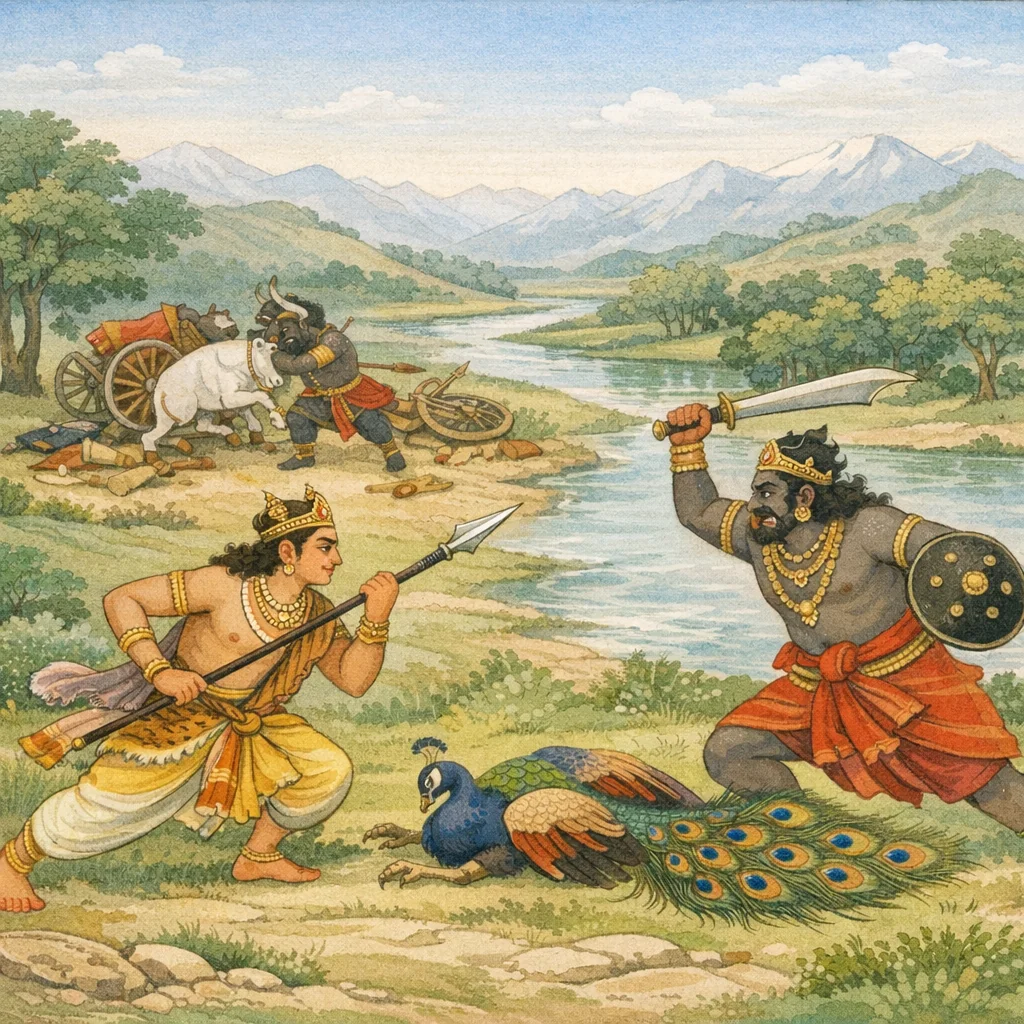
Adhyāya 21 opens with Sanatkumāra recounting how the asuras react on seeing Śiva’s foremost gaṇa-commanders—Nandī (Nandīśvara), Bhṛṅgin/“Ibhamukha” (the elephant-faced gaṇa), and Ṣaṇmukha (Kārttikeya). Enraged, the dānavas surge into ordered single duels (dvaṃdva-yuddha). Niśumbha targets Ṣaṇmukha and shoots five arrows into the heart of his peacock-mount, which collapses senseless; Kārttikeya retaliates by piercing Niśumbha’s chariot and horses and then wounding him with a sharp arrow, roaring in battle-fury. Niśumbha strikes back, and as Kārttikeya reaches for his śakti-spear, Niśumbha swiftly fells him with his own spear. In parallel, Nandīśvara duels Kālanemi: Nandī strikes him and severs vital parts of the chariot—horses, banner (ketu), chariot, and charioteer—provoking Kālanemi’s furious reply, including cutting Nandī’s bow with keen arrows. The chapter highlights tactical escalation, the symbolic disabling of martial apparatus, and the Purāṇic motif of heroic endurance amid wounds, setting the stage for later reversals and the reassertion of divine order.
Shlokas
Verse 1
सनत्कुमार उवाच । ते गणाधिपतीन्दृष्ट्वा नन्दीभमुखषण्मुखान् । अमर्षादभ्यधावंत द्वंद्वयुद्धाय दानवाः
Sanatkumāra said: Seeing the chiefs of Śiva’s gaṇas—Nandī, Bhṛṅgī, and the six-faced Lord Ṣaṇmukha—the dānavas, inflamed with fierce indignation, rushed forward to fight in single combat.
Verse 2
नन्दिनं कालनेमिश्च शुंभो लंबोदरं तथा । निशुंभः षण्मुखं देवमभ्यधावत शंकितः
Alarmed, Niśumbha rushed to assail the six-faced Lord Ṣaṇmukha; Śumbha and Kālanemi advanced against Nandin, and Lambodara too joined in the onslaught.
Verse 3
निशुंभः कार्तिकेयस्य मयूरं पंचभिश्शरैः । हृदि विव्याध वेगेन मूर्छितस्स पपात ह
Niśumbha swiftly pierced Kārtikeya’s peacock in the heart with five arrows; and that mount, stunned into faintness, fell to the ground.
Verse 4
ततः शक्तिधरः क्रुद्धो बाणैः पंचभिरेव च । विव्याध स्यंदने तस्य हयान्यन्तारमेव च
Then Śaktidhara, enraged, with only five arrows pierced his chariot and struck the horses yoked to it, right in their vital inner parts.
Verse 5
शरेणान्येन तीक्ष्णेन निशुंभं देववैरिणम् । जघान तरसा वीरो जगर्ज रणदुर्मदः
Then the valiant warrior, intoxicated with the fervor of battle, swiftly struck Niśumbha—the enemy of the gods—with another sharp arrow, and roared aloud.
Verse 6
असुरोऽपि निशुंभाख्यो महावीरोऽतिवीर्यवान् । जघान कार्तिकेयं तं गर्जंतं स्वेषुणा रणे
Then the asura named Niśumbha—an exceedingly mighty and heroic warrior—struck Kārtikeya, who was roaring on the battlefield, with his own arrow in the midst of combat.
Verse 7
ततश्शक्तिं कार्तिकेयो यावजग्राह रोषतः । तावन्निशुंभो वेगेन स्वशक्त्या तमपातयत्
Then Kārtikeya, in wrath, seized that spear; but at that very moment Niśumbha, with great speed, struck him down with his own spear.
Verse 8
एवं बभूव तत्रैव कार्तिकेयनिशुंभयोः । आहवो हि महान्व्यास वीरशब्दं प्रगर्जतोः
Thus, O great Vyāsa, right there itself a mighty battle arose between Kārtikeya and Niśumbha, as both roared aloud with heroic cries.
Verse 9
ततो नन्दीश्वरो बाणैः कालनेमिमविध्यत । सप्तभिश्च हयान्केतुं रथं सारथिमाच्छिनत्
Then Nandīśvara struck Kālanemi with his arrows; and with seven arrows he cut down the horses, the banner, the chariot, and the charioteer.
Verse 10
कालनेमिश्च संकुद्धो धनुश्चिच्छेद नंदिनः । स्वशरासननिर्मुक्तैर्महातीक्ष्णैश्शिलीमुखैः
Kālanemi, inflamed with wrath, loosed from his own bow-string exceedingly sharp, iron-tipped arrows and severed Nandin’s bow.
Verse 11
अथ नन्दीश्वरो वीरः कालनेमिं महासुरम् । तमपास्य च शूलेन वक्षस्यभ्यहनद्दृढम्
Then the heroic Nandīśvara, evading the great demon Kālanemi, struck him firmly in the chest with his trident.
Verse 12
स शूलभिन्नहृदयो हताश्वो हतसारथिः । अद्रेः शिखरमुत्पाट्य नन्दिनं समताडयत्
Though his heart was pierced by the trident, and though his horses and charioteer were slain, he tore up a mountain peak and struck Nandin with it.
Verse 13
अथ शुंभो गणेशश्च रथमूषक वाहनौ । युध्यमानौ शरव्रातैः परस्परमविध्यताम्
Then Śuṃbha and Gaṇeśa—one mounted on a chariot, the other upon the mouse as his vāhana—fought on, striking each other again and again with volleys of arrows.
Verse 14
गणेशस्तु तदा शुंभं हृदि विव्याध पत्रिणा । सारथिं च त्रिभिर्बाणैः पातयामास भूतले
Then Gaṇeśa pierced Śumbha in the heart with a feathered arrow, and with three arrows he struck down the charioteer to the ground.
Verse 15
ततोऽतिक्रुद्धश्शुंभोऽपि बाणदृष्ट्या गणाधिपम् । मूषकं च त्रिभिर्विद्ध्वा ननाद जलदस्वनः
Then Śumbha, exceedingly enraged, set his arrow-aim upon the Lord of the Gaṇas; and having pierced his mouse-vāhana with three arrows, he roared like thunderclouds.
Verse 16
मूषकश्शरभिन्नाङ्गश्चचाल दृढवेदनः । लम्बोदरश्च पतितः पदातिरभवत्स हि
The mouse, its body pierced by the arrow, staggered in grievous pain. And Lambodara too fell down—indeed, bereft of his mount, he became a foot-soldier.
Verse 17
ततो लम्बोदरश्शुंभं हत्वा परशुना हृदि । अपातयत्तदा भूमौ मूषकं चारुरोह सः
Then Lambodara struck down Śumbha, cleaving his heart with the axe. At that moment he cast him to the ground and mounted his mouse-vāhana again.
Verse 18
समरायोद्यतश्चाभूत्पुनर्गजमुखो विभुः । प्रहस्य जघ्नतुः क्रोधात्तोत्रेणैव महाद्विपम्
Again the mighty Lord with the elephant face stood fully poised for battle. Then, laughing, in wrath he struck down the great elephant, using only the goad as his weapon.
Verse 19
कालनेमिर्निशुंभश्च ह्युभौ लंबोदरं शरैः । युगपच्चख्नतुः क्रोधादाशीविषसमैर्द्रुतम्
Then Kālanemi and Niśumbha—both together—struck Lambodara at once with arrows, in anger, swiftly, their shafts as deadly as venomous serpents.
Verse 20
तं पीड्यमानमालोक्य वीरभद्रो महाबलः । अभ्यधावत वेगेन कोटिभूतयुतस्तथा
Seeing him sorely oppressed, Vīrabhadra, the mighty one, rushed forward with great speed, accompanied likewise by crores of bhūtas.
Verse 21
इति श्रीशिवमहापुराणे द्वितीयायां रुद्रसंहितायां पञ्चमे युद्धखंडे जलंधरोपाख्याने विशे षयुद्धवर्णनं नामैकविंशतितमोऽध्यायः
Thus, in the Śrī Śiva Mahāpurāṇa, in the Second Book—the Rudra Saṃhitā—within the Fifth section, the Yuddha Khaṇḍa, in the narrative of Jalandhara, ends the twenty-first chapter entitled “Description of the Special Battle.”
Verse 22
ततः किलकिला शब्दैस्सिंहनादैश्सघर्घरैः । विनादिता डमरुकैः पृथिवी समकंपत
Then, amid the tumult of clamorous cries, lion-like roars, and harsh rumblings—while the ḍamaru drums resounded—the very earth began to tremble.
Verse 23
ततो भूताः प्रधावंतो भक्षयंति स्म दानवान् । उत्पत्य पातयंति स्म ननृतुश्च रणांगणे
Then the bhūtas rushed forward and began to devour the Dānavas. Leaping up, they struck them down again and again, and they even danced upon the battlefield.
Verse 24
एतस्मिन्नंतरे व्यासाभूतां नन्दीगुहश्च तौ । उत्थितावाप्तसंज्ञौ हि जगर्जतुरलं रणे
Meanwhile, Nandī and Guha—who had been struck down and rendered senseless—regained awareness. Rising again, the two roared mightily on the battlefield.
Verse 26
स नन्दी कार्तिकेयश्च समायातौ त्वरान्वितौ । जघ्नतुश्च रणे दैत्यान्निरंतरशरव्रजैः । छिन्नैर्भिन्नैर्हतैर्दैत्यैः पतितैर्भक्षितैस्तथा । व्याकुला साभवत्सेना विषण्णवदना तदा
Then Nandī and Kārtikeya arrived in haste. In the battle they struck down the Dānavas with unceasing volleys of arrows. As the demons were cut, split, and slain—some falling, some even being devoured—their army grew shaken and bewildered, and at that time their faces turned despondent.
Verse 27
एवं नन्दी कार्तिकेयो विकटश्च प्रतापवान् । वीरभद्रो गणाश्चान्ये जगर्जुस्समरेऽधिकम्
Thus Nandī, Kārtikeya, the mighty Vikaṭa, Vīrabhadra, and the other Gaṇas roared all the more upon the battlefield, revealing the fierce, protective power of Śiva’s hosts as they advanced to uphold dharma.
Verse 28
निशुंभशुंभौ सेनान्यौ सिन्धुपुत्रस्य तौ तथा । कालनेमिर्महादैत्योऽसुराश्चान्ये पराजिताः
Niśumbha and Śumbha—those two commanders of Sindhu’s son—were likewise defeated; and Kālanemi, the great Dānava, along with other Asuras too, was vanquished.
Verse 29
प्रविध्वस्तां ततस्सेनां दृष्ट्वा सागरनन्दनः । रथेनातिपताकेन गणानभिययौ बली
Seeing that army utterly shattered, the mighty son of Sagara advanced against Shiva’s gaṇas, mounting a chariot marked by an exceedingly lofty banner.
Verse 30
ततः पराजिता दैत्या अप्यभूवन्महोत्सवाः । जगर्जुरधिकं व्यास समरायोद्यतास्तदा
Then, though they had been defeated, the Daityas became as if in great celebration. O Vyāsa, at that time, readying themselves again for battle, they roared all the more loudly.
Verse 31
सर्वे रुद्रगणाश्चापि जगर्जुर्जयशालिनः । नन्दिकार्तिकदंत्यास्यवीरभद्रादिका मुने
All the Rudra-gaṇas, radiant with the certainty of victory, roared aloud—O sage—Nandin, Kārtika, Dantyāsya, Vīrabhadra, and the others.
Verse 32
हस्त्यश्वरथसंह्रादश्शंखभेरीरवस्तथा । अभवत्सिंहनादश्च सेनयोरुभयोस्तथा
Then there arose the thunderous clamor of elephants, horses, and chariots, along with the blare of conches and kettledrums. From both armies alike, lion-like war-cries also resounded.
Verse 33
जलंधरशरव्रातैर्नीहारपटलैरिव । द्यावापृथिव्योराच्छन्नमंतरं समपद्यत
By the volleys of Jalandhara’s arrows, like dense sheets of mist, the whole expanse between heaven and earth was covered over and obscured.
Verse 34
शैलादिं पंचभिर्विद्ध्वा गणेशं पंचभिश्शरैः । वीरभद्रं च विंशत्या ननाद जलदस्वनः
That warrior, whose roar was like the thunder of rain-clouds, pierced Śailādi with five shafts, Gaṇeśa with five arrows, and Vīrabhadra with twenty, then bellowed aloud upon the battlefield.
Verse 35
कार्तिकेयस्ततो दैत्यं शक्त्या विव्याध सत्वरम् । जलंधरं महावीरो रुद्रपुत्रो ननाद च
Then Kārttikeya—the mighty son of Rudra—swiftly pierced the demon Jalandhara with his śakti-spear, and, as a great hero, he roared aloud.
Verse 36
स पूर्णनयनो दैत्यः शक्तिनिर्भिन्नदेहकः । पपात भूमौ त्वरितमुदतिष्ठन्महाबलः
That daitya, his eyes wide open and his body pierced by the spear, fell swiftly to the ground; yet, being of great strength, he quickly rose again.
Verse 37
ततः क्रोधपरीतात्मा कार्तिकेयं जलंधरः । गदया ताडयामास हृदये दैत्यपुंगवः
Then Jalandhara—his mind overwhelmed by anger, that foremost of demons—struck Kārttikeya with his mace, hitting him in the region of the heart.
Verse 38
गदाप्रभावं सफलं दर्शयन्शंकरात्मजः । विधिदत्तवराद्व्यास स तूर्णं भूतलेऽपतत्
O Vyāsa, Śaṅkara’s son, demonstrating that the mace’s power had truly taken effect, at once fell upon the ground—overcome by the boon bestowed by Vidhātā (Brahmā).
Verse 39
तथैव नंदी ह्यपतद्भूतले गदया हतः । महावीरोऽपि रिपुहा किंचिद्व्याकुलमानसः
Even so, Nandī fell to the ground, struck by the mace. Though a great hero and slayer of foes, his mind was for a moment somewhat disturbed.
Verse 40
ततो गणेश्वरः क्रुद्धस्स्मृत्वा शिवपदाम्बुजम् । संप्राप्यातिबलो दैत्य गदां परशुनाच्छिनत्
Then Gaṇeśvara, angered, remembered the lotus-feet of Lord Śiva. Becoming exceedingly powerful, he reached the daitya and, with his axe, severed the demon’s mace.
Verse 41
वीरभद्रस्त्रिभिर्बाणैर्हृदि विव्याध दानवम् । सप्तभिश्च हयान्केतुं धनुश्छत्रं च चिच्छिदे
Vīrabhadra pierced the demon in the heart with three arrows; and with seven more he cut down the horses, the banner, the bow, and the parasol.
Verse 42
ततोऽतिक्रुद्धो दैत्येन्द्रश्शक्तिमुद्यम्य दारुणाम् । गणेशं पातयामास रथमन्यं समारुहत्
Then the lord of the Daityas, inflamed with fierce wrath, raised his dreadful spear and struck Gaṇeśa down; thereafter he mounted another chariot.
Verse 43
अभ्यगादथ वेगेन स दैत्येन्द्रो महाबलः । विगणय्य हृदा तं वै वीरभद्रं रुषान्वितः
Then that mighty Daitya king rushed forward with great speed; filled with anger, he inwardly made light of Vīrabhadra, holding him of no account.
Verse 44
वीरभद्रं जघानाशु तीक्ष्णेनाशीविषेण तम् । ननाद च महावीरो दैत्यराजो जलंधरः
Then that demon-king Jalandhara swiftly struck Vīrabhadra with a sharp, serpent-like weapon; and the mighty hero Jalandhara roared aloud.
Verse 45
वीरभद्रोऽपि संकुद्धस्सितधारेण चेषुणा । चिच्छेद तच्छरं चैव विव्याध महेषुणा
Vīrabhadra too, enraged, with a sharp-edged arrow, cut down that missile; and then, with a mighty shaft, he pierced his opponent.
Verse 46
ततस्तौ सूर्यसंकाशौ युयुधाते परस्परम् । नानाशस्त्रैस्तथास्त्रैश्च चिरं वीरवरोत्तमौ
Then those two supreme heroes, radiant like the sun, fought one another for a long time—striking with many kinds of weapons and also with divine missiles.
Verse 47
वीरभद्रस्ततस्तस्य हयान्बाणैरपातयत् । धनुश्चिच्छेद रथिनः पताकां चापि वेगतः
Then Vīrabhadra struck down his horses with arrows. With swift force he also cut the chariot-warrior’s bow and his banner, shattering that combatant’s pride upon the battlefield.
Verse 48
अथो स दैत्यराजो हि पुप्लुवे परिघायुधः । वीरभद्रोपकठं स द्रुतमाप महाबलः
Then the king of the Daityas, wielding an iron bludgeon, leapt forward; mighty in strength, he swiftly came close to Vīrabhadra.
Verse 49
परिघेनातिमहता वीरभद्रं जघान ह । सबलोऽब्धितनयो मूर्ध्नि वीरो जगर्ज च
Then the ocean-born hero, wielding a very mighty iron club, struck Vīrabhadra upon the head; and that valiant one, full of strength, roared aloud.
Verse 50
परिघेनातिमहता भिन्नमूर्द्धा गणाधिपः । वीरभद्रः पपातोर्व्यां मुमोच रुधिरं बहु
Struck by a very mighty iron bar, the leader of the Gaṇas—Vīrabhadra—had his head split; he fell upon the earth and shed much blood.
Verse 51
पतितं वीरभद्रं तु दृष्ट्वा रुद्रगणा भयात् । अपागच्छन्रणं हित्वा क्रोशमाना महेश्वरम्
Seeing Vīrabhadra fallen, the hosts of Rudra became afraid; abandoning the battlefield, they fled away, crying out to Maheśvara (Lord Śiva) for refuge.
Verse 52
अथ कोलाहलं श्रुत्वा गणानां चन्द्रशेखरः । निजपार्श्वस्थितान् वीरानपृच्छद्गणसत्तमान्
Then Candraśekhara (Lord Śiva), hearing the uproar raised by the Gaṇas, questioned the heroic and foremost Gaṇas who stood close by His side.
Verse 53
शंकर उवाच । किमर्थं मद्गणानां हि महाकोलाहलोऽभवत् । विचार्यतां महावीराश्शांतिः कार्या मया ध्रुवम्
Śaṅkara said: “For what reason has this great tumult arisen among My gaṇas? Consider it well, O great heroes. Surely, I must bring about peace.”
Verse 54
यावत्स देवेशो गणान्पप्रच्छ सादरम् । तावद्गणवरास्ते हि समायाताः प्रभुं प्रति
As the Lord of the gods respectfully questioned the gaṇas, at that very time those foremost among the gaṇas indeed came swiftly to their Master.
Verse 55
तान्दृष्ट्वा विकलान्रुद्रः पप्रच्छ इति कुशलं प्रभुः । यथावत्ते गणा वृत्तं समाचख्युश्च विस्तरात्
Seeing them distressed and weakened, Rudra—the Lord—asked after their welfare. Then his gaṇas related to him, exactly as it had happened, the entire account in detail.
Verse 56
तच्छ्रुत्वा भगवानुद्रो महालीलाकरः प्रभुः । अभयं दत्तवांस्तेभ्यो महोत्साहं प्रवर्द्धयन्
Hearing that, the Blessed Lord Rudra—the sovereign who performs great divine play—granted them fearlessness, thereby increasing their great courage.
Frequently Asked Questions
A sequence of dvaṃdva-yuddhas (single-combats) where Niśumbha engages Ṣaṇmukha/Kārttikeya and Kālanemi engages Nandīśvara, featuring weapon exchanges and the disabling of chariots and mounts.
Purāṇic battle symbolism often targets the ‘supports’ of power—mount, horses, banner, and bow—signifying the dismantling of an opponent’s operative capacity and the collapse of adharmic momentum.
Śiva’s executive agencies: Nandīśvara (gaṇa authority) and Ṣaṇmukha/Kārttikeya (martial śakti), presented as instruments through which Rudra’s order is defended.