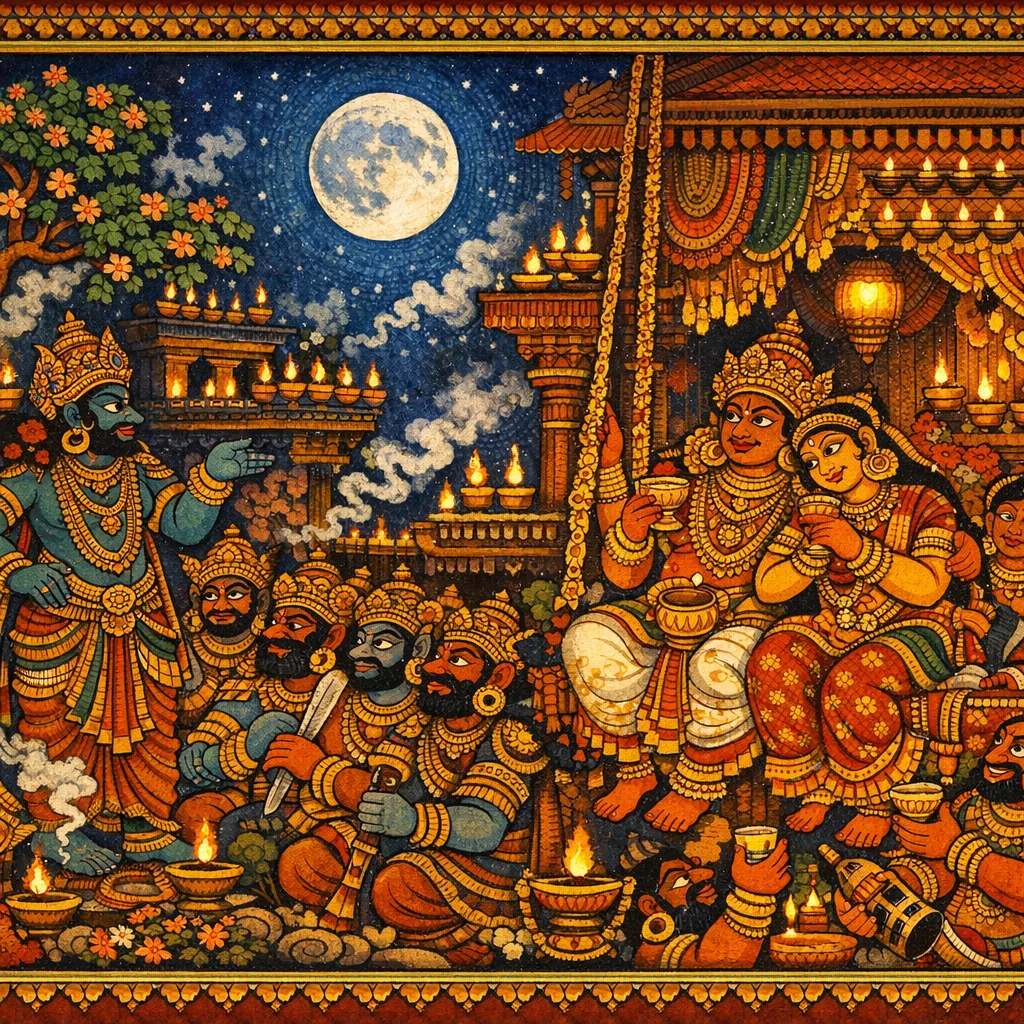
Adhyaya 139: Maya’s War-Counsel to the Danavas and the Moonlit Revels in Tripura (Prelude to Tripura’s Fall)
त्रिपुररक्षणे मयदानवसंवादः
Speaker: Sūta, Mayā (Mayāsura), Dānavas/Daityas of Tripura
Sūta continues the Tripura narrative: after Tāraka is slain, Mayā drives off the Pramathas and addresses the fear-struck Dānavas. He marks the destined time—when the Moon joins Puṣya—and commands them to act without fear at that ordained moment, defending the city with total resolve. The chief tactic is to deflect Maheśvara’s single dreadful chariot so that Rudra cannot release the decisive arrow. The Dānavas roar assent, vow strenuous obedience, and boast of meeting Rudra in battle while claiming fidelity to dharma. The chapter then lingers on Tripura at dusk: moonrise, lamps blazing in streets and homes, fragrant blossoms, music in drinking halls, swings, jeweled ornaments, and erotic sport under Kāma’s sway. It closes with moonlight fading and the Sun rising—an ominous transition toward the next phase of divine retribution.
Key Concepts
Shlokas in Adhyaya 139
Verse 1
*सूत उवाच तारकाख्ये हते युद्धे उत्सार्य प्रमथान्मयः उवाच दानवान्भूयो भूयः स तु भयावृतान् //
Sūta said: When the battle with Tāraka ended in his death, Maya drove off the Pramathas and again and again addressed the Dānavas, who were overwhelmed with fear.
Verse 2
भो ऽसुरेन्द्राधुना सर्वे निबोधध्वं प्रभाषितम् यत्कर्तव्यं मया चैव युष्माभिश्च महाबलैः //
O lords of the Asuras, now all of you listen well to what I am about to declare—what must be done by me, and also by you mighty ones.
Verse 3
पुष्यं समेष्यते काले चन्द्रश्चन्द्रनिभाननाः यदैकं त्रिपुरं सर्वं क्षणमेकं भविष्यति //
In due course the Moon will come into conjunction with Puṣya (the Puṣya nakṣatra); and then, O you whose faces are radiant like the Moon, the whole of Tripura will, as it were, become a single instant—everything collapsing into one moment.
Verse 4
कुरुध्वं निर्भयाः काले कोकिलाशंसितेन च स कालः पुष्ययोगस्य पुरस्य च मया कृतः //
Act without fear at the proper time—indicated by the auspicious call of the kokilā (cuckoo); for that time has been ordained by me for the Puṣya-yoga and for the founding of a city.
Verse 5
काले तस्मिन्पुरे यस्तु संभावयति संहतिम् स एनं कारयेच्चूर्णं बलिनैकैषुणा सुरः //
At that time in the city, whoever perceives the enemy’s compact formation (saṃhati) should have a mighty hero reduce it to powder with a single arrow.
Verse 6
यो वः प्राणो बलं यच्च या च वो वैरितासुराः तत्कृत्वा हृदये चैव पालयध्वमिदं पुरम् //
Whatever is your very life-breath, whatever is your strength, and whichever asuras are hostile to you—holding all that firmly within your heart, protect this city.
Verse 7
महेश्वररथं ह्येकं सर्वप्राणेन भीषणम् विमुखीकुरुतात्यर्थं यथा नोत्सृजते शरम् //
With all one’s strength, one should forcefully turn aside that single, terrifying chariot of Maheśvara, so that it does not release its arrow.
Verse 8
तत एवं कृते ऽस्माभिस् त्रिपुरस्यापि रक्षणे प्रतीक्षिष्यन्ति विवशाः पुष्ययोगं दिवौकसः //
When we have thus undertaken the protection of Tripura as well, the gods—left with no other course—will wait for the auspicious conjunction called Puṣya-yoga.
Verse 9
निशम्य तन्मयस्यैवं दानवास्त्रिपुरालयाः मुहुः सिंहरुतं कृत्वा मयमूचुर्यमोपमाः //
Hearing Mayā’s words thus, the Dānavas who dwelt in Tripura repeatedly let out lion-like roars and then spoke to Mayā—those fierce ones, like Yama himself.
Verse 10
प्रयत्नेन वयं सर्वे कुर्मस्तव प्रभाषितम् तथा कुर्मो यथा रुद्रो न मोक्ष्यति पुरे शरम् //
With full effort, all of us shall carry out what you have declared; we will act in such a way that Rudra will not be able to discharge his arrow against the city.
Verse 11
अद्य यास्यामः संग्रामं तद्रुद्रस्य जिघांसवः कथयन्ति दितेः पुत्रा हृष्टा भिन्नतनूरुहाः //
“Today we shall go to battle, intent on killing that Rudra!”—thus the sons of Diti proclaimed, exultant, their bodies bristling with excitement.
Verse 12
कल्पं स्थास्यति वा खस्थं त्रिपुरं शाश्वतं ध्रुवम् अदानवं वा भविता नारायणपदत्रयम् //
The sky-borne Tripura will endure for a kalpa—eternal and steadfast; and likewise the threefold station of Nārāyaṇa shall remain free from the Daityas (demons).
Verse 13
वयं न धर्मं हास्यामो यस्मिन्योक्ष्यसि नो भवान् अदैवतम् अदैत्यं वा लोकं द्रक्ष्यन्ति मानवाः //
“We shall not abandon dharma. When you yoke us to our task, people will behold a world that is neither godless nor demonic.”
Verse 14
इति संमन्त्र्य हृष्टास्ते पुरान्तर्विबुधारयः प्रदोषे मुदिता भूत्वा चेरुर्मन्मथचारताम् //
Thus, after conferring together, those delighted hosts of gods moved about within the city; at twilight, becoming joyful, they wandered in the sportive ways of Kāma (the god of love).
Verse 15
मुहुर्मुक्तोदयो भ्रान्त उदयाग्रं महामणिः तमांस्युत्सार्य भगवांश् चन्द्रो जृम्भति सो ऽम्बरम् //
Again and again, the great jewel—the Moon—seems to be released into its rising, wavering at the very edge of the horizon; driving away the masses of darkness, that radiant, lordly Moon unfolds and fills the sky.
Verse 16
कुमुदालंकृते हंसो यथा सरसि विस्तृते सिंहो यथा चोपविष्टो वैडूर्यशिखरे महान् //
Like a swan upon a broad lake adorned with white kumuda lotuses, and like a mighty lion seated upon a lofty crest of vaidūrya (the cat’s-eye gem)—so should the revered presence appear: expansive, radiant, and supremely majestic.
Verse 17
विष्णोर्यथा च विस्तीर्णे हारश्चोरसि संस्थितः तथावगाढे नभसि चन्द्रो ऽत्रिनयनोद्भवः भ्राजते भ्राजयंल् लोकान् सृजञ्ज्योत्स्नारसं बलात् //
Just as a necklace rests upon the broad chest of Viṣṇu, so too the Moon—born from Atri’s eye—shines set deep in the sky, illuminating the worlds as it forcefully pours forth the nectar-like essence of moonlight.
Verse 18
शीतांशावुदिते चन्द्रे ज्योत्स्नापूर्णे पुरे ऽसुराः प्रदोषे ललितं चक्रुर् गृहमात्मानमेव च //
When the cool-rayed Moon had risen and the city was filled with moonlight, the Asuras, at twilight (pradoṣa), carried out their graceful revelry and then withdrew each to his own house.
Verse 19
रथ्यासु राजमार्गेषु प्रासादेषु गृहेषु च दीपाश्चम्पकपुष्पाभा नाल्पस्नेहप्रदीपिताः //
In the lanes and on the royal highways, and likewise in palaces and in homes, lamps—shining like campaka blossoms—should be lit with ample oil (ghee), not with a scant supply.
Verse 20
तदा मठेषु ते दीपाः स्नेहपूर्णाः प्रदीपिताः गृहाणि वसुमन्त्येषां सर्वरत्नमयानि च ज्वलतो ऽदीपयन्दीपांश् चन्द्रोदय इव ग्रहाः //
Then, in those monasteries, lamps filled with oil were lit. Their houses, rich in wealth and as though fashioned from every kind of jewel, blazed with radiance—so that the shining lamps seemed to kindle one another, like the stars at the rising of the moon.
Verse 21
चन्द्रांशुभिर्भासमानम् अन्तर्दीपैः सुदीपितम् उपद्रवैः कुलमिव पीयते त्रिपुरे तमः //
In Tripurī, the darkness is as though “drunk up”: the city shines with moonbeams and is brightly lit by lamps within, just as a noble family is consumed by calamities.
Verse 22
तस्मिन्पुरे वै तरुणप्रदोषे चन्द्राट्टहासे तरुणप्रदोषे रत्यर्थिनो वै दनुजा गृहेषु सहाङ्गनाभिः सुचिरं विरेमुः //
In that city, at the tender hour of dusk—when the moonlit night seemed to laugh aloud—those Danuja lords, seeking pleasure, sported for a long time in their houses together with their women.
Verse 23
विनोदिता ये तु वृषध्वजस्य पञ्चेषवस्ते मकरध्वजेन तत्रासुरेष्वासुरपुंगवेषु स्वाङ्गाङ्गनाः स्वेदयुता बभूवुः //
But those who were stirred up by Makaradhvaja—the bannered god of desire, wielder of the five flower-arrows—against Vṛṣadhvaja (Śiva), then among the demons and the foremost of the Asuras, their own women became drenched in perspiration, overcome by passion.
Verse 24
कलप्रलापेषु च दानवीनां वीणाप्रलापेषु च मूर्छितेषु मत्तप्रलापेषु च कोकिलानां सचापबाणो मदनो ममन्थ //
Amid the sweet, artful chatter of the women, amid the swooning strains of the vīṇā, and amid the intoxicated calls of the cuckoos—Kāma (Madana), armed with bow and arrows, churned and stirred the heart.
Verse 25
तमांसि नैशानि द्रुतं निहत्य ज्योत्स्नावितानेन जगद्वितत्य खे रोहिणीं तां च प्रियां समेत्य चन्द्रः प्रभाभिः कुरुते ऽधिराज्यम् //
Swiftly destroying the darkness of night and spreading a canopy of moonlight across the world, the Moon—having met in the sky his beloved Rohiṇī—establishes his sovereign rule through his radiance.
Verse 26
स्थित्वैव कान्तस्य तु पादमूले काचिद्वरस्त्री स्वकपोलमूले विशेषकं चारुतरं करोति तेनाननं स्वं समलंकरोति //
Standing right at her beloved’s feet, a noble woman makes a most charming decorative mark (viśeṣaka) at the base of her own cheek; by that she adorns and beautifies her face.
Verse 27
दृष्ट्वाननं मण्डलदर्पणस्थं महाप्रभा मे मुखजेति जप्त्वा स्मृत्वा वराङ्गी रमणेरितानि तेनैव भावेन रतीमवाप //
Having seen her face reflected in a round mirror, the fair-limbed woman repeatedly murmured, “My great radiance is born from my own face.” Remembering the lover’s words addressed to her, she attained rati—erotic delight—through that very same state of feeling.
Verse 28
रोमाञ्चितैर्गात्रवरैर्युवभ्यो रतानुरागाद् रमणेन चान्याः स्वयं द्रुतं यान्ति मदाभिभूताः क्षपा यथा चार्कदिनावसाने //
Some women, their lovely bodies thrilled with gooseflesh, out of desire for union and love of a lover, go swiftly of their own accord toward young men, overcome by the intoxication of passion—just as night comes on at the end of the sunlit day.
Verse 29
पेपीयते चातिरसानुविद्धा विमार्गितान्या च प्रियं प्रसन्ना काचित्प्रियस्यातिचिरात्प्रसन्ना आसीत्प्रलापेषु च सम्प्रसन्ना //
One woman, steeped in overflowing passion, drinks deeply of delight; another, having sought him out, becomes gracious toward her beloved. Yet another, after a long time, is reconciled with her lover, and in tender conversation becomes fully contented.
Verse 30
गोशीर्षयुक्तैर्हरिचन्दनैश्च पङ्काङ्किताक्षी च वरासुरीणाम् मनोज्ञरूपा रुचिरा बभूवुः पूर्णामृतस्येव सुवर्णकुम्भाः //
Smeared with gośīrṣa and yellow sandalwood paste, and with their eyes darkened by collyrium, those foremost of women appeared exquisitely charming and radiant—like golden jars filled with amṛta, the nectar of immortality.
Verse 31
क्षताधरोष्ठा द्रुतदोषरक्ता ललन्ति दैत्या दयितासु रक्ताः तन्त्रीप्रलापास्त्रिपुरेषु रक्ताः स्त्रीणां प्रलापेषु पुनर्विरक्ताः //
With lips bruised and wounded, inflamed by swiftly rising faults and passions, the Daityas sport—attached to their beloved women. Enamored of the twang and chatter of stringed instruments and of the pleasures of the cities, they grow attached there; yet, when it comes to the lamentations of women, they again become indifferent.
Verse 32
क्वचित्प्रवृत्तं मधुराभिगानं कामस्य बाणैः सुकृतं निधानम् आपानभूमीषु सुखप्रमेयं गेयं प्रवृत्तं त्वथ साधयन्ति //
In some places sweet singing begins—like a treasured store won by the arrows of Kāma; and in drinking-halls they then carry on measured, pleasure-giving songs, setting such music in motion and bringing it to completion.
Verse 33
गेयं प्रवृत्तं त्वथ शोधयन्ति केचित्प्रियां तत्र च साधयन्ति केचित्प्रियां सम्प्रति बोधयन्ति संबुध्य संबुध्य च रामयन्ति //
When a song has begun, some refine it further; some, within it, accomplish what is pleasing; some awaken delight in the listener at once—and, rousing the heart again and again, they continually gladden the audience.
Verse 34
धूतप्रसूनप्रभवः सुबन्धः सूर्ये गते वै त्रिपुरे बभूव समर्मरो नूपुरमेखलानां शब्दश्च संबाधति कोकिलानाम् //
When the sun had set, in Tripurā there arose a sweet fragrance born of scattered blossoms; and the soft, murmuring sound of women’s anklets and girdles mingled—almost crowding in upon—the calls of the cuckoos.
Verse 35
प्रियावगूढा दयितोपगूढा काचित्प्ररूढाङ्गरुहापि नारी सुचारुबाष्पाङ्कुरपल्लवानां नवाम्बुसिक्ता इव भूमिरासीत् //
One woman—embraced by her beloved and clasping her dear one in return—her hairs standing on her limbs, seemed like the earth newly watered, where lovely sprouts and tender leaves arise as tears well up.
Verse 36
शशाङ्कपादैरुपशोभितेषु प्रासादवर्येषु वराङ्गनानाम् माधुर्यभूताभरणा महान्तः स्वना बभूवुर्मदनेषु तुल्याः //
In those excellent palaces of noble women, beautified by moonlight, great sounds arose—made sweet as though they were ornaments—comparable to the stirrings of love.
Verse 37
पानेन खिन्ना दयितातिवेलं कपोलमाजिघ्रसि किं ममेदम् आरोह मे श्रोणिमिमां विशालां पीनोन्नतां काञ्चनमेखलाढ्याम् //
Worn out by drinking, O beloved, you keep kissing and smelling my cheek again and again—what is it in me that so captivates you? Come, mount upon my broad hips, full and high, adorned with a golden girdle.
Verse 38
रथ्यासु चन्द्रोदयभासितासु सुरेन्द्रमार्गेषु च विस्तृतेषु दैत्याङ्गना यूथगता विभान्ति तारा यथा चन्द्रमसो दिवान्ते //
On streets lit by the rising moon, and along broad avenues fit for Indra himself, the women of the Daityas, moving in groups, shine forth—like stars appearing around the moon at the close of day.
Verse 39
अट्टाट्टहासेषु च चामरेषु प्रेङ्खासु चान्या मदलोलभावात् संदोलयन्ते कलसम्प्रहासाः प्रोवाच काञ्ची गुणसूक्ष्मनादा //
Amid peals of loud laughter, with chamara fly-whisks waving, and with others swaying on swings in intoxicated, wavering playfulness, the women gently set the whole scene in motion with their delicate, tinkling laughter; and the jeweled girdle (kāñcī) seemed to ‘speak’ with a fine, subtle resonance from its strings.
Verse 40
अम्लानमालान्वितसुन्दरीणां पर्याय एषो ऽस्ति च हर्षितानाम् श्रूयन्ति वाचः कलधौतकल्पा वापीषु चान्ये कलहंसशब्दाः //
This indeed is the delightful scene of joyous maidens adorned with unfading garlands: their voices—gleaming like refined gold—are heard, and in the stepwells and reservoirs the calls of other swans resound.
Verse 41
काञ्चीकलापश्च सहाङ्गरागः प्रेङ्खासु तद्रागकृताश्च भावाः छिन्दन्ति तासामसुराङ्गनानां प्रियालयान् मन्मथमार्गणानाम् //
Their jeweled girdles, the perfumed unguents upon their limbs, and the love-moods stirred on the swings by that passion—these, like Madana’s arrows striking their mark, tear apart the hearts of the beloveds of the Asura maidens.
Verse 42
चित्राम्बरश्चोद्धृतकेशपाशः संदोल्यमानः शुशुभे ऽसुरीणाम् सुचारुवेशाभरणैरुपेतस् तारागणैर् ज्योतिरिवास चन्द्रः //
Clad in variegated garments, with his locks lifted up and swaying, he shone amid the Asurīs—adorned with splendid attire and ornaments—like the moon, a luminous orb, amid a host of stars.
Verse 43
संदोलनाद् उच्छ्वसितैश्छिन्नसूत्रैः काञ्चीभ्रष्टैर्मणिभिर्विप्रकीर्णैः दोलाभूमिस्तैर्विचित्रा विभाति चन्द्रस्य पार्श्वोपगतैर् विचित्रा //
From the swaying motion, pearls and gems—flung out, their strings snapped and slipped from girdles—lie scattered about; and with them the ground beneath the swing shines in variegated splendor, like the moon’s side adorned with mottled brilliance.
Verse 44
सचन्द्रिके सोपवने प्रदोषे रुतेषु वृन्देषु च कोकिलानाम् शरव्ययं प्राप्य पुरे ऽसुराणां प्रक्षीणबाणो मदनश्चचार //
In the moonlit dusk, in garden groves amid the chorus of cuckoos calling in flocks, Madana (Cupid) came within arrow-range of the city of the Asuras; yet, his arrows spent and weakened, he wandered on.
Verse 45
इति तत्र पुरे ऽमरद्विषाणां सपदि हि पश्चिमकौमुदी तदासीत् / रणशिरसि पराभविष्यतां वै भवतुरगैः कृतसंक्षया अरीणाम् //
Thus, in that city of the gods’ enemies, a “western moonlight,” dim as at dusk, suddenly fell. And on the very field of battle, those destined for defeat had their foes cut down to the last by the steeds (and riders) of Bhava (Śiva).
Verse 46
चन्द्रो ऽथ कुन्दकुसुमाकरहारवर्णो ज्योत्स्नावितानरहितो ऽभ्रसमानवर्णः विछायतां हि समुपेत्य न भाति तद्वद् भाग्यक्षये धनपतिश्च नरो विवर्णः //
Even the moon—white as a garland of jasmine blossoms—when deprived of the canopy of its moonlight, takes on the color of clouds and does not shine, fallen into dullness. In the same way, when good fortune is exhausted, even a wealthy man, a lord of riches, becomes pale and lusterless.
Verse 47
चन्द्रप्रभामरुणसारथिनाभिभूय संतप्तकाञ्चनरथाङ्गसमानबिम्बः स्थित्वोदयाग्रमुकुटे बहुरेव सूर्यो भात्यम्बरे तिमिरतोयवहां तरिष्यन् //
Outshining the moonlight and even Aruṇa, his charioteer, the Sun—whose orb is like a chariot-wheel of heated gold—stands upon the crowned summit of the eastern horizon and blazes in the sky, as though about to cross beyond the darkness-bearing, water-laden masses.
Frequently Asked Questions
The chapter’s central instruction is Mayā’s strategic counsel: defend Tripura with total resolve and, above all, prevent Rudra/Śiva from releasing the single decisive arrow from Maheśvara’s chariot. The narrative frames success and failure around correct timing—Puṣya-yoga—showing how nakṣatra-based time (kāla) is treated as a controlling factor in war, city-security, and destiny.
This adhyāya is primarily mythic narrative and strategic counsel (a Rajadharma-adjacent war/defense theme), with strong Jyotiṣa content via Puṣya-yoga timing. It also carries an Asura-architecture motif through Mayā and Tripura (contextual to Vāstu, though no measurements are given). Genealogy is not a focus; “dharma” appears as a rhetorical claim by the Dānavas rather than a formal dharma-śāstra exposition.