Adhyaya 203
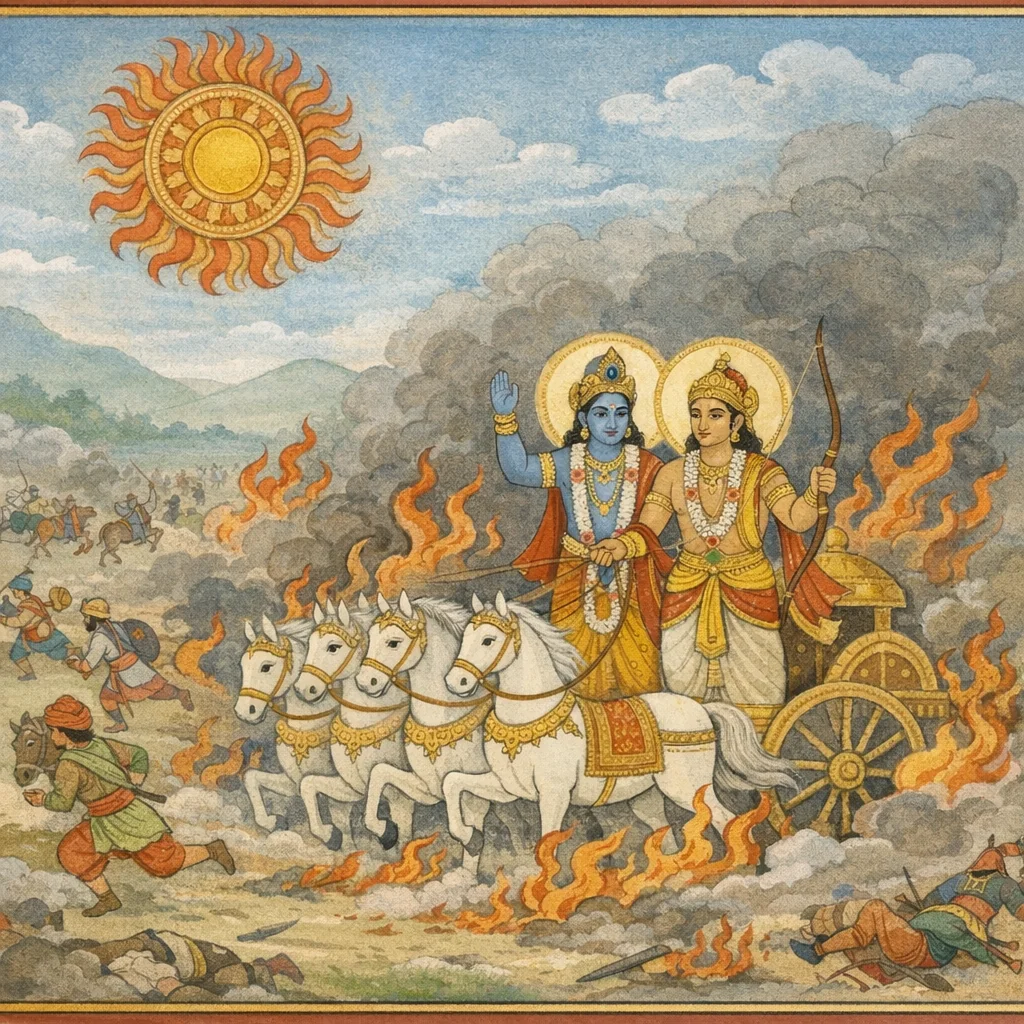
Chapter Arc: अश्वत्थामा के आग्नेयास्त्र के प्रचण्ड प्राकट्य से पाण्डव-सेना में भगदड़ मचती है; श्रीकृष्ण और अर्जुन के प्रयत्न से भी सैनिक ठहर नहीं पाते। → अस्त्र-तेज से दिशाएँ दहक उठती हैं—महाभूत भ्रमित-से, सूर्य घूमता-सा, त्रैलोक्य ज्वरग्रस्त-सा प्रतीत होता है। पाण्डव-पक्ष की एक अक्षौहिणी जलकर नष्ट होने लगती है; अर्जुन अकेले सोमक, मत्स्य और अन्य टुकड़ियों को समेटकर कौरवों की ओर मोड़ते हैं, पर विनाश-वेग थमता नहीं। → आग्नेयास्त्र के तेज से पाण्डवों की पूरी अक्षौहिणी ‘अद्भुत रूप’ से दग्ध दिखाई देती है—युद्धभूमि एक अग्निकुण्ड बन जाती है और समस्त लोक-व्यवस्था डगमगाती-सी लगती है। → व्यास धृतराष्ट्र को इस ‘महत्त्वपूर्ण विषय’ का रहस्य बताने का उपक्रम करते हैं—अस्त्रों के पीछे स्थित दैवी-तत्त्व और तपोबल का संकेत देते हुए प्रसंग को व्याख्या-धारा में मोड़ते हैं; अंततः अस्त्र-प्रभाव से मुक्त होकर श्रीकृष्ण और अर्जुन साथ-साथ प्रकट होते हैं, मानो आकाश में तमोनुद चन्द्र-सूर्य। → व्यास की व्याख्या आगे किस दैवी-नियम/स्तुति (शतरुद्रीय) से जुड़कर इस अस्त्र-प्रलय का अर्थ स्पष्ट करेगी—यह जिज्ञासा बनी रहती है।
Shlokas
Verse 1
#सस्न का + () अजानना एकाधिकंद्विशततमो<्ध्याय: अश्वत्थामाके द्वारा आग्नेयास्त्रके प्रयोगसे एक अक्षौहिणी पाण्डव-सेनाका संहार; श्रीकृष्ण और अर्जुनपर उस अस्त्रका प्रभाव न होनेसे पी अश्वत्थामाको व्यासजीका शिव और महिमा बताना संजय उवाच तत् प्रभग्नं बल॑ दृष्टवा कुन्तीपुत्रो धनंजय: । न्यवारयदमेयात्मा द्रोणपुत्रजयेप्सया,संजय कहते हैं--राजन्! तदनन्तर अमेय आत्मबल-से सम्पन्न कुन्तीकुमार अर्जुनने सेनाको भागती देख द्रोणपुत्रपर विजय पानेकी इच्छासे उसे रोका
Sañjaya said: O King, seeing the army broken and in flight, Kuntī’s son Dhanañjaya (Arjuna)—a man of immeasurable spirit—checked it, driven by the resolve to win victory over Droṇa’s son.
Verse 2
ततस्ते सैनिका राजन् नैव तत्रावतस्थिरे । संस्थाप्यमाना यत्नेन गोविन्देनारजुनेन च,नरेश्वर! श्रीकृष्ण और अर्जुनके द्वारा प्रयत्नपूर्वक ठहराये जानेपर भी वे सैनिक वहाँ खड़े न हो सके
Sañjaya said: Then, O King, your soldiers could not hold their ground there at all. Even though Govinda (Krishna) and Arjuna strove to steady and re-form them, they were unable to stand firm.
Verse 3
एक एव च बीभत्सु: सोमकावयवै: सह । मत्स्यैरन्यैश्व संधाय कौरवान् संन्यवर्तत,अकेले अर्जुन ही सोमकोंकी टुकड़ियों, मत्स्यदेशीय योद्धाओं तथा अन्य लोगोंको साथ लेकर कौरवोंका सामना करनेके लिये लौटे
Sañjaya said: Arjuna—terrible to his foes—alone, yet supported by the Somaka detachments, the warriors of Matsya, and other allies, formed a compact array and turned back to confront the Kauravas.
Verse 4
ततो द्रुतमतिक्रम्य सिंहलाडगूलकेतनम् । सव्यसाची महेष्वासमश्चृत्थामानमब्रवीत्,सव्यसाची अर्जुन सिंहकी पूँछके चिह्नवाली ध्वजासे युक्त महाधनुर्थर अश्वत्थामाके पास तुरंत आकर उससे इस प्रकार बोले--
Sañjaya said: Then Arjuna—renowned as Savyasācī—swiftly advancing past the warrior whose banner bore the emblem of a lion’s tail, addressed Aśvatthāmā, the great archer, saying thus—
Verse 5
या शक्तिर्यच्च विज्ञानं यद् वीर्य यच्च पौरुषम् । धार्तरिष्ट्रेषु या प्रीतिद्वेषो5स्मासु च यश्व ते,“आचार्यपुत्र! तुममें जो शक्ति, जो विज्ञान, जो बल-पराक्रम, जो पुरुषार्थ, कौरवोंपर जो प्रेम तथा हमलोगोंपर जो तुम्हारा द्वेष हो, साथ ही तुममें जो तेज और प्रभाव हो, वह सब मुझपर दिखाओ। द्रोणाचार्यका वध करनेवाला वह धृष्टद्युम्न ही तुम्हारा सारा घमंड चूर कर देगा
Sañjaya said: “O son of the Ācārya, display upon me all that is in you—your power, your discernment, your martial energy, and your manly resolve; the affection you bear toward the Dhārtarāṣṭras and the hatred you hold toward us as well. Let your brilliance and influence be shown in full.”
Verse 6
यच्च भूयो<स्ति तेजस्ते तत् सर्व मयि दर्शय । स एव द्रोणहन्ता ते दर्प छेत्स्यति पार्षत:,“आचार्यपुत्र! तुममें जो शक्ति, जो विज्ञान, जो बल-पराक्रम, जो पुरुषार्थ, कौरवोंपर जो प्रेम तथा हमलोगोंपर जो तुम्हारा द्वेष हो, साथ ही तुममें जो तेज और प्रभाव हो, वह सब मुझपर दिखाओ। द्रोणाचार्यका वध करनेवाला वह धृष्टद्युम्न ही तुम्हारा सारा घमंड चूर कर देगा
Sañjaya said: “And whatever further brilliance and power you possess—show all of it upon me. For that very Pārṣata, Dhṛṣṭadyumna, the slayer of Droṇa, will shatter your pride.”
Verse 7
कालानलसमप्रख्यं द्विषतामन्तकोपमम् | समासादय पाज्चाल्यं मां चापि सहकेशवम् । दर्प नाशयितास्म्यद्य तवोद्वृत्तस्य संयुगे,“कालाग्निके समान तेजस्वी तथा शत्रुओंके लिये यमराजके समान भयंकर पांचालराजकुमार धृष्टद्युम्नपर तथा श्रीकृष्णसहित मुझपर भी तुम आक्रमण करो। तुम बड़े उद्दण्ड हो रहे हो। आज युद्धमें मैं तुम्हारा सारा घमंड दूर कर दूँगा”
Sañjaya said: “Assail the Pāñcāla prince—Dhṛṣṭadyumna—who blazes like the fire of Time and is, to his enemies, as dreadful as Death itself; and attack me as well, together with Keśava (Kṛṣṇa). You have grown insolent; today, on the battlefield, I shall shatter all your pride.”
Verse 8
धृतराष्ट्र रवाच आचार्य पुत्रो मानाहों बलवांश्वापि संजय । प्रीतिर्धनंजये चास्य प्रियश्षापि महात्मन:,धृतराष्ट्रने पूछा--संजय! आचार्यपुत्र अश्वत्थामा बलवान् और सम्मानके योग्य है। उसका अर्जुनपर प्रेम है और वह भी महात्मा अर्जुनको प्रिय है। अर्जुनका उसके प्रति ऐसा कठोर वचन पहले कभी नहीं सुना गया। फिर उस दिन कुन्तीकुमार अर्जुनने अपने मित्रके प्रति वैसी कठोर बात क्यों कही?
Dhṛtarāṣṭra said: “Sañjaya, I consider the preceptor’s son Aśvatthāman to be strong and worthy of honor. He bears affection for Dhanañjaya (Arjuna), and that great-souled Arjuna too holds him dear. I have never before heard Arjuna speak such harsh words to him. Why, then, did Kuntī’s son Arjuna on that day address his friend with such severity?”
Verse 9
न भूतपूर्व बीभत्सोर्वाक्यं परुषमीदृशम् । अथ कस्मात् स कौन्तेय: सखायं रूक्षमुक्तवान्,धृतराष्ट्रने पूछा--संजय! आचार्यपुत्र अश्वत्थामा बलवान् और सम्मानके योग्य है। उसका अर्जुनपर प्रेम है और वह भी महात्मा अर्जुनको प्रिय है। अर्जुनका उसके प्रति ऐसा कठोर वचन पहले कभी नहीं सुना गया। फिर उस दिन कुन्तीकुमार अर्जुनने अपने मित्रके प्रति वैसी कठोर बात क्यों कही?
Sanjaya said: “Never before has such harsh speech been heard from Arjuna (Bībhatsu). Why, then, did that son of Kuntī address his friend with such rough words?”
Verse 10
संजय उवाच युवराजे हते चैव वृद्धक्षत्रे च पौरवे । इष्वस्त्रविधिसम्पन्ने मालवे च सुदर्शने
Sañjaya said: When the young prince had been slain, and also Vṛddhakṣatra the Paurava—both accomplished in the disciplines of archery and missile-weapons—and when the Mālava (warrior) Sudarśana too had fallen…
Verse 11
धृष्टय्युम्ने सात्यकौ च भीमे चापि पराजिते । युधिष्ठिरस्य॒ तैर्वाक्यैर्मर्मण्यपि च घट्टिते
Sañjaya said: When Dhṛṣṭadyumna, Sātyaki, and Bhīma had been defeated, and when Yudhiṣṭhira too was struck to the quick—as though their words had bruised his very vital points—the moral weight of that hour lay not only in the loss upon the battlefield, but in the piercing reproach and counsel that shook the king’s resolve and sense of duty.
Verse 12
अन्तर्भेदे च संजाते दुःखं संस्मृत्य च प्रभो । अभूतपूर्वो बीभत्सोर्दु:खान्मन्युरजायत
Sañjaya said: “O lord, when dissension arose within their ranks, and recalling the sorrow, an unprecedented wrath was born in Bhībhatsu (Arjuna) out of grief.”
Verse 13
संजयने कहा--प्रभो! चेदिदेशके युवराज, पौरव वृद्धक्षत्र तथा बाणोंके प्रयोगमें कुशल मालवराज सुदर्शनके मारे जानेपर धूृष्टद्युम्मन, सात्यकि और भीमसेनके परास्त हो जानेपर अर्जुनके मनमें बड़ा कष्ट हुआ था। इसके सिवा, युधिष्ठिरके उन व्यंगवचनोंसे उनके मर्मस्थलमें बड़ी चोट पहुँची थी और पहलेके दुःखोंका स्मरण करके भी उनका हृदय फट गया था; अतः: अधिक खेदके कारण अर्जुनके मनमें अभूतपूर्व क्रोध जाग उठा || १०-- १२ || तस्मादनर्हमशलीलमप्रियं द्रौणिमुक्तवान् | मान्यमाचार्यतनयं रूक्ष॑ं कापुरुषं यथा,इसीलिये माननीय आचार्यपुत्र अश्वत्थामाके प्रति, जो कठोर वचन सुननेके योग्य नहीं था, अर्जुनने कायर मनुष्यसे कहनेयोग्य अश्लील, अप्रिय और कठोर बातें कह डालीं
Sañjaya said: “O lord! When the prince of Cedi was slain, and the aged Paurava warrior and Sudarśana, king of the Mālavas skilled in the use of arrows, were also killed; when Dhṛṣṭadyumna, Sātyaki, and Bhīmasena were defeated, great anguish seized Arjuna. Moreover, Yudhiṣṭhira’s barbed words struck him in his most sensitive place; remembering former sorrows, his heart seemed to split. Therefore, from excess of grief, an unprecedented anger awoke in Arjuna. And so he spoke to Aśvatthāman, Droṇa’s son—revered, and not fit to be addressed with harsh speech—unworthy words, indecent and bitter, such as one would hurl at a coward.”
Verse 14
एवमुक्त: श्वसन् क्रोधान्महेष्वासतमो नृप । पार्थेन परुषं वाक््यं सर्वमर्मभिदा गिरा,नरेश्वर! जब अर्जुनने सारे मर्मस्थानोंको विदीर्ण कर देनेवाली वाणीद्वारा उससे ऐसी कठोर बात कह दी, तब श्रेष्ठ महाधनुर्धर अश्व॒त्थामा क्रोधके मारे लंबी साँस लेने लगा
Sañjaya said: Thus addressed, O king, the foremost of great bowmen began to breathe hard in anger, after Pārtha had spoken to him harshly—words that struck at every vital point.
Verse 15
द्रौणिश्वुकोप पार्थाय कृष्णाय च विशेषतः । स तु यत्तो रथे स्थित्वा वार्युपस्पृश्य वीर्यवान्
Sañjaya said: Aśvatthāman, Droṇa’s son, flared up in anger against Pārtha (Arjuna) and, in particular, against Kṛṣṇa. Yet that mighty warrior, restraining himself, remained standing on his chariot and performed the rite of touching water—an act of composed preparation before action.
Verse 16
दृश्यादृश्यानरिगणानुद्दिश्याचार्यनन्दन:,फिर धूमरहित अग्निके समान एक तेजस्वी बाणको अभिमन्त्रित करके शत्रुवीरोंका संहार करनेवाले आचार्यनन्दन अभश्रत्थामाने सर्वथा क्रोधावेशसे युक्त हो उसे प्रत्यक्ष और परोक्ष शत्रुओंके उद्देश्यसे चला दिया
Sañjaya said: Aśvatthāmā, the son of the preceptor, overwhelmed on every side by a surge of wrath, invoked a radiant arrow blazing like smokeless fire. Aiming it against the host of enemies—those visible and those hidden—he released it, intent on the destruction of the opposing warriors. The verse underscores how anger, once enthroned, turns even consecrated power into an instrument of indiscriminate ruin.
Verse 17
सोऊभिमन्त्र्य शरं दीप्तं विधूममिव पावकम् | सर्वतः क्रोधमाविश्य चिक्षेप परवीरहा,फिर धूमरहित अग्निके समान एक तेजस्वी बाणको अभिमन्त्रित करके शत्रुवीरोंका संहार करनेवाले आचार्यनन्दन अभश्रत्थामाने सर्वथा क्रोधावेशसे युक्त हो उसे प्रत्यक्ष और परोक्ष शत्रुओंके उद्देश्यसे चला दिया
Sañjaya said: Having first empowered a blazing arrow with mantras—like smokeless fire—Aśvatthāmā, the slayer of enemy heroes, seized by wrath on every side, hurled it forth, aiming to strike both seen and unseen foes. The scene underscores how consecrated power, when driven by uncontrolled anger, becomes a fearsome instrument of indiscriminate destruction in war.
Verse 18
ततस्तुमुलमाकाशे शरवर्षमजायत । पावकार्चि: परीतं तत् पार्थमेवाभिपुप्लुवे,फिर तो आकाशमें बाणोंकी भयंकर वर्षा होने लगी और सब ओर फैली हुई आगकी लपटें अर्जुनपर ही टूट पड़ीं
Sañjaya said: Then, in the sky, a tumultuous rain of arrows arose. Surrounded by tongues of blazing fire, that onslaught surged forth and fell chiefly upon Pārtha (Arjuna), as though the battle’s fury were converging on him alone.
Verse 19
उल्काश्च गगनात् पेतुर्दिशश्व॒ न चकाशिरे । तमश्न सहसा रौद्रं चमूमवततार ताम्,आकाशसे उल्काएँ गिरने लगीं, दिशाओंका प्रकाश लुप्त हो गया और उस सेनामें सहसा भयानक अन्धकार उतर आया
Sañjaya said: Meteors began to fall from the sky; the quarters no longer shone. And suddenly a fierce, dreadful darkness descended upon that army—an ominous sign that the war’s violence was reaching a terrifying pitch.
Verse 20
रक्षांसि च पिशाचाश्न विनेदुरतिसड्रता: । ववुश्चवाशिशिरा वाता: सूर्यो नैव तताप च,राक्षत और पिशाच परस्पर मिलकर जोर-जोरसे गर्जना करने लगे, गरम हवा चलने लगी और सूर्यका ताप क्षीण हो गया
Sañjaya said: “The rākṣasas and piśācas, seized by fierce agitation, began to howl and roar loudly. Chilling winds blew, and even the sun seemed to lose its heat.” The verse signals an ominous turning in the war—nature and unseen forces mirror the moral and emotional turbulence on the battlefield, foreshadowing heightened violence and disorder.
Verse 21
वायसाश्चापि चाक्रन्दन् दिक्षु सर्वासु भैरवम् । रुधिरं चापि वर्षन्तो विनेदुस्तोयदा दिवि,कौए सम्पूर्ण दिशाओंमें काँव-काँव करके भयानक कोलाहल मचाने लगे तथा मेघ रक्तकी वर्षा करते हुए आकाशमें गरजने लगे
Sañjaya said: “Crows, too, began to cry out dreadfully in every direction; and the rain-clouds, as though pouring down blood, roared in the sky.”
Verse 22
पक्षिण: पशवो गावो विनेदुश्चापि सुव्रता: । परम॑ प्रयतात्मानो न शान्तिमुपलेभिरे,पक्षी और गाय आदि पशु भी चीत्कार करने लगे। उत्तम व्रतका पालन करनेवाले शुद्धचित्त साधु पुरुष भी अत्यन्त अशान्त हो उठे
Sañjaya said: “Even the birds, the beasts, and the cows began to cry out. And those disciplined, pure-minded men—faithful to noble vows—found no peace at all.”
Verse 23
भ्रान्तसर्वमहाभूतमावर्तितदिवाकरम् | त्रैलोक्यमभिसंतप्तं ज्वराविष्टमिवाभवत्,सम्पूर्ण महाभूत मानो चक्कर काट रहे थे। सूर्य भी घूमता-सा प्रतीत होता था। तीनों लोकोंके प्राणी ज्वरग्रस्तके समान संतप्त हो उठे थे
Sañjaya said: “All the great elements seemed to reel in confusion, and even the sun appeared to whirl. The three worlds grew intensely scorched, as though seized by a burning fever.”
Verse 24
अश्वत्थामाके द्वारा अर्जुनपर आग्नेयास्त्रका प्रयोग एवं उसके द्वारा पाण्डव-सेनाका संहार अस्त्रतेजो$भिसंतप्ता नागा भूमिशयास्तथा । निःश्वसन्तः समुत्पेतुस्तेजो घोरं मुमुक्षव:,पृथ्वीपर पड़े रहनेवाले नाग भी उस अस्त्रके तेजसे संतप्त हो भयंकर आगसे छुटकारा पानेके लिये फुफकारते हुए ऊपर उछलने लगे
Sañjaya said: “Even the serpents that lay upon the earth, scorched by the blazing energy of that weapon, began to hiss and leap upward, desperate to escape the dreadful heat.”
Verse 25
जलजानि च सत्त्वानि दहमानानि भारत । न शान्तिमुपजम्मुर्हि तप्यमानैर्जलाशयै:,भारत! जलाशय भी तप गये थे, जिससे दग्ध होनेवाले जलचर प्राणियोंको भी शान्ति नहीं मिल पाती थी
Sañjaya said: “O Bhārata, even the water-born creatures, burning in that heat, could find no relief; for the very lakes and reservoirs themselves had grown scorching.”
Verse 26
दिग्भ्य: प्रदिग्भ्य: खाद् भूमे: सर्वत: शरवृष्टय: । उच्चावचा निपेतुर्वे गरुड़ानिलरंहस:,दिशा, विदिशा, आकाश और पृथ्वी सब ओरसे छोटे-बड़े नाना प्रकारके बाणोंकी वर्षा होने लगी, वे सभी बाण गरुड़ और वायुके समान वेगशाली थे
Sañjaya said: From every direction and intermediate quarter, from the sky and from the earth on all sides, showers of arrows began to fall—some high, some low, of many kinds—each speeding like Garuḍa and the rushing wind. The scene signals the battle’s total engulfment, where martial prowess overwhelms the field and the moral weight of violence presses upon all who witness it.
Verse 27
तैः शरैद्रोणपुत्रस्य वजवेगै: समाहता: । प्रदग्धा रिपव: पेतुरग्निदग्धा इव द्रुमा:,द्रोणपुत्रके चलाये हुए उन वज्रके समान वेगशाली बाणोंसे घायल हुए शत्रुसैनिक आगके जलाये हुए वृक्षोंके समान दग्ध होकर गिरने लगे
Sañjaya said: Struck by those arrows of Droṇa’s son—swift as a thunderbolt—the enemy warriors, as if scorched, began to fall, like trees burned down by fire. The passage underscores the terrifying momentum of battle, where martial prowess, once unleashed, reduces opponents to helpless collapse, raising the ethical weight of violence even amid a kṣatriya war.
Verse 28
दहामाना महानागा: पेतुरुर्व्या समनन््ततः । नदन्तो भैरवान् नादाज्जलदोपमनि:स्वनान्,विशालकाय गजराज दग्ध हो-होकर मेघकी गर्जनाके समान भयंकर चीत्कार करते हुए सब ओर धराशायी होने लगे
Sañjaya said: As they were being scorched, the great elephants collapsed to the earth on every side, bellowing dreadful cries—sounds like thunderclouds—while their massive bodies burned amid the carnage of war.
Verse 29
अपरे प्रद्रुता नागा भयत्रस्ता विशाम्पते । भ्रेमुर्दिशो यथा पूर्व वने दावाग्निसंवृता:,प्रजानाथ! भयभीत होकर भागे हुए दूसरे बहुत-से हाथी सम्पूर्ण दिशाओंमें उसी प्रकार चक्कर काटने लगे, जैसे पहले वनमें दावानलसे घिर जानेपर वे चारों ओर चक्कर लगाते थे
Sañjaya said: O lord of the people, other elephants too, panic-stricken and fleeing, began to wheel about in every direction—just as they once circled helplessly in a forest when surrounded by a raging wildfire. The image underscores how fear in war scatters even the mighty, driving them into blind, self-preserving motion rather than ordered action.
Verse 30
ट्रमाणां शिखराणीव दावदग्धानि मारिष | अश्वव्न्दान्यदृश्यन्त रथवृन्दानि भारत
Sañjaya said: “O noble one, O Bhārata, the clusters of chariots and the herds of horses appeared as though they were mountain-peaks of trees scorched by a forest-fire—blackened, broken, and stripped of their former splendor.”
Verse 31
अपतन्त रथौघाश्ष तत्र तत्र सहस्रश: | माननीय नरेश! भारत! अश्वसमूह तथा रथवृन्द दावानलसे दग्ध हुए वृक्षोंके अग्रभागके समान दिखायी दे रहे थे और जहाँ-तहाँ सहस्रों रथसमूह गिरे पड़े थे || ३० ई ।। तत् सैन्यं भयसंविग्नं ददाह युधि भारत
Sañjaya said: “O revered king, descendant of Bharata, chariot-formations were collapsing in thousands here and there. The masses of horses and clusters of chariots looked like the scorched tops of trees consumed by a forest-fire; and in many places, countless chariots lay fallen. That army, shaken by fear, was being consumed in the battle, O Bhārata.”
Verse 32
दृष्टवा तु पाण्डवीं सेना दह्यमानां महाहवे
Sañjaya said: Seeing the Pāṇḍava army burning in the great battle, he reports the scene as one of overwhelming destruction—an image that underscores how war, once unleashed, consumes even the righteous side, testing resolve and dharma amid chaos.
Verse 33
ततस्तूर्यसहस्राणि नानालिज्रानि भारत
Then, O Bhārata, thousands of war-instruments—trumpets and other resounding signals of many kinds—were sounded, heightening the tumult of battle and stirring the warriors’ resolve.
Verse 34
कृत्स्ना हाक्षीहिणी राजन् सव्यसाची च पाण्डव:
Sañjaya said: “O King, the entire akṣauhiṇī (full army-division) and the Pāṇḍava archer Savyasācī (Arjuna) as well…” (The line signals the scale of forces and the central presence of Arjuna, framing the episode in terms of overwhelming martial power and the moral weight borne by the principal warrior.)
Verse 35
नैव नस्तादृशं राजन दृष्टपूर्व न च श्रुतम्
Sañjaya said: “O King, never before have we seen anything like this, nor have we even heard of it.”
Verse 36
अर्जुनस्तु महाराज ब्राद्ममस्त्रमुदैरयत्
Sañjaya said: O great king, Arjuna then unleashed the Brahmā-weapon—invoking a supreme, sacred force amid the battle, a moment that showed how the war had escalated to the use of extraordinary powers whose deployment bears grave moral weight.
Verse 37
सर्वस्त्रिप्रतिघातार्थ विहितं पद्मययोनिना । महाराज! उस समय अर्जुनने ब्रह्मास्त्रको प्रकट किया; जिसे ब्रह्माजीने सम्पूर्ण अस्त्रोंके विनाशके लिये बनाया है ।। ततो मुहूर्तादिव तत् तमो व्युपशशाम ह
Sañjaya said: “O great king, at that time Arjuna brought forth the Brahmāstra—ordained by Brahmā, the lotus-born, for the purpose of countering and destroying all other weapons. Then, as if within a mere moment, that enveloping darkness subsided.”
Verse 38
तत्राद्भुतमपश्याम कृत्स्नामक्षौहिणीं हताम्
Sañjaya said: “There we beheld a marvel—an entire akṣauhiṇī (a full battle-division) lying slain.”
Verse 39
ततो वीरौ महेष्वासौ विमुक्तौ केशवार्जुनौ
Sañjaya said: Then those two heroic masters of the great bow—Keśava and Arjuna—were released, resuming their freedom of action amid the battle’s press.
Verse 40
ततो गाण्डीवधन्वा च केशवश्चाक्षतावुभौ,उस समय गाण्डीवधारी अर्जुन और भगवान् श्रीकृष्ण दोनोंके शरीरपर आँच नहीं आने पायी थी। पताका, ध्वज, अश्व, अनुकर्ष और श्रेष्ठ आयुधोंसहित मुक्त हुआ उनका वह रथ आपके सैनिकोंको भयभीत करता हुआ चमक उठा
Sañjaya said: Then both Arjuna, the wielder of the Gāṇḍīva, and Keśava (Kṛṣṇa) remained unscathed—no harm could touch their bodies. Freed and intact, their chariot, furnished with banner and standard, horses, reins, and excellent weapons, shone forth, striking fear into your troops.
Verse 41
सपताकध्वजहय: सानुकर्षवरायुध: । प्रबभौ स रथो मुक्तस्तावकानां भयंकर:,उस समय गाण्डीवधारी अर्जुन और भगवान् श्रीकृष्ण दोनोंके शरीरपर आँच नहीं आने पायी थी। पताका, ध्वज, अश्व, अनुकर्ष और श्रेष्ठ आयुधोंसहित मुक्त हुआ उनका वह रथ आपके सैनिकोंको भयभीत करता हुआ चमक उठा
At that moment, Arjuna, bearer of the Gāṇḍīva, and the Lord Śrī Kṛṣṇa allowed no scorch to touch their bodies. Their chariot—released (from the weapon’s grip)—adorned with banner and standard, horses, reins, and finest arms, blazed forth, terrifying your troops.
Verse 42
हु ढ़ है (हे ततः किलकिलाशब्द: शड्खभेरीस्वनै: सह । पाण्डवानां प्रहृष्टानां क्षेन समजायत,तब पाण्डव हर्षसे खिल उठे और क्षणभरमें शंख तथा भेरियोंकी ध्वनिके साथ उनका आनन्दमय कोलाहल गूँज उठा
Sañjaya said: Then, in an instant, a jubilant clamour arose among the delighted Pāṇḍavas, mingling with the blare of conches and the resounding beat of war-drums. That sound marked their surge of confidence and shared resolve, as they bore the moral weight of battle while remaining steadfast to the cause they had chosen.
Verse 43
हताविति तयोरासीत् सेनयोरुभयोर्मतिः । तरसाभ्यागतौ दृष्टवा सहितौ केशवार्जुनौ,श्रीकृष्ण और अर्जुनके सम्बन्धमें उन दोनों ही सेनाओंको यह विश्वास हो गया था कि वे मारे गये। फिर उन दोनोंको एक साथ वेगपूर्वक निकट आया देख सबको बड़ी प्रसन्नता हुई
Sañjaya said: Both armies had come to believe that Kṛṣṇa and Arjuna had been slain. But when they saw Keśava and Arjuna approaching again together with great speed, a wave of relief and joy spread through the host—showing how swiftly fear and rumor sway minds in war, and how the presence of righteous leadership restores morale and steadiness.
Verse 44
तावक्षतौ प्रमुदितौ दध्यतुर्वारिजोत्तमौ । दृष्टवा प्रमुदितान् पार्थास्त्वदीया व्यथिता भृशम्,उन दोनोंके शरीरमें क्षति नहीं पहुँची थी। वे दोनों वीर आनन्दमग्न हो अपने उत्तम शंख बजाने लगे। कुन्तीके पुत्रोंको प्रसन्न देखकर आपके पुत्रोंके मनमें बड़ी व्यथा हुई
Neither of them had suffered any injury. Exultant, the two heroes blew their finest conches. Seeing the sons of Kuntī rejoicing, your sons were stricken with intense anguish.
Verse 45
विमुक्तौ च महात्मानौ दृष्टवा द्रौणि: सुदु:खित: । मुहूर्त चिन्तयामास किं त्वेतदिति मारिष,माननीय नरेश! महात्मा श्रीकृष्ण और अर्जुनको आग्नेयास्त्रसे मुक्त देख अश्वत्थामाको बड़ा दुःख हुआ। वह दो घड़ीतक इसी चिन्तामें डूबा रहा कि “यह क्या हो गया?”
Sañjaya said: Seeing those two great-souled heroes—Kṛṣṇa and Arjuna—released from the Fire-weapon (Agneyāstra), Droṇa’s son Aśvatthāmā was overwhelmed with grief. For a while he remained absorbed in thought, wondering, “How has this happened, sir?”
Verse 46
चिन्तयित्वा तु राजेन्द्र ध्यानशोकपरायण: । निःश्वसन् दीर्घमुष्णं च विमनाश्चाभवत् ततः
Sañjaya said: O king, after reflecting deeply, absorbed in brooding grief, he heaved a long, hot sigh; and then his spirit sank into dejection.
Verse 47
राजेन्द्र! चिन्ता और शोकमें मग्न होकर कुछ देरतक विचार करनेके पश्चात् अश्वत्थामा गरम-गरम दीर्घ उच्छवास लेने लगा और मन-ही-मन उदास हो गया ।। ततो द्रौणिर्धनुस्त्यक्त्वा रथात् प्रस्कन्द्य वेगित: । धिग् धिक् सर्वमिदं मिथ्येत्युक्त्वा सम्प्राद्रवद् रणात्
O king, absorbed in anxious thought and grief, after pondering for a while Aśvatthāmā began to draw long, hot breaths and grew despondent within. Then Droṇi cast aside his bow, sprang swiftly from his chariot, and crying, “Shame! Shame! All this is false,” ran from the battlefield.
Verse 48
तत्पश्चात् द्रोणकुमार धनुष त्यागकर रथसे कूद पड़ा और “धिक्कार है! धिककार है!! यह सब मिथ्या है' ऐसा कहकर वह रणभूमिसे वेगपूर्वक भाग चला ।। ततः स्निग्धाम्बुदाभासं वेदावासमकल्मषम् | वेदव्यासं सरस्वत्यावासं व्यासं ददर्श ह,इतनेमेंही उसे स्निग्ध मेघके समान श्याम कान्तिवाले, वेद और सरस्वतीके आवास- स्थान तथा वेदोंका विस्तार करनेवाले, पापशून्य महर्षि व्यास वहाँ दिखायी दिये
After that, Droṇa’s son cast aside his bow, leapt down from his chariot, and crying, “Shame! Shame! All this is false,” fled swiftly from the battlefield. Just then he beheld the sage Vyāsa—dark-hued like a dense rain-cloud, stainless in sin, the very abode of the Vedas and of Sarasvatī, and the expander and arranger of Vedic knowledge—standing there before him.
Verse 49
त॑ं द्रौणिरग्रतो दृष्टवा स्थितं कुरुकुलोद्वह । सन्नकण्ठोडब्रवीद् वाक्यमभिवाद्य सुदीनवत्,कुरुकुलके श्रेष्ठ पुरुष! महर्षि व्यासको सामने खड़ा देख द्रोणकुमारका गला आँसुओंसे भर आया। उसने अत्यन्त दीनभावसे प्रणाम करके उनसे इस प्रकार पूछा --
Sañjaya said: Seeing him standing before him—O foremost of the Kuru line—Droṇa’s son became choked with emotion. After bowing in reverence, he spoke in a deeply humbled, despondent manner.
Verse 50
५ ]/7 १0) ॥ ५८८, थ्र्टा श्व्ट ॥/९ २2०.४ है ४ ५। भो भो माया यदच्छा वा न विद्य: किमिदं भवेत् । अस्त्रं त्विदं कथं मिथ्या मम कश्न व्यतिक्रम:,“महर्षे! यह माया है या दैवेच्छा। मेरी समझमें नहीं आता कि यह क्या है? यह अस्त्र झूठा कैसे हो गया? मुझसे कौन-सी गलती हो गयी?
He said: “O great sage! Is this illusion, or the working of fate? I cannot understand what this has become. How has this weapon turned futile? What transgression—what mistake—has been committed by me?”
Verse 51
अधरोत्तरमेतद् वा लोकानां वा पराभव: । यदिमौ जीवत: कृष्णौ कालो हि दुरतिक्रम:,“इस (आग्नेय) अस्त्रके प्रभावमें कोई उलट-फेर तो नहीं हो गया अथवा सम्पूर्ण लोकोंका पराभव होनेवाला है, जिससे ये दोनों कृष्ण जीवित बच गये। निश्चय ही कालका उल्लंघन करना अत्यन्त कठिन है
Sañjaya said: “Has some reversal occurred in the working of this (Agneya) weapon, or is it that the very worlds are destined for defeat—since these two ‘Kṛṣṇas’ have survived alive? For Time indeed is exceedingly hard to overstep.”
Verse 52
नासुरा न च गन्धर्वा न पिशाचा न राक्षसा: । न सर्पा यक्षपतगा न मनुष्या: कथंचन,“मेरे द्वारा प्रयोग किये हुए इस अस्त्रको असुर, गन्धर्व, पिशाच, राक्षस, सर्प, यक्ष, पक्षी और मनुष्य किसी तरह भी व्यर्थ नहीं कर सकते थे, तो भी यह प्रज्वलित अस्त्र केवल एक अक्षौहिणी सेनाको जलाकर शान्त हो गया
Sanjaya said: Neither the Asuras nor the Gandharvas, neither the Piśācas nor the Rākṣasas; neither serpents, nor Yakṣas, nor birds, nor human beings could in any way render futile the weapon I had discharged. Yet that blazing missile, after burning only a single akṣauhiṇī of troops, subsided and became calm.
Verse 53
उत्सहन्ते3न्यथा कर्तुमेतदस्त्रं मयेरितम् तदिदं केवल हत्वा शान्तमक्षौहिणीं ज्वलत्,“मेरे द्वारा प्रयोग किये हुए इस अस्त्रको असुर, गन्धर्व, पिशाच, राक्षस, सर्प, यक्ष, पक्षी और मनुष्य किसी तरह भी व्यर्थ नहीं कर सकते थे, तो भी यह प्रज्वलित अस्त्र केवल एक अक्षौहिणी सेनाको जलाकर शान्त हो गया
Sanjaya said: “No being could in any way render futile this weapon that I had discharged. Yet this blazing missile, after consuming only a single akṣauhiṇī of troops, became pacified.”
Verse 54
सर्वघाति मया मुक्तमस्त्रं परमदारुणम् | केनेमौ मर्त्यधर्माणौ नावधीत् केशवार्जुनौ
Sañjaya said: “I released a supremely dreadful weapon, capable of destroying all. Yet how is it that these two—Keśava and Arjuna—though subject to mortal conditions, were not slain by it?”
Verse 55
'मैंने तो अत्यन्त भयंकर एवं सर्वसंहारक अस्त्रका प्रयोग किया था; फिर उसने किस कारणसे इन मर्त्यधर्मा श्रीकृष्ण और अर्जुनका वध नहीं किया? ।। एतत् प्रब्रूहि भगवन् मया पृष्टो यथातथम् | श्रोतुमिच्छामि तत्त्वेन सर्वमेतन््महामुने,“भगवन्! महामुने! मैंने जो आपसे यह प्रश्न किया है, इसका मुझे यथार्थ उत्तर दीजिये। मैं यह सब कुछ ठीक-ठीक सुनना चाहता हूँ
“O Blessed one, O great sage—tell me this exactly as it truly is, since I have asked you. I wish to hear, in accordance with the real truth, the whole matter: though a most dreadful, all-destroying weapon was employed, for what reason did it not slay Kṛṣṇa and Arjuna, who are subject to mortal conditions?”
Verse 56
व्यास उवाच महान्तमेवमथ मां यं त्वं पृष्छसि विस्मयात् । त॑ प्रवक्ष्यामि ते सर्व समाधाय मन: शृणु
Vyāsa said: “The matter you ask me about in such astonishment is indeed a great one. I shall explain it to you in full; steady your mind and listen with focused attention.”
Verse 57
व्यासजी बोले--तू जिसके सम्बन्धमें आश्वर्यके साथ प्रश्न कर रहा है, उस महत्त्वपूर्ण विषयको मैं तुझसे बता रहा हूँ। तू अपने मनको एकाग्र करके सब कुछ सुन ।। योडसौ नारायणो नाम पूर्वेषामपि पूर्वज: । (आदिदेवो जगन्नाथो लोककर्ता स्वयं प्रभु: । आट्य: सर्वस्य लोकस्य अनादिनिधनोडच्युत: ।। जो हमारे पूर्वजोंके भी पूर्वज भगवान् नारायण हैं, वे ही आदिदेव, जगन्नाथ, लोककर्ता और स्वयं ही सब कुछ करनेमें समर्थ हैं। वे सम्पूर्ण जगत्के आदिकारण तथा स्वयं आदि- अन्तसे रहित हैं। अपनी मर्यादासे कभी च्युत न होनेके कारण वे अच्युत कहलाते हैं। व्याकुर्वते यस्य तत्त्वं श्रुतयो मुनयश्न ह । अतोडजय्य: सर्वभूतैर्ममसापि जगत्पति:ः ।।) श्रुतियाँ और महर्षिगण उन्हींके तत्त्वका विवेचन करते हैं। अतः उन जगदीश्वरको समस्त प्राणी मनसे भी जीतनेमें असमर्थ हैं। अजायत च कार्यार्थ पुत्रो धर्मस्य विश्वकृत्,वे विश्वविधाता भगवान् एक समय किसी विशेष कार्यके लिये धर्मके पुत्ररूपमें अवतीर्ण हुए थे
Vyāsa said: The matter about which you are asking with wonder is profound; I will explain it to you. Gather your mind and listen to everything. That Lord named Nārāyaṇa—ancestor even of the ancients—is the primal God, the Master of the universe, the maker of worlds, and sovereign in His own right. He is the first cause of all creation, without beginning or end, and never falls from His own order; therefore He is called Acyuta, the Unfailing. The Vedas and the great seers strive to expound His true nature; hence the Lord of the world cannot be conquered by any being—not even in thought. Yet for the sake of a particular purpose, that very Creator once took birth as the son of Dharma, descending into the world to uphold cosmic order through a chosen embodiment.
Verse 58
स तपस्तीव्रमातस्थे शिशिरं गिरिमास्थित: । ऊर्ध्वबाहुर्महातेजा ज्वलनादित्यसंनिभ:,अग्नि और सूर्यके समान महातेजस्वी उन भगवान् नारायणने हिमालय पर्वतपर रहकर अपनी दोनों भुजाएँ ऊपर उठाये हुए बड़ी कठोर तपस्या की थी
Vyāsa said: Dwelling upon the snow-clad mountain, he undertook an exceedingly severe austerity—standing with arms uplifted. Radiant with great spiritual power, he shone like fire and the sun.
Verse 59
षष्टिं वर्षमहस्राणि तावन्त्येव शतानि च । अशोषयत् तदा55त्मानं वायुभक्षोअम्बुजेक्षण:
Vyāsa said: For sixty thousand years—and for as many hundreds besides—he then dried up his own body, living only on air, O lotus-eyed one.
Verse 60
उन कमलनयन श्रीहरिने छाछठ हजार वर्षोतक केवल वायु पीकर उन दिनों अपने शरीरको सुखाया ।। अथापरं तपस्तप्त्वा द्विस्ततो<न्यत् पुनर्महत् | द्यावापथिव्योरविंवरं तेजसा समपूरयत्,तदनन्तर उससे दुगुने कालतक फिर भारी तपस्या करके उन्होंने अपने तेजसे पृथ्वी और आकाशके मध्यवर्ती आकाशको भर दिया
Vyāsa said: Thereafter, having performed austerities again—twice over, and then yet another great penance—he filled the entire mid-region between heaven and earth (the atmosphere) with the radiance born of his tapas.
Verse 61
स तेन तपसा तात ब्रह्मभूतो यदाभवत् | ततो विश्वेश्वरं योनिं विश्वस्य जगत: पतिम्,तात! उस तपस्यासे जब वे साक्षात् ब्रह्मस्वरूपमें स्थित हो गये, तब उन्हें उन भगवान् विश्वेश्वरका दर्शन हुआ जो सम्पूर्ण विश्वके उत्पत्ति-स्थान और जगत्के पालक हैं, जिन्हें पराजित करना अत्यन्त कठिन (असम्भव) है। सम्पूर्ण देवता जिनकी स्तुति करते हैं तथा जो सूक्ष्मसे भी अत्यन्त सूक्ष्म और महानसे भी परम महान् हैं
Vyāsa said: “Dear one, by that austerity, when he became established in the state of Brahman, he then beheld the Lord of the universe—Viśveśvara—who is the very womb and source of all creation and the protector of the world.”
Verse 62
ददर्श भृशदुर्धर्ष सर्वदेवैरभिष्टतम् । अणीयांसमणुभ्यश्व बृहदभ्यश्व बृहत्तमम्,तात! उस तपस्यासे जब वे साक्षात् ब्रह्मस्वरूपमें स्थित हो गये, तब उन्हें उन भगवान् विश्वेश्वरका दर्शन हुआ जो सम्पूर्ण विश्वके उत्पत्ति-स्थान और जगत्के पालक हैं, जिन्हें पराजित करना अत्यन्त कठिन (असम्भव) है। सम्पूर्ण देवता जिनकी स्तुति करते हैं तथा जो सूक्ष्मसे भी अत्यन्त सूक्ष्म और महानसे भी परम महान् हैं
Vyāsa said: He beheld the Lord who is exceedingly unconquerable, the most cherished and praised by all the gods—subtler than the subtlest and greater than the greatest.
Verse 63
रुद्रमीशानवृषभं हरं शम्भुं कपर्दिनम् | चेकितानं परां योनिं तिषछततो गच्छतश्ष ह,वे “रु अर्थात् दुःखको दूर करनेके कारण रुद्र कहलाते हैं। ब्रह्मा आदि लोकपालोंमें सबसे श्रेष्ठ हैं। पापहारी, कल्याणकी प्राप्ति करानेवाले तथा जटाजूटधारी हैं। वे ही सबको चेतना प्रदान करते हैं और वे ही स्थावर-जंगम प्राणियोंके परम कारण हैं
Vyāsa said: “(I praise) Rudra—Īśāna, the Bull-bannered Lord; Hara, Śambhu, the matted-haired one. He is the awakener of all consciousness and the supreme source-cause of beings, whether moving or unmoving. By removing suffering he is called ‘Rudra’; among Brahmā and the world-guardians he is the foremost, the remover of sin, and the bestower of auspicious good.”
Verse 64
दुर्वार्णं दुर्दुशं तिग्ममन्युं महात्मानं सर्वहरं प्रचेतसम् । दिव्यं चापमिषुधी चाददानं हिरण्यवर्माणमनन्तवीर्यम्,उन्हें कहीं कोई रोक नहीं सकता, उनका दर्शन बड़ी कठिनाईसे होता है, वे दुष्टोंपर प्रचण्ड कोप करनेवाले हैं, उनका हृदय विशाल है, वे सारे क्लेशोंको हर लेनेवाले अथवा सर्वसंहारी हैं, साधु पुरुषोंके प्रति उनका हृदय अत्यन्त उदार है, वे दिव्य धनुष और दो तरकश धारण करते हैं, उनका कवच सोनेका बना हुआ है तथा वे अनन्त बल-पराक्रमसे सम्पन्न हैं
Vyāsa said: “He is irresistible and hard to behold; his wrath against the wicked is razor-sharp. Great-souled and keen-minded, he is one who removes all afflictions—or, when the time demands, one who brings total destruction. He bears a divine bow and a pair of quivers; his armor is of gold, and his valor and might are without end.”
Verse 65
पिनाकिनं वज़िणं दीप्तशूलं परश्चधिं गदिनं चायतासिम् । शुभ्रं जटिलं मुसलिन चन्द्रमौलिं व्याप्राजिनं परिघिणं दण्डपाणिम्,वे अपने हाथोंमें पिनाक और वज्र धारण करते हैं, उनके एक हाथमें त्रिशूल चमकता रहता है, वे फरसा, गदा और लंबी तलवार लिये रहते हैं, मुसल, परिघ और दण्ड भी उनके हाथोंकी शोभा बढ़ाते हैं, उनकी अंगकान्ति उज्ज्वल है, वे मस्तकपर जटा और उसके ऊपर चन्द्रमाका मुकुट धारण करते हैं, उनके श्रीअंगमें बाघम्बर शोभा देता है
Vyāsa said: He bears the Pināka bow and the thunderbolt; in one hand his blazing trident ever shines. He carries the axe, the mace, and a long sword; the pestle, the iron club, and the staff also adorn his hands. His radiance is bright; he is matted-haired, crowned with the moon, and his body is graced with a tiger-skin.
Verse 66
शुभाड़दं नागयज्ञोपवीतं विश्वैर्गणै: शोभितं भूतसंघै: । एकी भूतं तपसां संनिधानं वयो&तिगै: सुष्ठतमिष्टवाग्भि:,उनकी भुजाओंमें सुन्दर अंगद (बाजूबंद) और गलेमें नागमय यज्ञोपवीत शोभा पाते हैं, वे अपने पार्षदस्वरूप सम्पूर्ण भूतसमुदायोंसे सुशोभित हैं, उन्हें एकमात्र अद्वितीय परमेश्वर समझना चाहिये, वे तपस्याकी निधि हैं और वृद्ध पुरुष प्रिय वचनोंद्वारा उनकी स्तुति करते हैं
Vyāsa said: He is adorned with beautiful armlets and wears a serpent-formed sacred thread; he shines amid all the hosts and the multitudes of beings who attend him. Know him as the one, unrivalled Lord—the very treasury and abiding seat of austerity—whom aged sages praise with well-chosen, pleasing words.
Verse 67
जल दिशं खं क्षितिं चन्द्रसूर्यी तथा वाय्वग्नी प्रमिमाणं जगच्च । नालं द्रष्ट यं जना भिन्नवृत्ता ब्रह्मद्विषष्नममृतस्य योनिम्,जल, दिशा, आकाश, पृथ्वी, चन्द्रमा, सूर्य, वायु, अग्नि तथा जगत्को माप लेनेवाला काल--ये सब उन्हींके स्वरूप हैं। वे ब्रह्मद्रोहियोंक नाशक और मोक्षके परम कारण हैं, दुराचारी मनुष्य उनका दर्शन पानेमें असमर्थ हैं
Vyāsa said: Water, the quarters, the sky, the earth, the moon and the sun, likewise wind and fire, and Time that measures the whole world—these are all forms of Him. He is the destroyer of those who hate Brahman and the supreme source of immortality (liberation); people of divided and corrupt conduct are not capable of beholding Him.
Verse 68
यं पश्यन्ति ब्राह्मणा: साधुवृत्ता: क्षीणे पापे मनसा वीतशोका: । त॑ निष्पतन्तं तपसा धर्ममीड्यं तदभकक्त्या वै विश्वरूप॑ ददर्श | दृष्टवा चैनं वाड्मनोबुद्धिदेहै: संह्ृष्टात्मा मुमुदे वासुदेव:,जिन्होंने मनसे शोक-संतापको सर्वथा दूर कर दिया है, वे सदाचारी ब्राह्मण पापोंका क्षय हो जानेपर जिनका दर्शन कर पाते हैं, यह सम्पूर्ण विश्व जिनका स्वरूप है, जो साक्षात् धर्म तथा स्तवन करनेयोग्य परमेश्वर हैं, वे ही महेश्वर वहाँ उनकी तपस्या और भक्तिके प्रभावसे प्रकट हो गये तथा तपस्वी नारायणने उनका दर्शन किया। उनका दर्शन करके मन, वाणी, बुद्धि और शरीरके साथ ही उनकी अन्तरात्मा हर्षसे खिल उठी। उन भगवान् वासुदेवने बड़े आनन्दका अनुभव किया
Vyāsa said: Those brahmins of righteous conduct—whose sins have been exhausted and whose minds are free from grief—behold Him. That praiseworthy Lord, Dharma Himself, the One whose form is the whole universe, manifested there through the power of austerity and devotion; and the ascetic Nārāyaṇa beheld that Viśvarūpa. Seeing Him, Vāsudeva’s inner self blossomed with joy—together with his speech, mind, intellect, and body—and he experienced profound delight.
Verse 69
अक्षमालापरिक्षिप्तं ज्योतिषां परमं निधिम् । ततो नारायणो दृष्टवा ववन्दे विश्वसम्भवम्,रुद्राक्षकी मालासे विभूषित तथा तेजकी परम निधिरूप उन विश्व-विधाताका दर्शन करके भगवान् नारायणने उनकी वन्दना की
“Adorned with a rosary of rudrākṣa beads, a supreme treasure among the radiant ones—seeing that source of the universe, Nārāyaṇa then bowed in reverence.”
Verse 70
वरदं पृथुचार्वड्र्या पार्वत्या सहित प्रभुम् । क्रीडमानं महात्मानं भूतसड्डघगणैर्वृतम्
Vyāsa said: He beheld the Lord—bestower of boons—accompanied by Pārvatī, upon the broad and beautiful mountain, sporting in divine freedom, that great-souled One surrounded by hosts and companies of bhūtas.
Verse 71
अजमीशानमव्यक्त कारणात्मानमच्युतम् । वे वरदायक प्रभु हृष्ट-पुष्ट एवं मनोहर अंगोंवाली पार्वतीदेवीके साथ क्रीड़ा करते हुए पधारे थे। उन अजन्मा, ईशान, अव्यक्त, कारणस्वरूप और अपनी महिमासे कभी च्युत न होनेवाले परमात्माको उनके पार्षदस्वरूप भूतगणोंने घेर रखा था || ७० $ ।। (स्वजानुभ्यां महीं गत्वा कृत्वा शिरसि चाउ्जलिम् ।) अभिवाद्याथ रुद्राय सद्योउन्धकनिपातिने । पद्माक्षस्तं विरूपाक्षमभितुष्टाव भक्तिमान्,कमलनयन भगवान् श्रीहरिने पृथ्वीपर दोनों घुटने टेककर और मस्तकपर हाथ जोड़कर अन्धकासुरका विनाश करनेवाले उन रुद्रदेवको प्रणाम किया और भक्तिभावसे युक्त हो उन भगवान् विरूपाक्षकी वे इस प्रकार स्तुति करने लगे
Vyāsa narrates: The Unborn Lord—Īśāna, unmanifest, the very causal principle, and unfailing in His own glory—arrived, sporting with Pārvatī, whose limbs were radiant, well-formed, and captivating. Hosts of elemental beings, His attendants, surrounded that supreme deity. Then Padmākṣa (Śrī Hari), dropping to the earth on both knees and joining his hands upon his head, bowed to Rudra, the swift slayer of Andhaka. Filled with devotion, the lotus-eyed Lord began to praise that Virūpākṣa (the many-formed/three-eyed Lord), setting forth an ethic of reverence: even the greatest honors the divine order through humility and worship.
Verse 72
श्रीनारायण उवाच त्वत्सम्भूता भूतकृतो वरेण्य गोप्तारोड5स्य भुवनस्यादिदेव । आविश्येमां धरणीं ये5भ्यरक्षन् पुरा पुराणीं तव देवसृष्टिम्ू,श्रीनारायण बोले--सर्वश्रेष्ठ आदिदेव! जिन्होंने इस पृथ्वीमें समाकर आपकी पुरातन दिव्य सृष्टिकी रक्षा की थी तथा जो इस विश्वकी भी रक्षा करनेवाले हैं, वे सम्पूर्ण प्राणियोंकी सृष्टि करनेवाले प्रजापतिगण भी आपसे ही उत्पन्न हुए हैं
Śrī Nārāyaṇa said: O most excellent Primeval God, from you are born the Prajāpatis, the makers of beings. They are the guardians of this world; entering into this earth, they protected long ago your ancient, divine creation.
Verse 73
सुरासुरान् नागरक्ष:पिशाचान् नरान् सुपर्णानथ गन्धर्वयक्षान् । पृथग्विधान् भूतसंघांश्व विश्वां- स्त्वत्सम्भूतान् विद्य सर्वास्तथैव । ऐन्द्रं याम्यं वारुणं वैत्तपाल्यं पैन्र॑ त्वाष्टर कर्म सौम्यं च तुभ्यम्,देवता, असुर, नाग, राक्षस, पिशाच, मनुष्य, गरुड़ आदि पक्षी, गन्धर्व तथा यक्ष आदि जो पृथक्-पृथक् प्राणियोंक अखिल समुदाय हैं, उन सबको हम आपसे ही उत्पन्न हुआ मानते हैं। इसी प्रकार इन्द्र, यम, वरुण और कुबेरका पद, पितरोंका लोक तथा विश्वकर्माकी सुन्दर शिल्पकला आदिका आविर्भाव भी आपसे ही हुआ है
Śrī Nārāyaṇa said: “Know that all the diverse hosts of beings—gods and asuras, nāgas, rākṣasas and piśācas, humans, the suparṇas (Garuda-like birds), and also gandharvas and yakṣas—indeed the whole multitude in its many forms, are born from you. Likewise, the stations and powers associated with Indra, Yama, Varuṇa, and Kubera; the realm of the Pitṛs; and even the gracious craft of Viśvakarman—these too arise from you.”
Verse 74
रूपं ज्योति: शब्द आकाशवायु: स्पर्श: स्वाद्यं सलिलं गन्ध उर्वी । कालो ब्रह्मा ब्रह्म च ब्राह्मणाश्न त्वत्सम्भूतं स्थास्नु चरिष्णु चेदम्,शब्द और आकाश, स्पर्श और वायु, रूप और तेज, रस और जल तथा गन्ध और पृथ्वीकी उत्पत्ति भी आपसे ही हुई है। काल, ब्रह्मा, वेद, ब्राह्मण तथा यह सम्पूर्ण चराचर जगत् भी आपसे ही उत्पन्न हुआ है
Śrī Nārāyaṇa said: Form and light, sound and space, touch and wind, taste and water, and scent and earth—all arise from you. Time, Brahmā, the Veda, the Brāhmaṇas, and this entire universe of the moving and the unmoving are likewise born of you.
Verse 75
अदृभ्य: स्तोका यान्ति यथा पृथक्त्त्वं ताभिश्रैक्यं संक्षये यान्ति भूय: । एवं विद्वान प्रभवं चाप्ययं च मत्वा भूतानां तव सायुज्यमेति,जैसे जलसे उसकी बूँदें बिलग हो जाती हैं और क्षीण होनेपर कालक्रमसे वे पुन: जलमें मिलकर उसके साथ एकरूप हो जाती हैं, उसी प्रकार सम्पूर्ण भूत आपसे ही उत्पन्न होते और आपमें ही लीन होते हैं। ऐसा जाननेवाला विद्वान् पुरुष आपका सायुज्य प्राप्त कर लेता है
As drops separate from water and appear distinct, yet when they diminish in time they merge again into the same water and become one with it, so too all beings arise from you and dissolve back into you. Knowing this origin and dissolution, the wise person attains union with you.
Verse 76
दिव्यामृतौ मानसौ द्वौ सुपर्णो वाचा शाखा: पिप्पला: सप्त गोपा: । दशाप्यन्ये ये पुरं धारयन्ति त्वया सृष्टास्त्वं हि तेभ्य: परो हि,अन्तःकरणमें निवास करनेवाले दो दिव्य एवं अमृतस्वरूप पक्षी (ईश्वर और जीव) हैं। सात धातुरूप सात पीपल हैं, जो उनकी रक्षा करनेवाले हैं। वेदवाणी ही उन वृक्षोंकी विविध शाखाएँ हैं। दूसरी भी दस वस्तुएँ (इन्द्रियाँ) हैं, जो पांचभौतिक शरीररूपी नगरको धारण करती हैं। ये सारे पदार्थ आपके ही रचे हुए हैं, तथापि आप इन सबसे परे हैं
Nārāyaṇa said: “Within the inner instrument (the mind‑heart complex) dwell two divine, deathless birds—the Lord and the individual self. The seven pippala-trees are the seven bodily constituents, guarding that inner life; the branches are the utterance of the Veda. There are also ten further factors—the senses—which uphold the city that is the body made of the five elements. All these are fashioned by You; yet You remain beyond them all.”
Verse 77
भूतं भव्यं भविता चाप्यधृष्यं त्वत्सम्भूता भुवनानीह विश्वा । भक्त च मां भजमानं भजस्व मा रीरिषो मामहिताहितेन,भूत, वर्तमान, भविष्य तथा अजेय काल--ये सब आपके ही स्वरूप हैं। यहाँ सम्पूर्ण लोक आपसे ही उत्पन्न हुए हैं। मैं आपका भजन करनेवाला भक्त हूँ, आप मुझे अपनाइये। अहित करनेवालोंको रखकर मेरी हिंसा न कराइये
“You are the past, the present, the future, and the invincible Time. From You alone all the worlds here have arisen. I am Your devotee, worshipping You—therefore accept and protect me. Do not allow me to be harmed through the agency of those who act with ill will and wrongdoing.”
Verse 78
आत्मानं त्वामात्मनो5नन्यबोधं विद्वानेवं गच्छति ब्रह्म शुक्रम् । अस्तौषं त्वां तव सम्मानमिच्छन् विचिन्वन् वै सदृशं देववर्य । सुदुर्लभान् देहि वरान् ममेष्टा- नभिष्टृत: प्रविकार्षीक्ष मायाम्,आप जीवात्मासे अभिन्न अनुभव किये जानेवाले सबके आत्मा हैं, ऐसा जाननेवाला विद्वान् पुरुष विशुद्ध ब्रह्मभावको प्राप्त होता है। देववर्य! मैंने आपके सत्कारकी शुभ इच्छा लेकर यह स्तवन किया है। स्तुतिके सर्वथा योग्य आप परमेश्वरका मैं चिरकालसे अन्वेषण कर रहा था। जिनकी भलीभाँति स्तुति की गयी है ऐसे आप अपनी मायाको दूर कीजिये और मुझे अभीष्ट दुर्लभ वर प्रदान कीजिये
Nārāyaṇa said: “The wise person who knows You as the Self—understood as non-different from one’s own inner Self—thus attains the pure, stainless state of Brahman. O best of gods, desiring to honor You, I have offered this hymn of praise. Long have I sought the One truly worthy of perfect praise, the Lord who is Your equal in excellence. Now, being duly praised, withdraw Your veiling power (māyā) and grant me the rare boons I desire.”
Verse 79
व्यास उवाच तस्मै वरानचिन्त्यात्मा नीलकण्ठ: पिनाकधृत् । अर्हते देवमुख्याय प्रायच्छदृषिसंस्तुत:,व्यासजी कहते हैं--द्रोणकुमार! नारायण ऋषिके इस प्रकार स्तुति करनेपर अचिन्त्यस्वरूप, पिनाकधारी, नीलकण्ठ भगवान् शिवने वर पानेके सर्वथा योग्य उन देवप्रधान नारायणको बहुत-से वर दिये
Vyāsa said: Then the inconceivable-souled Lord Śiva—blue-throated and bearing the bow Pināka, praised by the seers—bestowed many boons upon him, upon that foremost of the gods who was truly worthy to receive them.
Verse 80
श्रीभगवानुवाच मत्प्रसादान्मनुष्येषु देवगन्धर्वयोनिषु । अप्रमेयबलात्मा त्वं नारायण भविष्यसि,श्रीभगवान् बोले--नारायण! तुम मेरे कृपा-प्रसादसे मनुष्यों, देवताओं तथा गन्धर्वॉमें भी असीम बल-पराक्रमसे सम्पन्न होओगे
The Blessed Lord said: “By the grace of My favor, among human beings and also among the divine and Gandharva orders of birth, you will become one whose very nature is immeasurable strength and prowess, O Nārāyaṇa.”
Verse 81
नच त्वां प्रसहिष्यन्ति देवासुरमहोरगा: । न पिशाचा न गन्धर्वा न यक्षा न च राक्षसा:,देवता, असुर, बड़े-बड़े सर्प, पिशाच, गन्धर्व, यक्ष, राक्षस, सुपर्ण, नाग तथा समस्त पशुयोनिके (सिंह, व्याप्र आदि) प्राणी भी तुम्हारा वेग नहीं सह सकेंगे। युद्धस्थलोंमें कोई देवता भी तुम्हें जीत नहीं सकेगा
Vyāsa said: “Neither the gods nor the asuras nor the mighty serpents will be able to withstand your onrush. Neither piśācas nor gandharvas, neither yakṣas nor rākṣasas will endure you. In the epic’s moral frame, this is not mere praise of strength: it marks a divinely sanctioned momentum in battle, assuring the warrior that even superhuman orders cannot check him on the field, as though his cause and resolve are, in this moment of war, aligned with a higher ordinance.”
Verse 82
न सुपर्णास्तथा नागा न च विश्वे वियोनिजा: । न वश्चित् त्वां च देवोडपि समरेषु विजेष्यति,देवता, असुर, बड़े-बड़े सर्प, पिशाच, गन्धर्व, यक्ष, राक्षस, सुपर्ण, नाग तथा समस्त पशुयोनिके (सिंह, व्याप्र आदि) प्राणी भी तुम्हारा वेग नहीं सह सकेंगे। युद्धस्थलोंमें कोई देवता भी तुम्हें जीत नहीं सकेगा
Vyāsa said: “Neither the Suparṇas nor the Nāgas, nor even the Viśve-devas and other beings of diverse births, will be able to withstand your force. On the battlefields, not even a god will be able to defeat you.”
Verse 83
न शस्त्रेण न वज्ेण नाग्निना न च वायुना | नचार्द्रेण न शुष्केण त्रसेन स्थावरेण च,शस्त्र, वज्र, अग्नि, वायु, गीले-सूखे पदार्थ और स्थावर एवं जंगम प्राणीके द्वारा भी कोई मेरी कृपासे किसी प्रकार तुम्हें चोट नहीं पहुँचा सकता। तुम समरभूमिमें पहुँचनेपर मुझसे भी अधिक बलवान् हो जाओगे
Vyāsa said: “Neither by weapon nor by thunderbolt, neither by fire nor by wind; neither by what is wet nor by what is dry; neither by the moving nor by the unmoving—by none of these can anyone, by any means, injure you while my grace stands over you. When you reach the battlefield, you will become even stronger than I.”
Verse 84
कश्चित् तव रुजां कर्ता मत्प्रसादात् कथंचन । अपि वै समरं गत्वा भविष्यसि ममाधिक:,शस्त्र, वज्र, अग्नि, वायु, गीले-सूखे पदार्थ और स्थावर एवं जंगम प्राणीके द्वारा भी कोई मेरी कृपासे किसी प्रकार तुम्हें चोट नहीं पहुँचा सकता। तुम समरभूमिमें पहुँचनेपर मुझसे भी अधिक बलवान् हो जाओगे
Vyāsa said: “By my grace, no one will be able to inflict any injury upon you in any manner. Even when you enter the battlefield, you will become mightier than I.”
Verse 85
एवमेते वरा लब्धा: पुरस्ताद् विद्धि शौरिणा । स एष देवश्लवरति मायया मोहयञ्जगत्,तुझे मालूम होना चाहिये, इस प्रकार श्रीकृष्णने पहले ही भगवान् शंकरसे ये अनेक वरदान पा लिये हैं। वे ही भगवान् नारायण श्रीकृष्णके रूपमें अपनी मायासे इस संसारको मोहित करते हुए विचर रहे हैं
Vyāsa said: “Know that these boons were obtained long ago by Śauri (Kṛṣṇa). That very divine Nārāyaṇa, appearing in the form of Kṛṣṇa, moves about in the world, deluding beings through his own māyā.”
Verse 86
तस्यैव तपसा जात नरं नाम महामुनिम् | तुल्यमेतेन देवेन तं जानीहा[र्जुन॑ सदा,नारायणके ही तपसे महामुनि नर प्रकट हुए हैं, जो इन भगवानके ही समान शक्तिशाली हैं। तू अर्जुनको सदा उन्हीं भगवान् नरका अवतार समझ
Vyāsa said: “From the austerities of that very Lord was born the great sage named Nara. Know him always, O Arjuna, to be equal in power to this divine Lord.” Thus the text casts Arjuna not merely as a warrior, but as one whose identity is rooted in sacred discipline and divine purpose, grounding the ethics of action in spiritual origin rather than personal ambition.
Verse 87
तावेतौ पूर्वदेवानां परमोपचितावृषी । लोकयात्राविधानार्थ संजायेते युगे युगे,ये दोनों ऋषि प्रमुख देवता, ब्रह्मा, विष्णु और रुद्रमेंसे विष्णुस्वरूप हैं और तपस्यामें बहुत बढ़े-चढ़े हैं। ये लोगोंको धर्म-मर्यादामें रखकर उनकी रक्षाके लिये युग-युगमें अवतार ग्रहण करते हैं
Vyāsa said: “These two are the foremost sages, greatly perfected through austerity, belonging to the ancient divine order. For the sake of establishing the proper course of the world’s life—so that people may be upheld within the bounds of dharma—they are born again and again in every age.”
Verse 88
तथैव कर्मणा कृत्स्नं महतस्तपसोडपि च । तेजो मन्युं च बिभ्रत्त्वं जातो रौद्रो महामते,महामते! तू भी (अपने पूर्वजन्ममें) भगवान् नारायणके ही समान ज्ञानवान् होकर उनके ही जैसे सत्कर्म तथा बड़ी भारी तपस्या करके उसके प्रभावसे पूर्ण तेज और क्रोध धारण करनेवाला रुद्रभक्त हुआ था और सम्पूर्ण जगत्को शंकरमय जानकर उन्हें प्रसन्न करनेकी इच्छासे तूने नाना प्रकारके कठोर नियमोंका पालन करते हुए अपने शरीरको दुर्बल कर डाला था
Vyāsa said: “In the same way, by the fullness of your righteous deeds and by your great austerity as well, you came to bear blazing spiritual power and fierce wrath, O wise one, becoming ‘raudra’ in nature. In that former birth you were, like Lord Nārāyaṇa, endowed with true knowledge; and desiring to please Śaṅkara—seeing the whole world as pervaded by him—you undertook many severe vows and disciplines, weakening your body through rigorous restraint.”
Verse 89
स भवान् देववत् प्राज्ञो ज्ञात्वा भवमयं जगत् । अवाकर्षस्त्वमात्मानं नियमैस्तत्प्रियेप्सपा,महामते! तू भी (अपने पूर्वजन्ममें) भगवान् नारायणके ही समान ज्ञानवान् होकर उनके ही जैसे सत्कर्म तथा बड़ी भारी तपस्या करके उसके प्रभावसे पूर्ण तेज और क्रोध धारण करनेवाला रुद्रभक्त हुआ था और सम्पूर्ण जगत्को शंकरमय जानकर उन्हें प्रसन्न करनेकी इच्छासे तूने नाना प्रकारके कठोर नियमोंका पालन करते हुए अपने शरीरको दुर्बल कर डाला था
Vyāsa said: “You, wise like a god, understood this world to be pervaded by Bhava (Śiva). Desiring to please him, O great-minded one, you drew down (mortified) your own self through strict observances—weakening the body by hard disciplines in the pursuit of devotion.”
Verse 90
शुभ्रमत्र भवान् कृत्वा महापुरुषविग्रहम् । ईजिवांस्त्वं जपैहोमिरुपहारैश्षन मानद,मानद! तूने यहाँ परम पुरुष भगवान् शंकरके उज्ज्वल विग्रहकी स्थापना करके होम, जप और उपहारोंद्वारा उनकी आराधना की थी
Vyāsa said: “Here you established a radiant image of the Supreme Person, Lord Śaṅkara. O giver of honor, you worshipped him with disciplined recitation, sacrificial offerings, and reverent gifts.”
Verse 91
स तथा पूज्यमानस्ते पूर्वदेहे5प्यतूतुषत् । पुष्कलांश्व वरान् प्रादात् तव विद्वन् हृदि स्थितान्,विद्वन्! इस प्रकार पूर्वजन्मके शरीरमें तुझसे पूजित होकर भगवान् शंकर बड़े प्रसन्न हुए थे और उन्होंने तुझे बहुत-से मनोवांछित वर प्रदान किये थे
Thus, when you worshipped him in a former embodiment, he became deeply pleased. O wise one, Lord Śaṅkara then granted you abundant and auspicious boons—boons long cherished within your heart—showing how sincere devotion, even across lives, bears fitting fruit.
Verse 92
जन्मकर्मतपोयोगास्तयोस्तव च पुष्कला: । ताभ्यां लिड्रेडर्चितो देवस्त्वयार्चायां युगे युगे
Vyāsa said: “Your birth, deeds, austerity, and yogic discipline are abundant; and so too are those of the other. By these merits the Divine has been duly honored—by you, through worship of His sacred image, age after age.”
Verse 93
इस प्रकार तेरे और नर-नारायणके जन्म, कर्म, तप और योग पर्याप्त हैं। नर-नारायणने शिवलिंगमें तथा तूने प्रतिमामें प्रत्येक युगमें महादेवजीकी आराधना की है ।। सर्वरूपं भवं ज्ञात्वा लिड़्े योडर्चयति प्रभुम् । आत्मयोगाश्च तस्मिन् वै शास्त्रयोगाश्च शाश्वता:,जो भगवान् शंकरको सर्वस्वरूप जानकर शिवलिंगमें उनकी पूजा करता है, उसमें सनातन आत्मयोग (आत्मा-परमात्माके तत्त्वका ज्ञान) तथा शास्त्रयोग (स्वाध्यायजनित ज्ञान) प्रतिष्ठित होते हैं
Vyāsa said: “Knowing Bhava (Śiva) to be the One whose form is all forms, whoever worships that Lord in the liṅga becomes firmly established in the eternal disciplines: the yoga of the Self—direct insight into the reality of ātman and paramātman—and the yoga of the scriptures—wisdom born of study and sacred learning. Thus, across the ages, devotion grounded in right understanding ripens into enduring spiritual knowledge.”
Verse 94
एवं देवा यजन्तो हि सिद्धाश्ष परमर्षय: । प्रार्थयन्ते परं लोके स्थाणुमेकं॑ स सर्वकृत्,इस प्रकार आराधना करते हुए देवता, सिद्ध और महर्षिगण लोकमें एकमात्र सर्वोत्कृष्ट भगवान् शंकरसे ही अभीष्ट वस्तुकी प्रार्थना करते हैं; क्योंकि वे ही सब कुछ करनेवाले हैं
Vyāsa said: “Thus, even the gods—along with the perfected beings and the supreme seers—while performing worship, seek their desired ends in the highest realm from the one Lord Sthāṇu (Śiva) alone, for he is the universal doer, the power by whom all is accomplished.”
Verse 95
स एष रुद्रभक्तश्ष॒ केशवो रुद्रसम्भव: । कृष्ण एव हि यष्टव्यो यज्ैश्ञेव सनातन:,ये श्रीकृष्ण भगवान् शंकरके भक्त हैं और उन्हींसे प्रकट हुए हैं; अतः यज्ञोंद्वारा सनातनपुरुष श्रीकृष्णकी ही आराधना करनी चाहिये
Vyāsa said: “This Keśava is a devoted worshipper of Rudra and is also manifested through Rudra’s agency. Therefore, it is the eternal Kṛṣṇa alone who should be worshipped—especially through sacrificial rites—affirming that true reverence culminates in honoring the timeless Lord rather than being lost in sectarian division.”
Verse 96
सर्वभूतभवं ज्ञात्वा लिड्रमर्चति यः प्रभो: । तस्मिन्नभ्यधिकां प्रीतिं करोति वृषभध्वज:,जो भगवान् शिवके लिंगको सम्पूर्ण भूतोंकी उत्पत्तिका स्थान जानकर उसकी पूजा करता है, उसपर भगवान् शंकर अधिक प्रेम करते हैं
Vyāsa said: Whoever, knowing the Lord’s liṅga to be the very source from which all beings arise, worships it—upon that devotee Vṛṣabhadhvaja (Śiva, whose banner bears the bull) bestows an even greater love and favor.
Verse 97
संजय उवाच तस्य तदू वचन श्रुत्वा द्रोणपुत्रो महारथ: । नमश्लकार रुद्राय बहु मेने च केशवम्
Sañjaya said: Hearing those words, Droṇa’s son—the great chariot-warrior—bowed in reverence to Rudra, and he held Keśava in very high esteem.
Verse 98
संजय कहते हैं--राजन्! व्यासजीकी यह बात सुनकर द्रोणपुत्र महारथी अश्वत्थामाने मन-ही-मन भगवान् शंकरको प्रणाम किया और श्रीकृष्णकी भी महत्ता स्वीकार कर ली ।। हृष्टरोमा च वश्यात्मा सो5भिवाद्य महर्षये | वरूथिनीमभिप्रेक्ष्य हुवहारमकारयत्,उसके शरीरमें रोमांच हो आया। उसने विनीतभावसे महर्षिको प्रणाम किया और अपनी सेनाकी ओर देखकर उसे छावनीमें लौटनेकी आज्ञा दे दी
Sañjaya said: O King, hearing Vyāsa’s words, Aśvatthāmā—the great chariot-warrior, son of Droṇa—bowed inwardly to Lord Śaṅkara (Śiva) and also acknowledged the greatness of Śrī Kṛṣṇa. His hair stood on end; self-controlled and humbled, he saluted the great sage. Then, looking toward his own forces, he had the signal sounded, ordering the army to return to camp.
Verse 99
ततः प्रत्यवहारो5भूत् पाण्डवानां विशाम्पते | कौरवाणां च दीनानां द्रोणे युधि निपातिते,प्रजानाथ! तदनन्तर युद्धस्थलमें द्रोणाचार्यके मारे जानेके बाद पाण्डवों तथा दीन कौरवोंकी सेनाएँ अपने-अपने शिविरकी ओर चल दीं
Sañjaya said: Then, O lord of the people, there occurred a withdrawal of the Pāṇḍavas, and also of the dispirited Kauravas, once Droṇa had been struck down in battle.
Verse 100
युद्ध कृत्वा दिनान् पज्च द्रोणो हत्वा वरूथिनीम् । ब्रह्मलोक॑ गतो राजन ब्राह्म॒णो वेदपारग:,राजन्! इस प्रकार वेदोंके पारंगत विद्वान् द्रोणाचार्य पाँच दिनोंतक युद्ध तथा शत्रुसेनाका संहार करके ब्रह्मलोकको चले गये
Sañjaya said: O King, having fought for five days and having destroyed the enemy host, Droṇa—though a brāhmaṇa and a master of the Vedas—departed to Brahmaloka.
Verse 156
देवैरपि सुदुर्धर्षमस्त्रमाग्नेयमाददे । उस समय द्रोणपुत्रको अर्जुन और श्रीकृष्णपर अधिक क्रोध हुआ, उस पराक्रमी वीरने सावधानीके साथ रथपर खड़ा हो आचमन करके आग्नेयास्त्र हाथमें लिया, जो देवताओंके लिये भी अत्यन्त दुर्जय था
Sanjaya said: He took up the Agneya weapon—an incendiary celestial missile so hard to withstand that even the gods find it nearly unconquerable. In the heat of battle, driven by intensified wrath against Arjuna and Krishna, the son of Drona stood firmly upon his chariot, performed the purificatory sipping of water (ācamana) with care, and then grasped this fearsome fire-weapon—signaling a grave escalation where anger threatens to overrun restraint and dharma in war.
Verse 200
इस प्रकार श्रीमह्ाभारत द्रोणपर्वके अन्तर्गत नारायणास्त्रमोक्षपर्वमें अश्वत्थामाका पराक्रमविषयक दो सौवाँ अध्याय पूरा हुआ
Sanjaya said: Thus, in the Śrī Mahābhārata, within the Droṇa Parva—specifically in the section concerning the discharge (and resolution) of the Nārāyaṇa weapon—the two-hundredth chapter, dealing with Aśvatthāmā’s prowess, is concluded. This colophon-like statement marks a formal pause in the war narrative, emphasizing the gravity of divine weaponry and the ethical weight borne by those who wield it.
Verse 316
युगान्ते सर्वभूतानि संवर्तक इवानल: । भरतनन्दन! जैसे प्रलयकालमें संवर्तक अग्नि सब प्राणियोंको जलाकर भस्म कर देती है, उसी प्रकार उस आग्नेयास्त्रने पाण्डवोंकी उस भयभीत सेनाको युद्धस्थलमें जलाना आरम्भ कर दिया
Sanjaya said: “O joy of the Bharatas! As at the end of an age the all-consuming fire of dissolution burns every creature to ashes, so did that Agneya weapon begin to scorch the Pandavas’ terrified army upon the battlefield.”
Verse 323
प्रहशस्तावका राजन् सिंहनादान् विनेदिरे । राजन्! उस महासमरमें पाण्डव-सेनाको दग्ध होती देख आपके सैनिक अत्यन्त प्रसन्न हो जोर-जोरसे सिंहनाद करने लगे
Sanjaya said: “O King, your warriors, exultant, raised loud lion-roars. Seeing the Pandava army being scorched in that great battle, they became exceedingly delighted and shouted their triumphant roars again and again.”
Verse 336
तूर्णमाजष्निरे हृष्टास्तावका जितकाशिन: । भारत! तदनन्तर हर्षसे उललसित और विजयसे सुशोभित होनेवाले आपके सैनिक नाना प्रकारके सहस्रों बाजे बजाने लगे
Sañjaya said: Then, O Bhārata, your troops—exultant and confident of victory—quickly raised a triumphant clamor. Immediately afterward, elated with joy and adorned with the sense of conquest, they began to sound thousands of instruments of many kinds, proclaiming their morale and their belief that success was at hand.
Verse 343
तमसा संवृते लोके नादृश्यन्त महाहवे । नरेश्वर! उस महासमरमें सब लोग अन्धकारसे आच्छन्न हो गये थे। पाण्डवोंकी सारी अक्षौहिणी सेना और सव्यसाची अर्जुन भी नहीं दिखायी देते थे
Sañjaya said: “O king, when the world was enveloped in darkness, nothing could be seen in that great battle. In that vast clash, all were covered by gloom; even the entire army of the Pāṇḍavas—an akṣauhiṇī in full—and Arjuna, famed as Savyasācī, were no longer visible.”
Verse 356
यादृशं द्रोणपुत्रेण सृष्टमस्त्रममर्षिणा । राजन! अमर्षमें भरे हुए द्रोणपुत्रने जैसे अस्त्रकी सृष्टि की थी, वैसा हमलोगोंने पहले न तो कभी देखा था और न सुना ही था
Sañjaya said: “O King, the weapon that the son of Droṇa, driven by wrath, unleashed was of such a kind that we had never before seen it, nor even heard of it.”
Verse 373
प्रववी चानिल: शीतो दिशश्व विमला बभु: । फिर तो दो घड़ीमें वह सारा अन्धकार दूर हो गया, शीतल वायु बहने लगी और सारी दिशाएँ स्वच्छ हो गयीं
Sañjaya said: A cool breeze began to blow, and all the directions became clear and spotless—so that within a short while the enveloping darkness was dispelled.
Verse 383
अनभिश्ञेयरूपां च प्रदग्धामस्त्रतेजसा । वहाँ हमलोगोंने अद्भुत दृश्य देखा। पाण्डवोंकी वह सारी अक्षौहिणी उस अस्त्रके तेजसे इस प्रकार दग्ध एवं नष्ट हो गयी थी कि उसे पहचानना असम्भव हो गया
Sañjaya said: “Burned by the blazing power of that weapon, the army was reduced to a form beyond recognition. There we witnessed a truly astonishing sight: the entire Pandava host was so scorched and destroyed by the radiance of that missile that it became impossible to identify.”
Verse 393
सहितीौ प्रत्यदृश्येतां नभसीव तमोनुदौ । तदनन्तर उस अस्त्रसे मुक्त हुए महाधनुर्थर वीर श्रीकृष्ण और अर्जुन एक साथ दिखायी दिये, मानो आकाशमें चन्द्रमा और सूर्य प्रकट हो गये हों
Sañjaya said: Then, when the weapon’s force had been released and its obscuring effect dispelled, Śrī Kṛṣṇa and Arjuna—those two heroic masters of the great bow—were seen together again, like the moon and the sun appearing in the sky.
Verse 2031
इति श्रीमहा भारते द्रोणपर्वणि नारायणास्त्रमोक्षपर्वणि व्यासवाक्ये शतरुद्रिये एकाधिकद्विशततमो<ध्याय:
Thus, in the revered Mahābhārata, within the Droṇa Parva, in the section concerning the discharge of the Nārāyaṇa weapon, in Vyāsa’s narration, in the Śatarudrīya passage, ends the two-hundred-and-first chapter. This closing colophon frames the episode as sacred history and signals a transition point in the war narrative, where divine weaponry and restraint become central ethical concerns.