Adhyaya 5
Svargārohaṇa-parva Adhyāya 5 — Karmaphala-Nirdeśa and Phalāśruti (कर्मफलनिर्देशः फलश्रुतिश्च)
Upa-parva: Svargārohaṇa-upākhyāna (Karmaphala-nirdeśa)
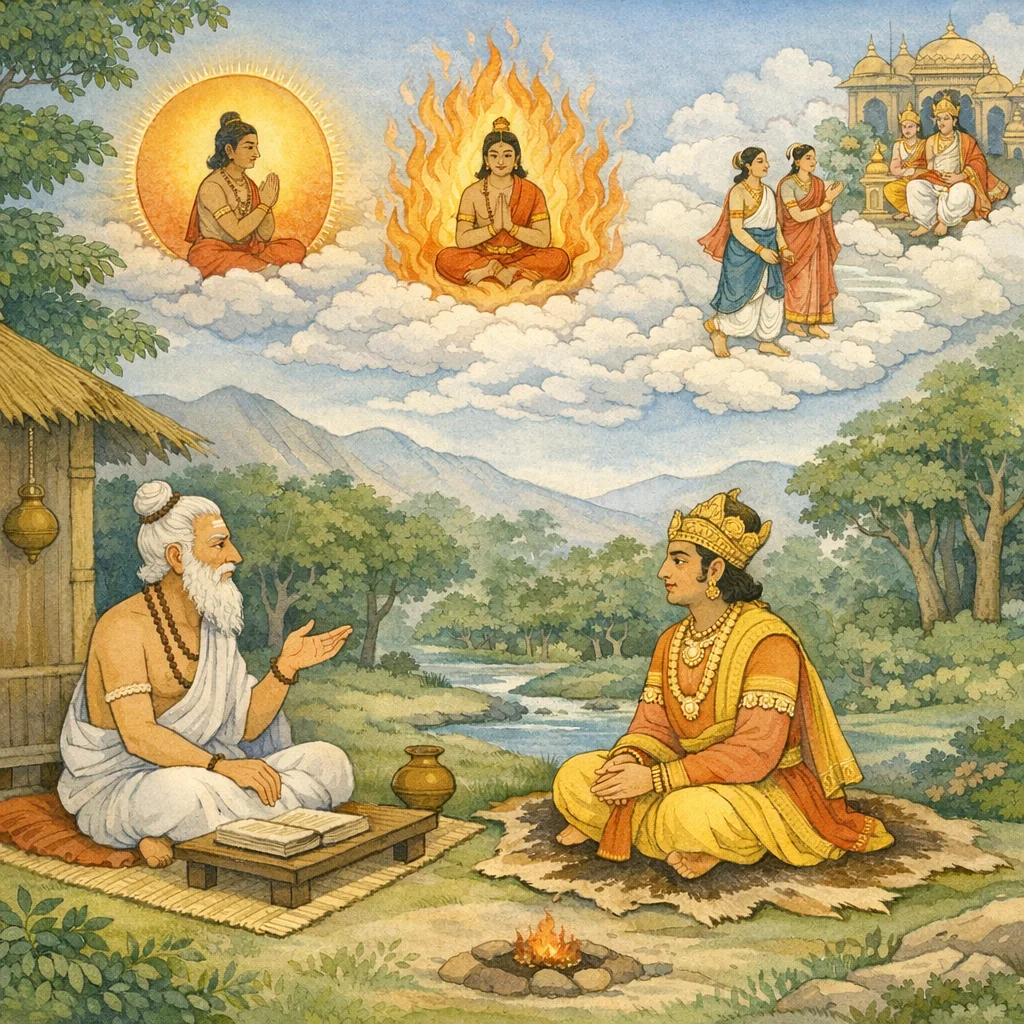
The chapter opens with Janamejaya enumerating celebrated warriors and kings (e.g., Bhīṣma, Droṇa, Dhṛtarāṣṭra, Virāṭa, Drupada, Śaṅkha, Uttara, Jayadratha, Karṇa’s sons, Ghaṭotkaca and others) and asking how long they remained in heaven, whether their station was permanent, and what final destiny they attained. Sauti notes that, with Vyāsa’s permission, the account proceeds through Vaiśaṃpāyana. Vaiśaṃpāyana states a general principle: all beings must reach an end-state corresponding to karma, and then details specific integrations—Bhīṣma with the Vasus; Droṇa entering Bṛhaspati; Kṛtavarmā among the Maruts; Pradyumna with Sanatkumāra; Dhṛtarāṣṭra attaining Kubera’s difficult-to-reach realms; Pāṇḍu going to Mahendra’s abode; several rulers entering the Viśvedevas; Abhimanyu identified with Varcā, Soma’s son, returning to Soma; Karṇa entering Ravi (the Sun); Śakuni reaching Dvāpara; Dhṛṣṭadyumna entering Pāvaka (Fire); Dhṛtarāṣṭra’s sons ascending after being ‘weapon-purified’; and Yudhiṣṭhira and Vidura (kṣattā) entering Dharma. The chapter then concludes the narrational frame of the sarpasatra: Janamejaya is astonished; the rite ends; Āstīka is pleased; priests are rewarded; and the epic’s sanctity is proclaimed through extensive phalāśruti, asserting Mahābhārata’s completeness across dharma, artha, kāma, and mokṣa and the merit of recitation, study, and teaching.
Chapter Arc: जनमेजय का प्रश्न उठता है—भीष्म, द्रोण, कर्ण, शकुनि, धृष्टद्युम्न, घटोत्कच और अन्य असंख्य वीर, जो युद्ध में गिरे, वे अंततः कहाँ गए और किस-किन मूलस्वरूपों में लीन हुए? → वैशम्पायन (द्विजोत्तम) तपोदीप्त दृष्टि से एक-एक करके नाम गिनाते हैं—यादव, पाञ्चाल, कौरव-पक्ष, पाण्डव-पक्ष, और वे सब ‘नानुकीर्तित’ भी—और बताते हैं कि मृत्यु के बाद उनकी गंतव्य-यात्रा देवताओं, लोकों और तत्त्वों की ओर हुई। → महान उलटफेर का उद्घाटन: अनेक ‘मानव-वीर’ अपने-अपने दिव्य/तत्त्वात्मक मूल में प्रविष्ट होते हैं—कर्ण सूर्य में, शकुनि द्वापर (कपट-तत्त्व) में, धृष्टद्युम्न पावक (अग्नि) में; पाण्डु दोनों पत्नियों सहित महेन्द्र-भवन में; और धृतराष्ट्र के पुत्र स्वर्गभोग के पश्चात् अपने मूलतः बलोन्मत्त यातुधान-स्वरूप की ओर लौटते हैं। → कथा ‘इतिहास’ से ‘माहात्म्य’ में रूपांतरित होती है—यह पुण्य, पवित्र, उत्तम आख्यान सत्यवादी कृष्णद्वैपायन द्वारा धर्मकाम्यया रचा गया; शस्त्रपूत महात्मा दिव्य लोकों को प्राप्त हुए और समस्त पात्र अपने-अपने कारण-स्वरूप में विलीन हुए।
Shlokas
Verse 1
अपन रा< बछ। ] अत्ऑफा:म पञठ्चमो<ध्याय: भीष्म आदि वीरोंका अपने-अपने मूलस्वरूपमें मिलना और महा'भारतका उपसहार तथा माहात्म्य जनमेजय उवाच भीष्मद्रोणौ महात्मानौ धृतराष्ट्रश्न पार्थिव: । विराटद्रुपदौ चोभौ शड्खश्नैवोत्तरस्तथा
Janamejaya said: “Bhīṣma and Droṇa, those great-souled heroes; King Dhṛtarāṣṭra; Virāṭa and Drupada—both of them; and Śaṅkha, as well as Uttara—what became of them?” In the closing movement of the epic, the king’s question turns from victory and loss to the moral accounting of lives: how the mighty, bound by duty and fate, reach their final state beyond the battlefield.
Verse 2
धृष्टकेतुर्जयत्सेनो राजा चैव स सत्यजित् | दुर्योधनसुताश्चैव शकुनिश्चैव सौबल:
Janamejaya said: “And Dhṛṣṭaketu, Jayatsena, and that king Satyajit; and also the sons of Duryodhana, and Śakuni the son of Subala.”
Verse 3
कर्णपुत्राश्च विक्रान्ता राजा चैव जयद्रथ: । घटोत्कचादयश्चैव ये चान्ये नानुकीर्तिता:
Janamejaya said: “And the valiant sons of Karṇa, and King Jayadratha as well; and Ghaṭotkaca and others—along with those many others who have not been mentioned by name.”
Verse 4
ये चान्ये कीर्तिता वीरा राजानो दीप्तमूर्तय: । स्वर्गे काल॑ कियन्तं ते तस्थुस्तदपि शंस मे
Janamejaya asked: “And those other heroic kings of radiant splendor who have been mentioned—how long did they remain in heaven? Tell me that as well.”
Verse 5
जनमेजयने पूछा--ब्रह्मन! महात्मा भीष्म और द्रोण, राजा धुृतराष्ट्र, विराट, ट्रुपद, शंख, उत्तर, धृष्टकेतु, जयत्सेन, राजा सत्यजित्द् दुर्योधनके पुत्र, सुबलपुत्र शकुनि, कर्णके पराक्रमी पुत्र, राजा जयद्रथ तथा घटोत्कच आदि तथा दूसरे जो नरेश यहाँ नहीं बताये गये हैं और जिनका नाम लेकर यहाँ वर्णन किया गया है, वे सभी तेजस्वी शरीर धारण करनेवाले वीर राजा स्वर्गलोकमें कितने समयतक एक साथ रहे? यह मुझे बताइये ।। आहोस्विछाश्रृतं स्थान तेषां तत्र द्विजोत्तम | अन्ते वा कर्मणां कां ते गतिं प्राप्ता नरर्षभा:,द्विजश्रेष्ठ! क्या उन्हें वहाँ सनातन स्थानकी प्राप्ति हुई थी? अथवा कर्मोका अन्त होनेपर वे पुरुषश्रेष्ठ किस गतिको प्राप्त हुए? इति श्रीमहा भारते शतसाहस्रयां संहितायां वैयासिकयां स्वर्गारोहणपर्वणि पउठ्चमो<5 ध्याय: इस प्रकार श्रीमहाभारत नामक व्यासनिर्मित शतसाहसी संहिताके स्व्गरोह्रणपर्वमें पॉचवाँ अध्याय पूरा हुआ
Janamejaya said: “O Brahmin! Bhīṣma and Droṇa, King Dhṛtarāṣṭra, Virāṭa, Drupada, Śaṅkha, Uttara, Dhṛṣṭaketu, Jayatsena, King Satyajit, the sons of Duryodhana, Śakuni the son of Subala, the valiant sons of Karṇa, King Jayadratha, Ghaṭotkaca, and other kings not named here though described by name—how long did all these heroic rulers, bearing radiant bodies, dwell together in heaven? Tell me. And, O best of twice-born, did they attain an everlasting station there, or when the fruits of their deeds were exhausted, what further destiny did those bull-like men reach?”
Verse 6
एतदिच्छाम्यहं श्रोतु प्रोच्यमानं द्विजोत्तम । तपसा हि प्रदीप्तेन सर्व त्वमनुपश्यसि,विप्रवर! मैं आपके मुखसे इस विषयको सुनना चाहता हूँ; क्योंकि आप अपनी उद्दीप्त तपस्यासे सब कुछ देखते हैं
Janamejaya said: “O best of twice-born sages, I wish to hear this matter as you explain it. For with your austerity blazing in spiritual power, you perceive everything, O foremost of Brahmins.”
Verse 7
सौतिर्वाच इत्युक्त: स तु विप्रर्षिरनुज्ञातो महात्मना | व्यासेन तस्य नृपतेराख्यातुमुपचक्रमे,सौति कहते हैं--राजा जनमेजयके इस प्रकार पूछनेपर महात्मा व्यासकी आज्ञा ले ब्रह्मर्षि वैशम्पायनने राजासे इस प्रकार कहना आरम्भ किया
Sauti said: When King Janamejaya had thus spoken, the brahmarṣi Vaiśampāyana—having received permission from the great-souled Vyāsa—began to narrate the account to the king. The passage marks the proper transmission of sacred history: inquiry is met with authorized teaching, and narration proceeds under the sanction of the lineage of seers.
Verse 8
वैशम्पायन उवाच न शक्यं कर्मणामन्ते सर्वेण मनुजाधिप । प्रकृति कि नु सम्यक्ते पृच्छैषा सम्प्रयोजिता,वैशम्पायनजी बोले--राजन्! कर्मोंका भोग समाप्त हो जानेपर सभी लोग अपनी प्रकृति (मूल कारण)-को ही नहीं प्राप्त हो जाते हैं; (कोई-कोई ही अपने कारणमें विलीन होता है) यदि पूछो, क्या मेरा प्रश्न असंगत है? तो इसका उत्तर यह है कि जो प्रकृतिको प्राप्त नहीं हैं, उनके उद्देश्यसे तुम्हारा यह प्रश्न सर्वथा ठीक है
Vaiśampāyana said: “O lord of men, it is not possible that, when the fruits of actions come to an end, everyone without exception attains dissolution into Prakṛti (the primordial ground). If you wonder whether my question is ill-posed, it is not: it is precisely relevant with regard to those who do not attain Prakṛti—what becomes of them, and by what principle are their destinies distinguished?”
Verse 9
शृणु गुह्मामिदं राजन् देवानां भरतर्षभ । यदुवाच महातेजा दिव्यचक्षु: प्रतापवान्,राजन्! भरतश्रेष्ठ) यह देवताओंका गूढ़ रहस्य है। इस विषयमें दिव्य नेत्रवाले, महातेजस्वी, प्रतापी मुनि व्यासजीने जो कहा है, उसे बताता हूँ; सुनो--
Vaiśampāyana said: “O King, bull among the Bharatas, listen to this secret concerning the gods. I shall relate what the mighty, radiant, and valiant sage—endowed with divine sight—Vyāsa declared on this matter.”
Verse 10
मुनि: पुराण: कौरव्य पाराशर्यों महाव्रत: । अगाथबुद्धि: सर्वज्ञो गतिज्ञ: सर्वकर्मणाम्,कुरुनन्दन! जो सब कर्मोकी गतिको जाननेवाले, अगाध बुद्धिसम्पन्न एवं सर्वज्ञ हैं उन महान् व्रतधारी, पुरातन मुनि, पराशरनन्दन व्यासजीने तो मुझसे यही कहा है कि “वे सभी वीर कर्मभोगके पश्चात् अन्ततोगत्वा अपने मूल स्वरूपमें ही मिल गये थे। महातेजस्वी, परम कान्तिमान् भीष्म वसुओंके स्वरूपमें ही प्रविष्ट हो गये”
Vaiśampāyana said: “O scion of the Kurus, the ancient sage Vyāsa, son of Parāśara—of great vows, of unfathomable intellect, all-knowing, and one who understands the final course of all actions—told me this: after experiencing the fruits of their deeds, all those heroes ultimately merged back into their own original forms. And Bhīṣma, of mighty splendor and supreme radiance, entered again into the state of the Vasus.”
Verse 11
तेनोक्त कर्मणामन्ते प्रविशन्ति स्विकां तनुम् वसूनेव महातेजा भीष्म: प्राप महाद्युति:,कुरुनन्दन! जो सब कर्मोकी गतिको जाननेवाले, अगाध बुद्धिसम्पन्न एवं सर्वज्ञ हैं उन महान् व्रतधारी, पुरातन मुनि, पराशरनन्दन व्यासजीने तो मुझसे यही कहा है कि “वे सभी वीर कर्मभोगके पश्चात् अन्ततोगत्वा अपने मूल स्वरूपमें ही मिल गये थे। महातेजस्वी, परम कान्तिमान् भीष्म वसुओंके स्वरूपमें ही प्रविष्ट हो गये”
Vaiśampāyana said: “At the end of the results of the deeds spoken of, they enter their own true form. Thus the mighty and radiant Bhīṣma—of great splendor—attained the state of the Vasus.” The verse underscores a moral horizon to action: after the fruition of karma, beings ultimately return to their intrinsic nature, and Bhīṣma’s life of vow-bound duty culminates in rejoining his divine origin.
Verse 12
अष्टावेव हि दृश्यन्ते वसवो भरतर्षभ । बृहस्पतिं विवेशाथ द्रोणो हाज्ञिरसां वरम्,भरतभूषण! यही कारण है कि वसु आठ ही देखे जाते हैं (अन्यथा भीष्मजीको लेकर नौ वसु हो जाते)। आचार्य द्रोणने आंगिरसोंमें श्रेष्ठ बृहस्पतिजीके स्वरूपमें प्रवेश किया
Vaiśampāyana said: “Indeed, only eight Vasus are seen, O bull among the Bharatas. Then Droṇa entered into Bṛhaspati, the foremost of the Aṅgirases.” In the closing movement of the epic, this statement frames the heroes’ departures as a return to their divine sources, underscoring the moral vision that embodied greatness in the world is ultimately transient and resolves back into cosmic order.
Verse 13
कृतवर्मा तु हार्दिक्य: प्रविवेश मरुद्गणान् । सनत्कुमार प्रद्युम्न: प्रविवेश यथागतम्,हृदिकपुत्र कृतवर्मा मरुदगणोंमें मिल गया। प्रद्युम्म जैसे आये थे उसी तरह सनत्कुमारके स्वरूपमें प्रविष्ट हो गये
Vaiśampāyana said: Kṛtavarmā, the son of Hṛdīka, entered into the host of the Maruts. Pradyumna, who was in truth Sanatkumāra, merged back into his original form, just as he had come. The narrative underscores that each warrior ultimately returns to his own cosmic source, and that worldly identities dissolve before the higher order that governs destiny.
Verse 14
धृतराष्ट्रो धनेशस्य लोकान् प्राप दुरासदान् । धृतराष्ट्रेण सहिता गान्धारी च यशस्विनी,धृतराष्ट्रने धनाध्यक्ष कुबेरके दुर्लभ लोकोंको प्राप्त किया। उनके साथ यशस्विनी गान्धारी देवी भी थीं
Vaiśampāyana said: Dhṛtarāṣṭra attained the hard-to-reach worlds belonging to Dhaneśa (Kubera), the lord of wealth. Along with Dhṛtarāṣṭra went the illustrious queen Gāndhārī. The narrative underscores that even those burdened by grave familial and moral tragedy may, through the ordained course of destiny and the completion of their earthly suffering, reach exalted realms—yet without erasing the ethical weight of past choices.
Verse 15
पत्नीभ्यां सहित: पाण्डुमहेन्द्रसदनं ययौ । विराटद्रुपदौ चोभौ धृष्टकेतुश्न पार्थिव:,विश्वेषां देवतानां ते विविशुर्नरसत्तमा: । राजा पाण्डु अपनी दोनों पत्नियोंके साथ महेन्द्रके भवनमें चले गये। राजा विराट, द्रपद, धृष्टकेतु, निशठ, अक्रूर, साम्ब, भानु, कम्प, विदूरथ, भूरिश्रवा, शल, पृथ्वीपति भूरि, कंस, उग्रसेन वसुदेव और अपने भाई शंखके साथ नरश्रेष्ठ उत्तर-ये सभी सत्पुरुष विश्वेदेवोंके स्वरूपमें मिल गये
Vaiśaṃpāyana said: King Pāṇḍu, accompanied by his two wives, went to the mansion of Mahendra (Indra). Likewise King Virāṭa and Drupada, and the royal Dhṛṣṭaketu, those best of men, entered into the state of the Viśvedevas. The passage underscores the epic’s closing moral arc: after the exhaustion of worldly power and conflict, even renowned rulers attain their destined divine stations, suggesting the transience of sovereignty and the primacy of one’s ordained end (gati) shaped by dharma.
Verse 16
निशठाक्रूरसाम्बाश्व भानुः कम्पो विदूरथ: । भूरिश्रवा: शलश्वैव भूरिश्व पृथिवीपति:
Vaiśampāyana said: “Niśaṭha, Krūra, Sāmba, Aśva, Bhānu, Kampana, Vidūratha, Bhūriśravā, Śalaśva, and Bhūriśva—the lord of the earth—(were among those named).” In the Svargārohaṇa narrative, such catalogues underscore the vast human cost of the Kurukṣetra conflict and serve as a moral reminder that worldly power and renown, however great, culminate in mortality and the reckoning of one’s deeds.
Verse 17
कंसश्रैवोग्रसेनश्व वसुदेवस्तथैव च । उत्तरश्न सह भ्रात्रा शड़्खेन नरपुड्भवः
Vaiśampāyana said: “Kāṁsa, and likewise Ugrāsena, and also Vasudeva; and Uttara too—together with his brother Śaṅkha—those foremost among men (were there/are named).” In the Svargārohaṇa narrative, such cataloguing underscores that even the mighty and renowned are gathered under the same law of impermanence, as the epic turns from victory and loss toward the final reckoning of lives and deeds.
Verse 18
वर्चा नाम महातेजा: सोमपुत्र: प्रतापवान्
Vaiśampāyana said: There was a mighty, radiant being named Varcā—valiant and powerful—who was the son of Soma. The narration highlights noble lineage and innate splendor as signs of destined strength and merit.
Verse 19
सोअभिमन्युर्नुसिंहस्य फाल्गुनस्य सुतो5भवत् | स युदृध्वा क्षत्रधर्मेण यथा नानन््य: पुमान् क्वचित्
Vaiśampāyana said: Abhimanyu was born as the son of Phālguna (Arjuna), a lion among men. Having fought in accordance with the kṣatriya code of duty, he proved himself unequalled by any man anywhere—an exemplar of warrior-dharma expressed through fearless, righteous combat.
Verse 20
विवेश सोम॑ धर्मात्मा कर्मणो<न्ते महारथ: । चन्द्रमाके महातेजस्वी और प्रतापी पुत्र जो वर्चा हैं, वे ही पुरुषसिंह अर्जुनके पुत्र होकर अभिमन्यु नामसे विख्यात हुए थे। उन्होंने क्षत्रिय-धर्मके अनुसार ऐसा युद्ध किया था, जैसा दूसरा कोई पुरुष कभी नहीं कर सका था। उन धर्मात्मा महारथी अभिमन्युने अपना कार्य पूरा करके चन्द्रमामें ही प्रवेश किया ।। १८-१९ ह।। आविवेश रविं कर्णो निहतः पुरुषर्षभ:
Vaiśampāyana said: Karṇa, that bull among men, having been slain, entered into the Sun. Thus the epic frames his death not as mere defeat but as a return to his cosmic source, suggesting the completion of a destined course shaped by valor, duty, and the moral consequences of war.
Verse 21
धृतराष्ट्रात्मजा: सर्वे यातुधाना बलोत्कटा:
Vaiśampāyana said: All the sons of Dhṛtarāṣṭra—fierce as yātudhānas (demonic beings) and formidable in strength—(were thus described). The line underscores how power, when severed from dharma, is portrayed as demonic ferocity rather than true nobility.
Verse 22
धर्ममेवाविशत् क्षत्ता राजा चैव युधिषछिर:,विदुर और राजा युधिष्ठिरने धर्मके ही स्वरूपमें प्रवेश किया। बलरामजी साक्षात् भगवान् अनन्तदेवके अवतार थे। वे रसातलमें अपने स्थानको चले गये। ये वे ही अनन्तदेव हैं जिन्होंने ब्रहद्माजीकी आज्ञा पाकर योगबलसे इस पृथ्वीकों धारण कर रखा है
Vaiśampāyana said: Vidura, the royal attendant, entered into Dharma itself, and King Yudhiṣṭhira also entered into Dharma’s very being. Balarāma was in truth an incarnation of the Lord Anantadeva; he departed to his own abode in Rasātala. This is that same Ananta who, having received Brahmā’s command, upholds the earth by the power of yoga.
Verse 23
अनन्तो भगवान् देव: प्रविवेश रसातलम् | पितामहनियोगाद् वै यो योगाद् गामधारयत्,विदुर और राजा युधिष्ठिरने धर्मके ही स्वरूपमें प्रवेश किया। बलरामजी साक्षात् भगवान् अनन्तदेवके अवतार थे। वे रसातलमें अपने स्थानको चले गये। ये वे ही अनन्तदेव हैं जिन्होंने ब्रहद्माजीकी आज्ञा पाकर योगबलसे इस पृथ्वीकों धारण कर रखा है
Vaiśampāyana said: The blessed Lord, the god Ananta, entered Rasātala—returning to his own abode. He is the very Ananta who, by the command of the Grandsire (Brahmā), upholds the earth through the power of yoga. (In this same closing movement of the narrative, Vidura and King Yudhiṣṭhira are described as entering into Dharma itself, underscoring that the end of their lives is framed as a return to their essential principle rather than a merely physical departure.)
Verse 24
य: स नारायणो नाम देवदेव: सनातन: । तस्यांशो वासुदेवस्तु कर्मणो<डन्ते विवेश ह
Vaiśampāyana said: “He who is known as Nārāyaṇa—the eternal God of gods—had an emanated portion as Vāsudeva; and that divine portion entered (the world) at the close of the destined course of events.”
Verse 25
वे जो नारायण नामसे प्रसिद्ध सनातन देवाधिदेव हैं उन्हींके अंश वसुदेवनन्दन श्रीकृष्ण थे, जो अवतारका कार्य पूरा करके पुन: अपने स्वरूपमें प्रविष्ट हो गये ।। षोडश स्त्रीसहस्राणि वासुदेवपरिग्रह: । अमज्जंस्ता: सरस्वत्यां कालेन जनमेजय,जनमेजय! भगवान् श्रीकृष्णकी जो सोलह हजार स्त्रियाँ थीं, उन्होंने अवसर पाकर सरस्वती नदीमें कूदकर अपने प्राण दे दिये
Vaiśampāyana said: O Janamejaya, in due course the sixteen thousand women who had been the consorts of Vāsudeva (Śrī Kṛṣṇa) cast themselves into the river Sarasvatī and ended their lives—an act presented here as occurring after Kṛṣṇa’s departure and the closing of his earthly mission, marking the dissolution of his household ties in the wake of time’s inexorable course.
Verse 26
तत्र त्यक्त्वा शरीराणि दिवमारुरुहु: पुनः । ताश्चैवाप्सरसो भूत्वा वासुदेवमुपाविशन्,वहाँ देहत्याग करनेके पश्चात् वे सब-की-सब पुनः स्वर्गलोकमें जा पहुँचीं और अप्सराएँ होकर पुनः भगवान् श्रीकृष्णकी सेवामें उपस्थित हो गयीं
There, after casting off their bodies, they all once again ascended to heaven. Becoming apsarases, they returned to attend upon Vāsudeva (Śrī Kṛṣṇa), resuming their place in his divine service—suggesting the restoration of their celestial status after the completion of their earthly episode.
Verse 27
हतास्तस्मिन् महायुद्धे ये वीरास्तु महारथा: । घटोत्कचादयश्चैव देवान् यक्षांश्ष॒ भेजिरे,इस प्रकार उस महाभारत नामक महायुद्धमें जो-जो वीर महारथी घटोत्कच आदि मारे गये थे वे देवताओं और यक्षोंके लोकोंमें गये
Vaiśampāyana said: Those heroic great chariot-warriors who were slain in that mighty war—Ghaṭotkaca and others—attained the worlds of the gods and the Yakṣas. The narrative underscores that even amid the devastation of war, the fallen are accorded their due posthumous destiny according to their nature and merit.
Verse 28
दुर्योधनसहायाश्न राक्षसा: परिकीर्तिता: । प्राप्तास्ते क्रमशो राजन् सर्वलोकाननुत्तमान्,राजन! जो दुर्योधनके सहायक थे, वे सब-के-सब राक्षस बताये गये हैं। उन्हें क्रमशः सभी उत्तम लोकोंकी प्राप्ति हुई
Vaiśampāyana said: “O King, those beings who had served as Duryodhana’s allies are described as Rākṣasas. Yet, in due order, they attained all the unsurpassed worlds.” The verse underscores a key Mahābhārata ethic: the cosmic outcome of beings is not judged solely by their battlefield alignment, but by the deeper ledger of their nature, destiny, and the moral order that distributes results according to hidden causes.
Verse 29
भवनं च महेन्द्रस्य कुबेरस्थ च धीमतः । वरुणस्य तथा लोकान् विविशु: पुरुषर्षभा:,ये श्रेष्ठ पुरुष क्रमश: देवराज इन्द्रके, बुद्धिमान् कुबेरके तथा वरुण देवताके लोकोंमें गये
Vaiśampāyana said: Those best of men entered, in due order, the celestial abodes—the palace of great Indra, the realm of the wise Kubera, and likewise the worlds of Varuṇa. The narrative underscores that, after the completion of their earthly course, the foremost among men attain fitting divine destinations in an ordered, merit-aligned progression.
Verse 30
एतत् ते सर्वमाख्यातं विस्तरेण महाद्ुते । कुरूणां चरितं कृत्स्नं पाण्डवानां च भारत,महातेजस्वी भरतनन्दन! यह सारा प्रसंग--कौरवों और पाण्डवोंका सम्पूर्ण चरित्र तुम्हें विस्तारके साथ बताया गया
Vaiśampāyana said: “O great-splendoured one, I have now narrated to you in full and in detail the entire history and conduct of the Kurus, and of the Pāṇḍavas as well, O Bhārata.”
Verse 31
सौतिर्वाच एतच्छुत्वा द्विजश्रेष्ठा:स राजा जनमेजय: । विस्मितो5भवदत्यर्थ यज्ञकर्मान्तरेष्वथ,सौति कहते हैं--विप्रवरो! यज्ञकर्मके बीचमें जो अवसर प्राप्त होते थे, उन्हींमें यह महाभारतका आख्यान सुनकर राजा जनमेजयको बड़ा आश्चर्य हुआ
Sauti said: “O best of the twice-born, having heard this account during the intervals of the sacrificial rites, King Janamejaya was filled with profound astonishment.”
Verse 32
ततः समापयामासु: कर्म तत् तस्य याजका: । आस्तीकश्चा भवत् प्रीत: परिमोक्ष्य भुजड्रमान्,तदनन्तर उनके पुरोहितोंने उस यज्ञकर्मको समाप्त कराया। सर्पोंको प्राणसंकटसे छुटकारा दिलाकर आस्तीक मुनिको भी बड़ी प्रसन्नता हुई
Then the officiating priests brought that sacrificial rite to its conclusion. Having rescued the serpents from mortal peril, the sage Āstīka too became deeply pleased—an affirmation that ritual power is to be restrained by dharma and compassion when it turns toward indiscriminate harm.
Verse 33
ततो द्विजातीन् सर्वास्तान् दक्षिणाभिरतोषयत् । पूजिताश्चापि ते राज्ञा ततो जम्मुर्यथागतम्,राजाने यज्ञकर्ममें सम्मिलित हुए समस्त ब्राह्मणोंको पर्याप्त दक्षिणा देकर संतुष्ट किया तथा वे ब्राह्मण भी राजासे यथोचित सम्मान पाकर जैसे आये थे उसी तरह अपने घरको लौट गये
Then the king satisfied all those twice-born Brahmins with appropriate gifts of honor (dakṣiṇā). Having also been duly revered by the king, those Brahmins departed thereafter, returning to their homes just as they had come. The passage underscores royal dharma: completing sacred rites by honoring the officiants with generosity and respect, so that the ritual concludes in social harmony and ethical propriety.
Verse 34
विसर्जयित्वा विप्रांस्तानू राजापि जनमेजय: । ततस्तक्षशिलाया: स पुनरायाद् गजाह्दयम्,उन ब्राह्मणोंको विदा करके राजा जनमेजय भी तक्षशिलासे फिर हस्तिनापुरको चले आये
Vaiśampāyana said: Having respectfully dismissed those brāhmaṇas, King Janamejaya too set out from Takṣaśilā and returned again to Gajāhvaya (Hastināpura). The episode underscores the king’s proper conduct in concluding a sacred engagement—honouring learned guests and then resuming his royal duties without attachment or delay.
Verse 35
एतत् ते सर्वमाख्यातं वैशम्पायनकीर्तितम् । व्यासाज्ञया समज्ञातं सर्पसत्रे नूपस्य हि,इस प्रकार जनमेजयके सर्पयज्ञमें व्यासजीकी आज्ञासे मुनिवर वैशम्पायनजीने जो इतिहास सुनाया था तथा मैंने अपने पिता सूतजीसे जिसका ज्ञान प्राप्त किया था, वह सारा-का-सारा मैंने आपलोगोंके समक्ष यह वर्णन किया है
Vaiśampāyana said: “All this has been fully related to you—the account proclaimed by Vaiśampāyana, understood under Vyāsa’s command at the king’s serpent-sacrifice. That entire tradition of the Itihāsa, as it was heard and handed down, I have now narrated before you.”
Verse 36
पुण्योडयमितिहासाख्य: पवित्र चेदमुत्तमम् कृष्णेन मुनिना विप्र निर्मितं सत्यवादिना
Vaiśampāyana said: This supreme and purifying work, known as an itihāsa, brings the rise of merit. O brāhmaṇa, it was composed by the sage Kṛṣṇa, a speaker of truth—thereby affirming its ethical authority and sanctifying power for those who hear and preserve it.
Verse 37
ब्रह्मन्! सत्यवादी मुनि व्यासजीके द्वारा निर्मित यह पुण्यमय इतिहास परम पवित्र एवं बहुत उत्तम है ।। सर्वज्ञेन विधिज्ञेन धर्मज्ञानवता सता | अतीन्द्रियेण शुचिना तपसा भावितात्मना,सर्वज्ञ, विधिविधानके ज्ञाता, धर्मज्ञ, साधु, इन्द्रियातीत ज्ञानसे सम्पन्न, शुद्ध, तपके प्रभावसे पवित्र अन्तःकरणवाले, ऐश्वर्यसम्पन्न, सांख्य एवं योगके विद्वान् तथा अनेक शास्त्रोंके पारदर्शी मुनिवर व्यासजीने दिव्य दृष्टिसे देखकर महात्मा पाण्डवों तथा अन्य प्रचुर धनसम्पन्न महातेजस्वी राजाओंकी कीर्तिका प्रसार करनेके लिये इस इतिहासकी रचना की है
Vaiśampāyana said: “O Brahmin! This sacred history, composed by the truth-speaking sage Vyāsa, is supremely pure and exceedingly excellent. Fashioned by one who is all-knowing, skilled in ritual and right procedure, grounded in the knowledge of dharma, a true and virtuous man—one whose insight transcends the senses, who is pure, and whose inner self has been refined by austerity—Vyāsa, the best of sages, learned in Sāṅkhya and Yoga and well-versed in many śāstras, beheld events with divine vision and composed this history to spread the fame of the great-souled Pāṇḍavas and of other mighty, illustrious kings rich in wealth.”
Verse 38
ऐश्व॒र्ये वर्तता चैव सांख्ययोगवता तथा । नैकतन्त्रविबुद्धेन दृष्टवा दिव्येन चक्षुषा,सर्वज्ञ, विधिविधानके ज्ञाता, धर्मज्ञ, साधु, इन्द्रियातीत ज्ञानसे सम्पन्न, शुद्ध, तपके प्रभावसे पवित्र अन्तःकरणवाले, ऐश्वर्यसम्पन्न, सांख्य एवं योगके विद्वान् तथा अनेक शास्त्रोंके पारदर्शी मुनिवर व्यासजीने दिव्य दृष्टिसे देखकर महात्मा पाण्डवों तथा अन्य प्रचुर धनसम्पन्न महातेजस्वी राजाओंकी कीर्तिका प्रसार करनेके लिये इस इतिहासकी रचना की है
Vaiśampāyana said: Endowed with spiritual majesty, established in Sāṅkhya and Yoga, and awakened to many branches of sacred learning, the sage Vyāsa—seeing with divine vision—composed this history so that the fame of the great-souled Pāṇḍavas and of other radiant kings rich in wealth might be spread abroad. The work is thus presented as a dharma-grounded record, authored by one who knows the ordinances of right conduct and whose inner being is purified by ascetic power.
Verse 39
कीर्ति प्रथणता लोके पाण्डवानां महात्मनाम् | अन््येषां क्षत्रियाणां च भूरिद्रविणतेजसाम्,सर्वज्ञ, विधिविधानके ज्ञाता, धर्मज्ञ, साधु, इन्द्रियातीत ज्ञानसे सम्पन्न, शुद्ध, तपके प्रभावसे पवित्र अन्तःकरणवाले, ऐश्वर्यसम्पन्न, सांख्य एवं योगके विद्वान् तथा अनेक शास्त्रोंके पारदर्शी मुनिवर व्यासजीने दिव्य दृष्टिसे देखकर महात्मा पाण्डवों तथा अन्य प्रचुर धनसम्पन्न महातेजस्वी राजाओंकी कीर्तिका प्रसार करनेके लिये इस इतिहासकी रचना की है
Vaiśaṃpāyana said: In order that the fame of the great-souled Pāṇḍavas—and of other kṣatriya kings, rich in wealth and radiant in prowess—might spread throughout the world, the sage Vyāsa, all-knowing, skilled in the ordinances of sacred law, a knower of dharma and a true saint, endowed with knowledge beyond the senses, pure, his inner being cleansed by the power of austerity, possessed of spiritual majesty, learned in Sāṅkhya and Yoga, and deeply versed in many śāstras, beheld all this with divine sight and composed this history.
Verse 40
यश्नेदं श्रावयेद् विद्वान् सदा पर्वणि पर्वणि । धूतपाप्मा जितस्वर्गो ब्रह्म भूयाय कल्पते,जो दिद्वान् प्रत्येक पर्वपर सदा इसे दूसरोंको सुनाता है उसके सारे पाप धुल जाते हैं। उसका स्वर्गपर अधिकार हो जाता है, तथा वह ब्रह्मभावकी प्राप्तिके योग्य बन जाता है
Verse 41
कार्ष्ण॑ वेदमिमं सर्व शृणुयाद् यः समाहित: । ब्रह्महत्यादिपापानां कोटिस्तस्य विनश्यति,जो एकाग्रचित होकर इस सम्पूर्ण “कार्ष्ण वेदैं” का श्रवण करता है उसके ब्रह्महत्या आदि करोड़ों पापोंका नाश हो जाता है
Vaiśaṃpāyana said: Whoever, with a collected and one-pointed mind, listens to this entire Kārṣṇa-Veda—his countless sins, beginning with the grave sin of brahmin-slaying, are destroyed. The verse underscores the purifying power of attentive hearing and the ethical demand for inner concentration in receiving sacred teaching.
Verse 42
यश्चेदं श्रावयेत् श्राद्धे ब्राह्मणान् पादमन्तत: । अक्षय्यमन्नपानं वै पितृंस्तस्योपतिष्ठते,जो श्राद्धकर्ममें ब्राह्यणोंको निकटसे महाभारतका थोड़ा-सा अंश भी सुना देता है, उसका दिया हुआ अन्नपान अक्षय होकर पितरोंको प्राप्त होता है
Vaiśampāyana said: If, at a śrāddha rite, one has Brahmins listen—even to a small portion of this (Mahābhārata), then the food and drink offered by him becomes inexhaustible in its merit and surely reaches his ancestors. The verse underscores the ethical power of sacred listening and recitation: remembrance of dharma through the epic is treated as a direct support to the departed, making ritual generosity enduring rather than momentary.
Verse 43
अब्वा यदेन: कुरुते इन्द्रियैर्मनसापि वा । महाभारतमाख्याय पश्चात् संध्यां प्रमुच्यते,मनुष्य अपनी इन्द्रियों तथा मनसे दिनभरमें जो पाप करता है वह सायंकालकी संध्याके समय महाभारतका पाठ करनेसे छूट जाता है
Vaiśampāyana said: Whatever sin a person commits during the day—whether through the senses or even in the mind—after reciting the Mahābhārata at the time of the evening twilight, one is released from it. The verse frames Mahābhārata-recitation as an act of ethical purification and self-correction at day’s end.
Verse 44
यद् रात्रौ कुरुते पापं ब्राह्मण: स्त्रीगणैर्व॒त: । महाभारतमाख्याय पूर्वा संध्यां प्रमुच्यते,ब्राह्मण रात्रिके समय स्त्रियोंक समुदायसे घिरकर जो पाप करता है वह प्रातःकालकी संध्याके समय महाभारतका पाठ करनेसे छूट जाता है
Vaiśampāyana said: Whatever sin a brāhmaṇa commits at night while surrounded by a company of women, he is released from it by reciting the Mahābhārata at the time of the morning twilight (the early sandhyā). The verse underscores the purificatory power attributed to sacred recitation and the ethical demand for self-restraint, especially regarding nocturnal misconduct.
Verse 45
भरतानां महज्जन्म तस्माद् भारतमुच्यते । महत्त्वाद् भारवत्त्वाच्च महाभारतमुच्यते । निरुक्तमस्य यो वेद सर्वपापै: प्रमुच्यते,इस ग्रन्थमें भरतवंशियोंके महान् जन्मकर्मका वर्णन है, इसलिये इसे महाभारत कहते हैं। महान् और भारी होनेके कारण भी इसका नाम महाभारत हुआ है। जो महाभारतकी इस व्युत्पत्तिको जानता और समझता है वह समस्त पापोंसे मुक्ता हो जाता है
Vaiśampāyana said: “Because it recounts the great birth and deeds of the descendants of Bharata, it is called the Bhārata. And because it is both vast in greatness and weighty in substance, it is called the Mahābhārata. Whoever truly knows this etymological sense of the work is released from all sins.”
Verse 46
अष्टादशपुराणानि धर्मशास्त्राणि सर्वश: । वेदा: साड्रास्तथैकत्र भारतं चैकत: स्थितम्,अठारह पुराणोंके निर्माता और वेदविद्याके महासागर महात्मा व्यास मुनिका यह सिंहनाद सुनो। वे कहते हैं--“अठारह पुराण, सम्पूर्ण धर्मशास्त्र और छहों अंगोंसहित चारों वेद एक ओर तथा केवल महाभारत दूसरी ओर, यह अकेला ही उन सबके बराबर है!
Vaiśampāyana said: “On one side stand the eighteen Purāṇas, all the Dharmaśāstras in their entirety, and the four Vedas together with their auxiliary disciplines; on the other side stands the Mahābhārata alone. Thus placed, the Mahābhārata by itself is equal to all of them.”
Verse 47
श्रूयतां सिंहनादो5यमृषेस्तस्य महात्मन: । अष्टादशपुराणानां कर्तुर्वेदमहोदधे:,अठारह पुराणोंके निर्माता और वेदविद्याके महासागर महात्मा व्यास मुनिका यह सिंहनाद सुनो। वे कहते हैं--“अठारह पुराण, सम्पूर्ण धर्मशास्त्र और छहों अंगोंसहित चारों वेद एक ओर तथा केवल महाभारत दूसरी ओर, यह अकेला ही उन सबके बराबर है!
Vaiśaṃpāyana said: “Hear this lion-like proclamation of that great-souled sage—Vyāsa—who composed the eighteen Purāṇas and is an ocean of Vedic knowledge.” (By this proclamation, the tradition underscores Vyāsa’s authoritative claim that the Mahābhārata, by itself, stands equal in weight to the Purāṇas, the Dharmaśāstras, and the four Vedas with their six auxiliaries.)
Verse 48
त्रिभिवर्षरिदं पूर्ण कृष्णद्वैपायन: प्रभु: । अखिल भारतं॑ चेदं चकार भगवान् मुनि:,मुनिवर भगवान् श्रीकृष्णद्वैपायनने तीन वर्षोमें इस सम्पूर्ण महाभारतको पूर्ण किया था
Vaiśampāyana said: The mighty Kṛṣṇa Dvaipāyana (Vyāsa), that blessed sage, completed this entire Bhārata in three years. The statement underscores the epic’s sacred authority and the disciplined, purposeful labor through which its comprehensive teaching on dharma was brought to completion.
Verse 49
आकर्णयय भक््त्या सततं जयाख्यं भारतं महत् । श्रीक्ष कीर्तिस्तथा विद्या भवन्ति सहिता: सदा,जो जय नामक इस महाभारत इतिहासको सदा भक्तिपूर्वक सुनता रहता है उसके यहाँ श्री, कीर्ति और विद्या तीनों साथ-साथ रहती हैं
Vaiśaṃpāyana said: Whoever continually listens with devotion to this great Bhārata, known as “Jaya,” will always have prosperity, good repute, and learning abiding together in his life.
Verse 50
धर्मे चार्थे च कामे च मोक्षे च भरतर्षभ । यदिहास्ति तदन्यत्र यन्नेहास्ति न कुत्रचित्,भरतश्रेष्ठ! धर्म, अर्थ, काम और मोक्षके विषयमें जो कुछ महाभारतमें कहा गया है, वही अन्यत्र है। जो इसमें नहीं है, वह कहीं नहीं है
Vaiśampāyana said: “O bull among the Bharatas, whatever is taught here in the Mahābhārata concerning dharma, material welfare, desire, and liberation is found elsewhere as well; but whatever is not found here is found nowhere at all.”
Verse 51
जयो नामेतिहासो<यं श्रोतव्यो मोक्षमिच्छता । ब्राह्मणेन च राज्ञा च गर्भिण्या चैव योषिता,मोक्षकी इच्छा रखनेवाले ब्राह्मणको, राज्य चाहनेवाले क्षत्रियको तथा उत्तम पुत्र॒की इच्छा रखनेवाली गर्भिणी स्त्रीकों भी इस जय नामक इतिहासका श्रवण करना चाहिये
Vaiśampāyana said: This narrative called “Jaya” should be listened to by one who seeks liberation. It should also be heard by a brāhmaṇa, by a king, and likewise by a pregnant woman who longs for an excellent son—thus commending this sacred history as beneficial for spiritual freedom, righteous rule, and worthy progeny.
Verse 52
स्वर्गकामो लभेत् स्वर्ग जयकामो लभेज्जयम् | गर्भिणी लभते पुत्र कन््यां वा बहुभागिनीम्,महाभारतका श्रवण या पाठ करनेवाला मनुष्य यदि स्वर्गकी इच्छा करे तो उसे स्वर्ग मिलता है और युद्धमें विजय पाना चाहे तो विजय मिलती है। इसी प्रकार गर्भिणी स्त्रीको महाभारतके श्रवणसे सुयोग्य पुत्र या परम सौभाग्यशालिनी कन्याकी प्राप्ति होती है
Vaiśampāyana said: One who longs for heaven attains heaven; one who longs for victory attains victory. Likewise, a pregnant woman, through hearing (or reciting) the Mahābhārata, obtains a worthy son—or else a daughter endowed with great good fortune. The verse presents the epic’s recitation as a dharmic act believed to yield results aligned with the listener’s righteous intention, linking sacred listening to moral aspiration and auspicious outcomes.
Verse 53
अनागतश्र मोक्षश्न कृष्णद्वैपायन: प्रभु: । संदर्भ भारतस्यास्य कृतवान् धर्मकाम्यया
Vaiśampāyana said: The venerable Kṛṣṇa Dvaipāyana (Vyāsa), who knew the means of liberation from the toils that are yet to come, composed and arranged this Bhārata out of a desire to uphold and promote dharma.
Verse 54
नित्यसिद्ध मोक्षस्वरूप भगवान् कृष्णद्वैपायनने धर्मकी कामनासे इस महाभारतसंदर्भकी रचना की है ।। षष्टिं शतसहस््राणि चकारान्यां स संहिताम् । त्रिंशच्छतसहस््राणि देवलोके प्रतिष्ठितम्,उन्होंने पहले साठ लाख श्लोकोंकी महाभारत-संहिता बनायी थी। उसमें तीस लाख श्लोकोंकी संहिताका देवलोकमें प्रचार हुआ। पंद्रह लाखकी दूसरी संहिता पितृलोकमें प्रचलित हुई। चौदह लाख श्लोकोंकी तीसरी संहिताका यक्षलोकमें आदर हुआ तथा एक लाख श्लोकोंकी चौथी संहिता मनुष्योंमें प्रचारित हुई
Vaiśampāyana said: The blessed Kṛṣṇa Dvaipāyana (Vyāsa), whose nature is ever-accomplished liberation, composed this Mahābhārata in connection with Dharma and human aims. First he produced a recension consisting of six million verses; of these, three million verses became established and circulated in the world of the gods. (Other recensions were current among the Pitṛs and Yakṣas, while a one-hundred-thousand-verse version spread among human beings.)
Verse 55
पित्रये पज्चदशं ज्ञेयं यक्षलोके चतुर्दश । एकं शतसहसंर तु मानुषेषु प्रभाषितम्,उन्होंने पहले साठ लाख श्लोकोंकी महाभारत-संहिता बनायी थी। उसमें तीस लाख श्लोकोंकी संहिताका देवलोकमें प्रचार हुआ। पंद्रह लाखकी दूसरी संहिता पितृलोकमें प्रचलित हुई। चौदह लाख श्लोकोंकी तीसरी संहिताका यक्षलोकमें आदर हुआ तथा एक लाख श्लोकोंकी चौथी संहिता मनुष्योंमें प्रचारित हुई
Vaiśampāyana said: “Know that in the realm of the Pitṛs it is fifteen (lakhs), and in the world of the Yakṣas it is fourteen (lakhs); but among human beings it is recited as one hundred thousand (verses).” In context, this statement explains how the Mahābhārata tradition is understood to exist in different, larger recensions across cosmic realms, while the human transmission is the concise, teachable form—emphasizing the sacred vastness of the epic and the responsibility of preserving what is accessible to people.
Verse 56
नारदो5श्रावयद् देवानसितो देवल: पितृन् | रक्षोयक्षात् शुको मर्त्यान् वैशम्पायन एव तु,देवताओंको देवर्षि नारदने, पितरोंको असित देवलने, यक्ष और राक्षसोंको शुकदेवजीने और मनुष्योंको वैशम्पायनजीने ही पहले-पहल महाभारत-संहिता सुनायी है
Vaiśampāyana said: Nārada recited it to the gods; Asita Devala recited it to the Pitṛs (ancestral fathers); Śuka recited it to the Yakṣas and Rākṣasas; and Vaiśampāyana himself first recited the Mahābhārata-saṃhitā to human beings. Thus the tradition is presented as a graded transmission of sacred history to every order of beings, affirming the epic’s universal moral authority and its role as a guide to dharma across worlds.
Verse 57
इतिहासमिमं पुण्यं महार्थ वेदसम्मितम् । व्यासोक्तं श्रूयते येन कृत्वा ब्राह्मणमग्रत:,शौनकजी! जो मनुष्य ब्राह्मणोंको आगे करके गम्भीर अर्थसे परिपूर्ण और वेदकी समानता करनेवाले इस व्यासप्रणीत पवित्र इतिहासका श्रवण करता है वह इस जगतमें सारे मनोवाड्छित भोगों और उत्तम कीर्तिको पाकर परम सिद्धि प्राप्त कर लेता है। इस विषयमें मुझे तनिक भी संशय नहीं है
Vaiśampāyana said: Whoever listens to this sacred history—of profound meaning and comparable in authority to the Veda—composed and spoken by Vyāsa, having first placed Brahmins in the foremost position (i.e., honoring them and hearing it in their presence), attains in this world all desired enjoyments and excellent fame, and finally reaches the highest fulfillment. Of this, I have not the slightest doubt.
Verse 58
स नर: सर्वकामांश्व कीर्ति प्राप्पेह शौनक । गच्छेत् परमिकां सिद्धिमत्र मे नास्ति संशय:,शौनकजी! जो मनुष्य ब्राह्मणोंको आगे करके गम्भीर अर्थसे परिपूर्ण और वेदकी समानता करनेवाले इस व्यासप्रणीत पवित्र इतिहासका श्रवण करता है वह इस जगतमें सारे मनोवाड्छित भोगों और उत्तम कीर्तिको पाकर परम सिद्धि प्राप्त कर लेता है। इस विषयमें मुझे तनिक भी संशय नहीं है
Vaiśampāyana said: O Śaunaka, the man who listens to this sacred history composed by Vyāsa—profound in meaning and comparable to the Veda—placing the Brāhmaṇas at the forefront, gains in this very world all desired enjoyments and noble fame, and thereafter attains the highest perfection. Of this, I have not the slightest doubt.
Verse 59
भारताध्ययनात् पुण्यादपि पादमधीयत: । श्रद्धया परया भक्त्या श्राव्यते चापि येन तु,जो अत्यन्त श्रद्धा और भक्तिके साथ महाभारतके एक अंशको भी सुनता या दूसरोंको सुनाता है उसे सम्पूर्ण महाभारतके अध्ययनका पुण्य प्राप्त होता है और उसीके प्रभावसे उसे उत्तम सिद्धि मिल जाती है
Vaiśampāyana said: Even if one learns only a single quarter-verse, the merit gained surpasses that of studying the entire Bhārata. Whoever, with supreme faith and devotion, listens to it—or causes it to be recited for others—obtains the full fruit of studying the Mahābhārata, and by that very power attains the highest spiritual accomplishment.
Verse 60
य इमां संहितां पुण्यां पुत्रमध्यापयच्छुकम् । मातापितृसहस्राणि पुत्रदारशतानि च । संसारेष्वनुभूतानि यान्ति यास्यन्ति चापरे,जिन भगवान् वेदव्यासने इस पवित्र संहिताको प्रकट करके अपने पुत्र शुकदेवजीको पढ़ाया था (वे महाभारतके सारभूत उपदेशका इस प्रकार वर्णन करते हैं--) “मनुष्य इस जगतमें हजारों माता-पिताओं तथा सैकड़ों स्त्री-पुत्रोंके संयोग-वियोगका अनुभव कर चुके हैं, करते हैं और करते रहेंगे
Vaiśampāyana said: “He who revealed this holy compendium and taught it to his son Śuka—(thus he sets forth the essential instruction of the Mahābhārata): In the course of worldly existence, people have already experienced, are experiencing, and will continue to experience the coming together and separation of thousands of mothers and fathers and hundreds of sons and wives. Such bonds are repeatedly formed and broken in saṃsāra.”
Verse 61
हर्षस्थानसहस्राणि भयस्थानशतानि च । दिवसे दिवसे मूढमाविशन्ति न पण्डितम्,अज्ञानी पुरुषको प्रतिदिन हर्षके हजारों और भयके सैकड़ों अवसर प्राप्त होते रहते हैं; किंतु विद्वान पुरुषके मनपर उनका कोई प्रभाव नहीं पड़ता है
Vaiśampāyana said: “Day after day, thousands of occasions for delight and hundreds of occasions for fear assail the foolish; but they do not overpower the wise.” In the ethical frame of the Mahābhārata’s closing movement, the verse underscores steadiness of mind: the untrained person is repeatedly swept away by changing circumstances, while the discerning remain inwardly composed and governed by understanding rather than impulse.
Verse 62
ऊर्ध्वबाहुर्विरौम्येष न च कश्चित् शूणोति मे । धर्मादर्थक्ष॒ कामश्ष॒ स किमर्थ न सेव्यते,“मैं दोनों हाथ ऊपर उठाकर पुकार-पुकारकर कह रहा हूँ, पर मेरी बात कोई नहीं सुनता। धर्मसे मोक्ष तो सिद्ध होता ही है; अर्थ और काम भी सिद्ध होते हैं, तो भी लोग उसका सेवन क्यों नहीं करते
Vaiśampāyana said: “With both arms raised aloft I cry out again and again, yet no one listens to me. From dharma arise not only liberation, but also prosperity and rightful pleasure—so why do people still refuse to practice it?”
Verse 63
न जातु कामाजन्न भयान्न लोभाद् धर्म त्यजेज्जीवितस्यापि हेतो: । नित्यो धर्म: सुखदुः:खे त्वनित्ये जीवो नित्यो हेतुरस्य त्वनित्य:,“कामनासे, भयसे, लोभसे अथवा प्राण बचानेके लिये भी धर्मका त्याग न करे। धर्म नित्य है और सुख-दुःख अनित्य। इसी प्रकार जीवात्मा नित्य है और उसके बन्धनका हेतु अनित्य'
Vaiśaṃpāyana said: One should never abandon dharma—whether out of desire, fear, or greed, nor even for the sake of preserving one’s life. Dharma is enduring, while pleasure and pain are transient. Likewise, the self is enduring, and the cause of its bondage is transient.
Verse 64
इमां भारतसावित्रीं प्रातरुत्थाय यः पठेत् । स भारतफल प्राप्य परं ब्रह्माधिगच्छति,यह महाभारतका सारभूत उपदेश 'भारत-सावित्री” के नामसे प्रसिद्ध है। जो प्रतिदिन सबेरे उठकर इसका पाठ करता है वह सम्पूर्ण महाभारतके अध्ययनका फल पाकर परब्रह्म परमात्माको प्राप्त कर लेता है
Vaiśampāyana said: Whoever rises early in the morning and recites this ‘Bhārata-Sāvitrī’—the essence-like instruction distilled from the Mahābhārata—obtains the full merit of studying the entire epic and, through that fruit, attains the Supreme Brahman. The verse frames daily recitation as a disciplined, devotional practice that leads from ethical reflection to the highest spiritual goal.
Verse 65
यथा समुद्रो भगवान् यथा हि हिमवान् गिरि: । ख्यातावुभौ रत्ननिधी तथा भारतमुच्यते,जैसे ऐश्वर्यशशाली समुद्र और हिमालय पर्वत दोनों ही रत्नोंकी निधि कहे गये हैं, उसी प्रकार महाभारत भी नाना प्रकारके उपदेशमय रत्नोंका भण्डार कहलाता है
Vaiśampāyana said: “Just as the glorious ocean and the Himavān mountain are both renowned as treasuries of jewels, so too the Mahābhārata is spoken of as a storehouse of many jewel-like teachings.”
Verse 66
कार्ष्ण वेदमिमं विद्वान् श्रावयित्वार्थम क्षुते । इदं भारतमाख्यानं यः पठेत् सुसमाहितः । स गच्छेत् परमां सिद्धिमिति मे नास्ति संशय:,जो दिद्वान् श्रीकृष्णद्वैपायनके द्वारा प्रसिद्ध किये गये इस महाभारतरूप पठ्चम वेदको सुनाता है उसे अर्थकी प्राप्ति होती है। जो एकाग्रचित्त होकर इस भारत-उपाख्यानका पाठ करता है वह मोक्षरूप परम सिद्धिको प्राप्त कर लेता है। इस विषयमें मुझे संशय नहीं है
Vaiśampāyana said: “A learned person who causes this Kārṣṇa Veda to be recited gains its true fruit. And whoever, with a well-collected mind, recites this narrative of the Bhārata attains the highest perfection—liberation. Of this, I have no doubt.”
Verse 67
द्वैपायनोष्ठपुटनि:सृतमप्रमेयं पुण्यं पवित्रमथ पापहरं शिवं च । यो भारतं समधिगच्छति वाच्यमानं कि तस्य पुष्करजलैरभिषेचनेन,जो वेदव्यासजीके मुखसे निकले हुए इस अप्रमेय (अतुलनीय), पुण्यदायक, पवित्र, पापहारी और कल्याणमय महाभारतको दूसरोंके मुखसे सुनता है उसे पुष्करतीर्थके जलमें गोता लगानेकी क्या आवश्यकता है
Vaiśampāyana said: This Mahābhārata—issuing from the lips of Dvaipāyana (Vyāsa)—is immeasurable, merit-giving, purifying, sin-destroying, and auspicious. For one who truly receives the Bhārata as it is recited aloud, what need remains for ritual bathing with the waters of Puṣkara?
Verse 68
यो गोशतं कनकश्ड्रमयं ददाति विप्राय वेदविदुषे सुबहुश्रुताय । पुण्यां च भारतकथां सततं शृणोति तुल्यं फलं भवति तस्य च तस्य चैव,सौ गौओंके सींगमें सोना मढ़ाकर वेदवेत्ता एवं बहुज्ञ ब्राह्मणको जो गौएँ दान देता है और जो महाभारतकथाका प्रतिदिन श्रवणमात्र करता है, इन दोनोंमेंसे प्रत्येकको बराबर ही फल मिलता है
Vaiśaṃpāyana said: He who gives a hundred cows with their horns adorned in gold to a Brahmin learned in the Vedas and richly versed in sacred lore, and he who continually listens to the holy narrative of the Bhārata—each of these two attains an equal spiritual reward. The verse elevates devoted hearing of the Mahābhārata as a dharmic act comparable in merit to a great, costly gift offered to a worthy recipient.
Verse 173
विश्वेषां देवतानां ते विविशुर्नरसत्तमा: । राजा पाण्डु अपनी दोनों पत्नियोंके साथ महेन्द्रके भवनमें चले गये। राजा विराट, द्रपद, धृष्टकेतु, निशठ, अक्रूर, साम्ब, भानु, कम्प, विदूरथ, भूरिश्रवा, शल, पृथ्वीपति भूरि, कंस, उग्रसेन वसुदेव और अपने भाई शंखके साथ नरश्रेष्ठ उत्तर-ये सभी सत्पुरुष विश्वेदेवोंके स्वरूपमें मिल गये
Vaiśampāyana said: Those best of men entered into the company of the Viśvedevas. King Pāṇḍu, together with his two wives, went to the mansion of Mahendra (Indra). King Virāṭa, Drupada, Dhṛṣṭaketu, Niṣaṭha, Akrūra, Sāmba, Bhānu, Kampa, Vidūratha, Bhūriśravas, Śala, the king Bhūri, Kaṁsa, Ugrasena, Vasudeva, and the foremost man Uttara along with his brother Śaṅkha—all these virtuous persons were united, taking on the form and status of the Viśvedevas. The passage underscores the epic’s moral closure: those remembered as righteous are gathered into divine orders, suggesting that ethical stature and rightful conduct culminate in exalted posthumous destinies.
Verse 206
द्वापरं शकुनि: प्राप धृष्टद्युम्नस्तु पावकम् । पुरुषप्रवर कर्ण जो अर्जुनके द्वारा मारे गये थे, सूर्यमें प्रविष्ट हुए। शकुनिने द्वापरमें और धृष्टद्युम्नने अग्निके स्वरूपमें प्रवेश किया
Vaiśampāyana said: Śakuni attained the Dvāpara principle, and Dhṛṣṭadyumna entered into the Fire. Karṇa—foremost among men—who had been slain by Arjuna, entered into the Sun. Thus, Śakuni merged into Dvāpara, and Dhṛṣṭadyumna merged into the very form of Agni. The passage frames their deaths not merely as ends, but as a return of each warrior’s defining nature to its cosmic source, underscoring the Mahābhārata’s vision of moral causality and dissolution after the war.
Verse 2136
ऋद्धिमन्तो महात्मान: शस्त्रपूता दिव॑ गता: । धृतराष्ट्रके सभी पुत्र स्वर्गभोगके पश्चात् मूलतः बलोन्मत्त यातुधान (राक्षस) थे। वे समृद्धिशाली महामनस्वी क्षत्रिय होकर युद्धमें शस्त्रोंके आघातसे पवित्र हो स्वर्गलोकमें गये थे
Vaiśampāyana said: Endowed with prosperity and greatness of soul, they were purified by weapons and went to heaven. All of Dhṛtarāṣṭra’s sons—after enjoying the fruits of heaven—were in their original nature violent, intoxicated with strength, and of the yātudhāna (rākṣasa) kind. Yet, as wealthy and high-minded kṣatriyas, they were cleansed by the blows of weapons in battle and attained the heavenly world—showing how the warrior’s fate is judged by the dharma of one’s station and the purifying consequence of one’s end, even when one’s inner disposition is flawed.
Frequently Asked Questions
He asks whether the warriors’ heavenly attainments are permanent or time-bound and what final destiny (gati) they reach at the completion of their karma, seeking a principled account rather than mere praise.
The text presents destiny as karma-governed and intelligible: all beings reach an outcome at the end of action, and individuals are described as returning to or merging with their appropriate cosmic principles or divine domains.
Yes. It asserts the Mahābhārata’s sanctity and efficacy—recitation, study, and teaching are described as purifying and merit-producing—thereby framing the epic as both ethical instruction and ritual-knowledge transmission.