Adhyaya 18
अक्रूर-सत्कारः, मथुरायात्रा-विरहः, यमुनातटे दिव्यदर्शनम्, चतुर्व्यूह-नमस्कारः
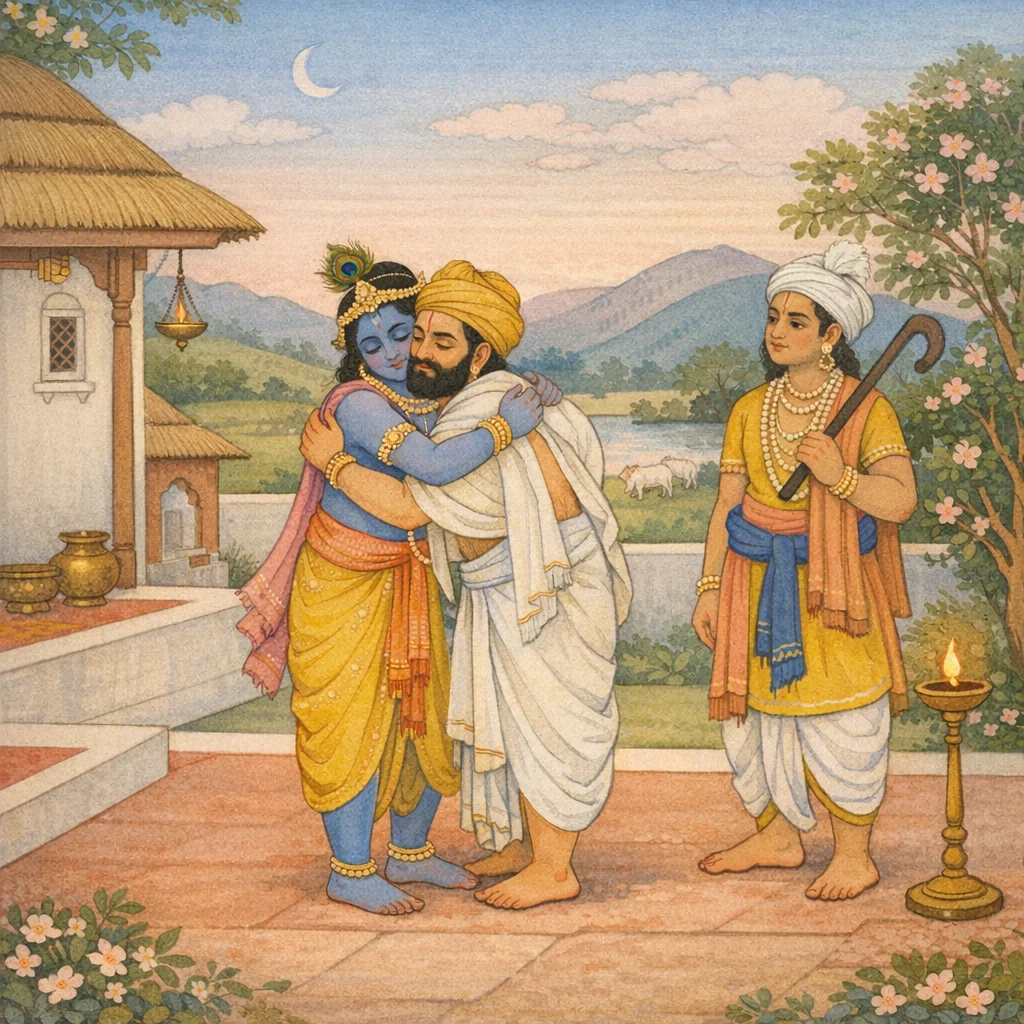
Parashara tells Maitreya: Akrura approaches Govinda and bows at His feet; Hari, whose hand bears the auspicious marks of banner, thunderbolt, and lotus, embraces him with affection. Balarama and Keshava honor him as a guest and hear from him of Kamsa’s oppressions. Krishna declares with certainty that within three nights Kamsa will be slain, and that they will depart for Mathura the next day. At dawn, as they set out, the gopis—burning in the fire of separation—lament and voice fears that Krishna, charmed by the sweet words of the city women, may not return; even the dust of the chariot makes the distance feel real. At midday on the bank of the Yamuna, Akrura performs his daily rites, enters the water, meditates on the Supreme Brahman, and receives a divine vision: Balabhadra in the form of Ananta, adorned with a thousand serpent hoods, and upon His lap four-armed Vasudeva bearing the discus and other weapons, praised by siddhas, sages, gandharvas, and nagas. Outside, on the chariot, Rama and Krishna are seen in human form; through this twofold vision Akrura understands the truth and hymns Achyuta—proclaiming Vishnu as pure Being beyond name and category, the support of the world through diverse powers, and concluding with the Pancharatra salutation to the Caturvyuha (Om Namo Vasudevaya… Sankarshana… Pradyumna… Aniruddha).
Shlokas
Verse 1
चिन्तयन्न् इति गोविन्दम् उपगम्य स यादवः अक्रूरो ऽस्मीति चरणौ ननाम शिरसा हरेः
Thus contemplating, that Yādava (Akrūra) approached Govinda; declaring, “I am Akrūra,” he bowed his head to the feet of Hari.
Verse 2
सो ऽप्य् एनं ध्वजवज्राब्जकृतचिह्नेन पाणिना संस्पृश्याकृष्य च प्रीत्या सुगाढं परिषस्वजे
He too—touching him with the hand marked by the auspicious emblems of banner, thunderbolt, and lotus—drew him close; and, filled with affection, embraced him firmly with deep joy.
Verse 3
कृतसंवन्दनौ तेन यथावद् बलकेशवौ ततः प्रविष्टौ संहृष्टौ तम् आदायात्ममन्दिरम्
Having been duly greeted with reverence by him, the two divine boys—Bala and Keśava—then entered joyfully, and taking him with them, went into their own inner residence.
Verse 4
सह ताभ्यां तदाक्रूरः कृतसंवन्दनादिकः भुक्तभोज्यो यथान्यायम् आचचक्षे ततस् तयोः
Then Akrūra, being with the two of them, first performed the proper courtesies—greetings and the like—and, having duly partaken of the hospitality offered. Afterward, in the manner befitting the occasion, he related to them all that had brought him there.
Verse 5
यथा निर्भर्त्स्यते तेन कंसेनानकदुन्दुभिः यथा च देवकी देवी दानवेन दुरात्मना
“(I shall tell you) how, by that Kamsa, Anakadundubhi (Vasudeva) would be harshly rebuked—and how the goddess-like Devakī too would be tormented by that wicked-souled, daemonic oppressor.”
Verse 6
उग्रसेने यथा कंसः सुदुरात्मा च वर्तते यं चैवार्थं समुद्दिश्य स कंसेन विसर्जितः
Consider how Kaṃsa—most wicked at heart—conducts himself toward Ugrasena; and for whatever purpose he was sent forth, he has been dispatched by Kaṃsa with that very intent.
Verse 7
तत् सर्वं विस्तराच् छ्रुत्वा भगवान् केशिसूदनः उवाचाखिलम् अप्य् एतज् ज्ञातं दानपते मया
Having heard all of that in full detail, the Blessed Lord—Keśisūdana—spoke: “O lord of generosity, all this has indeed been understood by me.”
Verse 8
करिष्ये च महाभाग यद् अत्रौपयिकं मतम् विचिन्त्यं नान्यथैतत् ते विद्धि कंसं हतं मया
And I shall do, O greatly fortunate one, whatever course is truly fitting here. Consider this well—there is no other outcome. Know it for certain: by me, Kaṃsa is as good as slain.
Verse 9
अहं रामश् च मथुरां श्वो यास्यावः समं त्वया गोपवृद्धाश् च यास्यन्ति ह्य् आदायोपायनं बहु
Tomorrow, Balarāma and I shall set out for Mathurā together with you; and the elder cowherds, too, will go—bearing many gifts and offerings.
Verse 10
निशेयं नीयतां वीर न चिन्तां कर्तुम् अर्हसि त्रिरात्राभ्यन्तरे कंसं हनिष्यामि सहानुगम्
Let this night be passed, O hero—do not give yourself to anxiety. Within three nights I shall strike down Kaṃsa, together with all who follow and uphold him.
Verse 11
समादिश्य ततो गोपान् अक्रूरो ऽपि सकेशवः सुष्वाप बलभद्रश् च नन्दगोपगृहे ततः
Having then given instructions to the cowherds, Akrūra—together with Keśava—lay down to rest; and Balabhadra too slept thereafter in the house of Nanda the cowherd-chief.
Verse 12
ततः प्रभाते विमले कृष्णरामौ महामती अक्रूरेण समं गन्तुम् उद्यतौ मथुरां प्रति
Then, at the clear and stainless dawn, the great-souled Krishna and Balarama prepared to set out—together with Akrura—on the journey toward Mathura.
Verse 13
दृष्ट्वा गोपीजनः सास्रः श्लथद्वलयबाहुकः निशश्वासातिदुःखार्तः प्राह चेदं परस्परम्
Seeing one another, the band of gopīs—eyes brimming with tears, bangles loosened upon their arms, and hearts overwhelmed by grief and heavy sighs—began to speak among themselves.
Verse 14
मथुरां प्राप्य गोविन्दः कथं गोकुलम् एष्यति नागरस्त्रीकलालापमधु श्रोत्रेण पास्यति
Having reached Mathurā, how will Govinda ever return to Gokula? He will drink with his ears the honey-sweet prattle of the city women—so how could his heart turn back?
Verse 15
विलासिवाक्यपानेषु नागरीणां कृतास्पदम् चित्तम् अस्य कथं भूयो ग्राम्यगोपीषु यास्यति
His mind has found its dwelling in the playful speech and refined charms of city-bred women—how could that same heart ever again return to the simple cowherd girls of the village?
Verse 16
सारं समस्तगोष्ठस्य विधिना हरता हरिम् प्रहृतं गोपयोषित्सु निर्घृणेन दुरात्मना
Then that pitiless, wicked-souled one—while Hari, by destiny’s own ordinance, was taking away the very essence of the entire cowherd settlement—struck the cowherd women.
Verse 17
भावगर्भस्मितं वाक्यं विलासललिता गतिः नागरीणाम् अतीवैतत् कटाक्षेक्षितम् एव च
Their speech is laced with inner meaning and softened by a smile; their movement is graceful with playful elegance—this, indeed, is the mark of refined city-bred women, and so too is their sidelong, glancing gaze.
Verse 18
ग्राम्यो हरिर् अयं तासां विलासनिगडैर् युतः भवतीनां पुनः पार्श्वं कया युक्त्या समेष्यति
This Hari has become as though rustic—tightly bound by their playful fetters. By what means, then, will He ever come again to your side?
Verse 19
एषएष रथम् आरुह्य मथुरां याति केशवः क्रूरेणाक्रूरकेणात्र निराशेन प्रतारितः
Look—there, look! Keśava has mounted the chariot and is going to Mathurā, deceived here by that cruel Akrūra—who, though named ‘A-krūra’ (not-cruel), comes without hope and yet contrives this betrayal.
Verse 20
किं न वेत्ति नृशंसो ऽयम् अनुरागपरं जनम् येनेमम् अक्ष्णोर् आह्लादं नयत्य् अन्यत्र नो हरिम्
Does this cruel one not understand a people wholly given over to love—how he drags the delight of our eyes away from Hari and forces it to rest anywhere else but on Him?
Verse 21
एष रामेण सहितः प्रयात्य् अत्यन्तनिर्घृणः रथम् आरुह्य गोविन्दस् त्वर्यताम् अस्य वारणे
Look—this utterly pitiless one is departing, accompanied by Rāma. O Govinda, mount the chariot at once; make haste to stop him.
Verse 22
गुरूणाम् अग्रतो वक्तुं किं ब्रवीषि न नः क्षमम् गुरवः किं करिष्यन्ति दग्धानां विरहाग्निना
Why do you ask us to speak in the presence of our elders? It is not permitted for us. And what could the teachers themselves do for those already scorched by the fire of separation?
Verse 23
नन्दगोपमुखा गोपा गन्तुम् एते समुद्यताः नोद्यमं कुरुते कश्चिद् गोविन्दविनिवर्तने
Led by Nanda, the cowherds rose, ready to depart; yet none strove to turn Govinda back—for a heart once held by the Lord cannot easily oppose His will.
Verse 24
सुप्रभाताद्य रजनी मथुरावासियोषिताम् पास्यन्त्य् अच्युतवक्त्राब्जं यासां नेत्रालिपङ्क्तयः
For the women of Mathurā, this very night has become a blessed dawn: their bee-like rows of eyes will drink the lotus of Acyuta’s face.
Verse 25
धन्यास् ते पथि ये कृष्णम् इतो यान्त्य् अनिवारिताः उद्वहिष्यन्ति पश्यन्तः स्वदेहं पुलकाञ्चितम्
Blessed are those who, unobstructed, go from here along the road with Krishna; gazing upon Him, they can scarcely bear even their own bodies, bristling with rapture.
Verse 26
मथुरानगरीपौरनयनानां महोत्सवः गोविन्दावयवैर् दृष्टैर् अतीवाद्य भविष्यति
For the eyes of Mathurā’s citizens, a great festival will arise today, surpassing all, when they behold the limbs and radiant form of Govinda.
Verse 27
को नु स्वप्नः सभाग्याभिर् दृष्टस् ताभिर् अधोक्षजम् विस्तारिकान्तिनयना या द्रक्ष्यन्त्य् अनिवारितम्
What wondrous dream was it, that those truly fortunate women beheld Adhokṣaja, the Lord beyond the senses? Now, with eyes widened and shining, they will see Him again—unhindered.
Verse 28
अहो गोपीजनस्यास्य दर्शयित्वा महानिधिम् उद्धृतान्य् अत्र नेत्राणि विधात्राकरुणात्मना
Alas! After revealing to these gopīs the great treasure of His very presence, the Creator—seemingly devoid of compassion—has here torn away their eyes, so that they may no longer behold Him.
Verse 29
अनुरागेण शैथिल्यम् अस्मासु व्रजतो हरेः शैथिल्यम् उपयान्त्य् आशु करेषु वलयान्य् अपि
As Hari moves away from us, even our ardor grows slack; and swiftly, even the bangles upon our hands become loose—so does the heart’s longing unbind the body itself.
Verse 30
अक्रूरः क्रूरहृदयः शीघ्रं प्रेरयते हयान् एवम् आर्तासु योषित्सु घृणा कस्य न जायते
Akrūra, cruel at heart, hastens the horses onward. Seeing women thus afflicted and in agony, in whom would compassion not arise?
Verse 31
एष कृष्णरथस्योच्चैश् चक्ररेणुर् निरीक्ष्यताम् दूरीभूतो हरिर् येन सो ऽपि रेणुर् न लक्ष्यते
Behold—this is the dust raised high by the wheels of Kṛṣṇa’s chariot; watch it well. Yet Hari has already sped so far away that even that dust is no longer seen.
Verse 32
इत्य् एवम् अतिहार्देन गोपीजननिरीक्षितः तत्याज व्रजभूभागं सह रामेण केशवः
Thus, watched by the gopīs with hearts overwhelmed by tender anguish, Keśava left the land of Vraja, accompanied by Rāma (Balarāma).
Verse 33
गच्छन्तो जवनाश्वेन रथेन यमुनातटम् प्राप्ता मध्याह्नसमये रामाक्रूरजनार्दनाः
Riding in a chariot drawn by swift horses, they went to the bank of the Yamunā; and by midday Rāma, Akrūra, and Janārdana arrived there.
Verse 34
अथाह कृष्णम् अक्रूरो भवद्भ्यां तावद् आस्यताम् यावत् करोमि कालिन्द्याम् आह्निकार्हणम् अम्भसि
Then Akrūra said to Kṛṣṇa: “May you both remain here for a while, until I complete my daily rite of worship in the waters of the Kāлиндī (Yamunā).”
Verse 35
तथेत्य् उक्तस् ततः स्नातः स्वाचान्तः स महामतिः दध्यौ ब्रह्म परं विप्र प्रविश्य यमुनाजले
“So be it,” he replied; then that great-souled one bathed and performed ācamana. Entering the waters of the Yamunā, O brāhmaṇa, he fixed his contemplation upon the Supreme Brahman.
Verse 36
फणासहस्रमालाढ्यं बलभद्रं ददर्श सः कुन्दामलाङ्गम् उन्निद्रपद्मपत्रारुणेक्षणम्
He beheld Balabhadra, adorned with a garland of a thousand serpent-hoods—his body spotless and radiant like jasmine, and his eyes tinged red like the petals of a fully blossomed lotus.
Verse 37
वृतं वासुकिरम्भाद्यैर् महद्भिः पवनाशिभिः संस्तूयमानं गन्धर्वैर् वनमालाविभूषितम्
He was surrounded by the great ones—Vāsuki, Rambhā, and others—beings who move with the swiftness of the wind; praised in song by the Gandharvas, and adorned with the forest-garland (vanamālā).
Verse 38
दधानम् असिते वस्त्रे चारुपद्मावतंसकम् चारुकुण्डलिनं मत्तम् अन्तर् जलतले स्थितम्
There, within the watery depths, stood a wondrous divine being—clad in dark garments, crowned with a lovely lotus-crest, adorned with beautiful earrings, intoxicated with sacred power and rapture, and stationed beneath the surface of the water.
Verse 39
तस्योत्सङ्गे घनश्यामम् आताम्रायतलोचनम् चतुर्बाहुम् उदाराङ्गं चक्राद्यायुधभूषणम्
Upon his lap appeared the Lord of deep cloud-dark hue, with long lotus-reddened eyes—four-armed, broad and noble-limbed—adorned with the discus and the other divine weapons.
Verse 40
पीते वसानं वसने चित्रमाल्यविभूषणम् शक्रचापतडिन्मालाविचित्रम् इव तोयदम्
Clad in yellow garments and adorned with variegated garlands and ornaments, he shone like a rain-cloud made wondrous with Indra’s rainbow and with chains of lightning.
Verse 41
श्रीवत्सवक्षसं चारुकेयूरमुकुटोज्ज्वलम् ददर्श कृष्णम् अक्लिष्टं पुण्डरीकावतंसकम्
He beheld Krishna—serene and unwearied—his chest marked with the sacred Śrīvatsa, shining with beautiful armlets and a radiant crown, adorned with the lotus as his ornament.
Verse 42
सनन्दनाद्यैर् मुनिभिः सिद्धयोगैर् अकल्मषैः विचिन्त्यमानं तत्रस्थैर् नासाग्रन्यस्तलोचनैः
There, sages beginning with Sanandana—perfected yogins free from all stain—remained seated in that place, their gaze fixed upon the tip of the nose, steadily contemplating him without cease.
Verse 43
बलकृष्णौ तथाक्रूरः प्रत्यभिज्ञाय विस्मितः सो ऽचिन्तयद् रथाच् छीघ्रं कथम् अत्रागताव् इति
Recognizing Balarāma and Kṛṣṇa, Akrūra was struck with wonder. He pondered within: “How have they come here so swiftly, leaving the chariot behind?”
Verse 44
विवक्षोः स्तम्भयाम् आस वाचं तस्य जनार्दनः ततो निष्क्रम्य सलिलाद् रथम् अभ्यागतः पुनः
As words were about to burst from him, Janārdana checked his speech. Then, emerging from the waters, He returned again to the chariot.
Verse 45
ददर्श तत्र चैवोभौ रथस्योपर्य् अधिष्ठितौ रामकृष्णौ यथापूर्वं मनुष्यवपुषान्वितौ
There he beheld them both—Rāma and Kṛṣṇa—seated aloft upon the chariot; just as before, they appeared in human form.
Verse 46
निमग्नश् च पुनस् तोये स ददर्श तथैव तौ संस्तूयमानौ गन्धर्वमुनिसिद्धमहोरगैः
And when he again plunged into the waters, he beheld those two just as before—being hymned and praised by Gandharvas, sages, Siddhas, and the great serpents.
Verse 47
ततो विज्ञातसद्भावः स तु दानपतिस् तदा तुष्टाव सर्वविज्ञान, ,मयम् अच्युतम् ईश्वरम्
Then, recognizing the Lord’s true nature, that ruler famed for generosity at once praised Acyuta—the Sovereign God—who is the very fullness of all knowledge.
Verse 48
सन्मात्ररूपिणे ऽचिन्त्यमहिम्ने परमात्मने व्यापिने नैकरूपैकस्वरूपाय नमो नमः
Salutations—again and again—to Him whose very nature is pure Being; whose majesty is beyond thought; the Supreme Self who pervades all; who appears in many forms, yet is in essence one and the same Reality.
Verse 49
सत्यरूपाय ते ऽचिन्त्य हविर्भूताय ते नमः नमो ऽविज्ञेयरूपाय पराय प्रकृतेः प्रभो
Salutations to You whose very form is Truth—unthinkable, beyond the mind—who become the sacred oblation itself. Salutations to You whose form cannot be grasped by any knowing, O Lord; You are the Supreme, transcending Prakṛti.
Verse 50
भूतात्मा चेन्द्रियात्मा च प्रधानात्मा तथा भवान् आत्मा च परमात्मा च त्वम् एकः पञ्चधा स्थितः
You alone are One, yet you abide in fivefold manner: as the Self within beings, as the Self within the senses, as the Self of Pradhāna (primordial Nature), as the individual self, and as the Supreme Self (Paramātman).
Verse 51
प्रसीद सर्वसर्वात्मन् क्षराक्षरमयेश्वर ब्रह्मविष्णुशिवाख्याभिः कल्पनाभिर् उदीरितः
Be gracious, O Self of all selves—O sovereign Lord whose being encompasses both the perishable and the imperishable. Though you are proclaimed through conceptual designations as “Brahmā,” “Viṣṇu,” and “Śiva,” you remain the one Supreme Reality behind those names.
Verse 52
अनाख्येयस्वरूपात्मन्न् अनाख्येयप्रयोजन अनाख्येयाभिधानं त्वां नतो ऽस्मि परमेश्वर
O Supreme Lord, your very nature is beyond all telling; your purpose is beyond all telling; even your designation is beyond all telling. To you, the Ineffable, I bow in reverence.
Verse 53
न यत्र नाथ विद्यन्ते नामजात्यादिकल्पनाः तद् ब्रह्म परमं नित्यम् अविकारि भवान् अज
O Lord—where no fabrications such as “name,” “class,” and the rest are found, that is the Supreme Brahman: eternal and changeless. You are That—unborn.
Verse 54
न कल्पनाम् ऋते ऽर्थस्य सर्वस्याधिगमो यतः ततः कृष्णाच्युतानन्तविष्णुसंज्ञाभिर् ईड्यसे
Since, without conceptual formation, no meaning of anything can be apprehended, therefore, O Lord, you are praised by the names Kṛṣṇa, Acyuta, Ananta, and Viṣṇu.
Verse 55
सर्वार्थास् त्वम् अज विकल्पनाभिर् एतद् देवाद्यं जगद् अखिलं त्वम् एव विश्वम् विश्वात्मंस् त्वम् इति विकारभावहीनः सर्वस्मिन् न हि भवतो ऽस्ति किंचिद् अन्यत्
You are all aims and all meanings, O Unborn One. By the mind’s differentiating notions, this entire universe—beginning with the gods—appears as manifold; yet in truth it is You alone. You are the cosmos; You are the Self within the cosmos. Thus, though spoken of in many ways, You remain free from all change; for within everything there exists nothing apart from You.
Verse 56
त्वं ब्रह्मा पशुपतिर् अर्यमा विधाता धाता त्वं त्रिदशपतिः समीरणो ऽग्निः तोयेशो धनपतिर् अन्तकस् त्वम् एको भिन्नार्थैर् जगद् अभिपासि शक्तिभेदैः
You are Brahmā; you are Paśupati (Śiva); you are Aryaman; you are Vidhātṛ and Dhātṛ. You are the lord of the gods; you are the Wind; you are Fire; you are the Lord of the waters; you are the Lord of wealth; you are Antaka, the Ender. Though one, you protect and govern the universe through distinctions of your own śakti, differing in function and meaning.
Verse 57
विश्वं भवान् सृजति सूर्यगभस्तिरूपो विश्वं च ते गुणमयो ऽयम् अज प्रपञ्चः रूपं परं सद् इति वाचकम् अक्षरं यज् ज्ञानात्मने सदसते प्रणतो ऽस्मि तस्मै
You bring forth the universe, taking the form of the sun’s radiance; and, O Unborn One, this entire manifold world, constituted of the guṇas, is yours. Your supreme reality is signified by the imperishable syllable that declares “Sat” (Being). To Him who is the very Self of knowledge—both the manifest and the unmanifest—I bow in reverence.
Verse 58
ॐ नमो वासुदेवाय नमः संकर्षणाय ते प्रद्युम्नाय नमस् तुभ्यम् अनिरुद्धाय ते नमः
Om—salutations to Vāsudeva. Salutations to You as Saṃkarṣaṇa; salutations to You as Pradyumna; and salutations to You as Aniruddha—O Lord, to You alone be reverence in every form.
Frequently Asked Questions
It dramatizes the avatāra paradox: the same Lord appears as human on the chariot while simultaneously revealed as the cosmic, worshipped Supreme within the Yamunā—teaching that līlā does not negate divinity but veils and reveals it by will.
It asserts that all names and forms are conceptual designations; in truth there is no ‘other’ besides the Lord who pervades all, remains changeless, and governs the universe through distinct śakti-functions—yet is one reality beyond prākṛta limitation.
It links the Krishna narrative to Pāñcarātra theology, presenting Vāsudeva and His emanational aspects (Saṃkarṣaṇa, Pradyumna, Aniruddha) as a structured remembrance that supports devotion, metaphysical clarity, and mokṣa-oriented contemplation.