Adhyaya 13
गोवर्धनोत्तरविस्मयः, रासलीलाप्रसङ्गः, तथा सर्वव्याप्तिवेदान्तोपदेशः
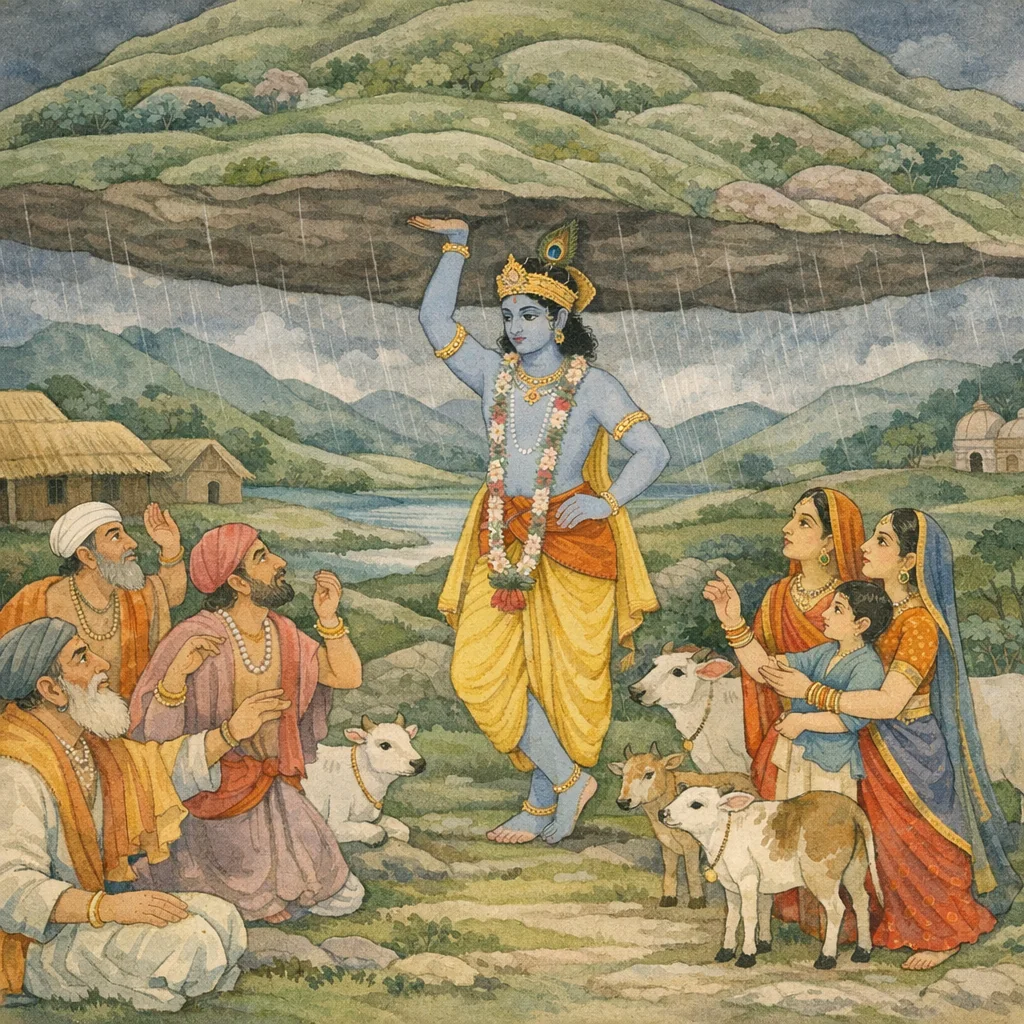
After Indra departs, the gopas marvel that the child Kṛṣṇa held up Govardhana and admit they no longer see Him as human, asking whether He is deva, dānava, yakṣa, or gandharva. Kṛṣṇa answers in līlā, turning them from anxious speculation to intimate kinship-bhāva. Parāśara then tells Maitreya of Kṛṣṇa’s moonlit play in Vṛndāvana: song draws the gopīs; some withdraw in modesty, others sink into one-pointed meditation. Parāśara teaches that such contemplation destroys pāpa and grants mukti, revealing Kṛṣṇa as Parabrahman. The rāsa begins—hand-holding, circling, singing, and fatigue—deepening bhakti, while Vedāntic doctrine frames it: Viṣṇu pervades husbands, wives, and all beings like wind and the elements, uniting rasa with sarva-vyāptitva.
Shlokas
Verse 1
गते शक्रे तु गोपालाः कृष्णम् अक्लिष्टकारिणम् ऊचुः प्रीत्या धृतं दृष्ट्वा तेन गोवर्धनाचलम्
When Śakra (Indra) had departed, the cowherds—beholding with affectionate wonder that Kṛṣṇa, the doer of effortless deeds, had held aloft Mount Govardhana—spoke to Him with joy and devotion.
Verse 2
वयम् अस्मान् महाभाग भवता महतो भयात् गावश् च भवता त्राता गिरिधारणकर्मणा
O greatly fortunate one, by your deed of holding aloft the mountain you have rescued us—and the cows as well—from a great terror.
Verse 3
बालक्रीडेयम् अतुला गोपालत्वं जुगुप्सितम् दिव्यं च कर्म भवतः किम् एतत् तात कथ्यताम्
These incomparable childlike pastimes, this seemingly lowly guise of a cowherd, and yet the divine deeds that are yours—what is the meaning of all this, dear one? Tell me, O child.
Verse 4
कालियो दमितस् तोये प्रलम्बो विनिपातितः धृतो गोवर्धनश् चायं शङ्कितानि मनांसि नः
Kāliya has been subdued in the waters; Pralamba has been struck down; and this Govardhana has been held aloft—yet our hearts still tremble with foreboding.
Verse 5
सत्यं सत्यं हरेः पादौ शपामो ऽमितविक्रम यथा त्वद्वीर्यम् आलोक्य न त्वां मन्यामहे नरम्
Truly—truly—we swear by the feet of Hari, O you of immeasurable prowess: having witnessed your valor, we no longer regard you as a mere man.
Verse 6
प्रीतिः सस्त्रीकुमारस्य व्रजस्य तव केशव कर्म चेदम् अशक्यं यत् समस्तैस् त्रिदशैर् अपि
O Keśava—this deed of yours is such that even all the gods together could not accomplish it: you have won the love of Vraja, with its women and its children, binding their hearts to you in effortless devotion.
Verse 7
बालत्वं चातिवीर्यं च जन्म चास्मासु शोभनम् चिन्त्यमानम् अमेयात्मञ् शङ्कां कृष्ण प्रयच्छति
Your childhood, your surpassing prowess, and your auspicious birth among us—when we ponder these, O Kṛṣṇa of immeasurable Self, a wonder-filled doubt arises within us: who, truly, are You?
Verse 8
देवो वा दानवो वा त्वं यक्षो गन्धर्व एव वा किं वास्माकं विचारेण बान्धवो ऽसि नमो ऽस्तु ते
Whether You are a god or a demon, a Yakṣa or even a Gandharva—what need have we to judge? You are our own kinsman; to You be reverent salutations.
Verse 9
क्षणं भूत्वा त्व् असौ तूष्णीं किंचित् प्रणयकोपवान् इत्य् एवम् उक्तस् तैर् गोपैः कृष्णो ऽप्य् आह महामुने
For a moment he fell silent, holding within himself a slight, love-born indignation. Then, thus addressed by those cowherds, O great sage, Kṛṣṇa too replied.
Verse 10
मत्संबन्धेन वो गोपा यदि लज्जा न जायते श्लाघ्यो वाहं ततः किं वो विचारेण प्रयोजनम्
O gopīs—if, through your bond with me, no sense of shame arises in you, then I am indeed worthy of praise; if so, what need have you of further deliberation?
Verse 11
यदि वो ऽस्ति मयि प्रीतिः श्लाघ्यो ऽहं भवतां यदि तदात्मबन्धुसदृशी बुद्धिर् वः क्रियतां मयि
If there is affection for me within you—if I am worthy of your esteem—then let your regard for me be as for one’s own inward kinsman: hold me with the closeness you grant to your very own.
Verse 12
नाहं देवो न गन्धर्वो न यक्षो न च दानवः अहं वो बान्धवो जातो नैतच् चिन्त्यम् अतो ऽन्यथा
I am not a god, nor a Gandharva; not a Yakṣa, nor a Dānava. I have been born as your own kinsman; therefore do not think otherwise, and do not be anxious.
Verse 13
इति श्रुत्वा हरेर् वाक्यं बद्धमौनास् ततो वनम् ययुर् गोपा महाभाग तस्मिन् प्रणयकोपिनि
Hearing thus the words of Hari, the cowherds fell silent, as though their lips were bound by stillness. O noble one, they then went into the forest, while the beloved remained in affectionate indignation.
Verse 14
कृष्णस् तु विमलं व्योम शरच्चन्द्रस्य चन्द्रिकाम् तथा कुमुदिनीं फुल्लाम् आमोदितदिगन्तराम्
But Krishna was like the stainless sky itself—like the cool radiance of the autumn moon; like a lotus-pond in full bloom, whose fragrance seems to gladden and pervade the farthest quarters.
Verse 15
वनराजीं तथा कूजद्भृङ्गमालामनोरमाम् विलोक्य सह गोपीभिर् मनश् चक्रे रतिं प्रति
Beholding the forest’s royal splendor—made delightful by swarms of humming bees—and being in the company of the gopīs, he turned his mind toward love.
Verse 16
विना रामेण मधुरम् अतीव वनिताप्रियम् जगौ कलपदं शौरिर् नानातन्त्रीकृतव्रतम्
Without Rāma, Śauri sang a melody sweet in itself and especially dear to women—measured in graceful cadence, and rendered with disciplined practice across many strings and modes.
Verse 17
रम्यं गीतध्वनिं श्रुत्वा संत्यज्यावसथांस् तदा आजग्मुस् त्वरिता गोप्यो यत्रास्ते मधुसूदनः
Hearing the enchanting resonance of his song, the gopīs at once abandoned their dwellings and hurried to the place where Madhusūdana was abiding.
Verse 18
शनैः शनैर् जगौ गोपी काचित् तस्य लयानुगम् दत्तावधाना काचिच् च तम् एव मनसास्मरत्
One gopī, little by little, began to sing, following the very cadence of his melody; another, wholly attentive, remembered only him within her mind.
Verse 19
काचित् कृष्णेति कृष्णेति प्रोक्त्वा लज्जाम् उपाययौ ययौ च काचित् प्रेमान्धा तत्पार्श्वम् अविलज्जिता
One maiden, having cried out again and again, “Krishna! Krishna!”, was overtaken by modesty and withdrew; yet another—blinded by love—went straight to his side, unashamed.
Verse 20
काचिद् आवसथस्यान्तः स्थित्वा दृष्ट्वा बहिर् गुरुम् तन्मयत्वेन गोविन्दं दध्यौ मीलितलोचना
One maiden, standing within her dwelling, saw her elder outside; and, becoming wholly absorbed in Govinda, she meditated with her eyes closed.
Verse 21
तच्चिन्ताविपुलाह्लादक्षीणपुण्यचया तथा तदप्राप्तिमहादुःखविलीनाशेषपातका
Absorbed in contemplation of Him, one is flooded with expansive bliss and the accumulated store of merit is exhausted; and if that attainment is not reached, then through the great sorrow of that non-attainment, all remaining sins are dissolved away.
Verse 22
चिन्तयन्ती जगत्सूतिं परब्रह्मस्वरूपिणम् निरुच्छ्वासतया मुक्तिं गतान्या गोपकन्यका
Meditating with single-pointed mind on the Begetter of the universe, whose very nature is the Supreme Brahman, a certain cowherd maiden—her breath stilled in samadhi—attained liberation.
Verse 23
गोपीपरिवृतो रात्रिं शरच्चन्द्रमनोरमाम् मानयाम् आस गोविन्दो रासारम्भरसोत्सुकः
Encircled by the Gopīs, Govinda—eager for the bliss of commencing the Rāsa—spent that night, made enchanting by the autumn moon, as though honoring it with His presence and play.
Verse 24
गोप्यश् च वृन्दशः कृष्णचेष्टास्व् आयत्तमूर्तयः अन्यदेशं गते कृष्णे चेरुर् वृन्दावनान्तरम्
And the cowherd women, moving in groups—their very forms and minds held fast upon Krishna’s every act—when Krishna had gone to another place, wandered restlessly through the inner paths of Vrindavana.
Verse 25
कृष्णो ऽहम् एतत् ललितं व्रजाम्य् आलोक्यतां गतिः अन्या ब्रवीति कृष्णस्य मम गीतिर् निशम्यताम्
One said, “I am Krishna. Behold how I move in this graceful, playful way—my gait is unlike any other. Let people speak of Krishna as they will; now listen to my song.”
Verse 26
दुष्ट कालिय तिष्ठात्र कृष्णो ऽहम् इति चापरा बाहुम् आस्फोट्य कृष्णस्य लीलासर्वस्वम् आददे
Another cried, “Wicked Kāliya—stand here!” and, as if declaring, “I am Kṛṣṇa,” snapped her arm in challenge and seized the very essence of Kṛṣṇa’s sportive sovereignty.
Verse 27
अन्या ब्रवीति भो गोपा निःशङ्कैः स्थीयताम् इह अलं वृष्टिभयेनात्र धृतो गोवर्धनो मया
Another gopī spoke: “O cowherds, stay here without fear. Enough of dreading the rain—here I have held Govardhana aloft.”
Verse 28
धेनुको ऽयं मया क्षिप्तो विचरन्तु यथेच्छया गोपी ब्रवीति चैवान्या कृष्णलीलानुकारिणी
“This Dhenuka I have flung down—let him roam wherever he pleases!” said one gopī; and another, imitating Kṛṣṇa’s playful līlās, echoed her in the same sportive mood.
Verse 29
एवं नानाप्रकारासु कृष्णचेष्टासु तास् तदा गोप्यो व्यग्राः समं चेरू रम्यं वृन्दावनं वनम्
Thus, as Kṛṣṇa’s playful deeds unfolded in many ways, the gopīs—restless and intent upon him—moved together through the lovely forest of Vṛndāvana.
Verse 30
विलोक्यैका भुवं प्राह गोपी गोपवराङ्गना पुलकाञ्चितसर्वाङ्गी विकासिनयनोत्पला
One gopī—the foremost among the cowherd maidens—looked upon the ground and spoke. Her whole body thrilled with rapture, and her lotus-like eyes opened wide in blossoming wonder.
Verse 31
ध्वजवज्राङ्कुशाब्जाङ्करेखावन्त्य् आलि पश्यत पदान्य् एतानि कृष्णस्य लीलालंकृतगामिनः
O friend, look—these are Kṛṣṇa’s footprints, whose very movement is adorned as līlā. They bear auspicious marks: the banner, the vajra, the goad (ankusha), and the lotus.
Verse 32
कापि तेन समं याता कृतपुण्या मदालसा पदानि तस्याश् चैतानि घनान्य् अल्पतनूनि च
Madālasa, rich in well-earned merit, went forth beside him. These are her footprints—close-set and compact, yet delicate and slender in form.
Verse 33
पुष्पावचयम् अत्रोच्चैश् चक्रे दामोदरो ध्रुवम् येनाग्राक्रान्तिमात्राणि पदान्य् अत्र महात्मनः
Here Dāmodara lifted Dhruva up in the honor of flowers; therefore in this very place remain the revered footprints of that great-souled devotee—marked only by the touch of his toes as the Supreme bore him aloft.
Verse 34
अत्रोपविश्य सा तेन कापि पुष्पैर् अलंकृता अन्यजन्मनि सर्वात्मा विष्णुर् अभ्यर्चितो यया
Seated there, she was adorned by him with flowers. For in a former birth, it was she who had worshipped Viṣṇu—the indwelling Self of all—with reverent offerings.
Verse 35
पुष्पबन्धनसंमानकृतमानाम् अपास्य ताम् नन्दगोपसुतो यातो मार्गेणानेन पश्यत
Casting aside her proud sulking—born of being honored with flower garlands and affectionate attentions—the son of Nanda went on by this very path; behold it clearly.
Verse 36
अनुयाने ऽसमर्थान्या नितम्बभरमन्थरा या गन्तव्ये द्रुतं याति निम्नपादाग्रसंस्थितिः
Though she is not fit for a long march and her gait is slowed by the weight of her hips, when she must reach her destination she moves swiftly—stepping with the forepart of her feet set low.
Verse 37
हस्तन्यस्ताग्रहस्तेयं तेन याति तथा सखी अनायत्तपदन्यासा लक्ष्यते पदपद्धतिः
With her hand placed in the grasp of her guide, she moves along; so too does her companion. Her footsteps are no longer self-directed—her very gait and pathway are seen to be governed by that guiding hold.
Verse 38
हस्तसंस्पर्शमात्रेण धूर्तेनैषा विमानिता नैराश्यान् मन्दगामिन्या निवृत्तं लक्ष्यते पदम्
By the mere touch of the hand, that crafty man dishonoured her; and then, as hope ebbed away and her steps grew slow with despair, her course turned back—her retreat became plainly visible.
Verse 39
नूनम् उक्ता त्वरामीति पुनर् एष्यामि ते ऽन्तिकम् तेन कृष्णेन येनैषा त्वरिता पदपद्धतिः
“Surely,” he thought, “I have said, ‘I am hurrying’—and so I shall return again to your presence.” Thus, by that Kṛṣṇa through whom this swift course of footsteps has been set in motion, the path itself is made rapid.
Verse 40
प्रविष्टो गहनं कृष्णः पदम् अत्र न लक्ष्यते निवर्तध्वं शशाङ्कस्य नैतद् दीधितिगोचरे
Kṛṣṇa has entered a deep, impenetrable darkness—no trace of his path can be discerned here. Turn back; this is not within the range of the Moon’s rays, nor within the reach of its light.
Verse 41
निवृत्तास् तास् ततो गोप्यो निराशाः कृष्णदर्शने यमुनातीरम् आगम्य जगुस् तच्चरितं तदा
Then those cowherd maidens, their hope of beholding Kṛṣṇa frustrated, turned back. Reaching the bank of the Yamunā, they began at once to sing of his deeds and līlās—letting remembrance become their only sight of him.
Verse 42
ततो ददृशुर् आयान्तं विकासिमुखपङ्कजम् गोप्यस् त्रैलोक्यगोप्तारं कृष्णम् अक्लिष्टचेष्टितम्
Then the gopīs beheld Kṛṣṇa coming toward them—his face like a lotus in full bloom—the protector of the three worlds, the Supreme Lord whose deeds are effortless and untroubled.
Verse 43
काचिद् आलोक्य गोविन्दम् आयान्तम् अतिहर्षिता कृष्ण कृष्णेति कृष्णेति प्राह नान्यद् उदीरयत्
One gopī, seeing Govinda draw near, was overwhelmed with joy; she kept crying, “Kṛṣṇa, Kṛṣṇa, Kṛṣṇa!” and spoke nothing else.
Verse 44
काचिद् भ्रूभङ्गुरं कृत्वा ललाटफलकं हरिम् विलोक्य नेत्रभृङ्गाभ्यां पपौ तन्मुखपङ्कजम्
One gopī, knitting her brows and tilting her forehead in playful, feigned displeasure, gazed upon Hari; with bee-like eyes she drank in the lotus of his face.
Verse 45
काचिद् आलोक्य गोविन्दं निमीलितविलोचना तस्यैव रूपं ध्यायन्ती योगारूढेव चाबभौ
One maiden, having beheld Govinda, gently closed her eyes; meditating only on his form, she appeared as though absorbed in yoga.
Verse 46
ततः काश्चित्प्रियालापैः काश्चिद् भ्रूभङ्गवीक्षितैः निन्ये ऽनुनयम् अन्याश् च करस्पर्शेन माधवः
Then Mādhava drew them back into harmony—some with affectionate words, some with playful, brow-arched glances, and others with the gentle touch of his hand.
Verse 47
ताभिः प्रसन्नचित्ताभिर् गोपीभिः सह सादरम् रराम रासगोष्ठीभिर् उदारचरितो हरिः
With the gopīs whose hearts had grown serene, noble Hari delighted—tenderly and with reverence—in the assemblies of the rāsa.
Verse 48
रासमण्डलबन्धो ऽपि कृष्णपार्श्वम् अनुज्झता गोपीजनेन नैवाभूद् एकस्थानस्थिरात्मना
Even the rāsa-circle could not truly be formed, for the gopīs—minds fixed in one place—would not leave Kṛṣṇa’s side.
Verse 49
हस्ते प्रगृह्य चैकैकां गोपिकां रासमण्डले चकार तत्करस्पर्शनिमीलितदृशं हरिः
Then Hari, taking each gopī by the hand within the rāsa-circle, made her close her eyes—absorbed in the sweetness of His touch.
Verse 50
ततः प्रववृते रासश् चलद्वलयनिस्वनैः अनुयातशरत्काव्यगेयगीतिर् अनुक्रमात्
Then the Rāsa-dance began, with the ringing of moving bangles; and in ordered succession it was accompanied by melodious, autumn-fit songs—poetry set to music.
Verse 51
कृष्णः शरच्चन्द्रमसं कौमुदीं कुमुदाकरम् जगौ गोपीजनस् त्व् एकं कृष्णनाम पुनः पुनः
Kṛṣṇa sang of the autumn moon, the moonlit radiance, and the lotus-lake that opens to that light; yet the gopīs had but one song—repeating the name “Kṛṣṇa” again and again.
Verse 52
परिवर्तश्रमेणैका चलद्वलयलापिनी ददौ बाहुलतां स्कन्धे गोपी मधुनिघातिनः
Worn by the ceaseless circling of the dance, one gopī—her bangles chiming as they swayed—rested the weight of her arm upon the shoulder of Madhusūdana, slayer of Madhu, seeking support in Him.
Verse 53
काचित् प्रविलसद्बाहुं परिरभ्य चुचुम्ब तम् गोपी गीतस्तुतिव्याजनिपुणा मधुसूदनम्
One gopī—skilled at veiling her praise as song—embraced Madhusūdana, whose arms played with graceful motion, and kissed Him.
Verse 54
गोपीकपोलसंश्लेषम् अभिपद्य हरेर् भुजौ पुलकोद्गमसस्याय स्वेदाम्बुघनतां गतौ
As the gopīs pressed cheek to cheek in embrace, Hari’s arms drew them close; and those divine arms, where rapture rose as gooseflesh, grew heavy with beads of sweat like a cloud laden with water.
Verse 55
रासगेयं जगौ कृष्णो यावत्तारतरध्वनिः साधु कृष्णेति कृष्णेति तावत् ता द्विगुणं जगुः
Kṛṣṇa sang the melody of the Rāsa, his voice rising ever higher and clearer; and as long as that sweet resonance flowed, the gopīs replied with redoubled fervor: “Sādhu! Kṛṣṇa! Kṛṣṇa!”
Verse 56
गते ऽनुगमनं चक्रुर् वलने संमुखं ययुः प्रतिलोमानुलोमेन भेजुर् गोपाङ्गना हरिम्
When He moved, they followed; when He turned, they came to face Him. Thus, alternately against and with the circling flow, the cowherd maidens continually embraced Hari—Viṣṇu himself appearing as Kṛṣṇa.
Verse 57
स तथा सह गोपीभी रराम मधुसूदनः यथाब्दकोटिप्रतिमः क्षणस् तेन विनाभवत्
Thus Madhusūdana sported there in joy together with the gopīs; and without Him, even a single moment became to them like time measured in crores of years.
Verse 58
ता वार्यमाणाः पतिभिः पितृभिर् भ्रातृभिस् तथा कृष्णं गोपाङ्गना रात्रौ रमयन्ति रतिप्रियाः
Though restrained by husbands, fathers, and brothers, the cowherd women—delighting in love—went by night to sport with Krishna, irresistibly drawn to the supreme Beloved of the heart.
Verse 59
सो ऽपि कैशोरकवयो मानयन् मधुसूदनः रेमे ताभिर् अमेयात्मा क्षपासु क्षपिताहितः
He too—Madhusūdana, honoring the maidens in the bloom of youth—delighted with them through the nights; the immeasurable Self, He dispelled all inauspiciousness and brought their sufferings to an end.
Verse 60
तद्भर्तृषु तथा तासु सर्वभूतेषु चेश्वरः आत्मस्वरूपरूपो ऽसौ व्याप्य वायुर् इव स्थितः
In their husbands and in those wives as well—and indeed in all beings—the Lord abides: taking the very form of the Self within, He pervades all, like the wind present everywhere.
Verse 61
यथा समस्तभूतेषु नभो ऽग्निः पृथिवी जलम् वायुश् चात्मा तथैवासौ व्याप्य सर्वम् अवस्थितः
Just as within all beings abide space, fire, earth, water, and wind as their inner basis, so too does Vishnu pervade everything and remain established in all.
Frequently Asked Questions
Because the Govardhana-līlā and earlier demon-subduing acts exceed human capacity; the text uses their wonder (vismaya) to transition from social familiarity to recognition of Viṣṇu’s aiśvarya, while still preserving Vraja’s intimate bhāva.
Parāśara narrates rāsa aesthetically, then anchors it philosophically by stating that the Lord pervades all beings as the inner Self (antaryāmin) and is present everywhere like the elements—showing devotion’s intimacy is grounded in non-sectarian metaphysics of sarva-vyāpti.
Single-pointed contemplation of the Jagat-sūti (source of the universe) who is Parabrahman can dissolve sin and culminate in liberation; even the anguish of non-attainment is portrayed as purifying, emphasizing the transformative power of bhakti-yoga through dhyāna and smaraṇa.