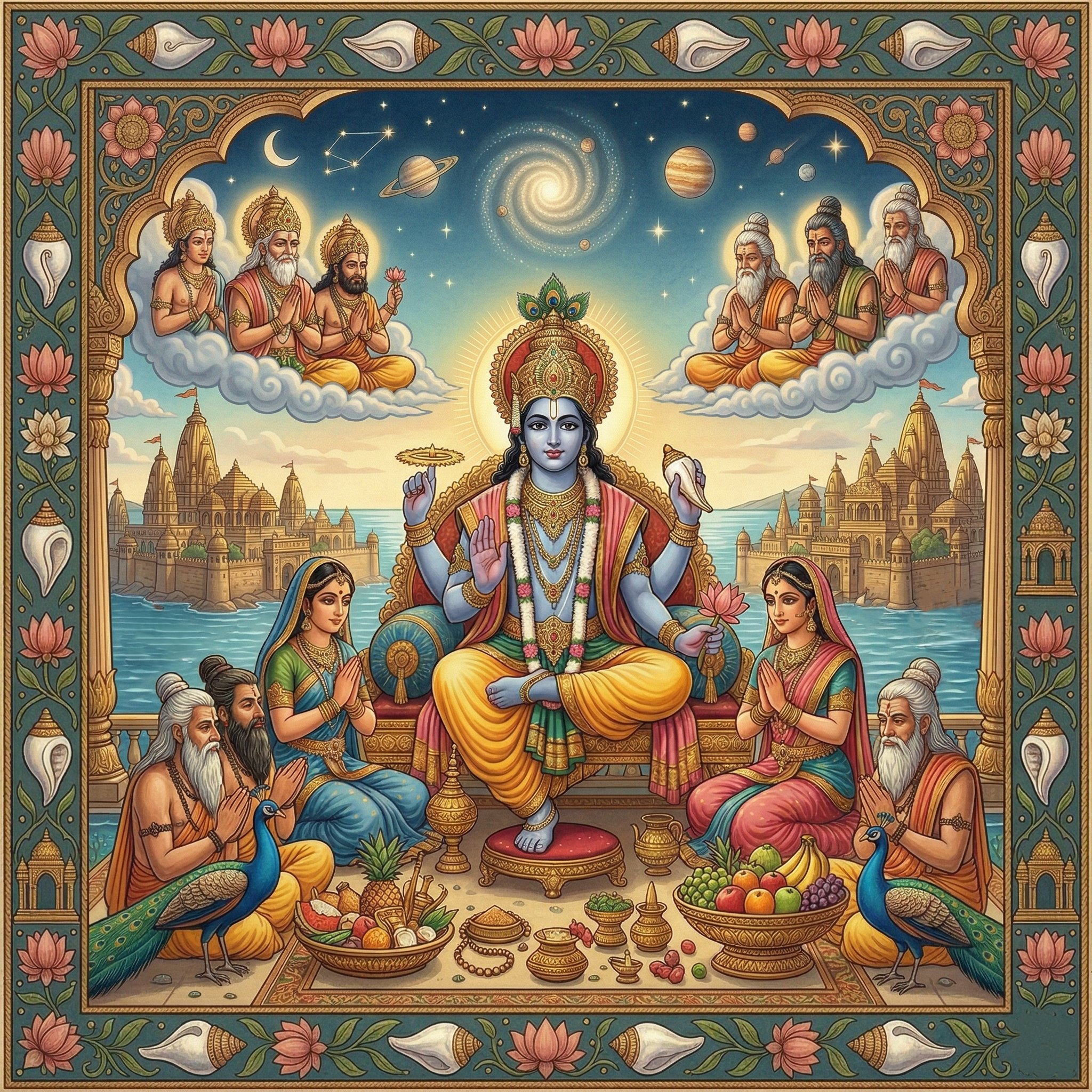
Dvaraka Mahatmya
Dvaraka Mahatmya
This section is anchored in the western coastal-sacred geography associated with Dvārakā and its wider Yādava/Vaiṣṇava memory field, extending to Prabhāsa as an epic-afterlife locus. It uses the sea, submerged city motifs, and pilgrimage networks to connect Krishna-centric narrative history with tīrtha practice and ethical reflection in Kali-yuga.
Adhyayas in Dvaraka Mahatmya
44 chapters to explore.
Adhyaya 1
कलियुगे विष्णुप्राप्त्युपायः — Seeking Viṣṇu in the Age of Kali
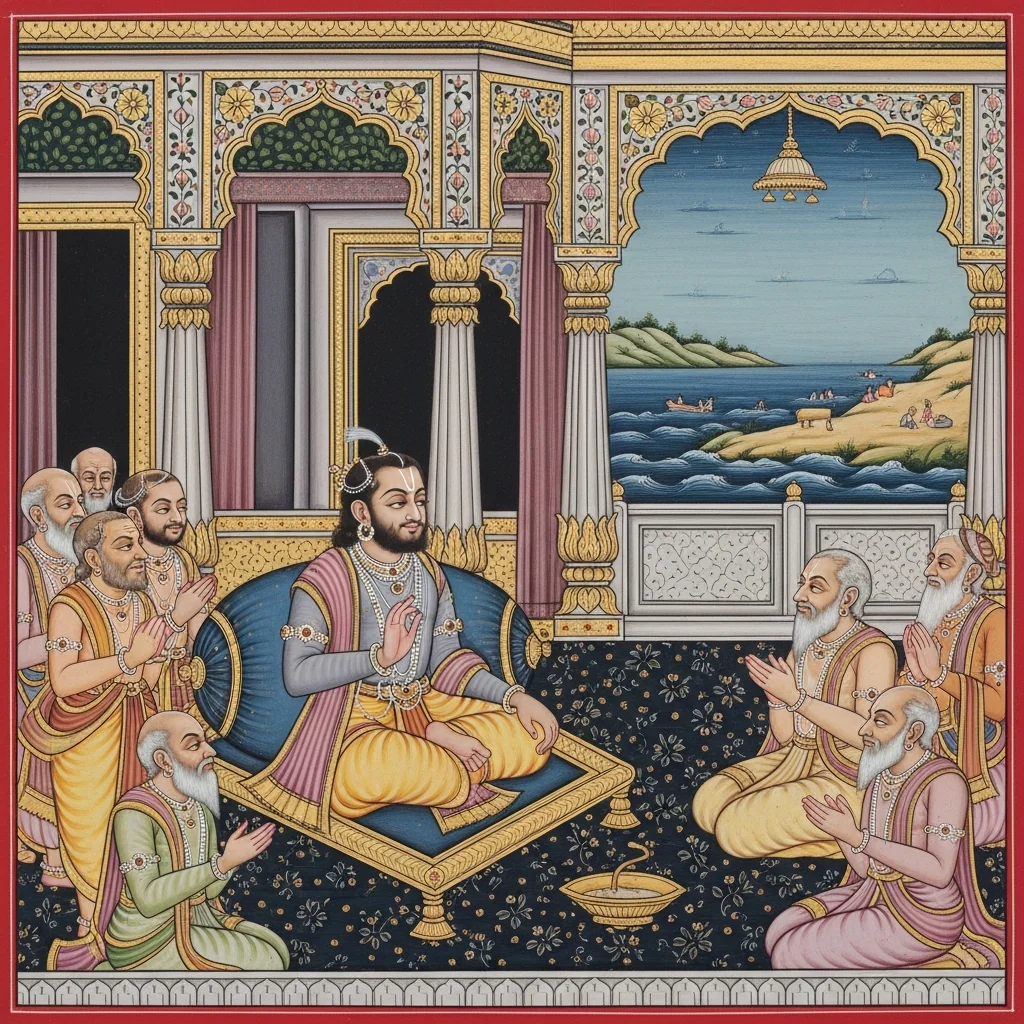
Chapter 1 opens with Śaunaka asking Sūta how, in the turbulent Kali-yuga of fractured doctrines, a seeker may draw near to Madhusūdana (Viṣṇu). Sūta replies by briefly recounting Janārdana’s descent and deeds: the early exploits in Vraja (the defeat of Pūtanā, Tṛṇāvarta, Kāliya, and others), the move to Mathurā (the slaying of Kuvalayāpīḍa and royal foes), and later political and sacrificial episodes (conflicts with Jarāsandha and the Rājasūya setting). The narrative then turns to the post-epic horizon: the Yādavas’ self-destructive strife at Prabhāsa, Kṛṣṇa’s withdrawal from the world, and Dvārakā’s inundation. Amid this decline, forest sages assemble, discern Kali-yuga’s moral erosion—dharma and social-ritual order weakening—and seek counsel from Brahmā. Brahmā admits the limits of knowing Viṣṇu’s supreme mode and directs them to Prahlāda in Sutala, an authoritative devotee who can indicate Hari’s locus and the means of access. The chapter closes as the sages reach Sutala, are welcomed by Bali with Prahlāda present, and formally request the confidential method to attain God without elaborate disciplines, preparing the next instruction.
Adhyaya 2
द्वारकाक्षेत्रप्रशंसा तथा दुर्वासोपाख्यानम् | Praise of Dvārakā and the Durvāsā Episode
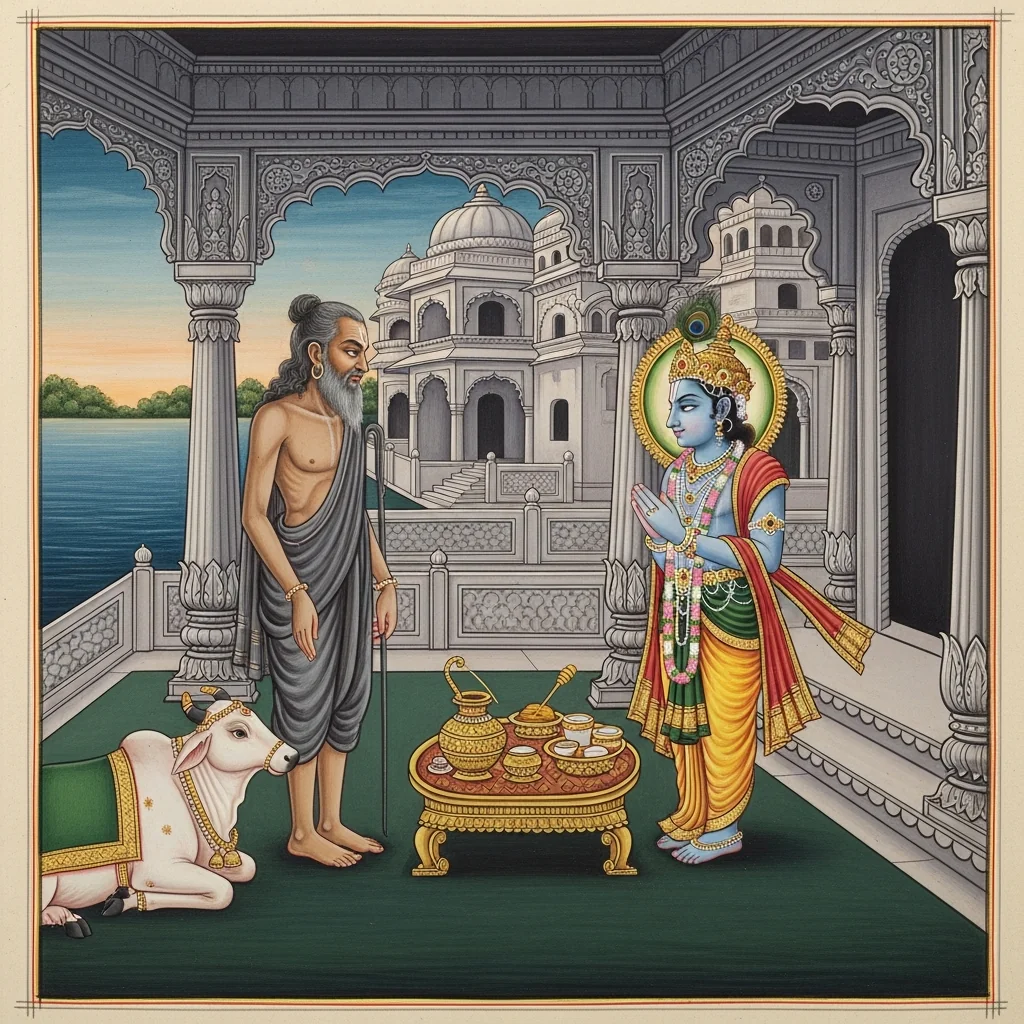
The chapter begins with Prahlāda addressing the sages, praising Dvārakā/Dvārāvatī as a sea-side sacred city on the Gomati, the Lord’s supreme abode and a saving destination in Kali-yuga. The sages raise a theological-historical doubt: if the Yādava line has ended and Dvārakā is said to be inundated, how can the Lord still be proclaimed there in Kali? The scene shifts to Ugrasena’s court, where news arrives that the sage Durvāsā is staying near the Gomati at Cakratīrtha. Kṛṣṇa, with Rukmiṇī, goes to receive him, stressing that honoring a guest is a binding dharmic duty with ritual consequences. Asked about the city’s extent, households, and dependents, Kṛṣṇa describes the sea-granted land, golden palaces, and the vast web of family and retinue, revealing the wonder of divine māyā and limitless power. Durvāsā then tests humility by having Kṛṣṇa and Rukmiṇī carry him on a chariot. When the thirsty Rukmiṇī drinks water without seeking his permission, Durvāsā curses her with perpetual thirst and separation from Kṛṣṇa. Kṛṣṇa consoles her with a teaching on mediated presence—seeing him there implies seeing her—and urges devotional attentiveness. The chapter ends with Kṛṣṇa appeasing and worshiping Durvāsā through full hospitality rites: washing the feet, offering arghya, gifting a cow, presenting madhuparka, and feeding him, establishing a canonical model of guest-reception ethics.
Adhyaya 3
Durvāsā-śāpa, Rukmiṇī-vilāpa, and the Sanctification of Rukmiṇī-vana (दुर्वासशाप-रुक्मिणीविलाप-रुक्मिणीवनमाहात्म्य)
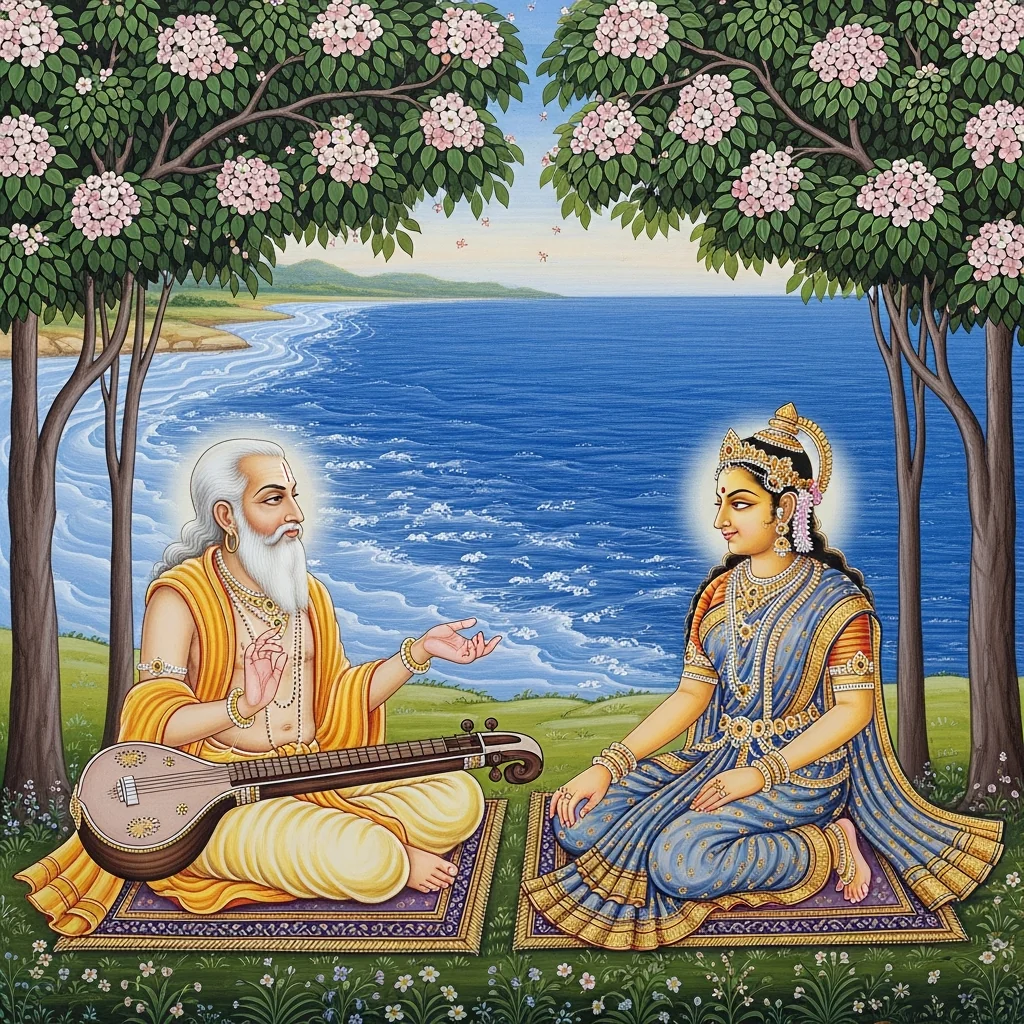
Chapter 3 presents a layered theological teaching on separation, divine instruction, and the arising of a tīrtha. The Ṛṣis marvel at Kṛṣṇa’s forbearance and at the truth-power carried by a sage’s speech. Prahlāda recounts how Rukmiṇī, struck by Durvāsas’ curse, laments her separation from Kṛṣṇa and questions the justice of being cursed despite her innocence. Overcome by grief, she faints, and Samudra (the Ocean) arrives to revive and refresh her. Nārada counsels steadiness and explains that Kṛṣṇa and Rukmiṇī are inseparable principles—Puruṣottama and Māyā/Śakti—and that the apparent separation is a “human-like” concealment meant to instruct the world. Samudra confirms this, praises Rukmiṇī’s exalted status, and announces the coming of Bhāgīrathī (Gaṅgā), whose presence beautifies and purifies the region; a divine grove forms and draws the people of Dvārakā. Seeing the pleasant outcome, Durvāsas’ anger flares again, and he intensifies the curse’s effects upon the land and waters. Rukmiṇī, overwhelmed, resolves on death, but Kṛṣṇa swiftly appears, prevents self-harm, and teaches non-duality and the limits of curse-power before the Divine. Durvāsas repents and seeks forgiveness; Kṛṣṇa upholds the integrity of the sage’s words while establishing a reconciliatory arrangement. The chapter ends with stated merits: bathing at the confluence on new- or full-moon days removes sorrow, and beholding Rukmiṇī on certain lunar dates grants desired aims, establishing the site as a tīrtha that heals suffering.
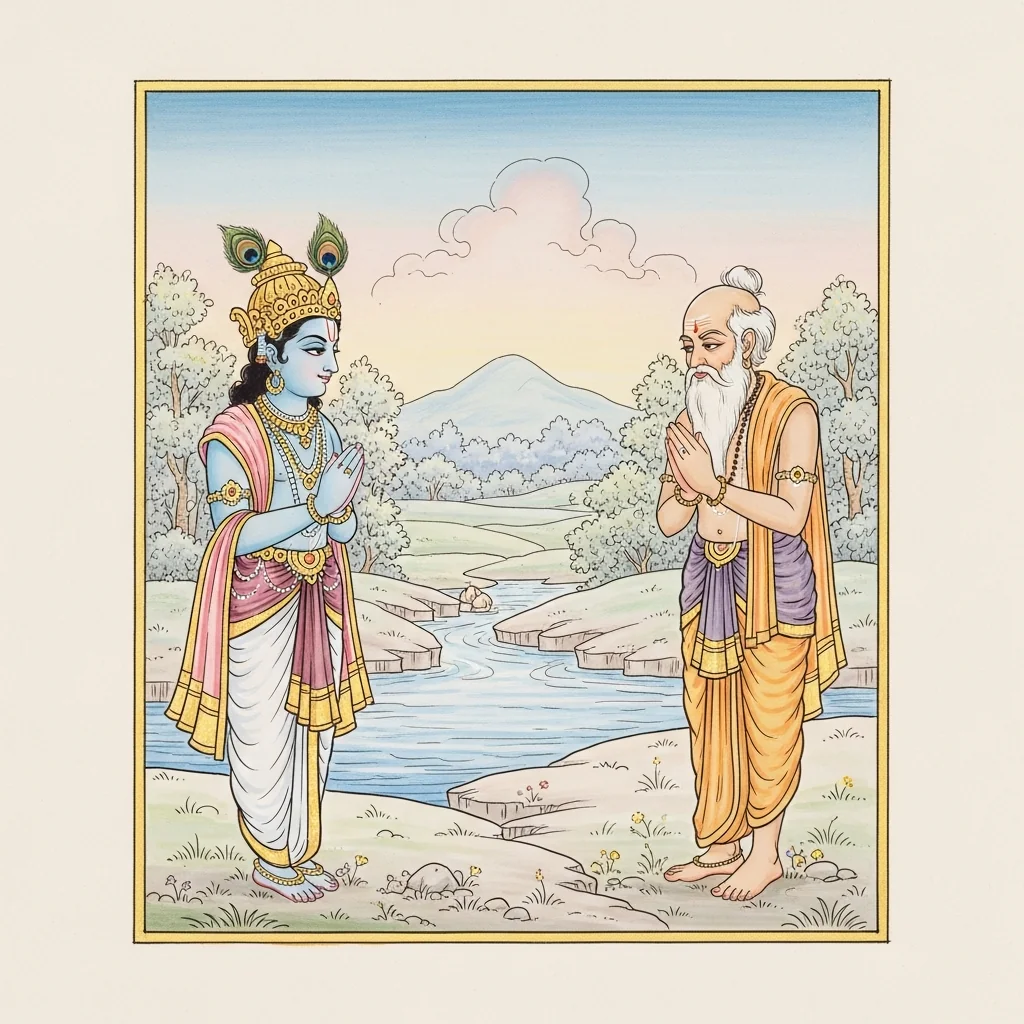
Adhyaya 4
Varadāna-tīrtha and Dvārakā-yātrā: Pilgrimage Ethics, Gomati-saṅgama, and Cakratīrtha Phala
Chapter 4, narrated by Sūta, unfolds as a layered theological teaching centered on Prahlāda’s instruction about Dvārakā’s sacred economy of merit. It opens with Kṛṣṇa and the sage Durvāsā exchanging boons, thereby establishing the tīrtha called Varadāna (“the place of boons”), whose power is tied to bathing at the Gomati–ocean confluence and worshiping both revered figures. The discourse then becomes a practical-ethical guide to pilgrimage: merely forming the intention to go to Dvārakā is meritorious; every step toward the city is equated with the fruits of great sacrifices; and serving pilgrims with shelter, kind speech, food, conveyances, footwear, water-vessels, and care for their feet is praised as exalted devotional service. By contrast, obstructing pilgrims is condemned with clearly stated harmful consequences. Expanding into doctrine, it frames Kali-yuga’s decline through Bṛhaspati’s teaching to Indra and culminates in the claim that Dvārakā is a kalidoṣa-vivarjita refuge, untouched by Kali’s faults. It highlights key tīrthas—especially Cakratīrtha, Gomati snāna, and Rukmiṇī-hrada—declaring that even incidental contact grants liberation and uplifts one’s lineage. The chapter concludes with threshold etiquette and preparatory acts such as honoring Gaṇeśa, formal prostrations, and reverential entry, presenting Dvārakā pilgrimage as a synthesis of devotion, social ethics, and ritual precision.
Adhyaya 5
गोमती-प्रादुर्भावः तथा चक्रतीर्थ-माहात्म्यम् (Origin of the Gomati and the Glory of Chakratirtha)
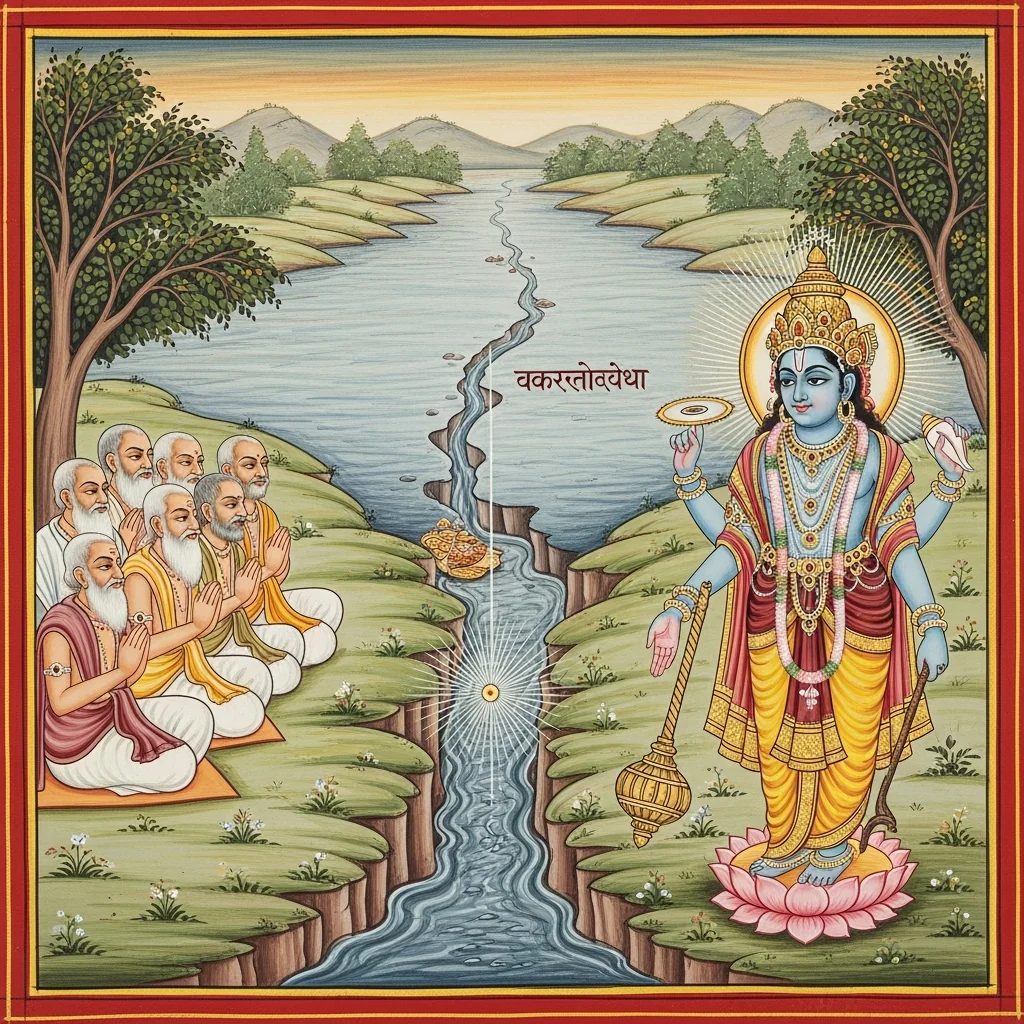
This chapter unfolds as a theological dialogue. Prahlāda directs the “best of the twice-born” pilgrims to the river Gomati, declaring that her darśana purifies and that her waters are worthy of reverence, for they destroy wrongdoing and grant auspicious aims. The ṛṣis then ask what Gomati is, who brought her, and why she reached Varuṇa’s oceanic realm. Prahlāda replies with a cosmogonic account: after the primordial dissolution, Brahmā arises from the lotus at Viṣṇu’s navel and begins creation. The mind-born sons like Sanaka refuse procreative creation and seek a vision of the Divine; performing austerities near the lord of rivers, they behold the radiant Sudarśana. A bodiless voice instructs them to prepare arghya and worship the divine weapon, and the sages praise Sudarśana with hymnic salutations. Brahmā commissions Gaṅgā to descend to earth for Hari’s purpose, proclaiming that she will be known as Gomati and will follow Vasiṣṭha, becoming famed in popular memory as his “daughter.” As Vasiṣṭha leads and Gaṅgā follows toward the western ocean, people honor her; at the sages’ site Viṣṇu appears in four-armed splendor, accepts worship, and grants boons. He names the place Cakratīrtha because Sudarśana first emerged there by splitting the waters, and even incidental bathing bestows liberation. Having washed Hari’s feet, Gomati enters the sea, becoming a great sin-destroying river, also remembered in tradition as the “former Gaṅgā.”
Adhyaya 6
गोमतीतीर्थविधानम् (Gomatī Tīrtha: Ritual Procedure and Vow-Observances)
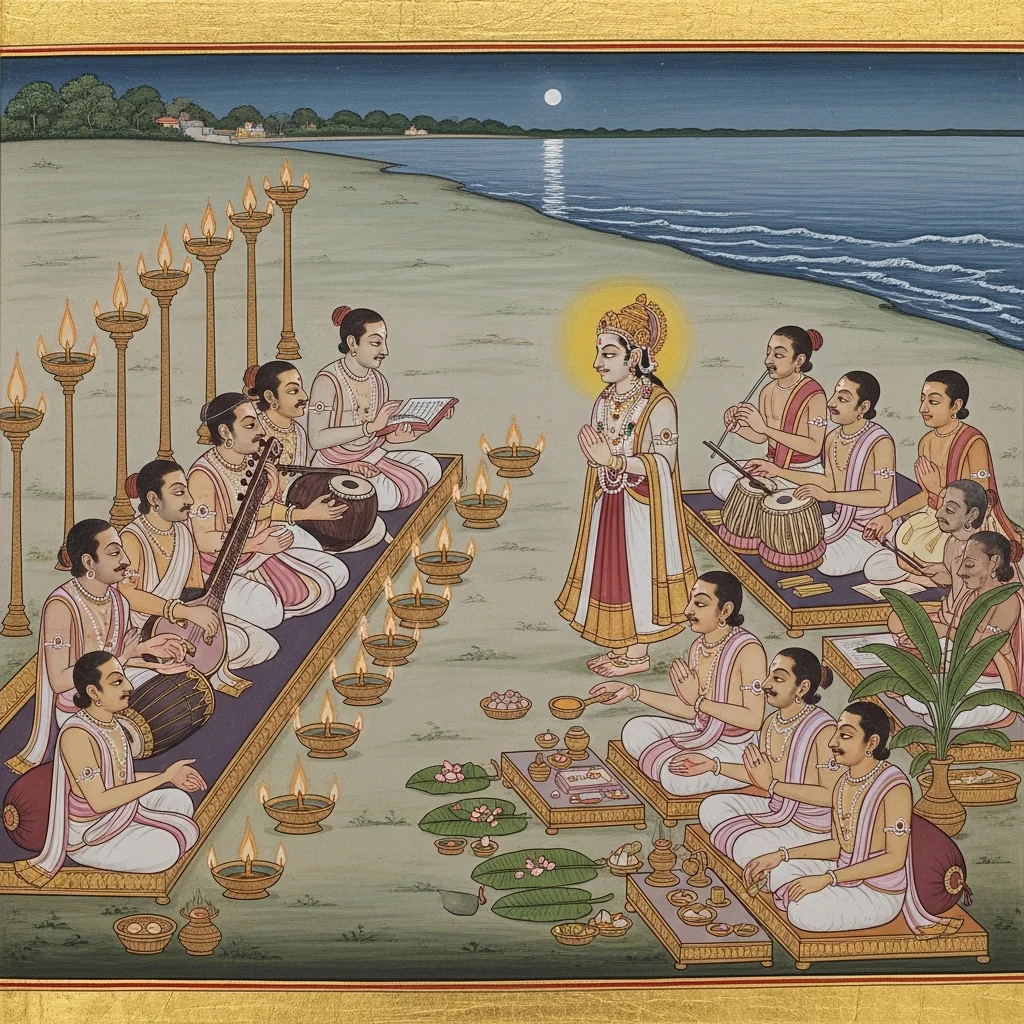
The chapter unfolds as a question-and-instruction dialogue: sages praise Prahlāda and ask for the detailed tīrthayātrā procedure at the place where the river Gomati flows, where Bhagavān is contemplated as present near Cakratīrtha. Prahlāda sets out a stepwise rite—approach the river and prostrate; wash; hold kuśa; offer arghya with a formula praising Gomati as Vasiṣṭha’s daughter and remover of sin; apply sacred earth (mṛttikā) with a mantra linking the ground to Viṣṇu’s cosmic deed as Varāha who uplifted the earth, praying for the removal of past wrongdoing; bathe according to rule with Vedic-style bathing formulae; then perform tarpaṇa for devas, pitṛs, and humans. The discourse expands into śrāddha protocol: invite Veda-knowing Brahmins, worship the Viśvedevās, perform śrāddha with faith, and give dakṣiṇā (gold/silver), clothing, ornaments, grains, and further charity to the distressed. It highlights the rare “five ga-kāras”—Gomati, gomaya-snāna, go-dāna, gopīcandana, and Gopīnātha-darśana—as powerful disciplines. Month-specific observances are prescribed: in Kārttika, daily bathing and worship culminating on Bodha-day with pañcāmṛta abhiṣeka, sandal adornment, tulasī and flowers, music/recitation, night vigil, feeding Brahmins, ratha-pūjā, and completion at the Gomati–ocean confluence; in Māgha, regulated offerings (til, hiraṇya), daily homa, and end-of-vow gifts such as warm garments and footwear. The phalaśruti equates Gomati rites with famed benchmarks (Kurukṣetra, Prayāga, Gayā-śrāddha, Aśvamedha-fruit), declaring purification even for grave transgressions, benefit to ancestors, and attainment of Viṣṇu-loka through mere bathing in Kṛṣṇa’s proximity.
Adhyaya 7
Cakratīrtha-māhātmya (Theological Discourse on the Glory of Cakra Tīrtha)
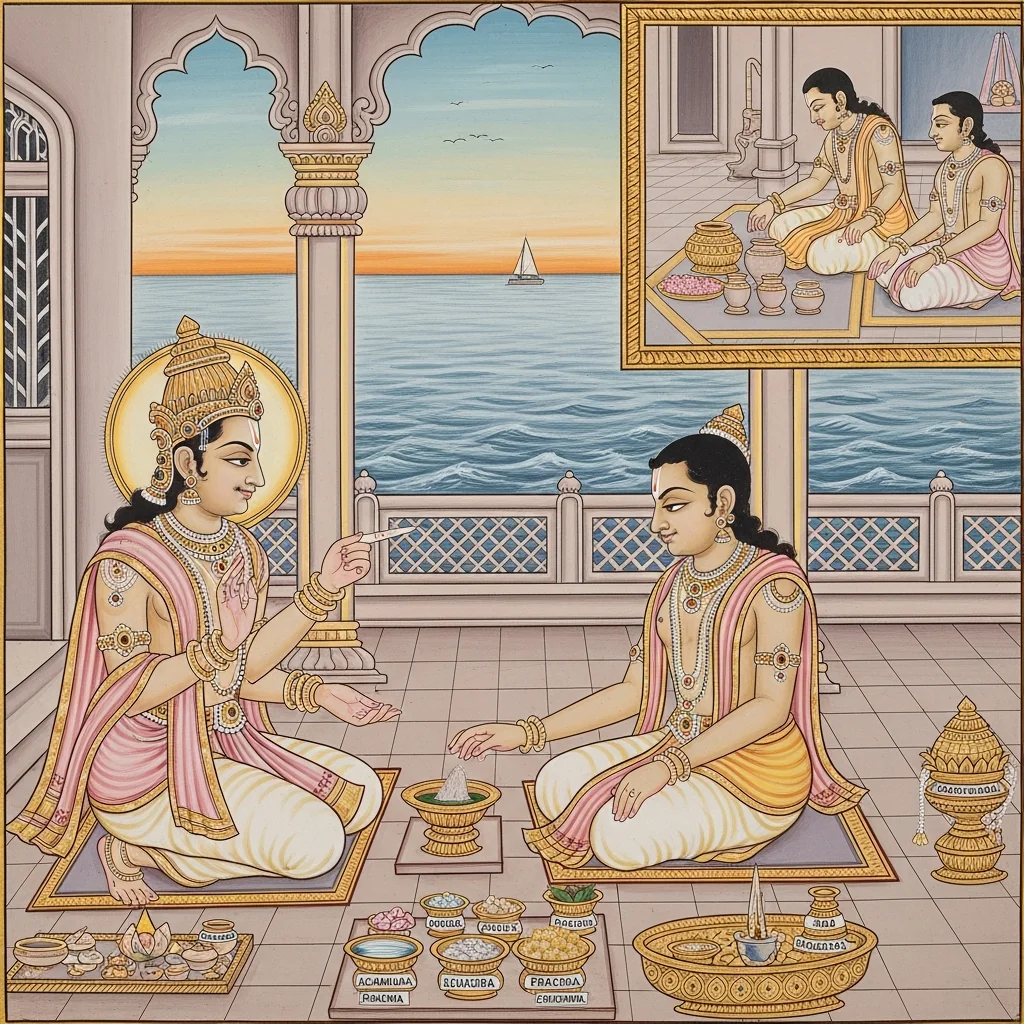
The chapter presents Prahlāda’s step-by-step instruction to learned pilgrims (dvija-śreṣṭhas) concerning the sea-side sacred ford known as Cakra-tīrtha/Rathāṅga. It first establishes the site’s holiness: stones bearing the mark of the cakra are said to conduce to liberation, and the tīrtha is validated through its direct connection with the vision of Bhagavān Kṛṣṇa, making it a supreme destroyer of sins. It then lays down ritual protocol. Pilgrims approach, wash feet, hands, and mouth, prostrate, and prepare an arghya offering with pañca-ratna and auspicious items—flowers, akṣata, gandha, fruits, gold, and sandal—while reciting a Viṣṇu-cakra-centered mantra. Bathing follows with a formulaic remembrance linking deities and cosmic principles; afterward one applies sacred clay, performs tarpaṇa for ancestors and deities, and proceeds to śrāddha. The phalāśruti magnifies the reward by comparing it to great sacrifices and famed pilgrimage standards such as Prayāga, asserting that mere bathing here yields equivalent merit. It further prescribes dāna—especially provisions, vehicles/animals, and ratha-related gifts—as pleasing to Jagatpati, and concludes with salvific and ancestral benefits: uplift of forebears in all conditions, attainment of proximity to Viṣṇu, and eradication of sins accrued by speech, action, and mind.
Adhyaya 8
गोमत्युदधिसंगम-माहात्म्य एवं चक्रतीर्थ-प्रशंसा (Glory of the Gomati–Ocean Confluence and Cakra-tīrtha)
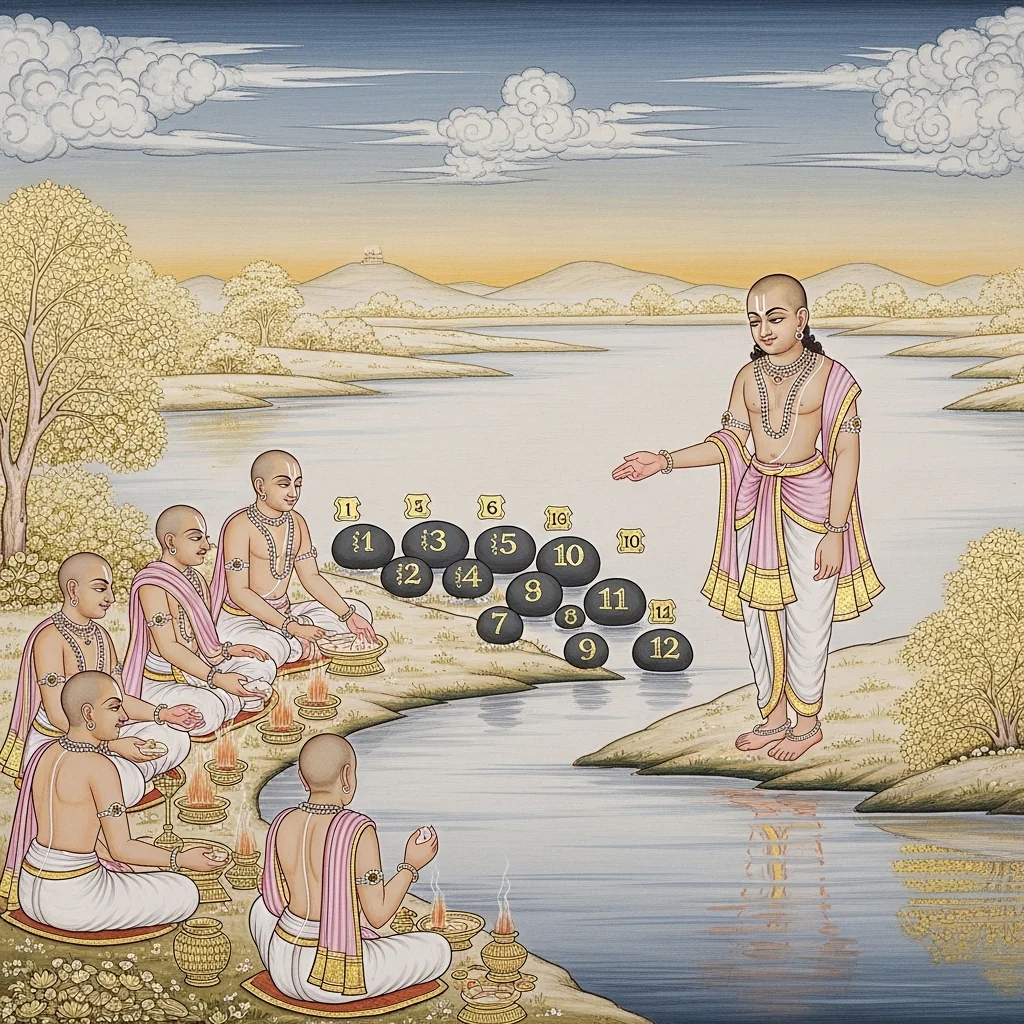
Chapter 8 is a prescriptive māhātmya in which Prahlāda instructs dvija listeners to turn from other celebrated rivers and come instead to the Gomati–Ocean confluence, declaring its unrivaled power to destroy sin and yield ritual merit. He outlines a staged observance: arrival and praise of the confluence, followed by arghya offerings to the ocean-lord and to the river Gomati with specified devotional utterances. The chapter then regulates bathing (including prescribed orientations) and proceeds to ancestral rites—tarpana and śrāddha—stressing dakṣiṇā and special gifts, especially gold. It catalogs major forms of dāna such as tulāpuruṣa, land-gift, kanyā-dāna, vidyā-dāna, and symbolic ‘dhenu’ gifts, each with declared results. Merit is said to intensify by timing, particularly on amāvāsyā during śrāddha-pakṣa and other auspicious occasions, so that even a defective śrāddha becomes complete at this site. The benefits are extended broadly, including to beings in various post-mortem conditions, who are said to gain release through snāna. Finally, a distinctive Cakra-tīrtha theology is presented: chakra-marked stones in configurations numbered from 1 to 12, linked to bhukti and mukti. The chapter culminates by assuring purification and liberation through darśana, sparśa, and remembrance of Hari at the time of death.
Adhyaya 9
रुक्मिणीह्रद-माहात्म्य (Rukmiṇī Hrada: Glory of the Sacred Lake and Prescribed Rites)
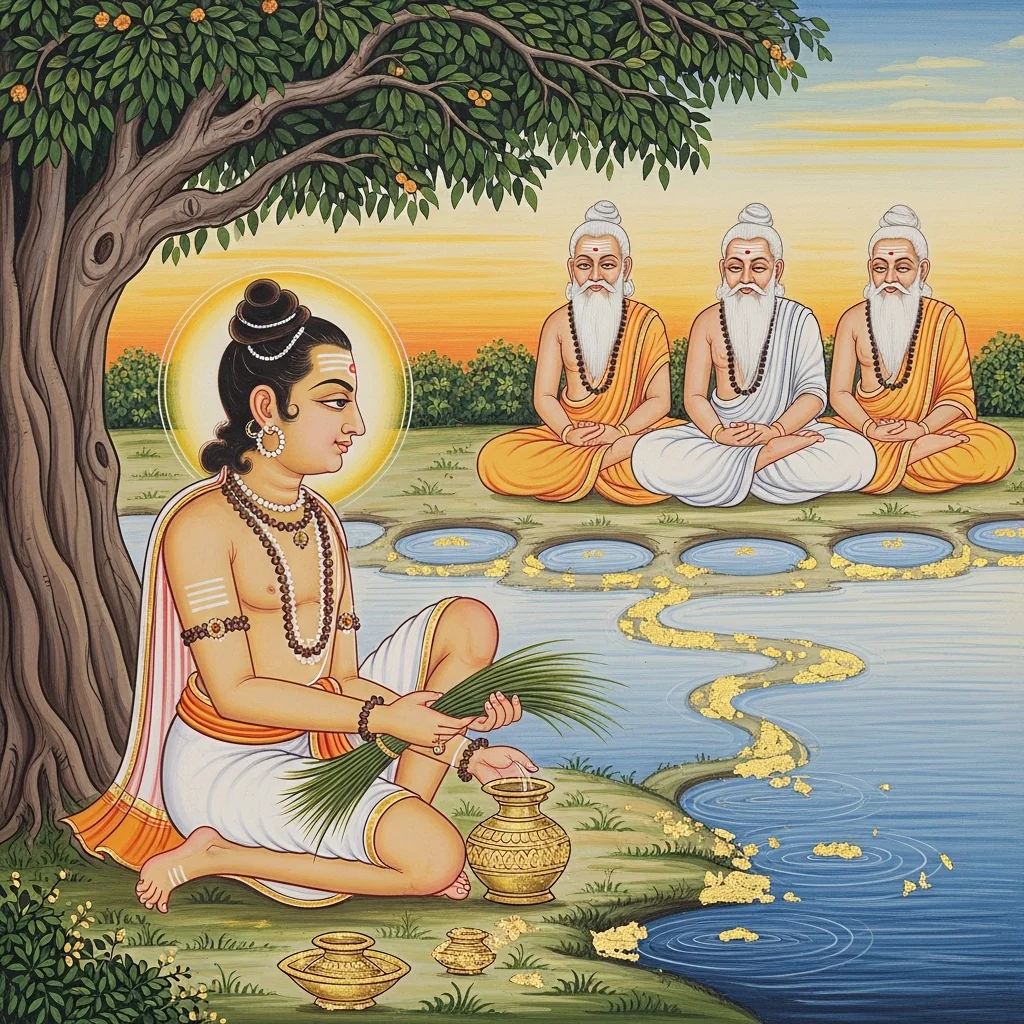
Chapter 9, framed as instruction in Prahlāda’s voice, directs pilgrims to famed sacred waters, including the “seven kuṇḍas,” said to cleanse moral impurity and increase prosperity and discerning wisdom. It recalls a divine epiphany: Hari (Viṣṇu) appears, praised by sages together with Lakṣmī, and is then honored with ritual offerings using “suragaṅgā” water. The Brahmā-born sages (Sanaka and others) are said to have formed distinct pools and performed ablutions for the Goddess; these waters are known as Lakṣmī-hradas and, in later ages, become renowned in Kali-yuga as Rukmiṇī-hrada (with an additional tīrtha-name remembrance connected to Bhṛgu). The chapter then lays out the rite in order: approach in purity, wash the feet, perform ācamana, take kuśa grass, face east, prepare a complete arghya with fruits, flowers, and akṣata, place silver upon the head, recite the offering formula to Rukmiṇī-hrada for the destruction of sin and the pleasure of Rukmiṇī, and then bathe (snāna). After bathing, it prescribes tarpaṇa to deities, humans, and especially ancestors, followed by śrāddha with invited Brahmins, dakṣiṇā including silver and gold, gifts of juicy fruits, feeding the couple with sweet food, and honoring Brahmin women and other women according to one’s means with garments (including red cloth). The phalaśruti promises fulfilled desires, attainment of Viṣṇu’s realm, Lakṣmī’s constant presence in the home, health and mental contentment, freedom from agitation, lasting ancestral satisfaction, stable progeny, long life, wealth, absence of enmity and grief, and release from repeated wandering in saṃsāra.
Adhyaya 10
नृगतीर्थ–कृकलासशापमोचनम् (Nṛga Tīrtha and the Release from the Lizard-Curse)
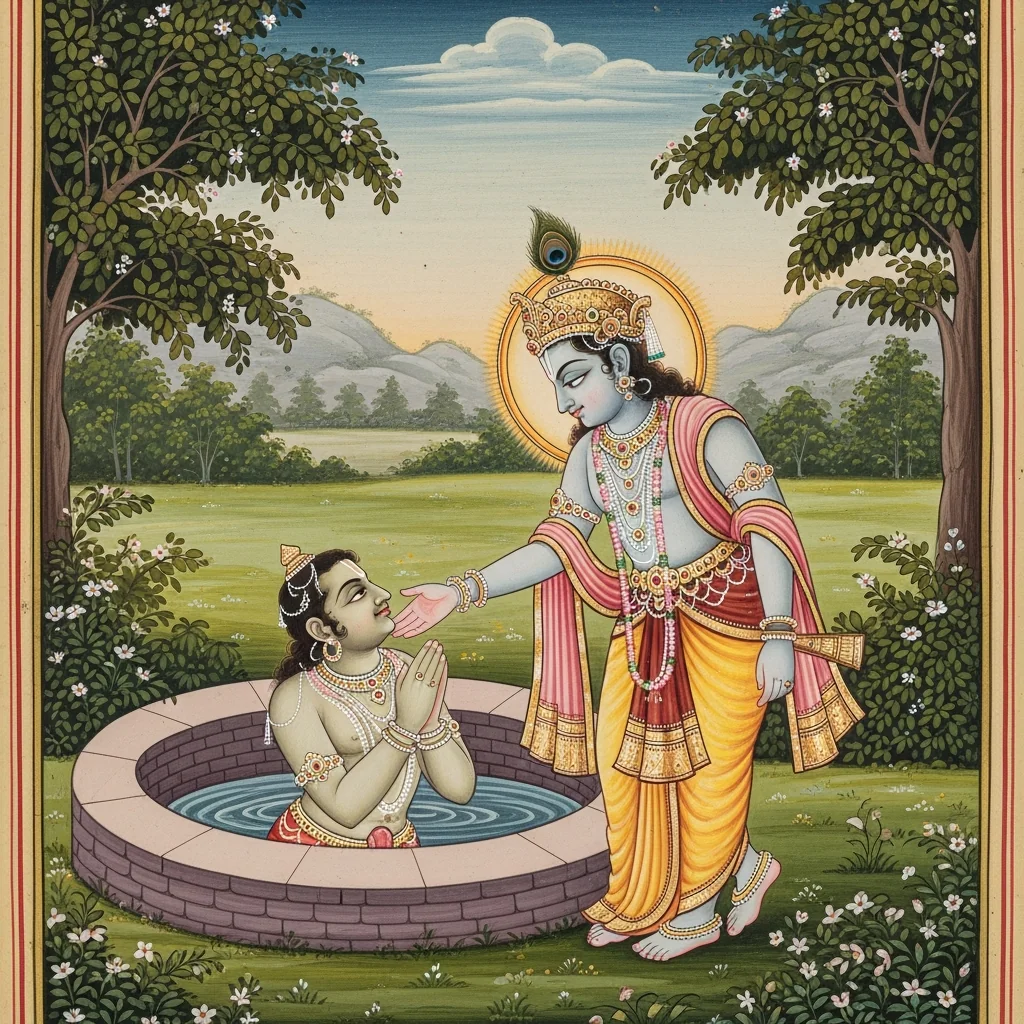
The chapter presents a tīrtha-legend in dialogue. Prahlāda extols the sacred pilgrimage spot called Kṛkalāsa/Nṛga-tīrtha and recounts King Nṛga’s life: a powerful, dharma-minded ruler who daily gifted cows to brahmins with proper honor-rites. Trouble arises when a cow given to the sage Jaimini escapes and is later re-gifted to another brahmin, Somaśarman; when the king fails to respond promptly to the dispute, the offended brahmins curse him to become a kṛkalāsa (lizard). After death, Yama offers Nṛga a choice about the order of experiencing karmic results; for this minor fault he endures many years in a lizard body. Near the end of Dvāpara, Kṛṣṇa (Devakī’s son) appears; Yadu princes find the immovable lizard in a water-body, and Kṛṣṇa’s touch releases Nṛga, who praises the Lord. Granted a boon, Nṛga asks that the pit/well be famed by his name and that devotees who bathe there and perform ancestor rites attain Viṣṇuloka. The chapter closes with ritual guidance: offer arghya with flowers and sandal, bathe using clay, perform tarpaṇa for ancestors/deities/humans, and conduct śrāddha with feeding and dakṣiṇā. It especially commends gifting a decorated cow with calf and a bed with accessories, along with ongoing charity to local needy people—promising wide tīrtha-fruits and successful journeys.
Adhyaya 11
विष्णुपदोद्भवतीर्थ-माहात्म्य (Glory of the Tīrtha Originating from Viṣṇu’s Footprint)
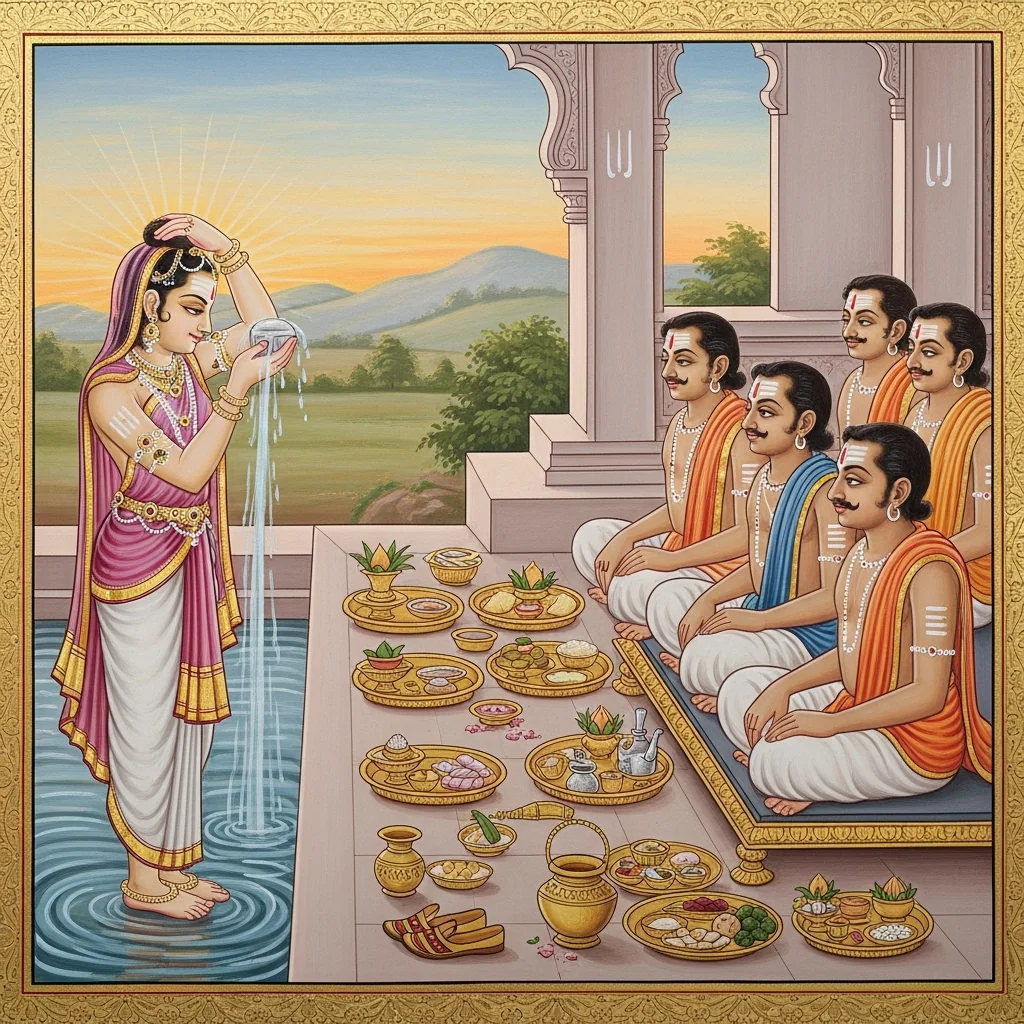
Chapter 11 records Prahlāda’s guidance to learned brāhmaṇas on approaching the tīrtha called “Viṣṇupadodbhava,” a sacred water-source said to arise from Viṣṇu’s footprint and revered in the Gaṅgā/Vaiṣṇavī tradition. Merely beholding this tīrtha is declared to yield the merit of Gaṅgā-snāna. Prahlāda sets out the rite in order: remember its origin and praise it as a destroyer of sin through recollection and recitation; offer arghya with formal salutations to the river as a goddess; perform disciplined snāna facing east, applying tīrtha-soil; and then do tarpaṇa for devas, pitṛs, and humans with tila and akṣata. He further enjoins inviting brāhmaṇas and performing śrāddha with proper dakṣiṇā (gold/silver), along with charity to the poor and afflicted, and practical gifts such as footwear, a water-pot, and salted curd-rice with greens and cumin, plus ritual clothing offerings linked with Rukmiṇī—ending with the devotional resolve to please Viṣṇu. The phalaśruti proclaims that the performer becomes kṛtakṛtya, the ancestors gain lasting satisfaction like Gayā-śrāddha and attain a Vaiṣṇava realm, the devotee receives prosperity and divine favor, and even hearing the chapter is said to free one from sins.
Adhyaya 12
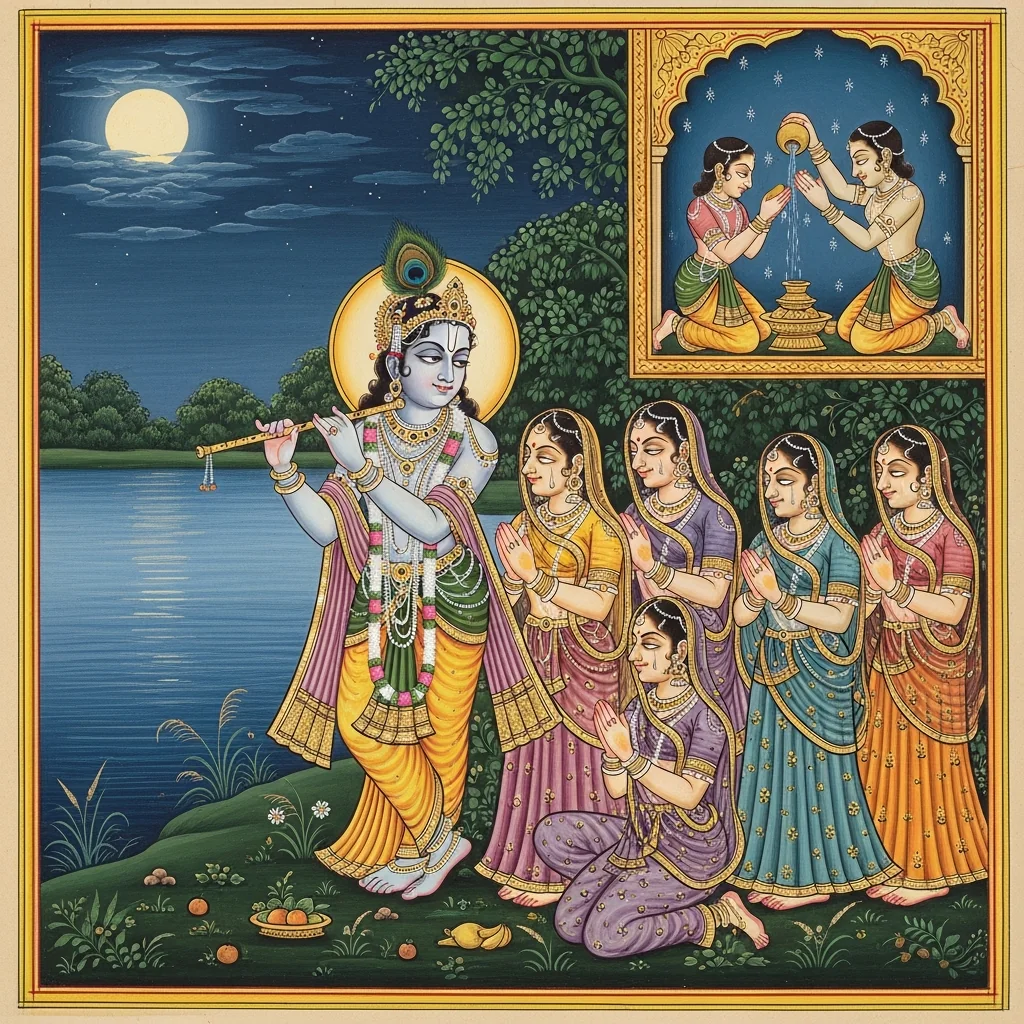
गोप्रचारतीर्थ-मयसरः-माहात्म्यं तथा श्रावणशुक्लद्वादशी-स्नानविधिः (Goprachāra Tīrtha and Maya-sarovara: Glory and the Śrāvaṇa Śukla Dvādaśī Bathing Rite)
Chapter 12 unfolds as a layered theological discourse: it begins with inquiry into a tīrtha and moves into an emotionally charged narrative, culminating in explicit ritual instruction. Prahlāda introduces the sacred ground of Go-prachāra, where devotional bathing yields merit equal to the fruit of gifting cows (go-dāna). The ṛṣis ask for the origin-story and the exact tīrtha where Jagannātha bathed. Prahlāda recounts events after Kaṁsa’s fall: Kṛṣṇa’s rule is established, Uddhava is sent to Gokula, and he meets Yaśodā and Nanda. The women of Vraja lament intensely and question the messenger; Uddhava consoles them and proclaims the unsurpassed excellence of their bhakti. The scene then shifts to Dvārakā’s environs, especially Maya-sarovara, said to have been created by the daitya Maya. When Kṛṣṇa arrives, the gopīs swoon and accuse him of abandonment; Kṛṣṇa replies with metaphysical teaching on divine immanence and cosmic causality, reframing separation as not absolute. Finally, Kṛṣṇa prescribes the Śrāvaṇa Śukla Dvādaśī snāna and śrāddha: bathe with devotion, offer arghya with kuśa and fruit with a specified arghya-mantra, and perform śrāddha with dakṣiṇā and gifts such as sweetened pāyasa, butter, ghee, an umbrella, a blanket, and deer-skin. The phalāśruti promises merit equal to Gaṅgā-snāna, attainment of Viṣṇuloka, liberation of ancestors across three lines, prosperity, and eventual arrival at Hari’s abode.
Adhyaya 13
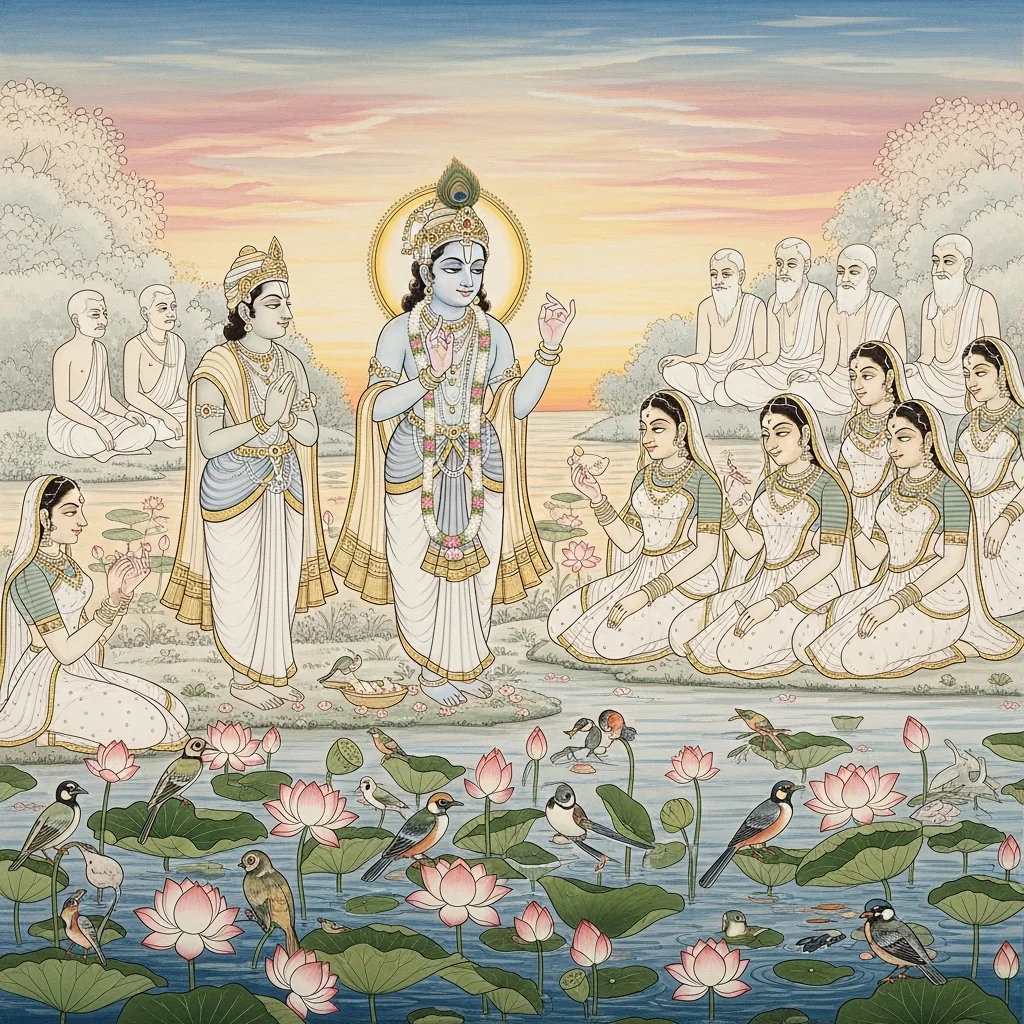
Gopī-saras-udbhavaḥ (Origin and Merit of Gopī-saras) / गोपीसर-उद्भवः
Adhyāya 13 unfolds a structured theological dialogue through Prahlāda’s narration. After hearing Śrī Kṛṣṇa, the gopīs bathe in an already existing lake associated with Māyā and rise into devotional ecstasy. They then petition Kṛṣṇa for a superior sacred pond (saraḥ) and for a regulated annual observance that would grant them enduring access to his presence. Kṛṣṇa creates a new, ideally beautiful water-body near the original—clear and deep, filled with lotuses and birds, and attended by ṛṣis, siddhas, and the Yadu community. He establishes its naming logic: it becomes known as “Gopī-saras” through the gopīs, and also bears the epithet “Gopra-cāra,” tied to the meaning of “go” and shared association. The chapter then prescribes ritual practice: offering arghya with a specific mantra, bathing, tarpaṇa for ancestors and deities, śrāddha, and graduated dāna (including cows, garments, ornaments, and support for the needy). A detailed phalaśruti follows, equating the bath’s merit with major gifts and promising fulfillment of desires (including progeny), purification, and higher destinations. The episode ends with the gopīs taking leave and Kṛṣṇa returning to his abode with Uddhava.
Adhyaya 14
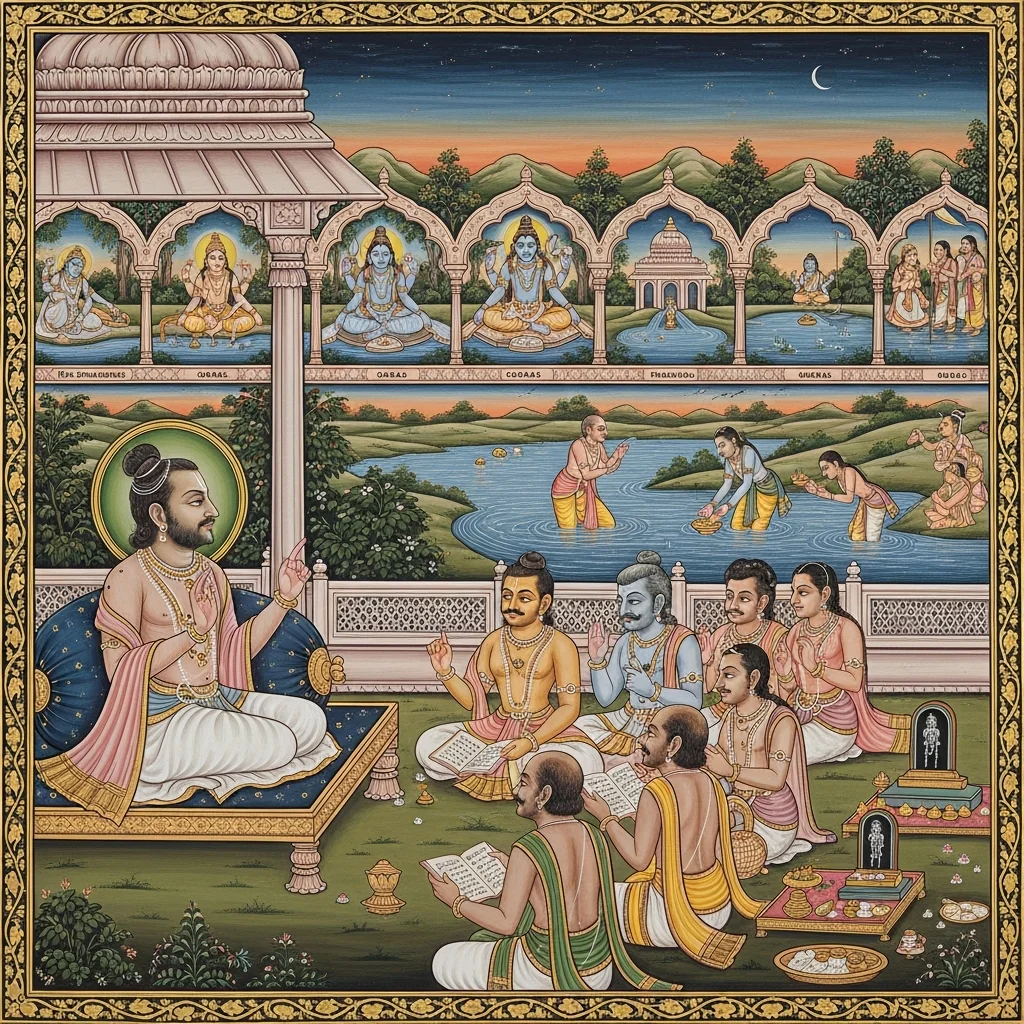
ब्रह्मकुण्डादि-तीर्थप्रतिष्ठा तथा पञ्चनद-माहात्म्य (Brahmakūṇḍa and Associated Tīrtha Installations; Pañcanada Māhātmya)
Prahlāda addresses the brāhmaṇas, listing the tīrthas connected with Dvārakā and giving brief guidance for their proper observances. The chapter is set within a cosmic visitation: after Kṛṣṇa arrives in Dvārakā with the Vṛṣṇis, Brahmā and other devas come for darśana and to fulfill their aims. Brahmā establishes Brahmakūṇḍa, praised as auspicious and sin-removing, and installs a solar presence on its bank; because of Brahmā’s primacy it is also called a mūla-sthāna, a “root place.” Then Candra creates a sin-destroying pond, and Indra founds a powerful liṅga and the famed Indrapada/Indreśvara, with stated occasions for worship such as Śivarātri and solar transitions. Śiva forms Mahādeva-saraḥ and Pārvatī forms Gaurī-saraḥ, whose fruits are linked to women’s welfare and household auspiciousness. Varuṇa and Kubera (Dhan-eśa) establish further saras—Varuṇapada and Yakṣādhipa-saraḥ—connected with śrāddha, offerings, and gifts. The account culminates at the Pañcanada tīrtha: five rivers are invoked and tied to sages, an arghya-mantra is given, and an ordered practice of snāna, tarpaṇa, śrāddha, and dāna is prescribed. The phala teaching promises prosperity, attainment of Viṣṇuloka, and uplift of ancestors, concluding that hearing this chapter brings purification and the supreme attainment.
Adhyaya 15
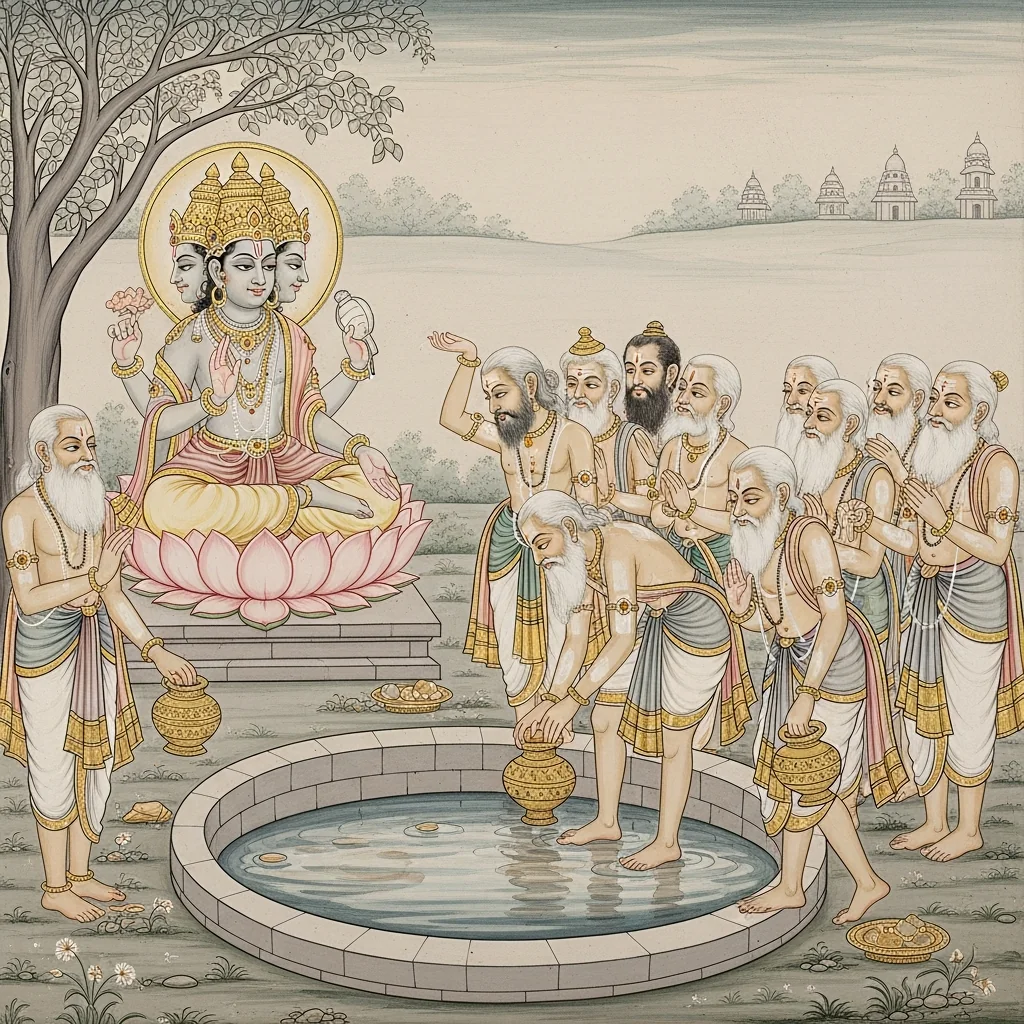
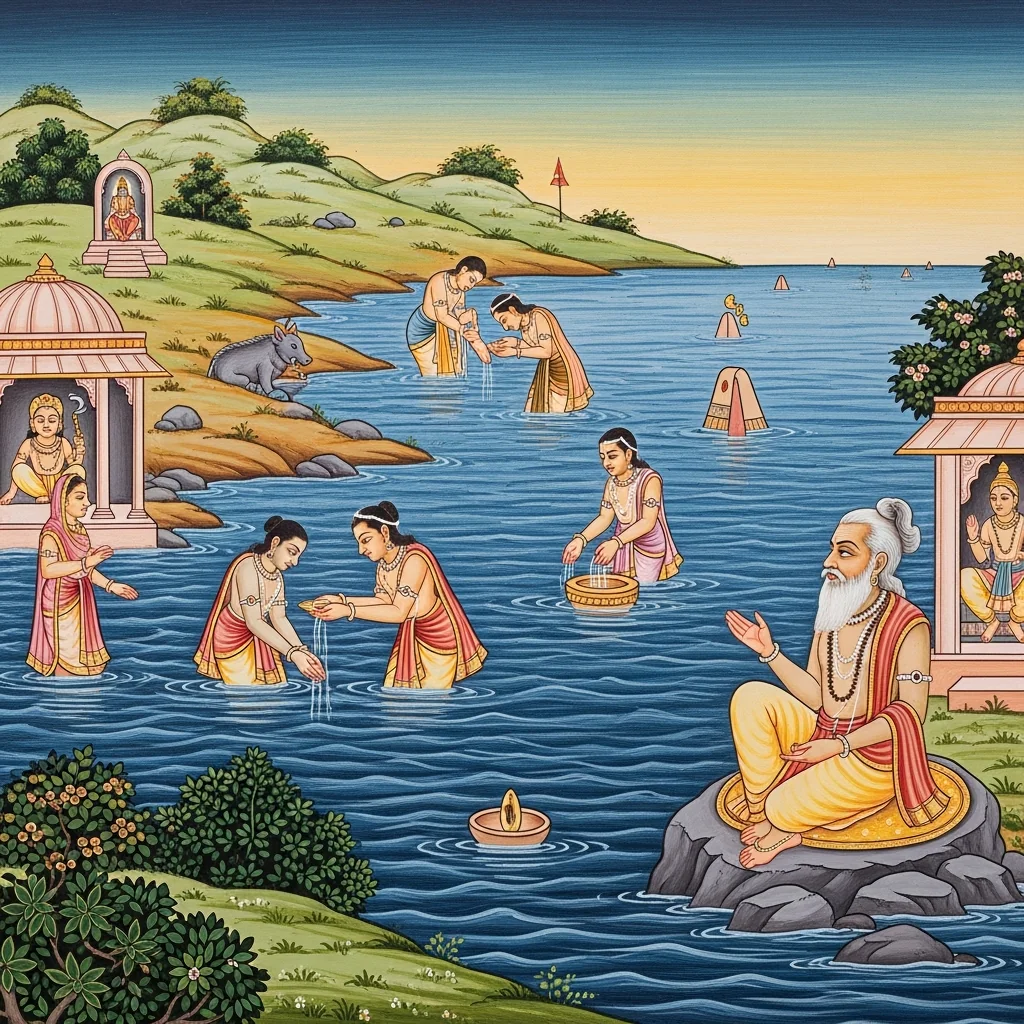
Siddheśvara–Ṛṣitīrtha Māhātmya (Installation of Siddheśvara and the Glory of Ṛṣitīrtha)
The chapter presents a theological and ritual sequence through sacred dialogue and the formal establishment of holiness. Prahlāda relates that Brahmā arrives and is honored by Sanaka and other sages; Brahmā blesses them, praising their devotion while noting that earlier their understanding had been limited by immaturity. A central doctrine is declared: worship of Kṛṣṇa is not regarded as complete if Nīlakaṇṭha (Śiva) is left unhonored; therefore Śiva should be worshiped with full effort, and such worship perfects bhakti. The yogasiddha sages go before the temple, install a Śiva-liṅga, and dig a well for ritual bathing; its water is lauded as pure like nectar. Brahmā then grants names and public authority: the liṅga is “Siddheśvara” and the well is “Ṛṣitīrtha.” The text specifies ritual efficacy: bathing there with devotion can liberate oneself along with one’s ancestors and cleanse faults such as false speech and habitual slander. Auspicious bathing times are listed (equinoxes, manv-ādi occasions, Kṛtayuga-ādya, the month of Māgha), and Śivarātri observance at Siddheśvara is exalted as especially powerful. A procedural ethic is outlined: offer arghya, apply sacred earth, bathe attentively, perform tarpaṇa for ancestors/deities/humans, conduct śrāddha, give dakṣiṇā without deceit, and donate prescribed items (grains, garments, fragrances, and more). The fruits promised are ancestral satisfaction, prosperity, progeny, destruction of demerit, increase of merit, fulfillment of aims, and finally an elevated destination for the faithful listener.
Adhyaya 16
Tīrtha-Parikramā of Dvārakā: Hidden and Manifest Pilgrimage Waters (गदातीर्थादि-तीर्थवर्णनम्)
This chapter is a catalog-style pilgrimage instruction spoken by Prahlāda to learned Brahmins, laying out a sequence of tīrthas around Dvārakā and assigning to each its rites and phalaśruti. It opens with Gadātīrtha, enjoining devotional bathing, offerings to ancestors and deities (tarpana), and worship of Viṣṇu in the Varāha form, by which one attains elevation to Viṣṇuloka. It then lists Nāgatīrtha, Bhadratīrtha, and Citrātīrtha, declaring merits equal to gifts such as the tila-dhenu and ghṛta-dhenu, and explains that Dvārāvatī’s flooding caused many tīrthas to become concealed. Chandrabhāgā is praised as sin-destroying, with fruit equal to a vājapeya, and the Goddess Kauṁārikā/Yaśodā-nandinī is described, whose darśana grants desired aims. Mahīṣa-tīrtha and Muktidvāra are presented as purificatory thresholds. The Gomati account links the river’s sanctity to Vasiṣṭha and Varuṇa’s realm, granting aśvamedha-equivalent merit; Bhṛgu’s tapas and Ambikā’s establishment add Śākta-Śaiva texture alongside mentions of multiple liṅgas. Further tīrthas—Kālindī-saras, Sāmbatīrtha, Śāṅkara-tīrtha, Nāgasara, Lakṣmī-nadī, Kambu-saras, Kuśatīrtha, Dyumnatīrtha, Jālatīrtha with Jāleśvara, Cakrasvāmi-sutīrtha, Jaratkāru-kṛta tīrtha, and Khañjanaka—are tied to snāna, tarpana, śrāddha, and dāna, and to destinations such as Nāgaloka, Śivaloka, Viṣṇuloka, and Somaloka. The close frames this as a concise tīrtha-vistara suited to Kali-age conditions, affirming that devotional listening itself purifies and culminates in Viṣṇuloka.
Adhyaya 17
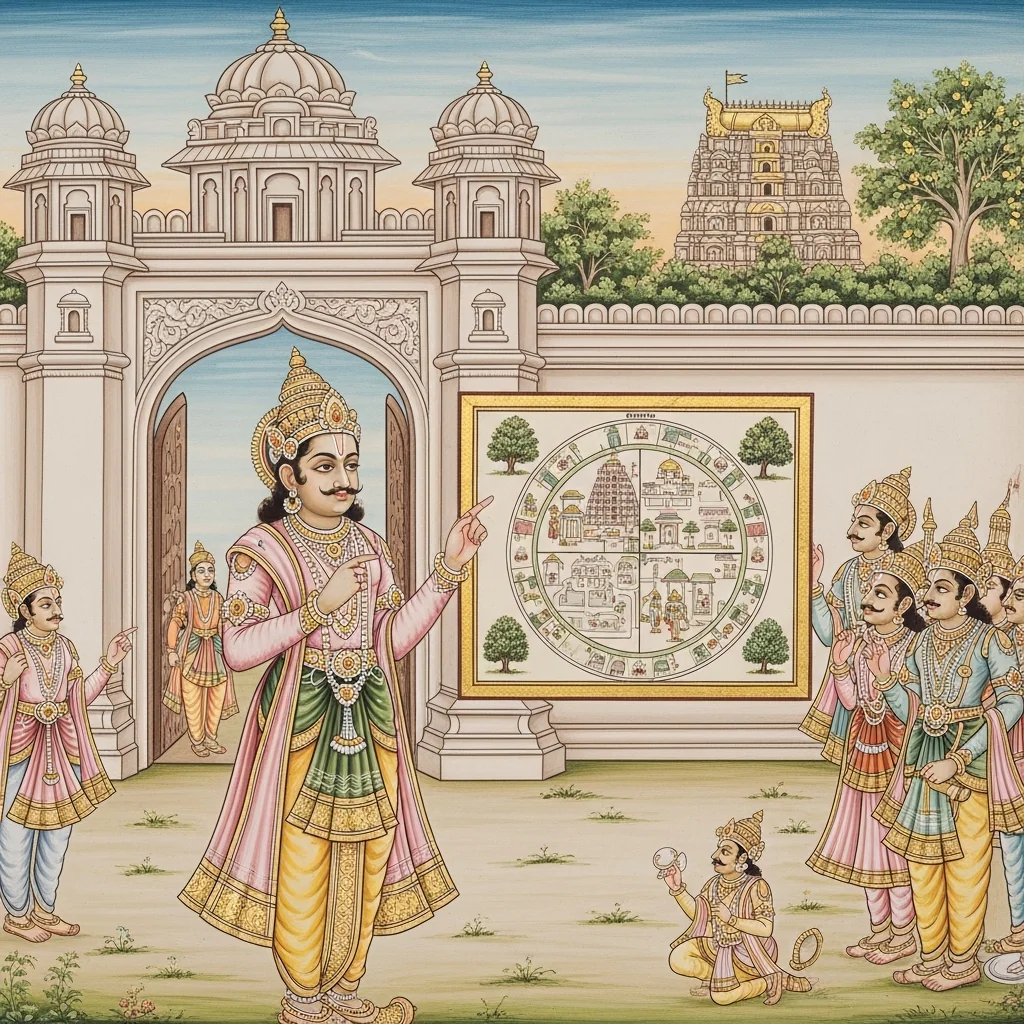
Dvārakā-dvārapāla-pūjākramaḥ (Ritual Sequence of Dvārakā’s Gate-Guardians and the Approach to Kṛṣṇa)
This chapter unfolds as a procedural dialogue. Prahlāda sets forth an ordered mode of worship for the Kali Yuga: after bathing at the tīrtha and giving suitable gifts (dakṣiṇā), the devotee should offer honors in sequence beginning at the thresholds and gates of Dvārakā, and only then approach Kṛṣṇa, Devakīnandana. The ṛṣis ask for a concise yet complete pūjā-vidhi, specifically inquiring who guards the city in each direction and who stands in front and behind. Prahlāda then enumerates the guardians by quarters: the eastern gate under Jayanta’s leadership, followed by the protectors of the southeast, south, southwest (nairṛti), west, northwest (vāyavya), north, and northeast (aiśānya). The chapter thus provides a ritual cartography: each direction is populated by named beings—devas, vināyakas, rākṣasas, nāgas, gandharvas, apsarases, and ṛṣis—and paired with a corresponding “royal tree” (such as nyagrodha, śāla, aśvattha, plakṣa), forming a complete ecology of sacred protection. An apparent anomaly is addressed: Gaṇeśa called “Rukmi” is worshiped first at Kṛṣṇa’s gate, though Rukmī opposed Kṛṣṇa in the Rukmiṇī episode. Prahlāda explains that after Rukmī’s conflict, humiliation, and release, Kṛṣṇa—so as to fulfill Rukmiṇī’s concern and to establish the principle of obstacle-removal—appointed Rukmī as a foremost, gate-associated form of Gaṇeśa. The chapter closes with a theological principle of ritual causality: the satisfaction of the gate-guardian (Gaṇeśa/Rukmi) is presented as a prerequisite for the Lord’s satisfaction, grounding temple etiquette in ethical discipline and liturgical hierarchy.
Adhyaya 18
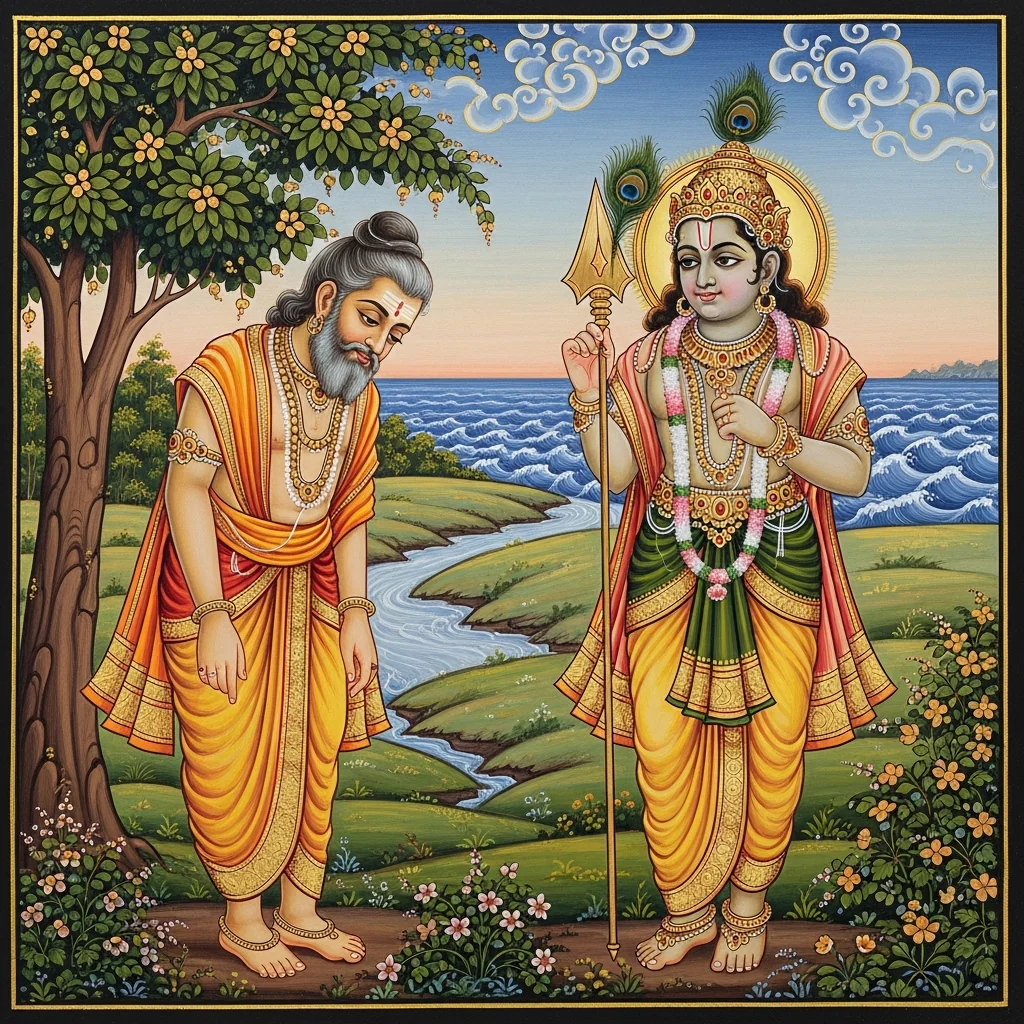
त्रिविक्रम-दर्शन-समफलत्व-प्रशंसा तथा दुर्वाससो मुक्तितीर्थ-प्रसङ्गः (Trivikrama Darśana and the Durvāsā at the Mokṣa-Tīrtha Episode)
Chapter 18 proceeds as a dialogue. Prahlāda first lists revered objects of devotion—Gaṇanātha, Rukmiṇī and those connected with Rukmī, the sage Durvāsā, Kṛṣṇa, and Balabhadra—and then sets forth a rule of spiritual valuation: many meritorious deeds (great sacrifices with full fees, digging wells and ponds, daily gifts of cows/land/gold, prāṇāyāma with japa and dhyāna, and bathing at major tīrthas such as the Jāhnavī) are repeatedly proclaimed “equal in fruit” to a single act—beholding (darśana) Devīśa Kṛṣṇa. The ṛṣis ask how Trivikrama manifested on earth and how a “Trivikrama form” becomes associated with Kṛṣṇa, and they also request the account of Durvāsā’s connection. Prahlāda narrates the Vāmana–Trivikrama episode: Viṣṇu spans the worlds in three strides, and, pleased by Bali’s devotion, continues to abide as Bali’s gatekeeper. In parallel, Durvāsā, seeking liberation, identifies Cakratīrtha at the Gomati–ocean confluence but is attacked and humiliated by local daityas as he prepares to bathe. Grieving over the fragility of his vow, he takes refuge in Viṣṇu; entering the daitya king’s palace, he beholds Trivikrama stationed at the doorway, laments and petitions for protection, and shows his wounds, stirring divine indignation. He then reports the obstruction of his intended snāna and begs Govinda to enable the bath and complete his observance, vowing to continue righteous wandering thereafter.
Adhyaya 19
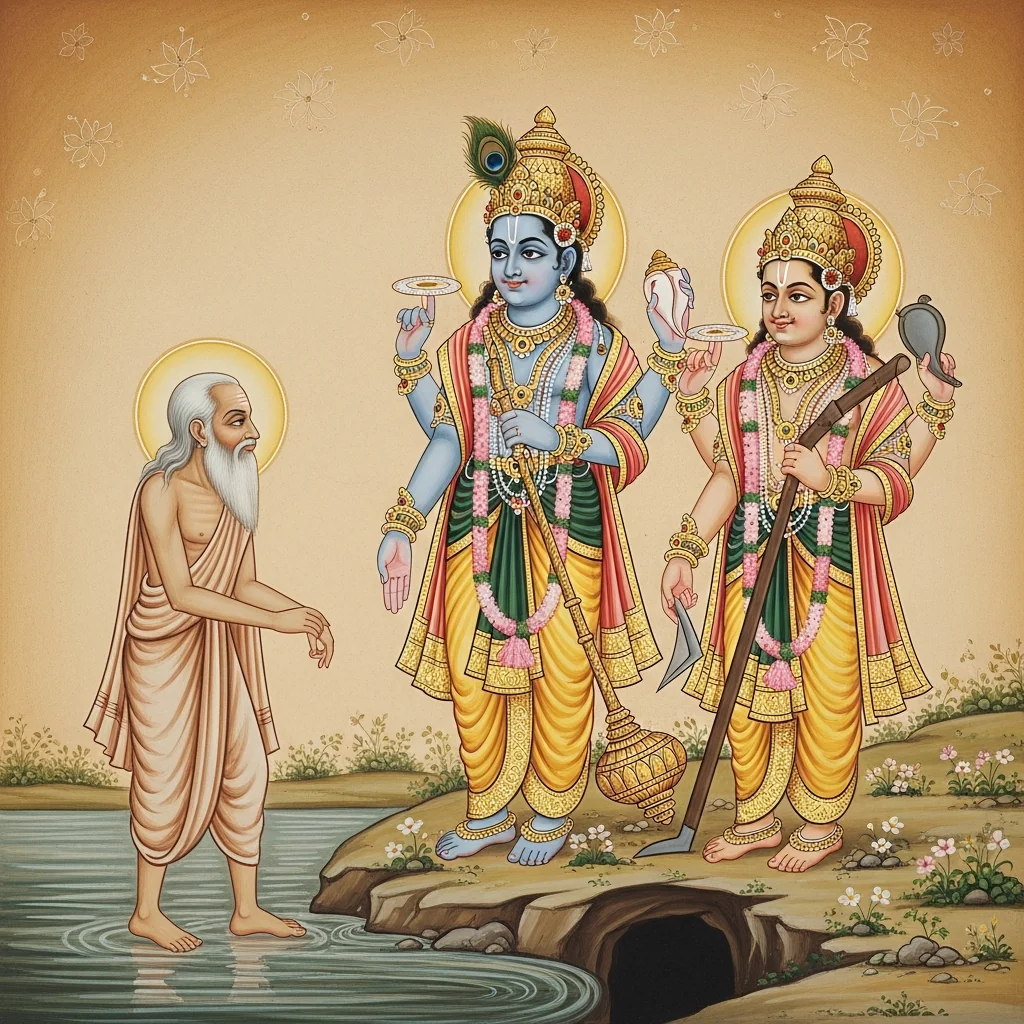
Durvāsā–Bali–Viṣṇu Saṃvāda at the Gomatī–Ocean Confluence (गोमती-उदधि-संगम)
This chapter presents a tightly ordered dialogue on vow-observance (vrata), the Lord’s responsiveness to bhakti, and the ethics of refusal under constraint. Prahlāda recounts how the sage Durvāsā, seeking protection of his life and the completion of his bathing vow, petitions for Viṣṇu’s presence at the confluence of the Gomatī River and the ocean. Viṣṇu declares a theological principle: He is “bound” by devotion and is acting under Bali’s directive, so the sage must first seek Bali’s consent. Bali praises Durvāsā yet refuses to relinquish Viṣṇu, recalling the Lord’s saving interventions as Varāha, Narasiṃha, and Vāmana/Trivikrama, and insisting that his bond with Keśava is non-negotiable. Durvāsā intensifies the pressure, vowing not to eat without bathing and threatening self-abandonment if Viṣṇu is not sent. The tension resolves when Viṣṇu compassionately intervenes, promising to make the bathing possible by forcefully clearing obstacles at the confluence. Bali bows in submission at Viṣṇu’s feet; Viṣṇu departs with Durvāsā, accompanied by Saṅkarṣaṇa (Ananta/Balabhadra), traveling through subterranean space to manifest at the confluence. There the divine beings instruct the sage to bathe; Durvāsā bathes at once and completes the required rites, restoring ritual order and preserving life.
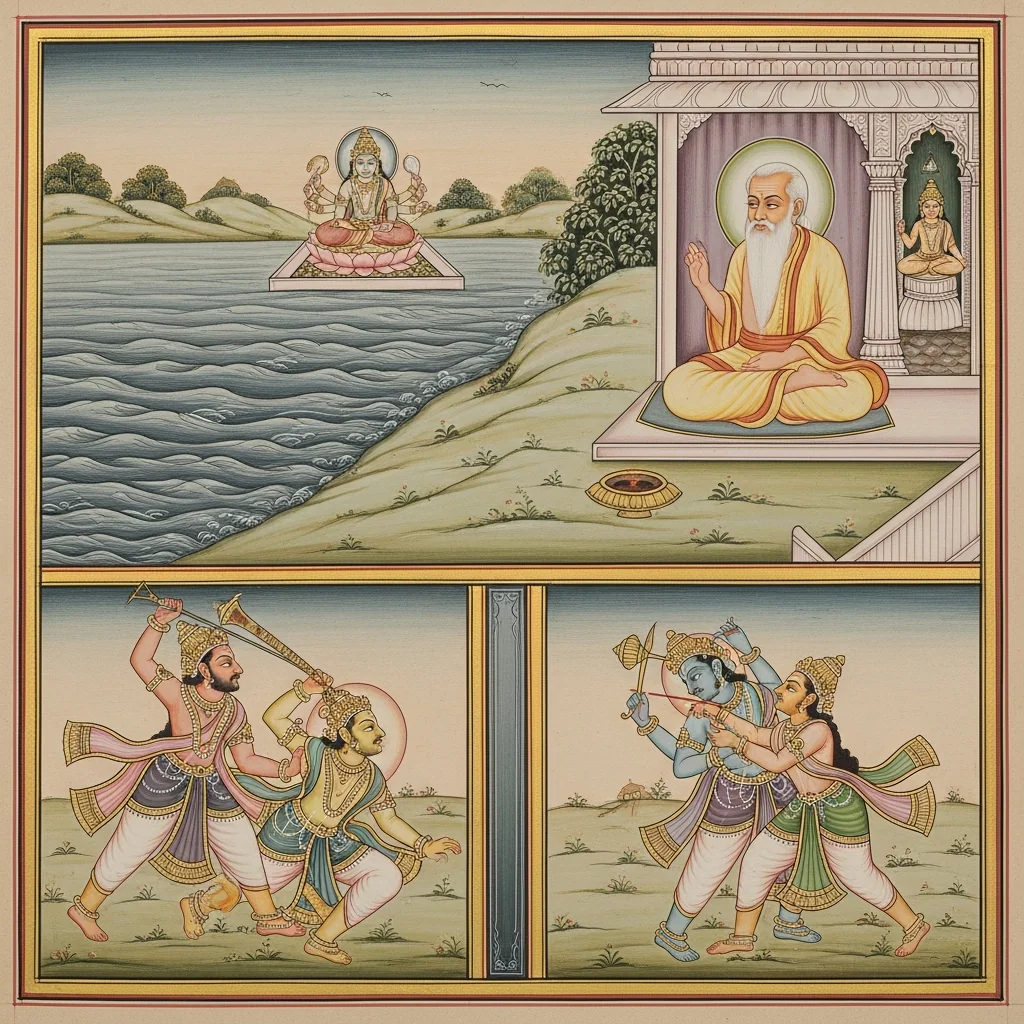
Adhyaya 20
गोमती-उदधि-संगमे तीर्थरक्षणम् — Protection of the Gomati–Ocean Confluence Tīrtha
Chapter 20 presents a conflict narrative through Prahlāda’s report. When the sacred brahma-ghoṣa is heard, the demon Durmukha tries to strike the ascetic Durvāsas; Jagannātha (Viṣṇu) intervenes and beheads Durmukha with the cakra. A coalition of daityas—named warriors and armed hosts—then surrounds Viṣṇu and Saṅkarṣaṇa, assailing them with missiles and close combat. The chapter repeatedly teaches a boundary-ethic: an ascetic who has completed the morning rites must not be harmed, and the liberation-bestowing tīrtha at the Gomati–ocean confluence must not be obstructed by sinful acts. Major duels follow: Golaka strikes Durvāsas but is slain by Saṅkarṣaṇa’s muśala; Kūrmapṛṣṭha is pierced and routed. The daitya-king Kuśa raises vast forces and, though advised to avoid a futile war, persists. Viṣṇu decapitates Kuśa, yet Kuśa revives again and again through Śiva’s boon of amaratva (deathlessness), creating a problem of restraint. Durvāsas identifies the cause—Śiva’s satisfaction has made Kuśa invulnerable to death—so Viṣṇu adopts containment: Kuśa’s body is placed into a pit and a liṅga is स्थापित, installed above it. Thus the violent deadlock is transformed into a shrine-centered resolution, integrating Vaiṣṇava protection of the tīrtha with Śaiva boon-theology and the practical restoration of sacred order.
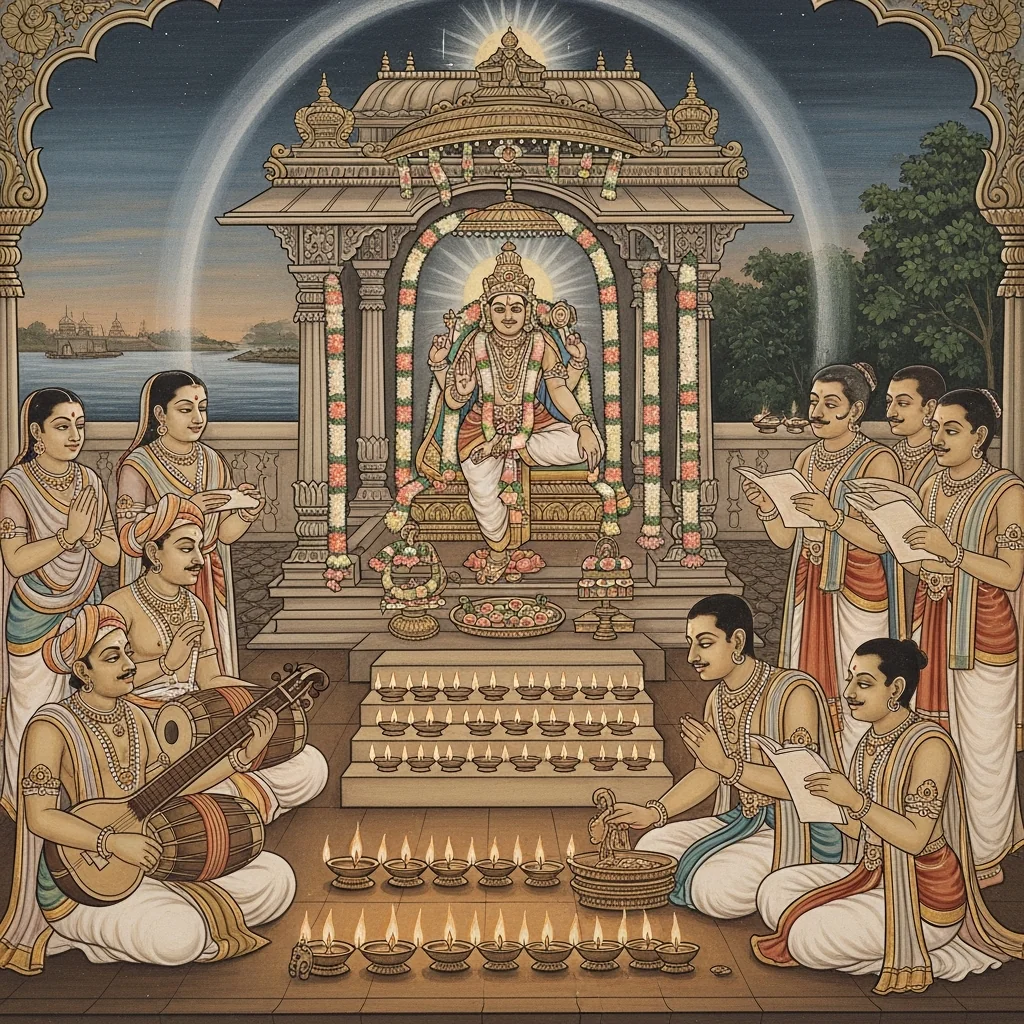
Adhyaya 21
गोमतीतीरस्थ-क्षेत्रस्थ-भगवत्पूजा-माहात्म्यवर्णनम् (Glorification of Worship of the Lord at the Gomati River Sacred Field)
Adhyāya 21 weaves together theological dialogue, sacred-site legend, and ritual instruction. Prahlāda recalls an earlier incident of transgression connected with a Śiva-liṅga and addresses Kṛṣṇa; Viṣṇu responds with approval and grants a boon rooted in valor that accords with devotion to Śiva. Kuśa then teaches a harmonizing vision—Mahādeva and Hari are one reality in two forms—and asks that the liṅga established by the Lord be famed by his own name as “Kuśeśvara,” ensuring lasting renown for the locale. The narrative turns to tīrtha-topography: Mādhava dispatches other dānavas, some descending to Rasātala while others approach Viṣṇu; Ananta and Viṣṇu abide there. Durvāsā recognizes the place as liberation-giving, linking it with the Gomati, Cakratīrtha, and Trivikrama’s presence, and notes that its sanctity endures into Kali-yuga when the Lord manifests as Kṛṣṇa. The latter half sets out a pūjā-vidhi for Madhusūdana at Dvārakā—bathing, anointing, and offerings of gandha, garments, incense, lamps, naivedya, ornaments, tāmbūla, and fruit—followed by ārātrika and prostration, with an all-night lamp offering and jāgaraṇa through recitation and music, promising fulfillment of aims. Special observances in Nabhas (with pavitrāropaṇa), in Kārttika (Prabodha day), at ayana transitions, and on certain months and dvādaśīs are said to satisfy ancestors, lead to Viṣṇu-loka, and bestow a sorrowless “stainless realm,” especially at the Gomati–ocean confluence.
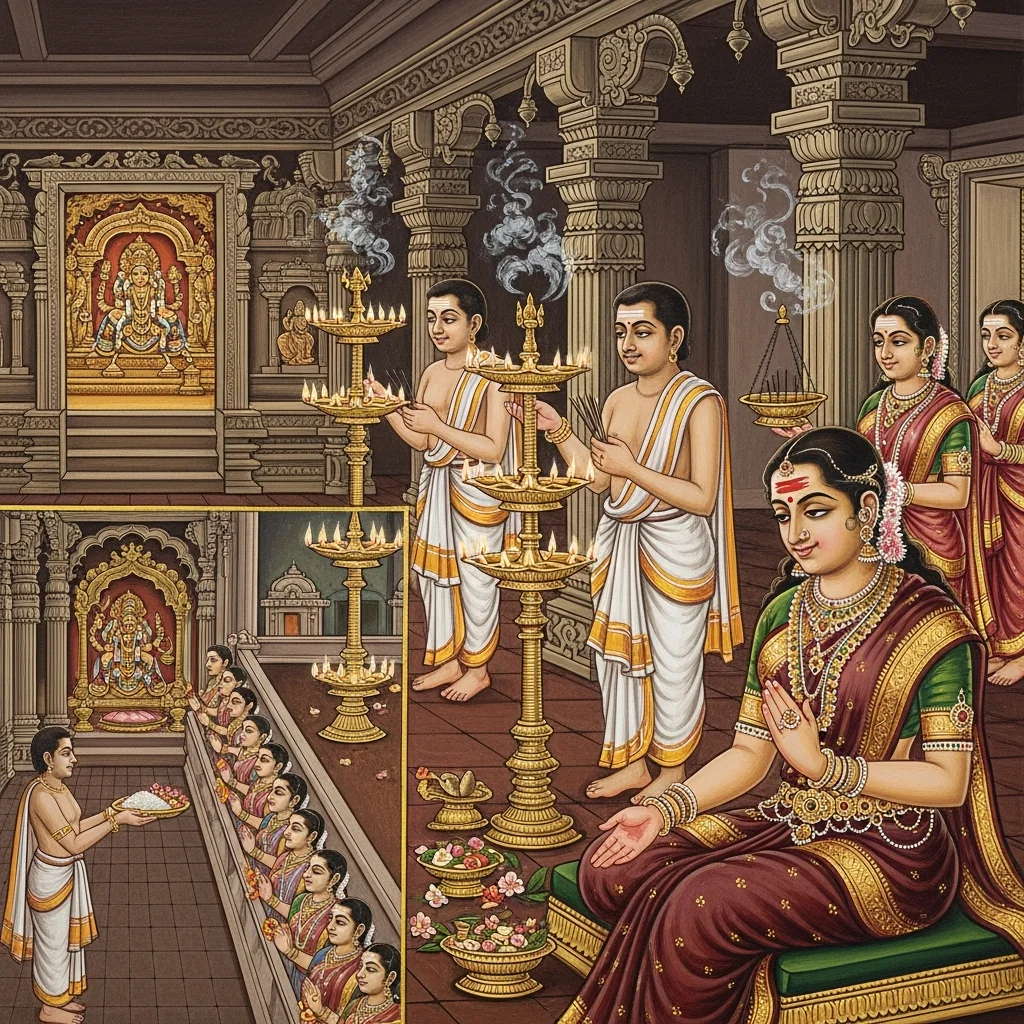
Adhyaya 22
रुक्मिणीपूजाविधिः — Ritual Protocols and Merit of Worshiping Rukmiṇī with Kṛṣṇa
This chapter records Śrī Prahlāda’s ritual-theological instruction to the brāhmaṇas, laying out an ordered worship centered on Jagannātha/Kṛṣṇa and especially on Rukmiṇī, praised as Kṛṣṇapriyā and Kṛṣṇavallabhā. It opens with preparatory pūjā—bathing the deity, anointing with fragrances, tulasī worship, offering naivedya, performing nīrājana, and devoutly honoring associated figures such as Ananta and Vainateya—followed by the command to give dāna without deceit and to feed the dependent poor. The teaching then turns to Rukmiṇī-darśana and worship, declaring that in Kali-yuga afflictions—graha-pīḍā, disease, fear, poverty, misfortune, and domestic rupture—end only upon beholding and venerating Kṛṣṇa’s beloved. It details abhiṣeka substances (curd, milk, honey, sugar, ghee, perfumes, sugarcane juice, tīrtha water), then unguents (śrīkhaṇḍa, kuṅkuma, mṛgamada), flowers, incense (aguru, guggulu), garments, and ornaments; it prescribes mantric arghya to “Vidarbhādhipa-nandinī,” ārati, and proper handling of sanctified water. Further rites include honoring brāhmaṇas and their wives with food and betel, worshiping the dvārapāla Unmatta with strong bali offerings, and venerating yoginīs, kṣetrapāla, Vīrūpasvāminī, the saptamātṛkās, and Kṛṣṇa’s eight consorts (Satyabhāmā, Jāmbavatī, and others). The phalaśruti repeatedly exalts the merit of seeing and worshiping Rukmiṇī with Kṛṣṇa in Dvārakā above other rites (yajña, vrata, dāna), lists auspicious dates (Dīpotsava caturdaśī, Māgha śukla aṣṭamī, Caitra dvādaśī, Jyeṣṭha aṣṭamī, Bhādrapada worship, Kārttika dvādaśī), and promises prosperity, health, fearlessness, and liberation; it concludes by affirming Dvārakā’s unique salvific power in Kali-yuga and noting the Purāṇic transmission lineage.
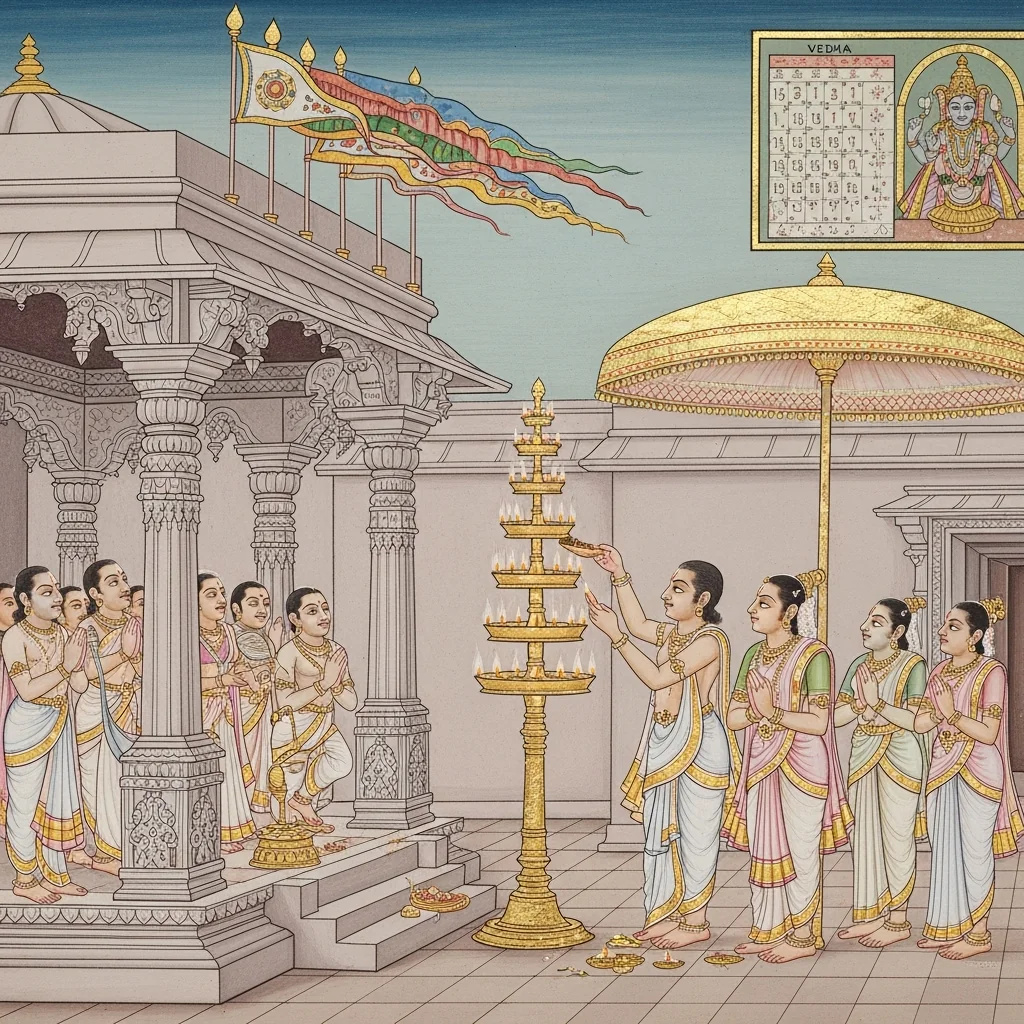
Adhyaya 23
Dvārakā-Māhātmya: Kṛṣṇa-darśana, Gomati-tīrtha, and Dvādaśī-vedha Ethics (Chapter 23)
Chapter 23 presents Mārkaṇḍeya’s teaching to King Indradyumna on Dvārakā’s exceptional ritual status and saving power in Kali-yuga. A comparative phalaśruti is set forth: even a brief stay, the mere intention to journey there, or a single day of Kṛṣṇa-darśana is praised as equal in merit to great pan-Indian tīrthas and long austerities. It then catalogs temple-centered sevā during Kṛṣṇa’s snāna: bathing with milk, curd, ghee, honey, and perfumed waters; wiping the Deity; garlanding; conch and music; recitation—especially the nāma-sahasra—along with singing, dancing, ārātrika, circumambulation, prostration, and offerings of lamps, naivedya, fruits, tāmbūla, and water vessels. Ornamental and constructional services are also commended: dhūpa, flags, maṇḍapas, painting, umbrellas, and fans. The third movement turns to an ethical-legal discourse on calendrical correctness, focusing on Dvādaśī and “vedha” defects, illustrated by Candraśarman’s dream of suffering ancestors. The chapter harmonizes pilgrimage claims: Somanātha-yātrā is completed by Kṛṣṇa-darśana at Dvārakā, and sectarian exclusivism is discouraged. It closes by extolling Gomati bathing, the efficacy of śrāddha/tarpaṇa, and tulasī devotion (mālā and leaves) as protective and purifying practices in Kali-yuga.
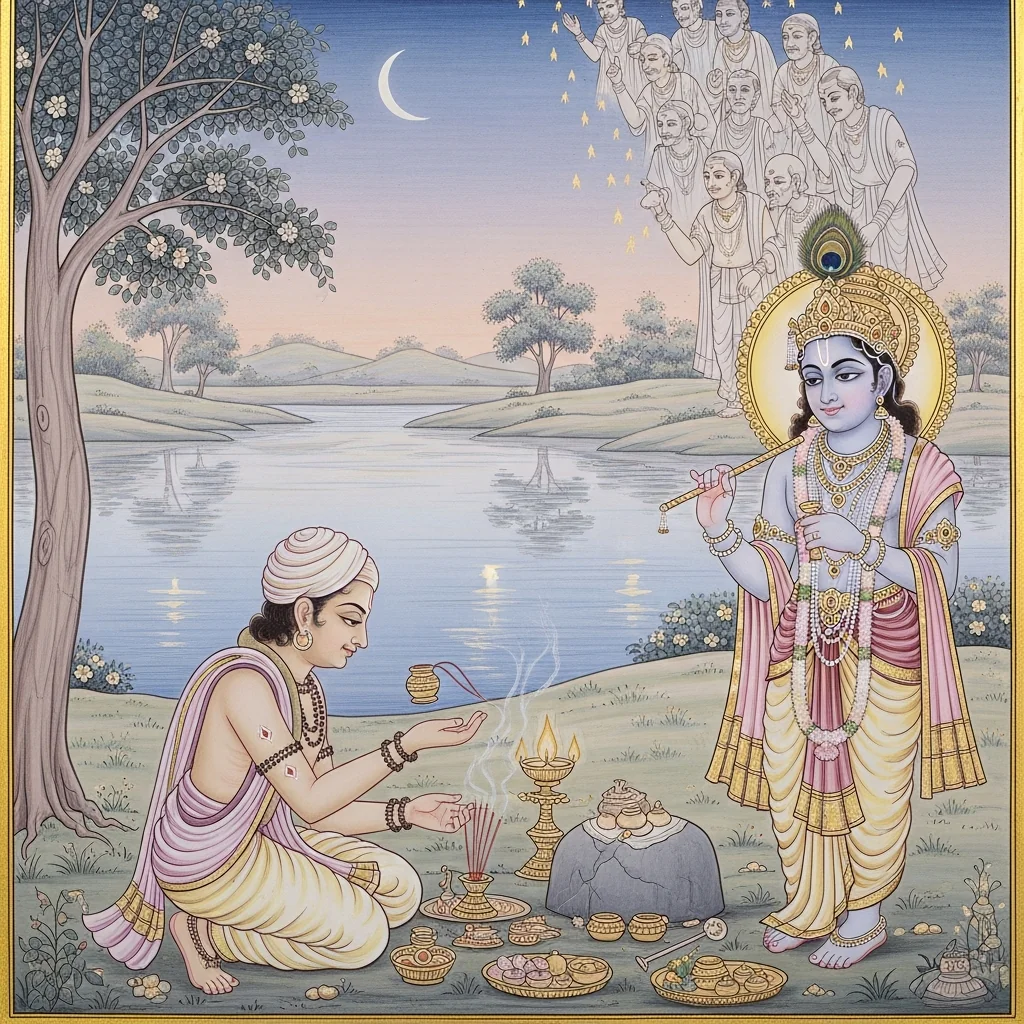
Adhyaya 24
चन्द्रशर्मा-द्वारकादर्शनं, त्रिस्पृशा-द्वादशीव्रत-प्रशंसा, पितृमोक्षोपदेशश्च (Chandraśarmā’s Dvārakā Darśana, Praise of Trispr̥śā Dvādaśī, and Instruction on Ancestral Liberation)
Mārkaṇḍeya recounts how the brāhmaṇa Candraśarmā reaches Dvārakā, a siddha- and deva-served sacred city famed as a mokṣa-bestowing abode, where sins are said to perish upon entry and mere sight. He extols the spiritual sufficiency of Dvārakā-darśana, implying that other tīrtha pursuits become secondary. Candraśarmā then performs rites on the Gomati’s bank: snāna, pitṛ-tarpaṇa, collecting and worshiping cakrāṅkita śilās from Cakratīrtha with the Puruṣasūkta, followed by Śiva-pūjā and formal piṇḍa-udaka offerings with the customary upacāras—vilepana, vastra, puṣpa, dhūpa, dīpa, naivedya, nīrājana, pradakṣiṇa, and namaskāra. Keeping nocturnal vigil (jāgaraṇa), he prays to Kṛṣṇa to remove the fault of daśamī-vedha that mars dvādaśī observance and to free his ancestors from preta-status; Kṛṣṇa affirms the power of bhakti and reveals the ancestors liberated and ascending. The pitṛs warn of the peril of a faulty (sasalya) dvādaśī—especially daśamī-vedha—as destructive to merit and devotion, urging careful calendrical safeguarding of the vow. Kṛṣṇa further declares that a single properly aligned trispr̥śā fast in Vaiśākha, joined with Dvārakā-darśana, can complete neglected observances, and he foretells Candraśarmā’s death in Vaiśākha at a trispr̥śā Wednesday conjunction. The chapter ends with Mārkaṇḍeya’s phala: hearing, reading, or writing and spreading this Dvārakā-māhātmya yields the promised merit.
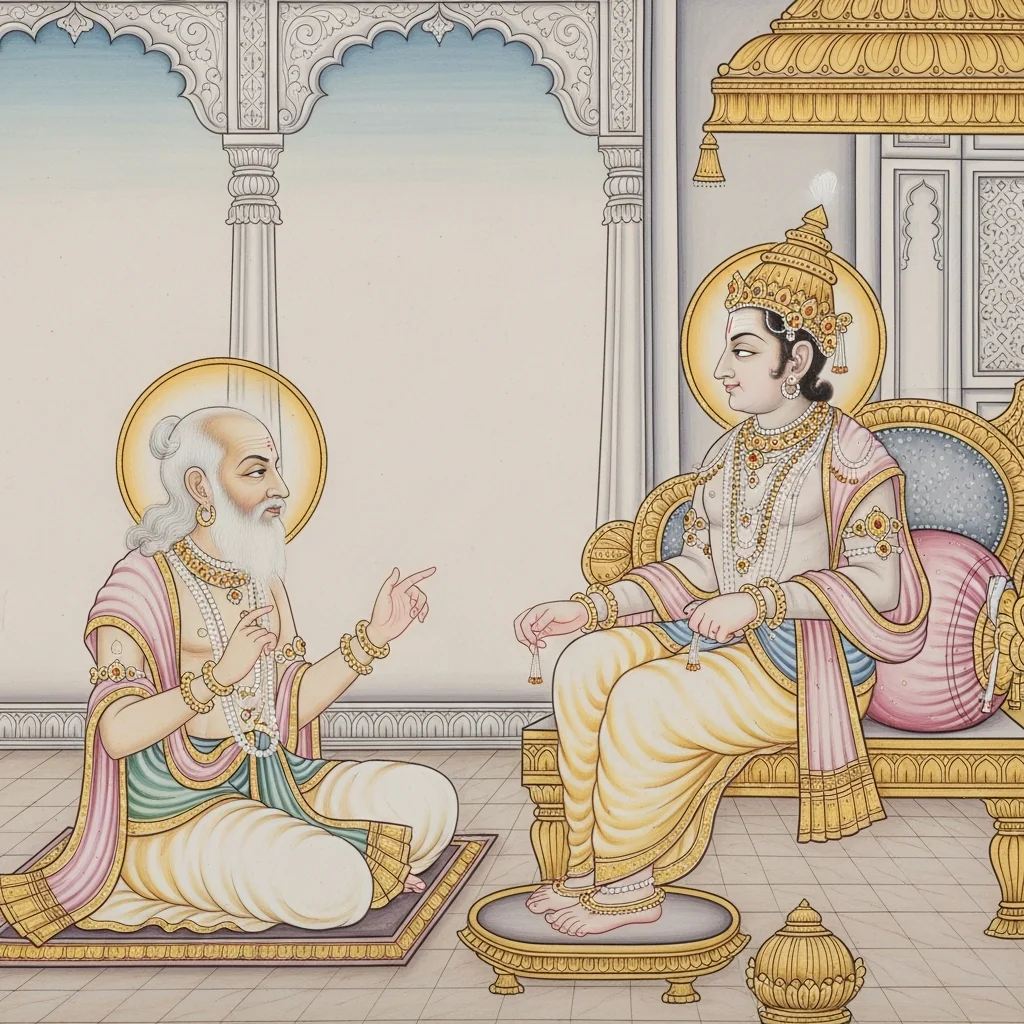
Adhyaya 25
द्वारकायाः माहात्म्यवर्णनम् | The Glory of Dvārakā and Comparative Tīrtha-Merit
The chapter unfolds as a royal question and a sage’s reply: King Indradyumna asks Mārkaṇḍeya to describe in detail a pure, sin-destroying tīrtha. The sage answers by naming three exemplary cities for the Kali age—Mathurā, Dvārakā, and Ayodhyā—each sanctified by divine presence (Hari/Kṛṣṇa and Rāma). It then sets out a comparative scale of merit, exalting even momentary contact with Dvārakā—dwelling there for an instant, remembering it, or hearing its glory—above long austerities or pilgrimages to Kāśī, Prayāga, Prabhāsa, and Kurukṣetra. Kṛṣṇa-darśana, kīrtana, and the Dvādaśī night-vigil (jāgaraṇa) are presented as central observances, with strong phalaśruti promises of purification, liberation, and benefit to ancestors (piṇḍadāna near the Gomati and offerings near Kṛṣṇa’s presence). The chapter also highlights Dvārakā’s portable sanctifiers—gopīcandana and tulasī—extending tīrtha-power into the home, and concludes that gifts given during Kṛṣṇa-jāgaraṇa are greatly magnified, making Dvādaśī wakefulness a high-value ethical-devotional practice in Kali age.
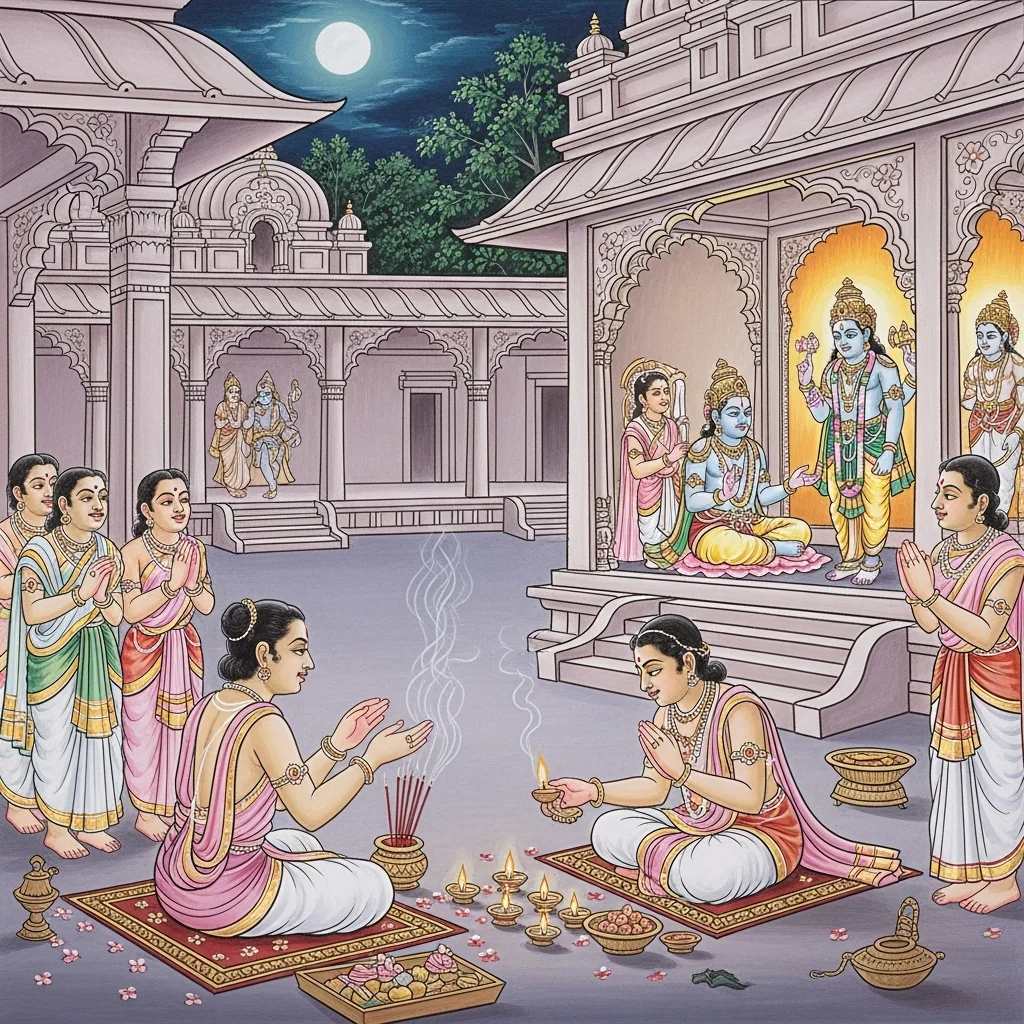
Adhyaya 26
हरिजागरण-प्रशंसा (Praise of Hari Night-Vigil) / Dvādāśī Jāgaraṇa and Its Fruits
The chapter begins with Mārkaṇḍeya portraying Prahlāda as a learned, disciplined Vaiṣṇava authority. Sages approach him seeking a brief teaching for attaining the highest state without arduous prerequisites, and Prahlāda reveals a “secret within secrets,” the distilled essence of Purāṇic instruction that grants both worldly welfare and liberation. The narrative then turns to Skanda (Ṣaṇmukha) petitioning Īśvara for a remedy to suffering and a practical path to release. Īśvara prescribes Hari-jāgaraṇa—the night-vigil for Viṣṇu—especially on Dvādāśī in Vaiṣṇava observance: nocturnal reading of Vaiṣṇava śāstra, singing hymns, taking darśana of the deity, reciting texts such as the Gītā and the nāma-sahasra, and worship with lamps, incense, offerings, and tulasī. Repeated phala statements promise swift destruction of accumulated sins, merit equal or superior to great sacrifices and vast gifts, benefit to lineage and ancestors, and freedom from rebirth for steadfast practitioners, while also praising faithful observers and censuring neglect or hostility toward Janārdana.
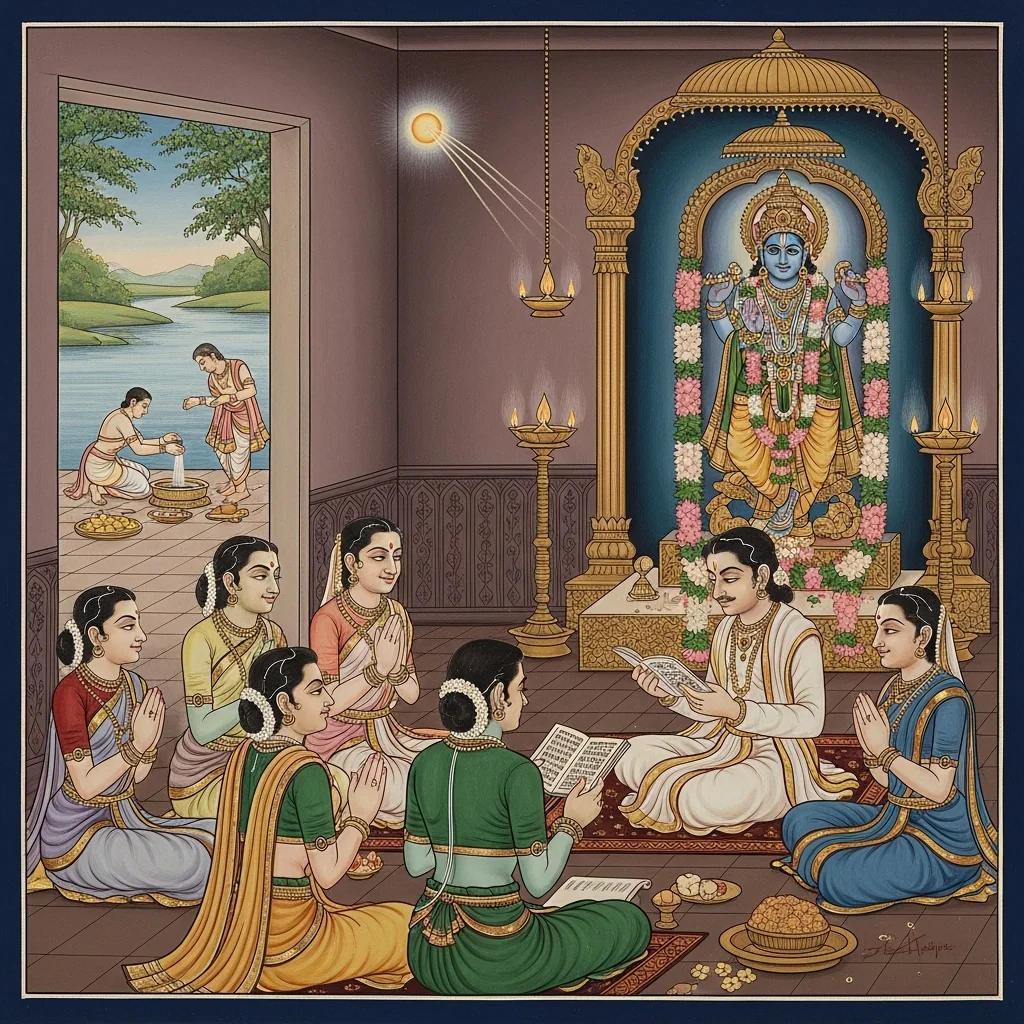
Adhyaya 27
द्वादशी-जागरणस्य सर्वतोवरेण्यत्ववर्णनम् (The Supreme Excellence of the Dvādaśī Vigil)
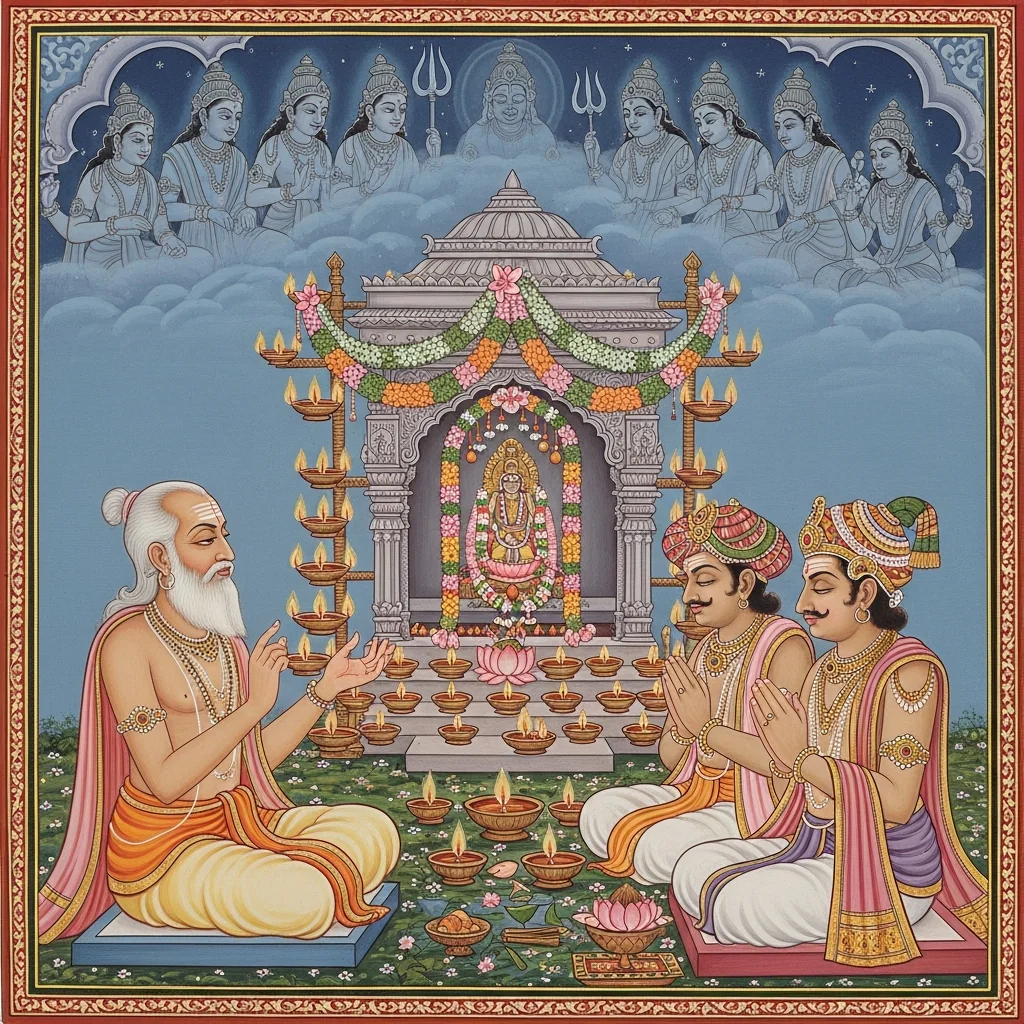
This chapter teaches the supreme efficacy of keeping a devotional vigil on Dvādaśī, especially when joined with worship of Hari/Viṣṇu and listening to the Bhāgavata. Īśvara declares that one who performs Hari-pūjā and hears the Bhāgavata during the Dvādaśī vigil gains merit multiplied beyond great Vedic sacrifices, cuts through bondage, and reaches Kṛṣṇa’s abode. It further asserts that even heavy accumulations of sin are neutralized by Bhāgavata hearing and Viṣṇu’s vigil, culminating in liberation imagery such as passing beyond the solar sphere. The chapter stresses calendrical exactness—Ekādaśī entering Dvādaśī and auspicious conjunctions—and extols gifts offered on Dvādaśī to Viṣṇu and to the ancestors as “Meru-like” in value. Ancestor rites are integrated: water-offerings and śrāddha near a great river are said to bring long-lasting satisfaction to forebears and confer boons. The fruit of the Dvādaśī vigil is then equated with diverse ethical disciplines (truth, purity, restraint, forgiveness), major donations, and famed tīrtha acts, presenting the vigil as a concentrated ritual substitute. Nārada is cited proclaiming that no vow equals Ekādaśī; neglect of Ekādaśī leads to continuing distress, while its observance is upheld as a remedy for the Kali age within a normative devotional path.
Adhyaya 28
हरिजागरण-माहात्म्य (The Glory of the Viṣṇu/Kṛṣṇa Night Vigil)
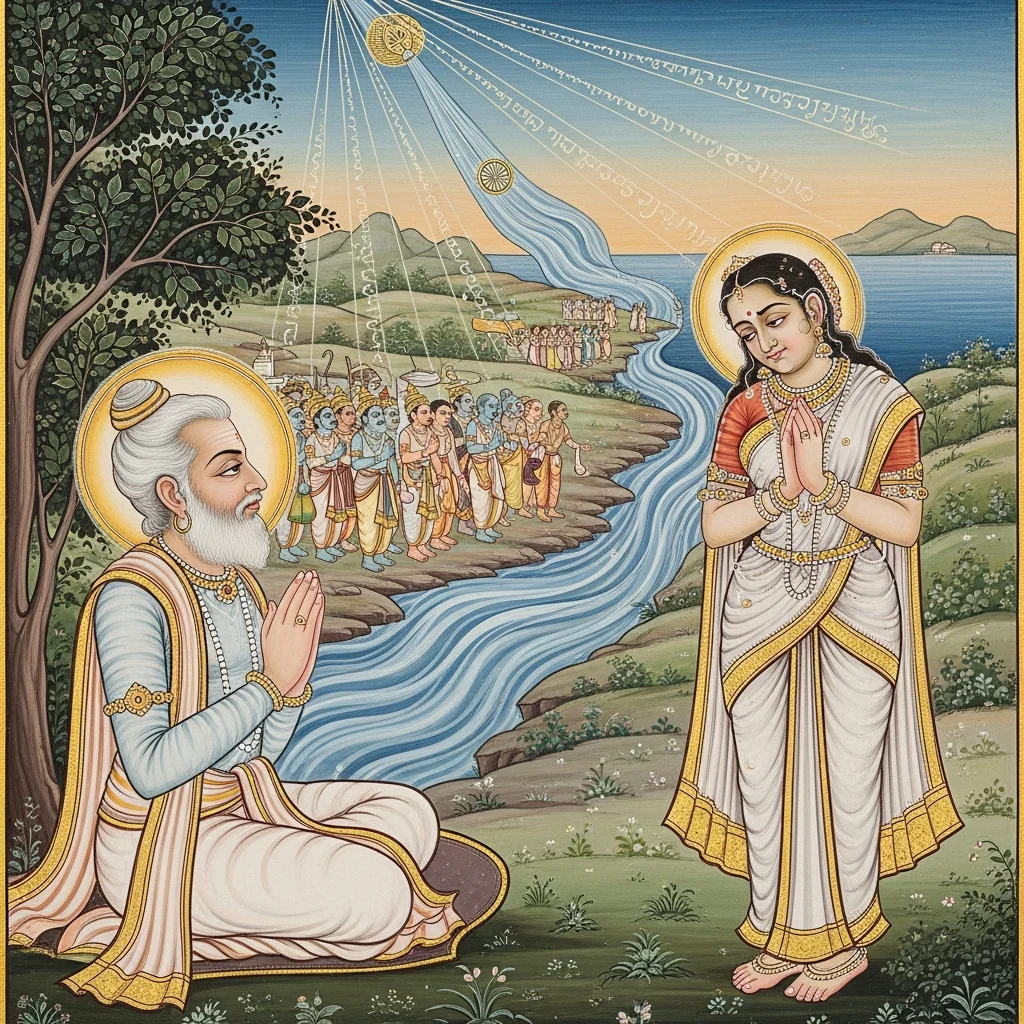
This adhyāya unfolds as a didactic dialogue in which Mārkaṇḍeya teaches the theological and ethical power of hari-jāgaraṇa—keeping a night vigil for Viṣṇu/Kṛṣṇa—especially in connection with Ekādaśī and Dvādaśī observance. The merit of the vigil is declared independent of flawless ritual purity or prior preparation: even the unbathed, the impure, and the socially marginalized are said to be purified and to attain elevated post-mortem states through participation. A strong phalaśruti repeatedly compares the vigil’s fruit to great sacrifices such as the aśvamedha, to tīrtha practices (like drinking at Puṣkara), to visits to river confluences, and to vast gifts, insisting that the vigil surpasses them all. It is also framed as a remedial discipline that can erase severe moral taints (grave sins are listed), while communal devotion—singing, dancing, vīṇā music, and kathā-kīrtana—is affirmed as a legitimate way to stay awake. Cosmic convergence is emphasized: gods, rivers, and sacred waters are said to assemble at the vigil, and those who do not perform it are warned of adverse outcomes. The chapter’s lesson is an ethics of accessible devotion for Kali-yuga: steadfast wakefulness, remembrance of Garuḍadhvaja, and restraint (not eating on Ekādaśī) are presented as a concise, high-yield path.
Adhyaya 29
गौतमी-तीर्थसमागमः—द्वारकाक्षेत्रप्रशंसा (Gautamī Tīrtha Assembly and the Praise of Dvārakā Kṣetra)
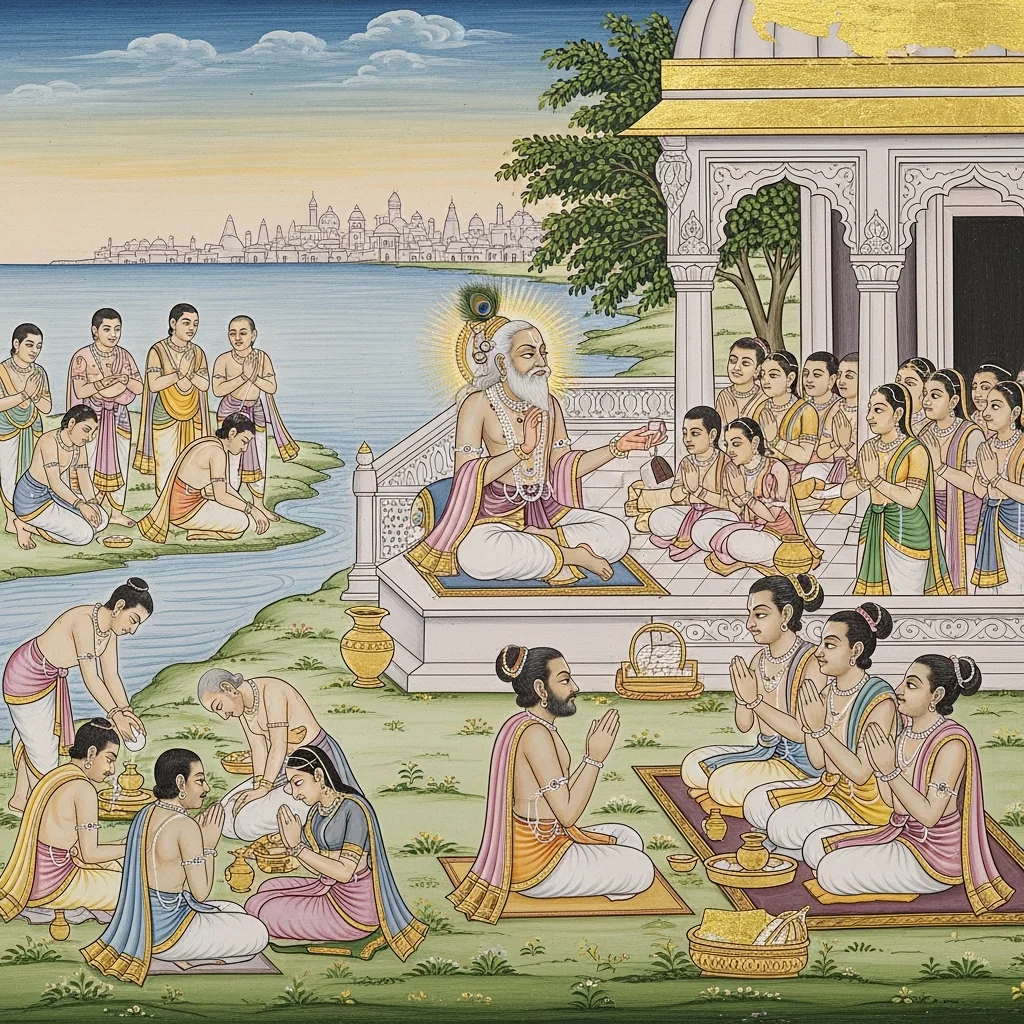
This chapter unfolds as a multi-voiced theological dialogue framed by Prahlāda’s narration. Nārada, noticing the auspicious time of Jupiter in Leo (siṃha-rāśi), witnesses an extraordinary gathering on the banks of the Godāvarī (Gautamī): great tīrthas, rivers, kṣetras, mountains, scriptures, siddhas, and divine beings assemble, astonished by the purity and radiance of that sacred locale. The personified Gautamī laments that she is weary and as though “burning” from contact with unethical people (durjana-saṃsarga), and she seeks a remedy to restore her serene purity. Nārada and the assembled holy entities deliberate; Gautama arrives and begins a contemplative appeal to Mahādeva. A bodiless divine voice then redirects the assembly to the northwestern seacoast, declaring Dvārakā—where the Gomati meets the ocean and where Viṣṇu abides facing west—to be the supreme purificatory field, like fire consuming fuel. The chapter ends with collective praise of Dvārakā and an intensified longing for bathing in the Gomati, bathing at Cakra-tīrtha, and receiving Kṛṣṇa’s darśana, while underscoring the ethical teaching: purity is strengthened by sat-saṅga (company of the good) and harmed by association with the wicked.
Adhyaya 30
Dvārakā-yātrā-vidhiḥ (Procedure and Ethics of the Pilgrimage to Dvārakā)
Adhyāya 30 unfolds as a procedural and ethical guide to the pilgrimage to Dvāravatī/Kuşasthalī for Kṛṣṇa-darśana, framed within Prahlāda’s narration. He describes a universal eagerness among tīrthas, kṣetras, ṛṣis, and devas to journey to Kṛṣṇa’s holy city, and the appearance of Nārada and Gautama is taken as an omen of an approaching, festival-like mass pilgrimage. The ṛṣis then respectfully question Nārada—hailed as the supreme guide among yogins—about the proper method (vidhi), required disciplines (niyama), things to avoid (varjanīya), what should be heard/recited/remembered on the road, and which celebrations are permitted. Nārada prescribes preparatory bathing and worship, feeding Vaiṣṇavas and brāhmaṇas according to one’s means, receiving Viṣṇu’s permission, and sustaining a devotional mind toward Kṛṣṇa. On the journey the pilgrim should remain calm, self-controlled, and pure; observe brahmacarya, sleep low (on the ground), and regulate the senses. Recommended practices include reciting divine names (including sahasranāma), reading Purāṇas, compassionate conduct, and service to the virtuous. Charity—especially food-giving—is strongly praised, with great merit even for small offerings, while quarrelsome speech, slander, deceit, and reliance on others’ food despite having means are forbidden. The chapter returns to Prahlāda’s narrative to portray varied expressions of bhakti along the way: listening to Viṣṇu-kathā, chanting names, singing, instrumental music, flags and festive processions, with rivers and famed tīrthas joining symbolically. It culminates as the pilgrims behold Kṛṣṇa’s abode from afar, affirming the yātrā as both communal worship and ethical training.
Adhyaya 31
Dvārakā as Tīrtha-Saṅgama: Darśana of Kṛṣṇa’s Ālaya and the Gomatī Māhātmya (द्वारकाक्षेत्रमहिमा तथा गोमतीमाहात्म्य)
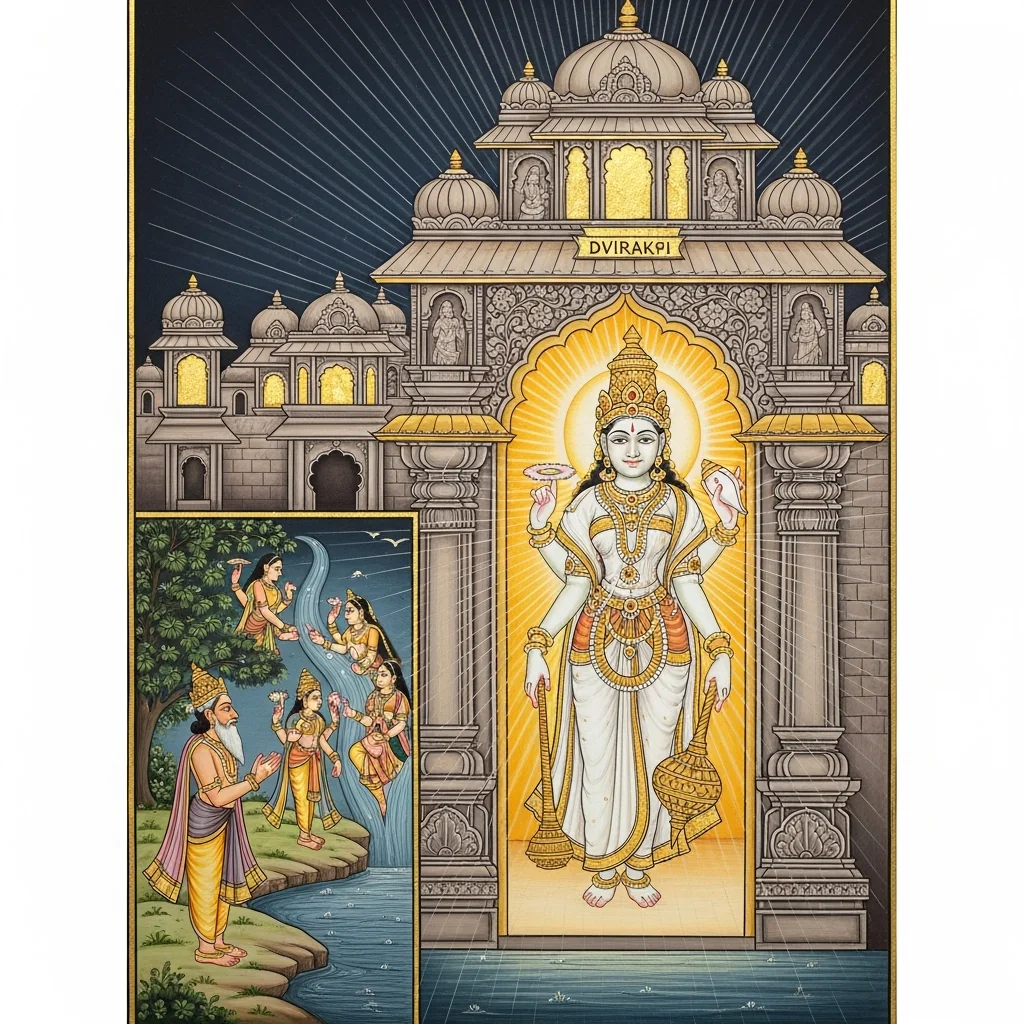
Adhyāya 31 portrays a convergence of devotion and sacred geography centered on Dvārakā. Prahlāda describes the city’s divine radiance that dispels darkness and fear, and its victory-signs in banners and flags. When the assembly beholds the abode of Viṣṇu/Kṛṣṇa, adorned with heavenly emblems, all bow down in prostration, overwhelmed by ecstatic bhakti. A sweeping enumeration follows of renowned tīrthas, rivers, kṣetras, and cities across India, declaring that the sacred landscape of the three worlds is, as it were, gathered in relation to Dvārakā. Nārada explains that such darśana is the fruit of accumulated merit, and that steadfast devotion and the resolve to reach Dvārakā are not won by minor austerities; Dvārakā shines among the “kings” of kṣetra-tīrthas like the sun among the heavenly lights. With music, dance, flags, and hymns the procession moves to the Gomatī, where Nārada proclaims her foremost among rivers, saying her snāna grants liberation and benefits even the ancestors. After bathing, the gathered beings approach Dvārakā’s gate and behold the city personified in regal, radiant form—white-hued, richly adorned, bearing conch, discus, and mace—prompting a collective, reverent praṇāma.
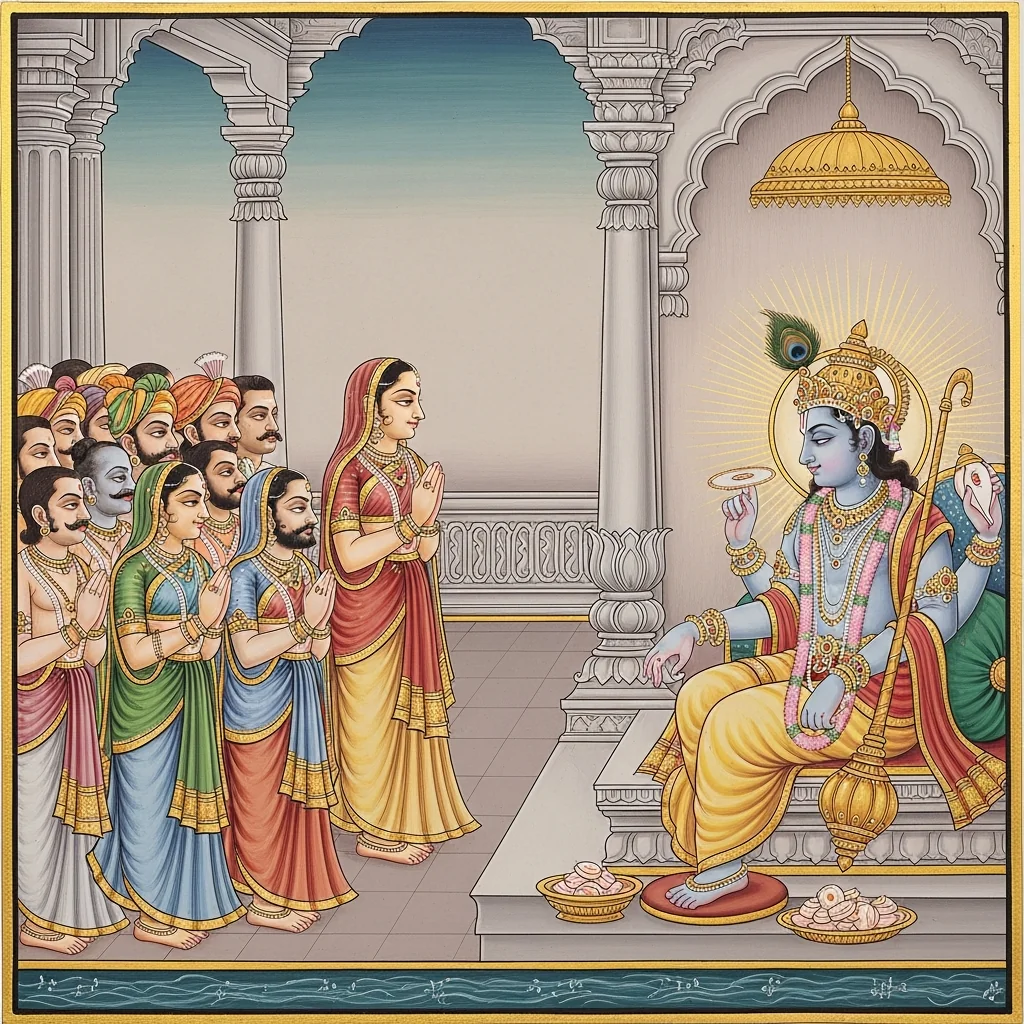
Adhyaya 32
द्वारकायाः सर्वतीर्थ-समागमः, देवसमागमश्च (Dvārakā as the Convergence of All Tīrthas and the Assembly of Devas)
This chapter unfolds, in staged revelation, Dvārakā’s supreme sanctity in the language of pilgrimage-theology. Nārada addresses Hari’s beloved Dvārakā and narratively displays a grand procession in which famed tīrthas, rivers, kṣetras, forests, and mountains arrive and bow at her feet—Prayāga, Puṣkara, Gautamī, Bhāgīrathī/ Gaṅgā, Narmadā, Yamunā, Sarasvatī, Sindhu; Vārāṇasī, Kurukṣetra, Mathurā, Ayodhyā; Meru, Kailāsa, Himālaya, Vindhya. The vision then widens to a cosmic register: divine music and acclamations arise; Brahmā, Maheśa with Bhavānī, Indra, and the assemblies of devas and ṛṣis appear, affirming that Dvārakā surpasses even heaven and praising Cakratīrtha and a stone marked with the cakra. Brahmā and Maheśa seek darśana of Kṛṣṇa, and Dvārakā leads them to Dvārakeśvara. A collective ritual sequence follows—bathing in the Gomati and the sea, pañcāmṛta-like abhiṣeka motifs, offerings of tulasī, incense, lamps, and food, with celebratory music and dance. Kṛṣṇa is pleased and grants a boon: steady, affectionate devotion to his feet. The chapter closes with a royal-style abhiṣeka of Dvārakā herself by Brahmā and Īśāna, the appearance of Viṣṇu’s attendants (such as Viṣvaksena and Sunanda), and a doctrinal seal: those who worship rightly gain the impulse to come to Dvārakā, a sign of divine favor.
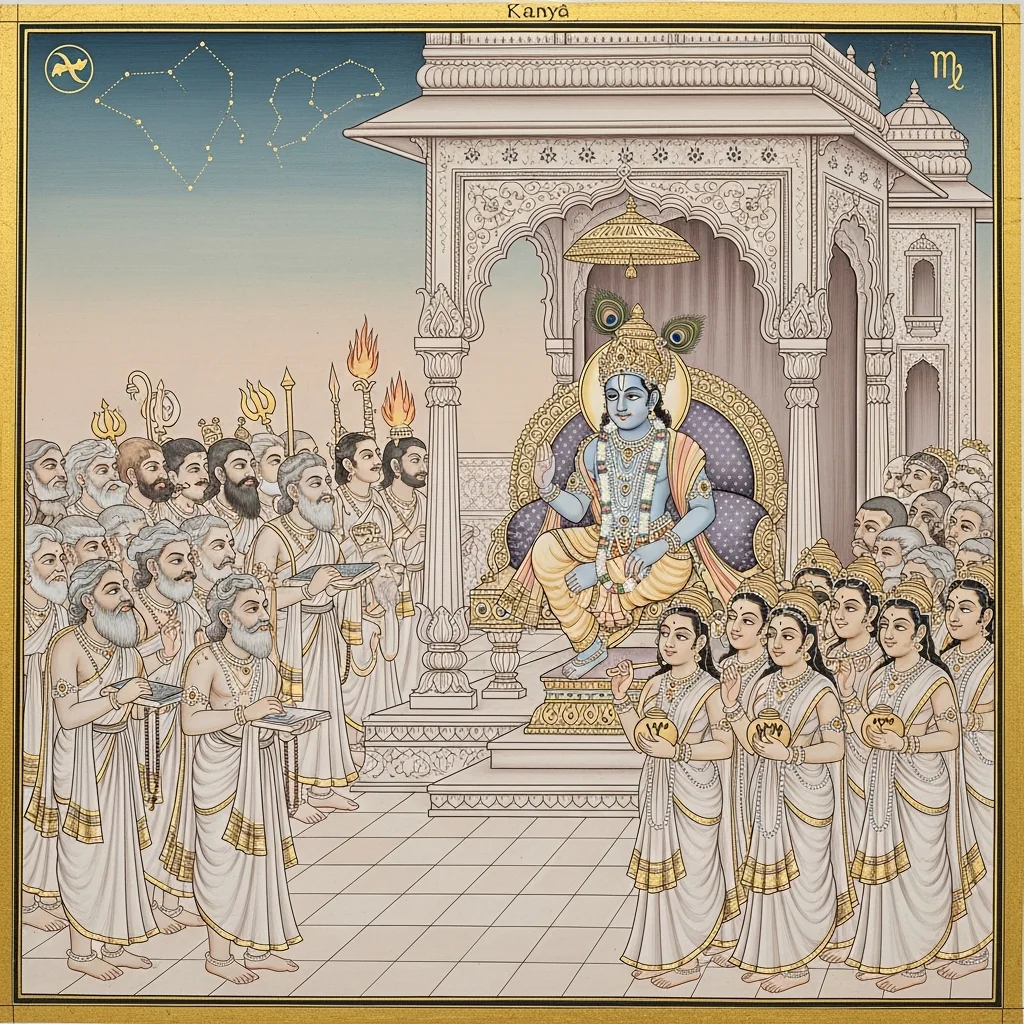
Adhyaya 33
द्वारकायां सर्वतीर्थक्षेत्रादिकृतनिवासवर्णनम् (Residence of All Tīrthas and Kṣetras at Dvārakā)
This adhyāya unfolds as a dialogue: Prahlāda, having heard remarks attributed to Viṣṇu’s attendants, asks to hear the māhātmya of Dvārakā. Brahmā and Maheśa reply by establishing Dvārakā as a royal preeminent center among tīrthas and liberation-bestowing kṣetras, praising it in a comparative manner that implicitly surpasses famed pilgrimage sites such as Prayāga and Kāśī. The chapter then turns to a systematic, direction-based enumeration: countless rivers and tīrthas (reckoned in koṭis) are said to dwell around Dvārakā, attending in devotion and repeatedly beholding Kṛṣṇa. A further catalogue names major kṣetras in the cardinal and intercardinal directions—Vārāṇasī, Avantī, Mathurā, Ayodhyā, Kurukṣetra, Purushottama, Bhṛgukṣetra/Prabhāsa, Śrīraṅga—followed by Śākta, Saura, and Gāṇapatya sacred sites, and mountains such as Kailāsa, Himavat, and Śrīśaila encircling the city. The conclusion frames this convergence as arising through śraddhā and bhakti, noting that when Guru (Bṛhaspati) is in Kanyā-rāśi, gods and sages joyfully come for darśana, affirming Dvārakā as an integrative pilgrimage cosmogram.
Adhyaya 34
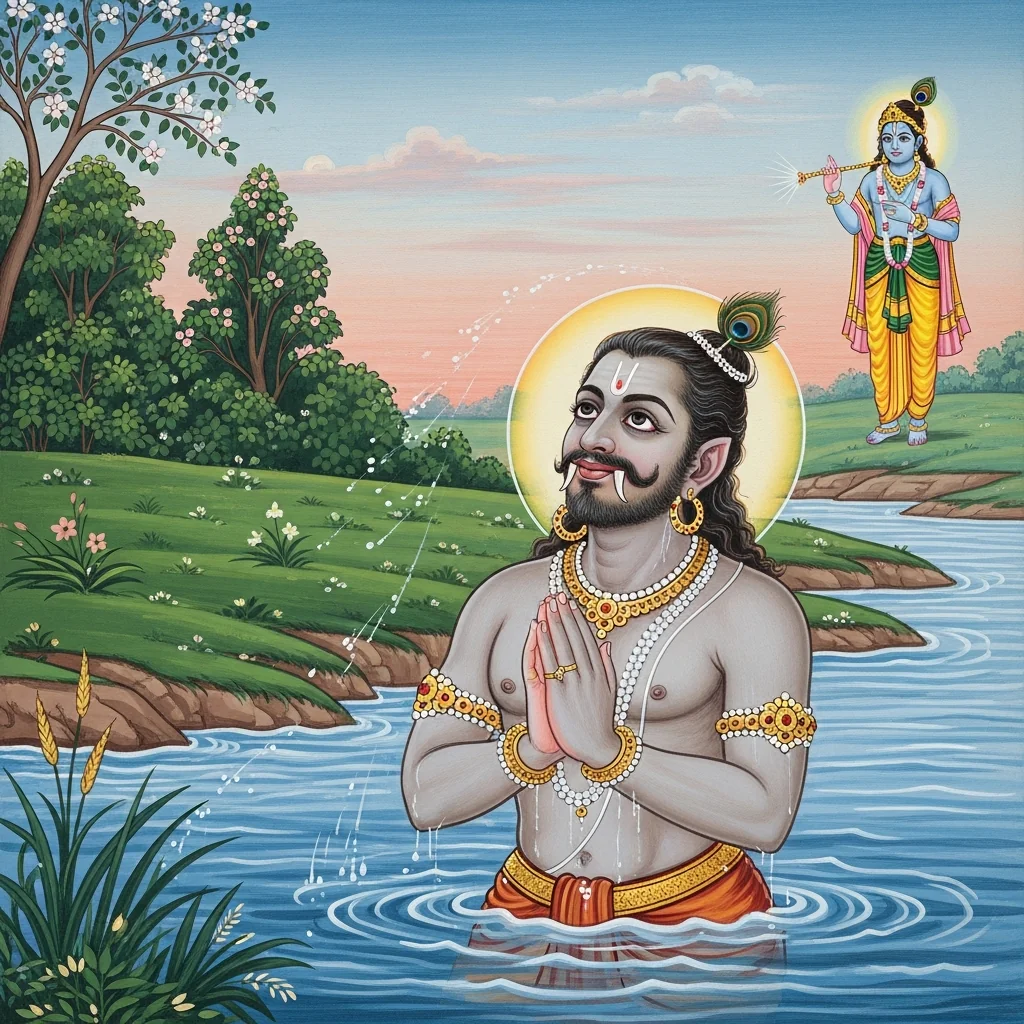
Vajralepa-vināśaḥ — The Dissolution of Hardened Wrongdoing through Dvārakā-Pathika Darśana
The chapter unfolds in layered teaching: Prahlāda extols to the sages Dvārakā’s unparalleled power to purify, and then introduces an itihāsa—an earlier dialogue between King Dilīpa and Sage Vasiṣṭha. Dilīpa asks for a kṣetra where sin does not “sprout again,” having heard that Kāśī can neutralize a severe moral residue called vajra-lepa. Vasiṣṭha recounts a cautionary tale of a renunciant in Kāśī who falls into dharma-transgressing conduct, declines further, and undergoes painful rebirths due to grave wrongdoing. Though Kāśī prevents immediate hellish retribution, the persistent vajra-lepa remains and drives long suffering across many forms of life. The turning point comes when a traveler connected with Dvārakā—purified by the Gomati and blessed with Kṛṣṇa-darśana—meets a rākṣasa: by the mere sight of this Dvārakā pathika, the rākṣasa’s vajra-lepa is instantly reduced to ashes. The rākṣasa then goes to Dvārakā, relinquishes the body at Gomati, and attains a Vaiṣṇava state, praised by celestial beings. The chapter closes by reaffirming Dvārakā as kṣetra-rāja, the sovereign of sacred places, where pāpa is said not to arise again, and culminates in Dilīpa’s pilgrimage and attainment through the living presence of Śrī Kṛṣṇa.
Adhyaya 35
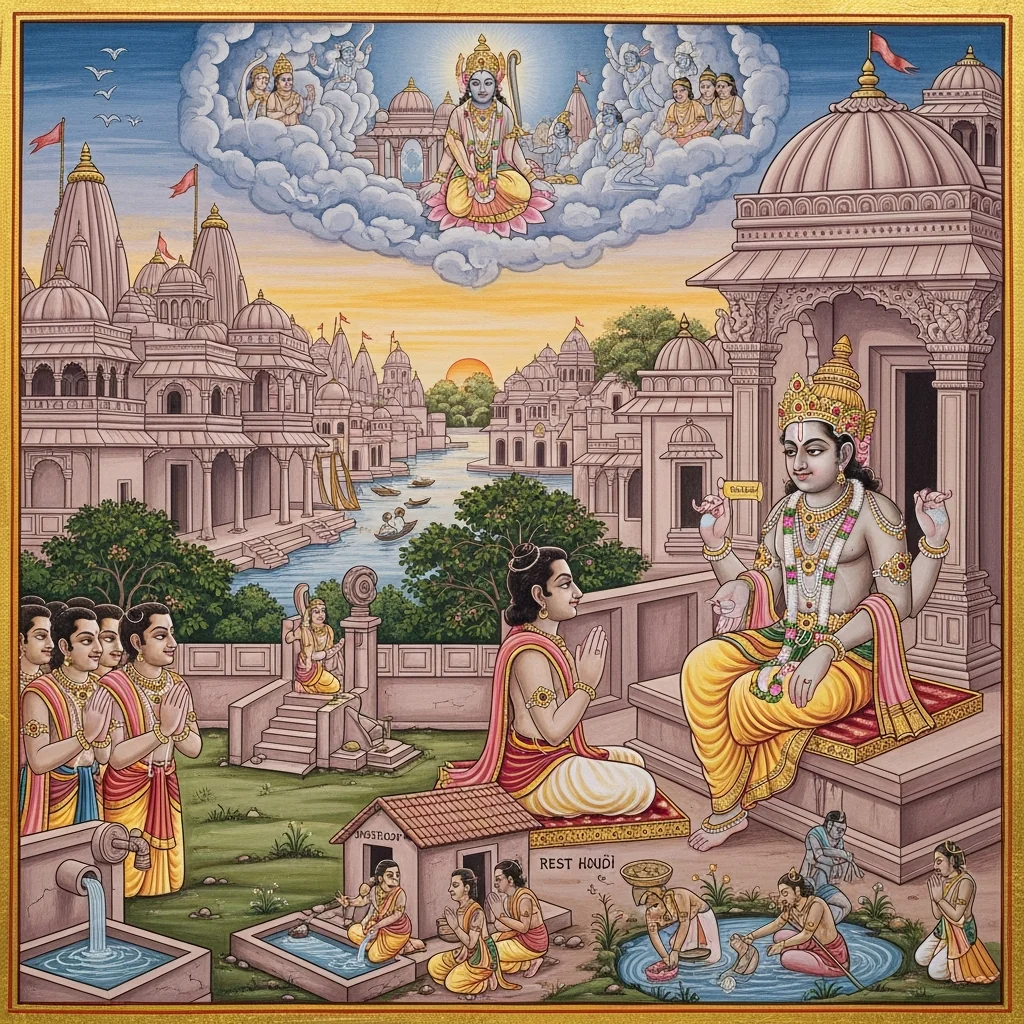
Dvārakā-kṣetra-māhātmya: Darśana, Dāna, Gomati-snānaphala, and Vaiṣṇava-nindā-doṣa (द्वारकाक्षेत्रमाहात्म्य—वैष्णवनिन्दादोषः)
Adhyāya 35 unfolds as a dialogue in which Prahlāda praises the unsurpassed holiness of Dvārakā and the transforming power of darśana—simply beholding its Vaiṣṇava devotees and residents, marked by the four-armed form. He argues in stages that Dvārakā’s sanctity is vast and manifest even to celestial beings, and that even its stones, dust, and minor creatures become channels of release, heightening the kṣetra’s salvific character. The chapter then establishes an ethical boundary by condemning Vaiṣṇava-nindā—disparaging Dvārakā’s residents—illustrated through Jayanta’s punitive function and the warning that such censure brings grievous suffering. In contrast, it prescribes praise and practice: serving Kṛṣṇa in Dvārakā, dwelling there with bhakti, and giving dāna even in small amounts are said to yield magnified fruits beyond renowned rites elsewhere (such as gifts at Kurukṣetra or merits of the Godāvarī). Calendrical and ritual notes follow, including bathing in the Gomati when Guru (Jupiter) is in Leo and increased efficacy in certain months. The conclusion turns to an ethic of sacred infrastructure—building shelters, waterworks, and rest-houses, repairing ponds and wells, and installing images of Viṣṇu—mapped to ascending heavenly enjoyments and attainment of Viṣṇuloka, ending with the question of why Dvārakā uniquely accelerates puṇya and prevents the “sprouting” of pāpa.
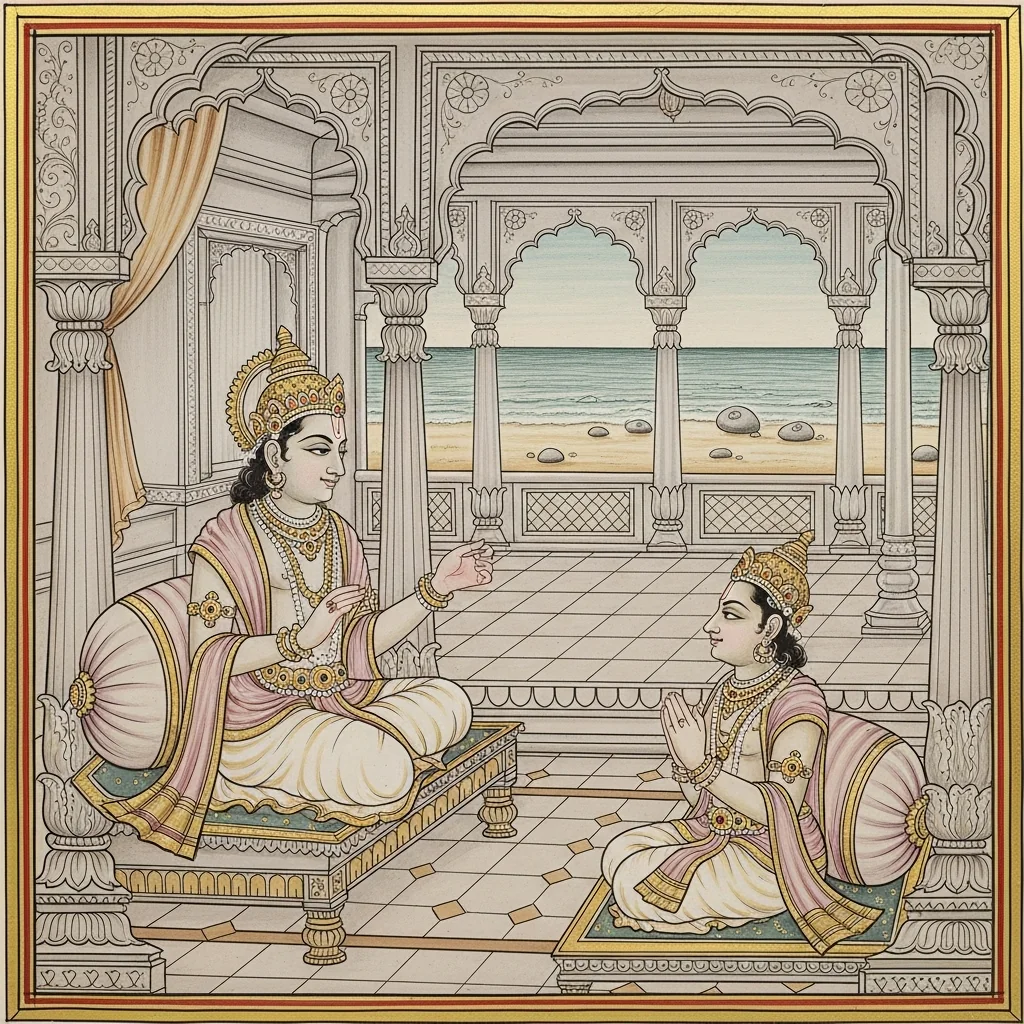
Adhyaya 36
द्वारकाक्षेत्रवैभववर्णनम् / Theological Praise of Dvārakā and its Pilgrimage Fruits
Sūta recounts a courtly dialogue in which Bali, stirred by Prahlāda’s words, asks about the grandeur of the sacred field of Dvārakā (kṣetra-vaibhava). Prahlāda replies with a structured māhātmya: every step taken toward Dvārakā yields merit, and even the mere intention to go has purifying power; moreover, even grave Kali-age faults do not cling to one who attains Kṛṣṇa’s presence, with special praise of Cakratīrtha and Kṛṣṇa’s city, Kṛṣṇapurī. He then ranks holy cities and declares Dvārakā supreme when the city protected by Kṛṣṇa is beheld. He speaks of “rarities” (durlabhatā)—residing there, receiving darśana, bathing in the Gomati, and seeing Rukmiṇī—and teaches devotional conduct at home: remembering Dvārakā, worshipping Keśava in household life, and observing sacred dates, especially tri-spṛśā-dvādaśī and the logic of related vrata. In Kali-yuga the fruits of fasting, vigil, and devotional song and dance are said to be greatly magnified, above all in Dvārakā and near Kṛṣṇa. The sanctity of the Gomati–ocean confluence, cakrāṅkita stones, and claims of equality or superiority over other famed tīrthas are extolled, along with family and social welfare—offspring through worship of Kṛṣṇa’s queens—and relief from fear and misfortune through Dvārakā darśana. The chapter closes with a strong phalaśruti: even adversity on the way to Dvārakā is framed as a sign of non-return to lower states.
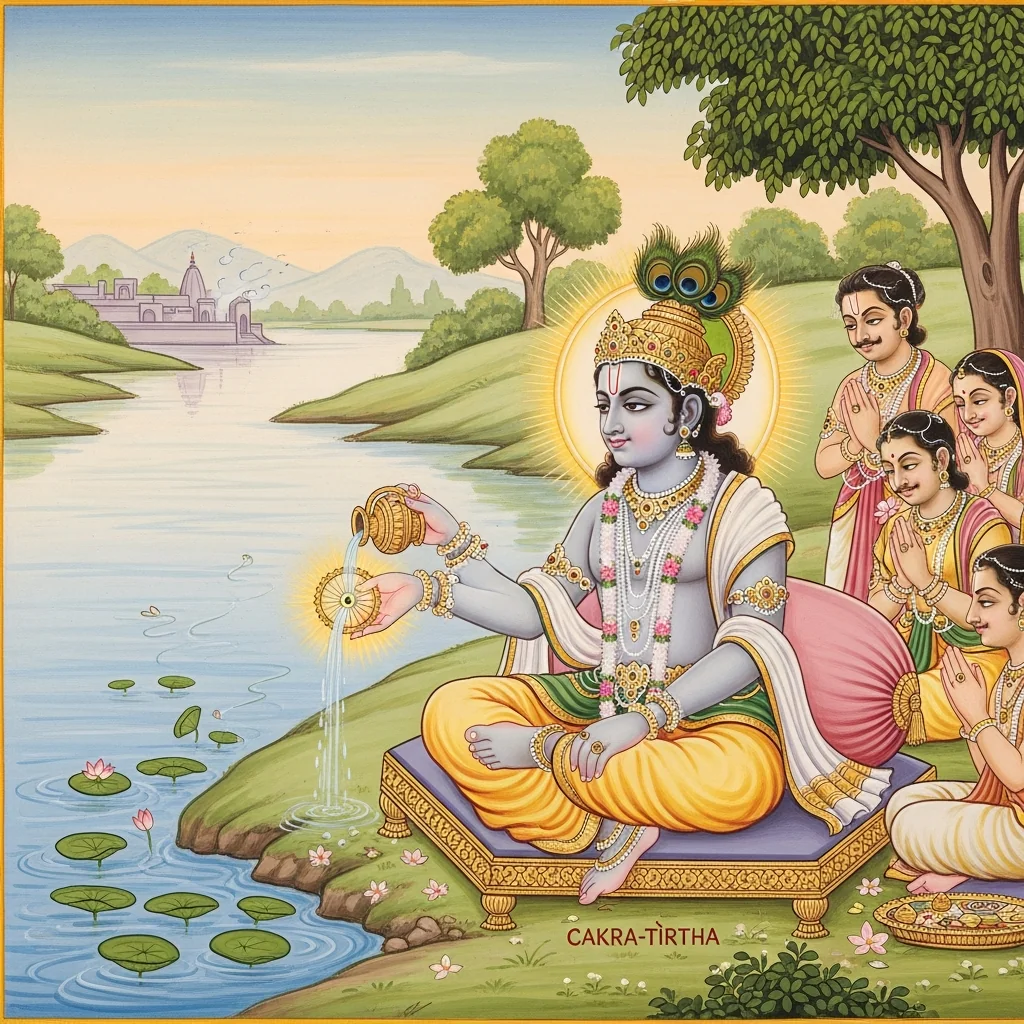
Adhyaya 37
Sudarśana–Cakra-cihna-aṅkita-pāṣāṇa Māhātmya (Glory of Chakra-Marked Stones at Dvārakā)
This chapter weaves a closely connected set of ritual and theological teachings within the sacred landscape of Dvārakā. Prahlāda first extols nāma-japa in the Kali age: the unceasing repetition of the name “Kṛṣṇa” as a steady discipline that transforms the heart and yields extraordinary merit. It then refines observances of Ekādaśī and Dvādaśī, naming special tithi conditions such as Unmīlinī and praising the multiplied fruit of nocturnal vigil (jāgaraṇa), including the rare Vañjulī configuration said to occur in Kali. The discourse turns to Cakra-tīrtha, where bathing is declared to cleanse moral blemishes and orient the devotee toward an undisturbed “supreme station,” the place being sanctified by the tradition that Kṛṣṇa washed the cakra there. A catalog follows of chakra-marked stones bearing one to twelve marks, each linked to a named divine form and graded results—from worldly stability and prosperity to sovereignty and, at the summit, nirvāṇa/mokṣa. The chapter closes with emphatic phala: mere touch or worship of such stones dissolves grave sins, remembrance at death is salvific, and bathing at Gomati-saṅgama and Bhṛgu-tīrtha neutralizes severe impurity—elevating devotion, even when mixed in disposition, toward sāttvika purity.
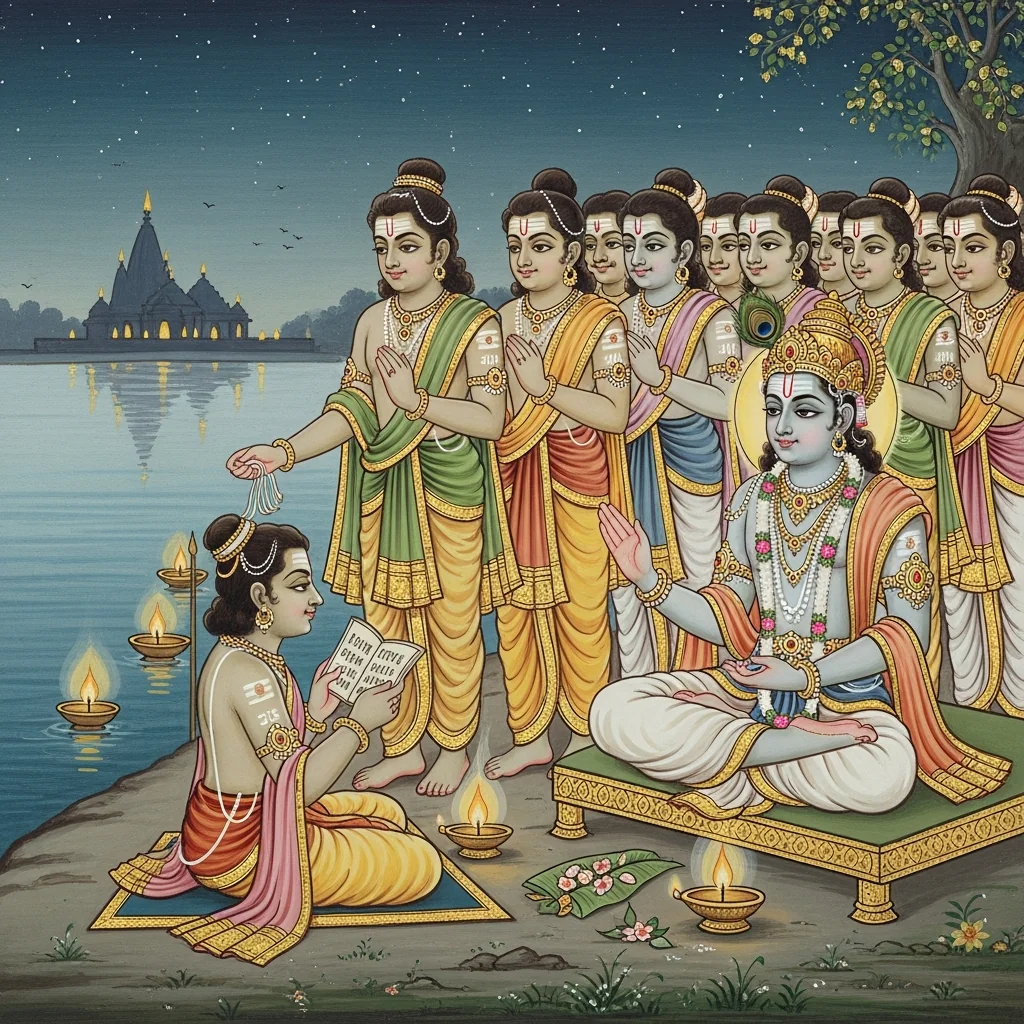
Adhyaya 38
Dvārakā-Māhātmya: Dvādaśī-Jāgaraṇa, Gomati–Cakratīrtha Merit, and Service to Vaiṣṇavas
This chapter, taught as Prahlāda’s theological instruction, portrays Dvārakā as a supremely potent ritual realm where even small deeds yield multiplied merit because of Śrī Kṛṣṇa’s nearness. Hearing and proclaiming Dvārakā’s glory (śravaṇa–kīrtana) is praised as a liberating practice. It contrasts costly gifts—such as repeated cow-donations to learned brāhmaṇas—with the claim that bathing in the Gomati, especially on days dear to Madhusūdana, can grant comparable results, shifting efficacy from expense to sacred place and time. A sustained ethical stress follows: feeding even one brāhmaṇa in Dvārakā, and above all supporting yatis/ascetics and Vaiṣṇavas with food and clothing, is repeatedly extolled as a duty one can carry out wherever one lives. The chapter elevates Vaiśākha Dvādaśī observance, Kṛṣṇa-pūjā, and night vigil (jāgaraṇa), adding a strong phalaśruti: vigil and Bhāgavata recitation are said to burn accumulated wrongdoing and bestow long heavenly residence. It maps purity as well—lands without Bhāgavata recitation, Śālagrāma worship, or Vaiṣṇava vows are deemed deficient, while even marginal regions become meritorious where devotees dwell. Protective and auspicious markers (Gopīcandana tilaka, Śaṅkhoddhāra clay, tulasī proximity, pādodaka) are listed, culminating in the declaration that Kṛṣṇa abides in Dvārakā in Kali-yuga and that a single day’s bath at Gomati–Cakratīrtha equals bathing at the tīrthas of the three worlds.
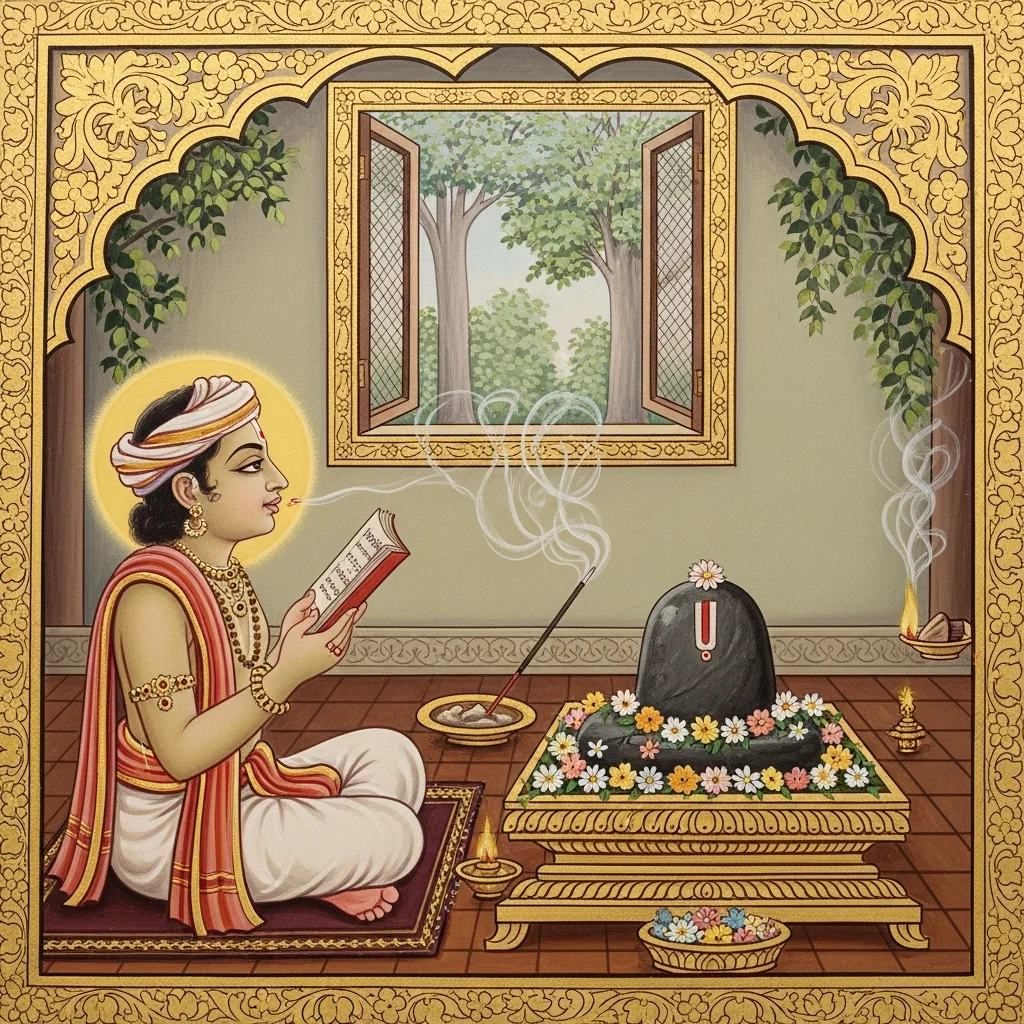
Adhyaya 39
Dvādāśī-Jāgaraṇa, Dvārakā-Smaraṇa, and Vaiṣṇava Ācāra (द्वादशी-जागरण, द्वारका-स्मरण, वैष्णव-आचार)
Chapter 39 begins with Prahlāda listing auspicious Dvādaśī designations and linking daily accruing merit to preparing havis-like offerings and keeping Viṣṇu’s night-vigil (jāgaraṇa), especially before the Śālagrāma-śilā. It prescribes ritual supports: ghee lamps with paired wicks, covering the Śālagrāma with flowers, and anointed worship of a Vaiṣṇava image—particularly one marked with the cakra—using sandal, camphor, kṛṣṇāguru, and musk. A concentrated phalaśruti equates the fruit of the Dvādaśī vigil with the cumulative merits of great tīrthas, sacrifices, vows, Vedic and Purāṇic study, austerities, and proper āśrama conduct, citing authoritative transmission; Sūta continues the relay and urges practice with faith. The teaching then expands to Dvārakā’s efficacy through mental contemplation, chanting, and home-recitation when travel is impossible, recommending listening, gifting to Vaiṣṇavas, and special recitation on Dvādaśī during the vigil. It also presents a motif of sacred presence in the home through sustained devotion, followed by ethical prohibitions—disrespecting Vaiṣṇavas, exploitative acts, and sacrilegious harm to sacred trees (especially aśvattha)—contrasted with the merit of planting and protecting nyagrodha, dhātrī, and tulasī. The chapter concludes with strong Kali-yuga norms: daily Viṣṇu-recitation and Bhāgavata singing, the merit of gopīcandana (tilaka, gifting, and Dvādaśī vigil), and daily utterance of “Dvārakā” as generating tīrtha-like merit.
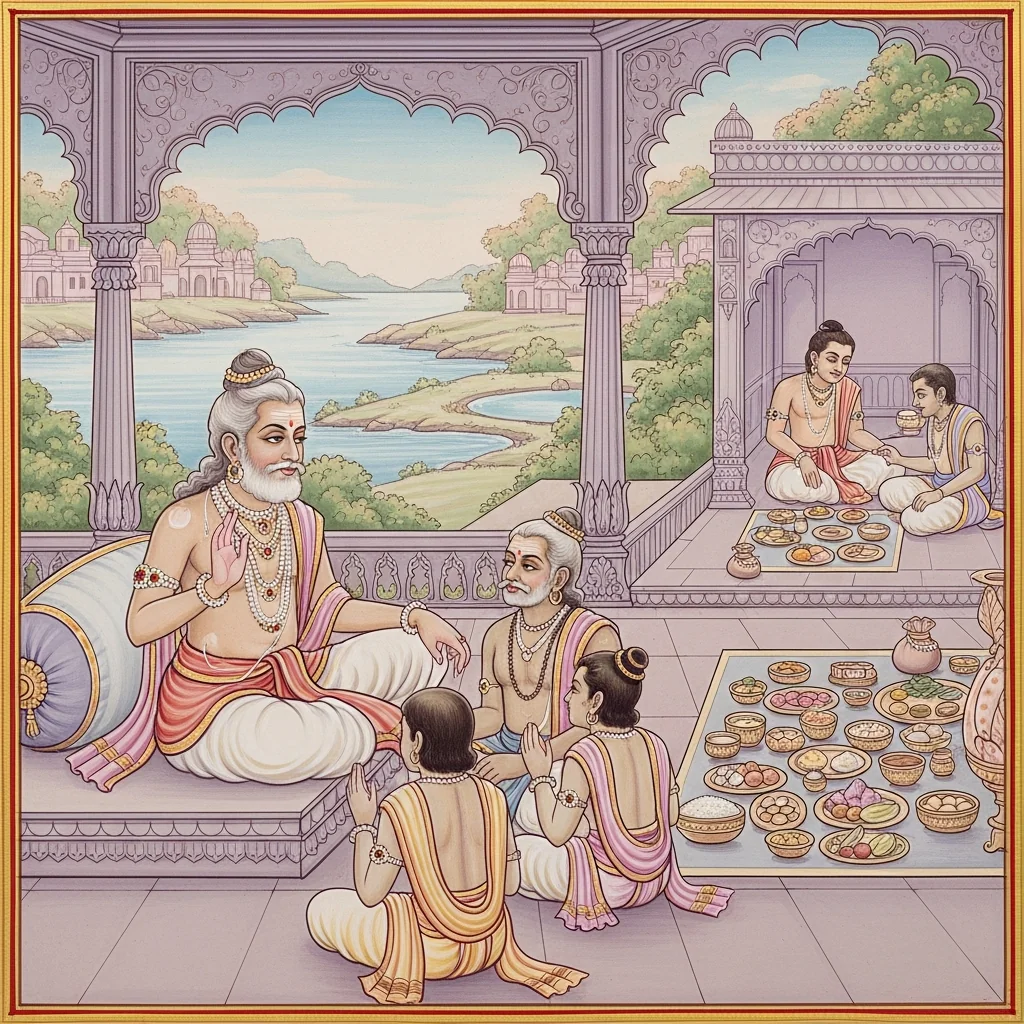
Adhyaya 40
कार्तिके चक्रतीर्थस्नानदानश्राद्धादिमाहात्म्यवर्णनम् (Kartika Observances at Cakratīrtha: Bathing, Gifts, and Śrāddha)
This adhyāya sets forth Prahlāda’s theological teaching on high-merit devotional observances centered on Kṛṣṇa worship and the ethics of pilgrimage at Dvārakā. It begins with leaf-offering worship of Śrīpati, using leaves inscribed with the devotee’s name, and especially śrīvṛkṣa leaves associated with Lakṣmī—praised here as even superior to tulasī and said to yield expansive merit. It then notes calendrical potency, highlighting Dvādaśī when it coincides with Sunday, and portrays Hari’s day as a meeting-point where merits gather. The chapter turns to Dvārakā’s social-ritual economy: feeding yatis/renunciants, gifting clothing and necessities, and extolling the exceptional merit of providing even a single meal to a mendicant there, surpassing large-scale feeding elsewhere. It affirms the salvific power of Kṛṣṇa-kīrtana, extends Dvārakā’s protective grace to residents and even dependent beings, and describes Kartika disciplines—bathing in the Gomati and Rukmiṇī-hrada, Ekādaśī fasting, Dvādaśī śrāddha at Cakratīrtha, Brahmin-feeding with specified foods and dakṣiṇā—culminating in ancestral satisfaction and divine approval. The phalāśruti concludes by promising imperishable merit to Kartika vow-keepers purified at the tīrtha.
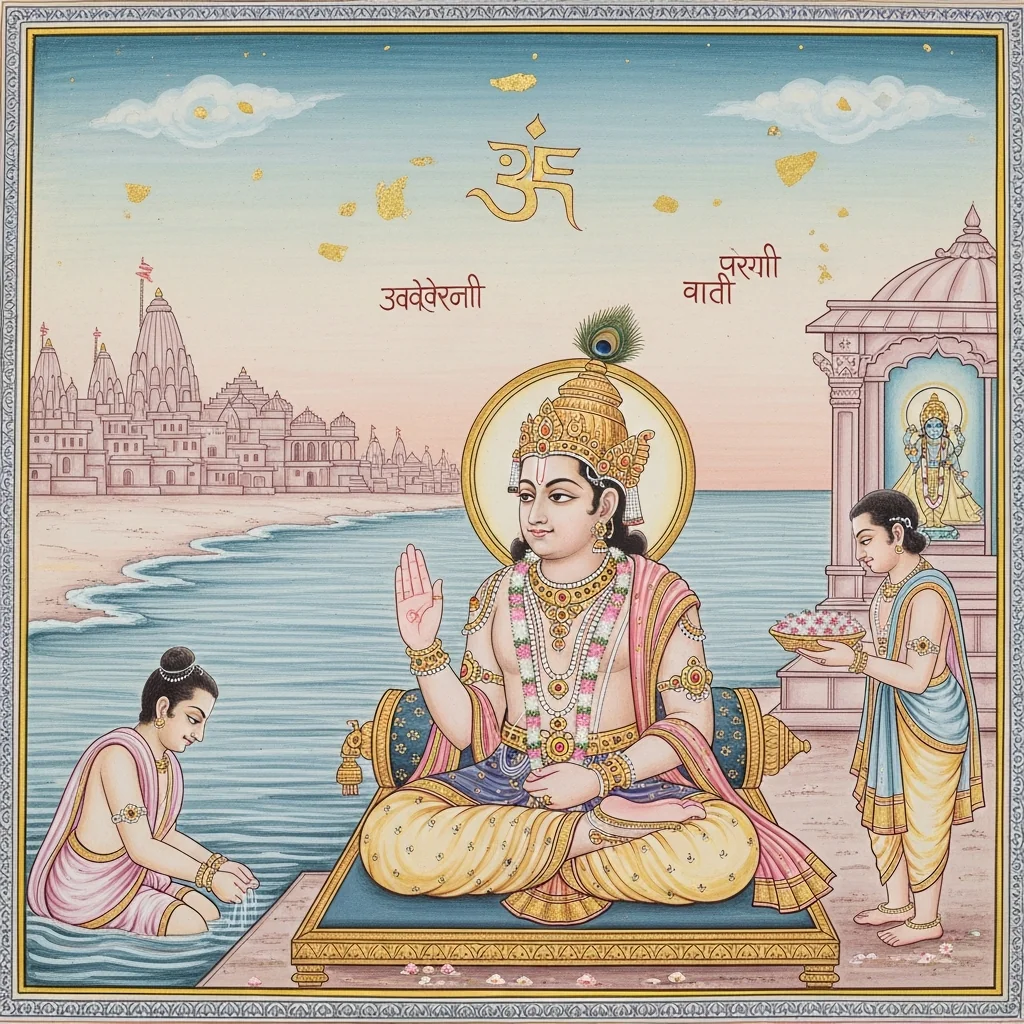
Adhyaya 41
गोमतीस्नान–कृष्णपूजन–यतिभोजन–दान–श्राद्धादि सत्फलवर्णनम् (Merits of Gomatī Bathing, Kṛṣṇa Worship, Feeding Ascetics, Gifts, and Śrāddha)
This chapter, in a ritual-theological discourse attributed to Prahlāda, proclaims the heightened power of devotion and ancestral rites when performed in Dvārakā, especially in connection with the Gomatī. It declares that one who bathes in the Gomatī and worships Kṛṣṇa with offerings such as ketakī flowers and tulasī attains extraordinary auspiciousness and is safeguarded from the harsh rounds of saṃsāra; in phala-śruti style, the merit is spoken of as nearing “immortality.” It further states that feeding even a single person in Dvārakā yields fruit surpassing the feeding of vast numbers elsewhere, and that mere mental remembrance of Dvārakā burns away wrongdoing of past, present, and future. In the Kali-yuga setting, steadfast orientation toward Dvārakā is portrayed as a sign that human purpose has been fulfilled. Dvārakā is also linked to ancestral welfare: the pitṛ-gaṇas are said to dwell there, and offerings of tila-water and śrāddha with piṇḍa-dāna—after first bathing in the Gomatī—become inexhaustible, granting lasting satisfaction to the ancestors. Eclipses, vyatīpāta, saṅkrānti, vaidhr̥ti, and other calendrical observances are invoked to frame proper ritual timing, while a wider tīrtha list situates Dvārakā’s supremacy within pan-Indic sacred geography.
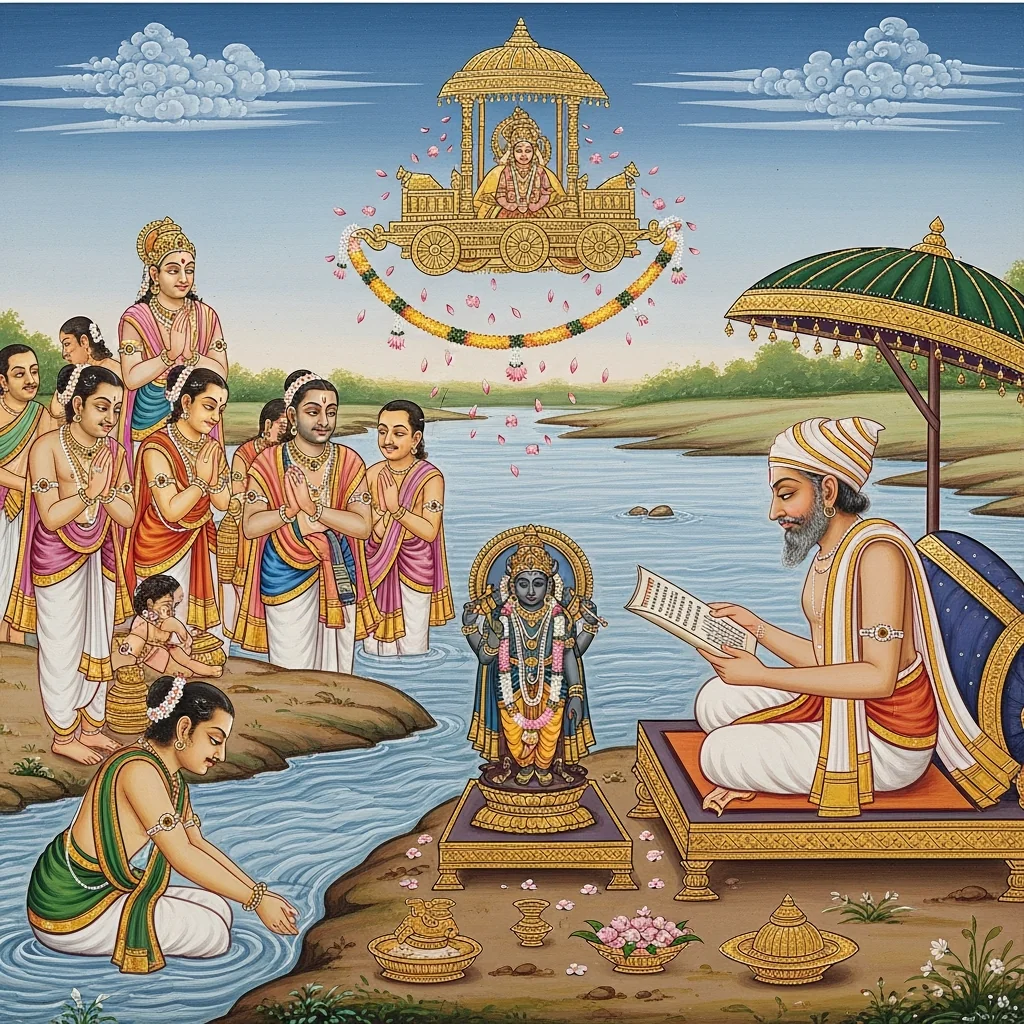
Adhyaya 42
द्वारकाक्षेत्रे वृषोत्सर्गादिक्रियाकरण-द्वारकामाहात्म्यश्रवणादि-फलवर्णनम् (Chapter 42: Results of bull-release and related rites; fruits of hearing/reciting Dvārakā Māhātmya)
Chapter 42 is a phalaśruti-style discourse attributed to Prahlāda. It begins by declaring that vṛṣotsarga (the ritual release of a bull) performed in Dvārakā—especially in Vaiśākha and Kārtika—brings posthumous uplift and release from adverse states. To stress its remedial power, the text names grave sins (brahmahatyā, surāpāna, theft, and guru-related violations) and states that bathing in the Gomati and receiving Śrī Kṛṣṇa’s darśana can dissolve even long-accumulated demerit. For Kali-yuga it highlights devotional acts: beholding Rukmiṇī with faith, circumambulating the city, and reciting the thousand names. A Dvādaśī observance is prescribed—reciting Dvārakā’s māhātmya in Viṣṇu’s presence—promising celestial honor and freedom of movement. The chapter then turns to lineage-blessings (“may such a person be born in our family”) and describes ideal practitioners: those who bathe at the Gomati–ocean confluence, perform śrāddha with sapinḍa elements, honor Vaiṣṇavas (including giving gopīcandana), and who listen to, recite, write, and keep the māhātmya at home. Textual writing-and-preservation (likhita-dhāraṇa) is exalted as a steady generator of merit, equated with great gifts and austerities, removing fear and easing ritual deficiency. It concludes by proclaiming Dvārakā as the abode where Viṣṇu, all tīrthas, devas, yajñas, Vedas, and ṛṣis are present, warning that virtues without hearing the māhātmya become ineffective, while faithful hearing yields prosperity and offspring within the stated time.
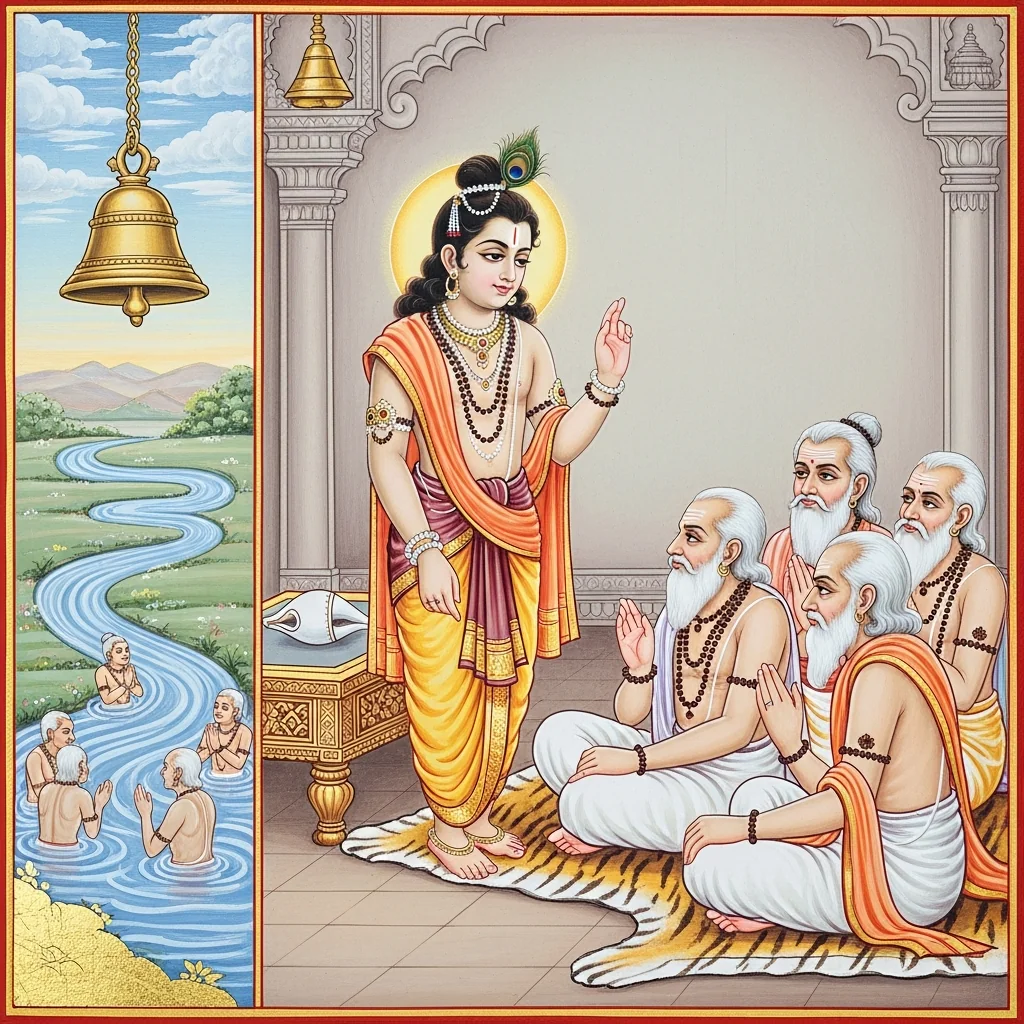
Adhyaya 43
तुलसीपत्रकाष्ठमहिमा तथा द्वारकायात्राविधिवर्णनम् | The Glory of Tulasī (Leaf & Wood) and the Procedure of the Dvārakā Pilgrimage
This chapter unfolds as a theological teaching on the media of bhakti and the logic of merit, voiced chiefly through Prahlāda, and then concluded by Sūta’s shift from instruction to pilgrimage. It first praises worship with tulasī leaves as a universally potent offering—spoken of in terms of wish-fulfilment—and it sanctifies ritual remnants as holy. It then sets out a hierarchy of merit for Viṣṇu-related substances: pādodaka (foot-water), śaṅkhodaka (conch-water), naivedya-śeṣa (remnants of offered food), and nirmālya (remnants of flowers), each compared to the fruit of great sacrifices. Temple protocol is also taught, especially bell-ringing (ghaṇṭā-vādya) during bathing and worship, said to substitute for other instruments and to generate vast merit. A major section extols tulasī wood (tulasī-kāṣṭha) and tulasī-derived sandal paste as purifying and funerary-sacramental: offered to deities and ancestors, used in cremation contexts, and declared to yield liberation-oriented results and divine recognition. In the closing verses, sages and Bali, delighted by Dvārakā’s greatness, journey to Dvārakā, bathe in the Gomatī, worship Kṛṣṇa, perform the yātrā correctly, give donations, and return—modeling the chapter’s teachings as lived pilgrimage ethics.
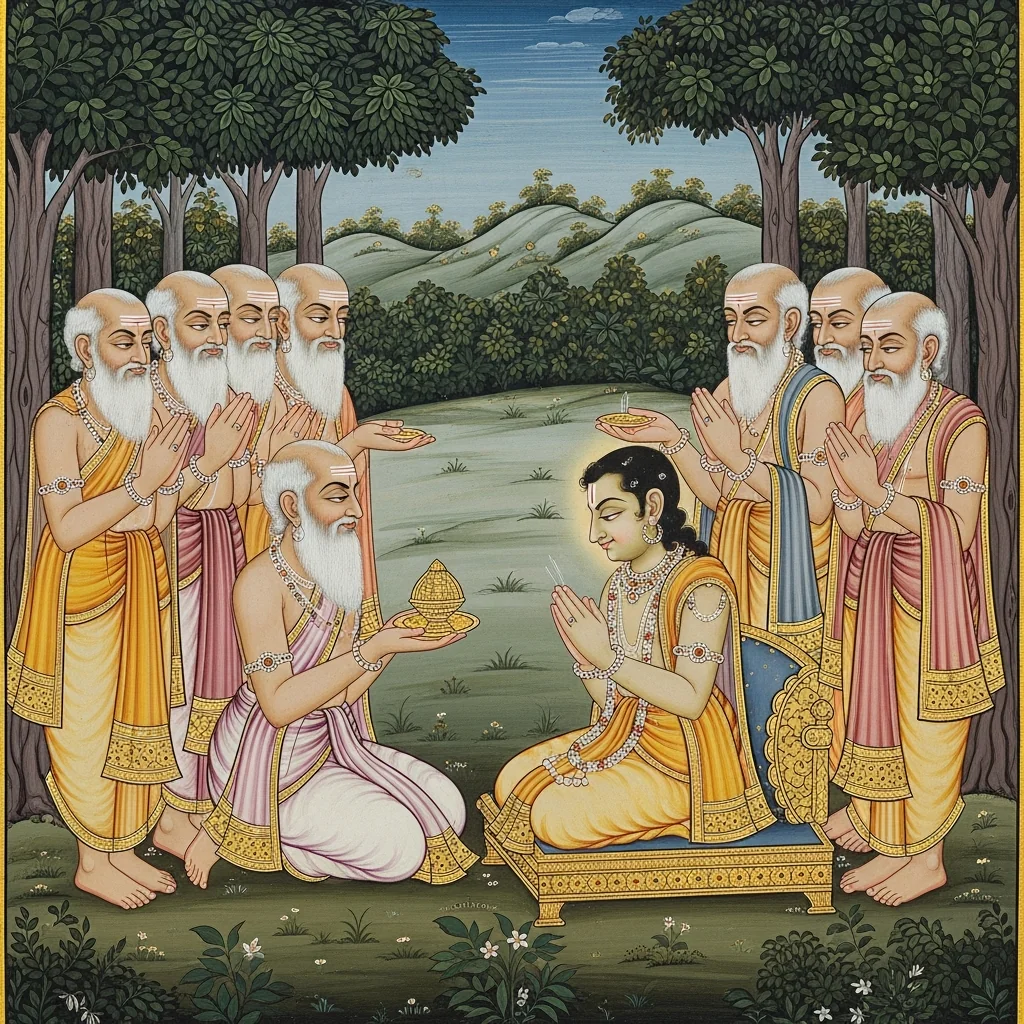
Adhyaya 44
स्कन्दमहापुराणश्रवणपठन-पुस्तकप्रदान-व्यासपूजनमाहात्म्य तथा उपसंहार (Chapter 44: Merit of Listening/Reciting, Gifting the Text, Honoring Vyāsa; Concluding Frame)
This adhyāya serves as a concluding phalaśruti and closing frame for the Skanda Purāṇa within the Dvārakā Māhātmya. Sūta first sets forth the authorized transmission lineage (paramparā)—Skanda → Bhṛgu → Aṅgiras → Cyavana → Ṛcīka, and others—establishing tradition as the ground of sacred authority. It then proclaims the fruits of hearing and reciting: freedom from sin, long life, social well-being in accord with varṇa-duties, and the fulfillment of aims such as sons, wealth, marital happiness, and reunion with relatives. Even partial hearing—down to a single pāda of a śloka—is said to lead toward salvific destinations. An ethical and pedagogical emphasis follows: honoring the reciter is equated with honoring Brahmā, Viṣṇu, and Rudra; and the debt to the guru who imparts even one syllable is declared beyond repayment, urging respectful support through gifts, offerings, and sustenance. The chapter closes in Vyāsa’s narration as sages praise Sūta for covering the standard purāṇic themes (creation, secondary creation, dynasties, manvantaras, cosmology), bless and honor him with garments and ornaments, and return to their rites—sealing the text’s completion and reaffirming communal norms of learning, gratitude, and ritual continuity.
FAQs about Dvaraka Mahatmya
It emphasizes Dvārakā as a sanctified civilizational and devotional center tied to Kṛṣṇa’s presence and legacy, with Prabhāsa functioning as a consequential sacred node where epic-era transitions are narrated and ritually remembered.
The section’s typical purāṇic logic associates merit with remembrance, recitation, and tīrtha-contact that reinforce dharma and devotion—especially framed as accessible supports when formal religious capacities are portrayed as diminished in Kali-yuga.
Key legends include Kṛṣṇa’s life-cycle recollections (from Vraja and Mathurā to Dvārakā), the Yādava lineage’s terminal events, the sea’s inundation motif around Dvārakā, and the subsequent re-siting of sacred habitation and memory.