Adhyaya 6
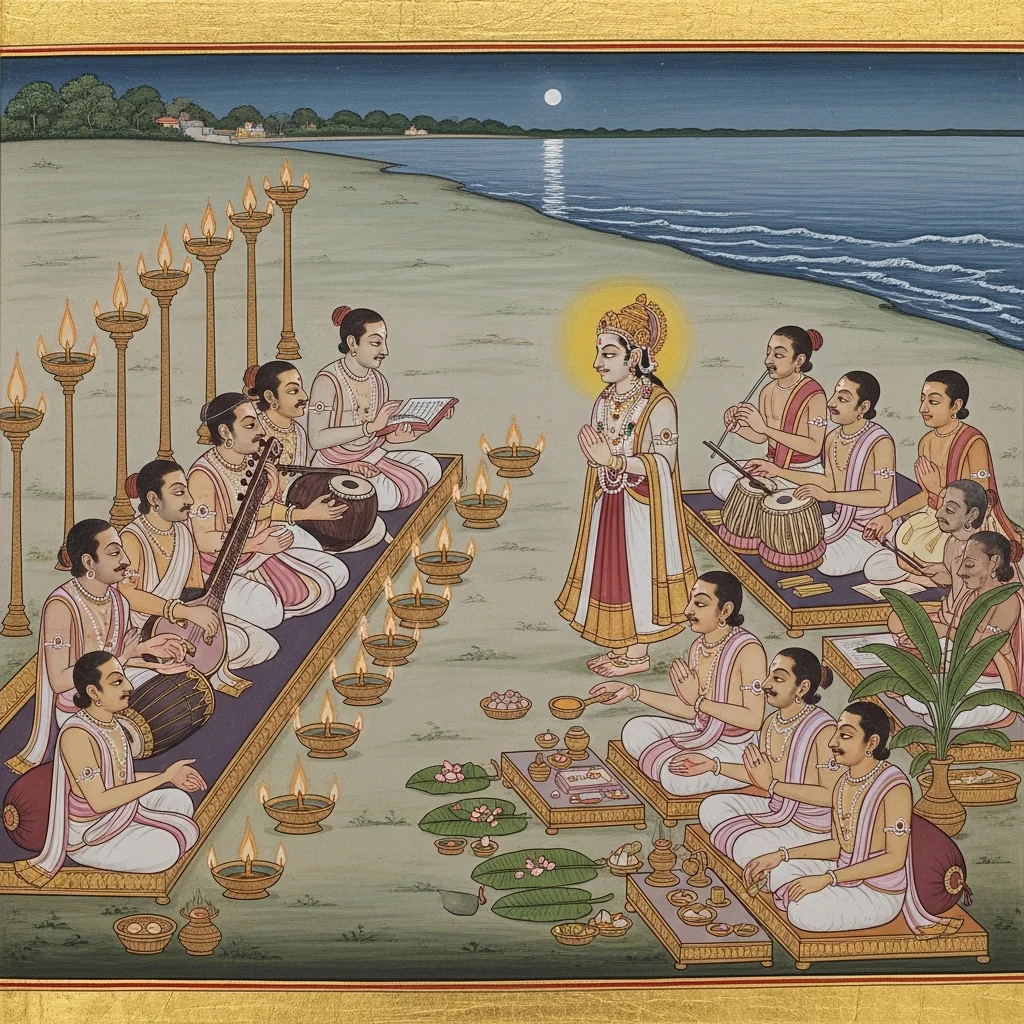
The chapter unfolds as a question-and-instruction dialogue: sages praise Prahlāda and ask for the detailed tīrthayātrā procedure at the place where the river Gomati flows, where Bhagavān is contemplated as present near Cakratīrtha. Prahlāda sets out a stepwise rite—approach the river and prostrate; wash; hold kuśa; offer arghya with a formula praising Gomati as Vasiṣṭha’s daughter and remover of sin; apply sacred earth (mṛttikā) with a mantra linking the ground to Viṣṇu’s cosmic deed as Varāha who uplifted the earth, praying for the removal of past wrongdoing; bathe according to rule with Vedic-style bathing formulae; then perform tarpaṇa for devas, pitṛs, and humans. The discourse expands into śrāddha protocol: invite Veda-knowing Brahmins, worship the Viśvedevās, perform śrāddha with faith, and give dakṣiṇā (gold/silver), clothing, ornaments, grains, and further charity to the distressed. It highlights the rare “five ga-kāras”—Gomati, gomaya-snāna, go-dāna, gopīcandana, and Gopīnātha-darśana—as powerful disciplines. Month-specific observances are prescribed: in Kārttika, daily bathing and worship culminating on Bodha-day with pañcāmṛta abhiṣeka, sandal adornment, tulasī and flowers, music/recitation, night vigil, feeding Brahmins, ratha-pūjā, and completion at the Gomati–ocean confluence; in Māgha, regulated offerings (til, hiraṇya), daily homa, and end-of-vow gifts such as warm garments and footwear. The phalaśruti equates Gomati rites with famed benchmarks (Kurukṣetra, Prayāga, Gayā-śrāddha, Aśvamedha-fruit), declaring purification even for grave transgressions, benefit to ancestors, and attainment of Viṣṇu-loka through mere bathing in Kṛṣṇa’s proximity.
Shlokas
Verse 1
ऋषय ऊचुः । साधुसाधु महाभाग प्रह्लादा सुरसत्तम । येन नः कलिमध्ये तु दर्शितो भगवान्हरिः
The sages said: “Well done, well done! O blessed Prahlāda, best among the noble—through you, even in the midst of the Kali age, Bhagavān Hari has been revealed to us.”
Verse 2
त्वन्मुखक्षीरसिंधूत्था कथेयममृतोपमा । कर्णाभ्यां पिबतां तृप्तिर्मुनीनां न प्रजायते । कथयस्व महाबाहो तीर्थयात्रां सुविस्तराम्
This tale, flowing from your mouth as though born of the Milk Ocean, is like nectar. Though the sages drink it through their ears, their satisfaction never arises—it is never enough. O mighty-armed one, narrate in full detail the pilgrimage to the sacred tīrthas.
Verse 3
अस्माभिस्तत्र गंतव्यं वहते यत्र गोमती । तिष्ठते यत्र भगवांश्चक्रतीर्थावलोककः
We must go to that place where the Gomatī flows, and where the Blessed Lord abides—He who gazes upon Cakratīrtha and sanctifies it.
Verse 4
भवाब्धौ पतितांस्तात उद्धरस्व भवार्णवात् । तीर्थयात्राविधानं च कथयस्व महामते
“O dear one, lift up those who have fallen into the ocean of worldly becoming; rescue them from the sea of saṃsāra. And, O great-minded one, please explain the proper procedure for pilgrimage to the sacred tīrthas.”
Verse 5
प्रह्लाद उवाच । गत्वा तु गोमतीतीरे प्रणमेद्दंडवच्च ताम् । प्रक्षाल्य पाणिपादौ च कृत्वा च करयोः कुशान्
Prahlāda said: “Having gone to the bank of the Gomatī, one should bow to her fully, like a staff laid upon the ground. Then, washing one’s hands and feet, one should take kuśa-grass in the hands.”
Verse 6
गृहीत्वा तु फलं शुभ्रमक्षतैश्च समन्वितम् । प्राङ्मुखः प्रयतो भूत्वा दद्यादर्घ्यं विधानतः
“Then, taking a pure fruit together with unbroken rice-grains (akṣata), and becoming composed and disciplined while facing east, one should offer arghya according to the proper rule.”
Verse 7
ब्रह्मलोकात्समायाते वसिष्ठतनये शुभे । सर्वपापविशुद्ध्यर्थं ददाम्यर्घ्यं तु गोमति
O Gomatī, auspicious daughter of Vasiṣṭha, come from Brahmaloka— for the purification from all sins, I offer you this arghya.
Verse 8
वसिष्ठतनये देवि सुरवंद्ये यशस्विनि । त्रैलोक्यवंदिते देवि पापं मे हर गोमति
O Goddess, daughter of Vasiṣṭha—worshipped by the gods, glorious one—O Goddess honoured in the three worlds: remove my sin, O Gomatī.
Verse 9
इत्युच्चार्य्य द्विजश्रेष्ठा मृदमालभ्य पाणिना । विष्णुं संस्मृत्य मनसा मंत्रमेतमुदीरयेत्
Having thus spoken, O best of the twice-born, touching clay with the hand and mentally remembering Viṣṇu, one should recite this mantra.
Verse 10
अश्वक्रांते रथक्रांते विष्णुक्रांते वसुंधरे । उद्धृताऽसि वराहेण कृष्णेन शतबाहुना
O Earth, trodden by horses, trodden by chariots, trodden by Viṣṇu—O Vasundharā—you were lifted up by the Boar (Varāha), by Kṛṣṇa of a hundred arms.
Verse 11
मृत्तिके हर मे पापं यन्मया पूर्वसंचितम् । त्वया हतेन पापेन पूतः संवत्सरं भवेत्
O sacred clay, remove my sin that I have accumulated from long before. When that sin is destroyed by you, one becomes purified for a full year.
Verse 12
इत्येवं मृदमालिप्य स्नानं कुर्य्याद्यथाविधि । आपो अस्मानिति स्नात्वा शृणुध्वं यत्फलं लभेत्
Thus, having anointed oneself with the sacred earth, one should bathe according to the prescribed rule. Having bathed while reciting “āpo asmān…,” hear now the fruit (merit) that is obtained.
Verse 13
कुरुक्षेत्रे च यत्पुण्यं राहुग्रस्ते दिवाकरे । स्नानमात्रेण तत्पुण्यं गोमत्यां कृष्णसन्निधौ
Whatever merit is gained at Kurukṣetra when Rāhu eclipses the sun—that very merit is obtained by mere bathing in the Gomatī, in the presence of Kṛṣṇa.
Verse 14
भक्त्या स्नात्वा तु तत्रैवं कुर्यात्कर्म यथोदितम् । देवान्पितॄन्मनुष्यांश्च तर्पयेद्भावसंयुतः
After bathing there with devotion, one should perform the rites exactly as prescribed; and, endowed with sincere feeling, offer tarpana—libations of water—to the gods, the ancestors, and also to human beings.
Verse 15
ये च रौरवसंस्था हि ये च कीटत्वमागताः । गोमतीनीरदानेन मुक्तिं यांति न संशयः
Even those who dwell in the Raurava hell, and those who have fallen into the state of worms—by the offering of Gomatī’s water they attain liberation; of this there is no doubt.
Verse 16
विनाप्यक्षतदर्भैर्वा विना भावनया तथा । वारिमात्रेण गोमत्यां गयाश्राद्धफलं लभेत्
Even without rice-grains (akṣata) and darbha grass, and likewise without elaborate mental constructions—by water alone at the Gomatī one obtains the fruit of the Śrāddha performed at Gayā.
Verse 17
ततश्च विप्रानाहूय वेदज्ञांस्तीरसंश्रयान् । विश्वेदेवादि संपूज्य पितॄणां श्राद्धमाचरेत्
Then, having invited Brahmins learned in the Vedas who dwell by the sacred bank, one should duly worship the Viśvedevas and the other deities, and perform the Śrāddha for the ancestors.
Verse 18
श्रद्धया परया युक्तः श्राद्धं कृत्वा विधानतः । दक्षिणां च ततो दद्यात्सुवर्णं रजतं तथा
Endowed with supreme faith, after performing the Śrāddha according to rule, one should then give the dakṣiṇā (priestly honorarium)—gold and also silver.
Verse 20
दद्याद्विप्रं समभ्यर्च्य वस्त्रालंकारभूषणैः । सप्तधान्ययुतां दद्याद्विष्णुर्मे प्रीयतामिति
Having respectfully honored a Brahmin with garments, ornaments, and adornments, one should give a gift accompanied by the seven grains, saying: “May Viṣṇu be pleased with me.”
Verse 21
आसीमांतं विसृज्यैतान्ब्राह्मणान्नियतेंद्रियः । दीनांधकृपणेभ्यश्च दानं दद्यात्स्वशक्तितः
Having respectfully dismissed these Brahmins up to the boundary, with senses restrained, one should also give charity—according to one’s ability—to the poor, the blind, and the destitute.
Verse 22
गोमती गोमयस्नानं गोदानं गोपिचन्दनम् । दर्शनं गोपिनाथस्य गकाराः पंच दुर्लभाः
Gomatī, bathing with cow-dung for purification, the gift of a cow, gopī-candana (sacred clay), and the darśana of Gopīnātha—these five that begin with “ga” are rare to obtain.
Verse 23
तस्माच्चैव प्रकर्तव्यं गोदानं गोमतीतटे । एवं कृत्वा द्विजश्रेष्ठाः कृतकृत्यो भवेन्नरः
Therefore, the gift of a cow should surely be performed on the bank of the Gomatī. Having done so, O best of the twice-born, a man becomes one whose duties are fulfilled.
Verse 24
ये गता नरकं घोरं ये च प्रेतत्वमागताः । पूर्वकर्मविपाकेन स्थावरत्वं गताश्च ये
Those who have gone to dreadful hell, those who have become pretas (restless spirits), and those who—through the ripening of former karma—have fallen into immobile existence (as plants and the like)…
Verse 25
पितृपक्षे च ये केचिन्मातृपक्षे कुलोद्भवाः । सर्वे ते मुक्तिमायांति गोमत्या दर्शनात्कलौ
In Pitṛpakṣa, the sacred fortnight for the Fathers, and likewise in Mātṛpakṣa, the period sacred to the Mothers, whatever ancestors have arisen in one’s lineage—all of them attain liberation in the Kali age merely by the auspicious sight (darśana) of the Gomatī.
Verse 26
कृतं श्राद्धं नरैर्यैस्तु गोमत्यां भूसुरोत्तमाः । हयमेधस्य यज्ञस्य फलमायांत्यसंशयम्
O best of brāhmaṇas, those men who perform śrāddha at the Gomatī surely attain the fruit of the Aśvamedha sacrifice—without any doubt.
Verse 27
गंगास्नानेन यत्पुण्यं प्रयागे परिकीर्त्तितम् । तत्पुण्यं समवाप्नोति गोमत्यां श्राद्धकृन्नरः
Whatever merit is proclaimed for bathing in the Gaṅgā at Prayāga, that very merit is obtained by a man who performs śrāddha at the Gomatī.
Verse 28
विष्णुलोकं हि गच्छंति पितरस्तत्कुलोद्भवाः । अनेकजन्मसाहस्रं पापं याति न संशयः
Indeed, the Fathers—the ancestors born in that lineage—go to Viṣṇu’s world; and sins amassed over thousands of births are destroyed, without doubt.
Verse 29
सुवर्णशृंगसहितां राजतखुरभूषिताम् । रत्नपुच्छां वस्त्रयुतां ताम्रपृष्ठां सवत्सकाम्
A cow is to be offered adorned with golden horns, with hooves ornamented in silver, with a tail embellished with gems, clothed in garments, with a copper-backed covering, and together with her calf.
Verse 30
यो नरः कार्त्तिके स्नानं गोमत्यां कुरुते द्विजाः । प्रसन्नो भगवांस्तस्य लक्ष्म्या सह न संशयः
O brāhmaṇas, the man who bathes in the Gomati during the month of Kārttika—upon him the Lord becomes pleased, together with Lakṣmī, without doubt.
Verse 31
प्रत्यहं हुतं भोक्तारं तर्पयेत्सुसमाहितः । प्रत्यहं षड्रसं देयं भोजनं च द्विजातये
Each day, with steady attention, one should satisfy the consumer of the sacrifice through oblations; and each day one should give a meal of the six tastes, and also food to a twice-born (brāhmaṇa).
Verse 32
पूजयेत्कृष्णदेवं च प्रत्यहं भक्तितत्परः । येन केनापि विप्रेन्द्राः स्थातव्यं नियमेन तु
Intent on devotion, one should worship Lord Kṛṣṇa every day. O best of brāhmaṇas, by whatever means possible one must remain established in the observance (niyama).
Verse 33
ब्राह्मणानुज्ञया तत्र गृह्णीयान्नियमान्नरः । संपूर्णे कार्त्तिके मासि संप्राप्ते बोधवासरे
With the permission of the brāhmaṇas there, a man should undertake the niyamas, the sacred observances. When the month of Kārttika is fully completed and the day called Bodhavāra arrives, the rite reaches its proper time of conclusion.
Verse 34
पंचामृतेन देवेशं स्नापयेत्तीर्थवारिणा । श्रीखण्डं कुंकुमोन्मिश्रं मृगनाभिसमन्वितम् । विलेपयेच्च देवेशं भक्त्या दामोदरं हरिम्
One should bathe the Lord of gods (Devēśa) with pañcāmṛta and with water from the tīrtha. Then one should anoint the Lord with śrīkhaṇḍa sandal paste mixed with kuṅkuma and blended with musk; and, in devotion, thus apply the sacred unguents to Dāmodara Hari.
Verse 35
कुसुमैर्वारिसंभूतैस्तुलस्या करवीरकैः । तद्देशसंभवैः पुष्पैः पूजयेद्गरुडध्वजम्
One should worship Viṣṇu, whose banner is Garuḍa, with flowers born of the waters, with tulasī, with karavīra (oleander) blossoms, and with flowers that grow in that very sacred region.
Verse 36
नैवेद्यं रुचिरं दद्याद्वि ष्णुर्मे प्रीयतामिति । गीतवाद्यादिनृत्येन तथा पुस्तकवाचनैः
Let him offer pleasing food as naivedya, praying, “May Viṣṇu be pleased with me.” And let him honor Him with song, instrumental music, dance, and also with the recitation of sacred books.
Verse 37
रात्रौ जागरणं कार्य्यं स्तोत्रैर्नानाविधैरपि । आहूय ब्राह्मणान्भक्त्या भोजयेच्च स्वशक्तितः
At night one should keep a vigil (jāgaraṇa), chanting hymns (stotras) of many kinds. And, having invited brāhmaṇas with devotion, one should feed them according to one’s capacity.
Verse 38
ततो रथस्थितं देवं पूजयेद्गरुडध्वजम् । कार्त्तिकांते च विप्रेंद्रा गोमत्युदधिसंगमे
Then one should worship the Lord whose banner is Garuḍa, as He stands upon the chariot; and at the close of Kārttika, O best of brāhmaṇas, (one should do so) at the confluence of the Gomatī and the ocean.
Verse 39
स्नात्वा पितॄंश्च संतर्प्य पूजयेच्च जनार्द्दनम् । सुवस्त्रैर्भूषणैश्चापि समभ्यर्च्य रमापतिम् । अनुज्ञया तु विप्राणां व्रतं संपूर्णतां नयेत्
Having bathed and satisfied the ancestors with offerings, one should worship Janārdana. Adoring the Lord of Ramā as well with fine garments and ornaments, and with the permission of the brāhmaṇas, one should bring the vow to its proper completion.
Verse 40
एवं यः स्नाति विप्रेन्द्राः कार्त्तिके कृष्णसन्निधौ । सर्वपापविनिर्मुक्तो विष्णुलोकं स गच्छति
Thus, O best of brāhmaṇas, whoever bathes in Kārttika in the presence of Kṛṣṇa becomes freed from all sins and goes to the world of Viṣṇu.
Verse 41
माघस्नानं नरो भक्त्या गोमत्यां कुरुते तु यः । वैनतेयोदये नित्यं संतुष्टः सह भार्यया
But the man who, with devotion, performs the Māgha bathing in the Gomatī—daily at sunrise—remaining content, together with his wife, (fulfills the praised observance).
Verse 42
तिला हिरण्यसहिता देया ब्राह्मणसत्तमे । मोदका गुडसंमिश्राः प्रत्यहं दक्षिणान्विताः
O best of brāhmaṇas, sesame seeds together with gold should be given in charity; and every day, modakas mixed with jaggery should be given along with a proper honorarium (dakṣiṇā).
Verse 43
तिलैराज्याप्लुतैर्होमः कर्त्तव्यः प्रत्यहं नरैः । होमार्थं सेवयेद्वह्निं न शीतार्थं कदाचन
Men should perform the homa each day with sesame seeds soaked in ghee. One should tend the sacred fire for the sake of the homa, and never merely to ward off cold.
Verse 44
गोमत्यां स्नाति यो भक्त्या माघं माधववल्लभम् । समाप्तौ रक्तवस्त्राणि कञ्चुकोष्णीषमेव च
Whoever, with devotion, bathes in the Gomatī throughout Māgha—dear to Mādhava—should, at the close of the observance, offer red garments, and also a tunic and a turban.
Verse 45
दद्यादुपानहौ भक्त्या कुंकुमं च विशेषतः । कम्बलं तैलपक्वं च विष्णुर्मे प्रीयतामिति
With devotion one should give footwear, and especially kunkuma (saffron); also a blanket and food cooked in oil, praying: “May Viṣṇu be pleased with me.”
Verse 46
स्वामिकार्य्यमृतानां च संग्रामे शस्त्रसंकुले । गवार्थे ब्राह्मणार्थे च मृतानां या गतिः स्मृता
The blessed posthumous destiny that tradition teaches for those who die while serving their master, or who fall in battle amid weapons, or who die for the sake of cows, or for the sake of brāhmaṇas—
Verse 47
माघस्नाने च सा प्रोक्ता गोमत्यां नात्र संशयः । सर्वदानफलं तस्य सर्व तीर्थफलं तथा
That same exalted destiny is declared for bathing in Māgha at the Gomatī—there is no doubt. It grants him the fruit of all gifts (dānas) and likewise the fruit of all sacred fords (tīrthas).
Verse 48
माघस्नानान्नरो याति विष्णुलोकं सनातनम् । सर्वान्कामानवाप्नोति समभ्यर्च्य जनार्द्दनम्
By bathing in the month of Māgha, a person goes to the eternal realm of Viṣṇu; and by duly worshipping Janārdana, he attains all desired aims.
Verse 49
माघं यः क्षपते सर्वं गोमत्युदधिसंगमे । ब्राह्मणानुज्ञया विप्राः सर्वं संपूर्णतां व्रजेत्
O brāhmaṇas, whoever spends the entire month of Māgha at the confluence of the Gomatī and the ocean—doing so with the consent of brāhmaṇas—attains complete fulfillment in all respects.
Verse 50
पापिनोऽपि द्विजश्रेष्ठा ये स्नाता गोमतीजले । यज्विनां च गतिं यांति प्रसादाच्चक्रपाणिनः
O best of brāhmaṇas, even sinners who bathe in the waters of the Gomatī attain the destiny of sacrificers, by the grace of the Discus-bearing Lord (Viṣṇu).
Verse 51
ब्रह्मरुद्रपदादूर्ध्वं यत्पदं चक्रपाणिनः । स्नानमात्रेण गोमत्यां तत्प्रोक्तं कृष्णसंनिधौ
That abode of the Discus-bearer, higher than the stations of Brahmā and Rudra, is said to be attained merely by bathing in the Gomatī, in the very presence of Kṛṣṇa (Dvārakā).
Verse 52
मित्रद्रोहे च यत्पापं यत्पापं गुरुघातिनि । तत्पापं समवाप्नोति यात्राभंगं करोति यः
Whatever sin there is in betraying a friend, and whatever sin there is in slaying one’s guru—such sin is incurred by one who causes a pilgrimage (yātrā) to be broken or obstructed.
Verse 53
ब्रह्मस्वहारिणः पापास्तथा देवस्वहारिणः । स्नानमात्रेण शुद्ध्यंति गोमत्यां नात्र संशयः
Even those stained by the sin of stealing brāhmaṇa property, and likewise those who steal temple or divine property, are purified by bathing alone in the Gomatī—of this there is no doubt.
Verse 54
भीताऽभयप्रदानेन यत्पुण्यं लभते नरः । तत्पुण्यं समवाप्नोति गोमत्यां स्नानमात्रतः
Whatever merit a person gains by granting fearlessness to the frightened—he gains that very merit merely by bathing in the Gomatī.
Verse 55
भीताभय प्रदानेन पुत्रानिष्टान्न संशयः । धनकामस्तु विपुलं लभते धनमूर्जितम्
By granting fearlessness to the frightened, one surely obtains worthy sons—without doubt. And one who longs for wealth gains abundant, well-established prosperity.
Verse 56
प्राप्नुयादीप्सितान्कामान्गोमतीनीरसंगमे । कृतकृत्यो भवेद्विप्रा ऋणान्मुच्येत पैतृकात्
At the confluence of the Gomātī’s waters, one attains the desired aims. O brāhmaṇa, one becomes fulfilled in life’s duties and is released from ancestral debts.
Verse 57
मनसा वचसा चैव कर्मणा यदुपार्जितम् । तत्सर्वं नश्यते पापं गोमतीनीरसंगमात्
Whatever sin has been accumulated by mind, speech, and action—all of it is destroyed by the power of the Gomātī waters’ confluence.
Verse 58
पीतांबरधरो भूत्वा तथा गरुडवाहनः । वनमाली चतुर्बाहुर्दिव्यगन्धानुलेपनः । याति विष्ण्वालयं विप्रा अपुनर्भवलक्षणम्
Adorned like Viṣṇu—clad in yellow, borne upon Garuḍa, wearing the forest-garland, four-armed, anointed with divine fragrances—one goes, O brāhmaṇa, to Viṣṇu’s abode, marked by freedom from rebirth.
Verse 59
गोमतीस्नानमात्रेण मानवो नात्र संशयः । सर्वपापविनिर्मुक्तो याति विष्णुं सनातनम्
By merely bathing in the Gomātī, a person—without doubt—becomes free from all sins and attains Viṣṇu, the Eternal.