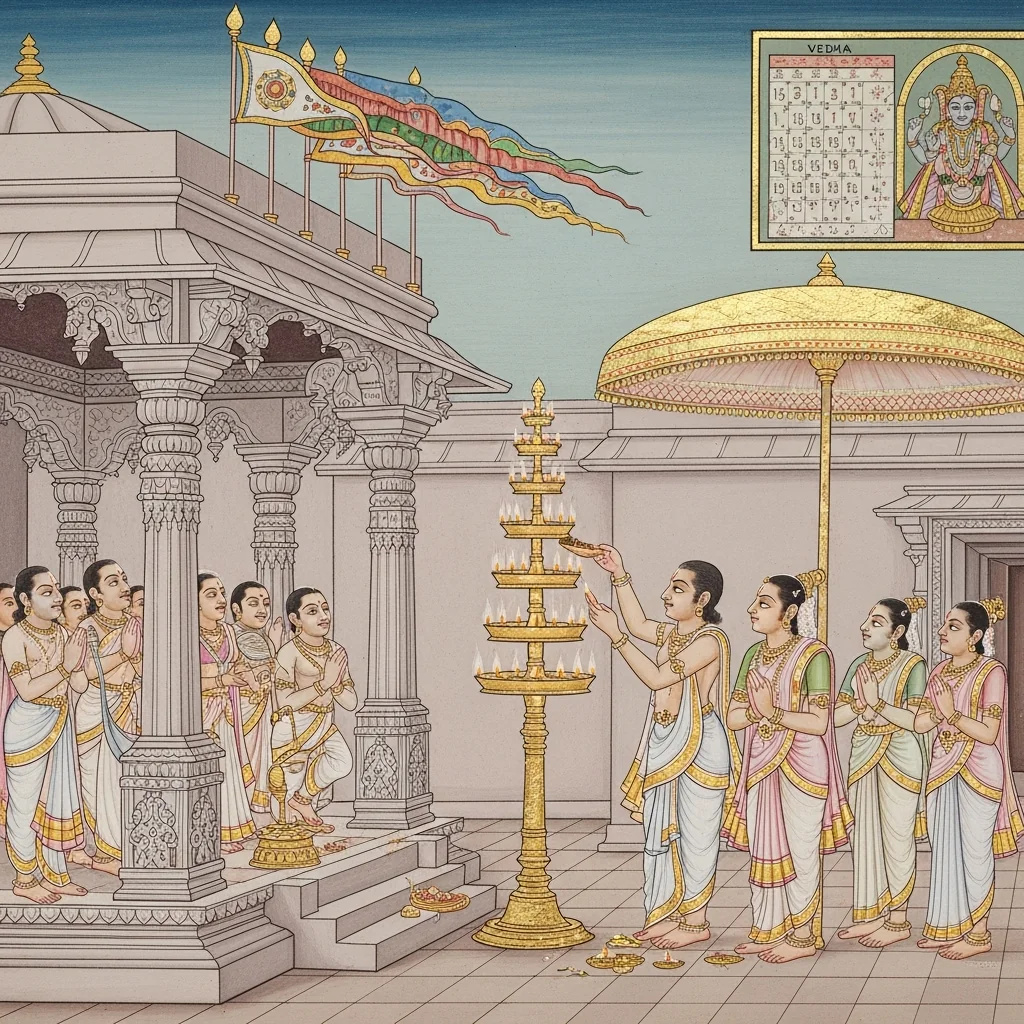
Adhyaya 23
Chapter 23 presents Mārkaṇḍeya’s teaching to King Indradyumna on Dvārakā’s exceptional ritual status and saving power in Kali-yuga. A comparative phalaśruti is set forth: even a brief stay, the mere intention to journey there, or a single day of Kṛṣṇa-darśana is praised as equal in merit to great pan-Indian tīrthas and long austerities. It then catalogs temple-centered sevā during Kṛṣṇa’s snāna: bathing with milk, curd, ghee, honey, and perfumed waters; wiping the Deity; garlanding; conch and music; recitation—especially the nāma-sahasra—along with singing, dancing, ārātrika, circumambulation, prostration, and offerings of lamps, naivedya, fruits, tāmbūla, and water vessels. Ornamental and constructional services are also commended: dhūpa, flags, maṇḍapas, painting, umbrellas, and fans. The third movement turns to an ethical-legal discourse on calendrical correctness, focusing on Dvādaśī and “vedha” defects, illustrated by Candraśarman’s dream of suffering ancestors. The chapter harmonizes pilgrimage claims: Somanātha-yātrā is completed by Kṛṣṇa-darśana at Dvārakā, and sectarian exclusivism is discouraged. It closes by extolling Gomati bathing, the efficacy of śrāddha/tarpaṇa, and tulasī devotion (mālā and leaves) as protective and purifying practices in Kali-yuga.
Shlokas
Verse 1
मार्कंडेय उवाच । द्वारकायाश्च माहात्म्यमिंद्रद्युम्न निबोध मे । कलौ निवसते यत्र क्लेशहा रुक्मिणीपतिः
Mārkaṇḍeya said: O Indradyumna, learn from me the greatness of Dvārakā—where, even in the age of Kali, dwells the remover of afflictions, the Lord of Rukmiṇī.
Verse 2
कलौ कृष्णस्य माहात्म्यं ये शृण्वंति पठंति च । न तेषां जायते वासो यमलोके युगाष्टकम्
In Kali-yuga, those who listen to and recite the greatness of Kṛṣṇa do not come to dwell in Yama’s realm—even for eight ages.
Verse 3
नित्यं कृष्णकथा यस्य प्राणादपि गरीयसी । न तस्य दुर्ल्लभं किंचिदिह लोके परं नृप
O king, for one to whom the sacred discourse of Kṛṣṇa is ever dearer even than life-breath itself, nothing is hard to obtain—neither in this world nor in the next.
Verse 4
मन्वंतरसहस्रैस्तु काशीवासेन यत्फलम् । तत्फलं द्वारकावासे वसतां पंचभिर्दिनैः
The merit gained by dwelling in Kāśī for thousands of Manvantaras—that very same merit is attained by those who dwell in Dvārakā for five days.
Verse 5
कलौ निवसते यस्तु श्वपचो द्वारकां यदि । यतीनां गतिमाप्नोति प्राह ह्येवं प्रजापतिः
Indeed, even in the Kali-yuga, if a dog-cooker (one of the lowest castes) dwells in Dvārakā, he attains the spiritual state of the yatis, the ascetics—so Prajāpati declared.
Verse 6
द्वारकां गंतुकामं यः प्रत्यहं कुरुते नरः । फलमाप्नोति मनुजः कुरुक्षेत्रसमुद्भवम्
Whoever, day after day, sincerely forms the intention to go to Dvārakā obtains the merit that arises from pilgrimage to Kurukṣetra.
Verse 7
सोमग्रहे च यत्प्रोक्तं यत्फलं सोमनायके । दृष्ट्वा तत्फलमाप्नोति द्वारवत्यां जनार्द्दनम्
And whatever fruit is proclaimed at the time of a Soma-eclipse, and whatever merit is spoken of at Somanātha—by beholding Janārdana in Dvāravatī, one attains that very fruit.
Verse 8
पुष्करे कार्त्तिकीं कृत्वा यत्फलं वर्षकोटिभिः । तत्फलं द्वारकावासे दिनेनैकेन जायते
Whatever merit is gained by observing the Kārtikī vow at Puṣkara for crores of years—that very merit arises from dwelling in Dvārakā for but a single day.
Verse 9
द्वारकायां दिनैकेन दृष्टे देवकिनंदने । फलं कोटिगुणं ज्ञेयमत्र लक्षशतोद्भवम्
By beholding Devakī’s Son in Dvārakā even within a single day, the fruit is to be known as multiplied a crore-fold, bringing forth hundreds of thousands of merits here.
Verse 10
कलौ निवसतां भूप धन्यास्तेषां मनोरथाः । कृष्णस्य दर्शने नित्यं द्वारकागमने मतिः
O king, blessed are the aspirations of those who live in the Kali age—whose minds are ever set on beholding Śrī Kṛṣṇa and on going to Dvārakā.
Verse 11
एकामपि द्वादशीं तु यः करोति नृपोत्तम । कृष्णस्य सन्निधौ भूप द्वारकायाः फलं शृणु
O best of kings, O ruler, listen to the fruit of Dvārakā: whoever observes even a single Dvādaśī in the presence of Śrī Kṛṣṇa gains its reward.
Verse 12
धन्यास्ते कृतकृत्यास्ते ते जना लोकपावनाः । दृष्टं कृष्णमुखं यैस्तु पापकोट्ययुतापहम्
Blessed indeed, fulfilled indeed, are those people—purifiers of the world—who have beheld Kṛṣṇa’s face, for it removes tens of millions of crores of sins.
Verse 13
यत्फलं व्रतसंयुक्तैर्वासरैः कृष्णसंयुतैः । यज्ञैर्दानैर्बृहद्भिश्च द्वारकायां तथैकया
Whatever fruit is gained through days joined with vows and devoted to Kṛṣṇa, and through great sacrifices and great gifts—so too is that fruit gained even by a single observance in Dvārakā.
Verse 14
क्षीरस्नानं प्रकुर्वंति ये नराः कृष्ण मूर्धनि । शताश्वमेधजं पुण्यं बिंदुना बिंदुना स्मृतम्
Those who perform a milk-bathing (abhiṣeka) upon Kṛṣṇa’s head—each drop is remembered as conferring the merit born of a hundred Aśvamedha sacrifices.
Verse 15
दधि क्षीराद्दशगुणं घृतं दध्नो दशोत्तरम् । घृताद्दशगुणं क्षौद्रं क्षौद्राद्दशगुणोत्तरम्
Curd yields ten times the merit of milk; ghee yields ten times more than curd; honey yields ten times the merit of ghee; and beyond honey it increases tenfold again.
Verse 16
पुष्पोदकं च रत्नोदं वर्द्धनं च दशोत्तरम् । मंत्रोदकं च गंधोदं तथैव नृपसत्तम
So too, O best of kings: flower-water and jewel-water, and ‘vardhana’ (enhancing) water are each tenfold superior; likewise mantra-consecrated water and fragrant water are praised.
Verse 17
इक्षो रसेन स्नपनं शतवाजिमखैः समम् । तथैव तीर्थनीरं स फलं यच्छति भूमिप
O king, bathing the Lord with sugarcane juice is equal to a hundred Aśvamedha sacrifices; likewise, bathing with water from a tīrtha bestows that very fruit.
Verse 18
कृष्णं स्नानार्द्रगात्रं च वस्त्रेण परिमार्जति । तस्य लक्षार्जितस्यापि भवेत्पापस्य मार्जनम्
Whoever wipes Śrī Kṛṣṇa’s body—still wet after bathing—with a cloth, for that person there arises the cleansing of sin, even of sin accumulated by the hundred-thousands.
Verse 19
स्नापयित्वा जगन्नाथं पुष्पमालावरोहणम् । कुरुते प्रतिपुष्पं तु स्वर्णनिष्कायुतं फलम्
Having bathed Jagannātha, the Lord of the universe, if one then places a garland of flowers upon Him, for each individual flower one obtains the fruit equal to a gold niṣka.
Verse 20
स्नानकाले तु देवस्य शंखादीनां तु वादनम् । कुरुते ब्रह्मलोके तु वसते ब्रह्मवासरम्
Whoever sounds the conch and other auspicious instruments at the time of the Lord’s bath-worship attains residence in Brahmā’s world, dwelling there for a ‘day of Brahmā’—a vast cosmic span.
Verse 21
स्नानकाले स कृष्णस्य पठेन्नामसहस्रकम् । प्रत्यक्षरं लभेत्प्रेष्टं कपिलागोशतोद्भवम्
If, at the time of bathing worship, one recites Kṛṣṇa’s thousand names, then for each syllable one gains a cherished reward—merit equal to the gift of a hundred tawny cows.
Verse 22
फलमेतन्महीपाल गीतायाः परिकीर्तितम् । गजेंद्रमोक्षणेनैवं स्तवराजेन कीर्त्तितम्
O king, this is the fruit that has been proclaimed for the sacred Gītā; likewise it is declared for the “Gajendra-mokṣaṇa” hymn, the king of stotras.
Verse 23
स्तवैरृषिकृतैरन्यैः पठितैश्च नराधिप । तोषमाप्नोति देवेशः सर्वान्कामान्प्रयच्छति
O king, when other hymns composed by sages are recited, the Lord of the gods is pleased and bestows all desired aims.
Verse 24
किं पुनर्वेदपाठं तु स्नानकाले करोति यः । तस्य यल्लभते पुण्यं न ज्ञातं नरनायक
How much more so for one who recites the Veda at the time of bathing worship! The merit he gains is beyond measure, O leader of men.
Verse 25
स्नान काले च संप्राप्ते कृष्णस्याग्रे तु नर्तनम् । गीतं चैव पुनस्तत्र स्तवनं वदनेन हि
When the time for bathing worship arrives, one should dance before Kṛṣṇa; there one should also sing, and again offer praise with one’s own voice.
Verse 26
स्नानकाले तु कृष्णस्य जयशब्दं करोति यः । करताल समायुक्तं गीतनृत्यं करोति च
Whoever, at the time of Kṛṣṇa’s bathing worship, raises cries of “Jaya!” and performs song and dance accompanied by rhythmic clapping, gains great merit.
Verse 27
तत्र चेष्टां प्रकुर्वाणो हसते जल्पतेऽपि वा । मुक्तं तेन परं मातुर्योनियंत्रस्य निर्गमम्
Even if, in that place, one makes gestures, laughs, or speaks, through such devotional participation he is freed from the bondage of repeatedly emerging from the mother’s womb—release from the compulsion of rebirth.
Verse 28
नोत्तानशायी भवति मातुरंके नरेश्वर । गुणान्पठति कृष्णस्य यः काले स्नानकर्मणः
O king, whoever recites the virtues of Kṛṣṇa at the time of the bathing rite will not again lie helpless in his mother’s lap—he will not return to infant-birth.
Verse 29
चंदनागुरुमिश्रेण कंकुमेन सुगंधिना । विलेपयति यः कृष्णं कर्पूरमृगनाभिना । कल्पं तु भवने विष्णोर्वसते पितृभिः सह
Whoever anoints Kṛṣṇa with fragrant sandal mixed with agaru, with perfumed saffron, and with camphor and musk, dwells for a full aeon in Viṣṇu’s abode, together with his ancestors.
Verse 30
प्रत्येकं चंदनादीनामिंद्रद्युम्न न चान्यथा । नानादेशसमुद्भूतैः सुवस्त्रैश्च सुकोमलैः
O Indradyumna—indeed it is so and not otherwise—each offering of sandalwood and the like, and the presentation of very soft, fine garments brought from many regions, becomes (in Dvārakā) a distinct act of worship laden with merit.
Verse 31
धूपयित्वा सुगंधैश्च यो धूपयति मानवः । मन्वंतराणि वसते तत्संख्यानि हरेर्गृहे
The person who offers fragrant incense to Hari, perfuming the Lord’s presence, dwells in Hari’s abode for as many Manvantaras as the number of such offerings.
Verse 32
स्वशक्त्या देवदेवेशं भूषणैर्भूषयंति च । हेमजैरतुलैः शुभ्रैर्मणिजैश्च सुशोभनैः
According to their means, they adorn the Lord of gods, Deva-deveśa, with ornaments—peerless golden adornments and radiant, splendid jewels.
Verse 33
तेषां फलं महाराज रुद्राश्च वासवादयः
O great king, even the Rudras and the Indras and the other gods know only in part the fruit of such worship.
Verse 34
जानंति मुनयो नैव वर्जयित्वा तु माधवम् । येऽर्चयंति जगन्नाथं कृष्णं कलिमलापहम् । केतकीतुलसीपत्रैः पुष्पैर्मालतिसंभवैः
Even the sages do not fully know it—save in relation to Mādhava—namely, the fruit of those who worship Jagannātha Kṛṣṇa, remover of Kali’s stain, with ketakī, tulasī leaves, and mālatī-born flowers.
Verse 35
तद्देशसंभवैश्चान्यैर्भूरिभिः कुसुमैर्नृप । एकैकं नृप शार्दूल राजसूयसमं स्मृतम्
O king, with many other abundant flowers born in that very region—each single offering, O tiger among kings, is remembered as equal to a Rājasūya sacrifice.
Verse 36
ये कुर्वंति नराः पूजां स्वशक्त्या रुक्मिणीपतेः । क्रीडंति विष्णुलोके ते मन्वतरशतं नराः
Those who perform worship, according to their means, of Rukmiṇī’s Lord, sport in Viṣṇu’s world for a hundred Manvantaras.
Verse 37
यः पुनस्तुलसीपत्रैः कोमलमंजरीयुतैः । पूजयेच्छ्रद्धया यस्तु कृष्णं देवकिनंदनम्
But whoever, with faith, worships Kṛṣṇa—the son of Devakī—using tulasī leaves bearing tender blossoms, attains the highest merit.
Verse 38
या गतिर्योगयुक्तानां या गतिर्योगशालिनाम् । या गतिर्दानशीलानां या गतिस्तीर्थसेविनाम्
Whatever destination is attained by those perfected in yoga, whatever destination by those firmly established in yoga; whatever destination by the charitable, and whatever destination by those who serve the tīrthas—
Verse 39
या गतिर्मातृभक्तानां द्वादशीं वेधवर्जिताम् । कुर्वतां जागरं विष्णोर्नृत्यतां गायतां फलम्
—and whatever destination belongs to those devoted to their mothers; and the meritorious fruit of those who, on an unpierced (astronomically proper) Dvādaśī, keep vigil for Viṣṇu, dancing and singing in devotion.
Verse 40
वैष्णवानां तु भक्तानां यत्फलं वेदवादिनाम् । पठतां वैष्णवं शास्त्रं वैष्णवानां तु यच्छताम्
O king, the fruit belonging to devoted Vaiṣṇavas is the same as that gained by those who expound the Vedas—by those who recite and study the Vaiṣṇava scriptures, and by those who bestow gifts upon Vaiṣṇavas.
Verse 41
तुलसीमालया कृष्णः पूजितो रुक्मिणी पतिः । फलमेतन्महीपाल यच्छते नात्र सशयः
When Kṛṣṇa, the lord of Rukmiṇī, is worshipped with a garland of tulasī, He bestows this fruit, O ruler of the earth—of this there is no doubt.
Verse 42
यथा लक्ष्मीः प्रिया विष्णोस्तुलसी च ततोऽधिका । द्वारकायां समुत्पन्ना विशेषेण फलाधिका
Just as Lakṣmī is dear to Viṣṇu, so tulasī is dearer still than she. And tulasī that has arisen in Dvārakā is, in a special way, superior in the fruit it grants.
Verse 43
यत्र तत्र स्थितो विष्णुस्तुलसीदलमालया । पूजितो द्वारकातुल्यं पुण्यं स यच्छते कलौ
Wherever Viṣṇu may abide, if He is worshipped with a garland of tulasī leaves, He bestows merit equal to that of Dvārakā—even in the Kali age.
Verse 44
योऽर्चयेत्केतकीपत्रैः कृष्णं कलिमलापहम् । पत्रेपत्रेऽश्वमेधस्यफलं यच्छति भूभुज
O king, whoever worships Kṛṣṇa—the remover of Kali’s defilement—with ketakī leaves: with each leaf offered, He grants the fruit of an Aśvamedha sacrifice.
Verse 45
योऽर्चयेन्मालतीपुष्पैः कृष्णं त्रिभुवनेश्वरम् । तेनाप्तं नास्ति संदेहो यत्फलं दुर्लभं हरेः
Whoever worships Kṛṣṇa, the Lord of the three worlds, with mālatī flowers—by that worship he surely attains that fruit of Hari which is otherwise difficult to obtain.
Verse 46
ऋतुकालोद्भवैः पुष्पैर्योऽर्चयेद्रुक्मिणीपतिम् । सर्वान्कामानवाप्नोति दुर्लभान्देवमानुषैः
Whoever worships the lord of Rukmiṇī with flowers that arise in their proper season attains all desired aims—even those difficult to gain for gods and humans.
Verse 47
कृष्णेनागुरुणा कृष्णं धूपयंति कलौ युगे । सकर्पूरेण राजेन्द्र कृष्णतुल्या भवंति ते
O lord of kings, in the Kali age, those who incense Kṛṣṇa with dark aguru together with camphor become equal to Kṛṣṇa in divine splendor and blessedness.
Verse 48
साज्येन गुग्गुलेनापि सुगंधेन जनार्द्दनम् । धूपयित्वा नरो याति पदं भूयः सदा शिवम्
Even with fragrant guggulu mixed with ghee, if a man offers incense to Janārdana, he attains the ever-auspicious supreme abode and never returns again.
Verse 49
यो ददाति महीपाल कृष्णस्याग्रे तु दीपकम् । पातकं तु समुत्सृज्य ज्योतीरूपं लभेत्पदम्
O king, whoever places a lamp before Kṛṣṇa casts off sin and attains the supreme state that is radiant, formed of light.
Verse 50
द्वारे कृष्णस्य यो नित्यं दीपमालां करोति हि । सप्तद्वीपवतीराज्यं द्वीपेद्वीपे फलं लभेत्
Whoever daily arranges a garland-row of lamps at the doorway of Śrī Kṛṣṇa gains the fruit of sovereignty over the “seven continents”; in each realm he receives its due reward.
Verse 51
नैवेद्यानि मनोज्ञानि कृष्णाय विनिवेदयेत् । कल्पांतं तत्पितॄणां हि तृप्तिर्भवति शाश्वती
One should offer pleasing naivedya—food-offerings—to Kṛṣṇa; by this, until the end of the age, perpetual satisfaction comes to his pitṛs, the ancestral spirits.
Verse 52
फलानि यच्छते यो वै सुहृद्यानि नरेश्वर । जायंते तस्य कल्पांतं सफलास्तु मनोरथाः
O lord of men, whoever offers choice fruits in devotion finds his heartfelt wishes arise fulfilled, bearing fruit until the end of the age.
Verse 53
तांबूलं तु सकर्पूरं सपूगं नरनायक । कृष्णाय यच्छते यो वै पदं तस्याग्निदैवतम्
O leader of men, whoever offers Kṛṣṇa tāmbūla—betel prepared with camphor and areca-nut—attains a state associated with the Fire-deity, Agni.
Verse 54
सनीरं कर्पुरोपेतं कुंभं कृष्णाग्रतो न्यसेत् । कल्पांते न जलापेक्षां कुर्वंति च पितामहाः
One should place before Kṛṣṇa a water-filled pot, scented with camphor; then, until the end of the age, his forefathers will not suffer want of water.
Verse 56
तत्कुले नास्ति पापिष्ठो न च लोके यमस्य च । वायुलोकान्महीपाल न पुनर्विद्यते गतिः
In that family there is no most-sinful one, nor does anyone go to Yama’s realm. O king, from the world of Vāyu there is no return journey to mortal rebirth.
Verse 57
कृष्णवेश्मनि यः कुर्य्यात्सधूपं पुष्पमंडपम् । सपुष्पकविमानैस्तु क्रीडते कोटिभिर्द्दिवि
Whoever, in Kṛṣṇa’s residence, makes a flower-pavilion accompanied by incense, plays in heaven amid crores of celestial aerial cars adorned with flowers.
Verse 58
चलच्चामरवातेन कृष्णं यस्तोषयेन्नरः । तस्योत्तमांगं देवेशश्चुंबते स्वमुखेन हि
That person who pleases Kṛṣṇa by fanning him with a moving cāmara (yak-tail fan)—the Lord of the gods himself kisses that devotee’s head with his own mouth.
Verse 59
व्यजनेनाथ वस्त्रेण सुभक्त्या मातरिश्वना । देवदेवस्य राजेन्द्र कुरुते धर्मवारणम्
O king, when a fan and a cloth are offered with true devotion, Mātariśvan (Vāyu) fashions a “shield of dharma” for the God of gods.
Verse 60
धूपं चंदनमालां तु कुरुते कृष्णसद्मनि । देवकन्यायुतैर्लक्षैः सेव्यते सुरनायकैः
Whoever offers incense and a sandal-fragrant garland in Kṛṣṇa’s abode is attended by the chiefs of the gods, along with hundreds of thousands of celestial maidens.
Verse 61
ध्वजमारोपयेद्यस्तु प्रासादोपरि भक्तितः । तस्य ब्रह्मपदे वासः क्रीडते ब्रह्मणा सह
Whoever, with devotion, raises a flag atop the Lord’s temple-palace attains a dwelling in Brahmā’s realm and sports there in Brahmā’s company.
Verse 62
प्रांगणं वर्णकोपेतं स्वस्तिकैश्च समन्वितैः । देवदेवस्य कुरुते क्रीडते भुवनत्रये
Whoever decorates the courtyard with colored designs, adorned with auspicious svastika symbols for the God of gods, delights and sports throughout the three worlds.
Verse 63
यो दद्यान्मण्डपे पुष्पप्रकरं रुक्मिणीपतेः । देवोद्यानेषु सर्वेषु क्रीडते नरनायकैः
Whoever offers a heap of flowers in the pavilion to Rukmiṇī’s Lord sports in all the divine gardens, in the company of noble leaders among men.
Verse 64
प्रासादे देवदेवस्य चित्रकर्म करोति यः । वसते रुद्रलोके तु यावत्तिष्ठंति सागराः
Whoever performs decorative artistry in the temple of the God of gods dwells in Rudra’s world for as long as the oceans endure.
Verse 65
दद्याच्चन्द्रमयं यस्तु कृष्णोपरि नरेश्वर । वसते द्वारकां यावत्सोमलोके स तिष्ठति
O king, whoever offers a moon-like ornament (a lunar emblem) upon Kṛṣṇa—so long as Dvārakā endures, he abides in Soma’s world.
Verse 66
छत्रं बहुशलाकं तु किंकिणीवस्रगुण्ठितम् । दिव्यरत्नैश्च संयुक्तं हेमदण्डसमन्वितम्
A ceremonial parasol with many ribs, wrapped with cloth and little bells, set with divine jewels, and fitted with a golden staff—
Verse 67
समर्पयति कृष्णाय च्छत्रं लक्षार्बुदैर्वृतम् । अमरैः सहितः सर्वैः क्रीडते पितृभिः सह
He who presents that parasol to Kṛṣṇa—surrounded by vast multitudes—sports with all the immortals, and also together with the Pitṛs (ancestors).
Verse 68
दद्यान्नरविमानं तु कृष्णाय नरनायक । सत्कृतो धनदेनैव वसते ब्रह्मवासरम्
O leader of men, whoever donates a splendid vimāna-like conveyance to Kṛṣṇa—honored by Kubera himself—dwells for a ‘day of Brahmā’.
Verse 69
कृता पूजा दिकं भूप ज्वलंतं कृष्णमूर्द्धनि । आरार्तिकं प्रकुर्वाणो मोदते कृष्णसन्निधौ
O king, having completed worship, one who offers ārati with a blazing lamp before the countenance of Śrī Kṛṣṇa rejoices in Kṛṣṇa’s very presence.
Verse 70
दीप्तिमंतं सकर्पूरं करोत्यारार्तिकं नृप । कृष्णस्य वसते लोके सप्तकल्पानि मानवः
O king, the man who performs a radiant ārati with camphor dwells in Kṛṣṇa’s world for seven kalpas.
Verse 71
धृत्वा शंखोदकं यस्तु भ्रामयेत्केशवोपरि । संनिधौ वसते विष्णोः कल्पांतं क्षीरसागरे
Whoever takes water sanctified in a conch and circles it over Keśava (Śrī Kṛṣṇa) dwells in Viṣṇu’s immediate presence until the end of the aeon, in the Ocean of Milk.
Verse 72
एवं कृत्वा तु कृप्णस्य यः करोति प्रदक्षिणाम् । पठन्नामसहस्रं तु स्तवमन्यं पठन्नृप । सप्तद्वीपवतीपुण्यं लभते तु पदेपदे
Having done thus, O king, whoever circumambulates Kṛṣṇa—reciting the Thousand Names or chanting other hymns—gains at every step merit equal to that of the entire seven-continent world.
Verse 73
कुर्य्याद्दण्डनमस्कारमश्वमेधायुतैः समम् । कृष्णं संतोषयेद्यस्तु सुगीतैर्मधुरैः स्वरैः । सामवेदफलं तस्य जायते नात्र संशयः
A full prostration (daṇḍa-namaskāra) is equal in merit to ten thousand Aśvamedha sacrifices. And whoever pleases Kṛṣṇa with well-sung, sweet-toned songs attains the fruit of the Sāma Veda—of this there is no doubt.
Verse 74
यो नृत्यति प्रहृष्टात्मा भावैर्बहु सुभक्तितः । स निर्द्दहति पापानि मन्वंतरकृतान्यपि
Whoever dances with a gladdened heart, filled with many moods of pure devotion, burns away sins—even those wrought across the manvantaras.
Verse 75
यः कृष्णाग्रे महाभक्त्या कुर्य्यात्पुस्तकवाचनम् । प्रत्यक्षरं लभेत्पुण्यं कपिलाशतदानजम्
Whoever, with great devotion, recites the sacred text before Kṛṣṇa gains, for each syllable, manifest merit equal to the gift of a hundred tawny cows.
Verse 76
ऋग्यजुःसामभिर्वाग्भिः कृष्णं संतोषयंति ये । कल्पांतं ब्रह्मलोके तु ते वसंति द्विजोत्तमाः
Those excellent twice-born who delight Kṛṣṇa with utterances from the Ṛg, Yajus, and Sāma Vedas dwell in Brahmaloka until the end of the kalpa.
Verse 77
योगशास्त्राणि वेदांता न्पुराणं कृष्णसन्निधौ । पठंति रविबिंबं ते भित्त्वा यांति हरेर्लयम्
Those who read the Yoga-śāstras, the Vedāntas, and the Purāṇas in Kṛṣṇa’s presence pierce beyond the orb of the sun and attain absorption in Hari.
Verse 78
गीता नामसहस्रं तु स्तवराजो ह्यनुस्मृतिः । गजेन्द्रमोक्षणं चैव कृष्णस्यातीव वल्लभम्
The Gītā, the Thousand Names, the Stavarāja—the King of Hymns—remembrance (anusmṛti), and the account of Gajendra’s liberation: these are exceedingly dear to Kṛṣṇa.
Verse 79
श्रीमद्रागवतं यस्तु पठते कृष्णसन्निधौ । कुलकोटिशतैर्युक्तः क्रीडते योगिभिः सदा
Whoever recites the Śrīmad Bhāgavata in the very presence of Kṛṣṇa, accompanied by hundreds of crores of his lineage, ever sports in the sacred company of the yogins.
Verse 80
यः पठेद्रामचरितं भारतं व्यासभाषितम् । पुराणानि महीपाल प्राप्तो मुक्तिं न संशयः
O ruler of the earth, whoever recites the Rāma-carita, the Bhārata spoken by Vyāsa, and the Purāṇas attains liberation (mokṣa)—of this there is no doubt.
Verse 81
द्वादशीवासरे प्राप्त एवं कुर्वंति ये नराः । गीताद्यैः शतसाहस्रं पुण्यं यच्छति केशवः
When Dvādaśī (the twelfth lunar day) arrives, those who act in this way—through devotional deeds such as sacred singing—Keśava bestows upon them merit a hundred-thousandfold.
Verse 82
जागरे कोटिगुणितं पुण्यं भवति भूभिप । वसतां द्वारकावासात्प्रत्यहं लभते फलम्
O king, by keeping vigil (jāgara) the merit becomes multiplied a crore-fold. And those who dwell in Dvārakā obtain the fruit day after day simply by residing there.
Verse 83
गोमतीनीरपूतानां कृष्णवक्त्रावलोकि नाम् । दर्शनात्पातकं तेषां याति वर्षशतार्जितम्
For those purified by the waters of the Gomati and blessed with the sight of Kṛṣṇa’s face, by that very darśana their sins accumulated over a hundred years depart.
Verse 84
धन्यास्ते मानुषे लोके गोमत्युदधिवारिणा । तर्पयंति पितॄन्देवान्गत्वा द्वारवतीं कलौ
Blessed indeed in the human world are those who, in the Kali age, go to Dvāravatī and with the waters of the Gomati and the ocean perform tarpaṇa, satisfying the Pitṛs and the Devas.
Verse 85
गंगाद्वारे प्रयागे च गंगायां कुरुजांगले । प्रभासे शुक्लतीर्थे च श्रीस्थले पुष्करेऽपि च
At Gaṅgādvāra, at Prayāga, on the Gaṅgā in Kurujāṅgala, at Prabhāsa, at Śukla-tīrtha, at Śrī-sthala, and also at Puṣkara—
Verse 86
स्नानेन पिंडदानेन पितॄणां तर्पणे कृते । तृप्तिर्भवति भूपाल तथा गोमतिदर्शनात्
By bathing, by offering piṇḍas, and by performing tarpaṇa for the Pitṛs, satisfaction arises, O king; likewise, satisfaction is attained even by the darśana of the Gomati.
Verse 87
योजनैर्बहुभिस्तिष्ठन्गोमतीति च यो वदेत् । चांद्रायणसहस्रस्य फलमाप्नोति यत्नतः
Even while standing many yojanas away, whoever utters “Gomati” attains, through earnest effort, the fruit of a thousand Cāndrāyaṇa observances.
Verse 88
धन्या द्वारवती लोके वहते यत्र गोमती । स्वयं तु तिष्ठते यत्र नित्यं रुक्मिणिवल्लभः
Blessed is Dvāravatī in the world, where the Gomati flows—and where the beloved of Rukmiṇī Himself abides forever.
Verse 89
न स्नाता गोमतीतीरे कलौ पापेन मोहिताः । भविष्यति कथं तेषां पापबंधस्य संक्षयः
In the Kali age, those deluded by sin who do not bathe upon the banks of the Gomati—how shall the bondage of their sins ever be brought to an end?
Verse 90
निर्मिता स्वर्गनिःश्रेणी कलौ कृष्णेन गोमती । मनसः प्रीतिजननी जंतूनां नरसत्तम
O best of men, in the Kali age Kṛṣṇa fashioned the Gomati as a ladder leading to heaven; she begets joy within the hearts of living beings.
Verse 91
न दृश्यं स्वर्गसोपानं दृश्यते गोमतीसमम् । सुखदं पापिनां पुंसां स्नानमात्रेण मोक्षदम्
Nothing in the world is seen equal to the Gomati—like the very stairway to heaven. She grants happiness even to sinful men, and by bathing alone bestows liberation.
Verse 92
गोमतीनीरसंयुक्तो यत्र गर्जति सागरः । तत्र गच्छेन्नरव्याघ्र कृष्णस्तिष्ठति यत्र वै
Where the ocean roars, mingled with the waters of the Gomati—go there, O tiger among men; for there indeed is the place where Kṛṣṇa abides.
Verse 93
यत्र चक्रांकितशिला गोमत्युदधिनिःसृताः । यच्छंति पूजिता मोक्षं तां पुरीं को न सेवते
Where the stones marked with the discus—arisen from the Gomati and the ocean—when worshipped, bestow liberation: who would not resort to and revere that city?
Verse 94
यत्र चक्रांकिता मृत्स्ना तिष्ठते निर्मला नृप । कलौ पापविनाशार्थं तां पुरीं को न सेवते
Where pure earth, marked with the sacred discus, abides, O king—especially in the Kali age for the destruction of sins—who would not resort to that city?
Verse 95
अप्रदृश्या पुरा लोके दैत्यदानवरक्षसाम् । शरण्या देवतादीनां पुरीं तां को न सेवते
Formerly unseen and inaccessible in the world to Daityas, Dānavas, and Rākṣasas—yet a refuge even for the gods and others—who would not resort to that city?
Verse 96
त्यजते यां कलौ नैव कृष्णो देवकिनन्दनः । कर्मणा मनसा वाचा तां पुरीं को न सेवते
That city which Kṛṣṇa, Devakī’s son, does not abandon even in the Kali age—who would not honor and resort to it by deed, by mind, and by speech?
Verse 97
मार्कंडेय उवाच । शृणु राजन्प्रवक्ष्यामि कथां पापप्रणाशिनीम् । यां श्रुत्वा मुच्यते नूनं दुःखसंसार बंधनात्
Mārkaṇḍeya said: Listen, O king; I shall tell a sin-destroying account—hearing which one is surely released from the bondage of sorrowful worldly existence.
Verse 98
अवन्तीविषये पूर्वं ब्राह्मणो वेदपारगः । चंद्रशर्मेति विख्यातः शिवभक्तः सदा नृप
Formerly, in the region of Avantī, there lived a brāhmaṇa, master of the Vedas, renowned as Candraśarman—ever a devotee of Śiva, O king.
Verse 99
मनसा कर्मणा वाचा नान्यं ध्याति सदाशिवात् । शैवाद्व्रताद्व्रतं नान्यत्करोति च नराधिप
By mind, by deed, and by speech, he contemplated none other than Sadāśiva; and apart from Śaiva observances, he undertook no other vow, O lord of men.
Verse 100
नोपवासं हरिदिने कुरुते न व्रतं हरेः । विना चतुर्दशीं राजन्नान्यदेवसमुद्भवम्
He did not observe fasting on Hari’s day, nor did he undertake vows for Hari—except on the fourteenth lunar day (caturdaśī), O king; he followed no observance arising from other deities.
Verse 101
यत्रयत्र शिवक्षेत्रं यत्र तीर्थं तु शांकरम् । तत्र गच्छति राजेन्द्र वैष्णवं नैव गच्छति
O king, wherever there is a sacred domain of Śiva—wherever there is a Śaṅkara-tīrtha—there he goes; he does not go to the Vaiṣṇava holy places.
Verse 102
प्रतिवर्षं तु कुरुते सोमनाथस्य दर्शनम् । न जहाति विशेषेण सोमपर्व नरेश्वर
Each year he undertakes the auspicious darśana of Somanātha; and especially, O king, he never neglects the Soma-festival day.
Verse 103
एवं प्रकुर्वतस्तस्य वर्षाणि नवसप्ततिः । गतानि किल राजेन्द्र शिवभक्तिं प्रकुर्वतः
Thus, O best of kings, as he continued in this way—practising devotion to Śiva—seventy-nine years are said to have passed.
Verse 104
कदाचित्सोमपर्वण्यागते सोमोपनायकम् । नानादेशान्महीपाल ह्यसंख्याताश्च मानवाः
Once, when the day of the Soma festival arrived, O king, countless people came from many lands, bearing offerings for Soma’s sacred rite.
Verse 105
गताः कृष्णपुरीं सर्वे दृष्ट्वा सोमेश्वरं प्रभुम् । आहूतस्तैश्चंद्रशर्मा न गतो द्वारकां पुरीम्
All of them went to Kṛṣṇapurī and, having beheld Lord Someśvara, they invited Candraśarman; yet he did not go to the city of Dvārakā.
Verse 106
शिवक्षेत्रात्परं तीर्थं नाहं मन्ये जग त्त्रये । नान्यदेवो मया ज्ञात ईश्वराद्देवनायकात्
In the three worlds I deem no pilgrimage-place higher than a Śiva-kṣetra; nor do I acknowledge any god other than Īśvara, the leader of the gods.
Verse 108
विनाऽन्ये चंद्रशर्माणं गतास्ते द्वारकां पुरीम् । अन्यस्मिन्दिवसे राजन्गच्छतः स्वगृहं प्रति । चक्रुस्ते दर्शनं स्वप्ने चंद्रशर्मपितामहाः
Leaving Candraśarman behind, the others went to the city of Dvārakā. On another day, O king, as he was going toward his own home, Candraśarman’s forefathers appeared to him in a dream.
Verse 109
प्रेतभूता महाकायाः क्षुत्क्षामाश्चैव भीषणाः । दृष्ट्वा स्वप्नं महा रौद्रं भीतोऽसौ च प्रकंपितः
They were like preta-spirits—huge-bodied, famine-stricken, and terrifying. Seeing that exceedingly dreadful dream, he became afraid and trembled.
Verse 110
चन्द्रशर्मोवाच । के यूयं विकृताकारा जंतूनां च भयानकाः । पृथ्वीसमुद्भवा जीवा न दृष्टा न श्रुता मया
Candraśarman said: “Who are you, of distorted forms, terrifying to living beings? You seem like creatures born of the earth—yet I have neither seen nor heard of you before.”
Verse 111
प्रेता ऊचुः । मा भयं कुरु विप्रेंद्र तव पूर्वपितामहाः । आगतास्त्वत्समीपे तु महादुःखेन पीडिताः
The pretas said: “Do not be afraid, O best of brāhmaṇas. We are your earlier forefathers; we have come near you, afflicted by great sorrow.”
Verse 112
चन्द्रशर्मोवाच । इष्टं दत्तं तपस्तप्तं भवद्भिर्मत्पितामहैः । प्रेतत्वे कारणं यत्स्याद्भवतां विस्मयो मम
Candraśarman said: “My grandfathers—you yourselves—performed sacrifices, gave gifts, and practiced austerities. How then did the cause arise by which you fell into the state of pretas? This is a wonder to me.”
Verse 113
प्रेता ऊचुः । शृणु पुत्र प्रवक्ष्यामः प्रेतयोनेस्तु कारणम् । वासरं वासुदेवस्य सदा विद्धं कृतं पुरा
The pretas said: “Listen, dear son; we shall explain the cause of our birth as pretas. Formerly, we repeatedly committed the offence of ‘piercing’ (violating) the sacred day of Vāsudeva.”
Verse 114
प्रेतत्वं तेन संप्राप्तमस्माभिः शृणु पुत्रक । विशेषेण कृतं रात्रौ विद्धं जागरणं हरेः
“Thus we came to the state of pretas—listen, dear child. In particular, we committed the offence by improperly ‘piercing’ (spoiling) the night-vigil (jāgaraṇa) meant for Hari.”
Verse 115
पतनं नरके घोरे भविष्यति न संशयः । त्वया सह न संदेहो यावदाभूतसंप्लवम्
There will be a fall into a dreadful hell—of this there is no doubt; and with you, without uncertainty, it will endure until the great dissolution of beings.
Verse 116
चन्द्रशर्मोवाच । हरिभक्तिविहीनानां द्वादशीव्रतवर्जिनाम् । नाशं न याति प्रेतत्वं पूजितैः शंकरादिभिः
Candraśarman said: “For those devoid of devotion to Hari and who abandon the Dvādaśī vow, preta-hood is not destroyed—even if they worship Śaṅkara and other deities.”
Verse 117
न वा सन्तोषितो देवो भक्त्या त्रिपुरनाशनः । प्रदास्यति गतिं नूनं प्रेतत्वं न गमिष्यति
Nor, if the god Tripuranāśana (Śiva) is not truly satisfied through devotion, will he surely grant the saving path; thus preta-hood will not come to an end.
Verse 118
प्रेता ऊचुः । प्रायश्चित्तं विना पुत्र द्वादशीवेधसंभवम् । आपन्न गच्छते नूनं प्रेतत्वं नैव गच्छति
The pretas said: “O son, without prāyaścitta—expiation for the offence arising from violating Dvādaśī—one surely falls into calamity; preta-hood does not depart at all.”
Verse 119
प्रायश्चित्ती सदा पुत्र पूजयानोऽपि शंकरम् । विना केशवपूजाभिः पापं भजति गोवधम्
O son, even one who constantly performs expiation and even worships Śaṅkara—if he does so without worship of Keśava—incurs sin comparable to cow-slaughter.
Verse 120
प्रथमं केशवः पूज्यः पश्चाद्देवो महेश्वरः । पूजनीयाश्च भक्त्या वै याश्चान्याः संति देवताः
First Keśava is to be worshipped; thereafter the god Maheśvara. And with devotion, the other deities that exist are also to be worshipped.
Verse 121
मूलाच्छाखाः प्रशाखाश्च भवंति बहुशस्ततः । वासुदेवात्समुद्भूतं जगदेतच्चराचरम्
From a single root arise many branches and sub-branches; likewise, from Vāsudeva has arisen this entire universe of moving and unmoving beings.
Verse 122
तस्मान्मूलं परित्यज्य शाखां नैवार्चयेद्बुधः । विशेषेण जगन्नाथं त्रैलोक्याधिपतिं हरिम्
Therefore, a wise person should never abandon the root and worship only a branch—especially when worshipping Jagannātha Hari, the Lord of the three worlds.
Verse 123
तद्दिने ये प्रकुर्वंति सम्यग्वेधेन शोभितम् । सशल्यं तन्न संदेहः प्रेतत्वं याति तेन च
Those who, on that very day, perform the rite as though “properly marked,” yet tainted by an improper vedha (overlap)—truly, that act is “with a thorn”; without doubt, by it they fall into the state of a preta, a restless spirit.
Verse 124
हव्यं देवा न गृह्णन्ति कव्यं च पितरस्तथा । पूजां गृह्णाति नो सूर्यस्तथा चैव पितामहाः
The gods do not accept the havya-offering, and likewise the ancestors do not accept the kavya-offering; at that time even the Sun does not accept worship—nor do the forefathers (pitāmahas).
Verse 125
प्रेतास्ते ये प्रकुर्वंति सशल्यं वासरं हरेः । पौर्णमासीद्वये प्राप्ते राका साग्निविवर्जिता
They become pretas—those who, on Hari’s sacred day, perform a rite tainted with “thorns” (saśalya). When two full-moon observances coincide, the Rākā full moon is to be kept without the sacred fire, as prescribed.
Verse 126
विशेषेण तु वैशाखी श्राद्धादीनां प्रशस्यते । वैशाखे तु तृतीयां वै पूर्वविद्धां करोति यः
In particular, the month of Vaiśākha is praised for śrāddha and related rites. But whoever in Vaiśākha performs the tṛtīyā (third lunar day) as “pūrva-viddhā” (overlapped by the previous day) acts wrongly.
Verse 127
हव्यं देवा न गृह्णंति कव्यं चैव पितामहाः । यत्र देवा न गृह्णंति कथं तत्र पितामहाः । तस्मात्कार्य्या तृतीया च पूर्वविद्धा बुधैर्नरैः
The gods do not accept havya, and the forefathers do not accept kavya. Where the gods do not accept, how could the forefathers accept there? Therefore the wise should perform the tṛtīyā according to the pūrva-viddhā rule, as prescribed.
Verse 128
कुर्वते यदि मोहाद्वा प्रेतत्वं शाश्वतं ततः । नापयाति कृतैः पुण्यैर्बहुशस्तीर्थसेवनैः
If, out of delusion, one performs it wrongly, then from that arises enduring preta-hood; it is not easily removed even by accumulated merit and repeated service at many tīrthas.
Verse 129
दशमीं पौर्णमासीं च पित्रोः सांवत्सरं दिनम् । पूर्वविद्धं प्रकुर्वाणो नरकं प्रतिपद्यते
Whoever performs the Daśamī, the Paurṇamāsī, and the annual ancestral day (sāṃvatsarika) as pūrva-viddha—in the improper overlap mode—falls into hell.
Verse 130
दर्शश्च पौर्णमासी च साग्निकैः पूर्वसंयुता । नाग्निहीनैस्तु कर्त्तव्या पुनराह प्रजापतिः
For those who maintain the sacred fires, the Darśa and Paurṇamāsī rites are to be performed in accord with the earlier (pūrva) timing, together with the fire; but for those without fires, they are to be performed in another manner—thus Prajāpati again declared.
Verse 131
क्षयाहे तु पुनः प्रोक्ता स्वकालव्यापिनी तिथिः । श्राद्धं तत्र प्रकर्तव्यं ह्रासवृद्धी न कारणम्
On a day of tithi-loss (kṣaya), it is again taught that the tithi which pervades its own proper time is to be taken. The śrāddha should be performed then; apparent decrease or increase in the tithi’s extent is no reason to refrain.
Verse 132
तत्रोक्तं मनुना पुत्र वेदांतैर्भाष्यकारिभिः । तत्प्रमाणं प्रकर्तव्यं प्रेतत्वं भवतोऽन्यथा
My son, what has been taught there by Manu, and likewise by the Vedānta authorities and the great commentators, must be accepted as the standard and put into practice; otherwise, the state of being a preta (a restless departed spirit) will befall you.
Verse 133
एतै प्रकारैः प्रेतत्वं प्राणिनां जायते भुवि । निरीक्ष्य धर्मशास्त्राणि कार्य्यं विहितमात्मनः
In these ways, the condition of being a preta arises for living beings on earth. Therefore, having examined the Dharma-śāstras, one should perform what is enjoined for one’s own welfare.
Verse 134
प्रणम्य सोमनाथं तु यात्रां कृत्वा न गच्छति । कृष्णस्य दर्शनार्थाय तस्य किं जायते फलम्
If a person bows to Somanātha and undertakes the pilgrimage, yet does not go onward to behold Kṛṣṇa in darśana—what fruit, then, does he obtain?
Verse 135
कथ्यते परमा मूर्तिर्हरिरीश्वरसं संस्थिता । विभेदो नात्र कर्तव्यो यथा शंभुस्तथा हरिः
It is proclaimed that the Supreme Form—Hari (Viṣṇu)—is established in oneness with Īśvara. No distinction is to be made here: as Śambhu (Śiva) is, so too is Hari.
Verse 136
कृष्णस्य सोमनाथस्य नांतरं दृश्यते क्वचित् । यात्रा श्रीसोमनाथस्य संपूर्णा कृष्णदर्शनात्
Between Kṛṣṇa and Somanātha no difference is seen anywhere. The pilgrimage to Śrī Somanātha is made complete through the sacred vision (darśana) of Kṛṣṇa.
Verse 137
तस्मादुभयतः पुत्र गन्तव्यं नात्र संशयः । दृष्ट्वा सोमेश्वरं देवं गंतव्यं द्वारकां प्रति
Therefore, my son, one must go to both—there is no doubt. Having beheld the god Someśvara, one should proceed toward Dvārakā.
Verse 138
प्रभासे सोमनाथस्य लिंगमध्ये व्यवस्थितः । स्वयं तिष्ठति पुण्यात्मा भोगं गृह्णाति केशवः
At Prabhāsa, within the very midst of Somanātha’s liṅga, the holy-souled Keśava himself abides, personally receiving the offerings made there.
Verse 139
दृष्ट्वा सोमेश्वरं देवं द्वारकां न नरो गतः । पतनं नरके घोरे पितॄणां च भविष्यति
If a man beholds the god Someśvara yet does not go to Dvārakā, it is said that a grievous fall into a dreadful hell will occur—and even for his forefathers as well.
Verse 140
विशेषेण त्वया वत्स न कृतं द्वादशीव्रतम् । व्रतं कृतं यदस्माभिस्तत्कृतं वेधसंयुतम् । निर्गमं यमलोकाद्धि तदस्माकं न दृश्यते
Especially, dear child, you did not observe the Dvādaśī vow. The vow that we observed was performed with a blemish still clinging to it; therefore, for us no release from Yama’s realm is to be seen.
Verse 141
चन्द्रशर्मोवाच । यदि तात मयाऽज्ञानान्न कृतं द्वादशीव्रतम् । कस्मात्कृतं सशल्यं तु भवद्भिर्द्वादशीव्रतम्
Candraśarman said: “Father, if through ignorance I did not observe the Dvādaśī vow, then why did you observe the Dvādaśī vow with a ‘thorn’—that is, with a blemish upon it?”
Verse 142
प्रेता ऊचुः । कुविप्रैस्तु कुदैवज्ञैः शुक्रमायाविमोहितैः । पारुष्यताहेतुकैश्च प्रेतयोनिमिमां गताः
The Pretas said: “Deluded by wicked Brahmins and corrupt astrologers—bewitched by the glamour of wealth and deceit—and driven by harshness and cruelty, we have fallen into this state of being Pretas.”
Verse 143
दत्तं तप्तं हुतं जप्तमस्माकं विफलं गतम् । संप्राप्ता प्रेतयोनिस्तु सशल्याद्वादशीव्रतात्
“Whatever we gave in charity, whatever austerities we performed, whatever offerings we made into the fire, and whatever mantras we recited—all of it became fruitless. For we have come to the preta-state because we observed the Dvādaśī vow with śalya, a defiling blemish.”
Verse 144
सशल्यं ये प्रकुर्वंति वासरं केशव प्रियम् । तेषां पितामहाः स्वर्गात्प्रेतत्वं यांति पुत्रक
“Those who observe, in a tainted manner, the day dear to Keśava—because of them, their grandfathers fall even from heaven and go into the state of Pretas, O son.”
Verse 145
चन्द्रशर्मोवाच । प्रेतत्वं नाशमायाति कथमेतत्पितामहाः । कर्मणा केन तत्सर्वं यच्चाहं प्रकरोमि तत्
Candraśarman said: “How is it that the preta-state does not come to an end for my forefathers? By what deed may all this be set right—whatever must be done, that I shall do.”
Verse 146
प्रेता ऊचुः । मा गयां मा प्रयागं च पुष्करे कुरुजांगले । अयोध्यायामवंत्यां वा मधुरायां न चार्बुदे
The Pretas said: “Not Gayā, not Prayāga, not Puṣkara, nor Kurujāṅgala; not Ayodhyā, nor Avanti, nor Mathurā, nor Arbuda—none of these compare in this matter.”},{
Verse 147
न चान्यत्तीर्थलक्षं तु वर्जयित्वा तु गोमतीम् । गंगा सरस्वती चैव नर्मदा नैव पुष्करम्
“Nor even a hundred thousand other tīrthas—leaving aside the Gomatī—(not even) the Gaṅgā, Sarasvatī, Narmadā, nor Puṣkara match it for this purpose.”},{
Verse 148
यादृशं गोमतीतीरे कलौ प्रेतत्वनाशनम् । गोमतीनीरदानेन कृष्णवक्त्रविलोकनात्
“Such is the destruction of the preta-state on the bank of the Gomatī in the age of Kali—through offering the water of the Gomatī, and through beholding the face of Kṛṣṇa.”},{
Verse 149
विलयं यांति पापानि जन्मकोटिकृतान्यपि । वृथा संन्यासिनां पुण्यं वृथा च वनवासिनाम्
“Sins—even those committed across ten million births—dissolve away. Compared to this, the merit of renunciants seems in vain, and so too the merit of forest-dwellers seems in vain.”}]}}
Verse 150
सशल्यं वासरं विष्णोः कुर्वंति यदि पुत्रक । तस्माद्गच्छ मुखं पश्य पूर्णचन्द्रसमं मुखम्
O son, if people observe Viṣṇu’s sacred day in a tainted manner, then go and behold that Face—the Face radiant like the full moon.
Verse 151
कृष्णस्य द्वारकां गत्वा यथास्माकं गतिर्भवेत् । विफलं तव संजाता न कृतं यदुपार्ज्जितम्
Go to Kṛṣṇa’s Dvārakā, so that your destiny may become like ours—free. Otherwise your striving will be fruitless; whatever merit you have earned will not yield its proper result.
Verse 152
तद्व्यर्थ सकलं जातं विना केशव पूजनात् । विना केशवपूजायाः शंकरो यस्त्वयार्च्चितः । तत्पुण्यं विफलं जातं प्रेतयोनिं गमिष्यसि
Without worship of Keśava, all of that becomes fruitless. Even the worship you offered to Śaṅkara without first honoring Keśava turns barren of merit; that merit loses its power, and you will fall into the state of a preta, a restless departed spirit.
Verse 153
संपूर्णं तव पुण्यं च द्वारका कृष्णदर्शनात् । भविष्यति न सन्देहो गोमत्युदधिसन्निधौ
By beholding Kṛṣṇa at Dvārakā, your merit becomes complete—of this there is no doubt—there, at the sacred place where the Gomati meets the ocean.
Verse 154
दृष्ट्वा सोमेश्वरं देवं कृष्णं यदि न पश्यति । यात्राफलं न चाप्नोति वदत्येवं स्वयं शिवः
Even after seeing the deity Someśvara, if one does not behold Kṛṣṇa, one does not obtain the fruit of the pilgrimage—so declares Śiva himself.
Verse 155
दृष्टोऽहं तैर्न सन्देहो यैः कृतं कृष्णदर्शनम् । एका मूर्तिर्न सन्देहो मम कृष्णस्य नांतरम्
Those who have beheld Kṛṣṇa have indeed beheld me—there is no doubt. There is but one divine form; between me and Kṛṣṇa there is no difference.
Verse 156
दृष्ट्वा मां द्वारकां गत्वा कर्त्तव्यं कृष्णदर्शनम् । दृष्ट्वा कृष्णं तु मां पश्येद्यास्यत्येव महाफलम्
Having seen me, and then going to Dvārakā, one must behold Kṛṣṇa. And having seen Kṛṣṇa, one should behold me as well—thus one surely attains great fruit.
Verse 157
कृष्णदर्शनपूतात्मा यो मां पश्यति मानवः । न तस्य पुनरावृत्तिर्मम लोकाच्च वैष्णवात्
A person whose soul is purified by the sight of Kṛṣṇa—if he beholds me—does not return again (to saṃsāra) from my realm, the Vaiṣṇava world.
Verse 158
इत्याह देवदेवेशः स्वयं सोमपतिः पुरा । विप्राणां श्रुतमस्माभिर्वदतां पुष्करे सताम्
Thus spoke the Lord of the gods, Somapati, in ancient times. We heard this from holy brāhmaṇas speaking at Puṣkara.
Verse 159
तस्माद्गच्छ प्रयाणार्थ कुरु कृष्णस्य दर्शनम् । अन्यथा यास्यसे योनिं पैशाचीं पापदायिनीम्
Therefore go—set forth on your journey—and obtain the sight (darśana) of Kṛṣṇa. Otherwise you will fall into a piśāca-like birth, a sinful and ruinous condition.
Verse 160
कृतापराधोऽपि यदा कुरुते कृष्णदर्शनम् । मुच्यते नाऽत्र संदेहः पापाज्जन्मकृतादपि
Even one who has committed offenses, when he beholds the darśana of Kṛṣṇa, is set free; of this there is no doubt, even from sins committed from birth onward.
Verse 161
पूजिते देवदेवेशे कृष्णे देवकिनन्दने । पूजिता देवताः सर्वा ब्रह्मरुद्रभगादिकाः
When Kṛṣṇa—Devakī’s son and Lord of the gods—is worshipped, all deities are worshipped: Brahmā, Rudra, Bhaga, and the rest.
Verse 162
विना कृष्णस्य पूजां च रुद्राद्यास्त्रिदिवौकसः । पूजिता नैव कुर्वंति तुष्टिं पुत्र पितामहाः
Without the worship of Kṛṣṇa, even Rudra and the other gods who dwell in heaven—though worshipped—do not bestow satisfaction; likewise, O son, the Pitṛs (forefathers) do not become content.
Verse 163
तस्माद्द्वारवतीं गत्वा कृष्णस्य दर्शनं कुरु । प्रेतयोनेर्विनिर्मुक्ता यास्यामः परमां गतिम्
Therefore, go to Dvāravatī (Dvārakā) and obtain the darśana of Kṛṣṇa. Freed from the state of being born as pretas, we shall attain the supreme destination.
Verse 164
गोमतीनीरधौतानि यस्यांगानि कलौ युगे । मुनिभिर्योनिगमनं तस्य दृष्टं न पुत्रक
In the Kali age, for one whose limbs have been washed by the waters of the Gomati, the sages do not perceive any further descent into degraded births—O dear son.
Verse 165
ताडिताः पादयुग्मेन गोमतीनीरवीचयः । अगतीनां प्रकुर्वति गतिं वै ब्रह्मवादिनाम्
The rippling waves of the Gomati, touched by one’s two feet, truly grant a saving passage even to those without refuge—to the seekers who speak of Brahman.
Verse 166
यः पुनः कुरुते श्राद्धं गोमत्युदधिसंगमे । पितॄणां जायते तृप्तिर्यावदाभूतसंप्लवम्
Whoever performs śrāddha at the confluence of the Gomati and the ocean, satisfaction arises for the Pitṛs, enduring until the cosmic dissolution.
Verse 167
ससागरधरायां च सर्वतीर्थेषु यत्फलम् । दिनेनैकेन तत्पुण्यं द्वारकाकृष्णसन्निधौ
Whatever fruit is gained at all tīrthas across the earth with its oceans, that very merit is obtained in a single day in Dvārakā, in the presence of Kṛṣṇa.
Verse 168
यत्फलं त्रिदशैर्दृष्टं सर्वतीर्थसमुद्भवम् । तत्फलं लभते सर्वं द्वारकायां दिनेदिने
That fruit which the gods have recognized as arising from all tīrthas—one obtains all of it in Dvārakā, day after day.
Verse 169
तीर्थकोटिसहस्रैस्तु कृतैः श्राद्धैश्च यत्फलम् । पितॄणां तत्फलं प्रोक्तं गोमतीतिलतर्पणात्
The fruit for the Pitṛs that comes from śrāddhas performed at tens of millions of tīrthas—this very fruit is declared to arise from offering sesame-water libations (tilatarpaṇa) in the Gomati.
Verse 170
यतीनां भोजनं यस्तु यच्छते कृष्णमन्दिरे । सिक्थेसिक्थे भवेत्तृप्तिः पितॄणां युगसंख्यया
Whoever offers food to the yatis, the ascetics, in Kṛṣṇa’s temple—then with each morsel, satisfaction comes to the Pitṛs (the ancestral spirits) for a span measured in yugas.
Verse 171
कौपीनाच्छादनं छत्रं पादुके च कमण्डलुम् । दत्त्वा संन्यासिनां याति सप्त कल्पानि तत्फलम्
Having given to renunciants a kaupīna (loincloth) and coverings, an umbrella, sandals, and a kamaṇḍalu (water-pot), one attains the fruit of that gift for seven kalpas.
Verse 172
धन्यास्ते मानवाः पुत्र वसन्ति श्वपचादयः । द्वारकायां गतिं यांति वसतां तत्र योगिनाम्
Blessed indeed, my son, are those people—even dog-cookers and others of lowly station—who dwell in Dvārakā; for they attain the very spiritual destiny of the yogins who reside there.
Verse 173
त्रिकालं ये प्रपश्यंति वदनं प्रत्यहं हरेः । न तेषां पुनरावृत्तिः कल्पकोटिशतैरपि
Those who, every day, behold the face of Hari at the three times—morning, noon, and evening—for them there is no return to rebirth, even across hundreds of crores of kalpas.
Verse 174
या नारी विधवा भूत्वा कुरुते द्वारकाश्रयम् । कुलायुतसहस्रं तु नयते परमं पदम्
That woman who, having become a widow, takes refuge in Dvārakā—she leads a thousand times ten thousand, countless members of her lineage to the supreme state (Paramapada).
Verse 175
पुत्रेणापीह किं कार्य्यं न गतो द्वारकां यदि । नारी पुत्रशताच्छ्रेष्ठा गत्वा कृष्णपुरीं वसेत्
What use is a son in this world, if he has not gone to Dwārakā? A woman is better than a hundred sons if, having gone, she dwells in Kṛṣṇa’s city.
Verse 176
कृष्णं कृष्णपुरीं गत्वा योऽर्च्चयेत्तुलसीदलैः । प्राप्तं जन्मफलं तेन तारिताः प्रपितामहाः
Whoever goes to Kṛṣṇa’s city and worships Kṛṣṇa with tulasī leaves attains the fruit of human birth, and his forefathers are delivered.
Verse 177
तुलसीदलमालां तु कृष्णोत्तीर्णां तु यो वहेत् । पत्रेपत्रेऽश्वमेधानां दशानां लभते फलम्
Whoever wears a garland of tulasī leaves that has been offered to Kṛṣṇa gains, leaf by leaf, the fruit of ten Aśvamedha sacrifices.
Verse 178
तुलसीकाष्ठसंभूतां यो मालां वहते नरः । फलं यच्छति दैत्यारिः प्रत्यहं द्वारकोद्भवम्
The man who wears a rosary (mālā) made from tulasī wood—Daityāri, the foe of demons—grants him, day by day, the fruit born of Dwārakā’s sanctity.
Verse 179
निवेद्य विष्णवे मालां तुलसीकाष्ठसंभवाम् । वहते यो नरो भक्त्या तस्य नैवास्ति पातकम् । सदा प्रीतमनास्तस्य कृष्णो देवकिनंदनः
He who, after offering to Viṣṇu a rosary made of tulasī wood, wears it with devotion—no sin remains for him. Kṛṣṇa, the son of Devakī, is ever pleased in heart with that devotee.
Verse 180
तुलसीकाष्ठसंभूतं शिरोबाह्वादिभूषणम् । जायते यस्य मर्त्यस्य तस्य देहे सदा हरिः
For that mortal who wears ornaments—upon the head, the arms, and the like—fashioned from tulasī wood, Hari ever abides within his very body.
Verse 181
तुलसीमालया यस्तु भूषितः कर्म चाऽचरेत् । पितॄणां देवतानां च कृतं कोटिगुणं कलौ
But one who is adorned with a tulasī garland and performs his duties—whatever he does for the ancestors and for the deities becomes a crore-fold in the Kali age.
Verse 182
तुलसीकाष्ठमालां तु प्रेतराजस्य दूतकाः । दृष्ट्वा दूरेण नश्यंति वातोद्धूता यथाऽलयः
On seeing a rosary made of tulasī wood, the messengers of the Lord of the Departed (Yama) flee from afar—like a nest blown away by the wind.
Verse 183
जायते तद्ग्रहे नैव पापसंक्रमणं कुतः । श्रुतं पुराणमस्माभिः कथितं ब्रह्मवादिभिः
In that house, no contagion of sin arises—how could it? For we have heard this Purāṇic teaching as proclaimed by the expounders of Brahman.
Verse 184
तस्मान्माला त्वया धार्य्या तुलसीकाष्ठसंभवा । हरते नात्र संदेह ऐहिकामुष्मिकं त्वघम्
Therefore you should wear a garland (rosary) made from tulasī wood. It removes—without doubt—your sin both in this world and in the world beyond.
Verse 185
तुलसीमालया यस्तु भूषितो भ्रमते यदि । दुःस्वप्नं दुर्निमित्तं च न भयं शात्रवं क्वचित्
Whoever is adorned with a tulasī garland (tulasī-mālā)—even while moving about—has no fearful evil dreams, no inauspicious omens, and no danger from enemies at any time.
Verse 186
कृत्वा वै तीर्थसंन्यासं यतयो विधवाः स्त्रियः । जीवन्मुक्ताः कलौ ज्ञेयाः कुलकोटिसमन्विताः
Ascetics (yatis)—and even widowed women—who have undertaken renunciation in connection with a sacred tīrtha are to be known in the Kali Yuga as jīvanmuktas, liberated while living, accompanied by the merit of countless lineages.
Verse 187
धारयंति न ये मालां हैतुकाः पापमोहिताः । नरकान्न निवर्तंते दग्धाः कोपाग्निना हरेः
Those who do not wear the mālā—arguing and rationalizing, deluded by sin—do not return from hell, scorched by the fire of Hari’s wrath.
Verse 188
उन्मीलिनी वंजुलिनी त्रिस्पृशा पक्षवर्द्धिनी । त्वया पुत्र प्रकर्त्तव्या जयंती विजया जया
“Unmīlinī”, “Vaṃjulinī”, “Trispṛśā”, “Pakṣavarddhinī”, and also “Jayantī”, “Vijayā”, and “Jayā”: these sacred Aṣṭamī observances are to be duly performed by you, my son.
Verse 189
पापघ्नी चाष्टमी प्रोक्ता कृष्णस्यातीव वल्लभा । कृता कलौ युगे पुत्र द्वारका मोक्षदायिनी
The Aṣṭamī is called “Pāpaghnī” (sin-destroying) and is exceedingly dear to Kṛṣṇa. In the Kali age, my son, Dvārakā—when resorted to and served—bestows liberation (mokṣa).