Adhyaya 14
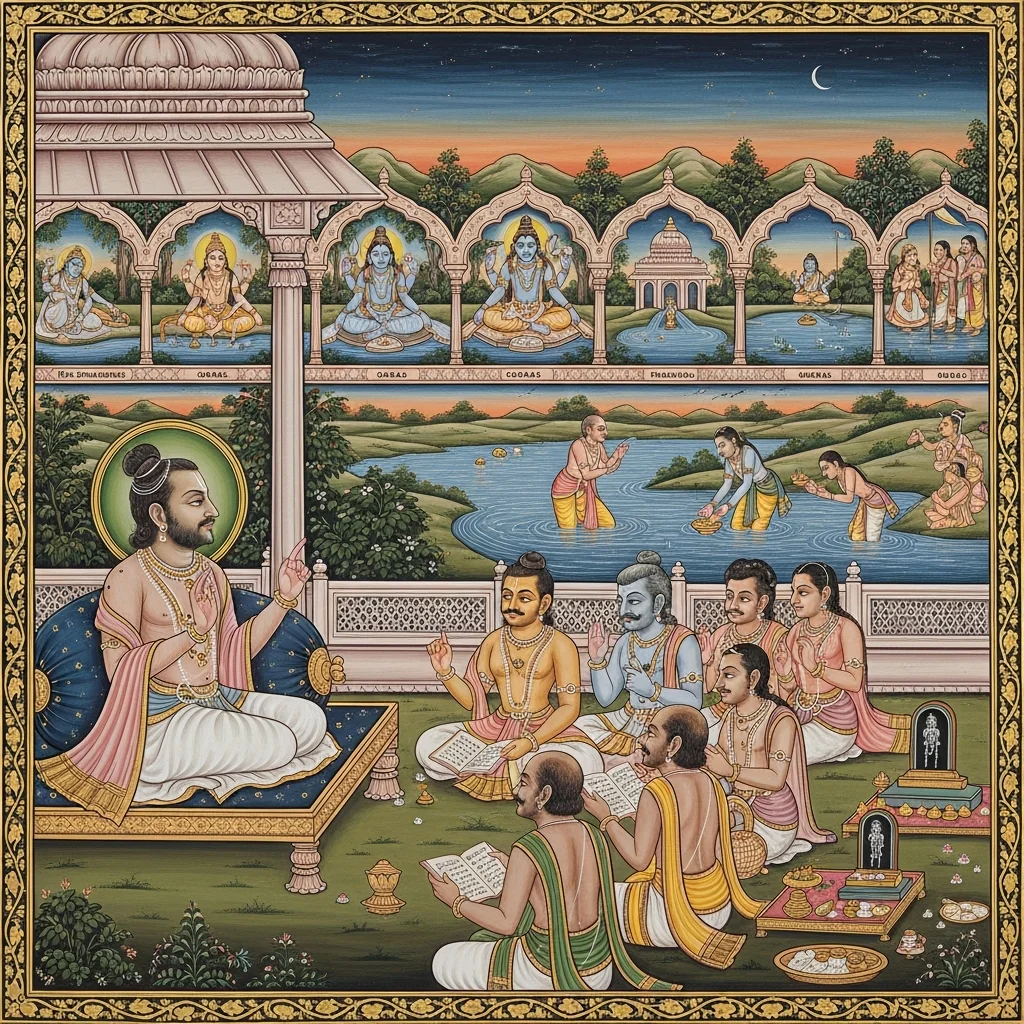
Prahlāda addresses the brāhmaṇas, listing the tīrthas connected with Dvārakā and giving brief guidance for their proper observances. The chapter is set within a cosmic visitation: after Kṛṣṇa arrives in Dvārakā with the Vṛṣṇis, Brahmā and other devas come for darśana and to fulfill their aims. Brahmā establishes Brahmakūṇḍa, praised as auspicious and sin-removing, and installs a solar presence on its bank; because of Brahmā’s primacy it is also called a mūla-sthāna, a “root place.” Then Candra creates a sin-destroying pond, and Indra founds a powerful liṅga and the famed Indrapada/Indreśvara, with stated occasions for worship such as Śivarātri and solar transitions. Śiva forms Mahādeva-saraḥ and Pārvatī forms Gaurī-saraḥ, whose fruits are linked to women’s welfare and household auspiciousness. Varuṇa and Kubera (Dhan-eśa) establish further saras—Varuṇapada and Yakṣādhipa-saraḥ—connected with śrāddha, offerings, and gifts. The account culminates at the Pañcanada tīrtha: five rivers are invoked and tied to sages, an arghya-mantra is given, and an ordered practice of snāna, tarpaṇa, śrāddha, and dāna is prescribed. The phala teaching promises prosperity, attainment of Viṣṇuloka, and uplift of ancestors, concluding that hearing this chapter brings purification and the supreme attainment.
Shlokas
Verse 1
श्रीप्रह्राद उवाच । संत्यनेकानि तीर्थानि बह्वाश्चर्यकराणि च । प्राप्ते कलियुगे घोरे तानि पुप्लुविरेर्णवे
Śrī Prahlāda said: There are many sacred fords and pilgrimage places, and many that work wondrous effects. But when the dreadful Kali age arrived, they were submerged in the ocean.
Verse 2
उद्देशतो मया विप्राः कीर्त्यमाना निबोधत । संक्षेपतो विप्रवरा यथा तेषां च याः क्रियाः
O brāhmaṇas, understand as I recount them by indication. O best of brāhmaṇas, I shall state briefly how they are, and what rites are performed for them.
Verse 3
संहृत्य च भुवो भारं साधू न्संस्थाप्य सत्पथे । द्वारवत्यामगात्कृष्णो वृष्णिसंघैः समावृतः
Having removed the burden of the earth and established the righteous upon the true path, Kṛṣṇa went to Dvāravatī, surrounded by the hosts of the Vṛṣṇis.
Verse 4
दर्शनार्थं तदा ब्रह्मा दैवतैः परिवारितः । वरुणो यमवित्तेशौ सूर्य्याचन्द्रमसौ तथा
Then, for the sake of beholding Him, Brahmā—surrounded by the gods—came, along with Varuṇa, Yama, Kubera the lord of wealth, and also the Sun and the Moon.
Verse 5
आगत्य सह कृष्णेन कार्यं संसाध्य चात्मनः । वेधाश्चक्रे तदा तीर्थं स्वनाम्ना कीर्तितं भुवि
Having arrived together with Kṛṣṇa and having accomplished his own intended purpose, Vedhā (Brahmā) then established a sacred ford (tīrtha), which became renowned on earth by his own name.
Verse 6
ब्रह्मकुण्डमिति ख्यातं सर्वपापहरं शुभम् । तत्तीरे स्थापयामास सहस्रकिरणं प्रभुम्
That (tīrtha) became famed as ‘Brahmakuṇḍa’—auspicious and the remover of all sins. Upon its bank he installed the Lord of a thousand rays (the Sun).
Verse 7
मूलं सुराणां हि किल ब्रह्मा लोकपितामहः । तेन संस्थापितं यस्मान्मूल स्थानमिति स्मृतम्
Indeed, Brahmā—the Grandfather of the worlds—is said to be the very root of the gods. And because it was established by him, it is remembered as ‘Mūlasthāna’, the Root-abode.
Verse 8
ब्रह्मतीर्थं तु तद्दृष्ट्वा चन्द्रश्चक्रे ततः सरः । तडागं चन्द्रनाम्ना वै सर्वपापप्रणाशनम्
Seeing that Brahmā-tīrtha, Candra (the Moon) then made a lake—indeed, a pond bearing the Moon’s own name, the destroyer of all sins.
Verse 9
तं दृष्ट्वा तेजसा युक्तं संहृष्टाः सुरसत्तमाः । ऊचुस्ते लोकस्रष्टारं शृणुष्व वचनं हि नः
Seeing him endowed with radiance, the foremost of the gods rejoiced. They said to the Creator of the worlds: “Do listen to our words.”
Verse 10
योऽत्र स्नानं प्रकुरुते पितॄन्संतर्पयिष्यति । पूजयिष्यति देवेशं मूलस्थानं सुरर्षभ
O bull among the gods! Whoever bathes here will satisfy the Pitṛs (ancestors) and will worship the Lord of the gods at Mūlasthāna.
Verse 11
सर्वपापविनिर्मुक्तो धनधान्यसमन्वितः । सप्तम्यां माघमासस्य शुक्लपक्षे द्विजर्षभाः । योऽत्र स्नानं प्रकुरुते मानवो भक्तिसंयुतः
O best of the twice-born! A person who, with devotion, bathes here on the seventh lunar day of the bright fortnight in the month of Māgha is freed from all sins and is endowed with wealth and grain.
Verse 12
मूलस्थानं च देवेश संस्नाप्य प्रविलेपयेत् । पूजयिष्यति वस्त्राद्यैः स्वशक्त्या भूषणैस्तथा
O Lord of the gods! Having bathed (the deity) at Mūlasthāna, one should anoint it with fragrant unguents; and worship with garments and other offerings, and likewise with ornaments according to one’s means.
Verse 13
पुष्पधूपादिभिश्चैव नैवेद्येन च मानवः । सर्वान्कामानवाप्नोति ब्रह्मलोकं स गच्छति
With flowers, incense, and such offerings, and with naivedya—food offered in worship—a person gains all desired aims and goes to Brahmaloka.
Verse 14
सावित्रीं च ततो दृष्ट्वा ब्रह्मणा स्थापितां च वै । कृत्वा चायतनं दिव्यं स्वां मूर्तिं सन्निवेश्य च । नाम चक्रे तदा देव्याः स्वयं तस्याः पितामहः
Then, seeing Sāvitrī too—indeed established by Brahmā—he built a divine shrine, installed his own image, and thereupon the Grandfather, Brahmā himself, bestowed a name upon that Goddess.
Verse 15
यः पश्यति स्वयं भक्त्या कृष्णं दृष्ट्वा जगत्पतिम् । सावित्रीं स सुखी भूत्वा सर्वान्कामानवाप्नुयात्
Whoever, with heartfelt devotion, beholds Kṛṣṇa—the Lord of the universe—and also beholds Sāvitrī, becomes happy and attains all cherished desires.
Verse 16
आयुरारोग्यमैश्वर्य्यं पुत्रसन्तानमेव च । न दौर्भाग्यं भवेत्तस्य न दारिद्यं न मूर्खता । न च व्याधिभयं तस्य यः पश्यति विधिं नरः
Longevity, health, prosperity and lordly fortune, and the blessing of sons and lineage arise; misfortune does not befall him—nor poverty, nor folly. Nor is there fear of disease for that man who beholds Vidhi (Brahmā).
Verse 17
गत्वा संस्नापयेद्देवीं कुंकुमेन कुसुंभकैः । संछाद्य वस्त्रैः संपूज्य पुष्पैर्नानाविधै स्तथा
Having gone there, one should bathe the Goddess with kunkuma (saffron) and kusumbha (safflower), then clothe her with garments and worship her with flowers of many kinds.
Verse 18
नैवेद्यफलतांबूलग्रीवासूत्रकदीपकैः । संपूज्य परया भक्त्या यात्रां च सफला लभेत्
Having worshipped fully with offerings of naivedya (sacred food), fruits, betel, necklaces/garlands, the sacred thread, and lamps—with supreme devotion—one attains a truly fruitful pilgrimage.
Verse 19
न वैधव्यं न दौर्भाग्यं न वंध्या न मृतप्रजा । विधिर्दृष्टो नरैर्यैस्तु कुले तेषां प्रजायते
In the family line of those men who have beheld Vidhi (Brahmā), there is no widowhood, no misfortune, no barrenness, and no loss of offspring; thus does sacred order arise in their house.
Verse 20
तस्मात्सर्वप्रयत्नेन विधिं पश्येत्सुभावतः । परितुष्टो भवेत्कृष्णो यात्रा च सफला भवेत्
Therefore, with every effort and with a pure disposition, one should behold Vidhi (Brahmā). Kṛṣṇa becomes fully pleased, and the pilgrimage becomes successful.
Verse 21
प्रह्लाद उवाच । ब्रह्मणा स्थापितं दृष्ट्वा सरः परमशोभनम् । इन्द्रश्चक्रे महाभागः सरः परमशोभनम्
Prahlāda said: Seeing the supremely beautiful sacred lake established by Brahmā, the fortunate Indra also fashioned there a lake of supreme beauty.
Verse 22
स्थापयामास देवेशो लिंगमप्रतिमौजसम् । तस्मिन्स्नात्वा च लभते यस्मादिन्द्रपदं नरः
The Lord of the gods established a liṅga of incomparable power. By bathing there, a man attains the state of Indra—hence it is called Indrapada.
Verse 23
तस्मादिन्द्रपदं नाम सुप्रसिद्धं धरातले । इन्द्रेण स्थापितं लिंगं यस्माद्भावनया सह । प्रसिद्धमिंद्रनाम्ना वा इन्द्रेश्वरमिति स्मृतम्
Therefore the name “Indrapada” is renowned upon the earth. Since the liṅga was established by Indra with devoted intention, it is also famed by Indra’s name and is remembered as “Indreśvara”.
Verse 24
यस्य प्रसिद्धिरतुला वृद्धिलिंगमिति द्विजाः । यस्य दर्शनमात्रेण मुच्यते सर्वपातकैः
O twice-born ones, its fame is incomparable as “Vṛddhiliṅga”; by the mere sight of it one is released from all sins.
Verse 25
पितॄणामक्षया तृप्तिर्जायते द्विजसत्तमाः । अष्टम्यां च चतुर्द्दश्यां स्नात्वा चेन्द्रपदे नरः
O best of the twice-born, by bathing at Indrapada on the eighth and the fourteenth lunar days, a man brings about inexhaustible satisfaction for the Pitṛs (ancestors) and attains the state of Indra.
Verse 26
इन्द्रेश्वरं च संपूज्य याति मुक्तिपदं नरः । विशेषतस्तु संपूज्यो मकरस्थे दिवाकरे
By duly worshipping Indreśvara, a man reaches the station of liberation. Indreśvara is to be worshipped with special emphasis when the Sun is in Makara (Capricorn).
Verse 27
उत्तरायणसंक्रांतौ लिंगपूरणकेन हि । शिवरात्रौ विशेषेण संपूज्य उमया सह । रात्रौ जागरणं कृत्वा परमं लोकमाप्नुयात्
At the Uttarāyaṇa Saṅkrānti, by the rite of “liṅga-pūraṇa” (filling/completing the liṅga), and especially on Śivarātri by worshipping (Śiva) together with Umā, and by keeping vigil through the night, one attains the supreme world.
Verse 28
प्रह्लाद उवाच । ब्रह्मतीर्थं च तद्दृष्ट्वा तथा शक्रसरोभवम् । दर्शयन्विष्णुना सार्द्धमेकरूपत्वमाप्नुयात्
Prahlāda said: “Having beheld Brahma-tīrtha, and likewise the lake born of Śakra (Indra), and showing it together with Viṣṇu, one attains oneness of form—union in divine likeness.”
Verse 29
सरश्चकार देवेशो भगवान्पार्वतीपतिः । सुमृष्टनिर्मलजलं नलिनीदलशोभितम्
The Lord of gods—Bhagavān, the consort of Pārvatī—created a lake, with waters clear and well-purified, beautified by lotus leaves.
Verse 30
उत्पलैः सर्वतश्छन्नं सरः सारसशोभितम् । तदगाधजलं दृष्ट्वा स्वयमेव पिनाकधृक् । सब्रह्मविष्णुना सार्द्धं स्नातस्तत्र वृषध्वजः
The lake was covered on all sides with blue lotuses and adorned by swans. Seeing its deep waters, the bearer of the Pināka (Śiva) himself—Bull-bannered—bathed there together with Brahmā and Viṣṇu.
Verse 31
ते देवास्तत्सरो दृष्ट्वा ब्रह्मविष्णुसुराऽसुराः । ऊचुः सर्वे सुसंहृष्टा वीक्षंतः पार्वतीपतिम्
Seeing that lake, those beings—Brahmā and Viṣṇu, the gods and even the asuras—were all delighted, and they spoke while beholding the Lord of Pārvatī.
Verse 32
यस्मात्कृतमिदं देवा ईश्वरेण महत्सरः । महादेव सरोनाम सुप्रसिद्धं भविष्यति
“Since this great lake has been made by Īśvara, O gods, it will become widely famous by the name ‘Mahādeva-saras.’”
Verse 33
योऽत्र स्नानं प्रकुरुते पितॄणां तर्पणं तथा । श्राद्धं पितॄणां भक्त्या च स गच्छेत्परमां गतिम्
Whoever bathes here, and likewise offers tarpaṇa to the Pitṛs, and with devotion performs śrāddha for the ancestors—he attains the highest destination.
Verse 34
सुप्रसन्ना भविष्यन्ति सर्वे देवा न संशयः । दर्शनात्पापनिर्मुक्तो महादेवसरस्य च
All the gods will become exceedingly pleased—of this there is no doubt. And by the very sight of Mahādeva-saras one is freed from sin.
Verse 35
महेशस्य च तद्दृष्ट्वा सरः परमशोभनम् । चकार पार्वती तत्र सरश्चाप्रतिमं तथा
Seeing that supremely beautiful lake of Maheśa (Śiva), Pārvatī too created there another incomparable sacred lake.
Verse 36
गौरीसर इति ख्यातं सर्वपापप्रणाशनम् । तत्र स्नात्वा नरो भक्त्या न दुर्गतिमवाप्नुयात्
Known as Gaurī-saras, it destroys all sins. A person who bathes there with devotion does not fall into an evil destiny.
Verse 37
न दौर्भाग्यं स्त्रियश्चैव न वैधव्यं कदाचन । स्नात्वा गौरीतीर्थवरे सर्वान्कामानवाप्नुयात्
For women there is no misfortune, nor widowhood at any time. Having bathed at the excellent Gaurī-tīrtha, one attains all desired aims.
Verse 38
वरुणश्च ततो दृष्ट्वा पुण्यान्यायतनानि च । चकार च सरो दिव्यं विष्णुभक्तिसमन्वितः
Then Varuṇa, beholding those holy shrines, created a divine lake as well, filled with devotion to Viṣṇu.
Verse 39
नाम्ना वरुणपदं तच्च पापक्षयकरं भुवि । नभस्ये पौर्णमास्यां च संतर्प्य पितृदेवताः
That tīrtha is called Varuṇapada, and on earth it brings about the destruction of sins. And on the full-moon day of the month Nabhas, having satisfied the Pitṛ-deities with offerings…
Verse 40
श्राद्धं कृत्वा विधानेन पितॄणां श्रद्धयान्वितः । उत्तमं लोकमाप्नोति यत्र गत्वा न शोचति
Having performed the Śrāddha for the ancestors according to rule, endowed with faith, one attains the highest world; having gone there, one does not grieve.
Verse 41
प्रदद्यादुदकुम्भांश्च दध्योदनसमन्वितान् । गाश्च वासांसि रत्नानि विष्णुर्मे प्रीयतामिति
One should donate water-pots together with curd-rice; also cows, garments, and jewels, dedicating the gift with the prayer, “May Viṣṇu be pleased with me.”
Verse 42
सरो दृष्ट्वा जलेशस्य सरश्चक्रे धनेश्वरः । यक्षाधिपसरोनाम सुप्रसिद्धं धरातले
Seeing the lake of the Lord of waters (Varuṇa), Dhaneśvara (Kubera) made another lake, renowned on earth as “Yakṣādhipa-saras”.
Verse 43
तथा तत्र नरो भक्त्या संपूज्य पितृदेवताः । सर्वान्कामानवाप्नोति दद्याद्वस्त्रद्विजातये
Likewise, there a person who, with devotion, worships the Pitṛ-deities attains all desires; and one should give garments in charity to a twice-born (brāhmaṇa).
Verse 44
प्रह्लाद उवाच । विष्णुं वरप्रदं श्रुत्वा भ्रातॄणां ब्रह्मनंदनाः । मंदाकिनी वसिष्ठेन समानीता धरातले
Prahlāda said: Having heard that Viṣṇu is the giver of boons, the sons of Brahmā, for the sake of their brothers, had the Mandākinī brought down to the earth by Vasiṣṭha.
Verse 45
अम्बरीषादयः सर्व आजग्मुः कृष्णपालिताम् । द्वारवत्यां च ते दृष्ट्वा गोमतीं सागरंगमाम्
All those led by King Ambarīṣa came to Dvāravatī, the city protected by Kṛṣṇa; and there they beheld the river Gomatī, flowing onward to meet the ocean.
Verse 46
तीर्थानि देवतानां च पुण्यान्यायतनानि च । तीर्थं पंचनदं चक्रुः प्रजानां पतयस्तथा
They established sacred fords (tīrthas) and holy abodes of the gods; and likewise those lords of the people founded the tīrtha called Pañcanada for the welfare of all.
Verse 47
पंच नद्यः समाहूतास्तत्राऽजग्मुः सुरान्विताः । मरीचये गोमती च लक्ष्मणा चात्रये तथा
Summoned there, five rivers arrived, accompanied by the gods: Gomatī came for Marīci, and Lakṣmaṇā likewise for Atri.
Verse 48
चंद्रभागा चांगिरसे पुलहाय कुशावती । पावनार्थं जांबवती जगाम क्रतवे तथा
Candrabhāgā came for Aṅgiras, and Kuśāvatī for Pulaha; and for the sake of purification, Jāmbavatī likewise went to Kratu.
Verse 49
तासु स्नात्वा महाभागा ब्रह्मपुत्रा यशस्विनः । नाम तस्य तदा चक्रुः पंचनद्यश्च तापसाः
Having bathed in those rivers, the fortunate and illustrious sons of Brahmā—those ascetics—then gave that place its name: “Pañcanadī”.
Verse 50
तस्मात्पंचनदं तीर्थं सर्वपापप्रणाशनम् । स्नातव्यं तत्र मनुजैः स्वर्गमोक्षार्थिभिस्तदा
Therefore the Pañcanada tīrtha destroys all sins; human beings who seek heaven and liberation should bathe there.
Verse 51
तत्र गत्वा सुनियतो गृहीत्वार्घ्यं फलेन हि । मंत्रेणानेन वै विप्रा दद्यादर्घ्यं विधानतः
Having gone there with disciplined conduct, taking arghya with fruit, O brāhmaṇas, one should offer that arghya properly, using this mantra, according to the rite.
Verse 52
ब्रह्मपुत्रैः समानीताः पंचैताः सरितां वराः । गृह्णंत्वर्घ्यमिमं देव्यः सर्वपापप्रशांतये
“Brought here by the sons of Brahmā, these five best of rivers—O goddesses, accept this arghya, for the complete pacification of all sins.”
Verse 53
इत्यर्घ्यमन्त्रः । स्नानं कृत्वा विधानेन पितॄन्संतर्प्पयेन्नरः । श्राद्धं कुर्य्याद्विधानेन श्रद्भया परया युतः
Thus ends the arghya-mantra. After bathing according to the prescribed rite, a man should satisfy the Pitṛs with tarpaṇa offerings; and, endowed with supreme faith, he should perform śrāddha in due form.
Verse 54
पंचरत्नं ततो देयं सप्तधान्यं द्विजातये । दीनांधकृपणानां च दानं दद्यात्स्वशक्तितः
Then one should give the “five gems” and the “seven grains” to a dvija (twice-born). And one should also give charity, according to one’s capacity, to the poor, the blind, and the destitute.
Verse 55
सर्वान्कामानवाप्नोति विष्णुलोकं स गच्छति । पुत्रपौत्रसमायुक्तः परं सुखमवाप्नुयात्
He attains all desired aims and goes to Viṣṇu’s world. Blessed with sons and grandsons, he obtains the highest happiness.
Verse 56
प्रेतयोनिं गता ये च ये च कीटत्वमागताः । सर्वे ते मुक्तिमायांति पितरस्त्रिकुलोद्भवाः
Even those ancestors who have fallen into the state of preta (restless spirits), and those who have become worms, all of them—the Pitṛs belonging to the three lines of the family—attain liberation (mukti).
Verse 57
श्रुत्वाऽध्यायमिमं पुण्यं शिवलोके च मोदते । सर्वपाप विनिर्मुक्तः स याति परमं पदम्
Having heard this holy chapter, he rejoices in Śiva’s world; freed from all sins, he goes to the supreme abode.