Adhyaya 16
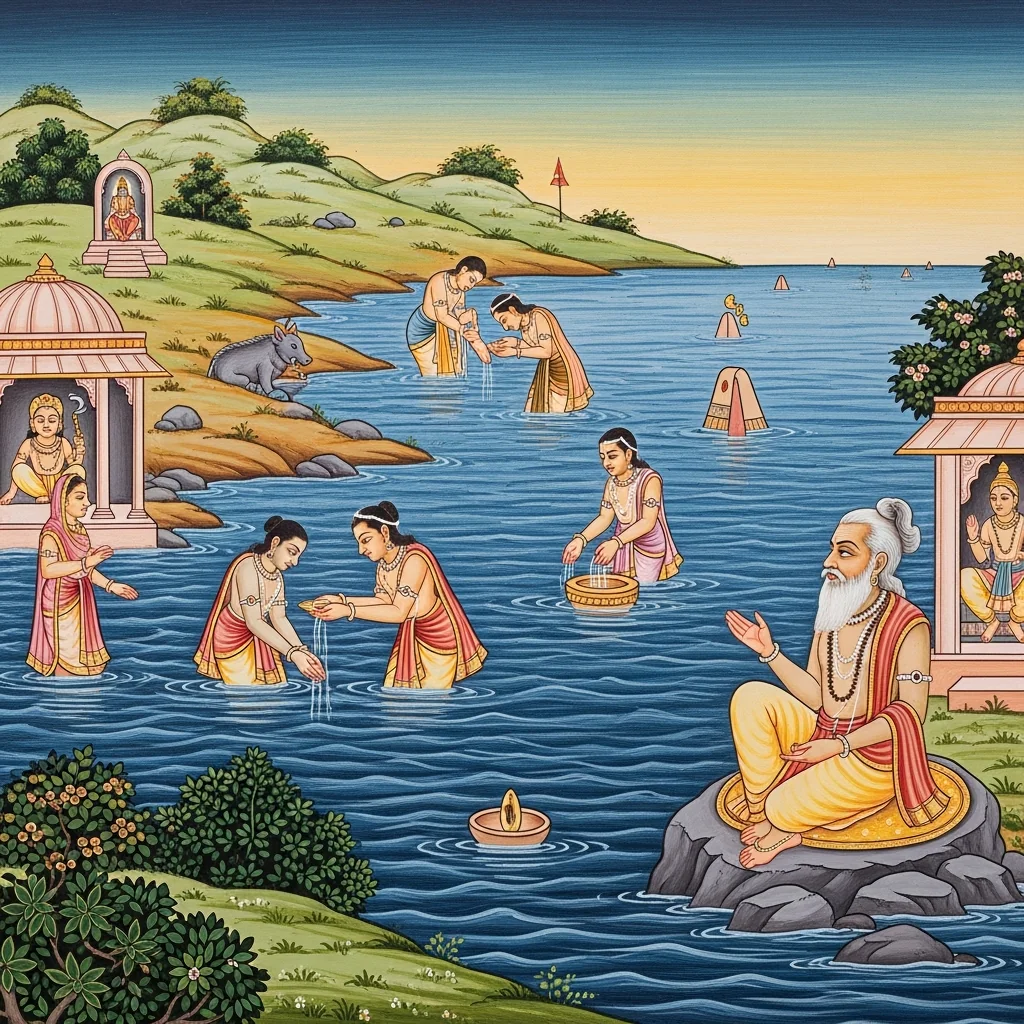
This chapter is a catalog-style pilgrimage instruction spoken by Prahlāda to learned Brahmins, laying out a sequence of tīrthas around Dvārakā and assigning to each its rites and phalaśruti. It opens with Gadātīrtha, enjoining devotional bathing, offerings to ancestors and deities (tarpana), and worship of Viṣṇu in the Varāha form, by which one attains elevation to Viṣṇuloka. It then lists Nāgatīrtha, Bhadratīrtha, and Citrātīrtha, declaring merits equal to gifts such as the tila-dhenu and ghṛta-dhenu, and explains that Dvārāvatī’s flooding caused many tīrthas to become concealed. Chandrabhāgā is praised as sin-destroying, with fruit equal to a vājapeya, and the Goddess Kauṁārikā/Yaśodā-nandinī is described, whose darśana grants desired aims. Mahīṣa-tīrtha and Muktidvāra are presented as purificatory thresholds. The Gomati account links the river’s sanctity to Vasiṣṭha and Varuṇa’s realm, granting aśvamedha-equivalent merit; Bhṛgu’s tapas and Ambikā’s establishment add Śākta-Śaiva texture alongside mentions of multiple liṅgas. Further tīrthas—Kālindī-saras, Sāmbatīrtha, Śāṅkara-tīrtha, Nāgasara, Lakṣmī-nadī, Kambu-saras, Kuśatīrtha, Dyumnatīrtha, Jālatīrtha with Jāleśvara, Cakrasvāmi-sutīrtha, Jaratkāru-kṛta tīrtha, and Khañjanaka—are tied to snāna, tarpana, śrāddha, and dāna, and to destinations such as Nāgaloka, Śivaloka, Viṣṇuloka, and Somaloka. The close frames this as a concise tīrtha-vistara suited to Kali-age conditions, affirming that devotional listening itself purifies and culminates in Viṣṇuloka.
Shlokas
Verse 1
प्रह्लाद उवाच । ततो गच्छेद्द्विजश्रेष्ठा गदातीर्थमनुत्तमम् । यत्र स्नात्वा नरो भक्त्या लभेद्भूदानजं फलम्
Prahlāda said: Then, O best of the twice-born, one should go to the unsurpassed Gadā-tīrtha. Bathing there with devotion, a person obtains the merit born of gifting land (bhū-dāna).
Verse 2
तर्पयेत्पितृदेवांश्च ऋषींश्चैव यथाक्रमम् । श्राद्धं च कारयेत्तत्र पितॄणां तृप्तिहेतवे
There one should offer tarpaṇa, in due order, to the Pitṛs, the Devas, and the Ṛṣis; and one should also have śrāddha performed there, for the satisfaction of the ancestors.
Verse 3
गदातीर्थे तु देवेशं विष्णुं वाराहरूपिणम् । समभ्यर्च्य नरो भक्त्या विष्णुलोके महीयते
At Gadā-tīrtha, having devoutly worshipped Lord Viṣṇu—the Lord of the gods—in his Varāha form, a person is honored and exalted in Viṣṇu’s world.
Verse 4
नागतीर्थं ततो गच्छेत्सरः परमशो भनम् । यत्र स्नात्वा नरः सम्यङ्नागलोकमवाप्नुयात्
Then one should go to Nāga-tīrtha, a supremely beautiful lake. Bathing there properly, a person attains the realm of the Nāgas.
Verse 5
भद्रतीर्थं ततो गच्छेत्सरस्त्रिभुवनार्चितम् । स्नानमात्रेण लभते तिलधेनुफलं नरः
Then one should go to Bhadra-tīrtha, a lake revered in the three worlds. By bathing there alone, a person gains merit equal to the gift of a ‘sesame-cow’ (tiladhenu).
Verse 6
चित्रातीर्थं ततो गच्छेत्सरः परमशोभनम् । स्नानमात्रेण लभते घृतधेनुफलं नरः
Then one should go to Citra-tīrtha, a lake of supreme beauty. By bathing there alone, a person gains merit equal to gifting a ‘ghee-cow’ (ghṛtadhenu).
Verse 7
यदा द्वारावती विप्रा प्लाविता सागरेण हि । पुण्यानि बहुतीर्थानि च्छन्नानि जलपांसुभिः
When Dvārāvatī, O brāhmaṇas, is flooded by the ocean, many holy tīrthas are concealed beneath water and sand.
Verse 8
दृश्यानि कतिचित्संति ह्यदृश्यान्यपराणि च । तानि सर्वाणि विप्रेन्द्राः कथयिष्यामि सर्वतः
Some are visible, and others are invisible as well. O best of brāhmaṇas, I shall describe all of them completely.
Verse 9
चंद्रभागां ततो गच्छेत्सर्वपापप्रणाशिनीम् । यत्र स्नात्वा नरो भक्त्या वाजपेयफलं लभेत्
Thereafter one should go to Candrabhāgā, the destroyer of all sins. Bathing there with devotion, a person attains the merit equivalent to the Vājapeya sacrifice.
Verse 10
देवी चंद्रार्चिता यत्र यशोदा नंदनंदिनी । कौमारिका शक्तिहस्ता खङ्गखेटकधारिणी
There, at that sacred place, is the Goddess worshipped by the Moon—Yaśodā, the beloved daughter of Nanda; the Virgin Goddess (Kaumārī), holding a spear in her hand, bearing sword and shield.
Verse 11
केश्यादिदैत्यदलिनी स्वसा वै रामकृष्णयोः । यस्या दर्शनमात्रेण सर्वान्कामानवाप्नुयात्
She is the crusher of demons such as Keśin and others; indeed, she is the sister of Rāma and Kṛṣṇa. By her mere darśana (sacred vision), one obtains all desired aims.
Verse 12
ततो गच्छेत विप्रेन्द्रास्तीर्थं महिषसंज्ञकम् । यस्य दर्शनमात्रेण मुच्यते सर्वपातकैः
Then, O best of brāhmaṇas, one should go to the tīrtha called Mahiṣa. By mere darśana—its sacred sight—one is freed from all sins and downfalls.
Verse 13
मुक्तिद्वारं ततो गच्छेत्तीर्थं पाप प्रणाशनम्
Thereafter one should go to the tīrtha called Muktidvāra, the Gate of Liberation, the destroyer of sin.
Verse 14
वसिष्ठेन समानीता मुनिना यत्र गोमती । स्नातो भवति गंगायां यत्र स्नात्वा कलौ युगे
There is the river Gomatī, brought there by the sage Vasiṣṭha. Bathing there is equal to bathing in the Gaṅgā—especially for one who bathes there in the Kali age.
Verse 15
गोमती निःसृता यस्मा त्प्रविष्टा वरुणालयम् । तत्र स्नात्वा नरो भक्त्या अश्वमेधफलं लभेत्
Where the Gomatī flows forth and enters the abode of Varuṇa—bathing there with devotion, a person obtains the fruit of the Aśvamedha sacrifice.
Verse 16
भृगुणा हि तपस्तप्तं स्थापिता यत्र चांबिका । भृग्वर्चिता ततो देवी प्रसिद्धा श्रूयते क्षितौ
There, after Bṛgu had performed austerities, Ambikā was established. Therefore the Goddess—worshipped by Bṛgu—is spoken of as renowned upon the earth.
Verse 17
संसिद्धिं परमां याति यस्याः संस्मरणान्नरः । शिवलिंगान्यनेकानि यत्र सन्ति महीतले
By remembering her, a person attains the supreme accomplishment; and in that place upon the earth, many Śiva-liṅgas abide.
Verse 18
ततो गच्छेत विप्रेन्द्राः कालिन्दीसर उत्तमम् । कालिन्दी सूर्यतनया सरश्चक्रे त्वनुत्तमम्
Then, O best of brāhmaṇas, one should go to the excellent lake of Kāлиндī; Kāлиндī, the Sun’s daughter, fashioned that unsurpassed lake.
Verse 19
तत्र स्नात्वा नरो भक्त्या न दुर्गतिमवाप्नुयात् । सांबतीर्थं ततो गच्छेत्सर्वपापप्रणाशनम्
Bathing there with devotion, a person does not fall into an evil destiny; thereafter he should go to Sāmbatīrtha, the sacred ford that destroys all sins.
Verse 20
कृत्वा श्राद्धं च विधिवल्लभेद्गोदानजं फलम्
And by performing the śrāddha according to rule, one obtains the merit that arises from gifting a cow.
Verse 21
गच्छेच्च शांकरं तीर्थं ततस्त्रैलोक्यपावनम् । यत्र स्नात्वा नरो भक्त्या लभेद्बहुसुवर्णकम्
Then he should go to Śāṃkara Tīrtha, the purifier of the three worlds; bathing there with devotion, a person gains abundant gold—great prosperity and merit.
Verse 22
ततो नागसरो गच्छेत्तीर्थं पापप्रणाशनम् । पितॄन्सन्तर्प्य विधिवन्नागलोकमवाप्नुयात्
Thereafter he should go to Nāgasara, a tīrtha that destroys sin. Having duly satisfied the ancestors with offerings, he attains the realm of the Nāgas.
Verse 23
लक्ष्मीं नदीं ततो गच्छेद्गच्छन्तीं सागरं प्रति । यस्या दर्शनमात्रेण मुच्यते सर्वपातकैः
Then he should go to the river Lakṣmī, flowing toward the ocean; by the mere sight of her, one is released from all great sins.
Verse 24
श्राद्धे कृते तु विप्रेन्द्राः पितरो मुक्तिमाप्नुयुः । दाने मनोरथावाप्तिर्जायते नात्र संशयः
O best of Brāhmaṇas, when śrāddha is performed, the ancestors attain liberation; and by acts of charity, the fulfillment of one’s rightful desires arises—of this there is no doubt.
Verse 25
कंबुसरस्ततो गच्छेत्तीर्थं पापप्रणाशनम् । तर्पणे च कृते श्राद्धे ह्यग्निष्टोमफलं लभेत्
Then he should go to Kaṃbu-saras, a sin-destroying tīrtha. When tarpaṇa and śrāddha are performed there, one obtains the fruit of the Agniṣṭoma sacrifice.
Verse 26
कुशतीर्थं ततो गच्छेत्स्नात्वा सन्तर्पयेत्पितॄन् । दानं दत्त्वा यथाशक्त्या निर्मलं लोकमाप्नुयात्
Thereafter he should go to Kuśatīrtha; having bathed, he should duly satisfy the ancestors. Giving charity according to one’s capacity, he attains a pure realm.
Verse 27
द्युम्नतीर्थं च तत्रैव सर्वपापप्रणाशनम् । कृत्वा श्राद्धं च तत्रैव वाजिमेधफलं लभेत्
Right there is Dyumnatīrtha, the destroyer of all sins. Performing śrāddha there, one gains the fruit of the Vājimedha sacrifice.
Verse 28
कुशतीर्थं ततो गच्छेत्पितॄणां तृप्तिरक्षया । यत्र श्राद्धात्तर्पणाच्च जायते नात्र संशयः
Then one should go to Kuśatīrtha, where the ancestors’ satisfaction becomes inexhaustible, born from śrāddha and tarpaṇa—of this there is no doubt.
Verse 29
जालतीर्थं ततो गच्छेत्सर्वपापहरं शुभम् । दुर्वाससा यत्र शप्ताः कोपाद्यदुकुमारकाः
Then one should proceed to Jāla-tīrtha—auspicious and destructive of all sins. It is the place where, in anger, Durvāsas cursed the young princes of the Yadu line.
Verse 30
देवो जालेश्वरस्तत्र सं बभूव उमापतिः । जालेश्वरं नरो दृष्ट्वा सद्यः पापात्प्रमुच्यते
There the Lord, Umāpati (Śiva), became manifest as Jāleśvara. By merely beholding Jāleśvara, a person is immediately freed from sin.
Verse 31
संपूज्य देवं भक्त्या च शिवलोकमवाप्नुयात्
And having duly worshipped the Lord with devotion, one attains Śiva’s world (Śivaloka).
Verse 32
चक्रस्वामिसुतीर्थं च ततो गच्छेद्धि मानवः । कृत्वा स्नानं पितॄंस्तर्प्य विष्णुलोकमवाप्नुयात्
Then one should go to the sacred ford called Cakrasvāmi-su-tīrtha. Having bathed there and offered tarpana—libations of water—to the ancestors, one attains Viṣṇu’s world, Viṣṇuloka.
Verse 33
जरत्कारुकृतं तीर्थं सर्वपापप्रणाशनम् । स्नात्वा तत्र द्विजश्रेष्ठा न दुर्गतिमवाप्नुयात्
There is a tīrtha established by Jaratkāru, the destroyer of all sins. O best of the twice-born, one who bathes there does not fall into an evil destiny.
Verse 34
ततो गच्छेद्द्विजश्रेष्ठास्तीर्थं खञ्जनकाभिधम् । आसीत्खञ्जनको नाम दैत्यश्चातिबलान्वितः
Then, O best of the twice-born, one should go to the tīrtha called Khañjanaka. Long ago there was a daitya named Khañjanaka, endowed with tremendous strength.
Verse 35
ततः खञ्जनकं तीर्थं तस्य नाम्नेति विश्रुतम् । तत्र स्नात्वा नरो याति सोमलोकं न संशयः
Thus that sacred ford became renowned by his name as Khañjanaka-tīrtha. Having bathed there, a person goes to Soma’s world, Somaloka—of this there is no doubt.
Verse 36
सन्ति तीर्थान्यनेकानि सुगुप्तानि द्विजोत्तमाः । तानि गच्छेत्तु विप्रेन्द्राः सर्वपापापनुत्तये
O best among the twice-born, there exist many other sacred fords, well concealed. O foremost of brāhmaṇas, one should visit them for the complete removal of all sins.
Verse 37
ततो गच्छेद्द्विजश्रेष्ठास्तीर्थमानकदुन्दुभेः । शूरतीर्थं परमकं गदतीर्थमतः परम्
Then, O best of the twice-born, one should go to the tīrtha of Ānakadundubhi (Vasudeva). Next comes the supremely excellent Śūra-tīrtha, and after that, Gada-tīrtha.
Verse 38
गावल्गणस्य तीर्थं च अक्रूरस्य महात्मनः । बलदेवस्य तीर्थं तु उग्रसेनस्य चापरम्
There is also the tīrtha of Gāvalgaṇa, and that of the great-souled Akrūra; likewise the tīrtha of Baladeva, and another belonging to Ugrasena.
Verse 39
अर्जुनस्य च तीर्थं तु सुभद्रातीर्थमेव च । देवकीतीर्थमाद्यं तु रोहिणीतीर्थमेव च
Here also are the sacred bathing-places: Arjuna’s Tīrtha, Subhadrā’s Tīrtha, the foremost Devakī-Tīrtha, and likewise Rohiṇī-Tīrtha.
Verse 40
उद्धवस्य च तीर्थं तु सारंगाख्यं तथैव च । सत्यभामाकृतं तीर्थं भद्रातीर्थमतः परम्
There is also Uddhava’s Tīrtha, and likewise the one known as Sāraṅga; the Tīrtha established by Satyabhāmā, and thereafter the Bhadrā-Tīrtha.
Verse 41
जामदग्न्यस्य तीर्थं तु रामस्य च महात्मनः । भासतीर्थं च तत्रैव शुकतीर्थमतः परम्
There is the Tīrtha of Jāmadagnya Rāma, the great-souled one; and there itself is Bhāsa-Tīrtha, and thereafter Śuka-Tīrtha.
Verse 42
कर्दमस्य च तीर्थं तु कपिलस्य महात्मनः । सोमतीर्थं च तत्रैव रोहिणीतीर्थमेव च
There is the Tīrtha of Kardama, and the Tīrtha of the great-souled Kapila; and there itself are Soma-Tīrtha and also Rohiṇī-Tīrtha.
Verse 43
एतान्यन्यानि संक्षेपान्मया वः कथितानि च । सर्वपापहराणीह मोक्षदानि न संशयः
These and many other tīrthas have been told to you in brief. Here they remove all sins and bestow liberation—of this there is no doubt.
Verse 44
प्रच्छन्नानि द्विजवरास्तीर्थानि कलिसंक्रमे । प्लावितानि समुद्रेण पांसुनाऽप्युदकेन च
O best of brāhmaṇas, at the onset of Kali-yuga these tīrthas became concealed—overwhelmed by the sea, and covered even by sand and water.
Verse 45
एतन्मया वः कथितं संक्षेपात्तीर्थविस्तरम् । आत्मप्रज्ञानुमानेन किमन्यच्छ्रोतुमिच्छथ
Thus, in brief, I have described to you the expanse of these tīrthas. By your own discernment, what else do you wish to hear?
Verse 46
शृणुयात्परया भक्त्या तीर्थयात्रामिमां द्विजाः । सर्वपापविनिर्मुक्तो विष्णुलोकं स गच्छति
O brāhmaṇas, whoever hears this account of the tīrtha-pilgrimage with supreme devotion becomes freed from all sins and goes to Viṣṇu’s world.