Adhyaya 42
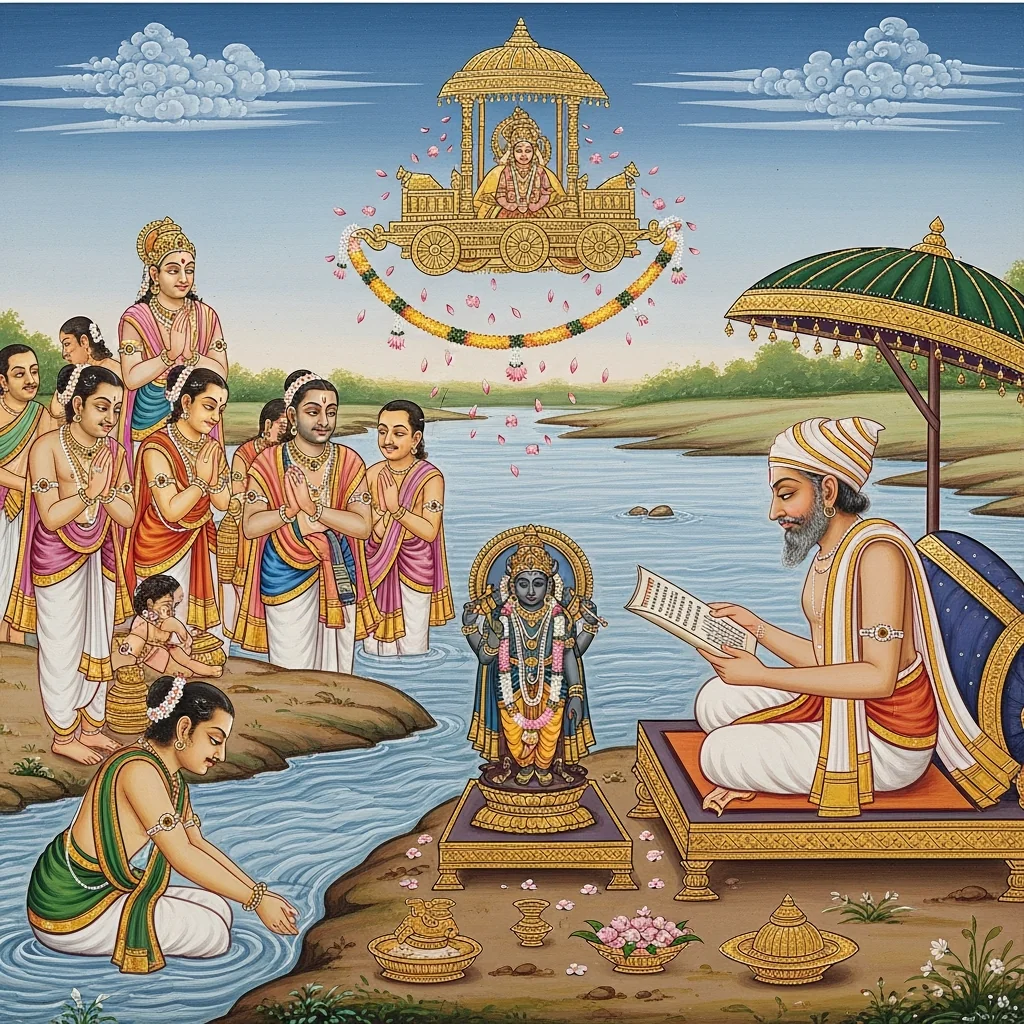
Chapter 42 is a phalaśruti-style discourse attributed to Prahlāda. It begins by declaring that vṛṣotsarga (the ritual release of a bull) performed in Dvārakā—especially in Vaiśākha and Kārtika—brings posthumous uplift and release from adverse states. To stress its remedial power, the text names grave sins (brahmahatyā, surāpāna, theft, and guru-related violations) and states that bathing in the Gomati and receiving Śrī Kṛṣṇa’s darśana can dissolve even long-accumulated demerit. For Kali-yuga it highlights devotional acts: beholding Rukmiṇī with faith, circumambulating the city, and reciting the thousand names. A Dvādaśī observance is prescribed—reciting Dvārakā’s māhātmya in Viṣṇu’s presence—promising celestial honor and freedom of movement. The chapter then turns to lineage-blessings (“may such a person be born in our family”) and describes ideal practitioners: those who bathe at the Gomati–ocean confluence, perform śrāddha with sapinḍa elements, honor Vaiṣṇavas (including giving gopīcandana), and who listen to, recite, write, and keep the māhātmya at home. Textual writing-and-preservation (likhita-dhāraṇa) is exalted as a steady generator of merit, equated with great gifts and austerities, removing fear and easing ritual deficiency. It concludes by proclaiming Dvārakā as the abode where Viṣṇu, all tīrthas, devas, yajñas, Vedas, and ṛṣis are present, warning that virtues without hearing the māhātmya become ineffective, while faithful hearing yields prosperity and offspring within the stated time.
Shlokas
Verse 1
प्रह्लाद उवाच । वृषोत्सर्गं करिष्यंति वैशाख्यां चैव कार्तिके । द्वारकायां पिशाचत्वं मुक्त्वा यांति पितामहाः
Prahlāda said: “In Vaiśākha and also in Kārttika they will perform vṛṣotsarga, the rite of releasing a bull as an act of dharma. In Dvārakā the forefathers are freed from the state of a piśāca and attain their onward, auspicious course.”
Verse 2
ब्रह्महत्या सुरापानं स्तेयं गुर्वंगनागमः । एवंविधानि पापानि कृत्वा चैव गुरूण्यपि
“(Even) brahmahatyā—slaying a brāhmaṇa—drinking liquor, theft, and violating the guru’s wife: having committed sins of this kind, even the most grievous…”
Verse 3
स्नानमात्रेण गोमत्यां श्रीकृष्णस्य च दर्शनात् । विलयं याति दैत्येन्द्र कल्पकोटिकृतान्यपि
By bathing only in the Gomatī and by the darśana of Śrī Kṛṣṇa, even sins amassed over crores of kalpas dissolve away, O lord of the Daityas.
Verse 4
रुक्मिणीं ये प्रपश्यंति भक्तियुक्ताः कलौ नराः । पुरीं प्रदक्षिणां कृत्वा जप्त्वा नामसहस्रकम्
In the Kali age, those people endowed with devotion who behold Rukmiṇī—having circumambulated the city in pradakṣiṇā and recited a thousand divine Names…
Verse 5
प्रदक्षिणीकृतं सर्वं ब्रह्मांडं नात्र संशयः । महादानैस्तु चान्यत्र यत्फलं परिकीर्तितम् । द्वारकायां तु रुक्मिण्यां दृष्टायां जायते तदा
By that circumambulation, the entire universe is as though circumambulated—there is no doubt. And whatever fruit is proclaimed elsewhere from great gifts (mahādāna), that very fruit arises then in Dvārakā upon seeing Rukmiṇī.
Verse 6
द्वादशीवासरे प्राप्ते माहात्म्यं द्वारकाभवम् । पठते संनिधौ विष्णोः शृणु वक्ष्यामि तत्फलम्
When the day of Dvādaśī arrives, one who recites this Dvārakā Māhātmya in the presence of Viṣṇu—listen, I shall declare the fruit of that.
Verse 7
सर्वेषु चैव लोकेषु कामचारी विराजते । पद्मवर्णेन यानेन किंकिणीजालमालिना
In all worlds, he shines as one who moves at will, riding in a lotus-hued celestial vehicle adorned with a net of tinkling bells.
Verse 8
दिव्यश्वेताश्वयुक्तेन कामगेन यथासुखम् । आभूतसंप्लवं यावत्क्रीडतेऽप्सरसां गणैः
Yoked to divine white horses, upon a wish-fulfilling chariot, he delights as he pleases, sporting with hosts of apsarases until the cosmic dissolution.
Verse 9
कृतकृत्यश्च भवति कल्पकोटिसमन्वितः । यथा निर्मथनादग्निः सर्वकाष्ठेषु दृश्यते । तथा च दृश्यते धर्मो द्वादशीसेवनान्नरे
He becomes one whose purpose is fulfilled, endowed with the merit of crores of kalpas. As fire is present in all wood and is revealed by churning, so dharma is revealed in a person through the observance of Dvādaśī.
Verse 10
अतः परं प्रवक्ष्यामि पितृभिः परिकीर्तितम् । अपि स्यात्स कुलेऽस्माकं गोमत्यां श्रद्धया नरः । स्नात्वा संपूज्य कृष्णं च श्राद्धं कुर्यात्सपिण्डकम्
Now I shall declare what has been proclaimed by the Pitṛs. May there be a man born in our lineage who, with faith, bathes in the Gomati, duly worships Kṛṣṇa, and then performs the śrāddha with the piṇḍa-offering to the sapinda kin.
Verse 11
अपि स्यात्स कुलेऽस्माकं गोमत्युदधिसंगमे । स्नात्वा पश्यति यः कृष्णमस्माकं तारणाय वै
May there be one born in our lineage who, after bathing at the confluence of the Gomati and the ocean, beholds Kṛṣṇa—for truly, it is for our deliverance.
Verse 12
अपिस्यात्स कुलऽस्माकं यः श्रुत्वा ब्राह्मणाननात् । द्वारकामाहात्म्यमिदं पूजयिष्यति भक्तितः
May there be one in our lineage who, having heard this Dvārakā-māhātmya from the mouth of a brāhmaṇa, will honor and revere it with devotion.
Verse 13
भविष्यति कुलेऽस्माकं यो गच्छेद्द्वारकां पुरीम् । संप्राप्य द्वादशीं शुद्धां यः करिष्यति जागरम्
In our lineage there will arise one who goes to the city of Dvārakā and, upon attaining the pure Dvādaśī, keeps the sacred vigil (jāgaraṇa).
Verse 14
भविष्यति कुलेऽस्माकं पुत्रो वा दुहिता तथा । स्तुवन्नामसहस्रं तु कृष्णस्याग्रे पठिष्यति
In our lineage there will be a son—or likewise a daughter—who, praising the Lord, will recite the thousand names before Kṛṣṇa.
Verse 15
अपि स्यात्स कुलेऽस्माकं भविष्यति धृतव्रतः । गोपीचन्दनदानेन यस्तोषयति वैष्णवान्
May there be one in our lineage who is steadfast in vows (vrata) and who pleases the Vaiṣṇavas by gifting gopī-candana.
Verse 16
अपि स्यात्स कुलेऽस्माकं वैष्णवानां तु सन्निधौ । द्वारकायाश्च माहात्म्यं पठिष्यति जितेन्द्रियः
May there be one in our lineage who, self-controlled, will recite the māhātmya—the greatness of Dvārakā—in the presence of Vaiṣṇavas.
Verse 17
भविष्यति कुलेऽस्माकं माहात्म्यं द्वारकाभवम् । लिखित्वा कृष्णतुष्ट्यर्थं स्वगृहे धारयिष्यति
In our lineage there will be one who, having written down this Dvārakā-born māhātmya for the pleasure of Kṛṣṇa, will keep it preserved in his own home.
Verse 18
स्वर्णदानं च गोदानं भूमिदानं तथैव च । यावज्जीवं भवेद्दत्तं येनेदं धारितं कलौ
Whoever preserves this Māhātmya in the Kali age is as though, throughout his whole life, he had bestowed gifts of gold, gifts of cows, and gifts of land.
Verse 19
तप्तकृच्छ्रं महाकृच्छ्रं मासोपोषणमेव च । यावज्जीवं कृतं तेन येनेदं श्रावितं कलौ
Whoever causes this Māhātmya to be heard in the Kali age is as though, throughout his life, he had performed the taptakṛcchra penance, the mahākṛcchra penance, and month-long fasts.
Verse 20
प्रायश्चित्तानि चीर्णानि पापानां नाशनाय । द्वारकायाश्च माहात्म्यं येन विस्तारितं कलौ
Atonements (prāyaścitta) are undertaken for the destruction of sins; likewise, in the Kali age, through this teaching the greatness of Dvārakā is spread far and wide.
Verse 21
तावत्तिष्ठंति पुरुषे ब्रह्महत्यादिकानि च । यावन्न लिखते जंतुर्माहात्म्यं द्वारकाभवम्
Sins—beginning with brahmin-slaying—remain within a person until that being writes down the Dvārakā Māhātmya.
Verse 22
दानैः सर्वैश्च किं तस्य सर्वतीर्थावगाहनैः । द्वारकायाश्च माहात्म्यं येनेदं लिखितं गृहे
What need has he of all charities and of bathing in all holy places—he by whom this Dvārakā Māhātmya has been written in his own home?
Verse 23
सर्व दुःखप्रशमनं सर्वकार्य्यप्रसाधनम् । चतुर्वर्गप्रदं नित्यं हरिभक्तिविवर्द्धनम्
It quells all sorrows, accomplishes every rightful undertaking, bestows the four aims of life, and ever increases devotion to Hari.
Verse 24
न चाधिर्भवते नूनं याम्यं तस्य भयं नहि । माहात्म्यं पठते यत्र द्वारकायाः समुद्भवम्
Indeed, where the Dvārakā Māhātmya, born of Dvārakā, is recited, no affliction arises, nor is there fear of Yama for him.
Verse 25
लिखितं तिष्ठते यस्य गृहे तत्तीर्थमेव च । बलाच्छुणुष्व माहात्म्यं द्वारकायाः समुद्भवम्
In whose home a written copy remains, that house itself is truly a tīrtha. Therefore, listen attentively to the Dvārakā Māhātmya that has arisen from Dvārakā.
Verse 26
विधि मन्त्रक्रियाहीनां पूजां गृह्णाति केशवः । माहात्म्यं तिष्ठते नित्यं लिखितं यस्य वेश्मनि । न तस्यागःसहस्रैस्तु कृतैर्लिप्यति मानवः
Keśava accepts even worship that lacks proper procedure and mantra-ritual. For the person in whose home this Māhātmya remains written and ever present, that human is not tainted even by thousands of sins committed.
Verse 27
यः पठेच्छृणुते वापि माहात्म्यं द्वारकाभवम् । न भवेद्भूतवैकल्यं धर्मवैकल्यमेव च
Whoever reads or even hears the Dvārakā Māhātmya—there will not arise deficiency of well-being of body and life, nor deficiency in dharma for him.
Verse 28
यः स्मरेत्प्रातरुत्थाय माहात्म्यं द्वारकाभवम् । द्वादशीनां च सर्वासां यच्चोक्तं लभते फलम्
Whoever, rising in the morning, remembers the Dvārakā Māhātmya attains the fruit proclaimed for all Dvādaśī observances.
Verse 29
त्रिदशैः पूज्यते नित्यं वन्द्यते सिद्धचारणैः । माहात्म्यं पठते यो वै द्वारकायाः समुद्भवम्
He who recites the Dvārakā Māhātmya that has arisen from Dvārakā is ever worshipped by the gods and revered by Siddhas and Cāraṇas.
Verse 30
द्वारका वसते यत्र तत्र विष्णुः सनातनः । तत्र तीर्थानि सर्वाणि सर्वे देवाः सवासवाः । यज्ञा वेदाश्च ऋषयस्त्रैलोक्यं सचरा चरम्
Wherever Dvārakā abides, there indeed dwells Viṣṇu, the Eternal. There are present all sacred tīrthas, and all the gods together with Indra; there are the sacrifices, the Vedas, and the ṛṣis—indeed the entire three worlds, moving and unmoving.
Verse 31
शक्तो हि द्वारकां गंतुं मानवो न हि पुत्रक । कृष्णदर्शनजं पुण्यं माहात्म्यं पठतो भवेत्
Indeed, not every person is able to go to Dvārakā, dear child. Yet one who recites this Māhātmya attains the very merit born of beholding Kṛṣṇa.
Verse 32
सत्यं शौचं श्रुतं वित्तं सुशीलं च क्षमाऽर्जवम् । सर्वं च निष्फलं तस्य माहात्म्यं न शृणोति यः
Truthfulness, purity, learning, wealth, good conduct, patience, and straightforwardness—everything becomes fruitless for one who does not listen to this Māhātmya.
Verse 33
षण्मासे च भवेत्पुत्रो लक्ष्मीश्चैव विवर्द्धते । तस्य यः शृणुते भक्त्या माहात्म्यं द्वारकाभवम्
Within six months a son is granted, and prosperity indeed increases—for the one who listens with devotion to this Māhātmya born of the glory of Dvārakā.
Verse 42
इति श्रीस्कांदे महापुराण एकाशीतिसाहस्र्यां संहितायां सप्तमे प्रभासखंडे चतुर्थे द्वारकामाहात्म्ये द्वारकाक्षेत्रे वृषोत्सर्गादिक्रियाकरण द्वारकामाहात्म्यश्रवणादिफलवर्णनंनाम द्विचत्वारिंशत्तमोऽध्यायः
Thus ends the forty-second chapter, entitled “Description of the fruits of hearing the Dvārakā Māhātmya and other acts—such as the rite of releasing a bull—in the sacred field of Dvārakā,” in the Prabhāsa Khaṇḍa (Book Seven) of the Śrī Skanda Mahāpurāṇa, in the Ekāśīti-sāhasrī Saṃhitā.