Adhyaya 2
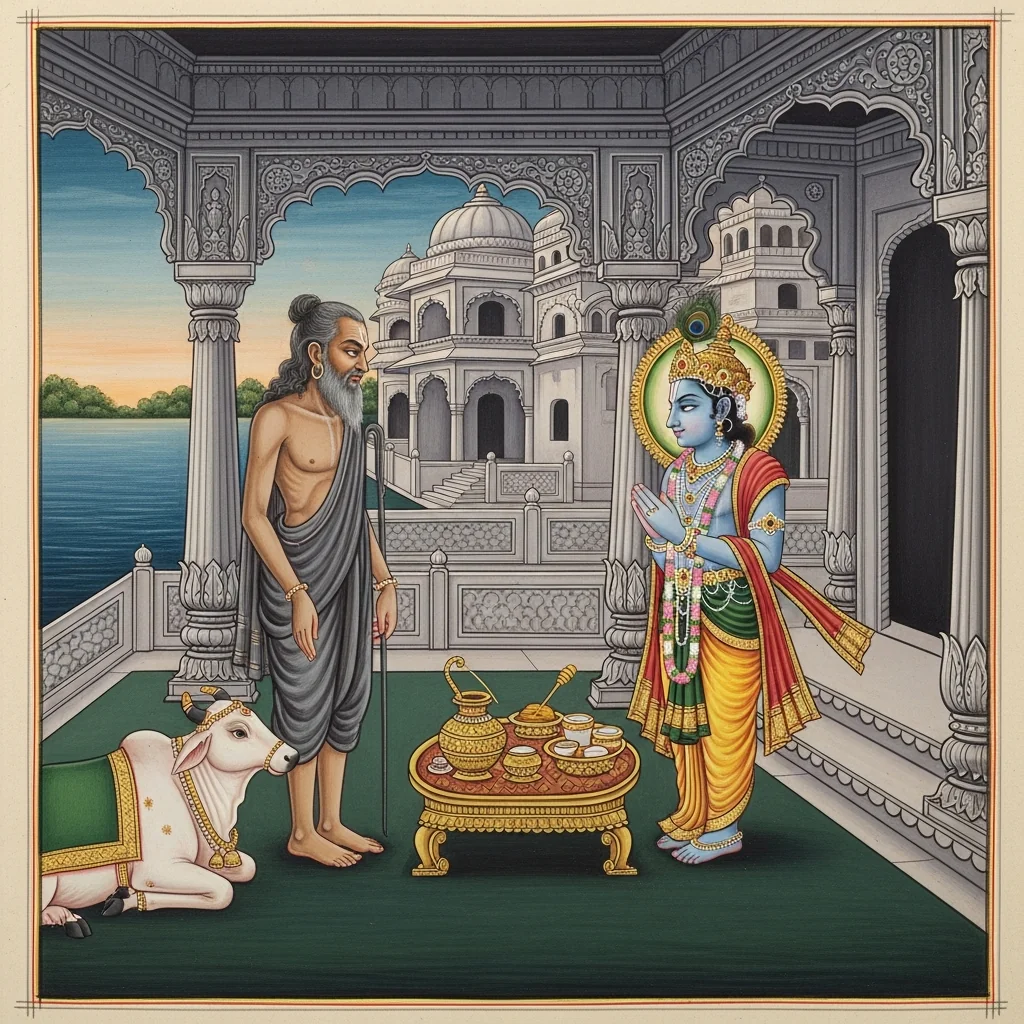
The chapter begins with Prahlāda addressing the sages, praising Dvārakā/Dvārāvatī as a sea-side sacred city on the Gomati, the Lord’s supreme abode and a saving destination in Kali-yuga. The sages raise a theological-historical doubt: if the Yādava line has ended and Dvārakā is said to be inundated, how can the Lord still be proclaimed there in Kali? The scene shifts to Ugrasena’s court, where news arrives that the sage Durvāsā is staying near the Gomati at Cakratīrtha. Kṛṣṇa, with Rukmiṇī, goes to receive him, stressing that honoring a guest is a binding dharmic duty with ritual consequences. Asked about the city’s extent, households, and dependents, Kṛṣṇa describes the sea-granted land, golden palaces, and the vast web of family and retinue, revealing the wonder of divine māyā and limitless power. Durvāsā then tests humility by having Kṛṣṇa and Rukmiṇī carry him on a chariot. When the thirsty Rukmiṇī drinks water without seeking his permission, Durvāsā curses her with perpetual thirst and separation from Kṛṣṇa. Kṛṣṇa consoles her with a teaching on mediated presence—seeing him there implies seeing her—and urges devotional attentiveness. The chapter ends with Kṛṣṇa appeasing and worshiping Durvāsā through full hospitality rites: washing the feet, offering arghya, gifting a cow, presenting madhuparka, and feeding him, establishing a canonical model of guest-reception ethics.
Shlokas
Verse 1
प्रह्लाद उवाच । सर्वेषामपि भूतानां दैत्यदानवरक्षसाम् । भवन्तो वै पूज्यतमा देवादीनां तथैव च
Prahlāda said: Among all beings—even among Daityas, Dānavas, and Rākṣasas—you sages are indeed the most worthy of worship, and likewise among the Devas and others as well.
Verse 2
अनुज्ञया तु युष्माकं प्रसादात्केशवस्य हि । अधिष्ठानं भगवतः कथयामि निबोधत
With your permission, and by the grace of Keśava, I shall describe the Lord’s sacred abode—listen and understand.
Verse 3
पश्चिमस्य समुद्रस्य तीरमाश्रित्य तिष्ठति । कुशस्थलीति या पूर्वं कुशेन स्थापिता पुरी
Resting upon the western ocean’s shore stands that city which was formerly called Kuśasthalī—the town established long ago by Kuśa.
Verse 4
वहते गोमती यत्र सागरेण समंततः । द्वारावतीति सा विप्रा आनर्त्तेषु प्रकीर्त्तिता
Where the Gomati flows and the sea surrounds it on every side—O brāhmaṇas—that place is renowned among the Ānartas as “Dvārāvatī.”
Verse 5
तस्यां वसति विश्वात्मा सर्वकामप्रदो हरिः । कला षोडशसंयुक्तो मूर्तिं द्वादशकान्वितः
There dwells Hari, the Soul of the universe, bestower of all desired aims—endowed with the sixteen divine excellences and manifest in twelvefold forms.
Verse 6
तदेव परमं धाम तदेव परमं पदम् । द्वारका सा च वै धन्या यत्राऽस्ते मधुसूदनः
That alone is the supreme abode; that alone is the highest state. Blessed indeed is that Dvārakā where Madhusūdana resides.
Verse 7
यत्र कृष्णश्चतुर्बाहुः शंखचक्रगदाधरः । नरा मुक्तिं प्रयास्यंति तत्र गत्वा कलौ युगे
Where Kṛṣṇa, four-armed, bearing conch, discus, and mace, is present—people who go there, even in the Kali age, attain liberation.
Verse 8
तच्छ्रुत्वा वचनं तस्य प्रह्लादस्य महात्मनः । विस्मयाविष्टमनसस्तमूचुर्मुनिसत्तमाः
Hearing the words of that great-souled Prahlāda, the foremost sages—their minds filled with wonder—spoke to him.
Verse 9
ऋषय ऊचुः । क्षयं यदुकुले याते भारे चोपहृते भुवः । प्रभासे यादवश्रेष्ठः स्वस्थानमगमद्धरिः
The sages said: When the Yadu lineage met its end and the burden of the earth had been lifted away, at Prabhāsa Hari—the foremost among the Yādavas—departed to His own divine abode.
Verse 10
द्वारावत्या प्लावितायां समंतात्सागरेण हि । कथं स भगवांस्तत्र कलौ दैत्य प्रकीर्त्यते
When Dvārāvatī has been submerged on all sides by the ocean, how, O Daitya, is that Blessed Lord said to be there in the Kali age?
Verse 11
कथयस्व सुरश्रेष्ठ कथं विष्णुर्महीतले । स्थितश्चानर्त्तविषय एतद्विस्तरतो वद
O best among the gods, tell me: how did Viṣṇu come to dwell upon the earth, and how did He take His station in the land of Ānarta (the Dvārakā region)? Relate this to me in full detail.
Verse 12
उग्रसेने नरपतौ प्रशासति वसुन्धराम् । कृष्णो यदुपुरीमेतां शोभयामास सर्वतः
While King Ugrasena ruled the earth, Kṛṣṇa beautified this city of the Yadus (Dvārakā) on every side.
Verse 13
रममाणे रमानाथे रामाभिरमणे हरौ । एकदा तु समासीने सभायां यदुसत्तमे
Once, as Hari—the Lord of Ramā (Śrī)—was delighting in the company of the rāmāḥ (noble ladies), He sat in the assembly as the foremost among the Yadus.
Verse 14
कथाभिः क्रियमाणाभिर्विचित्राभिरनेकधा । उद्धवः कथयामास प्रचारं यदुनंदनम्
As many wondrous conversations unfolded in diverse ways, Uddhava spoke to Yadunandana (Śrī Kṛṣṇa), conveying the news of a visitor’s arrival and movements.
Verse 15
यात्रायामनुसंप्राप्तं दुर्वाससमकल्मषम् । स्थितं तं गोमतीतीरे चक्रतीर्थसमीपतः
Durvāsā—stainless and free from sin—had arrived in the course of his pilgrimage and was staying on the bank of the Gomati, near Cakratīrtha.
Verse 16
तच्छ्रुत्वा सहसोत्थाय भगवान्रुक्मिणीगृहम् । जगाम हृष्टमनसा विश्वशक्तिरधोक्षजः
Hearing this, the Blessed Lord—Adhokṣaja, the power of the universe—rose at once and, with a joyful heart, went to Rukmiṇī’s residence.
Verse 17
आगत्योवाच वैदर्भीं संप्राप्तमृषिसत्तमम् । तपोनिर्धूत पाप्माऽयमत्रिपुत्रो महातपाः
Having come, he said to the princess of Vidarbha (Rukmiṇī): “The foremost of sages has arrived—this is Atri’s son, the great ascetic, whose sins have been burned away by austerity (tapas).”
Verse 18
आतिथ्येनार्चितो विप्रो दास्यते च महोदयम् । गृहिणी न गृहे यस्य सत्पात्रागमनं वृथा
When a brāhmaṇa is honored with hospitality (ātithya), he bestows great prosperity. But the house in which there is no true mistress of the home—there the arrival of a worthy guest is in vain.
Verse 19
तस्य देवा न गृह्णंति पितरश्च तथोदकम् । तदागच्छस्व गच्छामो निमंत्रयितुमत्रिजम्
For such a one, the gods accept no offerings, nor do the ancestors accept even the libations of water. Therefore, come—let us go to invite Atri’s son (Durvāsā).
Verse 20
तथेत्युक्त्वा तु सा देवी रथमारुरुहे सती । रथमारुह्य देवेशो रुक्मिण्या सहितो हरिः । जगाम तत्र यत्रास्ते दुर्वासा मुनिसत्तमः
Saying, “So be it,” that noble goddess mounted the chariot. Then Hari, the Lord of the gods, also ascended the chariot together with Rukmiṇī, and went to the place where Durvāsā, the best of sages, was staying.
Verse 21
दृष्ट्वा ज्वलंतं तपसा कूले नदनदीपतेः । कापालिकस्य पुरतः सुस्नातं वरसीकरैः
They beheld the sage blazing with ascetic power on the bank of the lord of rivers, and saw that skull-bearing ascetic freshly bathed, his body sprinkled with auspicious droplets of water.
Verse 22
प्रणम्य भगवान्भक्त्या पप्रच्छाऽनामयं ततः । पश्चाद्विदर्भतनया रुक्मिणी प्रणनाम तम्
After bowing with devotion, the Blessed Lord inquired about his well-being. Then afterward, Rukmiṇī—the daughter of Vidarbha—also bowed to him.
Verse 23
दुर्वासाश्चापि तौ दृष्ट्वा दर्शनार्थमुपागतौ । पप्रच्छ कुशलं तत्र स्वागतेनाभिनंद्य च
Durvāsā too, seeing the two of them come for his darśana, welcomed them there and, honoring their arrival, inquired about their welfare.
Verse 24
दुर्वासा उवाच । कुशलं कृष्ण सर्वत्र कुत्र वासस्तवाऽधुना । कति दारा धनापत्यमेतद्विस्तरतो वद
Durvāsā said: “O Kṛṣṇa, are you well everywhere? Where is your dwelling now? How many wives do you have, and what of your wealth and progeny? Tell me this in detail.”
Verse 25
श्रीकृष्ण उवाच । समुद्रेण प्रदत्ता मे भूभिर्द्वादशयोजना । तस्यां निवसतो ब्रह्मन्पुरी हेममयी मम
Śrī Kṛṣṇa said: “O Brahmin, the Ocean granted me land extending twelve yojanas. Dwelling there, my city is made of gold.”
Verse 26
प्रासादास्तत्र सौवर्णा नवलक्षाणि संख्यया । तस्यां वसामि संहृष्टस्त्वत्प्रसादात्सुनिर्भयः
“There, the palaces are golden—nine lakhs in number. I dwell in that city, joyful and utterly fearless, by your grace.”
Verse 27
तच्छुत्वा वचनं तस्य विस्मयाविष्टमानसः । प्रत्युवाच स दुर्वासाः प्रहस्य मधुसूदनम्
Hearing his words, Durvāsā—his mind seized with astonishment—smilingly replied to Madhusūdana (Kṛṣṇa).
Verse 28
वसंति तावका ये च तेषां संख्या वदस्व भोः । यावत्यश्च महिष्यस्ते पुत्राः परिजनास्तथा
“Tell me, sir, how many of your people dwell there. And how many queens you have, as well as your sons and attendants.”
Verse 29
श्रीकृष्ण उवाच । ब्रह्मन्षोडशसाहस्रं भार्य्याश्चाष्टाधिका मम । तासां मध्येऽभीष्टतमा विदर्भाधिपतेः सुता
Śrī Kṛṣṇa said: “O Brahmin, I have sixteen thousand wives, and eight more besides. Among them, the most beloved is the daughter of the king of Vidarbha.”
Verse 30
एकैकस्या दश सुताः कन्या चैका तथा मुने । षट्पंचाशद्यदूनां तु कोट्यः परिजनो मम
“For each (queen), there are ten sons and one daughter, O sage. And my retinue consists of fifty-six crores of Yādavas.”
Verse 31
शेषाः प्रकृतयो ब्रह्मंस्तेषां संख्या न विद्यते । तच्छ्रुत्वा चिंतयामास किमेतदिति विस्मितः
“O brāhmaṇa, the remaining manifestations of Prakṛti are beyond counting.” Hearing this, he reflected in astonishment, thinking, “What can this be?”
Verse 32
अहो ह्यनंतवीर्यस्य मायामाश्रित्य तिष्ठतः । अनंता सर्वकर्तृत्वे प्रवृत्तिर्दृश्यतामिय म्
Ah! For that One of endless power who abides supported by Māyā—this ceaseless activity of universal doership is seen in the world.
Verse 33
दुर्वासा उवाच । स्वागतं ते महाबाहो ब्रूहि किं करवाणि ते । दर्शनेन त्वदीयेन प्रीतिमेति च मे मनः
Durvāsā said: “Welcome to you, mighty-armed one. Tell me—what shall I do for you? By your very sight, my mind becomes filled with joy.”
Verse 34
श्रीकृष्ण उवाच । यदि प्रसन्नो भगवांस्तदागच्छस्व मे गृहम् । शिरसा धार्य्य पादांबु प्रयास्यामि पवित्रताम्
Śrī Kṛṣṇa said: “If you are pleased, O venerable one, then come to my house. Bearing the water from your feet upon my head, I shall attain purity.”
Verse 35
दुर्वासा उवाच । अक्षमासारसर्वस्वं किं मां नयसि माधव । नय मां यदि मद्वाक्यं करोषि सह भार्यया
Durvāsā said: “O Mādhava, you who are the very essence and all of forbearance—why do you not lead me as I desire? Lead me, if you will carry out my word, together with your wife.”
Verse 36
प्रह्लाद उवाच । एवमस्त्विति चोक्त्वा स प्रस्थितः स्वरथेन हि । तं दृष्ट्वा प्रस्थितं विष्णुं प्रहस्योवाच भर्त्सयन्
Prahlāda said: “Saying, ‘So be it,’ he set out indeed with his own chariot. Seeing Viṣṇu depart, he laughed and spoke, taunting him.”
Verse 37
दुर्वासा उवाच । दुर्वाससं न जानासि मुञ्चेमान्हयसत्तमान् । त्वं च भार्या तथा चेयं वहतं स्वरथेन माम्
Durvāsā said: “Do you not know Durvāsā? Unyoke these excellent horses. You—and your wife as well—must carry me in my own chariot.”
Verse 38
श्रीकृष्ण उवाच । भगवन्यथा प्रब्रवीषि विप्र कर्तास्मि तत्तथा । त्वया कृपालुना ब्रह्मन्पारितोऽहं सबांधवः
Śrī Kṛṣṇa said: “O venerable brāhmaṇa, just as you command, so shall I do. O brāhmaṇa, by your compassion I—together with my kinsmen—am protected and sustained.”
Verse 39
प्रह्लाद उवाच । तौ तथा ऋषिवर्य्योऽसौ युक्तां देवीं रथे स्वके । तथैव पुण्डरीकाक्षं याहि याहीत्यभाषत
Prahlāda said: That foremost of sages duly seated the goddess (the queen) in his own chariot, and likewise addressed Puṇḍarīkākṣa (Kṛṣṇa), saying, “Go on, go on!”
Verse 40
तं दृष्ट्वा देवताः सर्वा वहमानं रथं हरिम् । साधुसाध्विति भाषंत ऊचुः सर्वे परस्परम्
Seeing Hari hauling the chariot, all the gods exclaimed to one another, repeatedly saying, “Excellent! Excellent!”
Verse 41
अहो ब्रह्मण्यदेवस्य परां भक्तिं प्रपश्यत । स्कन्धे कृत्वा धुरं यो हि वहते भार्य्यया सह
Behold the supreme devotion of the Lord, ever gracious to the brāhmaṇas! For He, together with His wife, bears the yoke upon His own shoulder.
Verse 42
विकीर्यमाणः कुसुमैः सुरसंघैर्जनार्दनः । जगाम स रथं गृह्य सभार्यो द्वारकां प्रति
While hosts of gods showered Him with flowers, Janārdana mounted the chariot and, together with His wife, set out toward Dvārakā.
Verse 43
उह्यमाने रथे तस्मिन्रुक्मिणी तृषिताऽभवत् । उवाच कृष्णं वैदर्भी श्रमव्याकुललोचना
As that chariot was being drawn along, Rukmiṇī became thirsty. The princess of Vidarbha, her eyes distressed with fatigue, spoke to Kṛṣṇa.
Verse 44
श्रान्ता भारपरिक्लिष्टा वहती कोपनं द्विजम् । पाययित्वोदकं कान्त नय मां मन्दिरं स्वकम्
I am weary and weighed down, bearing this irascible brāhmaṇa. O beloved, after giving him water to drink, lead me to my own dwelling.
Verse 45
तच्छ्रुत्वा वचनं तस्याः पादाक्रान्त्या धरातलात् । आनयामास भगवान्गगां त्रिपथगां शुभाम्
Hearing her words, the Blessed Lord pressed the earth with His foot and brought forth from the ground the auspicious Gaṅgā—the river that flows through the three worlds.
Verse 46
तद्दृष्ट्वा निर्मलं शीतं सुगंधं पावनं तथा । पपौ पिपासिता देवी रुक्मिणी जाह्नवीजलम्
Seeing that water—clear, cool, fragrant, and purifying—the thirsty goddess Rukmiṇī drank the water of Jāhnavī (Gaṅgā).
Verse 47
पीतं तया जलं दृष्ट्वा चुकोप ऋषिसत्तमः । जज्वाल ज्वलनप्रख्यः शशाप परमेश्वरीम्
Seeing that she had drunk the water, the foremost of sages became enraged; blazing like fire, he pronounced a curse upon the exalted lady.
Verse 48
दुर्वासा उवाच । मामपृष्ट्वा जलं यस्मात्पीतवत्यसि रुक्मिणी । तस्मात्पानरता नित्यं भविष्यसि न संशयः
Durvāsā said: “Rukmiṇī, since you drank the water without asking me, therefore you shall always be attached to drinking—of this there is no doubt.”
Verse 49
अवियुक्ता रथाद्यस्मान्मामपृष्ट्वा जलं त्वया । पीतं तस्माच्च कृष्णेन वियुक्ता त्वं भविष्यसि
“Because, while you were not separated from the chariot, you drank the water without asking me; therefore you too shall be separated from Kṛṣṇa.”
Verse 50
प्रह्लाद उवाच । एतावदुक्त्वा वचनं क्रोधसंरक्तलोचनः । परित्यज्य रथं विप्रो भूमावेवावतिष्ठति
Prahlāda said: Having spoken these words, the brāhmaṇa—his eyes reddened with anger—abandoned the chariot and remained seated on the ground.
Verse 51
एवं शप्ता तदा देवी रुदोदातीव विह्वला । उवाच कृष्णं करुणं कथं स्थास्ये त्वया विना
Thus cursed, the Goddess—trembling as though weeping aloud—spoke to compassionate Kṛṣṇa: “How shall I remain here without you?”
Verse 52
श्रीकृष्ण उवाच । आयास्ये प्रत्यहं देवि द्विकालं भवनं तव । यो मां पश्यति चात्रस्थं स त्वामेव प्रपश्यति
Śrī Kṛṣṇa said: “O Goddess, I shall come to your abode every day, at both times (morning and evening). Whoever beholds Me present here, truly beholds you as well.”
Verse 53
मां हि दृष्ट्वा नरो यस्तु त्वां न पश्यति भक्तितः । अर्द्ध्ं यात्रा फलं तस्य भविष्यति न संशयः
Indeed, if a man beholds Me yet does not, with devotion, behold you, then only half the fruit of the pilgrimage will be his—of this there is no doubt.
Verse 54
आश्वास्य च प्रियामेवं ब्राह्मणं यदुनन्दनः । ततः प्रसादयामास दुर्वाससमकल्मषम्
Thus having comforted His beloved, Kṛṣṇa, the delight of the Yadus, then sought to please the brāhmaṇa Durvāsā, the sage free from every taint.
Verse 55
बाह्यो पवनमध्ये तु पूजयामास तं तथा । अवनिज्य स्वयं पादौ विप्रपादावनेजनम् । धारयामास शिरसा जगतः पावनो हरिः
Outdoors, in the open air, He honored him duly. Washing the brāhmaṇa’s feet with His own hands, Hari—the purifier of the worlds—placed that foot-water upon His head.
Verse 56
दत्त्वार्घ्यं गां च विप्राय मधुपर्कं स भक्तितः । विधिवद्भोजयामास षड्रसेन द्विजोत्तमम्
With devotion he offered the brāhmaṇa arghya, a cow, and madhuparka; then, according to rule, he fed that foremost of the twice-born with foods embodying the six tastes.