Adhyaya 7
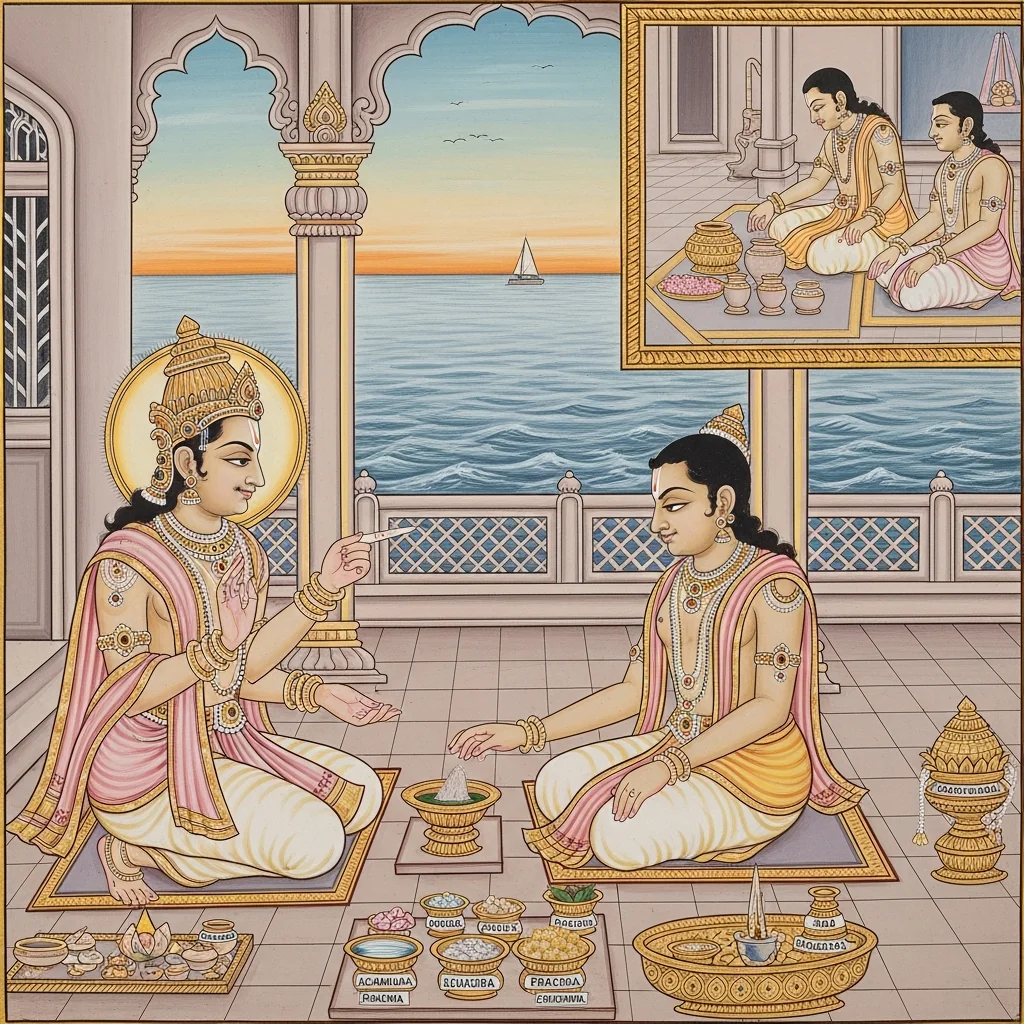
The chapter presents Prahlāda’s step-by-step instruction to learned pilgrims (dvija-śreṣṭhas) concerning the sea-side sacred ford known as Cakra-tīrtha/Rathāṅga. It first establishes the site’s holiness: stones bearing the mark of the cakra are said to conduce to liberation, and the tīrtha is validated through its direct connection with the vision of Bhagavān Kṛṣṇa, making it a supreme destroyer of sins. It then lays down ritual protocol. Pilgrims approach, wash feet, hands, and mouth, prostrate, and prepare an arghya offering with pañca-ratna and auspicious items—flowers, akṣata, gandha, fruits, gold, and sandal—while reciting a Viṣṇu-cakra-centered mantra. Bathing follows with a formulaic remembrance linking deities and cosmic principles; afterward one applies sacred clay, performs tarpaṇa for ancestors and deities, and proceeds to śrāddha. The phalāśruti magnifies the reward by comparing it to great sacrifices and famed pilgrimage standards such as Prayāga, asserting that mere bathing here yields equivalent merit. It further prescribes dāna—especially provisions, vehicles/animals, and ratha-related gifts—as pleasing to Jagatpati, and concludes with salvific and ancestral benefits: uplift of forebears in all conditions, attainment of proximity to Viṣṇu, and eradication of sins accrued by speech, action, and mind.
Shlokas
Verse 1
श्रीप्रह्लाद उवाच । ततो गच्छेद्द्विजश्रेष्ठा रथांगाख्यं महोदधिम् । चक्रांका यत्र पाषाणा दृश्यंते मुक्तिदायकाः
Śrī Prahlāda said: Then, O best of brāhmaṇas, one should go to the great ocean called Rathāṅga, where stones bearing the marks of the Disc are seen—bestowers of liberation.
Verse 2
यैः पूज्यते जगन्नाथः प्रत्यहं भाव संयुतैः । सदा नेत्रैरनिमिषैर्वीक्ष्यते च जनार्दनः
By those who, filled with devotion, worship Jagannātha every day, Janārdana is ever beheld with unblinking eyes.
Verse 3
यच्च साक्षाद्भगवता दृष्टं कृष्णेन दृष्टितः । तत्तीर्थं सर्वपापघ्नं चक्राख्यं परमं हरेः
And that place which was directly beheld by the Blessed Lord—by Kṛṣṇa’s own gaze—becomes the supreme tīrtha of Hari, called Cakra, destroying all sins.
Verse 4
यस्य प्रसिद्धिः परमा त्रैलोक्ये सचराचरे । प्रयागादधिकं यच्च मुक्तिदं ह्यस्ति पावनम्
Its renown is supreme throughout the three worlds, among all that moves and all that is still. It is said to surpass even Prayāga—purifying and bestowing mokṣa, liberation.
Verse 5
सुरैरपि प्रपूज्यंते यत्रांगानि शरीरिणाम् । अंकितानि च चक्रेण षण्मासान्नात्र संशयः
There, even the gods greatly revere the limbs of embodied beings—those that, within six months, become marked with the Disc (Cakra). Of this there is no doubt.
Verse 6
यद्दृष्ट्वा मुच्यते पापात्प्रसंगेनापि मानवः । तत्तीर्थं सर्वतीर्थानां पावनं प्रवरं स्मृतम्
That tīrtha—by merely beholding which a person is freed from sin, even if only by chance—is remembered as the foremost purifier among all sacred fords.
Verse 7
तत्र गत्वा द्विजश्रेष्ठाः प्रक्षाल्य चरणौ मुदा । करौ चास्यं चैव पुनः प्रणमेद्दंडवत्पुनः
Having gone there, O best of the twice-born, one should joyfully wash the feet, the hands, and the mouth; and then once more bow again in full daṇḍavat prostration.
Verse 8
प्रणिपत्य गृहीत्वार्घ्यं पंचरत्नसमन्वितम् । सपुष्पाक्षतगंधैश्च फलहेमसुचंदनैः
After bowing down, one should take up an arghya-offering furnished with the five gems, together with flowers, akṣata (unbroken rice), fragrances, fruits, gold, and fine sandalwood.
Verse 9
संपन्नमर्घ्यमादाय मंत्रमेतमुदीरयेत् । प्रत्यङ्मुखः सुनियतः संमुखो वा महोदधेः
Taking the well-prepared arghya, one should recite this mantra—either facing west, with steady self-restraint, or else facing the great ocean.
Verse 10
ॐ नमो विष्णु रूपाय विष्णुचक्राय ते नमः । गृहाणार्घ्यं मया दत्तं सर्वकामप्रदो भव
Oṁ—salutations to the form of Viṣṇu; salutations to you, the discus of Viṣṇu. Accept this arghya offered by me; become the bestower of all desired aims.
Verse 11
अग्निश्च तेजो मृडया च रुद्रो रेतोधा विष्णुरमृतस्य नाभिः । एतद्ब्रुवन्वाडवाः सत्यवाक्यं ततोऽवगाहेत पतिं नदीनाम्
“Agni is its radiance; Rudra is its gracious power; Viṣṇu is its life-bearing essence, and it is the navel of immortality.” Speaking these true words, O sages, one should then bathe in the Lord of rivers.
Verse 12
मृदमालभ्य सजलां विप्रा देवकरच्युताम् । धारयित्वा तु शिरसा स्नानं कुर्य्याद्यथाविधि
O brāhmaṇas, having taken moist earth that has fallen from the hand of the deity, and having placed it upon the head, one should then bathe according to rule.
Verse 13
तर्पयेच्च पितॄन्देवान्मनुष्यांश्च यथाक्रमम् । तर्पयित्वा हविर्द्रव्यं प्रोक्षयित्वा च भक्तितः
One should offer libations to the ancestors, the gods, and human beings in due order; and after satisfying them, one should, with devotion, sprinkle the oblation-material with sanctifying water.
Verse 14
अश्वमेधसहस्रेण सम्यग्यष्टेन यत्फलम् । स्नानमात्रेण तत्प्रोक्तं चक्रतीर्थे द्विजोत्तमाः
Whatever fruit is gained by a thousand Aśvamedha sacrifices duly performed—that very fruit is declared to arise from mere bathing at Cakratīrtha, O best of the twice-born.
Verse 15
प्रयागे यत्फलं प्रोक्तं माघ्यां माधवपूजने । स्नानमात्रेण तत्प्रोक्तं चक्र तीर्थे द्विजोत्तमाः
Whatever fruit is spoken of at Prayāga for the worship of Mādhava in the month of Māgha—that very fruit is declared to arise from mere bathing at Cakra-tīrtha, O best of the twice-born.
Verse 16
कारयेच्च ततः श्राद्धं पितॄणां श्रद्धयान्वितः । विश्वेदेवान्सुवर्णेन राजतेन तथा पितॄन्
Thereafter, with faith, one should have the śrāddha performed for the Pitṛs; and one should honor the Viśvedevas with gold, and the ancestors likewise with silver.
Verse 17
संतर्प्य भोजनेनैव वस्त्रालंकारभूषणैः । दीनान्धकृपणेभ्यश्च दानं देयं स्वशक्तितः
Having satisfied them with food, and with garments, ornaments, and adornments, one should also give charity—according to one’s capacity—to the poor, the blind, and the destitute.
Verse 18
चक्रतीर्थे तीर्थवरे विशेषाद्द्विजसत्तमाः । रत्नदानं प्रकुर्वीत प्रीणनार्थं जगत्पतेः
At Cakratīrtha—the excellent of tīrthas—O best of twice-born, one should especially make gifts of jewels, for the sake of pleasing the Lord of the universe.
Verse 19
गन्त्रीमनडुहा युक्तां सर्वास्तरणसंयुताम् । सोपस्करां च दद्याद्वै विष्णुर्मे प्रीयतामिति
Indeed, one should donate a cart yoked with oxen, fully furnished with all coverings and equipment, saying, “May Viṣṇu be pleased with me.”
Verse 20
सुविनीतं शीलयुतं तथा सोपस्करं हयम् । भूषयित्वा च विप्राय दद्याद्दक्षिणया सह
One should adorn a well-trained horse, of good conduct and furnished with equipment, and give it to a brāhmaṇa together with a proper honorarium (dakṣiṇā).
Verse 21
एवं कृते द्विजश्रेष्ठाः कृतकृत्यो भवेन्नरः । मुक्तिं प्रयांति तस्यैव पितरस्त्रिकुलोद्भवाः
When this is done, O best of brāhmaṇas, a man becomes one who has fulfilled his duties; and his ancestors—arising from the three lines of kin—attain liberation.
Verse 22
प्रेतयोनिं गता ये च ये च कीटत्वमागताः । पच्यंते नरके ये च महारौरवसंज्ञके
Even those who have fallen into the state of pretas, those who have become worms, and those who are being tormented in the hell called Mahāraurava—
Verse 23
ते सर्वे तृप्तिमायांति चकतीर्थ प्रभावतः । श्राद्धे कृते द्विजश्रेष्ठा गयाश्राद्धफलं लभेत्
All of them attain satisfaction by the power of Cakratīrtha; and when śrāddha is performed there, O best of brāhmaṇas, one obtains the fruit of the famed Gayā-śrāddha.
Verse 24
या गतिर्मातृभक्तानां यज्वनां या गतिः स्मृता । चक्रतीर्थे द्विजश्रेष्ठाः स्नात्वा तां लभते नरः
Whatever blessed state is remembered for those devoted to their mother, and whatever state is spoken of for sacrificers, that very state a man attains by bathing at Cakratīrtha, O best of brāhmaṇas.
Verse 25
श्राद्धं प्रशस्तं विप्रेंद्राः संप्राप्ते चंद्रसंक्षये । सूर्यग्रहे विशेषेण कुरुक्षेत्रफलं स्मृतम् । श्राद्धे स्नाने तथा दाने पितॄणां तर्पणे तथा
Śrāddha is highly commended, O lords among brāhmaṇas, when the waning of the moon arrives; and especially at a solar eclipse it is said to yield the fruit of (a pilgrimage to) Kurukṣetra—whether in śrāddha, in bathing, in charity, and likewise in the libations offered to the Pitṛs.
Verse 26
प्रशस्तं चक्रतीर्थं च नात्र कार्य्या विचारणा
Cakratīrtha is indeed most excellent; about this there is no need for any further deliberation.
Verse 27
सर्वदा पावनं विप्राश्चक्रतीर्थं न संशयः । यस्तु श्राद्धं प्रकुर्वीत यात्रायामागतो नरः
O brāhmaṇas, Cakratīrtha is ever-purifying—of this there is no doubt. And the person who, having come on pilgrimage, performs a śrāddha…
Verse 28
चक्रतीर्थे द्विजश्रेष्ठाः संपूज्य मधुसूदनम् । पूजितेषु द्विजेंद्रेषु विष्णुसांनिध्यमाप्नुयात्
O best of brāhmaṇas, at Cakratīrtha, having duly worshiped Madhusūdana (Viṣṇu), and having honored the foremost brāhmaṇas, one attains the close presence of Viṣṇu.
Verse 29
वाचा कृतं कर्मकृतं मनसां समुपार्जितम् । स्नानमात्रेण तत्पापं नश्यते नात्र संशयः
Sins committed by speech, by deeds, and accumulated within the mind—by bathing here alone that sin is destroyed; of this there is no doubt.