Adhyaya 30
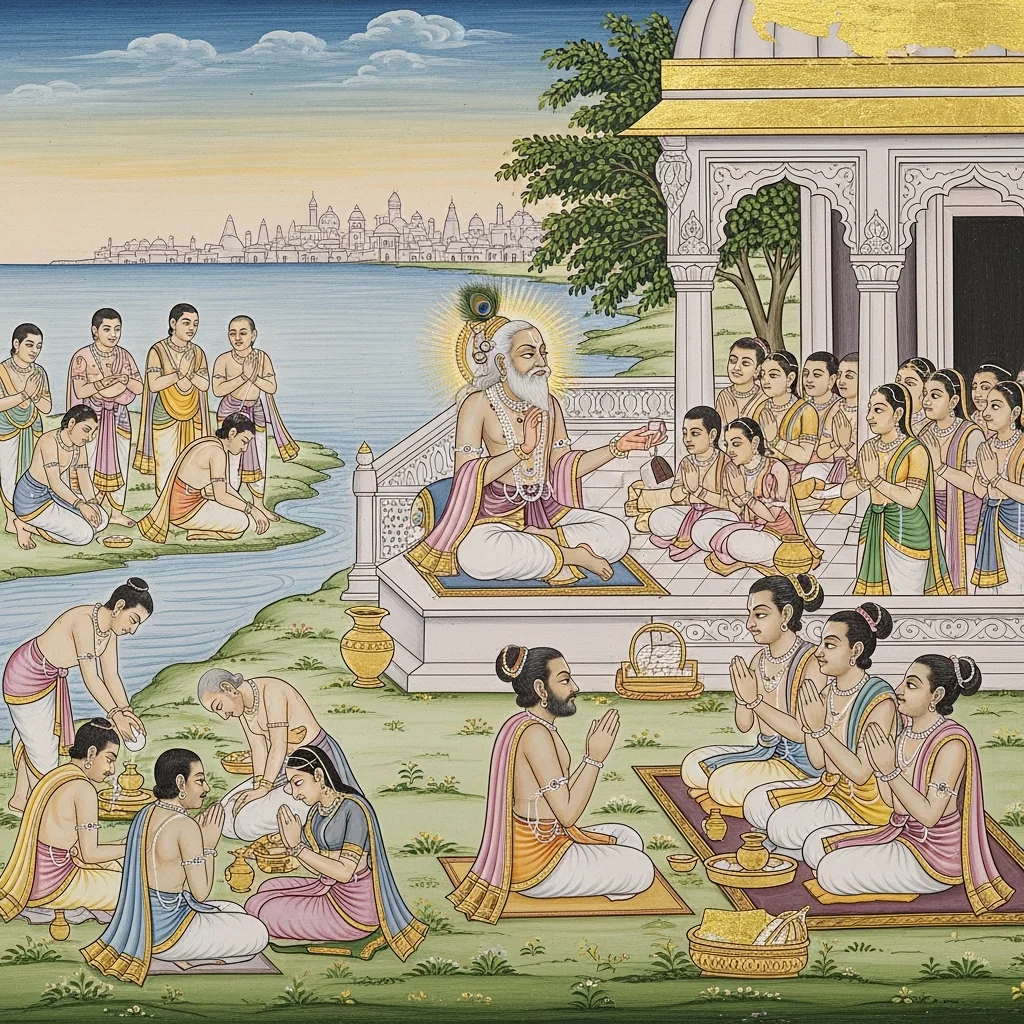
Adhyāya 30 unfolds as a procedural and ethical guide to the pilgrimage to Dvāravatī/Kuşasthalī for Kṛṣṇa-darśana, framed within Prahlāda’s narration. He describes a universal eagerness among tīrthas, kṣetras, ṛṣis, and devas to journey to Kṛṣṇa’s holy city, and the appearance of Nārada and Gautama is taken as an omen of an approaching, festival-like mass pilgrimage. The ṛṣis then respectfully question Nārada—hailed as the supreme guide among yogins—about the proper method (vidhi), required disciplines (niyama), things to avoid (varjanīya), what should be heard/recited/remembered on the road, and which celebrations are permitted. Nārada prescribes preparatory bathing and worship, feeding Vaiṣṇavas and brāhmaṇas according to one’s means, receiving Viṣṇu’s permission, and sustaining a devotional mind toward Kṛṣṇa. On the journey the pilgrim should remain calm, self-controlled, and pure; observe brahmacarya, sleep low (on the ground), and regulate the senses. Recommended practices include reciting divine names (including sahasranāma), reading Purāṇas, compassionate conduct, and service to the virtuous. Charity—especially food-giving—is strongly praised, with great merit even for small offerings, while quarrelsome speech, slander, deceit, and reliance on others’ food despite having means are forbidden. The chapter returns to Prahlāda’s narrative to portray varied expressions of bhakti along the way: listening to Viṣṇu-kathā, chanting names, singing, instrumental music, flags and festive processions, with rivers and famed tīrthas joining symbolically. It culminates as the pilgrims behold Kṛṣṇa’s abode from afar, affirming the yātrā as both communal worship and ethical training.
Shlokas
Verse 1
श्रीप्रह्लाद उवाच । तदा तेषां सुतीर्थानां क्षेत्राणामभवन्मुदः । गन्तुं द्वारवतीं पुण्यां सर्वेषामपि सर्वशः
Śrī Prahlāda said: Then joy arose among all those excellent tīrthas and sacred regions—every one of them, in every way—desiring to go to the holy Dvāravatī (Dvārakā).
Verse 2
द्वारकागमने दृष्ट्वा तथा नारदगौतमौ । महोत्सवो महांस्तत्र भविष्यति मनोहरः
Seeing that journey toward Dvārakā—and Nārada and Gautama as well—it was known that a great and delightful festival would take place there.
Verse 3
तीर्थानां कृष्णयात्रायां गन्तव्यमित्यवो चतुः । अथ ते ह्यृषयो देवाः सर्वतीर्थसमन्विताः
They declared, “To the Kṛṣṇa-pilgrimage of the tīrthas we must go.” Then those sages and divine beings—endowed with the power of all tīrthas—proceeded accordingly.
Verse 4
गौतमीं तु पुरस्कृत्य ययुर्द्वारवतीं मुदा । तदा सर्वाणि तीर्थानि क्षेत्रारण्यानि कृत्स्नशः । द्वारकागमनं चक्रुः सानन्दा ऋषयः सुराः
Placing the Gautamī in the forefront, they went joyfully to Dvāravatī. Then all the tīrthas—along with the sacred regions and forest-shrines, entirely—made the journey to Dvārakā, as sages and gods rejoiced.
Verse 5
श्रद्धया परया भक्त्या कृष्णदर्शनलालसाः । वीणानिनादतत्त्वज्ञं नारदं पथि तेऽ ब्रुवन्
With deep faith and supreme devotion, yearning for the vision of Kṛṣṇa, they spoke on the road to Nārada—knower of the truth of the vīṇā’s resonance and its spiritual meaning.
Verse 6
ऋषय ऊचुः । राशयः पुण्यपुञ्जानां कृता वै तपसां तथा । यज्ञदानव्रतानां च तीर्थानां महतां भुवि
The sages said: “Upon the earth are gathered heaps of holy merit—born of austerities, and likewise of sacrifice, gifts, and vows—and also of the great tīrthas.”
Verse 7
संप्राप्तस्तत्प्रसादोऽयं यद्द्रक्ष्यामः कुशस्थलीम् । पृच्छामहेऽधुना त्वां वै योगिनां परमं गुरुम्
This grace has been attained: that we shall behold Kuśasthalī (Dvārakā). Therefore we now question you indeed, O supreme guru among yogins.
Verse 8
द्वारकायास्तु यात्रायां को विधिः संप्रकीर्तितः । नियमः कोऽत्र कर्त्तव्यो वर्जनीयं च किं मुने
O sage, what procedure is prescribed for the pilgrimage to Dvārakā? What disciplines should be observed there, and what should be avoided?
Verse 10
श्रोतव्यं कीर्तितव्यं च स्मर्तव्यं किं च वै पथि । उत्सवाश्चात्र के प्रोक्ता द्वारकायाश्च तत्पथि । एकैकश्च महाभाग भक्तानन्दविवर्द्धनम् । एतत्सर्वं महाभाग कृपया संप्रकीर्त्यताम्
Along the road, what should be listened to, what should be sung in praise, and what should be remembered? What festivals are prescribed on this route to Dvārakā? Each of these, O noble one, increases the joy of devotees—out of compassion, please proclaim it all.
Verse 11
श्रीनारद उवाच । कृताभ्यंगस्तु पूर्वेद्युः संपूज्य श्रद्धया हरिम् । भोजयेद्वैष्णवान्विप्रान्स्वशक्त्या संप्रहर्षितः
Śrī Nārada said: “On the previous day, having performed the oil-bath (abhyanga), one should worship Hari with faith; then, rejoicing, one should feed Vaiṣṇavas and brāhmaṇas according to one’s capacity.”
Verse 12
अनुज्ञातो महाविष्णोः प्रसादमुपयुज्य वै । शयीत भुवि सुप्रीतो द्वारकां कृष्णमानसः
Having received Mahāviṣṇu’s permission and partaken of His prasāda (consecrated offering), one should sleep upon the ground in contentment, with the mind fixed on Kṛṣṇa and the resolve set on reaching Dvārakā.
Verse 14
ततस्तु तदनुज्ञातो गीतवादित्रसंस्तवैः । यात्रारंभं प्रकुर्वीत द्वारकायां प्रहर्षितः
Then, having obtained that permission, one should begin the pilgrimage with songs, musical instruments, and hymns of praise, proceeding joyfully toward Dvārakā.
Verse 15
द्वारकां गच्छमानस्तु शान्तो दांतः शुचिः सदा । ब्रह्मचर्यमधः शय्यां कुर्वीत नियतेन्द्रियः
While going to Dvārakā, one should remain peaceful, self-controlled, and always pure; observing brahmacarya, one should sleep on the ground, with the senses restrained.
Verse 16
सहस्रनामपठनं पुराणपठनं तथा । कर्त्तव्यं सकृपं चित्तं सतां शुश्रूषणं तथा
One should recite the Sahasranāma (Thousand Names) and likewise read the Purāṇas; one should keep a compassionate heart and also render service to the virtuous.
Verse 17
अन्नदानादिकं सर्वं विभवे सति मानवः । अपि स्वल्पं स्वशक्त्या वै कृतं कोटिगुणं भवेत्
So long as one has the means, a person should perform every act of merit beginning with the gift of food; even a little done according to one’s capacity truly becomes a millionfold in result.
Verse 18
पथि कृष्णस्य यो भक्त्या ग्रासमेकं प्रयच्छति । द्वीपांता तेन दत्ता भूः पुण्यस्यान्तो न विद्यते
Whoever, on Kṛṣṇa’s path, offers with devotion even a single morsel—by him the earth up to the ends of the continents is as though donated; there is no end to such merit.
Verse 19
किं पुनर्द्वारकाक्षेत्रे कृष्णस्य च समीपतः । कलावेकेकसिक्थे च राजसूयायुतं फलम्
How much more, then, in the sacred field of Dvārakā, and in Kṛṣṇa’s very presence! Even an offering as small as a single sesame-seed-like particle there yields the fruit of tens of thousands of Rājasūya sacrifices.
Verse 20
गयाश्राद्धसहस्राणि कृतानि शतसंख्यया । अन्नदानं कृतं यैस्तु द्वारकापथि मानवैः
For those people who perform gifts of food on the road to Dvārakā, it is as though they have performed thousands of Gayā-śrāddhas—indeed, counted by the hundreds.
Verse 21
औषधं चान्नपानीयं पादुके कंबलं तथा । वासांस्युपानहौ चैव वित्तं च विभवे सति । वर्जयेत्संकरं विद्वान्यूथालापांस्तथैव च
One should give medicine, food and drink, sandals and blankets, garments and footwear, and also money—according to one’s capacity. The wise should avoid disorderly mixing and also avoid idle chatter in crowds.
Verse 22
परनिन्दां च पैशुन्यं परस्य परिवञ्चनम् । परान्नं परपाकं च सति वित्ते त्यजेद्बुधः
When one has sufficient means, the wise should renounce slandering others, malicious tale-bearing, cheating others, and dependence on another’s food or another’s cooking.
Verse 23
न दोषो हीनवित्तस्य तावन्मात्रपरिग्रहे । श्रोतव्या सत्कथा विष्णोर्नामसंकीर्त्तनामृतम्
There is no fault for one of scant means in accepting only what is necessary. Rather, one should listen to the holy narratives of Viṣṇu—the nectar of chanting His names.
Verse 24
द्वारकापथिगच्छद्भिरन्योन्यं भक्तिवर्द्धनम् । जप्तव्यं वैदिकं जाप्यं स्तोत्रमागमिकं तथा
Those traveling on the Dvārakā route should mutually increase one another’s devotion; they should perform Vedic japa, and likewise recite Āgamic hymns.
Verse 25
यात्रायां यत्फलं प्रोक्तं श्रीकृष्णस्य च वै कलौ । न शक्यते मया वक्तुं वदनैर्युगसंख्यया
The fruit declared for Śrī Kṛṣṇa’s pilgrimage in the Kali age cannot be fully expressed by me—even with mouths numbering as many as the yugas.
Verse 26
इत्येतत्कथितं सर्वं यत्पृष्टं तु द्विजोत्तमाः । यतध्वं तत्प्रयत्नेन विष्णुप्राप्तौ च सत्वरम्
Thus, O best of twice-born ones, everything that you asked has been explained. Strive for it with effort—swiftly—toward attaining Viṣṇu.
Verse 27
श्रीप्रह्लाद उवाच । एवं ते नारदेनोक्ता मुनयो हृष्टमानसाः । चक्रुस्ते सहिताः सर्वे कृष्णदेवस्य तत्पथि
Śrī Prahlāda said: Thus instructed by Nārada, the sages—delighted in heart—set forth together upon that path of Lord Kṛṣṇa.
Verse 28
केचिच्छृण्वन्ति ता विष्णोः सत्कथा लोकविश्रुताः । यासां संश्रवणादेव भगवान्विशते हृदि
Some listen to those sacred, world-renowned narratives of Viṣṇu; by merely hearing them, the Lord enters the heart.
Verse 29
कीर्त्यमानानि नामानि महापुण्यप्रदानि वै । पावनानि सदा लोके कलौ विप्रा विशेषतः
The names that are sung bestow great merit; they are ever purifying in the world—especially in the Kali age, O brāhmaṇas.
Verse 30
पुराणसंहिता दिव्या मुनिभिः परिकीर्तिताः । प्रकाशयंति या विष्णोर्महिमानं सुमंगलम्
The divine compendia of the Purāṇas, praised by the sages, illuminate the supremely auspicious glory of Viṣṇu.
Verse 31
सद्गुणाः कर्मवीर्य्याणि कृतानि विष्णुना पुरा । लीलावताररूपैस्तु शृण्वन्ति परया मुदा
With supreme joy they listen to Viṣṇu’s noble qualities and heroic deeds performed long ago, manifested through His playful descents (avatāras).
Verse 32
अपरे वासुदेवस्य चरितानि सुमंगलाः । वदंति परया भक्त्या सानन्दाः साश्रुलोचनाः
Others, filled with bliss and eyes brimming with tears, recount with supreme devotion the supremely auspicious deeds of Vāsudeva.
Verse 33
अन्ये स्मरंति देवेशमनादिनिधनं विभुम् । केचिज्जपंति मुनयः स्तोत्राणि परया मुदा
Some remember the Lord of the gods—the all-pervading One, without beginning or end; and some sages, in supreme delight, chant hymns as japa.
Verse 34
केचित्तु शतनामानि जपन्ति मुनयः पथि । अन्ये सहस्रनामानि लक्षनाम तथाऽपरे
Some sages, as they journey, chant the hundred Names in japa; others chant the thousand Names, and still others the hundred-thousand Names.
Verse 35
केचिल्लौकिकगीतानि हरिनामानि हर्षिताः । उत्सवैश्च व्रजंत्यन्ये पताकादिविभूषिताः
Some, delighted, sing worldly melodies that bear the Names of Hari; others proceed in festival processions, adorned with banners and the like.
Verse 36
गीतवादित्रघोषेण करतालस्वनेन च । नास्ति धन्यतमस्तस्मात्त्रिषु लोकेषु कश्चन
By the clamor of song and instruments, and by the ringing of karatālas (hand cymbals), none in the three worlds is more blessed than such devotees.
Verse 37
दर्शनं यस्य संजातं वैष्णवानामनुत्तमम् । तथैव जाह्नवी पुण्या यमुना च सरस्वती
For one who has attained the incomparable darśana of the Vaiṣṇavas, the merit is likewise as though one had gained the holy Jāhnavī (Gaṅgā), Yamunā, and Sarasvatī.
Verse 38
रेवाद्याः सरितः सर्वाः प्रचक्रुर्गीतनर्त्तनम् । प्रयागादीनि तीर्थानि सागराः पर्वतोत्तमाः
All the rivers, beginning with the Revā, set themselves to song and dance; Prayāga and the other tīrthas, the oceans, and the most excellent of mountains likewise joined in the celebration.
Verse 39
वाराणसी कुरुक्षेत्रं पुण्यान्यन्यानि कृत्स्नशः । त्रैलोक्ये यानि तीर्थानि क्षेत्राणि देवनायकाः । चक्रुर्गीतं च नृत्यं च द्वारकायाश्च सत्पथि
Vārāṇasī, Kurukṣetra, and all other holy places—whatever tīrthas and sacred regions exist in the three worlds—together with the divine leaders, performed song and dance upon the noble path of Dvārakā.
Verse 40
एकैकस्मिन्पदे दत्ते द्वारकापथि गच्छताम् । पुण्यं क्रतुसहस्राणां तत्पादरजसंख्यया
For those who journey on the road to Dvārakā, with each single step they set forward, merit arises equal to thousands of Vedic sacrifices—measured by the very number of dust-particles touched by their feet.
Verse 41
अथ ते मुनयः सर्वे तीर्थक्षेत्रादिसंयुताः । श्रीमत्कृष्णालयं दूराद्ददृशुर्नारदादयः
Then all those sages—accompanied by the powers of sacred fords, holy fields, and the like—led by Nārada and others, beheld from afar the splendid abode of Śrī Kṛṣṇa.