Adhyaya 21
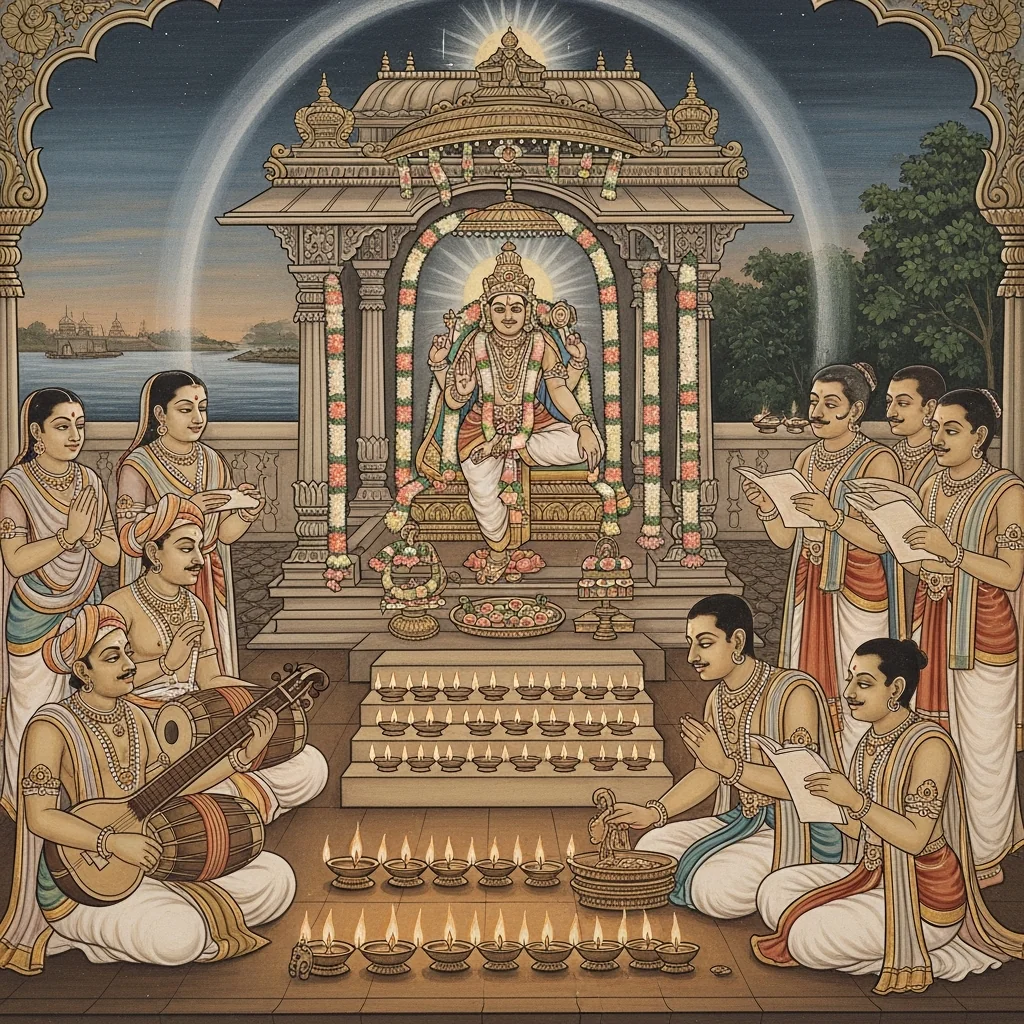
Adhyāya 21 weaves together theological dialogue, sacred-site legend, and ritual instruction. Prahlāda recalls an earlier incident of transgression connected with a Śiva-liṅga and addresses Kṛṣṇa; Viṣṇu responds with approval and grants a boon rooted in valor that accords with devotion to Śiva. Kuśa then teaches a harmonizing vision—Mahādeva and Hari are one reality in two forms—and asks that the liṅga established by the Lord be famed by his own name as “Kuśeśvara,” ensuring lasting renown for the locale. The narrative turns to tīrtha-topography: Mādhava dispatches other dānavas, some descending to Rasātala while others approach Viṣṇu; Ananta and Viṣṇu abide there. Durvāsā recognizes the place as liberation-giving, linking it with the Gomati, Cakratīrtha, and Trivikrama’s presence, and notes that its sanctity endures into Kali-yuga when the Lord manifests as Kṛṣṇa. The latter half sets out a pūjā-vidhi for Madhusūdana at Dvārakā—bathing, anointing, and offerings of gandha, garments, incense, lamps, naivedya, ornaments, tāmbūla, and fruit—followed by ārātrika and prostration, with an all-night lamp offering and jāgaraṇa through recitation and music, promising fulfillment of aims. Special observances in Nabhas (with pavitrāropaṇa), in Kārttika (Prabodha day), at ayana transitions, and on certain months and dvādaśīs are said to satisfy ancestors, lead to Viṣṇu-loka, and bestow a sorrowless “stainless realm,” especially at the Gomati–ocean confluence.
Shlokas
Verse 1
श्रीप्रह्लाद उवाच । शिवलिगमलंघ्यं हि बुद्धिपूर्वं हतो ह्यहम् । उवाच कृष्णं दनुजश्छलितोऽहं त्वयाऽनघ
Śrī Prahlāda said: “Indeed, I was slain because I knowingly transgressed what must not be transgressed—the Śiva-liṅga.” Then the Danuja spoke to Kṛṣṇa: “O sinless one, I have been outwitted by you.”
Verse 2
श्रीविष्णु रुवाच । परितुष्टोस्मि ते दैत्य शौर्येण शिवसंश्रयात् । वरं वरय भद्रं ते यदिच्छसि महामते
Śrī Viṣṇu said: “O Daitya, I am pleased with your valor, since it rests upon refuge in Śiva. Choose a boon—may it be auspicious for you—whatever you desire, O great-minded one.”
Verse 3
कुश उवाच । यथा पूज्यो महादेवो मम त्वं च तथा हरे । एक एव द्विधामूर्तिस्तस्मात्त्वां वरयाम्यहम्
Kuśa said: “Just as Mahādeva is worshipful to me, so are you, O Hari. You are one reality appearing in two forms; therefore, I choose you yourself as my boon.”
Verse 4
शिवलिंगं त्वया नाथ स्थापितं यन्ममोपरि । मम नाम्ना भवतु च कुशेश्वर इति स्मृतम्
O Lord, the Śiva-liṅga that you installed above me—let it bear my name and be remembered as “Kuśeśvara.”
Verse 5
अनुग्राह्यो यद्यहं ते मम कीर्तिर्भवत्वियम् । एवं भविष्यतीत्युक्तस्तत्रैवावस्थितोऽसुरः
If I am one to be favored by you, let this be my renown. When he was told, “So it shall be,” the Asura remained there itself, at that sacred spot.
Verse 6
ततोऽन्यदानवान्सर्वान्प्रेषयामास माधवः । रसातलगता केचित्केचिद्विष्णुं समागताः
Then Mādhava dispatched all the other Dānavas: some were driven down to Rasātala, while others came into the presence of Viṣṇu.
Verse 7
अनंतः संस्थितस्तत्र विष्णुश्च तदनंतरम् । ज्ञात्वा विमुक्तिदं तीर्थं दुर्वासा मुनिपुंगवः
There Ananta became established, and immediately after that, Viṣṇu as well. Knowing that this tīrtha bestows liberation, Durvāsā—the foremost of sages—took up his abode there.
Verse 8
गोमत्यां चक्रतीर्थे च भगवांश्च त्रिविक्रमः । तेन तन्मुक्तिदं मत्वा दुर्वासास्तत्र संस्थितः
At the Gomati, at Cakratīrtha, the Blessed Lord Trivikrama is present. Therefore, considering that tīrtha to be liberation-giving, Durvāsā settled there.
Verse 9
एवं त्रिविक्रमः स्वामी तदाप्रभृति संस्थितः । कलौ पुनः कलान्यासात्कृष्णत्वमगमत्प्रभुः
Thus the Lord Trivikrama has remained established there from that time onward. Again, in the Kali age, by manifesting His divine portion, the Lord assumed the form of Kṛṣṇa.
Verse 10
प्रह्लाद उवाच । पूजाविधिं हरेर्विप्राः शृणुध्वं सुसमाहिताः । विशेषात्फलदः प्रोक्तः पूजितो मधुमाधवे
Prahlāda said: “O brāhmaṇas, listen with full attention to the procedure of worship of Hari. Worship offered to Madhu-Mādhava is declared to be especially fruit-giving.”
Verse 11
मधुसूदनीं नरो यस्तु द्वारवत्यां करोति च । पूजयेत्कृष्णदेवं च स्नापयित्वा विलिप्य च
Whoever performs the rite of Madhusūdana in Dvāravatī should worship Lord Kṛṣṇa as well—having bathed the deity and anointed it with fragrant unguents.
Verse 12
गन्धैश्च वाससाऽच्छाद्य धूपैर्दीपैरनेकधा । नैवेद्यैर्भूषणैश्चैव तांबूलेन फलेन च
Adorning Him with fragrances and garments, and worshipping with incense and many kinds of lamps; with naivedya (food offerings), ornaments, betel, and fruits as well—
Verse 13
आरार्तिकेन संपूज्य दण्डवत्प्रणिपत्य च । घृतेन दीपकं दत्त्वा रात्रौ जागरणं तथा । कुर्य्याच्च गीतवादित्रैस्तथा पुस्तकवाचकैः
Having worshipped fully with ārati and bowing down in daṇḍavat prostration, one should offer a lamp with ghee and keep vigil through the night; and one should do so with devotional songs and instruments, and also with recitations from sacred books.
Verse 14
कृत्वा चैवं विधिं भक्त्या सर्वान्कामानवाप्नु यात्
By performing this observance with devotion (bhakti), one attains all desired aims.
Verse 15
तथा नभसि सम्पूज्य पवित्रारोपणेन च । पितॄणां चाक्षया तृप्तिः सफलाः स्युर्मनोरथाः
Likewise, in the month of Nabhas, if one duly worships the Lord and performs the offering of the pavitra (sacred thread/garland), the ancestors gain inexhaustible satisfaction, and one’s cherished wishes are fulfilled.
Verse 16
प्रबोधवासरे प्राप्ते कार्तिके द्विज सत्तमाः । संपूज्य कृष्णं देवेशं परां गतिमवाप्नुयात्
O best of the twice-born: when the day of Prabodha arrives in the month of Kārttika, one who duly worships Kṛṣṇa, the Lord of the gods, attains the supreme state.
Verse 17
तथा नभस्ये संपूज्य पवित्रारोपणेन च । सर्वान्कामानवाप्नोति विष्णुलोकं च गच्छति
Likewise, in the month of Nabhasya, by duly worshipping the Lord and performing the rite of placing the Pavitra, one obtains all desired aims and goes to Viṣṇu’s world.
Verse 18
युगादिषु च संपूज्य ह्ययने दक्षिणोत्तरे । आषाढज्येष्ठमाघेषु पौषादिद्वादशीषु च
By duly worshipping the Lord on Yugādi days, at the southern and northern solstices, in the months of Āṣāḍha, Jyeṣṭha, and Māgha, and on the Dvādaśī observances beginning with those of Pauṣa, one gains great merit.
Verse 19
कलौ कृष्णं पूजयित्वा गोमत्युदधिसंगमे । विमलं लोकमाप्नोति यत्र गत्वा न शोचति
In the age of Kali, having worshipped Kṛṣṇa at the confluence of the Gomati and the ocean, one attains a stainless realm—having gone there, one does not grieve.
Verse 21
इति श्रीस्कांदे महापुराण एकाशीतिसाहस्र्यां संहितायां सप्तमे प्रभासखंडे चतुर्थे द्वारकामाहात्म्ये गोमतीतीरस्थ क्षेत्रस्थ भगवत्पूजामाहात्म्यवर्णनंनामैकविंशतितमोऽध्यायः
Thus ends the twenty-first chapter, called “The Description of the Greatness of Worship of the Blessed Lord in the Sacred Field on the Gomati River-bank,” in the Dvārakā Māhātmya, the fourth division within the seventh (Prabhāsa) Khaṇḍa of the venerable Skanda Mahāpurāṇa, in the Saṃhitā of eighty-one thousand verses.