Adhyaya 27
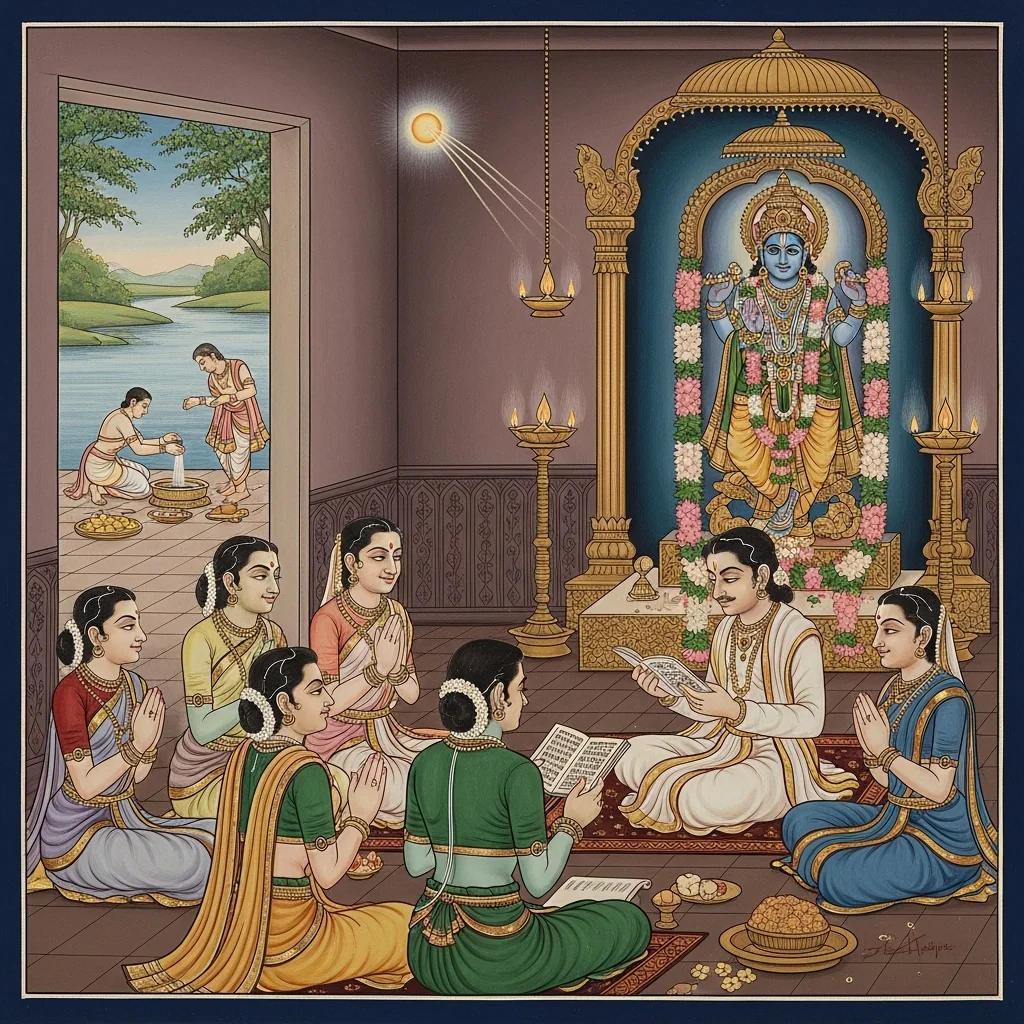
This chapter teaches the supreme efficacy of keeping a devotional vigil on Dvādaśī, especially when joined with worship of Hari/Viṣṇu and listening to the Bhāgavata. Īśvara declares that one who performs Hari-pūjā and hears the Bhāgavata during the Dvādaśī vigil gains merit multiplied beyond great Vedic sacrifices, cuts through bondage, and reaches Kṛṣṇa’s abode. It further asserts that even heavy accumulations of sin are neutralized by Bhāgavata hearing and Viṣṇu’s vigil, culminating in liberation imagery such as passing beyond the solar sphere. The chapter stresses calendrical exactness—Ekādaśī entering Dvādaśī and auspicious conjunctions—and extols gifts offered on Dvādaśī to Viṣṇu and to the ancestors as “Meru-like” in value. Ancestor rites are integrated: water-offerings and śrāddha near a great river are said to bring long-lasting satisfaction to forebears and confer boons. The fruit of the Dvādaśī vigil is then equated with diverse ethical disciplines (truth, purity, restraint, forgiveness), major donations, and famed tīrtha acts, presenting the vigil as a concentrated ritual substitute. Nārada is cited proclaiming that no vow equals Ekādaśī; neglect of Ekādaśī leads to continuing distress, while its observance is upheld as a remedy for the Kali age within a normative devotional path.
Shlokas
Verse 1
ईश्वर उवाच । स्थित्वा द्वादशिजागरे क्रतु समे दुःखापहे पुण्यदे रम्यं भागवतं शृणोति पुरुषः कृत्वा हरेः पूजनम् । पुण्यं वाजिमखस्य कोटिगुणितं संप्राप्य भक्तोत्तमश्छित्त्वा पाशसमूह पक्षनिचयं प्राप्नोति कृष्णालयम्
Īśvara said: Having observed the Dvādaśī vigil—equal to a great sacrifice, removing sorrow and bestowing merit—when a person, after worshipping Hari, listens to the delightful Bhāgavata, that foremost devotee attains merit multiplied a crore-fold beyond the Aśvamedha sacrifice. Cutting through the whole mass of binding nooses, the host of fetters, he reaches the abode of Kṛṣṇa.
Verse 2
हत्यापापसमूहकोटिनिचयैर्गुर्वंगनाकोटिभिःस्तेयैर्लक्षगुणैर्गुरोर्वधकरैः संवेष्टितो यद्यपि । श्रुत्वा भागवतं छिनत्ति सकलं कृत्वा हरेर्जागरं मुक्तिं याति नरेन्द्र निर्मलवपुर्भित्त्वा रवेर्मंडलम्
O king, even if a man is wholly enwrapped by heaps of sin—crores of murders, crores of violations involving the guru’s wife, thefts multiplied a hundred-thousandfold, and even the crime of slaying one’s guru—yet by hearing the Bhāgavata in full and by keeping Hari’s night-vigil, he cuts it all away and attains liberation, his body made pure, passing beyond the orb of the sun.
Verse 3
एकादशी द्वादशिसंप्रविष्टा कृता नभस्ये श्रवणेन युक्ता । विशेषतः सोमसुतेन संगमे करोति मुक्तिं प्रपितामहानाम्
When the Ekādaśī vow is observed so that it extends into Dvādaśī, and it is performed in the month of Nabhas (Bhādrapada) in conjunction with the Śravaṇa nakṣatra—then, especially at the confluence associated with Somāsuta, it bestows liberation upon one’s forefathers, even up to the great-grandfathers.
Verse 4
यद्दीयते द्वादशिवासरे शुभे विष्णुं समुद्दिश्य तथा पितॄणाम् । पर्य्याप्तमिष्ठैः क्रतुतीर्थदानैर्भक्त्या प्रदत्तं खलु मेरुतुल्यम्
Whatever gift is given on the auspicious day of Dvādaśī, dedicating it to Lord Viṣṇu and likewise to the Pitṛs—when offered with devotion—becomes in merit equal to Mount Meru, sufficient beyond the fruits of sacrifices, great rites, pilgrimages, and ritual charities.
Verse 5
महानदीं प्राप्य दिनं च विष्णोस्तोयांजलिं यस्तुपितॄन्ददाति । श्राद्धं कृतं तेन समाः सहस्रं यच्छन्ति कामान्पितरः सुतृप्ताः
Having reached the Mahānadī, on Viṣṇu’s sacred day, whoever offers the Pitṛs a handful of water (tarpana)—by that act a Śrāddha is deemed performed for a thousand years; and the ancestors, fully satisfied, bestow the desired boons.
Verse 6
शरणागतानां परिपालनेन ह्यन्नप्रदानेन शृणुष्व पुत्र । ऋणप्रदाने द्विजदेवतानां तद्वै फलं जागरणेन् विष्णोः
Listen, my son: the very fruit gained by protecting those who seek refuge, by giving food, and by repaying what is owed to the god-like twice-born (brāhmaṇas)—that same merit is indeed obtained through keeping a sacred night-vigil (jāgara) for Viṣṇu (in Dvārakā).
Verse 7
यः स्वर्णधेनुं मधुनीरधेनुं कृष्णाजिनं रौप्यसुवर्णमेरु । ब्रह्मांडदानं प्रददाति याति स वै फलं जागरणेन विष्णोः
Whoever gives in charity a golden cow, a cow of honey and milk, a black antelope-skin, a Mount Meru fashioned of silver and gold, or even the gift of the whole cosmic egg (brahmāṇḍa)—he attains that very merit simply by keeping the sacred night-vigil for Lord Viṣṇu.
Verse 8
सत्येन शौचेन दमेन यत्फलं क्षमादयादानबलेन षण्मुख । दशाश्वमेधैर्बहुदक्षिणैश्च तेषां फलं जागरणेन विष्णोः
O Ṣaṇmukha, whatever merit arises from truthfulness, purity, self-restraint, forgiveness and the like, and from the power of generous giving—even the fruit of ten Aśvamedha sacrifices with abundant priestly fees—all that fruit is obtained by keeping vigil (jāgaraṇa) for Lord Viṣṇu.
Verse 9
स्नानेन यत्प्राप्य नदीं वीरष्ठां यत्पिंडदानेन पितुर्गयायाम् । यद्धेमदानात्कुरुजांगले च तत्स्यात्फलं जागरणेन विष्णोः
The very merit gained by bathing in the river Vīraṣṭhā, by offering piṇḍas to one’s father at Gayā, and by gifting gold in Kuru-jāṅgala—that same fruit is obtained by keeping a night-vigil for Viṣṇu.
Verse 10
हत्यायुतानां यदि संचितानिस्तेयानि रुक्मस्य तथामितानि । निहंत्यनेकानि पुराकृतानि श्रीजागरे ये प्रपठंति गीतम्
Even if one has amassed tens of thousands of killings and countless thefts of gold, those long-committed sins are destroyed for those who, during the sacred night-vigil, recite the holy song in praise of the Lord.
Verse 11
मार्गं न ते सौरपुरस्य दूतान्वनांतरं षण्मुख किंचिदन्यत् । स्वप्ने न पश्यंति च ते मनुष्या येषां गता जागरणेन निद्रा
O Ṣaṇmukha, those people whose sleep has been driven away by keeping vigil do not behold, even in dream, the messengers of Yama’s city—nor any other fearful wilderness-path.
Verse 12
काषायवस्त्रैश्च जटाभरैश्च पूर्ताग्निहोत्रैः किमु चान्य मन्त्रैः । धर्मार्थकामवरमोक्षकरीं च भद्रामेकां भजस्व कलिकालविनाशिनीं च
What need is there of ochre robes and matted locks, of public works and fire-offerings (agnihotra), or of other mantras? Worship that one auspicious observance alone—the blessed practice that grants dharma, artha, kāma, and the supreme mokṣa, and destroys the evils of the Kali age.
Verse 13
इत्युक्तपूर्वं किल नारदेन श्रेयोर्थबुद्ध्या विनतासुताय । कृष्णात्परं नान्यदिहास्ति दैवं व्रतं तदह्नः परमं न किंचित्
Thus indeed Nārada had earlier spoken, with the intent of highest welfare, to Vinatā’s son (Garuḍa): “Here there is no divinity higher than Kṛṣṇa, and no vow superior to the vow of that day.”
Verse 14
भोभोः सुराः शृणुत नारद इत्यवोचद्भोभोः खगेन्द्रऋषिसिद्धमुनीन्द्रसंघाः । उत्क्षिप्य बाहुमथ भक्तजनेन चोक्तं नैकादशीव्रतसमं व्रतमस्ति किंचित्
“Hear, O gods!”—so Nārada declared. “Hear, O hosts of Garuḍa, ṛṣis, siddhas, and great sages!” Then, raising his arm, he proclaimed what the devotees affirm: “No vow whatsoever equals the Ekādaśī vow.”
Verse 15
पक्षीन्द्र पापपुरुषा न हरिं भजंति तद्भक्तिशास्त्रनिरता न कलौ भवंति । कुर्वंति मूढमनसो दशमीविमिश्रामेकादशीं शुभदिनं च परित्यजंति
O lord of birds, sinful men do not worship Hari, nor in Kali-yuga do they devote themselves to the scriptures of His bhakti. With deluded minds they taint Ekādaśī by mixing it with Daśamī, and they abandon that auspicious day.
Verse 16
आर्त्तः सदा चैव सदा च रोगी पापी सदा चैव सदा च दुःखी । सदा कुलघ्नोऽथ सदा च नारकी विद्धं मुरारेर्दिनमाश्रयेत्तु यः
He who resorts to the “pierced” day of Murāri (the Lord) becomes ever afflicted, ever diseased, ever sinful, ever sorrowful; ever a destroyer of his lineage, and ever bound for hell.
Verse 27
इति श्रीस्कांदे महापुराण एकाशीतिसाहस्र्यां संहिताया सप्तमे प्रभासखंडे चतुर्थे द्वारकामाहात्म्ये द्वादशीजागरणस्य सर्वतोवरेण्यत्ववर्णनंनाम सप्तविंशतितमोऽध्यायः
Thus ends the twenty-seventh chapter, entitled “The Description of the Universal Supremacy of the Dvādaśī Night-Vigil,” in the fourth part, Dvārakā Māhātmya, of the seventh book, Prabhāsa Khaṇḍa, within the Śrī Skanda Mahāpurāṇa, the Saṃhitā of eighty-one thousand verses.