Adhyaya 8
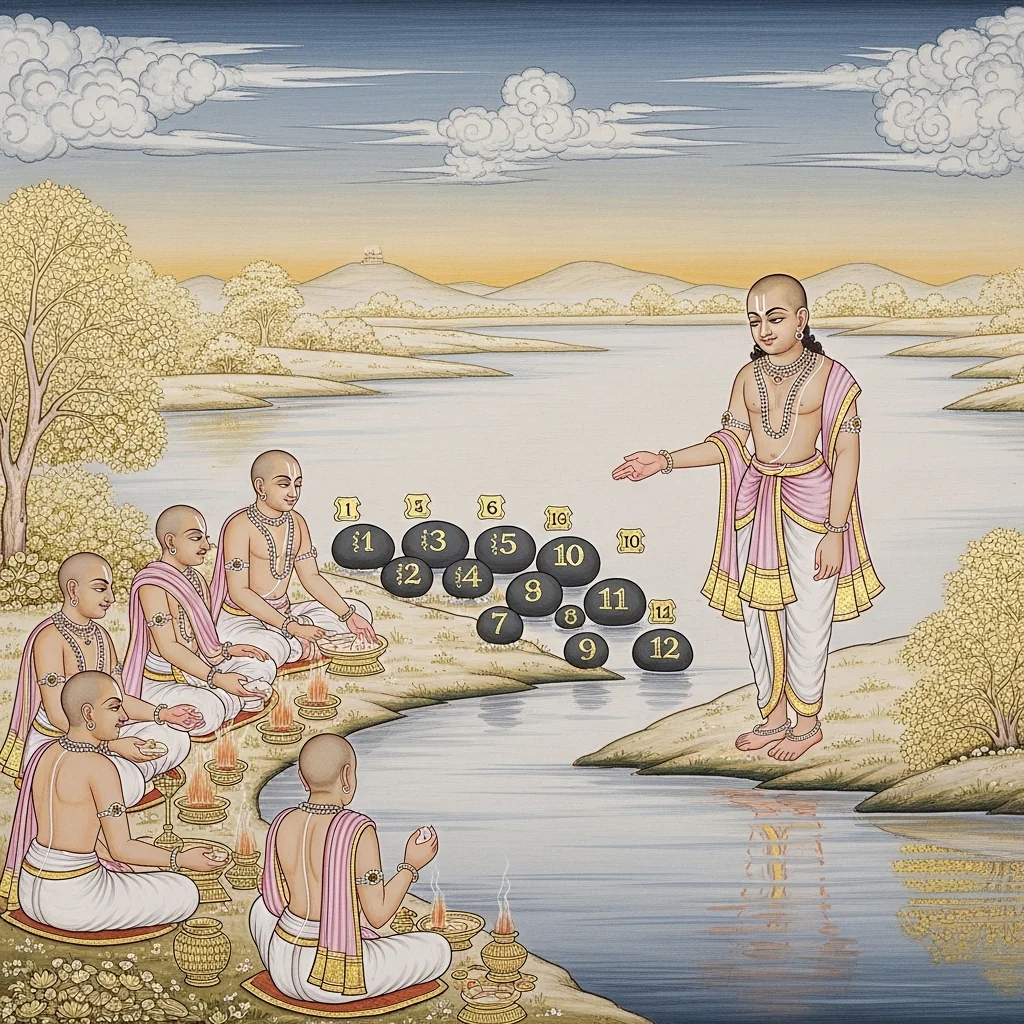
Chapter 8 is a prescriptive māhātmya in which Prahlāda instructs dvija listeners to turn from other celebrated rivers and come instead to the Gomati–Ocean confluence, declaring its unrivaled power to destroy sin and yield ritual merit. He outlines a staged observance: arrival and praise of the confluence, followed by arghya offerings to the ocean-lord and to the river Gomati with specified devotional utterances. The chapter then regulates bathing (including prescribed orientations) and proceeds to ancestral rites—tarpana and śrāddha—stressing dakṣiṇā and special gifts, especially gold. It catalogs major forms of dāna such as tulāpuruṣa, land-gift, kanyā-dāna, vidyā-dāna, and symbolic ‘dhenu’ gifts, each with declared results. Merit is said to intensify by timing, particularly on amāvāsyā during śrāddha-pakṣa and other auspicious occasions, so that even a defective śrāddha becomes complete at this site. The benefits are extended broadly, including to beings in various post-mortem conditions, who are said to gain release through snāna. Finally, a distinctive Cakra-tīrtha theology is presented: chakra-marked stones in configurations numbered from 1 to 12, linked to bhukti and mukti. The chapter culminates by assuring purification and liberation through darśana, sparśa, and remembrance of Hari at the time of death.
Shlokas
Verse 1
प्रह्लाद उवाच । मा गच्छध्वं सुरनदीं कालिंदीं मा सरस्वतीम् । गच्छध्वं च द्विजश्रेष्ठा गोमत्युदधिसंगमे
Prahlāda said: “Do not go to the divine river Gaṅgā; do not go to Kāliṇdī (Yamunā), nor to Sarasvatī. Rather, O best of brāhmaṇas, go to the confluence of the Gomati River and the Ocean.”
Verse 2
प्राप्यते हेलया यत्र सर्वे कामा न संशयः । गोमतीजलकल्लोलैः क्रीडते यत्र सागरः
Where, even with ease, all desired aims are obtained—of this there is no doubt; where the Ocean seems to play amid the wave-crests of Gomati’s waters.
Verse 3
पापघ्नं गोमतीतीरं प्राप्यते पुण्यवन्नरैः । सागरेण च संमिश्रं महापातकनाशनम्
The sin-destroying bank of the Gomati is attained by meritorious people; and when it mingles with the Ocean, it becomes a destroyer of even the gravest sins.
Verse 4
गोमती संगता यत्र सागरेण द्विजोत्तमाः । मुक्तिद्वारं तु तत्प्रोक्तं कलिकाले न संशयः
O best of brāhmaṇas, where the Gomati meets the Ocean—this is declared to be a “gateway to liberation”, especially in the Kali age; of this there is no doubt.
Verse 5
यत्पुण्यं लभते तूर्णं गंगासागरसंगमे । तत्पुण्यं समवाप्नोति गोमत्युदधिसंगमे
Whatever merit one swiftly gains at the confluence of the Gaṅgā and the Ocean, that very same merit is obtained at the confluence of the Gomatī and the Ocean.
Verse 6
नमस्कृत्य च तोयेशं गोमतीं च सरिद्वराम् । अर्घ्यं दद्याद्विधानेन कृत्वा च करयोः कुशान्
Having bowed to the Lord of waters (the Ocean) and to the Gomatī, best of rivers, one should, according to the rite, offer arghya—placing kuśa grass in both hands.
Verse 7
मंत्रेणानेन विप्रेंद्रा दद्यादर्घ्यं विधानतः । ब्राह्मणैः सह संगत्य सदा तत्तीर्थवासिभिः
O best of brāhmaṇas, with this very mantra one should offer arghya in the prescribed manner—always in the company of brāhmaṇas and those who dwell at that sacred tīrtha.
Verse 8
भक्त्या चार्घ्यं प्रदास्यामि देवाय परमा त्मने । त्राहि मां पापिनं घोरं नमस्ते सुररूपिणे
With devotion I shall offer this arghya to the Deity, the Supreme Self. Save me—terribly sinful as I am. Salutations to You who appear in divine form.
Verse 9
तीर्थराज नमस्तुभ्यं रत्नाकर महार्णव । गोमत्या सह गोविंद गृहाणार्घ्यं नमोऽस्तु ते
O King of tīrthas, salutations to You—O great ocean, treasure-house of gems. O Govinda, together with the Gomatī, accept this arghya; homage be to You.
Verse 10
दत्त्वा चार्घ्यं शिखां बद्ध्वा संस्मृत्य जलशायिनम् । कुर्याच्च प्राङ्मुखः स्नानं ततः प्रत्यङ्मुखस्तथा
Having offered arghya and tied the tuft of hair, remembering the Lord who reclines upon the waters, one should bathe facing east; and then likewise facing west.
Verse 11
स्नात्वा च परया भक्त्या पितॄन्संतर्पयेत्ततः । विश्वेदेवादि संपूज्य पितॄणां श्राद्धमाचरेत्
After bathing, with supreme devotion one should satisfy the ancestors with tarpaṇa offerings. Having duly worshipped the Viśvedevas and others, one should perform the śrāddha for the forefathers.
Verse 12
यथोक्तां दक्षिणां दद्याद्विष्णुर्मे प्रीयतामिति । विशेषतः प्रदातव्यं सुवर्णं विप्रसत्तमाः
One should give the dakṣiṇā as prescribed, saying, “May Viṣṇu be pleased with me.” O best of brāhmaṇas, gold especially should be given as a distinguished gift.
Verse 13
दंपत्योर्वाससी चैव कंचुकोष्णीषमेव च । लक्ष्म्या सह जगन्नाथो विष्णुर्मे प्रीयतामिति
One should also give garments for a couple, and likewise a tunic and a turban, saying, “May Lord Viṣṇu, the Jagannātha, together with Lakṣmī, be pleased with me.”
Verse 14
महादानानि सर्वाणि गोमत्युदधिसंगमे । सप्तद्वीपपतिर्भूत्वा विष्णुलोके महीयते
All great gifts (mahādānas) given at the confluence of the Gomatī and the ocean grant the fruit of becoming a lord of the seven continents, and one is honored in the world of Viṣṇu.
Verse 15
यस्तुलापुरुषं दद्याद्गोमत्युदधिसंगमे । सप्तद्वीपपतिर्भूत्वा विष्णुलोके महीयते
Whoever offers the tulāpuruṣa gift at the confluence of the Gomatī and the ocean becomes lord of the seven continents and is honored in the realm of Viṣṇu.
Verse 16
आत्मानं तोलयेद्यस्तु स्वर्णेन रजतेन वा । वस्त्रैर्वा कुंकुमैर्वापि फलैर्वापि तथा रसैः
But whoever weighs himself out—whether with gold or with silver, or with cloth, or with kunkuma (saffron), or with fruits, and likewise with juices—and gives accordingly, performs tulāpuruṣa charity.
Verse 17
भुक्त्वा भोगान्सुविपुलांस्तथा कामान्मनोहरान् । संपूज्यमानस्त्रिदशैर्याति विष्ण्वालयं नरः
Having enjoyed abundant pleasures and delightful fulfillments of desire, a man—honored by the gods—attains the abode of Viṣṇu.
Verse 18
हिरण्यरूप्यदानं च ह्यश्वं धेनुं तथैव च । गोमतीसंगमे दत्त्वा सर्वान्कामानवाप्नुयात्
By giving gifts of gold and silver—and likewise a horse and a cow—at the confluence of the Gomātī, one obtains the fulfillment of all desires.
Verse 19
भूमिदानं च यो दद्याद्गोमत्युदधिसंगमे । स्नात्वा शुचिर्हरिं स्मृत्वा तस्माद्धन्यतरो नहि
Whoever gives the gift of land at the confluence of the Gomatī and the ocean—bathing there, becoming pure, and remembering Hari—none is more blessed than he.
Verse 20
कन्यादानं च यः कुर्याद्विद्यादानमथापि वा । गोमत्याः संगमे स्नात्वा याति ब्रह्मपदं नरः
A man who performs kanyādāna (the sacred gifting of a maiden in marriage), or even vidyādāna (the gifting of knowledge), having bathed at the confluence of the Gomātī, attains Brahmapada—the state of Brahman.
Verse 21
यो दद्यात्स्वर्णधेनुं च घृतधेनुं समाहितः । ब्रह्माण्डदानमपि वा तस्य पुण्यमनंतकम्
He who, with a mind made steady, gives a “golden cow” and a “ghee-cow,” or even performs the gift known as brahmāṇḍa-dāna, his merit is without end.
Verse 22
तथा लवणधेनुं च जलधेनुमथापि वा । दत्त्वा याति परं स्थानं गोमत्युदधिसंगमे
Likewise, by giving a “salt-cow” or even a “water-cow” at the confluence of the Gomātī and the ocean, one reaches the supreme abode.
Verse 23
युगादिषु च सर्वेषु गोमत्युदधिसंगमे । स्नात्वा संतर्प्य च पितॄनक्षयं लोकमाप्नुयात्
On every Yugādi occasion, by bathing at the Gomātī–ocean confluence and offering tarpaṇa to satisfy the ancestors, one attains an imperishable world.
Verse 24
आषाढ्यां च तथा माघ्यां कार्तिक्यां संगमे नरः । पितॄणां तर्पणं स्नानं श्राद्धं पावकपूजनम् । कुर्याच्चैव तथा दानं यदीच्छेदक्षयं पदम्
In the months of Āṣāḍha, Māgha, and Kārtika, at the confluence a man should perform bathing, tarpaṇa offerings to the ancestors, śrāddha, worship of the sacred fire (pāvaka/agni), and also charity—if he desires the imperishable state.
Verse 25
पितॄणां चाक्षया तृप्तिर्गयाश्राद्धेन वै यथा । तद्वच्छ्राद्धान्महाभाग गोमत्युदधिसंगमे
Just as the ancestors gain imperishable satisfaction through śrāddha at Gayā, so too, O noble one, does śrāddha at the confluence of the Gomātī and the ocean yield the same fruit.
Verse 26
कुर्य्यात्स्नानं तथा दानं पितॄणां तर्पणं तथा । पञ्चकासु द्विजश्रेष्ठास्तथा चैवाष्टकासु च
Let the best among the twice-born perform sacred bathing, charity (dāna), and tarpaṇa offerings to the ancestors—during the Pañcakā days, and likewise during the Aṣṭakā observances.
Verse 27
वैधृतौ च व्यतीपाते छायायां कुंजरस्य च । षष्ठ्यां च कपिलाख्यायां तथा हि द्वादशीषु च
On the Vaidhṛti and Vyatīpāta yogas, on the day called the Elephant’s Shadow, on the Ṣaṣṭhī known as Kapilā, and likewise on the Dvādaśī days—(rites at this sacred confluence are especially efficacious).
Verse 28
गोमत्यां संगमे स्नात्वा दद्याद्दानं विशेषतः । निर्मलं स्थानमाप्नोति यत्र गत्वा न शोचति
Having bathed at the confluence of the Gomātī, one should give charity with special intent. He attains a stainless abode, reaching which he no longer grieves.
Verse 29
श्राद्धपक्षे त्वमावास्यां गोमत्युदधिसंगमे । हेलया प्राप्यते पुण्यं दत्त्वा पिण्डं गयासमम्
On the new-moon day (amāvasyā) in the Śrāddha fortnight, at the confluence of the Gomātī and the ocean, merit is gained even with little effort; by offering a piṇḍa there, one receives fruit equal to that of Gayā.
Verse 30
तस्मात्सर्वं प्रयत्नेन त्वमावास्यां द्विजोत्तमाः । श्राद्धं हि पितृपक्षांते कार्य्यं गोमतिसंगमे
Therefore, O best of the twice-born, with every effort one should perform the śrāddha on the new-moon, at the close of Pitṛpakṣa, at the confluence of the Gomatī.
Verse 31
यद्यप्यश्रोत्रियं श्राद्धं यद्यप्युपहतं भवेत् । पक्षश्राद्धकृतं पुण्यं दिनेनैकेन लभ्यते
Even if the śrāddha is offered to an unqualified recipient, even if it is in some way impaired, the merit of a full fortnight’s śrāddha is gained in a single day (here).
Verse 32
श्रद्धाहीनं मन्त्रहीनं पात्रहीनमथापि वा । द्रव्यहीनं कालहीनं मनसः स्वास्थ्यवर्जितम्
(Even if the rite is) devoid of faith, devoid of mantras, lacking a proper recipient; or lacking resources, lacking proper time, and performed without mental steadiness—
Verse 33
श्राद्धपक्षे ह्यमायां तु गोमत्युदधिसंगमे । परिपूर्णं भवेत्सर्वं पितॄणां तृप्तिरक्षया
But on the new-moon in the Śrāddha fortnight, at the confluence of the Gomatī and the ocean, everything becomes fully complete—and the satisfaction of the ancestors becomes inexhaustible.
Verse 34
गोमती कमला चैव चंद्रभागा तथैव च । तिस्रस्तु संगता नद्यः प्रविष्टा वरुणालयम्
Gomatī, Kamalā, and likewise Candrabhāgā—these three rivers, having come together, enter the abode of Varuṇa, the ocean.
Verse 35
गयायां पिंडदानेन प्रयागे ह्यस्थिपातने । तत्पुण्यं समवाप्नोति पक्षांते श्राद्धकृन्नरः
By offering piṇḍas at Gayā and by casting the bones at Prayāga, one attains that very merit; likewise, a man who performs śrāddha here at the end of the fortnight gains the same fruit.
Verse 36
यदीच्छेत्सर्वतीर्थेषु हेलया त्वभिषेचनम् । स्नानं कुर्वीत भक्त्या वै गोमत्युदधिसंगमे
If one wishes to gain with ease the fruit as though one had bathed at all tīrthas, one should bathe with devotion at the confluence of the Gomatī and the ocean.
Verse 38
श्राद्धे कृते त्वमावस्यां पितृपक्षे च वै द्विजाः । अपुत्रा चैव या नारी काकवंध्या च या भवेत्
O brāhmaṇas, when śrāddha is performed—especially on the amāvasyā (new-moon day) and during Pitṛpakṣa—even a woman without a son, and even one afflicted with barrenness (kākavandhyā), is said here to fall within the sphere of remedial merit through these rites.
Verse 39
मृतपुत्रा तथा विप्राः संगमे स्नानमाचरेत् । दोषैः प्रमुच्यते सर्वैर्गोमप्युदधिसंगमे । स्नात्वा सुखमवाप्नोति प्रजां च चिरजीविनीम्
Likewise, O brāhmaṇas, a woman whose child has died should bathe at the confluence. At the confluence of the Gomatī and the ocean one is freed from all faults. Having bathed there, one attains happiness and also offspring who are long-lived.
Verse 40
यानि कानि च दानानि पृथिव्यां सम्भवंति हि । तानि सर्वाणि देयानि गोमत्युदधिसंगमे
Whatever kinds of gifts (dānas) are possible upon the earth—indeed, all of them should be given at the confluence of the Gomatī and the ocean.
Verse 41
सर्वदैव च विप्रेन्द्रा विशेषात्सर्वपर्वसु । स्नानं कुर्वीत नियतो गोमत्युदधिसंगमे
At all times, O best of brāhmaṇas—and especially on every sacred festival day—one should, with disciplined restraint, bathe at the confluence of the Gomatī and the ocean.
Verse 42
दर्शनादेव पापस्य क्षयो भवति भो द्विजाः । प्रणामे मनसस्तुष्टिर्मुक्तिश्चैवावगाहने
By mere sight of this sacred place, O brāhmaṇas, sin is diminished. By bowing in reverence, the mind is satisfied; and by immersion in its waters, liberation (mokṣa) itself is attained.
Verse 43
श्राद्धे कृते पितॄणां तु तृप्तिर्भवति शाश्वती । दाने मनोरथावाप्तिर्जायते नात्र संशयः
When Śrāddha is performed, the ancestors attain enduring satisfaction. And when gifts are given in dāna, the fulfillment of one’s cherished aims arises—of this there is no doubt.
Verse 44
कृतकृत्यास्तु ते धन्या यैः कृतं पितृतर्पणम् । श्राद्धं च ऋषिशार्दूला गोमत्युदधिसंगमे
Blessed indeed are those who have accomplished what must be done—those who have performed pitṛ-tarpaṇa, and also Śrāddha, O tiger-like sages, at the confluence of the Gomatī and the ocean.
Verse 45
पितृपक्षे च वै केचिन्मातृपक्षे तथैव च । तथा श्वशुरपक्षे च ये चान्ये मित्रबांधवाः
Some are connected with the pitṛpakṣa, the ancestral line; likewise some with the mātṛpakṣa, the maternal line. So too with the śvaśurapakṣa, the father-in-law’s line, and others who are friends and relations.
Verse 46
स्थावरत्वं गता ये च पुद्गलत्वं च ये गताः । पिशाचत्वं गता ये च ये च प्रेतत्वमागताः
Those who have fallen into immobile existence, those who have entered other embodied states, those who have become piśācas, and those who have become pretas—all are encompassed by the grace of this tīrtha.
Verse 47
तिर्य्यग्योनिगता ये च ये च कीटत्वमागताः । स्नानमात्रेण ते सर्वे मुक्तिं यांति न संशयः
Those who have gone into animal wombs, and those who have come to the state of insects—even they all, by bathing alone, go to liberation; of this there is no doubt.
Verse 48
किं पुनः श्राद्धदानादि गोमतीसंगमे तथा । कृत्वा मुक्तिमवाप्नोति मानवो नात्र संशयः
How much more, then, at the confluence of the Gomati, when one performs rites such as śrāddha and charitable gifts; having done so, a human being attains liberation—of this there is no doubt.
Verse 49
श्रवणद्वादशीयोगे गोमत्युदधिसंगमे । स्नात्वा मुक्तिमवाप्नोति यत्र गत्वा न शोचति
When the Śravaṇa constellation coincides with Dvādaśī, at the confluence of the Gomati and the ocean—having bathed there—one attains liberation, reaching that state after which one does not grieve.
Verse 50
सन्त्यज्य सर्वतीर्थानि गोमत्युदधिसंगमे । स्नानं कृत्वा तथा श्राद्धं कृतकृत्यो भवेन्नरः । परं लोकमवाप्नोति ह्यर्चयित्वा तु वामनम्
Setting aside all other tīrthas, at the Gomati–ocean confluence a man becomes ‘one who has fulfilled his duty’ by bathing and performing śrāddha; and by worshipping Vāmana there, he attains the supreme world.
Verse 51
सम्यक्स्नात्वा नरो यस्तु पूजयेद्गरुडध्वजम् । पीतांबरधरो भूत्वा दिव्याभरणभूषितः
But the man who bathes properly and worships Viṣṇu, whose banner is Garuḍa, becomes clad in yellow garments and adorned with divine ornaments.
Verse 52
वीक्ष्यमाणः सुरस्त्रीभिर्नागारिकृतकेतनः । चतुर्भुजधरो भूत्वा वनमालाविभूषितः । संस्तूयमानो मुनिभिर्याति विष्ण्वालयं नरः
Beheld by celestial women, dwelling in a heavenly abode, becoming four-armed and adorned with a forest-garland—praised by sages—the man goes to the abode of Viṣṇu.
Verse 53
गोमतीसंगमे स्नात्वा कृतकृत्यो भवेन्नरः । यत्र दैत्यवधं कृत्वा विष्णुना प्रभविष्णुना
Having bathed at the Gomati confluence, a man becomes one whose sacred duties are fulfilled—at that very place where mighty Viṣṇu, the supremely powerful one, once slew the demons.
Verse 54
चक्रं प्रक्षालितं पूर्वं कृष्णेन स्वयमेव हि । तेनैव चक्रतीर्थं हि ख्यातं लोकत्रये द्विजाः
Formerly, Kṛṣṇa himself washed his discus there; therefore it is renowned as Cakratīrtha throughout the three worlds, O twice-born ones.
Verse 55
भवंति यत्र पाषाणाश्चक्रांका मुक्तिदायकाः । यैः पूजितैर्जगन्नाथः कृष्णः सांनिध्यमाव्रजेत्
There, stones bearing the mark of the discus are found, bestowers of liberation; by worshipping them, Jagannātha Kṛṣṇa comes into the devotee’s sacred presence.
Verse 56
तत्रैव यदि लभ्येत चक्रैर्द्वादशभिः सह
And if, right there, it is obtained together with twelve marks of the sacred discus (cakra)…
Verse 57
द्वादशात्मा स विज्ञेयो मोक्षदः सर्वदेहिनाम् । एकचक्रांकितो यस्तु द्वारवत्यां सुशोभनः
That should be understood as “twelve-formed,” a bestower of liberation upon all embodied beings. But that which bears a single discus-mark, exceedingly beautiful in Dvāravatī…
Verse 58
सुदर्शनाभिधानोऽसौ मोक्षैकफलदो हि सः । लक्ष्मीनारायणो द्वाभ्यां भुक्तिमुक्तिफलप्रदः
He who is known as Sudarśana bestows the single supreme fruit—liberation. With two (marks or forms) he is Lakṣmī-Nārāyaṇa, granting as fruits both worldly enjoyment and final release.
Verse 59
त्रिभिस्त्रिविक्रमश्चैव त्रिवर्गफलदायकः । श्रीप्रदो रिपुहन्ता च चतुर्भिः संयुतः स हि
With three (marks or forms) he is indeed Trivikrama, the giver of the fruits of the three aims of life. Endowed with four, he grants prosperity and destroys enemies—so it is declared.
Verse 60
पञ्चभिर्वासुदेवस्तु जन्ममृत्युभयापहः । प्रद्युम्नः षड्भिरेवासौ लक्ष्मीं कांतिं ददाति यः
With five (marks or forms) he is Vāsudeva, who removes the fear of birth and death. With six he is Pradyumna, he who bestows Lakṣmī—fortune—and radiant splendor.
Verse 61
सप्तभिर्बलभद्रश्च चक्रगोऽत्र प्रकीर्तितः । लाच्छितश्चाष्टभिर्भक्तिं ददाति पुरुषोत्तमः
With seven marks, He is Balabhadra, here proclaimed as the One abiding with the Cakra. With eight marks, the Supreme Person, distinctively sign-marked, bestows bhakti—devotion.
Verse 62
सर्वं दद्यान्नवव्यूहो दुर्लभो यः सुरैरपि । दशावतारो दशमी राज्यदो नात्र संशयः
With nine marks, He is the ninefold manifestation (navavyūha), granting all, yet hard to attain even for the gods. With ten marks, He is the Ten Avatāras; the tenth bestows kingship—of this there is no doubt.
Verse 63
एकादशभिरैश्वर्यं चक्रगः संप्रयच्छति । निर्वाणं द्वादशात्मा च द्वादशभिर्ददाति च
With eleven marks, the Lord associated with the Cakra bestows aiśvarya—sovereign power and prosperity. With twelve marks, as the twelvefold Self (dvādaśātmā), He grants nirvāṇa—also through those twelve marks.
Verse 64
अत ऊर्ध्वं महाभागाः सौख्यमोक्षप्रदायकाः यतोऽत्र ते च पाषाणाः कृष्णचक्रेण चित्रिताः
Therefore, O greatly fortunate ones, from this point onward these grant happiness and liberation (mokṣa), for here those stones are adorned with Kṛṣṇa’s Cakra.
Verse 65
तेषां स्पर्शनमात्रेण मुच्यते सर्वकिल्बिषैः । चक्रतीर्थे नरः स्नात्वा कृष्णचक्रेण चिह्नितः
By merely touching them, one is freed from all sins. Having bathed at Cakratīrtha, a person becomes marked with Kṛṣṇa’s Cakra, a sign of sanctification and protection.
Verse 66
पूजयित्वा चक्रधरं हरिं ध्यायेत्सनातनम् । नापुत्रो नाधनो रोगी न स संजायते नरः
Having worshipped Hari, the bearer of the Cakra, one should meditate upon the Eternal. Such a man is not born childless, nor poor, nor diseased.
Verse 67
ब्रह्महत्यादिकं पापं मनोवाक्कायकर्मजम् । तत्सर्वं विलयं याति सकृच्चक्रांकदर्शनात्
Sins such as brahmin-slaying, born of mind, speech, and bodily deeds—all of that perishes, simply by a single sight of the Cakra-mark.
Verse 68
म्लेच्छ देशे शुभे वापि चक्रांको दृश्यते यदि । तत्र चैव हरिक्षेत्रं मुक्तिदं नात्र संशयः
Even in a foreign land, or in a blessed region, if the Cakra-mark is seen, that very place becomes Hari’s sacred domain (Harikṣetra), bestowing liberation—of this there is no doubt.
Verse 69
मृत्युकालेऽपि सम्प्राप्ते यदि ध्यायेद्धरिं नरः । चक्रांकं धारयेदंगे स याति परमं पदम्
Even when the hour of death has arrived, if a man meditates on Hari and bears the Cakra-mark upon his body, he attains the supreme state.
Verse 70
हृदयस्थे च चक्रांके पूतो भवति तत्क्षणात् । नोपसर्पंति तं भीता दूताः कृष्णायुधं तदा । वैष्णवं लोकमा प्नोति नात्र कार्या विचारणा
When the Cakra-mark abides in the heart, one becomes purified that very instant. Then the fearful messengers do not approach him, for Kṛṣṇa’s weapon is present there. He attains the Vaiṣṇava world—no further deliberation is needed.
Verse 71
अपि पापसमाचारः किं पुनर्धार्मिकः शुचिः । गोमती संगमे स्नात्वा चक्रतीर्थे तथैव च । मुच्यते पातकैर्घोरै र्मानवो नात्र संशयः
Even one accustomed to sinful conduct—how much more a righteous and pure person—after bathing at the confluence of the Gomatī and likewise at Cakratīrtha, is freed from dreadful sins; of this there is no doubt.
Verse 72
राजसाः सत्त्वमायांति विष्णुधर्मं सनातनम् । क्षेत्रस्य तस्य माहात्म्यात्सत्यमेतत्प्रकीर्तितम्
Those dominated by rajas (passion) come to sattva (goodness) and to the eternal dharma of Viṣṇu—through the greatness of that sacred region; this is proclaimed as truth.
Verse 73
तामसं राजसं चापि यत्किञ्चिद्विष्णुपूजने । तच्च सत्त्वत्वमायाति निम्नगा च यथार्णवे
Whatever in the worship of Viṣṇu is tainted by tamas (darkness) or rajas (passion), that too is transformed into sattva (purity)—as a river, upon reaching the ocean, becomes one with it.
Verse 74
दुर्लभा द्वारका विप्र दुर्लभं गोमतीजलम् । दुर्लभं जागरो रात्रौ दुर्लभं कृष्णदर्शनम्
O brāhmaṇa, rare indeed is Dvārakā; rare is the water of the Gomatī; rare is wakeful vigil through the night; and rare is the vision (darśana) of Kṛṣṇa.
Verse 317
पक्षेपक्षे समग्रा तु पितृपूजा कृता च यैः । सम्पूर्णा जायते तेषां गोमत्युदधिसंगमे
For those who perform the full worship of the ancestors (pitṛ-pūjā) in each fortnight (pakṣa), that rite becomes truly complete at the confluence where the Gomatī meets the ocean.