Adhyaya 43
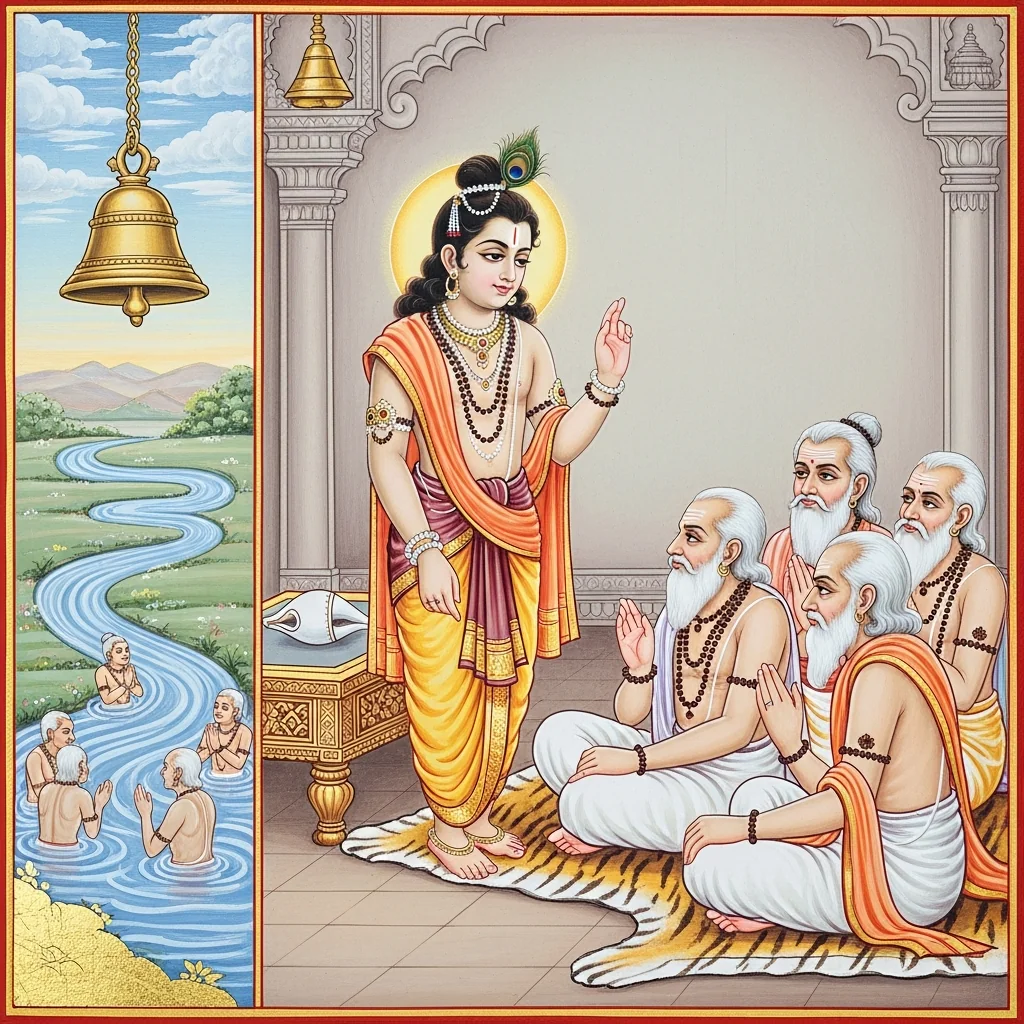
This chapter unfolds as a theological teaching on the media of bhakti and the logic of merit, voiced chiefly through Prahlāda, and then concluded by Sūta’s shift from instruction to pilgrimage. It first praises worship with tulasī leaves as a universally potent offering—spoken of in terms of wish-fulfilment—and it sanctifies ritual remnants as holy. It then sets out a hierarchy of merit for Viṣṇu-related substances: pādodaka (foot-water), śaṅkhodaka (conch-water), naivedya-śeṣa (remnants of offered food), and nirmālya (remnants of flowers), each compared to the fruit of great sacrifices. Temple protocol is also taught, especially bell-ringing (ghaṇṭā-vādya) during bathing and worship, said to substitute for other instruments and to generate vast merit. A major section extols tulasī wood (tulasī-kāṣṭha) and tulasī-derived sandal paste as purifying and funerary-sacramental: offered to deities and ancestors, used in cremation contexts, and declared to yield liberation-oriented results and divine recognition. In the closing verses, sages and Bali, delighted by Dvārakā’s greatness, journey to Dvārakā, bathe in the Gomatī, worship Kṛṣṇa, perform the yātrā correctly, give donations, and return—modeling the chapter’s teachings as lived pilgrimage ethics.
Shlokas
Verse 1
प्रह्लाद उवाच । सावित्रीं च भवानीं च दुर्गां चैव सरस्वतीम् । योऽर्चयेत्तुलसीपत्रैः सर्वकामसमन्वितः
Prahlāda said: Whoever worships Sāvitrī, Bhavānī, Durgā, and Sarasvatī with tulasī leaves becomes endowed with all desired aims.
Verse 2
गृहीत्वा तुलसीपत्रं भक्त्या विष्णुं समर्चयेत् । अर्चितं तेन सकलं सदेवासुरमानुषम्
Taking a tulasī leaf, one should worship Viṣṇu with devotion. By that act, all beings—gods, asuras, and humans—are as though worshipped.
Verse 3
चतुर्द्दश्यां महेशानं पौर्णमास्यां पितामहम् । येऽर्चयन्ति च सप्तम्यां तुलस्या च गणाधिपम्
Those who worship Maheśāna on the fourteenth lunar day, Pitāmaha (Brahmā) on the full-moon day, and Gaṇādhipa (Gaṇeśa) on the seventh—offering tulasī—gain merit thereby.
Verse 4
शंखोदकं तीर्थवराद्वरिष्ठं पादोदकं तीर्थवराद्वरिष्ठम् । नैवेद्यशेषं क्रतुकोटितुल्यं निर्माल्यशेषं व्रतदानतुल्यम्
The water from the sacred conch (śaṅkhodaka) is the most excellent among all tīrthas; the water that has washed the Lord’s feet is likewise the most excellent among tīrthas. The remnants of naivedya, the offered food, equal the merit of countless sacrifices, and the remnants of nirmālya, the sacred garlands, equal the merit of vows and gifts.
Verse 5
मुकुन्दाशनशेषं तु यो भुनक्ति दिनेदिने । सिक्थेसिक्थे भवेत्पुण्यं चान्द्रायणशताधिकम्
Whoever, day after day, eats the remnants of the food offered to Mukunda—at every morsel he gains merit exceeding a hundred Cāndrāyaṇa vows.
Verse 6
नैवेद्यशेषं तुलसीविमिश्रं विशेषतः पादजलेन विष्णोः । योऽश्नाति नित्यं पुरुषो मुरारेः प्राप्नोति यज्ञायुतकोटिपुण्यम्
Whoever daily partakes of the remnants of the offering to Murāri—mixed with tulasī and, above all, moistened with Viṣṇu’s sacred foot-water—attains merit equal to tens of millions of completed sacrifices.
Verse 7
यः श्राद्धकाले हरिभुक्तशेषं ददाति भक्त्या पितृदेवतानाम् । तेनैव पिंडात्सुतिलैर्विमिश्रादाकल्पकोटिं पितरः सुतृप्ताः
Whoever, at the time of śrāddha, devotedly offers to the Pitṛ-deities the remnants eaten by Hari—by that very piṇḍa mixed with fine sesame—his ancestors remain fully satisfied for a crore of kalpas.
Verse 8
स्नानार्चनक्रियाकाले घंटावाद्यं करोति यः । पुरतो वासुदेवस्य गवां कोटिफलं लभेत्
Whoever rings a bell during the rites of bathing and worship (snāna-arcana) in the presence of Vāsudeva gains merit equivalent to gifting a crore of cows.
Verse 9
सर्ववाद्यमयी घंटा केशवस्य सदा प्रिया । वादनाल्लभते पुण्यं यज्ञकोटिफलं नरः
The bell, embodying all instruments, is ever dear to Keśava; by ringing it, a person gains merit equal to the fruit of a crore of sacrifices.
Verse 10
वादित्राणामभावे तु पूजाकाले च सर्वदा । घंटावाद्यं नरैः कार्य्यं सर्ववाद्यमयी यतः
When other instruments are unavailable, and indeed at all times during worship, people should ring the bell—because it embodies the offering of all instruments.
Verse 11
तुलसीकाष्ठसंभूतं चन्दनं यच्छते हरेः । निर्द्दहेत्पातकं सर्वं पूर्वजन्मशतार्जितम्
If one offers to Hari sandal-paste made from tulasī-wood, it burns away every sin accumulated across hundreds of previous births.
Verse 12
ददाति पितृ पिंडेषु तुलसीकाष्ठचन्दनम् । पितॄणां जायते तृप्तिर्गयाश्राद्धेन वै तथा
If one places tulasī-wood sandal-paste upon the piṇḍas offered to the ancestors, the Pitṛs attain satisfaction equal to that gained through a śrāddha performed at Gayā.
Verse 13
सर्वेषामेव देवानां तुलसीकाष्ठचन्दनम् । पितॄणां च विशेषेण सदाऽभीष्टं हरेः कलौ
Tulasī-wood sandal-paste is pleasing to all the gods, and especially to the ancestors; in the age of Kali it is ever most desired by Hari.
Verse 14
हरेर्भागवता भूत्वा तुलसीकाष्ठचन्दनम् । नार्पयति सदा विष्णोर्न ते भागवताः कलौ
Even if one calls oneself a Bhāgavata, a devotee of Hari, if one does not ever regularly offer to Viṣṇu sandal-paste made from tulasī-wood, such a person is not truly a Bhāgavata in the age of Kali.
Verse 15
शरीरं दह्यते यस्य तुलसीकाष्ठवह्निना । नीयमानो यमेनापि विष्णुलोकं स गच्छति
One whose body is cremated in the fire of tulasī-wood—even if being led away by Yama—goes to the world of Viṣṇu.
Verse 16
यद्येकं तुलसीकाष्ठं मध्ये काष्ठस्य यस्य हि । दाहकाले भवेन्मुक्तः पापकोटिशतायुतैः
If, at the time of cremation, even a single piece of tulasī-wood is placed among the other firewood, that person is liberated—freed from sins numbering in tens of millions and more.
Verse 17
दह्यमानं नरं दृष्ट्वा तुलसीकाष्ठवह्निना । जन्मकोटिसहस्रैस्तु तोषितस्तैर्जनार्दनः
Seeing a person being cremated in a fire fueled by tulasī-wood, Janārdana (Viṣṇu) is pleased—as though by the merits of thousands of crores of births.
Verse 18
दह्यमानं नरं सर्वे तुलसीकाष्ठवह्निना । विमानस्थाः सुरगणाः क्षिपंति कुसुमांजलीन्
When a person is cremated in a fire of tulasī-wood, the gods—seated in their celestial vimānas—quickly shower handfuls of flowers upon him.
Verse 19
नृत्यंत्योऽप्सरसो हृष्टा गीतं गायन्ति सुस्वरम् । ज्वलते यत्र दैत्येन्द्र तुलसीकाष्ठपावकः
O lord of the Daityas, where the fire of Tulasī-wood blazes, delighted Apsarases dance and sing sweet-toned songs.
Verse 20
कुरुते वीक्षणं विष्णुः सन्तुष्टः सह शंभुना
Viṣṇu, satisfied—together with Śambhu (Śiva)—casts his gracious glance upon that rite and the departed.
Verse 21
गृहीत्वा तं करे शौरिः पुरुषं स्वयमग्रतः । मार्जते तस्य पापानि पश्यतां त्रिदिवौकसाम् । महोत्सवं च कृत्वा तु जयशब्दपुरःसरम्
Śauri (Kṛṣṇa) himself takes that person by the hand and leads him forward; before the very eyes of the dwellers of heaven, he wipes away that person’s sins, and then holds a great celebration, preceded by cries of ‘Victory!’
Verse 22
सूत उवाच । प्रह्लादेनोदितं श्रुत्वा माहात्म्यं द्वारकाभवम् । प्रहृष्टा ऋषयः सर्वे तथा दैत्येश्वरो बलिः
Sūta said: Hearing the Dvārakā Māhātmya as proclaimed by Prahlāda, all the sages rejoiced—and so too did Bali, the lord of the Daityas.
Verse 23
ततः सर्वेऽभिनन्द्यैनं प्रह्लादं दैत्यपुङ्गवम् । उद्युक्ता द्वारकां गत्वा द्रष्टुं कृष्णमुखाम्बुजम्
Then all of them, praising Prahlāda—the foremost among the Daityas—set out for Dvārakā, intent on going there to behold the lotus-face of Kṛṣṇa.
Verse 24
ततस्ते बलिना सार्धं मुनयः संशितव्रताः । आगत्य द्वारकां स्नात्वा गोमत्यां विधिपूर्वकम्
Then those sages of steadfast vows, together with Bali, came to Dvārakā and, in due accordance with sacred injunctions, performed the ritual bath in the Gomatī.
Verse 25
कृष्णं दृष्ट्वा समभ्यर्च्य कृत्वा यात्रां यथाविधि । दत्त्वा दानानि बहुशः कृतकृत्यास्ततोऽभवन्
Having beheld Kṛṣṇa and duly worshipped Him, and having completed the pilgrimage according to rule, they bestowed many gifts in charity; then they felt their purpose fulfilled.
Verse 26
जग्मुः स्वीयानि स्थानानि बलिः पातालमाययौ । प्रह्लादं च प्रणम्याशु मेने स्वस्य कृतार्थताम्
Then all returned to their own abodes. Bali went down to Pātāla; and, quickly bowing to Prahlāda, he deemed his own purpose fulfilled.
Verse 43
इति श्रीस्कान्दे महापुराण एकाशीतिसाहस्र्यां संहितायां सप्तमे प्रभासखण्डे चतुर्थे द्वारकामाहात्म्ये द्वारकामाहात्म्यश्रवणादिफलश्रुतिवर्णनपुरःसरतुलसीपत्रकाष्ठमहिमवर्णनपूर्वकं प्रह्लादद्विजसंवाद समाप्त्यनंतरं बलिना सह द्विजकृतद्वारकायात्राविधिवर्णनंनाम त्रिचत्वारिंशत्तमोऽध्यायः
Thus, in the revered Skanda Mahāpurāṇa—within the saṃhitā of eighty-one thousand verses—here ends the forty-third chapter of the seventh, the Prabhāsa-khaṇḍa, in the fourth section, the Dvārakā-māhātmya: declaring the merit and fruits of hearing the Dvārakā-māhātmya, preceded by an account of the greatness of tulasī leaves and wood; and, after the dialogue between Prahlāda and the brāhmaṇa has concluded, setting forth the rite of the Dvārakā pilgrimage performed by the brāhmaṇa together with Bali.