Adhyaya 13
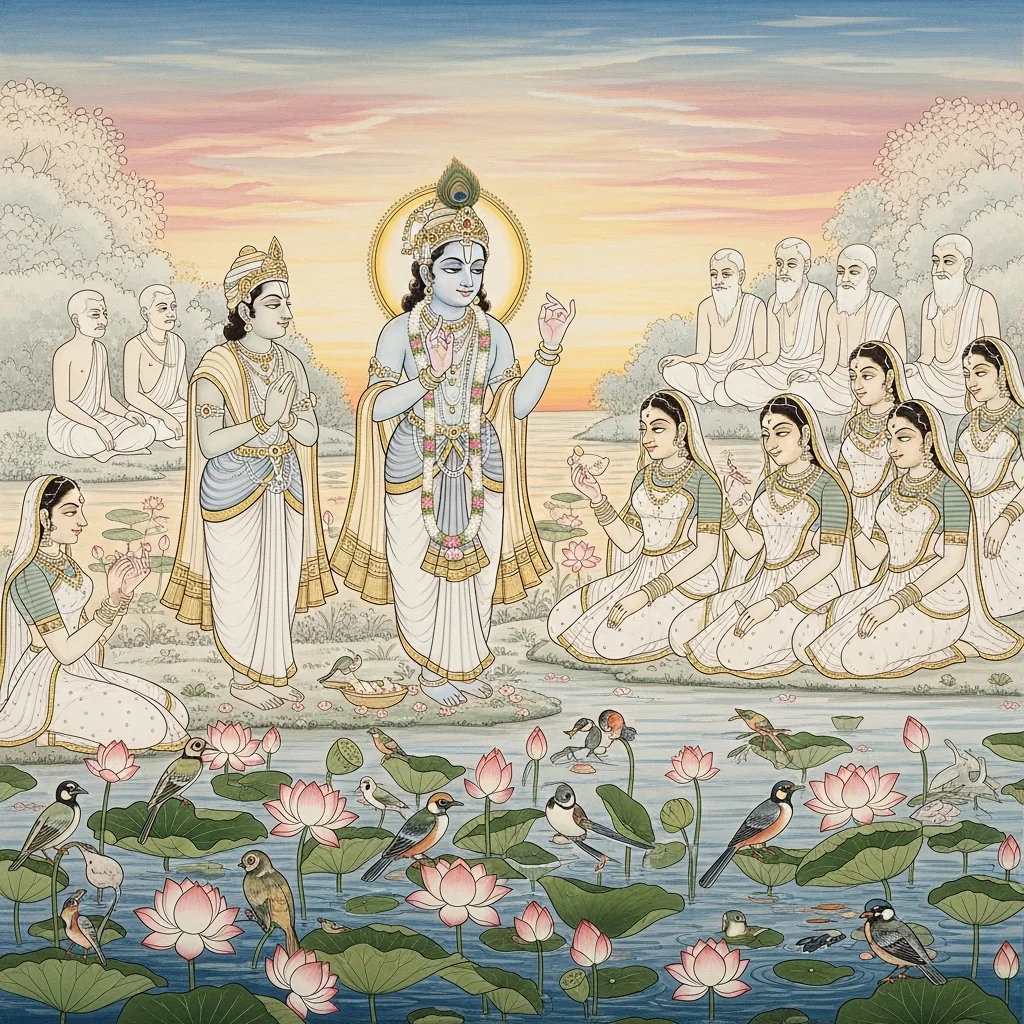
Adhyāya 13 unfolds a structured theological dialogue through Prahlāda’s narration. After hearing Śrī Kṛṣṇa, the gopīs bathe in an already existing lake associated with Māyā and rise into devotional ecstasy. They then petition Kṛṣṇa for a superior sacred pond (saraḥ) and for a regulated annual observance that would grant them enduring access to his presence. Kṛṣṇa creates a new, ideally beautiful water-body near the original—clear and deep, filled with lotuses and birds, and attended by ṛṣis, siddhas, and the Yadu community. He establishes its naming logic: it becomes known as “Gopī-saras” through the gopīs, and also bears the epithet “Gopra-cāra,” tied to the meaning of “go” and shared association. The chapter then prescribes ritual practice: offering arghya with a specific mantra, bathing, tarpaṇa for ancestors and deities, śrāddha, and graduated dāna (including cows, garments, ornaments, and support for the needy). A detailed phalaśruti follows, equating the bath’s merit with major gifts and promising fulfillment of desires (including progeny), purification, and higher destinations. The episode ends with the gopīs taking leave and Kṛṣṇa returning to his abode with Uddhava.
Shlokas
Verse 1
श्रीप्रह्लाद उवाच । इति कृष्णवचः श्रुत्वा गोप्यः संहृष्टमानसाः । तस्मिन्मयसरे स्नात्वा विमुक्ताऽशेषबन्धनाः
Prahlāda said: Having heard Kṛṣṇa’s words, the gopīs—delighted at heart—bathed in that lake of Māyā; and by that bathing they were freed from every bond without remainder.
Verse 2
कृष्णदर्शनसंजातपरमानन्दसंप्लुताः । ऊचुश्च वचनं गोप्यो मधुरं माधवं प्रति
Overwhelmed with supreme bliss born of beholding Kṛṣṇa, the gopīs spoke sweet words addressed to Mādhava.
Verse 3
गोप्य ऊचुः । धन्यः स दैत्यप्रवरो मयो येन कृतं सरः । यस्मिंस्त्वं देवतैः सार्द्धं समेष्यसि जगत्पते
The gopīs said: Blessed is Māyā, foremost among the Dānavas, by whom this lake was made—this very place where You, O Lord of the world, will assemble together with the gods.
Verse 4
यदि तुष्टोऽसि भगवन्ननुग्राह्या वयं यदि । अस्माकमपि वार्ष्णेय कारयस्व सरोत्तमम्
If You are pleased, O Bhagavān—if we are truly fit to receive Your grace—then, O Vārṣṇeya, have a most excellent lake made for us as well.
Verse 5
कीर्त्तनान्मृत्युलोकेऽस्मिंस्तव संदर्शनेन हि । अहर्निशं तव ध्यानाद्यास्यामः परमां गतिम्
By chanting Your glory in this realm of death—and indeed by beholding You—through meditating on You day and night we shall attain the supreme state.
Verse 6
श्रीकृष्ण उवाच । करिष्ये वः प्रियं साध्व्यो यूयं मम परिग्रहाः । अनुग्राह्या मया नित्यं भक्तिग्राह्योऽस्मि सर्वदा
Śrī Kṛṣṇa said: I shall do what is dear to you, O virtuous women; you are My own. You are ever to be favored by Me, for at all times I am won only by devotion.
Verse 7
प्रह्लाद उवाच । इत्युक्त्वा भगवान्कृष्णो गोपीनां हितकाम्यया । सरसः सन्निधौ तस्य सरस्त्वन्यच्चकार ह
Prahlāda said: Having spoken thus, Bhagavān Kṛṣṇa—desiring the welfare of the gopīs—created another lake near that lake.
Verse 8
तदगाधं स्वच्छजलं नलिनीदलशोभितम् । हंससारसयुग्मैश्च चक्रवाकैश्च शोभितम्
That lake was deep, with clear and pure water, adorned with lotus-leaves, and beautified by pairs of swans, sarasa cranes, and cakravāka birds.
Verse 9
कुमुदोत्पलकह्लारपद्मिनीखण्डमण्डितम् । सेवितं द्विजमुख्यैश्च सिद्धविद्याधरैस्तथा
It was adorned with clusters of water-lilies—kumuda, utpala, kahlāra—and with lotus-groves; and it was frequented by foremost Brāhmaṇas, and likewise by Siddhas and Vidyādharas.
Verse 10
सेवितं यदुनारीभिस्तथा यदुकुमारकैः । दिवारात्रौ सुसंपूर्णं सर्वैर्जानपदैर्जनैः
It was frequented by Yadu women and also by Yadu youths; day and night it was fully thronged by all the people of the countryside.
Verse 11
तं दृष्ट्वा जलकल्लोलैः सुसंपूर्णं जलाशयम् । हर्षाद्गोपीजनं कृष्णः प्रोवाच वचनं तदा
Seeing that reservoir of water completely filled with rolling waves, Kṛṣṇa, delighted, then spoke these words to the assembly of gopīs.
Verse 12
पश्यध्वं गोपिकाः शुभ्रं सरः सरं समीपतः । स्वच्छमिष्टजलापूर्णं सज्जनानां यथा मनः
“Behold, O gopīs—near at hand—this radiant lake, clear and filled with sweet, pleasing water, like the mind of the virtuous.”
Verse 13
कारणाद्भवतीनां च यस्मात्कृतमिदं सरः । भवतीनां तथा नाम्ना ख्यातमेतद्भविष्यति
“Because this lake has been made on account of you, it shall therefore become renowned in the world by your very name.”
Verse 14
गोर्वाचावाचकः शब्दो भवतीभिर्मया सह । गोप्रचारेति वै नाम्नां ख्यातिं लोके गमिष्यति
The word “go” signifies speech (vācā); and because of you—together with Me—this place will gain renown in the world by the name “Gopracāra.”
Verse 15
युष्माकं प्रियकामार्थं यस्मात्कृतमिदं सरः । तस्माद्गोपीसर इति ख्यातिं लोके गमिष्यति
Since this lake has been made to fulfill what is dear and desired by you, it will therefore become famous in the world as “Gopī-sara.”
Verse 16
गोप्य ऊचुः । अनुग्राह्या यदि वयमस्मन्नाम्ना कृतं सरः । अन्यत्किमपि वार्ष्णेय प्रार्थयामो वदस्व नः
The gopīs said: “If we are truly worthy of Your grace, and if this lake has been made in our name, then, O Vārṣṇeya, we ask for yet another boon—tell us (that You will grant it).”
Verse 17
श्रीकृष्ण उवाच । प्रार्थ्यतां यदभिप्रेतं यद्वो मनसि वर्तते । भक्त्या समागता यूयं नास्त्यदेयं ततो मया
Śrī Kṛṣṇa said: “Ask for whatever you desire—whatever rests in your hearts. You have come with devotion; therefore, for you there is nothing that I will withhold.”
Verse 18
गोप्य ऊचुः । यदि तुष्टोऽसि भगवन्यदि देयो वरो हि नः । तस्मात्त्वया सदा कृष्ण नरयानेन माधव
The gopīs said: “If You are pleased, O Lord, and if a boon is indeed to be granted to us—then, O Kṛṣṇa, O Mādhava, may You always come here in Your visible human form.”
Verse 19
अत्रागत्य नभस्येऽस्मिन्स्नातव्यं नियमेन हि । यत्र त्वं तत्र देवाश्च यज्ञास्तीर्थानि केशव
Having come here in this month of Nabhas, one should bathe with disciplined observance. For wherever You are, O Keśava, there too are the gods, the sacrifices, and the holy tīrthas.
Verse 20
यत्र त्वं तत्र दानानि व्रतानि नियमाश्च ये । ओंकारश्च वषट्कारः स्वाहाकारः स्वधा तथा
Wherever You are, there too are charities, vows, and all disciplines; there also are the syllable Oṃ, the vaṣaṭ-call, and the utterances svāhā and svadhā.
Verse 21
भूर्भुवःस्वर्महर्ल्लोको जनः सत्यं तपस्तथा । त्वन्मयं हि जगत्सर्वं सदेवासुरमानुषम्
Bhūr, Bhuvar, Svar, Maharloka, Janaloka, Satyaloka, and Tapoloka—indeed all the worlds—are pervaded by You alone. For this entire universe, together with gods, demons, and human beings, is of Your very essence.
Verse 22
तस्मात्त्वयि जगन्नाथे ह्यत्र स्नाते जनार्दने । स्नातमत्र त्रिभुवनं भविष्यति न संशयः
Therefore, O Lord of the universe, when You—Janārdana—bathe here, then the three worlds will be as though bathed in this very place; of this there is no doubt.
Verse 23
त्रैलोक्यपावनी गंगा तव पादजलं हि तत् । लक्ष्मीर्वक्षःस्थलस्थाने मुखे देवी सरस्वती
The Gaṅgā that purifies the three worlds is truly the water that has washed Your feet. Lakṣmī abides upon the place of Your chest, and the goddess Sarasvatī dwells upon Your face as divine speech.
Verse 24
सर्वभूतमयश्चात्र ततस्त्वं जगदीश्वर । यद्ददासि मनुष्याणां भविष्याणां कलौ युगे । तद्वदस्व महाबाहो कृपां कृत्वा जगत्पते
Since here You abide as the very essence of all beings, O Lord of the world—tell us, in compassion, O mighty-armed Master of the universe: what do You grant to human beings who will live in the future, in the age of Kali?
Verse 25
यात्रायामागतानां च अथ षण्मासवासिनाम् । सदैवात्र स्थितानां च यत्फलं तद्वदस्व नः
Tell us what fruit of merit comes to those who arrive here on pilgrimage, to those who dwell here for six months, and also to those who remain here continually.
Verse 26
श्रीकृष्ण उवाच । यत्फलं हि मनुष्याणां स्नातानां गोपिकासरे । तच्छृणुध्वमसंदिग्धं प्रसन्ने मयि गोपिकाः
Śrī Kṛṣṇa said: Hear, O Gopikās, without any doubt, the fruit gained by human beings who bathe in Gopikāsara, when I am graciously pleased.
Verse 27
सोपस्करां सवत्सां च वस्त्रालंकारभूषिताम् । यथोक्तदक्षिणोपेतां ब्राह्मणाय कुटुंबिने
A cow, complete with the requisite accessories, together with her calf, adorned with cloth and ornaments, and accompanied by the proper dakṣiṇā, is to be given to a householder brāhmaṇa.
Verse 28
सदाचाराय शुद्धाय दरिद्रायानुकारिणे । गां दत्त्वा फलमाप्नोति स्नानमात्रेण तत्फलम्
By giving a cow to one of good conduct, purity, and compassion toward the poor, one attains the fruit of such charity; yet by bathing alone at this tīrtha, one gains that very same fruit.
Verse 29
यावत्पदानि मनुजः कृष्णेन सह गच्छति । कुलानि देव्यस्तावंति वसंति हरिमन्दिरे
For as many steps as a person walks together with Kṛṣṇa, O Goddess, for that many generations his family line dwells in Hari’s divine abode.
Verse 30
कृष्णेन सह गच्छन्ति गीतवादित्रनिस्वनैः । स्तुवन्तो विविधैः स्तोत्रैर्गोविंदं गोपिकासरे
They go with Kṛṣṇa amid the sounds of song and instruments, praising Govinda with many kinds of hymns at Gopikāsara.
Verse 31
न मातुर्जठरे तेषां यातना जायते नृणाम् । सर्वान्कामानवाप्यांते वैष्णवं लोकमाप्नुयुः
For those people, no suffering arises even in the mother’s womb. Having gained all desired aims, they attain the Vaiṣṇava world, the realm of Viṣṇu.
Verse 32
अर्घ्यं दत्त्वा विधानेन स्नानं कुर्याद्विचक्षणः । मंत्रेणानेन वै साध्व्यः श्रद्धया परया युतः
Having offered arghya according to the proper rite, the discerning devotee should perform the sacred bath, endowed with supreme faith, using this very mantra.
Verse 33
नमस्ते गोपरूपाय विष्णवे परमात्मने । गोप्रचारे जगन्नाथ गृहाणार्घ्यं नमोऽस्तु ते
Salutations to You—Viṣṇu, the Supreme Self—who appear in the form of a cowherd. O Jagannātha, who moves among the pastures, accept this arghya; again, salutations to You.
Verse 34
अर्घ्यं दत्त्वा विधानेन मृदमालिप्य पाणिना । स्नायाच्छ्रद्धासमायुक्तस्तर्पयेत्पितृदेवताः
Having offered arghya in due rite and anointed the body with sacred earth by the hand, one should bathe with faith and then satisfy the ancestral deities through tarpana offerings.
Verse 35
श्राद्धं कुर्य्यात्ततो भक्त्या एकचित्तः समाहितः । यथोक्तदक्षिणा दद्याद्रजतं रुक्ममेव च
Thereafter, with devotion—single-minded and composed—one should perform the śrāddha and give the prescribed dakṣiṇā, including silver and gold.
Verse 36
विशेषतः प्रदातव्यं तांबूलं कज्जलं तथा । दुकूलानि च देयानि तथा कौसुंभकानि च
In particular, one should give tāmbūla (betel) and also kajjala (collyrium). Fine garments should be given as well, including cloth dyed kusumbha—saffron-hued.
Verse 37
दंपत्योर्वाससी चैव भूषणानि स्वशक्तितः । गावो देया द्विजातिभ्यो वृषभाश्च धुरंधराः । दीनांधकृपणानां च दानं देयं स्वशक्तितः
According to one’s capacity, one should give garments for husband and wife, and ornaments as well. Cows should be given to the dvija, and strong, burden-bearing bulls too. And, according to one’s means, charity should be given to the poor, the blind, and the destitute.
Verse 38
एवं कृत्वा नरः सम्यगुत्तमां गतिमाप्नुयात् । प्रयांति परमं लोकं पितरस्त्रिकुलोद्भवाः
Having done thus properly, a man attains the highest course. The ancestors—arisen from the three lines of kin—go to the supreme world.
Verse 39
लभते पुत्रकामस्तु पुत्रानिष्टान्मनोरमान्
One who longs for sons obtains sons—beloved and pleasing to the heart.
Verse 40
यं यं कामयते कामं स्वर्गमोक्षादिकं नरः । तत्सर्वं समवाप्नोति यः स्नाति गोपिकासरे
Whatever desire a person longs for—heaven, liberation, and the like—he obtains all of that, if he bathes in the Gopikā-sara, the sacred lake of the Gopikās.
Verse 41
यावल्लोका भविष्यंति तावत्स्थास्यति वै सरः । यावत्सरो यशस्तावद्भवतीनां भविष्यति
So long as the worlds endure, this sacred lake indeed shall remain. And as long as this lake remains, so long shall your fame endure as well.
Verse 42
यावत्कीर्तिर्मनुष्येषु तावत्स्वर्गे महीयते । विमुक्ताः सकलात्पापाद्यास्यंति परमां गतिम्
As long as your fame is spoken of among human beings, so long will you be honored in heaven. Freed from every sin, you shall attain the supreme destination.
Verse 43
तत्पुण्यं गोपीसर इदं जलैः पूर्णं सदैव हि । अवगाह्यं मया गोप्यो नभस्ये नियमेन हि
This meritorious Gopī-lake is indeed ever filled with waters. O gopīs, you should bathe in it—especially in the month of Nabhas—according to observance and rule.
Verse 44
भवत्यः पतिभावेन ब्रह्मभावेन वा पुनः । चिंतयंत्यः परं मां हि परागतिमवाप्स्यथ
O women, whether you contemplate Me with the feeling of a husband, or again with the attitude toward Brahman (the Absolute), by meditating on Me as the Supreme you shall attain the highest state.
Verse 45
प्रह्लाद उवाच । अनुज्ञाता भगवता ततस्ता गोपकन्यकाः । नमस्कृत्य च गोविंदं ययुः सर्वा यथागता
Prahlāda said: Then those cowherd maidens, having been granted leave by the Blessed Lord, bowed to Govinda, and all departed, returning as they had come.
Verse 46
भगवानपि गोविंद उद्धवेन समन्वितः । विसृज्य गोपिकाः कृष्णः स्वकं मंदिरमाविशत्
And the Blessed Lord Govinda too—accompanied by Uddhava—dismissed the gopīs, and Kṛṣṇa entered His own abode.