Adhyaya 3
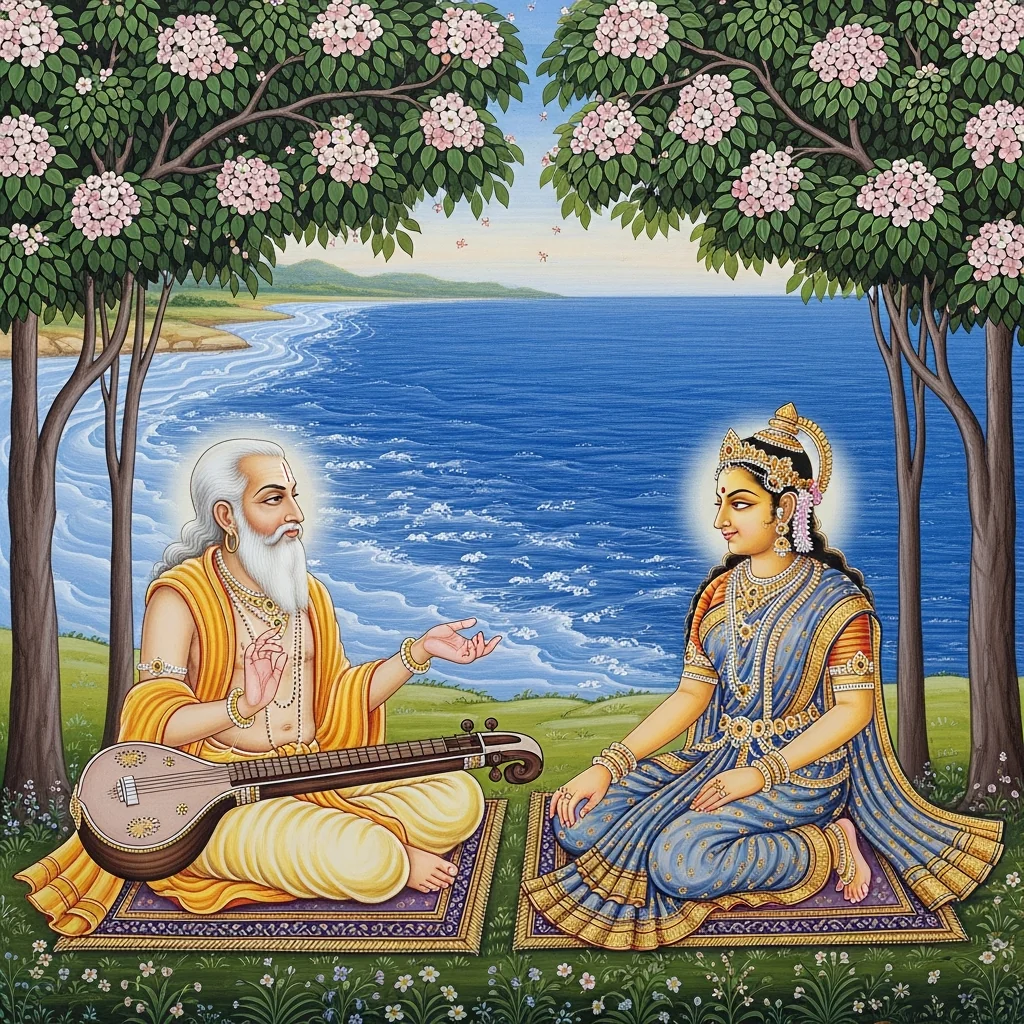
Chapter 3 presents a layered theological teaching on separation, divine instruction, and the arising of a tīrtha. The Ṛṣis marvel at Kṛṣṇa’s forbearance and at the truth-power carried by a sage’s speech. Prahlāda recounts how Rukmiṇī, struck by Durvāsas’ curse, laments her separation from Kṛṣṇa and questions the justice of being cursed despite her innocence. Overcome by grief, she faints, and Samudra (the Ocean) arrives to revive and refresh her. Nārada counsels steadiness and explains that Kṛṣṇa and Rukmiṇī are inseparable principles—Puruṣottama and Māyā/Śakti—and that the apparent separation is a “human-like” concealment meant to instruct the world. Samudra confirms this, praises Rukmiṇī’s exalted status, and announces the coming of Bhāgīrathī (Gaṅgā), whose presence beautifies and purifies the region; a divine grove forms and draws the people of Dvārakā. Seeing the pleasant outcome, Durvāsas’ anger flares again, and he intensifies the curse’s effects upon the land and waters. Rukmiṇī, overwhelmed, resolves on death, but Kṛṣṇa swiftly appears, prevents self-harm, and teaches non-duality and the limits of curse-power before the Divine. Durvāsas repents and seeks forgiveness; Kṛṣṇa upholds the integrity of the sage’s words while establishing a reconciliatory arrangement. The chapter ends with stated merits: bathing at the confluence on new- or full-moon days removes sorrow, and beholding Rukmiṇī on certain lunar dates grants desired aims, establishing the site as a tīrtha that heals suffering.
Shlokas
Verse 1
ऋषय ऊचुः । अहो ब्रह्मण्यदेवस्य कृष्णस्यामिततेजसः । महिमा यदयं नैव मृषा चक्रे मुनेर्वचः
The sages said: “Ah! Such is the greatness of Kṛṣṇa, the Lord devoted to brāhmaṇas, of immeasurable splendor—he did not allow the sage’s words to become false.”
Verse 2
तेन चक्रे न रोषं स सेतुपालो जनार्दनः । भृगोर्यश्चरणाघातं दधार हृदि लाञ्छनम्
Because of that, Janārdana, the guardian of the setu and protector of the world’s order, did not become angry; and he bore upon his chest, as a mark, the blow of Bhṛgu’s foot.
Verse 3
सा तु देवी कथं तेन प्रेयसा विप्रयोजिता । एकाकिनी स्थिता तत्र कथ्यतामसुरेश्वर
But how was that Goddess separated from her beloved? Remaining there all alone—tell us, O lord of the asuras.
Verse 4
उत्कण्ठिता अति वयं श्रोतुं द्वारवतीं मुदा । इदमादौ बुभुत्सामश्चित्तखेदापनुत्तये
We are exceedingly eager to hear, with joy, the account of Dvāravatī. First, we wish to understand this, so that the distress in the heart may be dispelled.
Verse 5
प्रह्लाद उवाच । श्रूयतामृषयः सर्वे गदतो मम विस्तरात् । यथा शापोद्भवं दुःखं मुमोच हरिवल्लभा
Prahlāda said: “Hear, all you sages, as I relate this at length—how Hari’s beloved (Rukmiṇī) was freed from the sorrow that arose from a curse.”
Verse 6
अथ दुर्वाससः शापमवाप्यारुन्तुदं तदा । यादवेन्द्रस्य गृहिणी सहसा पर्यदेवयत्
Then, having incurred the sharp, piercing curse of Durvāsas, the wife of the lord of the Yādavas (Rukmiṇī) suddenly broke into lamentation.
Verse 7
रुक्मिण्युवाच । कल्याणी बत वाणीयं लौकिकी संविभाव्यते । कूपके चैव सिन्धौ च प्रमाणान्नाधिकं जलम्
Rukmiṇī said: “Alas—this ‘auspicious’ speech is being weighed in a worldly way: in a small well and in the ocean alike, water is still only as much as the measure allows.”
Verse 8
यासाहं भूरिभाग्या वै प्राप्य नाथं जगत्पतिम् । इयमेकाकिनी जाता पौलस्त्याद्देवहेलनात्
I, once truly most blessed—having attained the Lord, the ruler of the world—have now become utterly alone, because of contempt toward the divine, brought by Paulastya (Durvāsas).
Verse 9
क्व मंगलालयः श्रीमाननवद्यगुणो हरिः । अल्पपुण्या सुसंबाधा कामिनी क्वातिचञ्चला
Where is Hari—abode of auspiciousness, glorious, and flawless in virtues—and where am I, a woman driven by desire, scant in merit, hemmed in by limitations, and exceedingly fickle?
Verse 10
तथापि घटयामास धाता वंचनकोविदः । विधानमशुभाया मे वियोगविषमव्यथम्
Yet the Ordainer, skilled in bringing about bewildering turns, arranged for me—ill-fated as I am—a destiny of harsh anguish through separation.
Verse 11
अन्यथा वर्णगुरवः स्नातास्त्रैविद्यवर्त्मनि । कथं नु शप्तुमर्हन्ति स्वयं खिन्नामनागसम्
Otherwise, how could the venerable teachers of the social orders—purified in the path of the three Vedas—be fit to curse one who is herself distressed and guiltless?
Verse 12
विदधे वज्रमयं तु किं न्विदं हृदयं मेऽतिकठोरमेव हि । शतधा न विदीर्यते यतो विरहे दुर्विषहे मधुद्विषः
Did the Creator make my heart of diamond—so exceedingly hard—that it does not shatter into a hundred pieces, even in this unbearable separation from Madhudviṣ (Kṛṣṇa)?
Verse 13
अधिकृत्य सुदुश्चरं तपः प्रतिलब्धः प्रथमं मयात्मजः । तनयेन विनाकृताऽप्यहं न मृता पंचसु वासरेष्विह
After undertaking austerity most difficult to endure, I first obtained a son; yet, though bereft of my child, I have not died here even after five days.
Verse 14
उपलभ्य सुदारुणामिमामपि पीडामवितास्म्यहं तदा । यदिदं विधुनोति कल्मषं खलु तन्मां समुपेत्य लक्षवृद्धिम्
Even after meeting this most dreadful affliction, I shall live on; for it truly shakes off impurity—therefore may it come upon me and increase my merit a hundred-thousandfold.
Verse 15
इति साऽतिविलप्य दुःखितार्था कुररीतुल्यतया शुशोच वेगात् । विरहेण विघूर्णिताशया द्विजशापापहता मुमूर्च्छ सद्यः
Thus, having lamented profusely in her sorrow, she grieved with sudden force like a kurarī-bird. Her mind, whirled by the pain of separation and struck down by a brāhmaṇa’s curse, she fainted at once.
Verse 16
अथ दुर्वाससा शप्ता रुक्मिणी कृष्णवल्लभा । मूर्च्छनामाप तत्रैव ह्याजगाम पयोनिधिः
Then Rukmiṇī, beloved of Kṛṣṇa, having been cursed by Durvāsas, fell into a swoon right there; and at that very moment the Ocean, lord of waters, came to that place.
Verse 17
सुधाशीकरगर्भेण पद्मकिंजल्कवायुना । न्यवीजयदिमां देवीं रुक्मिणीं कृष्णवल्लभाम्
With a breeze bearing droplets like nectar and fragrant with lotus pollen, the Ocean gently fanned the goddess Rukmiṇī, beloved of Kṛṣṇa.
Verse 18
एतस्मिन्नन्तरे तत्र व्योममार्गेण नारदः । गायन्गुणान्भगवतो वीणापाणिः समागतः
Meanwhile, Nārada arrived there by the path of the sky, vīṇā in hand, singing the virtues of the Blessed Lord.
Verse 19
स दृष्ट्वा सिंधुनाऽश्वास्यमानां विश्वस्य मातरम् । अवतीर्य श्रुतकथो बोधयामास नारदः
Seeing the Mother of the universe being comforted by the Ocean, Nārada descended; having heard the account, he began to rouse and counsel her.
Verse 20
नारद उवाच । मा खेदं देव देवेशि देवि त्वदधिपे पतौ । दूरीकृते विप्रशापात्कुरु कल्याणि धीरताम्
Nārada said: “Do not grieve, O goddess, O sovereign lady of the gods. When your Lord and husband has removed the brāhmaṇa’s curse, be firm and composed, O auspicious one.”
Verse 21
त्वं हि साक्षाद्भगवती कृष्णश्च पुरुषोत्तमः । अवतीर्णो धराभारमपनेतुं यदृच्छया
For you are directly the Blessed Goddess, and Kṛṣṇa is the Supreme Person. He has descended by his own free will to remove the burden of the earth.
Verse 22
देवो ह्यसौ परं ब्रह्म सदाऽनिर्विण्णमानसः । मायाशक्तिस्त्वमेतस्य सर्गस्थित्यन्तकारिणः
Indeed, he is the Divine Lord, the Supreme Brahman, whose mind is ever unwearied. And you are his Māyā-Śakti—the power by which creation, preservation, and dissolution are accomplished.
Verse 23
संहृत्य निखिलं शेते ययाऽसौ कलया स्वराट् । तदापि न वियुज्येत त्वया विश्वपतिः प्रभुः
Having withdrawn the entire universe, the Sovereign rests by that very portion of power (kalā). Even then, the Lord—Master of the universe—does not become separated from you.
Verse 24
अवियुक्तस्त्वया नित्यं देवदेवो जगत्पतिः । लीलावतारेष्वेतस्य सर्वेषु त्वं सहायिनी
The God of gods, the Lord of the world, is eternally not separated from you. In all of his playful descents (līlā-avatāras), you are his companion and helper.
Verse 25
योगं वियोगं च तथा न यात्येष त्वयाऽनघे । विडंबयति भूतानामुपकाराय चेश्वरः
O blameless one, He does not truly enter either union or separation with you. The Lord only adopts the appearance of such states, for the welfare and instruction of living beings.
Verse 26
आराधनीयाः सततं भूदेवा भूतिमीप्सता । प्रकोपनीया नैवैते तत्त्वज्ञा हि तपस्विनः
Those who are ‘gods upon earth’—the brāhmaṇas—should always be revered by one who seeks prosperity and auspiciousness. They should never be provoked, for ascetics who know the truth are truly seers of reality.
Verse 27
इत्येवं शिक्षयंल्लोकं वियोगं तेऽनुमन्यते । मुनि शापाद्धरिः साक्षाद्गूढः कपटमानुषः
Thus, to instruct the world, He consents to that separation from you. Because of a sage’s curse, Hari Himself remains concealed—appearing as a human by deliberate disguise.
Verse 28
अपि स्मरसि कल्याणि जातो रघुकुले स्वयम् । लोकानुग्रहमन्विच्छन्भूभारहरणोत्सुकः
O auspicious lady, do you remember how He Himself was born in the Raghu lineage—seeking the welfare of the worlds, eager to remove the burden of the earth?
Verse 29
तं हरिं जगतामीशं रुक्मिणि त्वं न वेत्सि किम् । प्राणेभ्योऽपि गरीयांसमयं देवः स एव हि
Rukmiṇī, do you not recognize that Hari, the Lord of the worlds? He is dearer than life-breath itself; that very Deity alone is your true refuge.
Verse 30
येनेदं पूरितं विश्वं बहिरन्तश्च सुव्रते । असंगस्य विभोः संगः कथं स्यादिति मन्मतिः
O virtuous lady, He by whom this entire universe is pervaded—outside and within—how could there be ‘attachment’ for that all-powerful One who is, by nature, unattached? Such is my understanding.
Verse 31
तया त्वया नियुक्तोऽसाविति प्रत्येमि सर्वशः । तद्विमुञ्चाऽधिमत्यर्थमात्मानमनुसंस्मर । प्रसीद मातः संधेहि धीरतां स्वमनीषया
I am fully convinced that He has been commissioned by you for this purpose. Therefore, abandon excessive grief; recollect your own true nature. Be gracious, O mother—compose yourself and gather steadiness through your own discernment.
Verse 32
इति ब्रुवति देवर्षाववसाने नदीपतिः । प्रोवाच वचनं तस्यै वाचा मृदुसुवर्णया
When the divine sage had finished speaking thus, the lord of rivers spoke to her in reply, in a voice gentle and golden-sweet.
Verse 33
समुद्र उवाच । यदाह देवि देवर्षिर्नत्वा त्वां सत्यमेव तत् । गीयसे त्वं हि वेदेषु नित्यं विष्णुः सहायिनी
Samudra said: O Goddess, what the divine sage proclaimed after bowing to you is indeed true. For in the Vedas you are ever praised as the eternal companion and support of Viṣṇu.
Verse 34
परः पुमानेव निरस्तविग्रहो गूढोऽधिपस्ते विदधाति भूयः । विश्वं व्यवस्थापयति स्वरोचिषा त्वया सहायेन बिभर्ति मूर्तिम्
That Supreme Person—formless in essence, yet hidden as the Sovereign—again brings His works to pass. By His own radiance He orders the universe; and with you as His aid, He bears a manifest form.
Verse 35
तदेष परिखेदस्ते न मनागपि युज्यते । वक्षःस्थलस्था भवती नित्यं श्रीवत्सलक्ष्मणः
Therefore this sorrow of yours is not fitting even in the least. You ever abide upon the chest of Viṣṇu, marked with Śrīvatsa—the eternal abode of Lakṣmī.
Verse 36
इयं भागीरथी देवी मदादेशादुपागता । विनोदयिष्यत्यनिशं त्वां हि देवि शरीरिणी
This goddess Bhāgīrathī has come here by my command. O Goddess, embodied and present, she will ceaselessly delight and comfort you.
Verse 37
एतस्याः स्यान्मृदु स्वादु पयः पूरोपशोभितम् । प्रदेशोऽयमशेषोऽपि भविता त्वत्सुखप्रदः
Her waters will be gentle and sweet, adorned with abundant flow; and this entire region, without remainder, will become a giver of happiness to you.
Verse 38
नानाद्रुमलताकीर्णं निकुंजैरुपशोभितम् । मातंगैश्च समाजुष्टं मंजुगुंजन्मधुव्रतम्
It was filled with many kinds of trees and creepers, adorned with lovely bowers; elephants resorted there, and the air resounded with the sweet humming of honey-seeking bees.
Verse 39
नवपल्लवभङ्गीभिः कुसुमस्तबकैः शुभैः । फलैरमृतकल्पैश्च मंजरी राजिभिस्तथा
With the graceful forms of fresh sprouts, with auspicious clusters of blossoms, with fruits like nectar, and with rows of flowering sprays, it shone in splendid radiance.
Verse 40
नंदनस्य श्रिया जुष्टं मनोनयननन्दनम् । वनं रम्यतरं चात्र ह्यचिरेण भविष्यति
A forest graced with the splendor of Nandana—delighting mind and eyes—will soon arise here, even more enchanting than before.
Verse 41
त्वया संबोधनीयाः स्म वयं मातः सदैव हि । अगम्यरूपा विद्या त्वमस्माभिर्बोध्यसे कथम्
O Mother, it is we who should always be instructed by you. You are Vidyā—Knowledge itself—of an unfathomable form; how could we presume to enlighten you?
Verse 42
तदा वामनुजानीहि प्रसीद परमेश्वरि । नमस्ते विश्वजननि भूयो ऽपि च नमोनमः
Then grant us leave, O Supreme Goddess; be gracious. Salutations to you, O Mother of the universe—again and again, our reverent bow.
Verse 43
प्रह्लाद उवाच । एवमुक्त्वा जगद्धात्रीं जग्मतुस्तौ यथागतम् । आजगाम च तत्रैव देवी भागीरथी स्वयम्
Prahlāda said: Having thus spoken to the World‑Sustaining Mother, those two departed as they had come; and there itself the goddess Bhāgīrathī arrived in person.
Verse 44
वनं समभवत्तत्र दिव्यभूरुहसेवितम् । सेव्यं समस्तलोकानां फलपुष्पसमृद्धिमत्
There a forest came into being, graced by divine trees—worthy of being visited by all beings—abounding in fruits and flowers.
Verse 45
प्रसादेन च भूतानां गंगाऽशेषाघहारिणी । भूषयामास तद्देशं सा च विष्णुपदी सरित्
By grace toward all beings, the Gaṅgā—remover of every sin—adorned that region. That river, famed as Viṣṇupadī, springing from Viṣṇu’s foot, beautified the land.
Verse 46
देवो च मुनिवाक्येन गंगायाश्च विनोदनात् । सौन्दर्या तस्य देशस्य किञ्चित्स्वास्थ्यमवाप ह
And by the sage’s word, and by the Gaṅgā’s gracious, heart‑gladdening aid, the beauty of that region regained a measure of well‑being and balance.
Verse 47
अथ विष्णुपदीं देवीं श्रुत्वा सागरसंगताम् । इतस्ततः समाजग्मुः श्रद्दधानाः पयस्विनीम्
Then, hearing that the goddess Viṣṇupadī—Gaṅgā—had met the ocean, faithful people gathered from every direction to that water‑abounding river.
Verse 48
द्वारकावासिनश्चैव जनाः काननशोभया । हृष्टचित्ताः समाजग्मुरनिशं रुक्मिणीवनम्
And the people dwelling in Dvārakā, delighted by the forest’s beauty, went continually with joyful hearts to Rukmiṇī’s grove.
Verse 49
श्रुत्वा तदखिलं सर्वं दुर्वासाः शांभवी कला । चुकोप स्मयमानश्च भूय एतदभाषत
Hearing all of that, Durvāsā—an embodiment of Śāmbhavī power—grew angry; yet, smiling, he again spoke these words.
Verse 50
दुर्वासा उवाच । कः प्रभुस्त्रिषु लोकेषु मह्यं वचनमन्यथा । विधातुमपि देवानामाद्यो लोकपितामहः
Durvāsā said: Who in the three worlds has the power to make my word otherwise—even the primordial Grandfather of the worlds, the first among the gods?
Verse 51
किं न जानाति लोकोऽयं मयि रोषकषायिते । शक्रं प्रति त्रिभुवनं भ्रष्टश्रीकमभूत्तदा
Does not this world know what happens when my anger is stirred? Once, because of Śakra, the three worlds became bereft of their splendor.
Verse 52
मम शापमविज्ञाय नन्दनप्रतिमे वने । कथं सा रुक्मिणी तत्र रमते जनसेविते
Without regard for my curse, how does that Rukmiṇī take delight there—in that grove like Nandana, frequented and attended by people?
Verse 53
तदेते तरवः सर्वे संत्वभोज्यफला नृणाम् । विभ्रष्टसर्वसौभाग्याः कुसुमस्तबकोज्झिताः
Therefore, let all these trees become such that their fruits are unfit for men to enjoy—bereft of all loveliness and deprived of clusters of blossoms.
Verse 54
इयं तु शापनिर्दग्धा हरचूडामणिः सरित् । वार्यस्याः स्यादपेयं तु नैवेह स्थातुमर्हति
And this river—Haracūḍāmaṇi, the ‘crest-jewel of Hara’—scorched by the curse, let her waters become undrinkable; indeed, she is not worthy to remain here.
Verse 55
प्रह्लाद उवाच । तदा सर्वमभूत्तत्र यद्यदाह च वै मुनिः । वाचि वीर्यं हि विप्राणां निर्मितं विष्णुना स्वयम्
Prahlāda said: Then, in that place, everything came to pass exactly as the sage had spoken. For the potency abiding in the speech of Brāhmaṇas is itself fashioned and upheld by Viṣṇu.
Verse 56
सा तु देवी तथा वृत्तमवेक्ष्य भृशदुःखिता । मेने दुरत्ययं दैवमापतत्तत्पुनःपुनः
But the goddess, seeing matters unfold thus, became exceedingly sorrowful. She thought that an unavoidable fate had struck her again and again.
Verse 57
ततस्तु सा विनिश्चित्य मरणं दुःखभेषजम् । उत्तरीयांबरेणैव बहिः किञ्चित्प्रबद्ध्य तु
Then she resolved that death would be the remedy for her grief. With her upper garment, she tied a noose outside, fastening it there.
Verse 58
अथावबुध्य तत्सर्वं सर्वभूतगुहाशयः । तां ज्ञात्वा सत्वरं चाऽगात्सुपर्णेन दयानिधिः
Then He—who abides in the hidden heart-cave of all beings—understood everything. Knowing her distress, the ocean of compassion hastened there, borne upon Suparṇa (Garuḍa).
Verse 59
ददर्श तादृशीं देवीं कण्ठपाशकरां विभुः । अधस्तात्तरुशाखायां निमीलितविलोचनाम्
The Lord beheld the goddess in that state, holding a noose at her neck. Beneath a tree-branch she stood, her eyes closed.
Verse 60
विभ्रष्टभूषणगणां कृशदेहवल्लीं म्लानाननांबुजरुचं मरणे प्रसक्ताम् । मेने स विग्रहवतीं करुणां कृपालुस्तां सौख्यदां गुणवतीं प्रणतार्तिहन्त्रीम्
Her ornaments had fallen away; her body was thin like a withered creeper; the lotus-glow of her face had faded, and her mind clung to death. Seeing her thus, the compassionate Lord knew her as Compassion embodied—bestower of solace, rich in virtue, and destroyer of the distress of those who bow in surrender.
Verse 61
संश्रुत्य साऽपि पतगाधिपते रवं वै प्रोन्मील्य नेत्रकमलेऽथ ददर्श कृष्णम् । सामन्यत त्रिकविवर्तितलोचनाब्जं प्राप्तं तमिष्टसुहृदं निजजीवनाथम्
Hearing the cry of the lord of birds (Garuḍa), she opened her lotus-eyes and beheld Kṛṣṇa. She gazed upon Him—her beloved friend who had arrived, the very Lord of her life—while her lotus-like eyes turned again and again in wonder.
Verse 62
सा रोमहर्षविवशा त्रपया परीता कोपानुरागकलुषा कृतविप्रलापा । संवर्द्धितद्विगुणशोकभरा च देवी नानारसं बत दृशोर्विषयं प्रपेदे
The goddess was overcome with trembling rapture, her hair standing on end, and she was filled with bashfulness. Her heart, clouded by mingled anger and love, poured forth broken words; her burden of sorrow doubled, and her eyes met a whirl of many emotions.
Verse 63
तस्याः ससाध्वसविसर्गचिकीर्षितायाः पाशं व्यपोह्य करचारु सरोरुहेण । आदाय पाणिममृतोपमया च वाचा संजीवयन्निदमुदारमुदाजहार
As she, in fear, was about to cast away her life, He removed the noose with His beautiful lotus-hand. Taking her hand and reviving her with nectar-like words, He uttered this noble speech.
Verse 64
श्रीकृष्ण उवाच । किमेतत्साहसं भीरु चिकीर्षत्यविचारितम् । ननु देवि ममाचक्ष्व किं नु ते खेदकारणम्
Śrī Kṛṣṇa said: “O timid one, what is this reckless act you are about to do without reflection? Tell Me, O goddess—what indeed is the cause of your sorrow?”
Verse 65
त्वं विद्याऽहं परो बोधस्त्वं माया चेश्वरस्त्वहम् । त्वं च बुद्धिरहं जीवो वियोगः कथमावयोः
“You are the divine Knowledge; I am the supreme Awareness. You are Māyā, and I am the Lord. You are the intellect, and I am the embodied soul—so how could there truly be any separation between us two?”
Verse 66
त्वया विमोहितात्मानो भ्राम्यन्त्यजभवादयः । सा कथं क्षुभ्यसि त्वं तु किं स्वधाम न बुध्यसे
“By you, even great beings—Brahmā and others—become deluded and wander. How then could you yourself be disturbed? Do you not recognize your own true abode—your real nature?”
Verse 67
त्वया हि बद्धा ऋषयस्ते चरन्तीह कर्मभिः । तां त्वां कथमृषिः शप्तुं शक्नुयाद्वरवर्णिनि
“Indeed, by you the sages themselves are bound and thus move about here under the compulsion of karma. So how could any ṛṣi have the power to curse you, O fair and excellent lady?”
Verse 68
शिक्षार्थं त्विह लोकानामेवं मे देवि चेष्टितम् । मन्मायया समाविष्टः कुरुते विवशः पुमान् । पश्य कोपपरीतात्मा यः स शान्तो मुनीश्वरः
O Devī, for the instruction of the people of this world I have acted thus. A man, entered and overpowered by My Māyā, acts helplessly, as though against his will. Behold—he whose mind is now seized by anger is in truth that very tranquil lord among sages.
Verse 69
प्रह्लाद उवाच । सोऽभ्येत्य भक्तिनम्रोऽथ दुर्वासा मुनिसत्तमः । विचार्य मनसा सर्वं पश्चात्तापानुपाश्रयत्
Prahlāda said: Then Durvāsā, the best of sages, approached, bowed low in devotion. Reflecting on everything within his mind, he thereafter took refuge in remorse (repentance).
Verse 70
किं मया कृतमित्युक्त्वा तत्समीपमुपागमत् । अपतद्विलुठन्भूमौ दण्डवच्चाश्रुसंप्लुतः
Saying, “What have I done?”, he went near to them. He fell down, rolling on the ground, prostrating like a staff, drenched with tears.
Verse 71
पितरौ जगतो देवौ क्षामयामास दीनवत् । तुष्टाव सूक्तवाक्यैस्तु रहस्यैर्भक्तिसंयुतः
Like one helpless, he begged forgiveness from the two deities, the parents of the world. And, endowed with devotion, he praised them with well-spoken words, profound and esoteric in meaning.
Verse 72
आह चेदं जगन्नाथं यदि मय्यस्त्यनुग्रहः । तदा पुरेव संयोगो देव देव्या विधीयताम्
And he said to the Lord of the universe: “If there is grace toward me, then let the union of the God and the Goddess be restored, just as it was before.”
Verse 73
अथ प्रहस्य गोविन्दस्तमाह मुनिसत्तमम् । न हि ते वचनं जातु मृषा भवितुमर्हति
Then Govinda, smiling, said to that best of sages: “Indeed, your word can never become false.”
Verse 74
मयैवं विहितः सेतुः कथमुच्छेद्यतां द्विज । सद्भिराचरितः सेतुः सिद्धो लोकस्य पालकः
“This boundary-law (setu) has been established by Me—how could it be cut off, O brāhmaṇa? This setu, practiced by the good, is accomplished and serves as the protector of the world.”
Verse 75
दिनेदिने द्विकालं च आयास्ये मुनिसत्तम । विनोदयिष्ये तां तां तु मुनिकन्यां च काम्यया
“O best of sages, I shall come day after day, at both times (morning and evening), and, as I desire, I shall delight that maiden of the sage again and again.”
Verse 76
तुष्यामि साधनैर्नान्यैर्मत्कथाकथनैरपि । यथा संपूज्य मामत्र मम प्रीतिर्भविष्यति
“I am not pleased by other means—even by the telling of stories about Me—so much as I shall be pleased when I am duly worshipped here; then My favor will arise.”
Verse 77
यदा च मयि वै कुण्ठमधिरूढे महामुने । प्रवेक्ष्यति तदा तेजो मम सर्वं त्रिविक्रमे
“And when I, O great sage, have ascended to Vaikuṇṭha, then all My radiance will enter into Trivikrama.”
Verse 78
रुक्मिणीयं च मन्मूर्तेः संयोगं पुनरेष्यति । इयं भागीरथी चापि सागरेण समा गुणैः । त्यक्त्वा ह्यशेषदुःखानि सुखं चैव गमिष्यति
Rukmiṇī, too, will again attain union with My own divine form. And this Bhāgīrathī (Gaṅgā) as well—equal to the ocean in virtues—casting off all sorrows, shall indeed go to bliss.
Verse 79
अनुग्रहं विधायैवमृषिणा सह केशवः । विवेश स्वपुरीं तत्र विधायोपांतिकं मुनिम्
Thus, having bestowed His favor, Keśava—together with the sage—entered His own city, after placing the muni nearby in attendance.
Verse 80
सापि देवी च संबुध्य तदा तस्य विचेष्टितम् । अनुग्रहाद्भगवतो बभूव विगत ज्वरा
That goddess, too, then understood his actions; and by the Lord’s grace she became free from fever and affliction.
Verse 81
यतश्च मुक्ता दुःखेन तत्र देवी हरिप्रिया । ततो भागीरथी सा तु गदिता दुःखमोचिनी
And since the goddess, beloved of Hari, was there released from sorrow, therefore that Bhāgīrathī came to be spoken of as “the Remover of Suffering.”
Verse 82
अमावास्यां पौर्णमास्यां यस्तस्याः संगमे शुभे । स्नायादशेषदुःखात्तु स नरः परिमुच्यते
On the new-moon and full-moon days, whoever bathes at her auspicious confluence is completely freed from all sorrow.
Verse 83
अष्टम्यां च चतुर्दश्यां नवम्यां चावलोकिता । नराणां रुक्मिणी देवी सर्वान्कामा न्प्रयच्छति
On the eighth, the fourteenth, and the ninth lunar days, when Goddess Rukmiṇī is beheld in devotion, she grants people all desired wishes.
Verse 84
इत्येतत्कथितं देव्या ऋषयो दुःखमोचनम् । अनुग्रहश्च देवस्य किं भूयः श्रोतुमिच्छथ
Thus, O sages, the sorrow-removing greatness of the Goddess has been told, and also the Lord’s grace. What more do you wish to hear?