Adhyaya 36
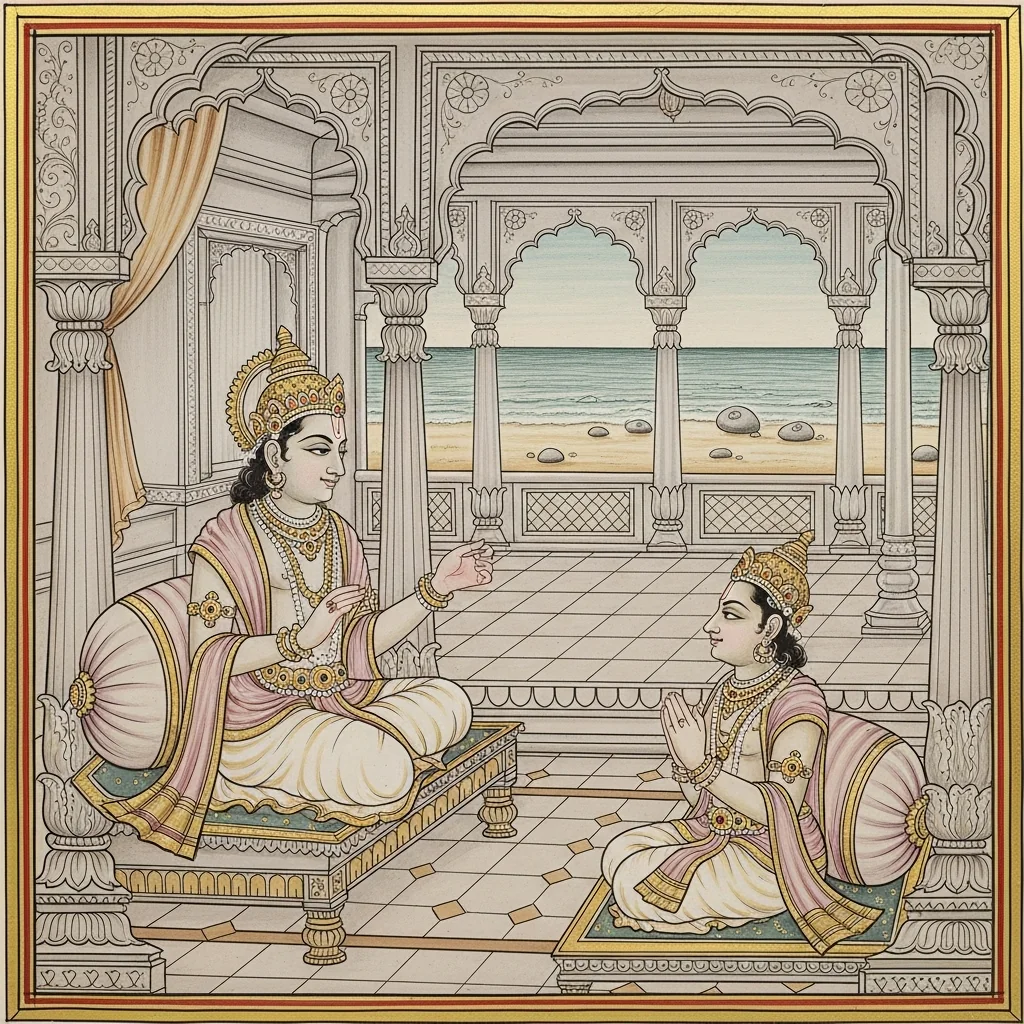
Sūta recounts a courtly dialogue in which Bali, stirred by Prahlāda’s words, asks about the grandeur of the sacred field of Dvārakā (kṣetra-vaibhava). Prahlāda replies with a structured māhātmya: every step taken toward Dvārakā yields merit, and even the mere intention to go has purifying power; moreover, even grave Kali-age faults do not cling to one who attains Kṛṣṇa’s presence, with special praise of Cakratīrtha and Kṛṣṇa’s city, Kṛṣṇapurī. He then ranks holy cities and declares Dvārakā supreme when the city protected by Kṛṣṇa is beheld. He speaks of “rarities” (durlabhatā)—residing there, receiving darśana, bathing in the Gomati, and seeing Rukmiṇī—and teaches devotional conduct at home: remembering Dvārakā, worshipping Keśava in household life, and observing sacred dates, especially tri-spṛśā-dvādaśī and the logic of related vrata. In Kali-yuga the fruits of fasting, vigil, and devotional song and dance are said to be greatly magnified, above all in Dvārakā and near Kṛṣṇa. The sanctity of the Gomati–ocean confluence, cakrāṅkita stones, and claims of equality or superiority over other famed tīrthas are extolled, along with family and social welfare—offspring through worship of Kṛṣṇa’s queens—and relief from fear and misfortune through Dvārakā darśana. The chapter closes with a strong phalaśruti: even adversity on the way to Dvārakā is framed as a sign of non-return to lower states.
Shlokas
Verse 1
सूत उवाच । प्रह्लादस्य वचः श्रुत्वा स्थितस्तत्र सभास्थले । पप्रच्छात्युत्सुकमना बलिस्तत्क्षेत्रवैभवम्
Sūta said: Having heard Prahlāda’s words, Bali—standing there in the assembly hall, his mind intensely eager—asked about the grandeur of that sacred kṣetra.
Verse 2
प्रह्लादस्तद्वचः श्रुत्वा भक्तिभावपुरस्कृतम् । अभिनन्द्य च तं प्रेम्णा प्रवक्तुमुपचक्रमे
Hearing those words, spoken from devotion, Prahlāda warmly welcomed him with affection and began to explain.
Verse 3
प्रह्लाद उवाच । एकैकस्मिन्पदे दत्ते पुरीं द्वारवतीं प्रति । पुण्यं क्रतुसहस्राणां फलं भवति देहिनाम्
Prahlāda said: With each single step taken toward the city of Dvāravatī (Dvārakā), embodied beings gain merit whose fruit equals that of thousands of Vedic sacrifices.
Verse 4
येऽपीच्छंति मनोवृत्त्या गमनं द्वारकां प्रति । तेषां प्रलीयते पापं पूर्वजन्मायुतार्जितम्
Even those who, by the very inclination of their mind, long to go toward Dvārakā—of them the sin amassed through tens of thousands of past births is dissolved.
Verse 5
अत्युग्राण्यपि पापानि तावत्तिष्ठंति विग्रहे । यावन्न गच्छते जंतुः कलौ द्वारवतीं प्रति
Even the most dreadful sins remain lodged in embodied existence only so long as, in the age of Kali, a person does not set out toward Dvāravatī (Dvārakā).
Verse 6
लोभेनाऽप्युपरोधेन दंभेन कपटेन वा । चक्रतीर्थे तु यो गच्छेन्न पुनर्विशते भुवि
Even if driven by greed, obstruction, hypocrisy, or deceit—whoever goes to Cakratīrtha does not enter the world again (is not reborn).
Verse 7
हीनवर्णोऽपि पापात्मा मृतः कृष्णुपुरीं प्रति । कलि कालकृतैर्दोषैरत्युग्रैरपि मानवः । भक्त्या कृष्णमुखं दृष्ट्वा न लिप्यति कदाचन
Even a sinful person of low status, if he dies while bound for Kṛṣṇupurī (Dvārakā), is never tainted. Though a human may be afflicted by the fierce faults born of the age of Kali, by devotion—having beheld Kṛṣṇa’s face—he is not stained at any time.
Verse 8
तावद्विराजते काशी ह्यवंती मथुरापुरी । यावन्न पश्यते जंतुः पुरीं कृष्णेन पालिताम्
Kāśī, Avantī, and the city of Mathurā shine only so long as one has not beheld the city protected by Kṛṣṇa—Dvārakā.
Verse 9
येषां कृष्णालये प्राणा गता दानवनायक । न तेषां पुनरावृत्तिः कल्पकोटिशतैरपि
O lord of the Dānavas, those whose life-breath departs in Kṛṣṇa’s abode (Dvārakā) have no return again—not even after hundreds of crores of kalpas.
Verse 10
दुर्लभो द्वारकावासो दुर्लभं कृष्णदर्शनम् । दुर्लभं गोमतीस्नानं रुक्मिणीदर्शनं कलौ
In the Kali age, rare indeed are: dwelling in Dvārakā, beholding Kṛṣṇa, bathing in the holy Gomati, and having the darśana of Rukmiṇī.
Verse 11
नित्यं कृष्णपुरीं रम्यां ये स्मरंति गृहे स्थिताः । न तेषां पातकं किंचिद्देहमाश्रित्य तिष्ठति
Those who, even while remaining at home, daily remember the beautiful city of Kṛṣṇa—no sin whatsoever can cling to their body.
Verse 12
केशवार्चा गृहे यस्य न तिष्ठति महीपते । तस्यान्नं न च भोक्तव्यमभक्ष्येण समं स्मृतम्
O king, in whose house the worship of Keśava is not established—one should not eat that person’s food; it is remembered to be on par with what is forbidden to consume.
Verse 13
नोष्णत्वं द्विज राजे वै न शीतत्वं हुताशने । वैष्णवानां न पापत्वमेकादश्युपवासिनाम्
As heat is never absent from fire, nor coolness from the moon, so sinfulness does not belong to Vaiṣṇavas who fast on Ekādaśī.
Verse 14
नास्ति नास्ति महाभागाः कलिकालसमं युगम् । स्मरणात्कीर्त्तनाद्विष्णोः प्राप्यते परमव्ययम्
O fortunate ones, there is no age like the age of Kali—none at all—for by remembering and praising Viṣṇu one attains the supreme, imperishable state.
Verse 15
सत्यभामापतिर्यत्र यत्र पुण्या च गोमती । नरा मुक्तिं प्रयास्यंति तत्र स्नात्वा कलौ युगे
Where Satyabhāmā’s Lord abides, and where the holy Gomati flows—by bathing there in the age of Kali, people proceed toward liberation.
Verse 16
माधवे शुक्लपक्षे तु त्रिस्पृशां द्वादशीं यदि । लभते द्वारकायां तु नास्ति धन्यतरस्ततः
If, in the bright fortnight of Mādhava (Vaiśākha), one obtains the Trispṛśā Dvādaśī in Dwārakā, then none is more blessed than that person.
Verse 17
त्रिस्पृशां द्वादशीं प्राप्य गत्वा कृष्णपुरीं नरः । यः करोति हरेर्भक्त्या सोऽश्वमेधफलं लभेत्
Having reached the Trispṛśā Dvādaśī and gone to Kṛṣṇa’s city, the one who worships Hari with devotion obtains the fruit of the Aśvamedha sacrifice.
Verse 18
नंदायां तु जयायां वै भद्रा चैव भवेद्यदि । उपवासार्चने गीते दुर्ल्लभा कृष्णसन्निधौ
If Nandā, Jayā, and also Bhadrā—those auspicious conjunctions—arise, then fasting, worship, and devotional song in the very presence of Kṛṣṇa become exceedingly rare and precious.
Verse 19
उदयैकादशी स्वल्पा अंते चैव त्रयोदशी । संपूर्णा द्वादशी मध्ये त्रिस्पृशा च हरेः प्रिया
When the Ekādaśī at sunrise is brief and the Trayodaśī appears at the end, with a full Dvādaśī in between—this is Trispṛśā, beloved of Hari.
Verse 20
एकेन चोपवासेन उपवासाऽयुतं फलम् । जागरे शतसाहस्रं नृत्ये कोटिगुणं कलौ
In the age of Kali, the merit of a single fast equals that of ten thousand fasts; a night of vigil equals a hundred thousand; and devotional dancing becomes a crore-fold.
Verse 21
तत्फलं लभते मर्त्त्यो द्वारकायां दिनेदिने । गृहेषु वसतामेतत्किं पुनः कृष्णसंनिधौ
That very merit is gained by a mortal in Dwārakā day after day. If it is so even for those who merely dwell in their homes, how much more in the very presence of Kṛṣṇa!
Verse 22
वाङ्मनःकायजैर्दोषैर्हता ये पापबुद्धयः । द्वारवत्यां विमुच्यंते दृष्ट्वा कृष्णमुखं शुभम्
Even those of sinful intent, stricken by faults born of speech, mind, and body, are released in Dwāravatī upon beholding the auspicious face of Kṛṣṇa.
Verse 23
दैत्येश्वर नराः श्लाघ्या द्वारवत्यां गताश्च ये
O lord of the Daityas, those men who have gone to Dwāravatī are truly praiseworthy.
Verse 24
दुर्ल्लभानीह तीर्थानि दुर्लभाः पर्वतोत्तमाः । दुर्ल्लभा वैष्णवा लोके द्वारकावसतिः कलौ
In this world, holy fords are rare, and rare are the noblest mountains. Rare are Vaiṣṇavas among people—and in the Kali-yuga, rare indeed is dwelling in Dwārakā.
Verse 25
गवां कोटिसहस्राणि रत्नको टिशतानि च । दत्त्वा यत्फलमाप्नोति तत्फलं कृष्णसन्निधौ
Whatever merit one gains by gifting thousands of crores of cows and hundreds of crores of jewels—that very merit is obtained in the presence of Kṛṣṇa.
Verse 26
यस्याः सीमां प्रविष्टस्य ब्रह्महत्यादिपातकम् । नश्यते दर्शनादेव तां पुरीं को न सेवते
For one who enters even the boundary of that city, sins such as brahmahatyā are destroyed by mere sight. Who would not resort to and revere such a city?
Verse 27
चक्रांकिता शिला यत्र गोमत्युदधिसंगमे । यच्छति पूजिता मोक्षं तां पुरीं को न सेवते
Where, at the confluence of the Gomati and the ocean, there is a stone marked with the discus—when worshipped, it bestows liberation. Who would not resort to and revere that city?
Verse 28
सिंहस्थे च गुरौ विप्रा गोदावर्य्यां तु यत्फलम् । तत्फलं स्नानमात्रेण गोमत्यां कृष्णसन्निधौ
O brāhmaṇas, whatever merit is gained in the Godāvarī when Jupiter (Guru) is in Leo— that same merit is obtained merely by bathing in the Gomati, in the presence of Kṛṣṇa.
Verse 29
द्वारकाऽवस्थितं तोयं षण्मासं पिबते नरः । तस्य चक्रांकितो देहो भवते नात्र संशयः
If a man drinks the water found in Dwārakā for six months, his body becomes marked with the discus-sign—of this there is no doubt.
Verse 30
मन्वन्तरसहस्राणि काशीवासेन यत्फलम् । तत्फलं द्वारकायां च वसतः पंचभिर्द्दिनैः
Whatever spiritual fruit is gained by residing in Kāśī for thousands of Manvantaras, that very same fruit is obtained by one who dwells in Dwārakā for merely five days.
Verse 31
तावन्मृतप्रजा नारी दुर्भगा दैत्यपुंगव । यावन्न पश्यते भक्त्या कलौ कृष्णप्रियां पुरीम्
O foremost of Dānavas, a woman is deemed as though bereft of offspring and ill-fated only so long as—here in the Kali age—she has not beheld with devotion that city beloved of Kṛṣṇa, namely Dvārakā.
Verse 32
रुक्मिणीं सत्यभामां च देवीं जांबवतीं तथा । मित्रविंदां च कालिंदीं भद्रां नाग्नजितीं तथा
He (Śrī Kṛṣṇa) was accompanied by Rukmiṇī and Satyabhāmā, and also by Devī Jāmbavatī; likewise by Mitravindā, Kāliṇdī, Bhadrā, and Nāgnajitī as well.
Verse 33
संपूज्य लक्ष्मणां तत्र वैष्णवीः कृष्णवल्लभाः । एताः संपूज्य विधिवच्छ्रेष्ठपुत्रश्च लभ्यते
There, having duly worshipped Lakṣmaṇā and the Vaiṣṇavī goddesses beloved of Kṛṣṇa, and honoring them according to the proper rite, one attains an excellent son.
Verse 34
तावद्भवभयं पुंसां गृहभंगश्च मूर्खता । यावन्न पश्यते भक्त्या कलौ कृष्णपुरीं नरः
So long do men suffer the fear of saṃsāra, the ruin of their household, and the darkness of folly—until, in the Kali age, one beholds Kṛṣṇapurī (Dvārakā) with devotion.
Verse 35
न सर्वत्र महापुण्यं संगमे सरितांपतेः । जाह्नवीसंगमान्मुक्तिर्गोमतीनीरसंगमात् । संपर्के गोमतीनीरपूतोऽहं कृष्णसन्निधौ
Not every confluence of rivers yields the highest merit. Liberation is proclaimed at the confluence of the Jāhnavī (Gaṅgā); and at the meeting with the waters of the Gomati, release too is attained. By contact with the Gomati’s sanctifying waters, I also am purified—here, in the very presence of Kṛṣṇa.
Verse 36
गोमतीनीरसंपृक्तं ये मां पश्यंति मानवाः । न तेषां पुनरावृत्तिरित्याह सरितांपतिः
“Those who behold Me while touched by—or sanctified with—the waters of the Gomati: for them there is no return (to rebirth).” Thus declares the Lord of rivers (the Ocean).
Verse 37
द्वारकां गच्छमानस्य विपत्तिश्च भवेद्यदि । न तस्य पुनरावृत्तिः कल्पकोटिशतैरपि
If, while journeying to Dvārakā, some misfortune should occur, for that person there is no return to saṃsāra—even after hundreds of crores of kalpas.