Adhyaya 37
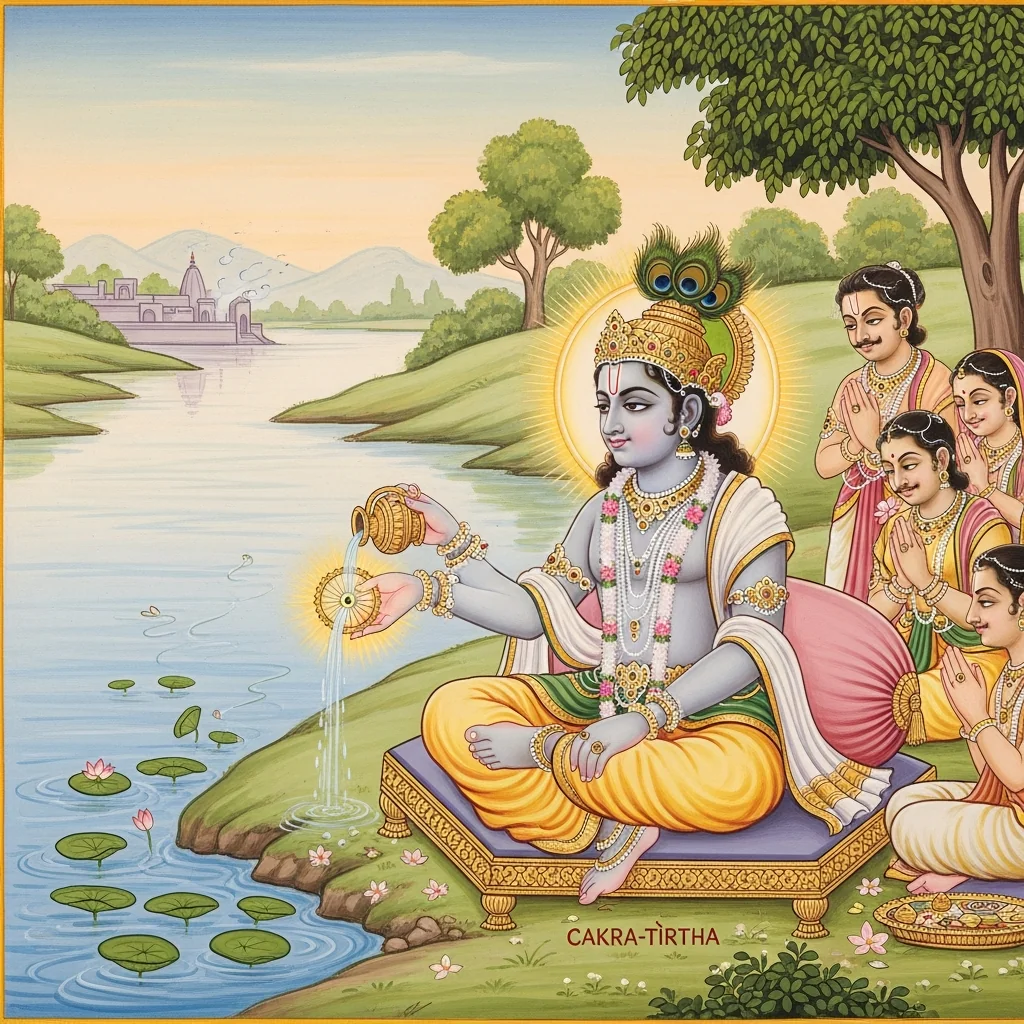
This chapter weaves a closely connected set of ritual and theological teachings within the sacred landscape of Dvārakā. Prahlāda first extols nāma-japa in the Kali age: the unceasing repetition of the name “Kṛṣṇa” as a steady discipline that transforms the heart and yields extraordinary merit. It then refines observances of Ekādaśī and Dvādaśī, naming special tithi conditions such as Unmīlinī and praising the multiplied fruit of nocturnal vigil (jāgaraṇa), including the rare Vañjulī configuration said to occur in Kali. The discourse turns to Cakra-tīrtha, where bathing is declared to cleanse moral blemishes and orient the devotee toward an undisturbed “supreme station,” the place being sanctified by the tradition that Kṛṣṇa washed the cakra there. A catalog follows of chakra-marked stones bearing one to twelve marks, each linked to a named divine form and graded results—from worldly stability and prosperity to sovereignty and, at the summit, nirvāṇa/mokṣa. The chapter closes with emphatic phala: mere touch or worship of such stones dissolves grave sins, remembrance at death is salvific, and bathing at Gomati-saṅgama and Bhṛgu-tīrtha neutralizes severe impurity—elevating devotion, even when mixed in disposition, toward sāttvika purity.
Shlokas
Verse 1
श्रीप्रह्लाद उवाच । कृष्णकृष्णेति कृष्णेति श्वपचो जागरन्निशि । जपेदपि कलौ नित्यं कृष्णरूपी भवेद्धि सः
Śrī Prahlāda said: Even a caṇḍāla, keeping awake at night, if in the Kali age he constantly performs japa—“Kṛṣṇa, Kṛṣṇa, Kṛṣṇa”—then indeed he becomes Kṛṣṇa-formed, attaining likeness to the Lord through unceasing repetition.
Verse 2
कृष्णकृष्णेति कृष्णेति कलौ वदत्यहर्निशम् । नित्यं यज्ञायुतं पुण्यं तीर्थकोटिसमुद्भवम्
In the Kali age, one who repeatedly utters “Kṛṣṇa, Kṛṣṇa—Kṛṣṇa” day and night continually gains merit equal to ten thousand sacrifices, a holiness arising from crores of sacred tīrthas.
Verse 3
संपूर्णैकादशी भूत्वा द्वादश्यां वर्द्धते यदि । उन्मीलिनीति विख्याता तिथीनामुत्तमा तिथिः
When Ekādaśī is fully formed yet extends into Dvādaśī, that exceptional lunar day is celebrated as “Unmīlinī”—the most excellent among tithis.
Verse 4
वंजुलीवासरे ये वै रात्रौ कुर्वंति जागरम् । यज्ञायुतायुतं पुण्यं मुहूर्तार्द्धेन जायते
Those who keep a night-long vigil on the Vaṃjulī-day gain, in merely half a muhūrta, merit equal to ten-thousand times ten-thousand sacrifices.
Verse 5
संपूर्णा द्वादशी भूत्वा वर्द्धते चापरे दिने । त्रयोदश्यां मुनिश्रेष्ठा वंजुली दुर्ल्लभा कलौ
O best of sages, when Dvādaśī is complete yet extends into the following day, reaching Trayodaśī, that Vaṃjulī occurrence is rare in the Kali age.
Verse 6
उन्मीलिनीमनुप्राप्य ये प्रकुर्वंति जागरम् । निमिषार्द्धेन तत्पुण्यं गवां कोटिफलप्रदम्
Those who, upon attaining the Unmīlinī tithi, undertake a sacred vigil (jāgara)—even for half a moment—gain merit that grants the fruit of gifting a crore of cows.
Verse 7
संपूर्णैकादशी भूत्वा प्रत्यऽहं वर्द्धते यदि । दर्शश्च पौर्णमासी च पक्षवृद्धिस्तथोच्यते
If the Ekādaśī is complete and then continues to extend day after day, then both the new-moon (darśa) and the full-moon (paurṇamāsī) are said to be “pakṣavṛddhi”—a lengthening of the fortnight.
Verse 8
पक्षवृद्धिकरीं प्राप्य ये प्रकुर्वंति जागरम् । निमिषार्द्धार्द्धमात्रेण गवां कोटिफलप्रदम्
Those who, when a pakṣavṛddhi-producing tithi occurs, undertake a sacred vigil (jāgara)—even for just a quarter of a moment—gain merit that grants the fruit of gifting a crore of cows.
Verse 9
श्रीप्रह्लाद उवाच । चक्रतीर्थे नरः स्नात्वा मुच्यते सर्व किल्बिषैः । स याति परमं स्थानं दाहप्रलयवर्जितम्
Śrī Prahlāda said: Having bathed at Cakratīrtha, a person is freed from all sins; and he attains the supreme abode, untouched by burning and dissolution (pralaya).
Verse 10
चक्रं प्रक्षालितं यत्र कृष्णेन स्वयमेव हि । तेन वै चक्रतीर्थं हि पुण्यं च परमं हरेः । भवंति तत्र पाषाणाश्चक्रांका मुक्तिदायकाः
The place where Kṛṣṇa himself washed the discus (cakra)—therefore that spot is indeed called Cakratīrtha, supremely holy and belonging to Hari. There, stones bearing the mark of the discus arise, and they bestow liberation (mokṣa).
Verse 11
तत्रैव यदि लभ्यंते चक्रैर्द्वादशभिः सह । द्वादशात्मा स विज्ञेयो मोक्षदः परिकीर्तितः
If, right there, a stone is found bearing twelve discus (cakra) marks, it should be known as “of twelvefold nature”; it is renowned as a bestower of liberation (mokṣa).
Verse 12
एकचक्रेण पाषाणो द्वारवत्यां सुशोभनः । सुदर्शनाभिधेयोसौ मोक्षैकफलदायकः
In Dvāravatī, a beautiful stone bearing a single discus (cakra) mark is called “Sudarśana”; it grants the one supreme fruit—liberation (mokṣa).
Verse 13
लक्ष्मीनारायणौ द्वौ तौ भुक्तिमुक्तिफलप्रदौ । त्रिभिश्चैवाच्युतं देवं सदेन्द्रपददायकम्
By uttering the divine Name twice, one attains Lakṣmī–Nārāyaṇa, bestowers of the fruits of worldly enjoyment and liberation. By uttering it thrice, one reaches Acyuta, the imperishable Lord, who grants even the exalted station of Indra.
Verse 14
भूतिदो विघ्नहंता च चतुश्चक्रो जनार्द्दनः । पञ्चभिर्वासुदेवस्तु जन्ममृत्युभयापहः
By four utterances, one attains Janārdana—four-armed, bearing the discus—giver of prosperity and destroyer of obstacles. By five utterances, one attains Vāsudeva, who removes the fear of birth and death.
Verse 15
प्रद्युम्नः षड्भिरेवासौ लक्ष्मीं कांतिं ददाति च । सप्तभिर्बलदेवस्तु गोत्रकीर्तिविवर्द्धनः
By six utterances, that Lord is Pradyumna, who bestows Lakṣmī—fortune—and radiant splendor. By seven utterances, he is Baladeva, who increases one’s lineage and good fame.
Verse 16
वांछितं चाष्टभिर्भक्त्या ददाति पुरुषोत्तमः । सर्वं दद्यान्नवव्यूहो दुर्ल्लभो यः सुरोत्तमैः
With devotion, by eight utterances, Puruṣottama grants the boon one desires. The ninefold Vyūha bestows everything—He whom even the foremost of the gods can scarcely attain.
Verse 17
राज्यप्रदो दशभिस्तु दशावतार एव च । एकादशभिरैश्वर्य्यमनिरुद्धः प्रयच्छति
By ten utterances, he becomes the giver of sovereignty—indeed, the Lord of the Ten Avatāras. By eleven utterances, Aniruddha bestows lordly power and divine opulence.
Verse 18
निर्वाणं द्वादशात्मा तु चक्रैर्द्वादशभिः स्मृतम् । अत ऊर्ध्वमनंतोऽसौ सौख्यमोक्षप्रदायकः
Nirvāṇa is taught as the twelvefold reality, remembered through twelve Cakras (disc-forms). Beyond this, Ananta bestows both spiritual happiness and liberation.
Verse 19
ये केचित्तत्र पाषाणाः कृष्णचक्रेण मुद्रिताः । तेषां स्पर्शनमात्रेण मुच्यते सर्वकिल्बिषैः
Whatever stones are found there, marked with Kṛṣṇa’s discus-seal—by merely touching them one is released from all sins and stains.
Verse 20
ब्रह्महत्यादिकं पापं मनोवाक्कायकर्मजम् । तत्सर्वं विलयं याति चक्रांकितप्रपूजनात्
Sins such as brahma-slaughter, and all wrongdoing born of mind, speech, and bodily action—everything is dissolved by devoted worship of that which is marked with the Cakra.
Verse 21
म्लेच्छदेशे शुभे वाऽपि चक्रांको यत्र तिष्ठति । योजनानि दश द्वे च मम क्षेत्रं च सुन्दरि
Whether in a foreign land or in an auspicious region—wherever the Cakra-mark abides, O fair one, for twelve yojanas around it lies My sacred field.
Verse 22
मृत्युकाले च संप्राप्ते हृदये यस्तु धारयेत् । चक्राकं पापदलनं स याति परमां गतिम्
And when the time of death arrives, whoever holds in the heart the Cakra-mark that crushes sin—he attains the supreme destination.
Verse 23
गोमतीसंगमे स्नात्वा भृगुतीर्थे तथैव च । न मातुर्वसते कुक्षौ यद्यपि स्यात्स पातकी
Even if a person is a sinner, after bathing at the confluence of the Gomatī and likewise at Bhṛgu-tīrtha, he does not again dwell in a mother’s womb.
Verse 24
तामसं राजसं वापि यत्कृतं विष्णुपूजनम् । तत्सात्त्विकत्वमभ्येति निम्नगांभो यथार्णवे
Even worship of Viṣṇu performed in a tamasic or rajasic manner becomes sattvic in effect—just as the waters of a river, upon reaching the ocean, take on the nature of the sea.
Verse 37
इति श्रीस्कांदे महापुराण एकाशीति साहस्र्यां संहितायां सप्तमे प्रभासखण्डे चतुर्थे द्वारकामाहात्म्ये द्वारकाक्षेत्रस्थसुदर्शनप्रमुखानन्तान्तचक्रचिह्नांकित पाषाणमाहात्म्यवर्णनपूर्वकतत्पूजनफलादिकथनंनाम सप्तत्रिंशत्तमोऽध्यायः
Thus ends the thirty-seventh chapter of the revered Skanda Mahāpurāṇa, in the Ekāśīti-sāhasrī Saṃhitā, within the seventh Prabhāsa Khaṇḍa and the fourth Dvārakā Māhātmya, entitled: “An account of the greatness of stones in the Dvārakā sacred region marked with the discus-sign—beginning with Sudarśana and extending to Ananta—together with narration of the fruits of their worship and related matters.”