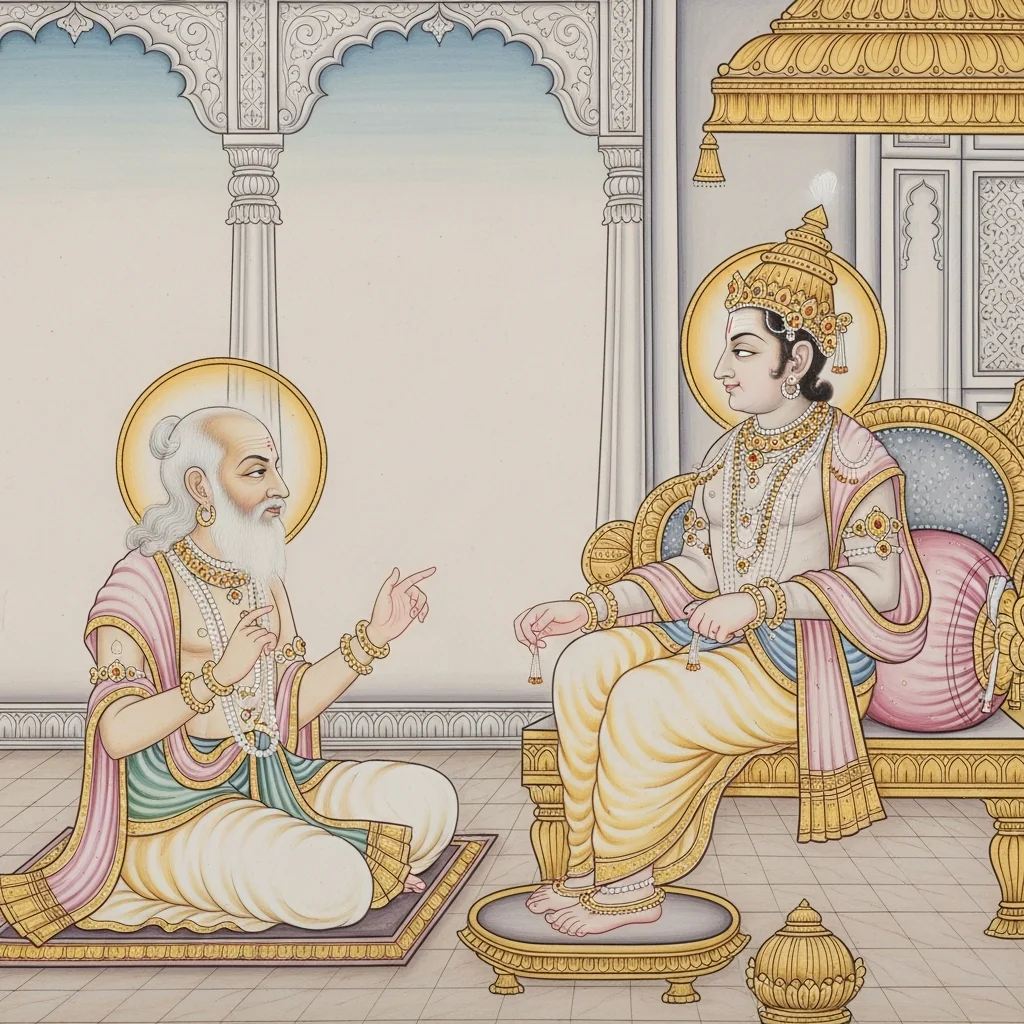
Adhyaya 25
The chapter unfolds as a royal question and a sage’s reply: King Indradyumna asks Mārkaṇḍeya to describe in detail a pure, sin-destroying tīrtha. The sage answers by naming three exemplary cities for the Kali age—Mathurā, Dvārakā, and Ayodhyā—each sanctified by divine presence (Hari/Kṛṣṇa and Rāma). It then sets out a comparative scale of merit, exalting even momentary contact with Dvārakā—dwelling there for an instant, remembering it, or hearing its glory—above long austerities or pilgrimages to Kāśī, Prayāga, Prabhāsa, and Kurukṣetra. Kṛṣṇa-darśana, kīrtana, and the Dvādaśī night-vigil (jāgaraṇa) are presented as central observances, with strong phalaśruti promises of purification, liberation, and benefit to ancestors (piṇḍadāna near the Gomati and offerings near Kṛṣṇa’s presence). The chapter also highlights Dvārakā’s portable sanctifiers—gopīcandana and tulasī—extending tīrtha-power into the home, and concludes that gifts given during Kṛṣṇa-jāgaraṇa are greatly magnified, making Dvādaśī wakefulness a high-value ethical-devotional practice in Kali age.
Shlokas
Verse 1
इंद्रद्युम्न उवाच । कथयस्व मुनिश्रेष्ठ किंचित्कौतूहलं मम । पुण्यं पवित्रं पापघ्नं तीर्थं तु वद विस्तरात्
Indradyumna said: O best of sages, a certain curiosity has arisen in my mind. Tell me in detail of a tīrtha—holy and meritorious, purifying, and the destroyer of sin.
Verse 2
मार्कण्डेय उवाच । मथुरा द्वारकाऽयोध्या कलिकाले पुरीत्रयम् । धर्मार्थकामदं भूप मोक्षदं हरिवल्लभम्
Mārkaṇḍeya said: Mathurā, Dvārakā, and Ayodhyā—these are the three great cities in the Kali age. O king, they grant dharma, artha, and kāma, and they bestow mokṣa, for they are beloved of Hari.
Verse 3
मधुरायां तु कालिंदी गोमती कृष्णसन्निधौ । अयोध्यायां तु सरयूर्मुक्तिदा सेविता सदा
In Mathurā is the Kāliṇdī (Yamunā), and the Gomatī is in the presence of Kṛṣṇa (at Dvārakā). In Ayodhyā is the Sarayū, ever revered, bestower of liberation.
Verse 4
द्रारवत्यामयोध्यायां कृष्णं रामं शुभप्रदम् । मथुरायां हरिं विष्णुं स्मृत्वा मुक्तिमवाप्नुयात्
In Dvāravatī (Dvārakā) and in Ayodhyā, by remembering Kṛṣṇa and Rāma, the givers of auspiciousness, and in Mathurā by remembering Hari, Viṣṇu, one attains liberation.
Verse 5
धन्या सा मथुरा लोके यत्र जातो हरिः स्वयम् । द्वारका सफला लोके क्रीडितं यत्र विष्णुना
Blessed is Mathurā in this world, for there Hari Himself was born. Fulfilled and fruitful is Dvārakā in this world, for there Viṣṇu sported in His divine līlā.
Verse 6
धन्यानामपि सा पूज्या अयोध्या सर्वकामदा । या स्वयं रामदेवेन पालिता धर्मबुद्धिना
Even among the blessed, Ayodhyā is worthy of worship—the bestower of all desires—because it was ruled and protected by Lord Rāma Himself, whose mind was firmly established in dharma.
Verse 7
यद्ददाति फलं काशी सेविता कल्पसंख्यया । कला ददाति मथुरा वासरेणापि तत्फलम्
The fruit that Kāśī grants when revered through a multitude of kalpas—Mathurā grants that very fruit in but a fraction (kalā); indeed, even in a single day it bestows the same reward.
Verse 8
मन्वंतरसहस्रे तु प्रयागे यत्फलं भवेत् । निमिषार्द्धेन वसतां द्वारकायां तु तत्फलम्
Whatever merit would arise from spending even a thousand manvantaras at Prayāga—that very fruit is gained by those who dwell in Dvārakā for merely half a moment.
Verse 9
प्रभासे च कुरुक्षेत्रे यत्फलं वत्सरैः शतैः । वसतां निमिषार्द्धेन ह्ययोध्यायां च तद्भवेत्
The merit that would be obtained at Prabhāsa and at Kurukṣetra over a hundred years—that same merit arises from dwelling in Ayodhyā for only half a moment.
Verse 10
अयोध्याधिपतिं रामं मथुरायां तु केशवम् । द्वारकावासिनं कृष्णं कीर्तनं चापि दुर्ल्लभम्
Rāma, the lord of Ayodhyā; Keśava in Mathurā; and Kṛṣṇa who dwells in Dvārakā—even the chanting (kīrtana) of their glory is hard to obtain for those of scant merit.
Verse 11
मथुराकीर्तनेनापि श्रवणाद्द्वारकापुरः । अयोध्यादर्शनेनापि त्रिशुद्धं च पदं व्रजेत्
By praising Mathurā, by hearing the glory of the city of Dvārakā, and by beholding Ayodhyā—one attains the thrice-purified state, the sacred abode.
Verse 12
कृष्णं स्वयंभुवं देवं द्वारका त्रिदिवोपमा । श्रुता चाप्यथवा दृष्टा कुरुते जन्मसंक्षयम्
Dvārakā—like the very heaven of the gods—where Kṛṣṇa, the self-manifest Lord, is worshipped: whether merely heard of or truly beheld, it brings the cycle of repeated births to exhaustion.
Verse 13
श्रुताभिलिखिता दृष्टा ह्ययोध्या मथुरापुरी । पापं हरति कल्पोत्थं द्वारका च तृतीयका
Ayodhyā and the city of Mathurā—whether heard of, written down, or beheld—remove sin accumulated over an aeon; and Dvārakā is the third among them, equally renowned.
Verse 14
कृष्णं विष्णुं हरिं देवं विश्रांतं च कलौ स्मृतम् । द्वादश्यां जागरे रात्रावश्वमेधायुतं फलम्
In the Kali age, remembering Kṛṣṇa—Viṣṇu, Hari, the Lord—who is said to be “at rest” here, and keeping vigil through the night of Dvādaśī yields the fruit of ten thousand Aśvamedha sacrifices.
Verse 15
बालक्रीडनकं स्थानं ये स्मरंति दिनेदिने । स्वर्णशैलपदं नृणां जायते राजसत्तम
O best of kings, for those who day after day remember the place where the Lord played as a child, there arises for them the attainment of the “Golden Mountain” state, the blessed abode.
Verse 16
धन्यास्ते मानवा लोके कलिकाले नरोत्तम । प्लवनं सिंधुतोयेन गोमत्यां यैर्नरैः कृतम्
O best of men, blessed indeed in this Kali age are those in this world who have performed plavana—crossing or sacred immersion—in the Gomati with the waters of the Sindhu (the sea).
Verse 17
पश्चिमाशां नरः स्नात्वा कृत्वा वै करसंपुटम् । द्वारकां ये स्मरिष्यंति तेषां कोटिगुणं फलम्
After bathing and forming the cupped-hands gesture (karasaṃpuṭa), those who, facing west, remember Dvārakā gain merit whose fruit is multiplied a crore-fold.
Verse 18
मनसा चिन्तयेद्यो वै कलौ द्वारवतीं पुरीम् । कपिलाऽयुतपुण्यं च लभते हेलया नरः
In the Kali age, whoever truly contemplates in the mind the city of Dvāravatī (Dvārakā) gains—effortlessly, as though in play—the merit equal to gifting ten thousand Kapilā cows.
Verse 19
गंगासागरजं पुण्यं गंगाद्वारभवं तथा । कलौ द्वारवतीं गत्वा प्राप्नोति मनुजाधिप
O lord among men, by going to Dvāravatī (Dvārakā) in the Kali age one attains the merit of Gaṅgā-sāgara as well as that of Gaṅgā-dvāra (Haridvāra).
Verse 20
सप्तकल्पस्मरो भूप मार्कण्डेयः स्मराम्यहम् । समाना वाऽधिका वापि द्वारवत्या न कापि पूः
O king, I am Mārkaṇḍeya, the sage who remembers seven kalpas. I declare: no city anywhere is equal to—or greater than—Dvāravatī (Dvārakā).
Verse 21
दुर्वाससा समो धन्यो नास्ति नाप्यधिको नृप । भाषाबंधं येन कृत्वा द्वारकायां धृतो हरिः
O king, none is as blessed as Durvāsā—nor is anyone more blessed—for by a binding word, a solemn pledge, he caused Hari to be held fast in Dvārakā.
Verse 22
मा काशीं मा कुरुक्षेत्रं प्रभासं मा च पुष्करम् । द्वारकां गच्छ राजर्षे पश्य कृष्णमुखं शुभम्
Not Kāśī, not Kurukṣetra, not Prabhāsa, nor even Puṣkara—O royal sage, go to Dvārakā and behold the auspicious face of Kṛṣṇa.
Verse 23
अश्वमेधसहस्रं तु राजसूयशतं कलौ । पदेपदे च लभते द्वारकां याति यो नरः
In the Kali age, the man who journeys to Dvārakā gains at every step the merit of a thousand Aśvamedha sacrifices and a hundred Rājasūya rites.
Verse 24
सफलं जीवितं तेषां कलौ नृपवरोत्तम ये । षां न स्खलितं चित्तं द्वारकां प्रति गच्छताम्
O best of kings, in the Kali age their lives are truly fulfilled—those whose minds do not falter as they set forth toward Dvārakā.
Verse 25
माता च पुत्रिणी तेन पिता चैव पितामहाः । पिंडदानं कृतं येन गोमत्यां कृष्णसन्निधौ
By him his mother is blessed with a worthy son, and so too his father and forefathers—he who offers the piṇḍa, the ancestral oblation, on the Gomati in the presence of Kṛṣṇa.
Verse 26
गोपीचन्दनमुद्रां तु कृत्वा भ्रमति भूतले । सोऽपि देशो भवेत्पूतः कि पुनर्यत्र संस्थितम्
Even if one merely roams the earth bearing the mark made of gopī-candana, that very place becomes purified—how much more so the place where it is established and worn with devotion.
Verse 27
द्वारकायां समुद्भूतां तुलसीं कृष्णसेविताम् । नित्यं बिभर्ति शिरसा स भवेत्त्रिदशाधिपः
He who daily bears upon his head the tulasī that has sprung up in Dvārakā and is served by Kṛṣṇa becomes a lord among the gods.
Verse 28
दैत्यारेर्भगवत्तिथिश्च विजया नीरं च गगोद्भवं नित्यंकाशिपुरी तथैव तुलसी धात्रीफलं वल्लभम्
Beloved are the sacred lunar day (tithi) of the Lord who is the enemy of the Daityas, the festival of Vijayā, and the water born of the heavenly Gaṅgā; beloved too is Kāśī, ever holy, and likewise Tulasī and the āmalakī fruit—dear to the Lord.
Verse 29
शास्त्रं भागवतं तथा च दयितं रामायणं द्वारका पुण्यं मालतिसम्भवं सुदयितं गीतं कृतं जागरम्
Beloved is the Bhāgavata scripture, and beloved too the Rāmāyaṇa; holy is Dvārakā. Most beloved are devotional song and the keeping of vigil (jāgara); and cherished as well is that which is born of Mālatī—the fragrant offering.
Verse 30
गृहे यस्य सदा तिष्ठेद्गोपीचन्दनमृत्तिका । द्वारका तिष्ठते तत्र कृष्णेन सहिता कलौ
In whose house gopī-candana clay is always kept, in that very place Dvārakā abides in the Kali age—together with Kṛṣṇa.
Verse 31
कृतघ्नो वाऽथ गोघ्नोऽपि हैतुकः कृत्स्नपापकृत् । गोपीचन्दनसंपर्कात्पूतो भवति तत्क्षणात्
Even a thankless person—or even a slayer of a cow—indeed one who commits every kind of sin, becomes purified at that very moment through contact with gopīcandana.
Verse 32
गोपीचन्दनखंडं तु यो ददातीह वैष्णवे । कुलमेकोत्तरं तेन शतं तारितमेव वा
Whoever here gives a piece of gopīcandana to a Vaiṣṇava—by that act, a hundred and one members of his lineage are carried across (to safety/liberation).
Verse 33
द्वारकासम्भवा भूप तुलसी यस्य मंदिरे । तस्य वैवस्वतो नित्यं बिभेति सह किंकरैः
O King, in whose home there is Tulasī that has arisen from Dvārakā—Yama, son of Vivasvān, constantly fears him, along with his attendants.
Verse 34
द्वारकासंभवा मृत्स्ना तुलसीकृष्णकीर्तनम् । क्रतुकोटिशतं पुण्यं कथितं व्याससूनुना
Dvārakā-born sacred clay, Tulasī, and the singing of Kṛṣṇa’s names—these are declared by Vyāsa’s son to yield the merit of hundreds of crores of sacrifices.
Verse 35
आलोड्य सर्वशास्त्राणि पुराणानि पुनःपुनः । मया दृष्टा महीपाल न द्वारकासमा पुरी
Having churned through all the śāstras and the Purāṇas again and again, O ruler of the earth, I have seen that no city equals Dvārakā.
Verse 36
द्वारकागमनं येन कृतं कृष्णस्य कीर्तनम् । स्नातं तीर्थसहस्रैस्तु तेनेष्टं क्रतुकोटिभिः
By one who has journeyed to Dvārakā and performed the praise of Kṛṣṇa, it is as though he has bathed in thousands of sacred fords, and as though he has performed crores of sacrifices.
Verse 37
इद्रियाणां तु दमनं किं करिष्यति देहिनाम् । सांख्यमध्ययनं चापि द्वारकां गच्छते न चेत्
What will the restraint of the senses accomplish for embodied beings—or even the study of Sāṃkhya—if one does not go to Dvārakā?
Verse 38
पशवस्ते न सन्देहो गर्दभेन समा जनाः । दृष्टं कृष्णमुखं यैर्न गत्वा द्वारवतीं पुरीम्
Without doubt they are beasts—people no better than donkeys—who, having beheld the face of Kṛṣṇa, still do not go to the city of Dwāravatī (Dwārakā).
Verse 39
कृतकृत्यास्तु ते धन्या द्वादश्यां जागरे हरेः । कृत्वा जागरणं भक्त्या नृत्यमाना मुहुर्मुहुः
Blessed indeed are those who have fulfilled life’s purpose—those who keep awake in devotion to Hari on the sacred Dvādaśī. Having observed this night-vigil with bhakti, they rejoice again and again, dancing in devotional ecstasy.
Verse 40
कृष्णालयं तु यो गत्वा गोमत्यां पिंडपातनम् । करोति शक्त्या दानं च मुक्तास्तस्य पितामहाः
Whoever goes to Kṛṣṇālaya and, on the Gomati, offers the piṇḍa-oblation (for the departed) and gives charity according to one’s capacity—his forefathers (grandfathers/ancestors) are thereby liberated.
Verse 41
प्रेतत्वं च पिशा चत्वं न भवेत्तस्य देहिनः । जन्मजन्मनि राजेंद्र यो गतो द्वारकां पुरीम्
O king of kings, for the embodied being who has gone to the city of Dvārakā, birth after birth, the fate of becoming a preta or a piśāca shall never arise.
Verse 42
अनशनेन यत्पुण्यं प्रयागे त्यजतस्तनुम् । द्वादश्यां निमिषार्द्धेन तत्फलं कृष्णसन्निधौ
Whatever merit is gained by fasting and then relinquishing the body at Prayāga on Dvādaśī—that very fruit is obtained in but half a moment in the presence of Kṛṣṇa.
Verse 43
सूर्यग्रहे गवां कोटिं दत्त्वा यत्फलमाप्नुयात् । तत्फलं कलिकाले तु द्वारवत्यां दिनेदिने
Whatever merit one would obtain by gifting a crore of cows at a solar eclipse—one attains that very same fruit in the Kali age, day after day, in Dvāravatī (Dvārakā).
Verse 44
कोटिभारं सुवर्णस्य ग्रहणे चंद्रसूर्ययोः । दत्त्वा यत्फलमाप्नोति तत्फलं कृष्णदर्शने
Whatever merit one obtains by donating a crore-weight of gold at the time of a lunar or solar eclipse—that very merit is attained merely by beholding Lord Kṛṣṇa.
Verse 45
दोलासंस्थं च ये कृष्णं पश्यंति मधुमाधवे । तेषां पुत्राश्च पौत्राश्च मातामहपितामहाः
Those who behold Śrī Kṛṣṇa—Madhusūdana and Mādhava—seated upon the swing (dolā) gain blessing for their whole lineage: their sons and grandsons, and even their maternal and paternal grandfathers are uplifted by that merit.
Verse 46
श्वशुराद्याः सभृत्याश्च पशवश्च नरोत्तम । क्रीडंति विष्णुना सार्द्धं यावदाभूतसंप्लवम्
O best of men, one’s father-in-law and other relatives, together with attendants and even the animals, sport in the company of Viṣṇu, abiding with Him until the final dissolution of beings.
Verse 47
या काचिद्द्वादशी भूप जायते कृष्णसन्निधौ । पश्यामि नांतरं किञ्चित्कलिकाले विशेषतः
O king, whatever Dvādaśī—the sacred twelfth lunar day—arises in the very presence of Śrī Kṛṣṇa, I see no other observance equal to it, especially in the age of Kali.
Verse 48
कृष्णस्य सन्निधौ नित्यं वासरा द्वादशीसमाः । युगादिभिः समाः सर्वे नित्यं कृष्णस्य सन्निधौ
In Kṛṣṇa’s constant presence, every day is ever equal to Dvādaśī; and all sacred times—such as the beginnings of the yugas—are likewise present there eternally, in Kṛṣṇa’s proximity.
Verse 49
कलौ द्वारवती सेव्या ज्ञात्वा पुण्यं विशेषतः । षटपुर्यश्चैव सुलभा दुर्ल्लभा द्वारका कलौ
In Kali-yuga, knowing its extraordinary merit, one should devote oneself to Dvāravatī (Dvārakā). Though the six sacred cities are accessible, Dvārakā is difficult to attain in Kali-yuga.
Verse 50
स्मरणात्कीर्तनाद्यस्माद्भुक्तिमुक्ती सदा नृणाम् । दुर्वाससा तु ऋषिणा रक्षिता तिष्ठते पुरी
For by remembering it and singing its praise, people ever attain both worldly well-being (bhukti) and liberation (mukti); therefore the city endures, protected by the sage Durvāsā.
Verse 51
कलौ न शक्यते गंतुं विना कृष्णप्रसादतः । कृष्णस्य दर्शनं कर्तुं यान्ति रुद्रादयः सुराः
In the Kali-yuga, one cannot go there without Kṛṣṇa’s grace. Even the gods—Rudra and the rest—come to behold Kṛṣṇa.
Verse 52
त्रिकालं जगतीनाथ रुक्मिणीदर्शनाय च । सफला भारती तस्य कृष्णकृष्णेति या वदेत्
O Lord of the world, at the three times of day, and also to behold Rukmiṇī—truly fruitful is the speech of one who utters, “Kṛṣṇa, Kṛṣṇa.”
Verse 53
द्वारका यायिनं दृष्ट्वा गायंति दिविसंस्थिताः । नरकात्पितरो मुक्ताः प्रचलंति हसंति च
Seeing a pilgrim bound for Dvārakā, those dwelling in heaven sing with joy; and the ancestors, freed from hell, dance about and laugh.
Verse 54
गोप्यं यत्पातकं पुंसां गोमती तद्व्यपोहति । स्मरणात्कीर्त्तनाद्वापि किं पुनः प्लवने कृते
Whatever hidden sin people may bear, the Gomati washes it away. If such is the fruit of remembering or praising her, how much more when one truly bathes and immerses in her waters.
Verse 55
रुक्मिणीसहितं देवं शंखोद्धारे च शंखिनम् । पिंडारके चतुर्बाहुं दृष्ट्वाऽन्यैः किं करिष्यति
Having seen the Lord together with Rukmiṇī; and at Śaṅkhoddhāra, the Bearer of the conch; and at Piṇḍāraka, the Four-armed One—what need would there be for any other holy observance or sacred place?
Verse 56
रुक्मिणी देवकीपुत्रश्चक्रतीर्थं च गोमती । गोपीनां चंदनं लोके तुलसी दुर्लभा कलौ
Rukmiṇī; Kṛṣṇa, the son of Devakī; the Cakra-tīrtha; and the Gomati—these are renowned. In this world, the gopīs’ sandal-paste and holy tulasī are hard to obtain in the Kali-yuga.
Verse 57
दुर्लभास्ते सुता ज्ञेया धरणीपापनाशकाः । गयां गत्वा तु ये पिंडं द्वारकां कृष्णदर्शनम् । करिष्यंति कलौ प्राप्ते वंजुलीसमुपोषणम्
Rare indeed are those sons—know them as destroyers of the earth’s sins—who, in the Kali age now come, will go to Gayā to offer piṇḍa, then to Dvārakā for the vision (darśana) of Kṛṣṇa, and will observe the Vaṃjulī fast.
Verse 58
समं पुण्यफलं तेषां वंजुली द्वारका समा । येन न्यूना नाधिकाऽपि कथितं विष्णुना स्वयम्
The merit (puṇya) gained from them is equal: Vaṃjulī is equal to Dvārakā. It is neither less nor more—so has Viṣṇu Himself declared.
Verse 59
वंजुली चाधिकां राजञ्छृणु वक्ष्यामि कारणम् । द्वादश्यामुपवासेन द्वादश्यां पारणेन तु । प्राप्यते हेलया चैव तद्विष्णोः परमं पदम्
And Vaṃjulī is even superior, O King—listen, I shall tell the reason. By fasting on Dvādaśī and by breaking the fast (pāraṇa) on that very Dvādaśī, even with little effort, one attains the supreme abode of Viṣṇu.
Verse 60
गृहेषु वसतां तीर्थं गृहेषु वसतां तपः । गृहेषु वसतां मोक्षो वंजुलीसमुपोषणात्
For those who remain in their homes, Vaṃjulī-observance itself becomes a tīrtha; for those who remain in their homes, it becomes austerity (tapas); for those who remain in their homes, it becomes liberation (mokṣa)—through the fasting/observance connected with Vaṃjulī.
Verse 61
वंजुली द्वारका गंगा गया गोविंदकीर्त्तनम् । गोमती गोकुलं गीता दुर्ल्लभं गोपिचन्दनम्
Vaṃjulī; Dvārakā; the Gaṅgā; Gayā; the kīrtana of Govinda’s Name; the Gomati; Gokula; the Gītā; and the rare gopī-candana—all these are proclaimed as supremely meritorious.
Verse 62
एतच्छृणोति यो भक्त्या कृत्वा मनसि केशवम् । अश्वमेधसहस्रस्य फलमाप्नोति मानवः
Whoever listens to this with devotion, holding Keśava in the heart, attains the fruit of a thousand Aśvamedha sacrifices.
Verse 63
श्रोष्यंति जागरे ये वै माहात्म्यं केशवस्य च । सर्वपापविनिर्मुक्ताः पदं यास्यंति वैष्णवम्
Those who listen to the greatness of Keśava while keeping vigil are freed from all sins and will go to the Vaiṣṇava state, the sacred abode.
Verse 64
पठिष्यंति नरा नित्यं ये वै श्रोप्यंति भक्तितः । तुलापुरुषदानस्य फलं ते प्राप्नुवंति हि
Those who regularly recite this, and those who devoutly listen to it, indeed obtain the fruit of tulāpuruṣa-dāna, the ‘weighing-gift’ charity.
Verse 65
कृष्णजागरणे दानं यच्चाल्पमपि दीयते । सर्वं कोटिगुणं ज्ञेयमित्याहुः कवयो नृप
O King, whatever charity is given during the Kṛṣṇa-vigil—even if small—should be known to become a koṭi-fold in merit; thus declare the sages.
Verse 66
मानकूटं तुलाकूटं कन्याहयगवां क्रयात् । तत्सर्वं विलयं याति द्वादश्यां जागरे कृते
Fraud in measures, fraud in weights, and the sin incurred through buying and selling maidens, horses, or cattle—all of it is dissolved when a Dvādaśī vigil is performed.