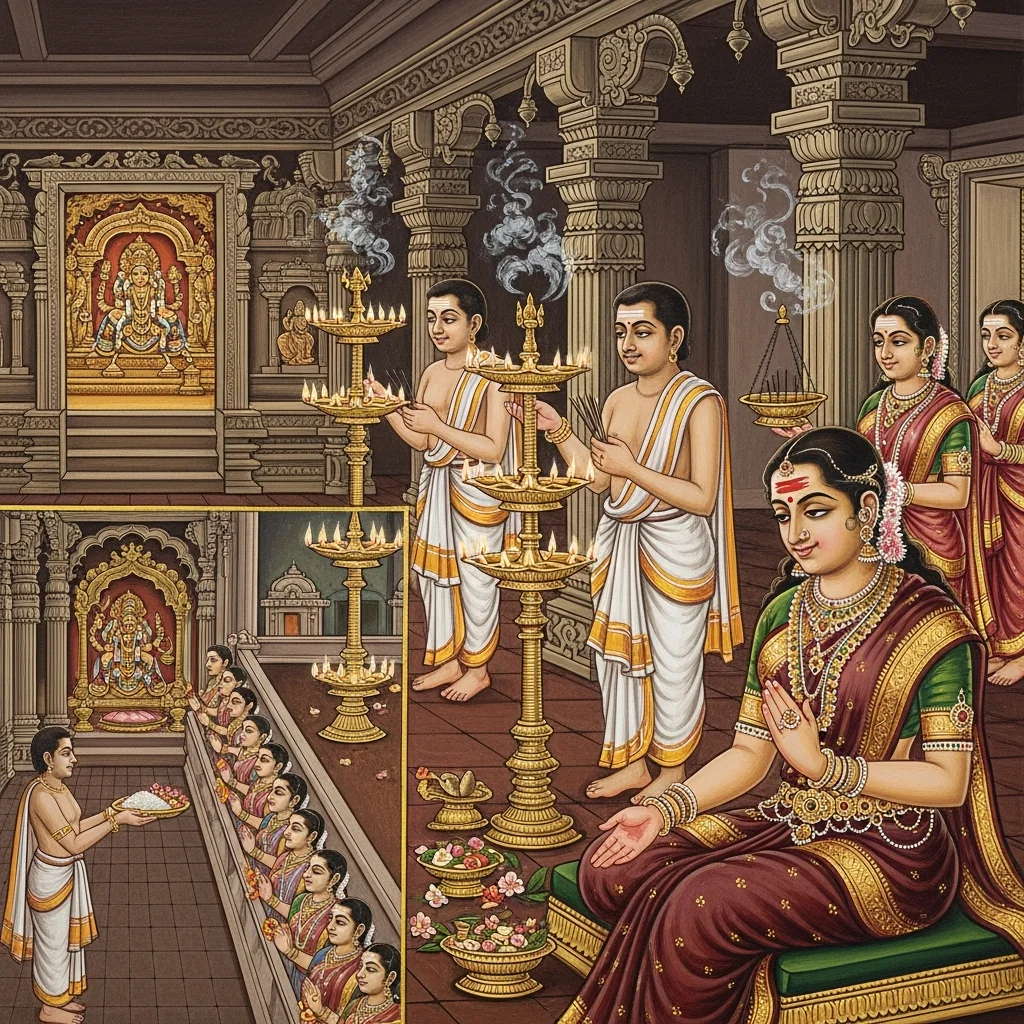
Adhyaya 22
This chapter records Śrī Prahlāda’s ritual-theological instruction to the brāhmaṇas, laying out an ordered worship centered on Jagannātha/Kṛṣṇa and especially on Rukmiṇī, praised as Kṛṣṇapriyā and Kṛṣṇavallabhā. It opens with preparatory pūjā—bathing the deity, anointing with fragrances, tulasī worship, offering naivedya, performing nīrājana, and devoutly honoring associated figures such as Ananta and Vainateya—followed by the command to give dāna without deceit and to feed the dependent poor. The teaching then turns to Rukmiṇī-darśana and worship, declaring that in Kali-yuga afflictions—graha-pīḍā, disease, fear, poverty, misfortune, and domestic rupture—end only upon beholding and venerating Kṛṣṇa’s beloved. It details abhiṣeka substances (curd, milk, honey, sugar, ghee, perfumes, sugarcane juice, tīrtha water), then unguents (śrīkhaṇḍa, kuṅkuma, mṛgamada), flowers, incense (aguru, guggulu), garments, and ornaments; it prescribes mantric arghya to “Vidarbhādhipa-nandinī,” ārati, and proper handling of sanctified water. Further rites include honoring brāhmaṇas and their wives with food and betel, worshiping the dvārapāla Unmatta with strong bali offerings, and venerating yoginīs, kṣetrapāla, Vīrūpasvāminī, the saptamātṛkās, and Kṛṣṇa’s eight consorts (Satyabhāmā, Jāmbavatī, and others). The phalaśruti repeatedly exalts the merit of seeing and worshiping Rukmiṇī with Kṛṣṇa in Dvārakā above other rites (yajña, vrata, dāna), lists auspicious dates (Dīpotsava caturdaśī, Māgha śukla aṣṭamī, Caitra dvādaśī, Jyeṣṭha aṣṭamī, Bhādrapada worship, Kārttika dvādaśī), and promises prosperity, health, fearlessness, and liberation; it concludes by affirming Dvārakā’s unique salvific power in Kali-yuga and noting the Purāṇic transmission lineage.
Shlokas
Verse 1
श्रीप्रह्लाद उवाच । शृणुध्वं द्विजशार्दूला यथावत्कथयामि वः । स्नापयित्वा जगन्नाथं तथा गंधैर्विलिप्य च । पूजयित्वा तुलस्या तु भूषयित्वा च भूषणैः
Śrī Prahlāda said: “Listen, O tiger-like Brāhmaṇas; I shall tell you properly. Having bathed Jagannātha, and anointed Him with fragrant unguents; and having worshipped Him with Tulasī, and adorned Him with ornaments….”
Verse 2
नैवेद्येन च सन्तर्प्य तथा नीराजनादिभिः । दुर्वाससं तथा पूज्य पुंडरीकाक्षमेव च
One should satisfy the Lord with food-offerings (naivedya), and also with nīrājana (ārati) and related rites; and one should worship Durvāsas as well, and likewise Puṇḍarīkākṣa, the Lotus-eyed Lord.
Verse 3
अनंतं वैनतेयादीन्भक्त्या सम्पूज्य मानवः । दद्याद्दानं स्वशक्त्या च वित्तशाठ्यविवर्जितः
Having devotedly worshipped Ananta and Vainateya (Garuḍa) and the others, a person should give charity according to one’s capacity, free from deceit regarding wealth.
Verse 4
दीनांधकृपणांस्तत्र तर्पयेच्च समाश्रितान्
There, one should also feed and satisfy the poor, the blind, and the destitute—those who have sought refuge and depend upon others.
Verse 5
रुक्मिणीं च ततो गच्छेद्विदर्भतनयां नरः । उपहृत्योपहारांश्च बलिभिर्गंधदीपकैः
Then one should go to Rukmiṇī, the daughter of Vidarbha, bringing offerings—together with bali (oblations), fragrances, and lamps.
Verse 6
पीडयंति ग्रहास्तावद्व्याधयोऽभिभवंति च । भक्त्या न पश्यति नरो यावत्कृष्णप्रियां कलौ
So long as, in the Kali age, a man does not with devotion behold and take refuge in Kṛṣṇa’s beloved (Rukmiṇī), the planets afflict him and diseases overpower him.
Verse 7
उपसर्गभयं तावद्दुःखं च भूतसंभवम् । भक्त्या न पश्यति नरो यावत्कृष्णप्रियां कलौ
So long as, in the Kali age, a man does not with devotion behold Kṛṣṇa’s beloved (Rukmiṇī), he remains subject to the fear of calamities and to sufferings arising from hostile spirits and unseen forces.
Verse 8
भवेद्दरिद्री दुःखी च तावद्वै परयाचकः । भक्त्या न पश्यति नरो यावत्कृष्णप्रियां कलौ
So long as, in the Kali age, a man does not with devotion behold Kṛṣṇa’s beloved (Rukmiṇī), he becomes poor and sorrowful—dependent on others and forced to beg.
Verse 9
तावन्मृतप्रजा नारी दुर्भाग्या दुःखसंयुता । भक्त्या न पश्यति यदा नारीकृष्णप्रियां तथा
So long as a woman does not, with devotion, behold Rukmiṇī—Kṛṣṇa’s beloved—thus long she remains ill-fated, bound to sorrow, and bereft of living offspring.
Verse 10
तावच्छत्रुभयं पुंसां गृहभंगं च मूर्खता । भक्त्या न पश्यति नरो यावत्कृष्णप्रियां कलौ
In the Kali age, so long as a man does not, with devotion, behold Rukmiṇī—Kṛṣṇa’s beloved—there remain for people fear of enemies, the breaking of the household, and the folly born of delusion.
Verse 11
संपूज्य क्रृष्णं विधिवद्रुक्मिणीं पूजयेत्ततः । स्नापयेद्दधिदुग्धाभ्यां मधुशर्करया तथा
Having duly worshipped Kṛṣṇa according to the rite, one should then worship Rukmiṇī; and one should bathe (her image) with curd and milk, and likewise with honey and sugar.
Verse 12
घृतेन विविधैर्गन्धैस्तथैवेक्षुरसेन च । तीर्थोदकेन संस्नाप्य सर्वान्कामानवाप्नुयात्
Bathing (her image) with ghee, with various fragrances, likewise with sugarcane juice, and then with sacred tīrtha-water, one attains all desired aims.
Verse 13
एवं यः स्नापये द्देवीं रुक्मिणीं क्रृष्णवल्लभाम् । न तस्य दुर्ल्लभं किंचिदिह लोके परत्र च
Thus, for one who bathes the Goddess Rukmiṇī—beloved of Kṛṣṇa—there is nothing difficult to obtain, either in this world or in the world beyond.
Verse 14
श्रीखण्डकुंकुमेनैव तथा मृगमदेन च । विलेपयेदपुत्रस्तु स पुत्रं लभते धुवम्
By anointing (the Goddess) with sandal paste and kuṅkuma, and also with musk, one who is without a son surely obtains a son.
Verse 15
सदा स भोगी भवति रूपवाञ्जनपूजितः । पूजयेन्मालतीपुष्पैः शतपत्रैः सुगन्धिभिः
He ever becomes one who enjoys prosperity and comforts—handsome and honored by people—when he worships with mālatī blossoms and sweet-smelling hundred-petalled flowers (lotuses/roses).
Verse 16
करवीरैर्मल्लिकाभिश्च चम्पकैस्तु विशेषतः । कमलैर्वारिसंभूतैः केतकीभिश्च पाटलैः
One should worship (the Goddess) with oleander, jasmine, and especially with campaka blossoms; and with lotuses born of the waters, with ketakī flowers, and with pāṭalā blooms.
Verse 17
धूपेनागुरुणा चैव पूजयेद्गौग्गु लेन च । वस्त्रैः सुकोमलैः शुभ्रैर्नानादेशसमुद्भवैः
One should worship with incense and fragrant aguru, and also with guggulu; and offer very soft, white garments brought from various regions.
Verse 18
भक्त्या संछाद्य वैदर्भीं रुक्मिणीं कृष्णवल्लभाम् । भूषणैर्भूषयेद्देवीं मणिरत्न समन्वितैः
Having reverently clothed Rukmiṇī—the princess of Vidarbha, beloved of Kṛṣṇa—one should adorn the Goddess with ornaments set with gems and jewels.
Verse 19
तस्मिन्कुले नाऽसुखः स्यान्नाऽधर्मो नाऽधनस्तथा । नाऽपुत्रो न विकर्मस्थः कितवो नीचसेवकः
In that lineage there shall be no misery, no unrighteousness, and no poverty; there shall be no childlessness, none engaged in forbidden deeds, no gambler, and no servile attendant of the base.
Verse 20
यैः पूजिता जगन्माता रुक्मिणी मानवैः कलौ । नैवेद्यैर्भक्ष्यभोज्याद्यैर्देवी मे प्रीयतामिति । तांबूलं च सकर्पूरं भावेन विनिवेदयेत्
In the Kali age, those who worship Jagad-mātā Rukmiṇī with naivedya—foods, sweets, and the like—praying, “May the Goddess be pleased with me,” should also offer betel with camphor, with heartfelt devotion.
Verse 21
गृहीत्वा च फलं शुभ्रं ह्यक्षतैश्च समन्वितम् । मन्त्रेणानेन वै विप्रा ह्यर्घ्यं दद्याद्विधानतः
Taking a bright, pure fruit together with akṣata (unbroken rice-grains), O brāhmaṇas, one should, according to rule, offer arghya with the following mantra.
Verse 22
कृष्णप्रिये नमस्तुभ्यं विदर्भाधिपनंदिनि । सर्वकामप्रदे देवि गृहाणार्घ्यं नमोऽस्तु ते
O beloved of Kṛṣṇa, salutations to you; O daughter of the king of Vidarbha, salutations. O Goddess, bestower of all desired aims, accept this arghya—salutations to you.
Verse 23
आरार्तिकं ततः कुर्याज्ज्वलन्तं भावनान्वितः । नीराजनं प्रकर्तव्यं कर्पूरेण विशेषतः
Then, with devotional contemplation, one should perform the blazing ārārtika; and nīrājana should be done, especially using camphor.
Verse 24
शंखे कृत्वा तु पानीयं भ्रामयेद्भावसंयुतः । भ्रामयित्वा च शिरसा धारणीयं विशुद्धये
Placing water in a conch, one should wave it with devotion; and after waving it, one should touch it to the head or hold it there for purification.
Verse 25
दण्डवत्प्रणमेद्भूमौ नमः कृष्णप्रियेति च । विप्रपत्नीश्च विप्रांश्च पूजयेच्छक्तितो द्विजाः
One should bow to the ground in full prostration (daṇḍavat), saying, “Salutations, O beloved of Kṛṣṇa.” And, according to one’s capacity, O twice-born, one should honor the wives of brāhmaṇas and the brāhmaṇas themselves.
Verse 26
ग्रीवासूत्रकसिन्दूरैर्वासोभिः कञ्चुकैस्तथा । सुगन्धकुसुमैरर्च्य कुंकुमेन विलिप्य च
One should worship (the Lord) with neck-ornaments and sindūra (vermilion), with garments and bodices; and, having offered fragrant flowers, one should also anoint (the deity) with kuṅkuma (saffron paste).
Verse 27
कौसुंभकैः कज्जलेन तांबूलेन च तोषयेत् । भक्ष्यैर्भोज्यैमोदकैश्च इक्षुभिर्मधुसर्पिभिः
One should delight (the Lord) with kausumbha-hued offerings, with kajjala (collyrium), and with tāmbūla (betel); and with foods to be chewed and eaten—modakas, sugarcane, honey, and ghee.
Verse 28
प्रीतो भवति देवेशो रुक्मिण्या सह केशवः । विशेषतः फलानीह दातव्यानि द्विजोत्तमाः
Thus Keśava—the Lord of the gods—together with Rukmiṇī becomes pleased. Therefore, O best of the twice-born, fruits in particular should be offered here.
Verse 29
उन्मत्तकं ततो देवं द्वारपालं प्रपूजयेत् । स्नापयित्वा सुगन्धेन कुंकुमेन विलिप्य च
Thereafter, one should duly worship the divine gatekeeper Unmattaka; having bathed him with fragrant substances, one should also anoint him with saffron paste (kunkuma).
Verse 30
धूपेन धूपयित्वा तु पुष्पाद्यैः संप्रपूजयेत । नैवेद्यैर्भक्ष्यभोज्यैश्च मांसेन सुरया तथा
Having offered incense, one should worship thoroughly with flowers and the like; and with food-offerings (naivedya)—chewables and eatables—also with meat and likewise with liquor (surā).
Verse 31
प्रभूतबलिभिश्चैव पिष्टेन विविधेन च । योगिनीनां चतुःषष्टिं तस्मिन्पीठे प्रपूजयेत्
With abundant bali-offerings, and with various preparations of flour-paste, one should worship the sixty-four Yoginīs upon that sacred pīṭha (seat/shrine).
Verse 32
अर्चयेद्धरसिद्धिं च क्षेत्रपालं च सर्वशः । विरूपस्वामिनीं तत्र तथा वै सप्तमातरः
One should worship Dharasiddhi, and also the Kṣetrapāla in every way; and there, likewise, one should worship Virūpasvāminī and indeed the Seven Mothers.
Verse 33
अष्टमूर्तीः कृष्णपत्नीः पीठे तस्मिन्प्रपूजयेत् । रुक्मिणीं सत्यभामां च शुभां जांबवतीं तथा
Upon that pīṭha, one should worship the eight forms of Kṛṣṇa’s consorts—Rukmiṇī, Satyabhāmā, Śubhā, and likewise Jāmbavatī.
Verse 34
मित्रविन्दां च कालिन्दीं भद्रां नाग्नजितीं तथा । अष्टमीं लक्ष्मणां तत्र पूजयेत्कृष्णवल्लभाः
And one should worship Mitravindā, Kālindī, Bhadrā, and likewise Nāgnajitī; and there one should worship Lakṣmaṇā as the eighth—these beloved consorts of Śrī Kṛṣṇa.
Verse 35
एताः संपूज्य विधिवत्संतर्प्य दधिपायसैः । गीतवादित्रघोषेण दीपैर्जागरणेन च
Having duly worshipped these (queens) according to rite, and having satisfied them with curd and sweet milk-rice, one should celebrate with the sound of songs and instruments, with lamps, and with a night-long vigil.
Verse 36
पुत्र पौत्रसमायुक्तो धनधान्यसमन्वितः । सर्वान्कामानवाप्नोति तस्य विष्णुः प्रसीदति
Blessed with sons and grandsons, and endowed with wealth and grain, one attains all desired aims; upon such a devotee, Śrī Viṣṇu becomes gracious.
Verse 37
किं तस्य वहुदानैस्तु किं व्रतैर्नियमैस्तथा । येन दृष्टा जगन्माता रुक्मिणी कृष्णवल्लभा
What need has one of many gifts in charity, or of vows and disciplines, if one has beheld Jagad-mātā Rukmiṇī, the beloved of Śrī Kṛṣṇa?
Verse 38
किं यज्ञैर्बहुभिस्तस्य संपूर्णवरदक्षिणैः । येन दृष्टा जगन्माता रुक्मिणी कृष्णवल्लभा
What need has one of many sacrifices, complete with excellent dakṣiṇā (priestly fees), if one has beheld Jagad-mātā Rukmiṇī, the beloved of Śrī Kṛṣṇa?
Verse 39
तेन दत्तं हुतं तेन जप्तं तेन सनातनम् । येन दृष्टा जगन्माता रुक्मिणी कृष्णवल्लभा
For that person, charity is fulfilled, the fire-offering is fulfilled, and the eternal japa is fulfilled—because they have beheld Jagad-mātā Rukmiṇī, the beloved of Kṛṣṇa.
Verse 40
हेलया तेन संप्राप्ताः सिद्धयोऽष्टौ न संशयः । गत्वा द्वारवतीं येन दृष्टा केशववल्लभा
Even with ease, that person attains the eight siddhis—there is no doubt—who, having gone to Dvāravatī, beholds Keśava’s beloved, Rukmiṇī.
Verse 41
सफलं जीवितं तस्य सफलाश्च मनोरथाः । कलौ कृष्णपुरीं गत्वा दृष्ट्वा माधववल्लभाम्
Fruitful is that person’s life, and fulfilled are their heartfelt wishes, who in the age of Kali goes to Kṛṣṇa’s city and beholds Mādhava’s beloved, Rukmiṇī.
Verse 42
देव राज्येन किं तस्य तथा मुक्तिपदेन च । न दृष्टा चेज्जगन्माता रुक्मिणी कृष्णवल्लभा
What use to such a person is sovereignty among the gods, or even the station of liberation, if Jagad-mātā Rukmiṇī, the beloved of Kṛṣṇa, has not been beheld?
Verse 43
तस्मात्सर्वप्रयत्नेन रुक्मिणी कृष्णवल्लभा । सदाऽर्चनीया मनुजैर्द्रष्टव्या सर्वकामदा
Therefore, with every effort, people should always worship Rukmiṇī—the beloved of Kṛṣṇa—and seek her darśana, for she grants all desires.
Verse 45
स्नानगन्धादि वस्त्रैस्तु प्रभूतबलिभिस्तथा । गीतवादित्रघोषेण दीपजागरणेन च । तोषिता भीष्मकसुता सर्वान्कामान्प्रयच्छति
When Bhīṣmaka’s daughter Rukmiṇī is pleased by ritual bathing, perfumes and other offerings, garments, abundant bali-offerings, the sound of songs and instruments, and by keeping vigil with lamps, she bestows all desired aims.
Verse 46
तथा दीपोत्सवदिने चतुर्द्दश्यां समाहितः । पूजयित्वा यथाशास्त्रमीप्सितं लभते फलम्
Likewise, on the day of the lamp-festival, on the fourteenth lunar day, one who is composed and worships according to scripture attains the desired fruit.
Verse 47
माघमासे सिताष्टम्यां कन्दर्प्पजननी तु यैः । पूजिता गन्धपुष्पाद्यैरुपहारैरनेकशः । सफलं जीवितं तेषां सफलाश्च मनोरथाः
On the bright eighth day of the month of Māgha, those who worship Kandarpajanānī—the mother of Kāma—with fragrances, flowers, and many kinds of offerings: their lives become fruitful, and their cherished aims are fulfilled.
Verse 48
द्वादश्यां चैत्रमासे तु कृष्णेन सह रुक्मिणीम् । ये पश्यंति नरा देवीं रुक्मिणीं मधुमाधवे । कृष्णेन सह गच्छन्तीं धन्यास्ते मानवा भुवि
But on the twelfth lunar day in the month of Caitra, those who behold the Goddess Rukmiṇī together with Kṛṣṇa—Rukmiṇī, beloved of Madhu’s slayer—going forth with Kṛṣṇa, are truly blessed upon the earth.
Verse 49
पुत्रपौत्रसमायुक्ता धनधान्यसमन्विताः । जीविते व्याधिनिर्मुक्ताः पदं गच्छन्त्यनामयम्
Endowed with sons and grandsons, possessed of wealth and grain, and freed from illnesses while living, they attain the state that is without affliction.
Verse 50
ज्येष्ठाष्टम्यां नरैर्यैस्तु पूजिता कुष्णवल्लभा । तेषां मनोरथावाप्तिर्जायते नात्र संशयः
On the eighth lunar day (Aṣṭamī) in the month of Jyeṣṭha, those who worship Rukmiṇī, beloved of Śrī Kṛṣṇa—surely they attain the fulfillment of their desires; of this there is no doubt.
Verse 51
तथा भाद्रपदे मासि मातुः पूजा कृता तु यैः । सर्वपापविनिर्मुक्ता यांति विष्णुपदे नराः
Likewise, in the month of Bhādrapada, those who perform worship of the Divine Mother—freed from all sins, they go to the abode of Viṣṇu.
Verse 52
कार्त्तिके मासि द्वादश्यां रुक्मिणीं कृष्णसंयुताम् । ये पश्यंति नरास्तेषां न भयं विद्यते क्वचित्
On the twelfth lunar day (Dvādaśī) in the month of Kārttika, those who behold Rukmiṇī united with Kṛṣṇa—fear is found for them nowhere.
Verse 53
यस्त्वेकत्र स्थितां पश्येद्रुक्मिणीं कृष्णसंयुताम् । सफलं जीवितं तस्य ह्यक्षया पुत्रसंततिः । अक्षयं धनधान्यं च कदा नैव दरिद्रता
But whoever beholds Rukmiṇī, standing in one place together with Kṛṣṇa—his life becomes fruitful; his line of children is unfailing; his wealth and provisions are inexhaustible; and poverty never comes to him.
Verse 54
य एवं रुक्मिणीं पश्येत्पूजयेत्कृष्णवल्लभाम् । सर्वपापविनिर्मुक्तो विष्णुलोकं स गच्छति
Thus, whoever beholds Rukmiṇī and worships Kṛṣṇa’s beloved—freed from all sins, he goes to Viṣṇu’s world.
Verse 55
यः स्नायात्सर्वतीर्थेषु दानं शक्त्या ददाति यः । तस्य पुण्यफलं चैव लोके यज्जायते द्विजाः । कथितं तदशेषेण कलौ कृष्णस्य संस्थितौ
O brāhmaṇas, the merit and its fruit in this world that arise for one who bathes at all sacred tīrthas and gives charity according to his capacity have been declared in full, in the context of Kṛṣṇa’s presence in the Kali age.
Verse 56
द्वारावतीं विना विप्रा मुक्तिर्न प्राप्यते कलौ । पुराणसंहितामेतां कृतवान्बलिबन्धनः । ददौ स तु प्रसादेन पूर्वं मह्यं द्विजोत्तमाः
O brāhmaṇas, in the Kali age liberation is not attained without Dvārāvatī (Dvārakā). This Purāṇic compendium was composed by Balibandhana (Viṣṇu, the binder of Bali), and formerly, out of grace, he bestowed it upon me, O best of the twice-born.
Verse 57
इहार्थे च पुरा प्रोक्तं इतिहासो द्विजोत्तमाः । प्रद्युम्नेन सुसंवादे मार्कण्डेन महात्मना
O best of the twice-born, in this very connection an ancient sacred account was once narrated, in an excellent dialogue between Pradyumna and the great-souled sage Mārkaṇḍeya.