Adhyaya 5
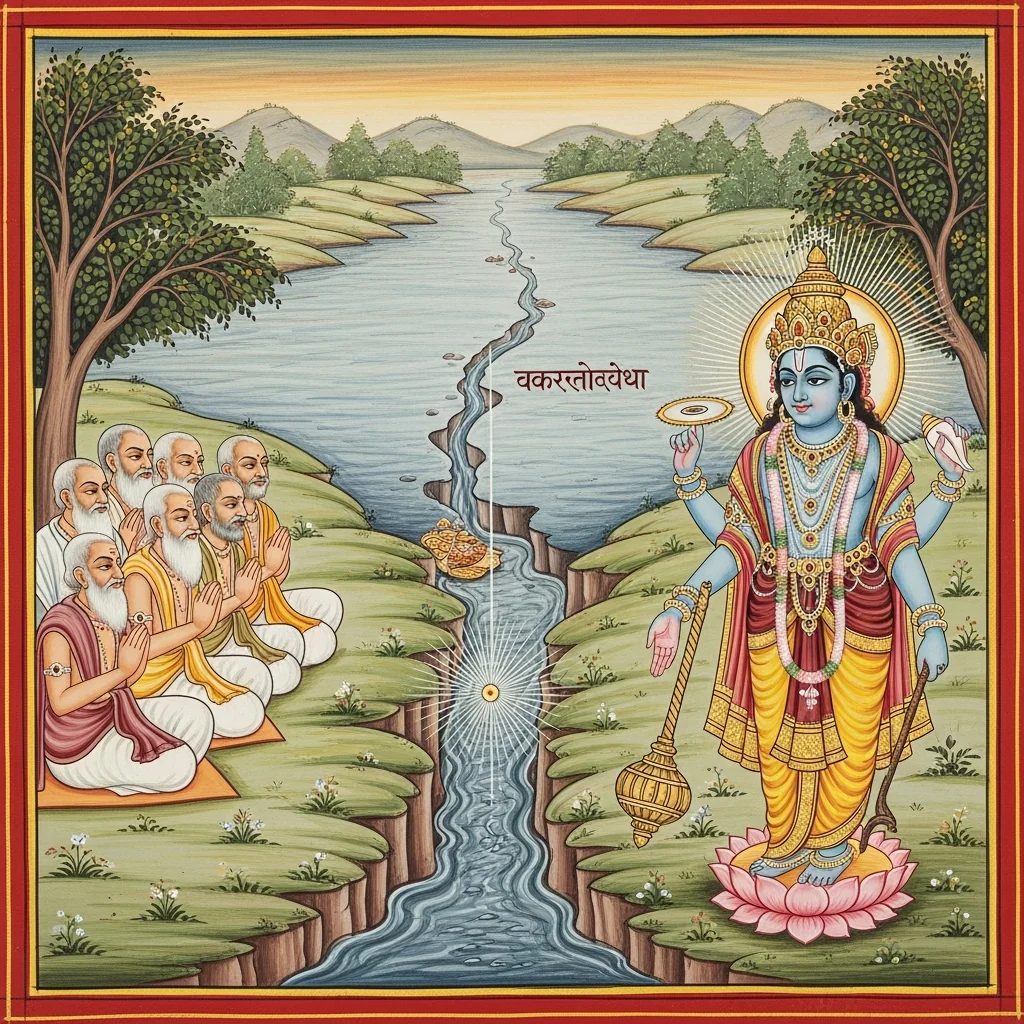
This chapter unfolds as a theological dialogue. Prahlāda directs the “best of the twice-born” pilgrims to the river Gomati, declaring that her darśana purifies and that her waters are worthy of reverence, for they destroy wrongdoing and grant auspicious aims. The ṛṣis then ask what Gomati is, who brought her, and why she reached Varuṇa’s oceanic realm. Prahlāda replies with a cosmogonic account: after the primordial dissolution, Brahmā arises from the lotus at Viṣṇu’s navel and begins creation. The mind-born sons like Sanaka refuse procreative creation and seek a vision of the Divine; performing austerities near the lord of rivers, they behold the radiant Sudarśana. A bodiless voice instructs them to prepare arghya and worship the divine weapon, and the sages praise Sudarśana with hymnic salutations. Brahmā commissions Gaṅgā to descend to earth for Hari’s purpose, proclaiming that she will be known as Gomati and will follow Vasiṣṭha, becoming famed in popular memory as his “daughter.” As Vasiṣṭha leads and Gaṅgā follows toward the western ocean, people honor her; at the sages’ site Viṣṇu appears in four-armed splendor, accepts worship, and grants boons. He names the place Cakratīrtha because Sudarśana first emerged there by splitting the waters, and even incidental bathing bestows liberation. Having washed Hari’s feet, Gomati enters the sea, becoming a great sin-destroying river, also remembered in tradition as the “former Gaṅgā.”
Shlokas
Verse 1
प्रह्लाद उवाच । ततो गच्छेद्द्विजश्रेष्ठा गोमतीं कृष्णसंश्रयाम् । यस्या दर्शनमात्रेण मुच्यते सर्वपातकैः । सर्वपापविनिर्मुक्तः कृष्णसायुज्यमाप्नुयात्
Prahlāda said: Then, O best of brāhmaṇas, one should go to the Gomātī River, sheltered by Kṛṣṇa. By merely beholding it, one is freed from all grievous sins; released from every fault, one attains sāyujya—union with Kṛṣṇa.
Verse 2
दुरितौघक्षयकरममंगल्यविनाशनम् । सर्वकामप्रदं नॄणां प्रणमेद्गोमतीजलम्
One should bow to the waters of the Gomātī, for they destroy floods of sin, remove inauspiciousness, and grant all rightful desires to humankind.
Verse 3
महापापक्षयकरमगतीनांगतिप्रदम् । पूर्वपुण्यवशात्प्राप्तं प्रणमेद्गोमतीजलम्
One should bow to the waters of the Gomātī, which destroy even great sins, grant true refuge to the refuge-less, and are attained only through the power of one’s former merits.
Verse 4
ऋषय ऊचुः । दैत्येन्द्र संशयोऽस्माकं तं त्वं छेत्तुमिहार्हसि । इयं का गोमती तत्र केनानीता महामते
The sages said: O lord of the Daityas, we have a doubt—please dispel it here. What is this Gomātī there, and by whom was she brought, O great-minded one?
Verse 5
केन कार्यवशेनेह संप्राप्ता वरुणालयम् । सर्वं भागवतश्रेष्ठ ह्येतद्विस्तरतो वद
For what purpose did she come here, to the abode of Varuṇa? O best among devotees, tell all of this to us in full detail.
Verse 6
प्रह्लाद उवाच । एकार्णवे पुरा भूते नष्टे स्थावर जंगमे । तदा ब्रह्मा समभवद्विष्णोर्नाभिसरोरुहात्
Prahlāda said: In ancient times, when there was only the single cosmic ocean and all beings, moving and unmoving, had vanished, then Brahmā arose from the lotus that sprang from Viṣṇu’s navel.
Verse 7
आदिष्टः प्रभुणा ब्रह्मा सृजस्व विविधाः प्रजाः । इति धाता समादिष्टो हरिणा सृष्टि कारणे
Brahmā was commanded by the Lord: “Create the many kinds of beings.” Thus the Creator was instructed by Hari for the work of creation.
Verse 8
उक्त्वा बाढमिति ब्रह्मा ततः सृष्टौ मनो दधे । ससर्ज मानसात्सद्यः सनकाद्यान्कुमारकान् । उवाच वचनं ब्रह्मा प्रजाः सृजत पुत्रकाः
Saying, “So be it,” Brahmā then set his mind upon creation. From his mind he at once produced the youthful sages beginning with Sanaka, and Brahmā said to them: “My sons, create beings.”
Verse 9
ब्रह्मणो वचनं श्रुत्वा ते कृतांजलयोऽब्रुवन् । भगवन्भगवद्रूपं द्रष्टुकामा वयं प्रभो
Hearing Brahmā’s words, they—with hands folded in reverence—said: “O Lord, we long to behold the form of Bhagavān, O Master.”
Verse 10
न बन्धमनुवर्त्तामः सृष्टिरूपं दुरासदम् । इत्युक्त्वा ते ययुः सर्वे सनकाद्या कुमारकाः
“We shall not follow the bondage that arises from the form of creation, so hard to transcend.” Having spoken thus, all the youthful sages, beginning with Sanaka, departed.
Verse 11
पश्चिमां दिशमास्थाय तीरे नदनदीपतेः । तेजोमयस्य रूपस्य द्रष्टुकामा महात्मनः । तस्मिन्मानसमाधाय तेपिरे परमं तपः
Setting out toward the western quarter, upon the bank of the Lord of rivers, longing to behold the radiant form of that Great Soul, they fixed their minds upon Him and performed supreme austerity.
Verse 12
बहुवर्षसहस्रैस्तु प्रसन्ने धरणीधरे । भित्त्वा जलं समुत्तस्थौ तेजोरूपं दुरासदम्
After many thousands of years, when the Bearer of the Earth was pleased, a formidable form of pure radiance arose—piercing through the waters—unapproachable in its splendor.
Verse 13
अनेकदैत्यदमनं बहुयंत्रविदारणम् । सूर्यकोटिप्रभाभासं सहस्रारं सुदर्शनम्
It was Sudarśana—the subduer of countless demons, the shatterer of many contrivances and war-engines—shining with the brilliance of ten million suns, and bearing a thousand spokes.
Verse 14
तं दृष्ट्वा विस्मिताः सर्वे ब्रह्मपुत्राः परस्परम् । वीक्षमाणा भगवतः परमायुधमुत्तमम्
Seeing it, all the sons of Brahmā were astonished, looking at one another as they beheld the Lord’s supreme and most excellent weapon.
Verse 15
तान्विलोक्य तथाभूतान्वागुवाचाशरीरिणी । भो ब्रह्मपुत्रा भगवाञ्छ्रीघ्रमाविर्भविष्यति
Seeing them in that condition, a bodiless voice spoke: “O sons of Brahmā, the Blessed Lord will soon manifest.”
Verse 16
अर्हणार्थं भगवतः शीघ्रमर्घ्यं प्रकल्प्यताम् । आयुधं लोकनाथस्य द्विजाः शीघ्रं प्रसाद्यताम्
“Quickly prepare the arghya-offering to honor the Lord. And, O twice-born ones, quickly propitiate the weapon of the Lord of the worlds.”
Verse 18
ऋषय उचुः । ज्योतिर्मय नमस्तेऽस्तु नमस्ते हरिवल्लभ । सुदर्शन नमस्तेऽस्तु सहस्राराऽक्षराऽव्यय
The sages said: “O Radiant One, obeisance to you; obeisance to you, beloved of Hari. O Sudarśana, obeisance to you—thousand-spoked, imperishable, undecaying.”
Verse 19
नमस्ते सूर्यरूपाय ब्रह्म रूपाय ते नमः । अमोघाय नमस्तुभ्यं रथांगाय नमोनमः
“Salutations to you who are sun-formed; salutations to you who are Brahman-formed. Salutations to you, the unfailing one; salutations again and again to you, O Discus.”
Verse 20
एवं ते पूजयामासुः सुमनोभिस्तथाऽक्षतैः
Thus they worshiped it with fragrant flowers and with unbroken grains (akṣata).
Verse 21
अस्मरन्मनसा देवं ब्रह्माणं पितरं स्वकम् । तेषां तु चिंतितं ज्ञात्वा ब्रह्मा गंगामथाब्रवीत्
In their minds they remembered their own father, the god Brahmā. Knowing what they were thinking, Brahmā then spoke to Gaṅgā.
Verse 22
याहि शीघ्रं सरिच्छ्रेष्ठे पृथिव्यां हरिकारणात् । गां गता त्वं महाभागे ततो बहुमताऽसि मे
“Go quickly, O best of rivers, to the earth for Hari’s purpose. Having gone to the earth, O fortunate one, you will thereafter be greatly honored by me.”
Verse 23
उर्व्यां ते गोमती नाम सुप्रसिद्धं भविष्यति
On the earth, you shall become widely renowned by the name “Gomatī.”
Verse 24
वसिष्ठस्यानुगा भूत्वा याहि शीघ्रं धरातलम् । तातं पुत्रीवानुयाता वसिष्ठतनया भव
Becoming a follower of Vasiṣṭha, go quickly down to the earth. Following that revered one as a daughter follows her father, become known as the daughter of Vasiṣṭha.
Verse 25
बाढमित्येव सा देवी प्रस्थिता वरुणालयम् । वसिष्ठस्त्वग्रतो याति तं गंगा पृष्ठतोऽन्वगात्
Saying, “So be it,” that goddess set out for the abode of Varuṇa. Vasiṣṭha went ahead, and Gaṅgā followed behind him.
Verse 26
तां दृष्ट्वा मनुजाः सर्वे वसिष्ठेन समन्विताम् । नमश्चक्रुर्महाभागां गच्छतो पश्चिमार्णवम्
Seeing that illustrious Goddess, accompanied by Vasiṣṭha as she proceeded toward the western ocean, all the people bowed down to her in reverence.
Verse 27
आविर्बभूव तत्रैव यत्र ते मुनयः स्थिताः । द्रष्टुकामा हरे रूपं श्रिया जुष्टं चतुर्भुजम्
She manifested right there where those sages were staying, longing to behold Hari’s form—four-armed and graced by Śrī.
Verse 28
दृष्ट्वा वसिष्ठमनुगामायान्तीं सुरपावनीम् । अवाकिरन्महाभागां सुमनोभिश्च सर्वशः
Seeing that supremely auspicious purifier of the gods approaching in the wake of Vasiṣṭha, they showered her from all sides with flowers.
Verse 29
दिव्यैर्माल्यैः सुगन्धैश्च गन्धधूपैस्तथाऽक्षतैः । संपूज्य हृष्टमनसः साधुसाध्विति चाब्रुवन्
With heavenly garlands, fragrances, scented incense, and unbroken grains (akṣata), they worshiped her fully; delighted at heart, they exclaimed, “Sādhu! Sādhu! Well done!”
Verse 30
वसिष्ठं तेऽग्रगं दृष्ट्वा ह्युदतिष्ठंस्ततो द्विजाः । अर्घ्यादिसत्क्रियां कृत्वा प्रहृष्टा इदमब्रुवन्
Seeing Vasiṣṭha in the lead, the brāhmaṇas rose. Having performed the respectful reception beginning with arghya-offerings, they joyfully spoke these words.
Verse 31
यस्मात्त्वया समानीता ह्यस्मिंल्लोके सरिद्वरा । तस्मात्तव सुतेत्येवं ख्यातिं लोके गमिष्यति
Since by you this best of rivers has been brought into this world, therefore she shall become renowned among people as “your daughter.”
Verse 32
गोः स्वर्गादागता यस्मादिदं स्थानं मती मता । तस्माद्धि गोमतीनाम ख्यातिं लोके गमिष्यति
Because she is regarded as having come from heaven as “go” (the celestial cow/Go), this place is esteemed accordingly; therefore indeed the name “Gomatī” will become famous in the world.
Verse 33
अस्या दर्शनमात्रेण मुक्तिं यास्यंति मानवाः । किं पुनः स्नान दानादि कृत्वा यांति हरेः पदम्
By the mere sight of this sacred place, people attain liberation. How much more, then, will they reach the abode of Hari after performing bathing, charity, and the other prescribed acts?
Verse 34
तामेव चार्घ्यं दत्त्वा ते योगींद्रा ईडिरे हरिम् । परं पुरुषसूक्तेन पुरुषं शेषशायिनम्
Having offered that very water as arghya, those great yogins praised Hari—the Supreme Person—by the Puruṣa Sūkta, hymning the Person who reclines upon Śeṣa.
Verse 35
इति संस्तुवतां तेषां हरिराविर्बभूव ह । पीतकौशेयवसनो वनमालाविभूषितः । दिव्यमाल्यानुलिप्तांगो दिव्याभरणभूषितः
As they were thus praising, Hari indeed manifested before them—clad in yellow silk, adorned with the forest-garland; his limbs anointed with divine fragrances and garlands, and ornamented with heavenly jewels.
Verse 36
शेषासनगतं देवं दिव्यानेकोद्यतायुधम् । ज्वलत्किरीटमुकुटं स्फुरन्मकरकुंडलम्
They beheld the God seated upon the throne of Śeṣa, bearing many divine weapons uplifted in splendor—his crown blazing, his makara-earrings flashing.
Verse 37
भक्ताभयप्रदं शांतं श्रीवत्सांकं महाभुजम् । सदा प्रसन्नवदनं घनश्यामं चतुर्भुजम्
He was the giver of fearlessness to devotees—peaceful, bearing the Śrīvatsa mark, mighty-armed; ever with a gracious face, dark as a rain-cloud, and four-armed.
Verse 38
पादसंवाहनासक्तलक्ष्म्या जुष्टं मनोहरम् । तं दृष्ट्वा मुनयः सर्वे हर्षोत्कर्षसमन्विताः । विष्णुं ते विष्णुसूक्तैश्च तुष्टुवुर्वेदसंभवैः
Charming and radiant, attended by Lakṣmī devoted to massaging his feet—seeing him, all the sages were filled with surging joy, and they praised Viṣṇu with hymns to Viṣṇu born of the Veda.
Verse 39
एवं संस्तुवता तेषां विष्णुर्दीनानुकंपकः । उवाच सुप्रसन्नेन मनसा द्विजसत्तमान्
While they praised him in this way, Viṣṇu—compassionate to the distressed—spoke with a most gracious heart to those best of twice-born sages.
Verse 40
श्रीभगवानुवाच । भोभोः कुमारास्तुष्टोऽहं प्रदास्यामि यथेप्सितम् । भविष्यथ ज्ञानयुता अस्पृष्टा मम मायया
The Blessed Lord said: “O young sages, I am pleased. I shall grant you what you desire. You shall become endowed with true knowledge, untouched by My māyā.”
Verse 41
यस्मान्मोक्षार्थिभिर्विप्रा जलेनाहं प्रसादितः । तस्मादिदं परं तीर्थं सर्वकामप्रदं परम्
Because you brāhmaṇas who seek liberation have propitiated Me through this water, therefore this is a supreme tīrtha—the highest—bestowing every worthy desire.
Verse 42
अनुग्रहाय भवतां यत्र चक्रं सुदर्शनम् । निःसृतं प्रथमं विप्रा जलं भित्त्वा ममाग्रतः
For your favor, O brāhmaṇas, it was here that the Sudarśana Cakra first emerged—bursting forth, cleaving the waters before Me.
Verse 43
चक्रतीर्थमिति ख्यातं तस्मादेतद्भविष्यति । ममापि नियतं वासो भविष्यति महार्णवे
Therefore this place shall become renowned as Cakratīrtha. And in the great ocean as well, My own dwelling shall be established here as a fixed abode.
Verse 44
येऽत्र स्नानं प्रकुर्वंति प्रसंगेनापि मानवाः । चक्रतीर्थे द्विजश्रेष्ठास्तेषां मुक्तिः करे स्थिता
O best of brāhmaṇas, even those who bathe here merely by chance at Cakratīrtha—liberation stands ready in their very hand.
Verse 45
भवतोऽपि सदा ह्यत्र तिष्ठध्वं च द्विजर्षभाः । वायुभूतांतरिक्षस्थाः सर्वकामस्य दायकाः
And you too, O bull-like sages among the twice-born, remain here always. Becoming like airy beings and dwelling in the mid-sky, be bestowers of every rightful desire.
Verse 46
प्रह्लाद उवाच । तच्छ्रुत्वा हृष्टमनसः कृत्वार्घ्यं सुरपावनीम् । अवनिज्य हरेः पादौ मूर्ध्नाऽपश्चाप्यधारयन्
Prahlāda said: Hearing this, their hearts rejoiced. They offered arghya with waters that purify by divine power; then, having washed Hari’s feet, they bore that water upon their heads in reverent devotion.
Verse 47
प्रक्षाल्य सा हरेः पादौ प्रविष्टा वरुणालयम् । तस्मिन्महापापहरा गोमती सागरं गता
Having washed Hari’s feet, she entered Varuṇa’s abode—the ocean. There the Gomati, destroyer of great sins, flowed onward and reached the sea.
Verse 48
वरं दत्त्वा ततो विष्णुस्तत्रैवान्तर धीयत । सनकाद्या ब्रह्मसुतास्तस्थुस्तत्र समाहिताः
Then Viṣṇu, having granted the boon, vanished there itself. Sanaka and the other sons of Brahmā remained in that place, composed and absorbed in contemplation.
Verse 49
एवं सा गोमती तत्र संजाता सागरंगमा । सर्वपापहरा प्रोक्ता पूर्वगंगेति या श्रुता
Thus the Gomati arose there and became a river that goes to the sea. She is proclaimed the remover of all sins, and is famed as the “Eastern Gaṅgā.”