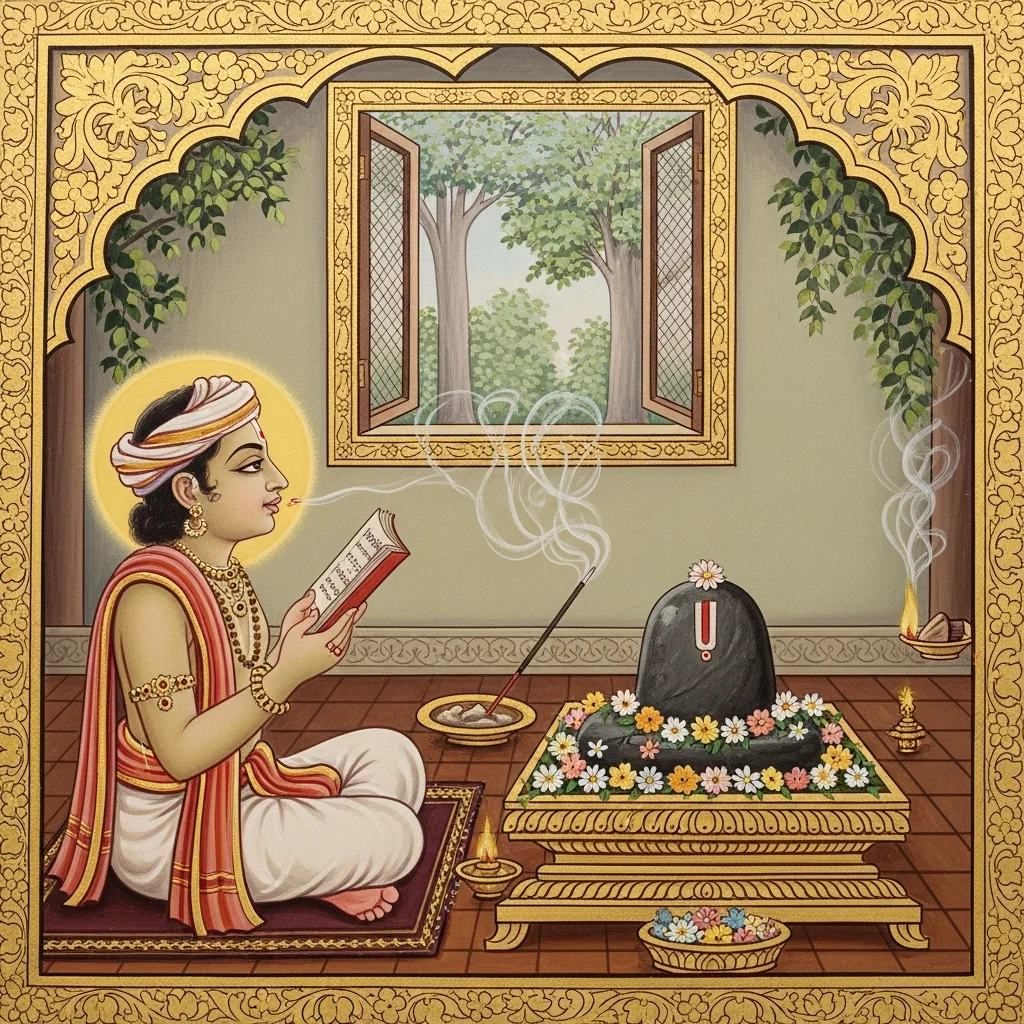
Adhyaya 39
Chapter 39 begins with Prahlāda listing auspicious Dvādaśī designations and linking daily accruing merit to preparing havis-like offerings and keeping Viṣṇu’s night-vigil (jāgaraṇa), especially before the Śālagrāma-śilā. It prescribes ritual supports: ghee lamps with paired wicks, covering the Śālagrāma with flowers, and anointed worship of a Vaiṣṇava image—particularly one marked with the cakra—using sandal, camphor, kṛṣṇāguru, and musk. A concentrated phalaśruti equates the fruit of the Dvādaśī vigil with the cumulative merits of great tīrthas, sacrifices, vows, Vedic and Purāṇic study, austerities, and proper āśrama conduct, citing authoritative transmission; Sūta continues the relay and urges practice with faith. The teaching then expands to Dvārakā’s efficacy through mental contemplation, chanting, and home-recitation when travel is impossible, recommending listening, gifting to Vaiṣṇavas, and special recitation on Dvādaśī during the vigil. It also presents a motif of sacred presence in the home through sustained devotion, followed by ethical prohibitions—disrespecting Vaiṣṇavas, exploitative acts, and sacrilegious harm to sacred trees (especially aśvattha)—contrasted with the merit of planting and protecting nyagrodha, dhātrī, and tulasī. The chapter concludes with strong Kali-yuga norms: daily Viṣṇu-recitation and Bhāgavata singing, the merit of gopīcandana (tilaka, gifting, and Dvādaśī vigil), and daily utterance of “Dvārakā” as generating tīrtha-like merit.
Shlokas
Verse 1
श्रीप्रह्लाद उवाच । जया च विजया चैव जयंती पापनाशिनी । उन्मीलिनी वंजुली च त्रिस्पृशा पक्षवर्द्धिनी
Śrī Prahlāda said: Jayā and Vijayā; Jayantī, the destroyer of sins; Unmīlinī, Vaṃjulī, Trispṛśā, and Pakṣavarddhinī—.
Verse 2
पुण्यं सर्वपुराणानां ते लभंते दिनेदिने । पक्वान्नं ये प्रकुर्वंति हविर्द्धान्यसमुद्भवम्
Day after day they obtain the merit praised in all the Purāṇas—those who prepare cooked food made from havis-grains (sacrificial grains) and offer it in devotion.
Verse 3
जागरे पद्मनाभस्य घृतेनैव सुपाचितम् । वर्तिद्वयसमायुक्तं दीपं घृतसमन्वितम्
During the night-vigil for Padmanābha, one should offer a ghee-lamp—well prepared with ghee, furnished with two wicks, and filled with ghee.
Verse 4
यः कुर्य्याज्जागरे विष्णोः शालिग्रामशिलाग्रतः । शालग्रामशिलाग्रे तु ये प्रकुर्वंति जागरम्
Whoever keeps the vigil for Viṣṇu in the presence of the Śālagrāma stone—indeed, those who perform the night-vigil before the Śālagrāma stone—gain exceptional merit.
Verse 5
कुर्वंति नृत्यवाद्ये च लोकानां रंजनाय च । संछादयंति कुसुमैः शालिग्रामशिलां च ये
Those who arrange dance and instrumental music for the people’s delight, and who, in worship, cover the Śālagrāma stone with flowers, are praised as doers of merit.
Verse 6
चक्रांकितां विशेषेण प्रतिमां वैष्णवीं द्विजाः । चंदनं च सकर्पूरं कृष्णागुरुसमन्वितम्
O twice-born ones, honour especially the Vaiṣṇava image marked with the discus; and offer sandalpaste with camphor, compounded with dark, fragrant agaru.
Verse 7
युक्तं मृगमदेनापि यः करोति विलेपनम् । द्वादश्यां देवदेवस्य रात्रौ जागरणे सदा
Whoever applies the unguent—mixed even with musk—on the Dvādaśī night, while ever keeping vigil for the Lord of lords, gains great merit.
Verse 8
तस्य पुण्यं प्रवक्ष्यामि संक्षेपेण च वोऽग्रतः । तत्फलं कोटितीर्थे तु उज्जयिन्यां महालये
I shall now tell you, briefly and plainly, the merit of that observance. Its fruit is as though gained at Koṭitīrtha in Ujjayinī, at the great sacred shrine.
Verse 9
वाराणस्यां कुरुक्षेत्रे मथुरायां त्रिपुष्करे । अयोध्यायां प्रयागे च तीर्थे सागरसंगमे
(It equals the merit obtained) in Vārāṇasī, in Kurukṣetra, in Mathurā, in Tripuṣkara; in Ayodhyā and in Prayāga; and at the sacred ford where the ocean meets the holy waters.
Verse 10
सर्वपुण्येषु तीर्थेषु देवतायतनेषु च । कृतैर्यज्ञायुतैस्तत्र व्रतदानैश्च पुष्कलैः
(That merit) equals the merit found in all sacred tīrthas and in the temples of the gods—as though tens of thousands of sacrifices had been performed there, together with abundant vows and generous gifts.
Verse 11
वेदैरधीतैर्यत्पुण्यं पुराणैश्चावगाहितैः । तपोभिश्चरितैः पुण्यं सम्यगाश्रम पालनैः
(It equals) the merit gained by studying the Vedas, by deeply learning the Purāṇas, by performing austerities, and by rightly maintaining the duties of one’s āśrama (stage of life).
Verse 12
यत्फलं मुनिभिः प्रोक्तं वेदव्यासेन पुत्रक । तत्फलं जागरे विष्णोः पक्षयोः शुक्लकृष्णयोः
O dear child, whatever spiritual reward the sages and Vedavyāsa have declared—that very reward is obtained by keeping vigil (jāgara) for Lord Viṣṇu, whether in the bright fortnight or the dark fortnight.
Verse 13
हैमवत्यै पुरा प्रोक्तं कैलासे शूलपाणिना । नारदाय पुरा प्रोक्तं ब्रह्मणा मत्समीपतः
Formerly, on Kailāsa, the Trident-bearing Lord taught this to Haimavatī; and long ago Brahmā taught it to Nārada in my very presence.
Verse 14
अरुणेन वज्रहस्ताय कथितं पृच्छते पुरा । द्वादशीजागरस्योक्तं फलं विप्रा मया च वः । तत्कुरुध्वं द्विजा यूयं जागरं विष्णुवासरे
Long ago, Aruṇa related this to Vajrahasta when he inquired. And I too have declared to you, O brāhmaṇas, the fruit of the Dvādaśī vigil. Therefore, O twice-born ones, perform this vigil on Viṣṇu’s sacred day.
Verse 15
सूत उवाच । इत्युक्त्वा ब्राह्मणान्प्राह बलिं पौत्रं स्वकं ततः । त्वमपि श्रद्धया पौत्र कुरु जागरणं हरेः
Sūta said: Having thus instructed the brāhmaṇas, he then addressed his own grandson Bali: “You too, my grandson, with faith, perform the night-vigil of Hari.”
Verse 16
द्वारका मनसा ध्याता पापं वर्षशतान्वितम् । कीर्तनाच्छतजन्मोत्थं दहते नात्र संशयः
Dvārakā, when merely contemplated in the mind, destroys sins accumulated over hundreds of years; and by her glorification (kīrtana) she burns away sins born of a hundred lifetimes—of this there is no doubt.
Verse 17
पापं जन्मसहस्रोत्थं पदमात्रेण गच्छताम् । द्वारका हरते नूनं मुक्तिः कृष्णस्य दर्शनात्
For those who take but a single step toward her, Dvārakā surely removes sins arising from a thousand births; and liberation comes through the vision of Kṛṣṇa.
Verse 18
न शक्नोति यदा गंतुं द्वारकां चैव मानवः । माहात्म्यं पठनीयं तु द्वारकासंभवं गृहे
When a person is unable to go to Dvārakā, then the Māhātmya concerning Dvārakā should certainly be read at home.
Verse 19
दातव्यं वैष्णवानां तु श्रोतव्यं भक्तिभावतः । द्वादश्यां च विशेषेण पठनीयं तु जागरे
One should give this teaching to Vaiṣṇavas and listen with a spirit of devotion. And especially on Dvādaśī, it should be recited during the night vigil.
Verse 20
द्वारका संभवं पुण्यं स संप्राप्नोति मानवः । प्रसादाद्वासुदेवस्य सत्यंसत्यं च भाषितम्
That person, by the grace of Vāsudeva, attains the sacred merit born of Dvārakā. This has been spoken as truth—truth indeed.
Verse 21
गृहे संतिष्ठते नित्यं मथुरा द्वारका तथा । अवंती च तथा माया प्रयागं कुरुजांगलम्
In one’s home there ever abide Mathurā and Dvārakā; so too Avantī and Māyā, Prayāga and Kurujāṅgala.
Verse 22
त्रिपुष्करं नैमिषं च गंगाद्वारं च सौकरम् । चंद्रेशं चैव केदारं तथा रुद्रमहालयम्
Tripuṣkara, Naimiṣa, Gaṅgādvāra, and Saukara; likewise Candreśa and Kedāra, and also Rudra’s great abode, Rudra-mahālaya.
Verse 23
वस्त्रापथं महादेवं महाकालं तथैव च । भूतेश्वरं भस्मगात्रं सोमनाथमुमापतिम्
Vastrāpatha, Mahādeva, and Mahākāla; Bhūteśvara, the Lord whose body is clad in sacred ash; and Somanātha, the consort of Umā.
Verse 24
कोटिलिंगं त्रिनेत्रं च देवं भृगुवनेचरम् । दीपेश्वरं महानादं देवं चैवाचलेश्वरम्
Koṭiliṅga, the Three-eyed Lord (Trinetra), and the deity who abides in Bhṛgu’s forest; Dīpeśvara, Mahānāda, and also Acaleśvara—these Śaiva tīrthas and forms are celebrated.
Verse 25
ब्रह्मादयः सुरगणा गृहे तिष्ठंति सर्वदा । पितरो नागगंधर्वा मुनयः सिद्धचारणाः
Brahmā and the hosts of the gods dwell in that house forever; so too the Pitṛs, Nāgas, Gandharvas, sages, Siddhas, and Cāraṇas.
Verse 26
तीर्थानि यानि कानि स्युरश्वमेधादयो मखाः । कृष्णजन्माष्टमीं पौत्र यः करोति विशेषतः
Whatever tīrthas there may be, and sacrifices such as the Aśvamedha—O grandson—he who observes Kṛṣṇa’s Janmāṣṭamī with special devotion attains their concentrated merit.
Verse 27
यथा भागवतं शास्त्रं तथा भागवतो नरः । उभयोरंतरं नास्ति हरहर्योस्तथैव च
As the Bhāgavata scripture is, so is the Bhāgavata devotee; there is no difference between the two—just so, there is no difference between Hara and Hari.
Verse 28
नीलीक्षेत्रं तु यो याति मूलकं भक्षयेत्तु यः । नैवास्ति नरकोद्धारं कल्पकोटिशतैरपि
But whoever goes to Nīlī-kṣetra and eats mūlaka (radish)—for him there is no deliverance from hell, even in hundreds of crores of kalpas.
Verse 29
नीलीकर्म तु यः कुर्य्याद्ब्राह्मणो लोभमोहितः । नाप्नोति सुकृतं किंचित्कुर्य्याद्वा रसविक्रयम्
But if a brāhmaṇa, deluded by greed, performs ‘nīlī-karma’, he gains no merit at all; likewise if he engages in selling ‘rasa’ (juices/commodities) as trade.
Verse 30
प्रसीदति न विश्वात्मा वैष्णवे चापमानिते । अश्वत्थं छेदयेद्यो वै एकैकस्मिंश्च पर्वणि
The All-Self (Viśvātman) is not pleased when a Vaiṣṇava is insulted; and whoever cuts down an aśvattha tree—especially on each sacred parvan—incurs grievous demerit.
Verse 31
मन्वंतराणि तावंति रौरवे वसतिर्भवेत् । अरिष्टकाष्ठैर्दैत्येंद्र कार्य्यं यः कुरुते क्वचित् । न पूजामर्घदानं च तस्य गृह्णाति भास्करः
For that many manvantaras, his dwelling becomes in Raurava (hell). O lord of the Daityas, whoever at any time does some work with ariṣṭa-wood—Bhāskara (the Sun) accepts neither his worship nor even his arghya offering.
Verse 32
छेदापकस्य चार्के तु च्छेदकस्य च दैत्यज । शतं जन्मानि दारिद्यं जायते च सरोगता
O son of a Daitya, both one who causes the Arka plant to be cut and one who cuts it himself are born for a hundred births in poverty and afflicted with disease.
Verse 33
रोपयेत्पालयेद्यो वै सूर्य्यवृक्षं नरोत्तमः । सप्तकल्पं वसेत्सोऽत्र समीपे भास्करस्य हि
The best of men who plants and tends the Sun’s sacred tree dwells here for seven kalpas, indeed, in the very proximity of Bhāskara (the Sun).
Verse 34
रोपितैर्देववृक्षैस्तु यत्फलं लक्षकोटिभिः । न्यग्रोधवृक्षेणैकेन रोपितेन फलं हि तत्
Whatever fruit is gained by planting tens of millions of divine trees—that very fruit is obtained by planting a single Nyagrodha (banyan) tree.
Verse 35
धात्रीद्रुमेऽप्येवमेव फलं भवति रोपिते । तुलसीरोपणे चैव अधिकं चापि सुव्रत । अमरत्वं च ते यांति नात्र कार्य्या विचारणा
So too, when the Dhātrī tree (āmalakī) is planted, the same merit arises. But in planting Tulasī the merit is even greater, O you of good vow; they even attain immortality—of this no doubt need be entertained.
Verse 36
द्वारकां कलिकाले तु प्रातरुत्थाय कीर्तयेत् । स सर्वपापनिर्मुक्तः स्वर्गं याति न संशयः
In the Kali age, one should rise in the morning and sing the praise of Dvārakā; freed from all sins, he goes to heaven—of this there is no doubt.
Verse 37
रोहिणीसहिता ये न द्वादशी समुपोषिता । महापातकसंयुक्तः कल्पांते नाकमाप्नुयात्
Whoever does not duly fast on Dvādaśī when it is joined with Rohiṇī (the nakṣatra) remains tainted with great sins and, even at the end of a kalpa, does not attain heaven.
Verse 38
वासरः को विना सूर्य्यं विना सोमेन का निशा । विना वृक्षेण को ग्रामो द्वादशी किं व्रतं विना
What is a day without the Sun? What is a night without the Moon? What is a village without a tree? And what is Dvādaśī without a vow (vrata)?
Verse 39
गृहं च नरकं तस्य यमदण्डं द्वितीयकम् । न यत्र पठते नित्यं विष्णोर्नामसहस्रकम्
That house is hell itself, and like a second rod of Yama, where the Viṣṇu-sahasranāma—the thousand names of Viṣṇu—is not recited daily.
Verse 40
नरकं च भवेत्तस्य द्वितीयं यमशासनम् । नैव भागवतं यत्र पुराणं गीयते कलौ । अन्धकूपेषु क्षिप्यंते ज्वलितेषु हुताशने
That place becomes hell, as though a second decree of Yama, where in the Kali age the Bhāgavata Purāṇa is not sung. Such people are cast into blind wells and into fires blazing with flame.
Verse 41
द्विषंति ये भागवतं न कुर्वंति दिनं हरेः । यमदूतैश्च नीयन्ते तथा भूमौ भवंति ते
Those who hate the Bhāgavata and do not observe Hari’s sacred day are led away by Yama’s messengers; and they are born again upon the earth.
Verse 42
वाच्यमानं न शृण्वंति हरेश्चरितमुत्तमम् । करपत्रैश्च पीड्यंते सुतीव्रैर्यम शासनात्
Those who refuse to listen when the supremely sacred deeds of Hari are being recited are, by Yama’s ordinance, tormented with exceedingly sharp hand-like blades.
Verse 43
निन्दां कुर्वंति ये पापा वैष्णवानां महात्मनाम् । तेषां निरयपातस्तु यावदाभूतसंप्लवम्
Those sinful people who slander the great-souled Vaiṣṇavas fall into hell—and their downfall lasts until the cosmic dissolution.
Verse 44
गोकोटितीर्थादधिकं स्नानं तत्राधिकं भवेत् । ये पश्यंति महापुण्या गोपीचंदनमृत्तिकाम् । गंगास्नानफलं तेषां जायते नात्र संशयः
Bathing there is said to surpass even the merit of countless sacred fords. Those greatly meritorious ones who behold the clay of Gopīcandana obtain the fruit of bathing in the Gaṅgā—of this there is no doubt.
Verse 45
वैष्णवानां प्रयच्छंति गोपीचं दनमृत्तिकाम् । येषां ललाटे तिलकः गोपीचंदनसंभवम्
They offer the sacred Gopīcandana clay to the Vaiṣṇavas—those upon whose foreheads shines a tilaka born of Gopīcandana.
Verse 46
गोपीचंदनपुंड्रेण द्वादश्यां जागरे कृते । विष्णोर्नामसहस्रस्य पाठेन मुक्तिमाप्नुयात्
Bearing the Vaiṣṇava forehead-mark (puṇḍra) of Gopīcandana, keeping vigil on Dvādaśī, and reciting Viṣṇu’s thousand names—one attains liberation.
Verse 47
ये नित्यं प्रातरुत्थाय वैष्णवानां तु कीर्तनम् । गोमतीस्मरणं कुर्युः कृष्णतुल्या न संशयः
Those who, rising each morning, continually sing the praises of the Vaiṣṇavas and remember the river Gomati become equal to Kṛṣṇa—of this there is no doubt.
Verse 48
ये नित्यं प्रातरुत्थाय द्वारकेति वदंति च । तीर्थकोटिभवं पुण्यं लभंते च दिनेदिने
Those who, rising each morning, daily utter the name ‘Dvārakā’ gain, day by day, merit equal to that arising from crores of sacred pilgrimages.